Xū & Shí (Hư & Thực / 虚实) — Empty and Solid
The Core Operating Principle
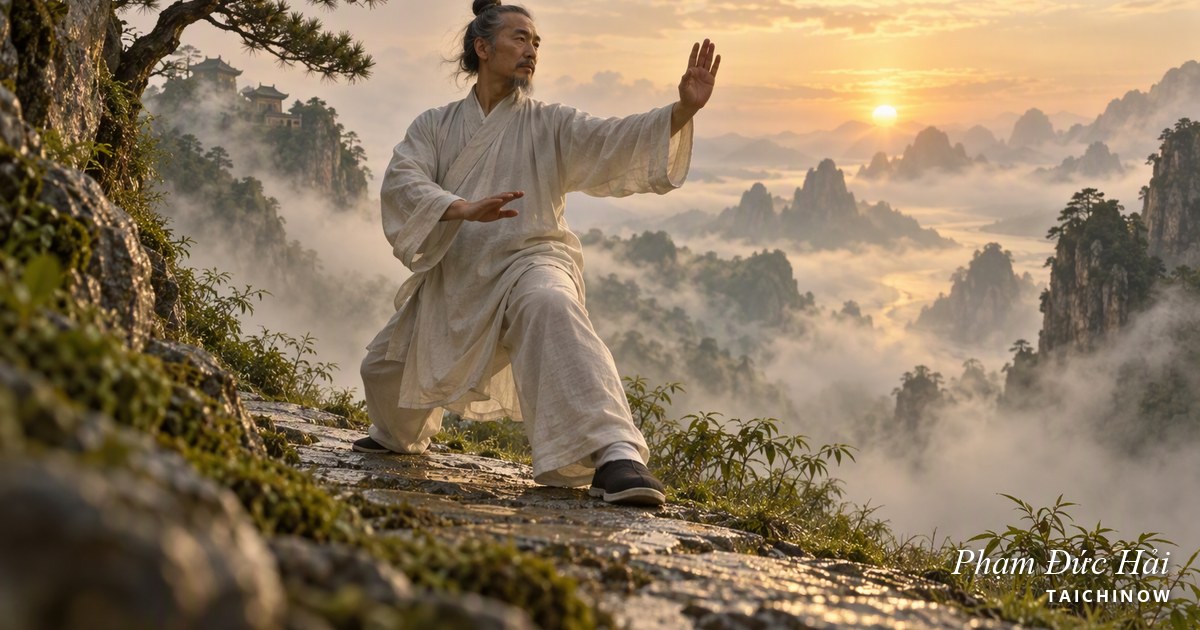
Hư (虚 / empty) and Thực (实 / full or solid) are the operating principle behind every movement. One leg is full, the other is empty. One hand is full, the other is empty. One direction is full, the other is empty. At every moment the body is moving between full and empty like waves.
A common error is to be double full — weight on both feet, tension in both hands. Another is double empty — weight floating, structure unsupported. Single full, single empty. Always.
Why This Matters at 50+
Young bodies can absorb ambiguity — both feet, both hands engaged, and it's fine. The 50+ body, especially when joints ache or balance wavers, punishes ambiguity. Whenever both feet are loaded, the knees absorb twice the load. Whenever both hands grip, the shoulders tighten. Single full, single empty is easier on the joints and more stable on the ground.
Xū/Shí Across the Five Styles
Chen uses large, low postures with visible weight shifts. Yang uses higher, more upright postures with subtler shifts. Wu emphasises compact, narrow steps. Wu (Hao) uses long, weighted steps with deep pauses. Sun uses high, mobile stances with frequent light-quick steps.
The Cost of Double-Loading
The body resists single full, single empty because both feet loaded feels safer. The nervous system prefers certainty; Xū/Shí requires tolerating momentary instability.
The cost: joints carry double load; muscles grip continuously; nervous system stays engaged; energy dissipates. The student who masters Xū/Shí is buying back joint life, muscular relaxation, cognitive bandwidth, and energetic efficiency.
Master Cue
"One full, one empty. Always."