Chen-Style Taijiquan
Phần 1
Page cover
(Cover)
Chen-style Taijiquan People's Sports Publishing House (Title page)
Chen-style Taijiquan Compiled by Shen Jiazhen and Gu Liuxin People's Sports Publishing House (Colophon)
Chen-style Taijiquan Compiled by Shen Jiazhen and Gu Liuxin Published by People's Sports Publishing House Printed by Beijing No. 1 Printing Works · Distributed by the Xinhua Bookstore, Beijing 787 × 1092 mm · 32mo · 182,000 characters · 10 25/32 printer's sheets First edition, December 1963 · Fourth printing, April 1982 Print run: 43,201–175,200 Unified book number: 7015·1209 · Price: 1.10 yuan Responsible editors: Yan Hai, Wang Jie Cover design: Zhou Menglin, Sun Jinrong Note on the Reprint This book was printed twice, in 1963 and 1964, and was not reprinted thereafter.
The Chen-style Taijiquan introduced in this book is the oldest of the Taijiquan schools. Its forms are divided into the First Route and the Second Route, both being routines transmitted by the late famous boxer Chen Fake. Chapters One, Two and Three of this book were written by Shen Jiazhen; Chapters Four and Five by Gu Liuxin. The movement illustrations were drawn from photographs of Chen Fake taken during his lifetime, and the postures not covered by these were supplemented with photographs of Chen Fake's son, Chen Zhaokui.
During the preparation of the original book, help was received from Zhou Yuanlong, Shao Bozhou, Yang Jingxuan, Chao Zhenmin, Lei Muni and others, and the text was proofread by Chen Zhaokui.
In this reprint only the "Introduction to Chen-style Taijiquan" has been rewritten and the "Preface" omitted; no changes have been made to the content of the original book. Readers are requested to point out any shortcomings, so that they may be improved.
Editorial Department, People's Sports Publishing House April 1980
- Introduction to Chen-style Taijiquan1
- Chapter One · The Eight Characteristics of Chen-style Taijiquan3
- Characteristic One · The Movement of Intent and Qi Governed by the Brain5
- i. Inner qi and the use of intent5
- ii. The realisation of intent-qi movement8
- Characteristic Two · The Elastic Movement of Extended Limbs and Body11
- i. Extension of the limbs and body11
- ii. The physiological effect of extension13
- iii. The eight gateways of jin and elastic ward-off jin14
- iv. Mastering elastic movement (ward-off jin)15
- Characteristic Three · The Spiral Movement of Reeling Silk17
- i. The essence of movement as reeling silk18
- ii. The function of the reeling-silk spiral movement20
- iii. The kinds of reeling-silk jin and their essentials21
- iv. Mastering spiral movement23
- Characteristic Four · The Substantial-Substantial Movement of an Upright, Centred Body with Upper and Lower Following Each Other27
- i. Proportions of substantial and insubstantial28
- ii. The three basic substantial-insubstantial states30
- iii. Mastering substantial and insubstantial32
- iv. Light, heavy, floating and sinking, and substantial-insubstantial33
- Characteristic Five · The Necklace Movement Led by the Waist and Spine, with Inner and Outer United37
- i. The essence of the necklace-string continuity38
- ii. The relation of "one part moves, all parts move" to the waist and spine39
- iii. Necklace-string continuity and strengthening the joints40
- iv. Regulating the range of motion of the joints40
- v. Mastering necklace-string continuity42
- Characteristic Six · The Unbroken, Ceaselessly Flowing Movement of a Single Breath44
- i. The realisation of "completed in a single breath"45
- ii. Examples from masters' practice47
- iii. Stirring of spirit and qi, and "completed in a single breath" ①48
- iv. Jin categories and "completed in a single breath"48
- Characteristic Seven · The Mutually Complementary Movement from Soft to Hard and Hard to Soft50
- i. The mutual complement of hard and soft51
- ii. The period of seeking softness and crushing stiffness52
- iii. The period of refining softness into hardness52
- iv. The exchange of hard and soft53
- v. Mastering the mutual complement of hard and soft54
- Characteristic Eight · The Alternating Movement from Slow to Fast and Fast to Slow57
- i. The progression of fast and slow58
- ii. The time and conditions of turning from slow to fast59
- iii. Alternation of fast and slow, evenness and jin categories60
- iv. Mastering the alternation of fast and slow62
- Conclusion63
- Chapter Two · Illustration of the First Route of Chen-style Taijiquan65
- Sequence of the Form Names of the First Route65
- Some Notes on the Illustrations67
- The First Route of Chen-style Taijiquan68
- Chapter Three · Illustration of the Second Route of Chen-style Taijiquan179
- Sequence of the Form Names of the Second Route of Chen-style Taijiquan179
- The Second Route of Chen-style Taijiquan181
- Chapter Four · Chen-style Taijiquan Push Hands242
- i. General Essentials of Push Hands243
- ii. Chen-style Push-Hands Methods244
- A. The four cardinal basic push hands: ward-off, roll-back, press, push244
- B. The four corner supplementary push hands: pluck, rend, elbow, shoulder248
- iii. Two Evolutions of Chen-style Push Hands251
- iv. Taijiquan Push Hands Combines Both Yin and Yang252
- v. Essentials of Push-Hands Movement253
- (1) Body method253
- (2) Hand method254
- (3) Step method255
- (4) Eye method257
- (5) Adhering, connecting, sticking, following257
- (6) One body prepared with five bows259
- (7) Lifting, gathering, storing and releasing, opening in issuing jin261
- (8) Breathing and square-round, hard-soft262
- (9) The role of inner jin in push hands263
- vi. The Guiding Role of the "Taijiquan Treatise" in Principle for Push Hands266
- Chapter Five · Chen-style Taijiquan Theory274
- Biographical Sketch of Chen Xin275
- i. The Classic Manual of Taijiquan276
- ii. The Taijiquan Manual278
- iii. Classified Quotations from Chen Xin's Taijiquan Theory ①278
- 1. A calm mind and an upright body, moving by intent278
- 2. Opening and closing, substantial and insubstantial, natural breathing281
- 3. Light, nimble and roundly turning, with the central qi fully pervading283
- 4. Coiling movement that smooths the channels286
- 5. Upper and lower following each other, inner and outer united288
- 6. Every posture linked, every movement inheriting289
- 7. Empty the collar and lift the crown, sink the qi to the cinnabar field290
- 8. Hollow the chest and raise the back, sink the shoulders and drop the elbows295
- 9. Refine softness into hardness, hard and soft complementary295
- 10. Slow before fast, fast returning again to slow298
- 11. Darting, running and leaping, suddenly up and down299
- 12. Hard and soft both dissolved, all is spirit in motion304
- 13. Cultivate the original source, study diligently and train hard306
- iv. Quotations from Chen Xin on the Thirteen Body Parts ①308
- 1. Head308
- 2. Eyes308
- 3. Ears309
- 4. Nose, mouth309
- 5. Neck310
- 6. Hands310
- 7. Fist310
- 8. Abdomen311
- 9. Waist311
- 10. Spine, back312
- 11. Hips and buttocks313
- 12. Feet314
- 13. Joints315
- v. Discourse on Crossing Hands316
- 1. A Collection of Discourses on Push-Hands Boxing316
- 2. The Sixteen Items of Push Hands320
- 3. The Thirty-Six Faults of Push Hands320
- 4. Two Songs of Push Hands323
- vi. Selected Short Essays on Taijiquan Theory by Chen Xin and Others323
- 1. In Praise of Taijiquan323
- 2. Poem on the Reeling-Silk Method of Taijiquan324
- 3. On the Reeling-Silk Jin That Opens the Young Learner of Taijiquan324
- 4. An Enquiry into the Origins of Taijiquan325
- 5. The Substance and Application of Taijiquan325
- 6. A General Discourse and Classic of Taijiquan326
- 7. Chen Fuyuan's Discourse on Taijiquan326
- 8. The Essentials of Taijiquan330
- Introduction to Chen-style Taijiquan Chen-style Taijiquan was founded by the famous boxer Chen Wangting at the end of the Ming and the beginning of the Qing dynasty. Chen Wangting was a native of Chenjiagou, Wenxian, Henan. From Chen Wangting onward, the Chen family transmitted and practised Taijiquan through the generations, continually refining and distilling the original routines, and gradually forming the First Route and the Second Route of the modern era. The linked movements of these two sets of forms were all carefully arranged; their speed and intensity differ, and their body methods, amount of exercise and difficulty differ too, yet both accord with the principles of gradual progress and of the mutual complement of hard and soft.
The movements of the First Route are comparatively simple — more soft than hard. It rests chiefly on the use of the four cardinal jins — ward-off, roll-back, press and push — and is assisted by the four corner methods of pluck, rend, elbow and shoulder; in the method of applying force it relies mainly on reeling-silk jin, with issuing jin as a supplement; the movements strive for suppleness, taking neutralising jin as the foundation, meeting hardness with softness and neutralising hardness, and in outward form it has the distinguishing qualities of slowness, softness and steadiness. In the beginning one practises with movements deliberately slow, with emphasis on training reeling-silk jin. In movement the body method leads the hand method, and the aim is to achieve the constantly varying effect of moving-apart (centrifugal force) and still-gathering (centripetal force). Because the movements are relatively slow and the frame is set at high, middle or low level, the amount of exercise can be adjusted; it is therefore suited both to those in good health who wish to strengthen their constitution and to the weak and to patients with certain chronic illnesses, for healing and health preservation.
The Second Route (Cannon Fist) has more complex movements and demands speed and compactness — more hard than soft. In the use of jin it relies chiefly on pluck, rend, elbow and shoulder, with ward-off, roll-back, press and push as supplements; the movements strive for firmness and hardness and for rapidity, with emphasis on training elastic jin. The routine contains the movements of "darting, springing and leaping; shifting and dodging, flashing and fighting", and has the distinguishing qualities of fast, hard and leaping. In outward appearance its fastness, hardness and leaping seem no different from other styles of boxing, yet in essence it still has its own characteristics: in movement it continually rotates the waist and turns the spine, rotates the wrist and turns the shoulder, and rotates the ankle and turns the knee, forming a whole series of spiral movements in which one part moves and all parts move, threaded through the whole body. Thereby it obtains the unified function of opening with releasing, closing with gathering, and of containing closing within opening and containing opening within closing. Because this route is fast and its explosive power is strong, it is rather better suited to young and able-bodied people, or to those with better physical strength.
· 1 · Through training in the routine one may gradually come to grasp the content and essentials of such techniques as the mutual complement of hard and soft, that is, what is called the skill of "knowing oneself". In order to make use of the methods of adhering, connecting, sticking and following so as to understand jin, Chen-style Taijiquan also created the adversarial practice of push hands, that is, the skill of "knowing the other". Chen-style push hands stresses yielding the self to follow the other, bringing one's own technique into play according to the opponent's external force. When the opponent moves urgently, respond urgently; when the opponent moves slowly, follow slowly. Hence one must alternately practise the form and push hands before one can master the skill of understanding jin and reach a degree of proficiency.
Chen-style Taijiquan is an ancient style of boxing. The other schools of Taijiquan (such as the Yang, Wu, Wu-Hao and Sun styles) all developed and innovated on the basis of Chen-style Taijiquan. Chen-style Taijiquan preserves rather more of the martial characteristic of neutralising softly and issuing hard, and to study and research this school of Taijiquan is of great reference value for the inheritance and innovation of the martial arts.
The First and Second Routes of Taijiquan introduced in this book are the forms fixed in the later years of the late Taijiquan master Chen Fake (a descendant of Chen Wangting, 1887–1957).
· 2 · Chapter One · The Eight Characteristics of Chen-style Taijiquan Taijiquan is an outstanding style of boxing created and gradually developed by our forebears in the course of long life practice. Only after several hundred years of repeated practice and constant summing-up of experience did people gradually come to understand its inner connections and laws of movement. The Taijiquan manuals left behind by our predecessors are the summation of just such practice. They give us valuable clues for the study of Taijiquan and can help us to learn it better. But, being limited by their times, our predecessors also left no little dross in their theory; hence in our practice we should test it against our new understanding, discard its dross, absorb its essence, and gain a firmer grasp of its correct theory, so that this style of boxing may better serve the people's cause of health care. Therefore, in learning Taijiquan one must from the very outset hold firmly to the correct theory found in these Taijiquan manuals, become familiar with where its crux lies, master it thoroughly, and only then develop and deepen it step by step from that foundation.
Throughout the whole process of movement, Taijiquan is threaded from beginning to end with "yin and yang" and "substantial and insubstantial". In Taijiquan movement this shows as the fact that every form possesses the pairs "opening and closing", "round and square", "rolling and releasing", "insubstantial and substantial", "light and heavy", "soft and hard", and "slow and fast", and that its movement contains the unique forms of left and right, up and down, inside and outside, large and small, advance and retreat, and so on — opposites in unity. These are the basic principles that constitute Taijiquan.
· 3 · Taijiquan is not only unique in outward form; it also has its own special requirements in inner work. In practising Taijiquan one must first use intent and not clumsy force; hence Taijiquan is, inwardly, a movement of intent and qi, and outwardly a movement of stirring spirit and qi. That is to say, one must train both intent and qi. This quality of intent-qi movement is where the essence of Taijiquan lies, and it governs the other various characteristics of Taijiquan as well. Moreover, when practising Taijiquan, under the mutual exchange of the extension of the whole body and of reeling silk in the forward and reverse directions, the movement must display both softness and hardness and be rich in elasticity. Its dynamic quality requires that one part moves and all parts move, that it be threaded joint by joint and linked without interruption, completed in a single breath. Its speed requires both slowness and swiftness, the swift and the slow alternating. Its force requires both softness and hardness, hard and soft complementary. Its stance and movement require central correctness without bias, substance within insubstantiality and insubstantiality within substance, and closing contained within opening and opening contained within closing. Only when these conditions are present can Taijiquan fully develop its special function. In physical culture and health care it not only strengthens the organs of movement and the internal organs but also trains and strengthens the directing power of consciousness — that is, the ability to "use intent and not force" — so that one may smoothly direct the qi to be lively throughout the whole body. In this way one trains both qi and intent; intent and qi grow and strengthen each other, and the body is naturally made strong. Likewise in combat it has its own unique function: one may use lightness to overcome heaviness and slowness to overcome swiftness, subdue the natural and then master the natural; and in movement, one part moving means all parts move, "the whole body as one family", attaining the understanding-jin skill of knowing oneself and the other and of knowing the moment and the situation ①.
The theory of Chen-style Taijiquan has points in common with the theory of the other schools of Taijiquan, and points of difference as well. The characteristics of Chen-style Taijiquan are now set out one by one as follows.
- ① To know the moment is to know time and master time; to know the situation is to know space and master space.
· 4 · Characteristic One · The Movement of Intent and Qi Governed by the Brain The manuals lay down:
(1) "Use the mind to move the qi; see that it is always sunk and steady, and only then can it be gathered and drawn into the bones";
(2) "Use the qi to move the body; see that it is always smooth and compliant, and only then can it move easily as the mind directs";
(3) "The mind is the command, the qi is the banner"; "the qi is best nourished by being kept upright, and then it does no harm";
(4) "The whole body's intent is in the spirit, not in the qi; if it is in the qi, then it stagnates."
From these four provisions it can be seen that Taijiquan is a boxing that uses intent to train intent, and also one that moves qi to train qi. But in practising, one must "use the mind to move the qi"; the mind is the one who gives the order and the qi is the "banner-bearer" that carries out the order; every single movement must use intent and not force, with intent moving first and form moving after, so that one may achieve "when intent arrives, qi arrives", and when qi arrives jin arrives; only then can the movement be steady, and only after long practice can the qi be gathered and drawn into the bones, reaching the deepest skill of "moving the qi". Hence it may be said that Taijiquan is a movement of intent and qi. "Using the mind to move the qi", "using the qi to move the body", and using intent rather than clumsy force, are the first characteristic of Taijiquan.
i. Inner qi and the use of intent As stated above, the qi is directed by the intent, and this qi is not the air of ordinary lung-breathing, but a kind of "inner qi". In the medical theory of our motherland this qi is called "original qi", "upright qi", the qi that passes through the channels, "pre-natal qi", and so on; it is held to be inherited from the mother's womb. In acupuncture and in qigong therapy this view is still followed today. Martial artists, on the other hand, call this qi "central qi", "inner qi", "inner jin" and so on, holding that only when one has practised to the point where this qi appears and one can master it is one's skill considered "at home".
· 5 · In sum, from ancient times down to the present, whether in the medical theory of our motherland or in martial and religious circles, the existence of this qi has been held, and various practical experiences confirm that such a qi truly exists. But modern science has not yet finally established what its substance is, and scholars at home and abroad who study the channel doctrine of our motherland's medicine do not agree on what this qi is, so that one cannot decide whom to follow. For example, some say this qi is simply the nerves, some say it is bioelectricity, some say it is a special secretion within the human body, some say it is a special functional system within the human body, and so on — every man a different view — and it still awaits further exploration. But the physiological phenomena of the human body are holistic: one cannot say that when intent moves, the nerves and bioelectricity do not move. Therefore, in expounding the qi spoken of in the boxing manuals, we provisionally assume it to be a composite of nerves, bioelectricity, the oxygen in the blood and so on, and provisionally assume it to be a function of the human body still awaiting clarification; the aim is first to inherit the theory of our predecessors so that we may further explore it.
In practising Taijiquan one seems to be doing "consciousness gymnastics", always emphasising the use of intent, while the movements of the limbs are merely the outward expression of intent. In this "consciousness gymnastics" what is hidden within is the process of the activity of inner qi, and what shows without is the bearing and the stirring display of outer qi; hence inner qi may issue from within to without, and may also be gathered from without to within.
Although in practising Taijiquan one should "use the qi to move the body", in practising one must not merely think about how the qi runs within the body, but must fix the intent upon the movement; otherwise the bearing will become dull and sluggish, and not only will the qi fail to flow smoothly but it will produce the morbid sign of a scattered qi-situation, so that both intent and qi suffer harm. Hence the manuals say, "Intent is in the spirit, not in the qi; if it is in the qi, then it stagnates." For this very reason, in practising one must pay special attention to the outward display of bearing, since the outward bearing is precisely the showing-forth of the inner intent. Inner intent and outer spirit must not be separated for a moment; if the inner intent relaxes even slightly, the outer spirit will scatter. This point must be known in practising.
Chen-style Taijiquan holds that movement should have both softness and hardness, both round and square, both slow and fast, · 6 · opening and closing. We hold this to accord with the physiological laws of the human body. As everyone knows, when the human body moves, the bioelectric potential rises; when the body is still, the potential falls. And the hardness and softness, opening and closing, swiftness and slowness of Taijiquan movement precisely cause the potential to rise and fall accordingly. When the potential rises, the blood circulation quickens, the partial pressure falls, and oxygen and haemoglobin rapidly dissociate, so that one feels qi. Under normal conditions the nerves cannot remain excited at the same level for a long time; hence bioelectricity generally undulates, and the ceaselessly flowing undulations of hard and soft, swift and slow, round and square in Taijiquan movement likewise accord with this law.
In terms of intent and qi too, it accords with the above law. As said above, the outward bearing and the activity of outer qi are the display of intent and qi to the outside and represent the inner intent and qi. The central link in this outer display of spirit and qi is mainly to pour the inner consciousness into the outer movement and to bring the movement to display a concentration of attention that is single-minded, firm, and lively without stagnation. But the intensity of attention, like the activity of the inner nerves, likewise has the quality of rising and falling. Hence in practising one must adapt to this quality before attention can be stabilised. At the same time, only when attention is stabilised will the thoughts not wander. But to maintain attention at an equal intensity for a long time while practising is not easy to do. In fact, even within a moment the degree of fluctuation of attention has its highs and lows. Therefore, in the course of movement, if one adopts a calm, wave-less kind of movement without fluctuation, one not only violates the above physiological law but also destroys the stability of attention. Hence, in order to stabilise attention, Taijiquan adopts a series of provisions (such as the alternation of swift and slow, the mutual containment of opening and closing, the mutual generation of round and square, and the mutual complement of hard and soft), and unifies them within a single movement.
These provisions cause intent-qi movement naturally to produce fluctuation, and cause the outward stirring of spirit and qi and the inward fluctuation of intent and qi to be coordinated, thereby raising the inner intent-qi movement, which in turn promotes the outer movement.
· 7 · Because Taijiquan is a movement of intent and qi, one who has long practised it can, merely by thinking of a certain part of the body, produce activity of qi there. Hence many people spare no time and go through the form morning and evening, constantly correcting the form, precisely in order to achieve this. Once the movements of Taijiquan have been practised into a fixed form, the processes of excitation and inhibition in the cerebral cortex can accurately alternate according to a definite programme; at the same time, the muscles can contract and relax in coordination, and even if one is suddenly stimulated by chance, this coordinated movement will not be impaired. To achieve this shows that a most solid coordinating relation has been established between the activity of the muscles and the internal organs: as soon as intent arrives, qi arrives, and as soon as qi arrives, jin arrives.
ii. The realisation of intent-qi movement It should also be pointed out that in the use of intent and qi, Taijiquan and the static exercises (sitting, standing and lying practice) are the same, both laying stress on training intent and training qi. But Taijiquan trains amid movement (seeking stillness in movement), and so is called a movement of intent and qi; whereas the static exercises have no movement, seeking stillness alone, so the two must not be confused.
Precisely because Taijiquan trains both inner and outer, and seeks stillness amid movement, in order to do the inner intent-qi movement well one must clearly bring out the outer stirring of spirit and qi. As the "Heart Understanding of Practising the Form" says, "The form is like a falcon striking a hare; the spirit is like a cat catching a mouse." And to achieve this skill of inner-outer union and mutual training, one must fulfil the requirements of the seven characteristics set out below in this chapter; that is, only by realising those seven characteristics can this characteristic — that Taijiquan is a movement of intent and qi — be realised. In other words, although the characteristics are divided into eight, they actually dwell together in one unity, with inner connections, and are separated only for convenience of exposition.
Before describing the remaining seven characteristics in detail, let us briefly explain the role of these seven characteristics in carrying out the characteristic of intent-qi movement.
Characteristic Two — elastic movement, which is the extension of the limbs and body, and may be said to be, · 8 · the result of elasticity. The soft, yielding elasticity is the inner factor that promotes the stirring of the limbs and body. Without elasticity the movement becomes rigid, and then the outward display of stirring spirit and qi can no longer be formed, and of course it cannot be coordinated with the inner fluctuation of intent and qi.
Characteristic Three — spiral movement, which can strengthen the rising-and-falling fluctuation of movement. If movement goes straight back and forth, without the up-and-down, inside-and-outside turning, it cannot bring about the rising-and-falling fluctuation of spirit, intent-qi and body method. For this, one must combine the wrist-turning and shoulder-turning, ankle-turning and knee-turning, and waist-turning and spine-turning of forward-reverse spiral movement, so as to achieve a Taiji jin that is threaded as one through the spirals and poured into all movements. In this way, when one does not move, so be it; when one moves, the situation of stirring is naturally formed, becoming the movement core for doing intent-qi movement well.
Characteristic Four — adjusting substantial and insubstantial, which is the root of the agile exchange of intent and qi and of the sensation of round liveliness like a pearl, and is the power-source of the stirring. The exchange of substantial and insubstantial in which the upper follows the lower and the lower follows the upper can cause the spirit-qi and the body method to be lively without stagnation, and the stirring of spirit-qi arises therefrom. If upper and lower cannot follow each other and substantial and insubstantial are not adjusted, then inner jin cannot reach central correctness without bias. If inner jin is biased, then inner jin and body method lean to one side, losing the requirement of supporting all eight directions. It is not easy to achieve the stirring of spirit-qi in a posture where the inner jin leans to one side.
Characteristic Five (threading joint by joint) and Characteristic Six (completed in a single breath) are essentially two stages of one characteristic; the former means that within one form the main joints of the whole body are required to be threaded like a dragon, passing through one joint after another in sequence; the latter means that in practising the whole set one form must be linked to the next without interruption, completed in a single breath, so as to enlarge the amount of exercise and achieve the concrete requirement of joint-by-joint stirring. If one cannot thread joint by joint, then broken jin arises, and where jin is broken there can be no stirring to speak of. If one cannot complete it in a single breath, then it is broken and unlinked, and where it is unlinked each form becomes isolated and cannot stir in a single breath. Hence if these two characteristics are not done well, the stirring of spirit-qi cannot be done well, so they are closely interlinked.
· 9 · Characteristic Seven (the mutual complement of hard and soft) and Characteristic Eight (the alternation of swift and slow) are two characteristics that unify the contradictions of two opposites, and are also characteristics that must be possessed technically in order to achieve the stirring of spirit and qi. Without this intertwining-as-one of swift and slow, hard and soft, it is not easy to make the preceding characteristics cooperate closely and to produce rising-and-falling fluctuation. Because these two characteristics require one to achieve "soft yet slow" and "hard yet swift", requiring hardness and swiftness to rise like an advancing wave and softness and slowness to fall back like a receding wave, such mutual intertwining will form a ceaselessly flowing propelling action. This action of the mutual complement of hard and soft and of the alternation of swift and slow can, in physical culture, achieve slow and soft movement of qi and hard and swift movement landing-points, so that qi travels throughout the body without any trace of dullness; and in combat it enables one to "respond urgently when the other moves urgently, and follow slowly when the other moves slowly", so that one can achieve the yielding of "when the other is hard, I am soft" and the sticking of "when the other is soft, I am hard". These two characteristics can drive the inner intent-qi movement and the outer stirring of spirit-qi to the peak of fluctuation.
From this it can be seen that Characteristic One is the characteristic that governs the other seven, but at the same time it can only be realised with the help of the other seven. Their relation is like that of the peony and its green leaves: they complete each other, and also restrain each other and promote each other. This must be known when first learning.
To make the first characteristic easier to grasp, its essentials are summarised as follows:
(1) In practising, the intent must always be concentrated on the movement, using intent to move qi; one must not merely silently think about how the inner qi runs.
(2) In practising, the movement must be smooth and steady, and when jin reaches its end-point it must display its jin category — these are the three measures by which intent and qi are made to stir.
(3) Firmly grasp the outer display of the stirring of spirit and qi, so as to avoid dullness and sluggishness, and in turn promote the inner intent-qi movement.
(4) Skilfully use the other seven characteristics, so as to coordinate and raise the intent-qi movement.
· 10 · Characteristic Two · The Elastic Movement of Extended Limbs and Body The manuals lay down:
(1) "Empty the collar and lift the crown; sink the qi to the cinnabar field";
(2) "Hollow the chest and raise the back; sink the shoulders and drop the elbows";
(3) "Loosen the waist and round the crotch; open the hips and bend the knees";
(4) "Gather the spirit and restrain the qi; extend the body and hands".
From the four provisions listed above it can be seen that emptying the collar and lifting the crown and sinking the qi to the cinnabar field serve to extend the trunk; hollowing the chest and raising the back serve to extend the back, using the front of the chest as a pillar; sinking the shoulders and dropping the elbows serve to extend the arms; and loosening the waist and rounding the crotch and opening the hips and bending the knees, and enabling the legs to turn roundly and lively, are the result of extending the legs in this particular posture. Hence the stepping of Taijiquan must, in the posture of rounded crotch, loosened waist, opened hips and bent knees, exchange substantial and insubstantial by turning the ankles and rotating the legs. Outwardly this is the display of the reeling-silk jin of the legs; inwardly, in fact, it promotes the extension of the legs. This series of extensions in turn brings about the extension of the whole body; the limbs and body not only produce elasticity, forming ward-off jin, but, because the whole body is extended, the spirit is also naturally raised. Hence, so long as one has the extending posture, one will not easily fall into the fault of straining and drumming up force (clumsy force), and conditions are provided for natural loosening and for the extension of body and hands. Therefore the elastic movement of extended limbs and body becomes the second characteristic of Taijiquan.
i. Extension of the limbs and body As said above, in practising Taijiquan the limbs and body must be extended, so as to strengthen the elasticity of the whole body; only with elasticity can one proceed further to ward-off jin. That is to say, ward-off jin is born of elasticity, and elasticity is born of the extension of the limbs and body. As to how each part of the body is to be extended, it is now set out one by one according to the manuals as follows.
· 11 · (1) Emptying the collar and lifting the crown, and sinking the qi to the cinnabar field — what is meant by "emptily lifting the crown jin" is that the crown jin is emptily lifted upward, and sinking the qi to the cinnabar field is sinking the qi downward into the cinnabar field; taken together, in consciousness there is the intention of pulling apart in opposite directions, and this gives the body the sensation of extension.
(2) Hollowing the chest and raising the back — hollowing the chest requires that the chest neither protrude nor cave in, making the chest a pillar for the extension of the back, since in mechanics a compression member is not allowed to be bent. The back relies on this pillar to be extended, and this is the extension of the back. On this point, a beginner must not mistake a protruded chest for raised back; for a hunched back will make the front of the chest cave in, which will make the front of the chest lose its pillar function, so that not only does the back lose its extending elasticity but it is also harmful to health.
(3) Sinking the shoulders and dropping the elbows — the main function of sinking the shoulders is to join the arms firmly to the shoulders through sinking down. Only when the arm is joined firmly to the shoulder can the arm take root. At the same time, dropping the elbows brings about extension between the elbows and the shoulders. When the arms perform the spiral reeling-silk movement, it is the dropping of the elbows that serves as its centre. At the same time, dropping the elbows and sitting the wrists can also extend between the elbows and the wrists. Hence sinking the shoulders, dropping the elbows and sitting the wrists constitute the extension of the whole arm.
(4) The rotation of opening the hips and bending the knees — this is the extension of the legs. The legs stand on the ground, so extension is comparatively difficult. Hence the requirement of opening the hips and bending the knees is laid on the legs, requiring that in this particular posture (rounded crotch) the substantial and insubstantial be exchanged by spiral movement, which shows mainly in the rotation of the knee-cap. Thus, when the leg rotates outward, the outer side is extended while the inner side contracts. This rotation of the legs, coordinating with the rotation of the hand, arm and body, becomes the rotation of the whole body, rising step by step, and one may then attain the jin of complete unity — "its root is in the feet, it issues in the legs, it is governed by the waist, and it takes form in the fingers".
Looking over the four provisions listed above, it can be seen that Taijiquan lays a requirement of extension on the trunk, the hands and the feet. Thereby not only is elasticity produced by the extension, becoming the founda- · 12 · tion of Taijiquan's ward-off jin, but also people's spirit is naturally raised, so that one does not fall into the morbid sign of drumming up force and so producing clumsy force ①.
ii. The physiological effect of extension When a muscle is subjected to force it may lengthen to a certain degree, but as soon as the external cause of the lengthening is removed it immediately returns to its original state — this is the elasticity inherent in the muscle itself. Ordinary common exercise is simply the training and raising of this elasticity. Judged by human physiology, this elastic contraction and extension of the muscle can have the following four effects:
(1) It can give the muscle's own ability to contract and extend a good training, and can make smooth the dense network of capillaries within the muscle.
(2) It can strengthen the metabolism of the tissue cells and stimulate all the life processes within the body.
(3) It can strengthen the gas exchange of the muscles and of all other tissues and organs.
(4) It can give the body more oxygen, and at the same time raise the rate at which the various tissues and organs utilise oxygen.
Taijiquan is not a mere movement of the limbs and body. What shows without is the stirring of the bearing, with postures extremely complex and varied; what is hidden within is gathered spirit and restrained qi, "using the mind to move the qi" — all of which has been explained in detail under the first characteristic. Moreover, Taijiquan not only trains both inner and outer, but also performs, throughout the extension of the limbs and body, the spiral forward-reverse reeling-silk movement of twisting back and forth. Thereby not only is the elasticity of the muscle itself
- ① Extension gives the body and hands a sensation within of being slender and long, whereas the production of ward-off force is due to drumming up force, which gives the body and hands a sensation within of being thick and short. Hence extension of the limbs and body will naturally not fall into the morbid sign of drumming up force and so producing clumsy force.
· 13 · given good training, and the speed of the blood circulation is raised, so that illnesses caused by impeded blood flow can be eliminated. This is one of the important effects produced by Taijiquan's extension of the limbs and body and its raising of the spirit.
Moreover, the elastic movement of Taijiquan also has a marked influence on lowering blood pressure, because in the process of the muscle's contraction and extension there are produced such substances as triphosphoric acid and adenylic acid that dilate the blood vessels. At the same time, in the activity of threading joint by joint the number of capillaries opened within the muscle increases many times over, and this too enlarges the cross-section of the blood-vessel communication, and so can lower blood pressure. Furthermore, because in practising the muscles repeatedly extend and recover, the blood vessels are not easily hardened. Especially with the coordination of the twisting, back-and-forth spiral movement, hardening of the blood vessels can be still further prevented. A person who has long practised Taijiquan for many years will, in practising, feel that the blood vessels in the back and in the four limbs seem to have enlarged, making one feel relaxed and comfortable in movement; whereas after some time without practice one has a sensation of blockage. The production of this phenomenon is precisely due to the increase or decrease in the number of opened capillaries.
iii. The eight gateways of jin and elastic ward-off jin Taijiquan requires the use of intent and not clumsy force, but this does not mean using intent and not using jin, for Taijiquan is constituted of the eight gateways of jin. All eight gateways of jin possess extending elasticity, and so they are called "jin" and not "force". Though the names of the eight gateways differ, in essence they are but one ward-off jin, and the other seven are merely given other names because their direction and function differ. Hence Taijiquan may also be called the boxing of ward-off jin. The content of the eight gateways is now analysed as follows, so as to make the second characteristic easier to grasp.
(1) With the whole in motion, when the centre of the palm reels silk from inside outward, it is called ward-off jin;
(2) With the whole in motion, when the centre of the palm reels silk from outside inward, it is called roll-back jin;
(3) When both hands at the same time ward off the ward-off jin outward crosswise, it is called press jin;
· 14 · (4) The downward ward-off jin in which the centre of the palm circles downward, touching one point without leaving it, is called push jin;
(5) The ward-off jin in which both hands cross and separate to left and right, front and back, is called pluck jin;
(6) The jin that rolls the ward-off jin up and stores it, then suddenly shakes and flicks it out within a short distance, is called rend jin;
(7) When the wrist has gone beyond the round-square circle and wards off outward using the ward-off jin of the second line of defence, it is called elbow jin;
(8) When the elbow has gone beyond the round-square circle and wards off outward using the ward-off jin of the body as the third line of defence, it is called shoulder jin.
Summing up what has been said above, in the last analysis the one chiefly trained within is ward-off jin. Ward-off jin is a soft, ceaseless "spring jin". This is the problem that must first be made clear.
iv. Mastering elastic movement (ward-off jin) (1) To train ward-off jin one must first destroy the original stiffness in a person's body. In any movement — for example lifting a heavy object — force must be used, and over the years this makes a person form, from childhood on, the habit of drumming up force to carry or lift weights. Drumming up force is straining, also called clumsy jin, whereas what Taijiquan requires is the spring jin of the whole body extended. Hence in practising Taijiquan there should be two stages: first the stage of eliminating the drummed-up force, then the stage of growing the new spring jin. If the old jin does not go, the new jin is not born; so the boxing discourse says, "Movement is like steel tempered a hundred times; what hardness can it not shatter ①?" That is to say, one must pass through a hundred smeltings and a thousand temperings in which no clumsy force whatever is used, and, in the various postures of extension and loosening, perform the twisting, back-and-forth kneading, before one can reach the point of extreme softness and shatter the person's
- ① The "Heart Understanding of Practising the Form" is a theoretical document guiding the practice of the form; it is not a rule governing two-person push hands.
· 15 · old stiffness — that is to say, so long as movement is like steel tempered a hundred times, then any stiff jin at all may be shattered without remainder. This is the sum of the experience of former masters of boxing, so this transforming of hardness into softness is an indispensable stage, which the beginner must on no account neglect. The longer this stage lasts the better, because only thereby can one become more thoroughly soft. Otherwise, if one's softness is not thorough, in the future it will be hard for the practitioner to avoid remaining within the shortcoming of having too little softness and too much hardness, and so being unable to reach balance.
(2) Ward-off jin is not a jin inherent in the human body. As said above, of the eight gateways of jin, ward-off jin is the basic one. Ward-off jin is born of elasticity; this elastic jin is not only the elasticity of the muscle itself, but is trained from the joint extension of the bones and ligaments and so on together with the muscles upon the basis of muscular elasticity. Hence it is not a jin inherent in the human body, but a jin that can be produced only after long practice. Its development is from nothing to having, and from having to strength. To train this elastic ward-off jin, one should do one's utmost according to the four provisions of the manual given above. The key essential is still to begin from the use of intent, so that in one's thinking there is the idea of extension. When this has been used for a long time, then together with the concrete extension of the limbs and body, one will not readily go astray.
(3) Gathered spirit and restrained qi are the foundation for strengthening elasticity and raising ward-off jin. When the limbs and body are extended, a person's spirit is raised and concentrated and the qi sinks and is restrained within — this is a naturally occurring phenomenon. Conversely, that is to say, so long as spirit is gathered and qi restrained, one can guide consciousness to have the bearing of extension, causing the limbs and body to extend, and thereby raising elasticity and strengthening ward-off jin. At the instant of gathered spirit and restrained qi, the muscle groups contract more fully, while the opposing muscle groups relax more fully; hence, through long training in relaxation and contraction, the elasticity of each part of the limbs and body is naturally strengthened, and at the same time the constitutional quality of the body is raised.
To make the second characteristic easier to grasp, its essentials are summarised as the following five points:
(1) Taijiquan chiefly trains ward-off jin; ward-off jin is born of elasticity, and elasticity is born · 16 · of the extension of the limbs and body, so one must pay attention to the extension of the limbs and body.
(2) The extension of the trunk and the upper part must be by emptying the collar and lifting the crown, sinking the qi to the cinnabar field, and hollowing the chest and raising the back.
(3) The extension of the hands and feet must be by sinking the shoulders and dropping the elbows, loosening the waist and rounding the crotch, and the rotation of opening the hips and bending the knees.
(4) In training ward-off jin, first seek softness and yielding so as to remove the old force (clumsy force), and at the same time extend so as to grow the new elastic jin.
(5) Only practising with gathered spirit and restrained qi is the inner factor that strengthens ward-off jin.
Characteristic Three · The Spiral Movement of Reeling Silk The manuals lay down:
(1) "Movement is like drawing silk";
(2) "Movement is like reeling silk";
(3) "However you open out and gather in, never for a moment may you depart from the Taiji";
(4) "The skilled hand, in a single movement, is a single Taiji; when the traces have wholly melted away, it returns to nothingness."
From the four provisions listed above it can be seen that Taijiquan movement must have the form of drawing silk. Drawing silk is drawn out with a revolving motion, for in drawing straight within revolving a spiral form is naturally produced — this is the unity of the opposites curved and straight. As for reeling-silk jin or silk-drawing jin, both mean this. Because in the process of reeling, in extending and contracting the four limbs one likewise produces a spiral appearance, so the boxing discourse says that whether the movement is a large one opening out or a small compact one, one may never depart from this Taiji jin of opposites in unity. When one has practised until proficient, the reeling-silk circles are practised smaller and smaller, reaching the state of there being a circle but no circle seen · 17 · — the state where one knows purely by intent ① — and so the spiral movement of the unity of the opposites of forward and reverse reeling silk becomes the third characteristic of Taijiquan.
i. The essence of movement as reeling silk Taijiquan movement must be like reeling silk, or like drawing silk. Both these figurative comparisons say that the appearance of the movement is like a spiral. At the same time, this spiral must travel along an arc: just as a bullet, after passing through the rifling in the gun-barrel, in moving through space has both a spiral rotation of its own and a parabolic path of movement. The reeling-silk jin of Taijiquan must possess this appearance.
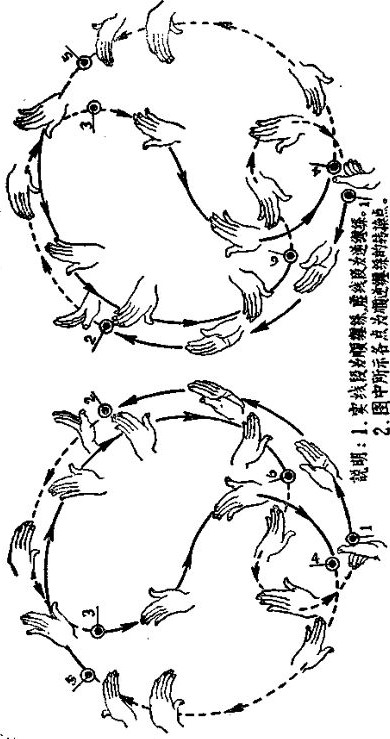
Having explained above the meaning that movement must be like reeling silk, how then should it be carried out in actual movement? It is extremely ordinary and simple: under the requirement of one part moving and all parts moving, the centre of the palm turns from inside outward or from outside inward during the movement ②, making it form the image of the Taiji diagram (as in Figure 1). At the same time, because the centre of the palm turns inward and outward, in the upper limbs this shows as turning the wrist and rotating the shoulder, in the lower limbs as turning the ankle and rotating the leg ③, and in the trunk as turning the waist and rotating the spine. The three combined form a spatial revolving curve whose root is in the feet, which is governed by the waist, and which takes form in the fingers. This is a requirement that Taijiquan must fulfil. Hence the manuals especially point out that in practising, whether the movement opens out broadly or is compact
- ① The small frame that Mr Yang Shaohou set out in his later years shows only the issuing of jin, not the movement. This is because the movement circles have become so small as to be invisible, leaving only the concrete display of the issuing of jin; it is the proficient skill of compactness in which no circle is seen.
- ② What is meant by turning from inside outward or outside inward is standardised by the turning of the index finger. As in Figure 1, when the hand goes from point 1 to point 2, the movement of the index finger at this time is a turning from inside outward, and so it is forward reeling; when the hand goes from point 2 to point 3, the movement of the index finger is a turning from outside inward, and so it is reverse reeling.
- ③ The division of the legs' forward and reverse reeling silk is standardised by the direction of rotation of the knee: when the knee, from the inner side of the patella, turns forward and downward, obliquely reeling outward, or from the outer side of the patella turns backward and upward, obliquely reeling inward, both are forward reeling; when the knee, from the outer side of the patella, turns forward and upward, obliquely reeling inward, or from the inner side of the patella turns backward and downward, obliquely reeling outward, both are reverse reeling.
· 18 · (A) Diagram of the left hand's reeling silk (B) Diagram of the right hand's reeling silk Notes: 1. The solid-line segments are forward reeling silk; the dashed lines are reverse reeling silk. 2. Every point marked in the diagrams is a change-over point of the reeling silk.
· 19 · or compactly gathered, one may never for a moment depart from the Taiji jin of "turning the palm over" and "turning the wrist and rotating the shoulder" — just as the earth, in revolving around the sun, travels an arc, while at the same time the earth itself rotates on its own axis as well. Hence the Taiji jin is not a flat circle, but a three-dimensional spiral rising.
ii. The function of the reeling-silk spiral movement If in practising the hand is held straight and follows the reeling without turning the palm over, and the leg is only front-bowed and back-seated without the coordination of left-right rotation, then the fault of "butting and resisting" and competing by force will arise (as in Figure 2). To correct this fault one must use spiral jin. For the radius of curvature of a spiral is changing; any pressure pressing upon this spiral rod can quite naturally be neutralised by being made to fall away through the rotation. This is a scientific method of neutralising jin. Its function can be seen from Figure 3.
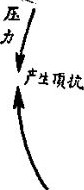
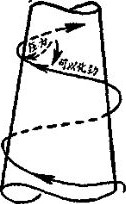
Figure 2 · Diagram of one-directional arc movement Figure 3 · Diagram of spiral silk-drawing movement The spiral reeling silk of Taijiquan is the origin of the name "Taiji" boxing. This spiral kind of movement is a uniquely Chinese manner of movement, rare in the world. In physical culture · 20 · it can impel the whole body to push jin threaded joint by joint ①, and from this advance to the state of inner-outer union in which one part moves and nothing does not move. This can exert a kind of massaging effect on the internal organs. At the same time it causes the outwardly displayed spirit-qi to stir, and thereby strengthens the cerebral cortex, and can thus further strengthen every tissue and organ of the whole body.
Next, in combat. The role of reeling-silk jin is also great. The core of Taijiquan combat is the understanding-jin skill of "knowing oneself and the other" and "knowing the moment and the situation". Understanding jin may be divided into two aspects: first, understanding jin for oneself, that is, understanding the jin of one's own movements, which must be obtained from practising the form; second, understanding jin of the other, that is, understanding the jin of others, which must be obtained from push hands. To know the other one must first know oneself — this is the process of coming to know things. To make the "knowing oneself" of form practice reach a highly proficient state, one must train the skill of the whole body as one family. The skill of the whole body as one family is trained from inner-outer union and threading joint by joint, and both of these are produced from the spiral reeling-silk movement. Hence in combat too, reeling-silk jin is extremely important.
iii. The kinds of reeling-silk jin and their essentials Taijiquan reeling-silk jin may, according to its nature, be divided into two basic reeling silks: one is the forward reeling silk in which the centre of the palm turns from inside outward, and the great majority of forward reeling silk is ward-off jin (as in the solid-line segments of Figure 1); the other is the reverse reeling silk in which the centre of the palm turns from outside inward, and the greater part of reverse reeling silk is roll-back jin (as in the dashed-line segments of Figure 1). These two kinds of reeling silk exist in every process of Taijiquan movement and are threaded through from beginning to end. Hence in every movement there is likewise contained the mutual change of the two jins of ward-off and roll-back; they are the basic contradiction in movement, and at the same time transform into each other within a single unity. Beneath these two basic reeling silks, because the direction differs and the changes vary, five further pairs of different directional reeling silks are distinguished
- ① Threading joint by joint is the fifth characteristic of Taijiquan.
· 21 · (as in Figure 4). The directional reeling silks of left-right and up-down combine into a single full circle, and at the same time, joined with inside-outside, they turn a flat circle into a three-dimensional circle — precisely the distinguishing quality that the Taiji-style spiral movement must possess. Next, in order that in practising there be sources of aid on every hand and that one follow and connect with others, Figure 4 · Diagram of the twelve reeling-silk jin categories — this is a structural chart: forward reeling silk / basic reeling silk / reverse reeling silk → directional reeling silk → left-right reeling / up-down reeling / inside-outside reeling / large-small reeling / advance-retreat reeling.
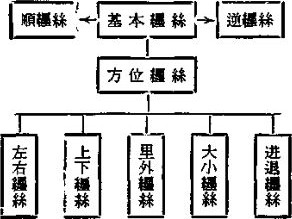
and for threading joint by joint like the whole body as one family, there is also the coordination of the two pairs of directional reeling silk, large-small and advance-retreat, so as to satisfy the special needs of health and of combat. Hence every form of Taijiquan must, upon the basis of the forward-reverse basic reeling silk, have at least three pairs of directional reeling silk combined together in the movement. So long as one has grasped this law, one may have a definite basis for the movement in drawing arcs, and both learning and correcting the forms will be much easier. In practising, if one feels that some movement has lost its proper position and feel, one may, according to where the reeling silk is not smooth, shift the waist and legs a little, so as to obtain smoothness, and the posture can then be corrected. Hence to have grasped the reeling silk is to have grasped the tool of self-correction. Let us now give examples to illustrate its function.
(1) "Cloud Hands" — this form is the only one among the thirteen postures that contains the large left-right reeling silk of double forward turning to double reverse. In the movement, the basic reeling silk of the two hands is the forward reeling silk in which the centre of the palm turns from inside outward, turning to the reverse reeling silk in which it turns from outside inward; its directional reeling silk is left-right, up-down, and slightly inside-outside. Left-right and up-down are a flat circle; if · 22 · one further makes the drawn circle slightly inside-outside, it can become a three-dimensional circle of a spatial curve, and can attain the function of qi adhering to the back.
(2) "White Crane Spreads Its Wings" — its basic reeling silk is one forward and one reverse, a kind of reeling silk rather common within the forms; its directional reeling silk is left-right, up-down and inside-outside. Because it is one forward and one reverse, in the left hand it is reverse reeling silk turning inward and downward, and in the right hand it is forward reeling silk turning outward and upward; the two together, under the requirement that the two arms be linked ①, become the "right-forward left-reverse separating ward-off circle" of upper-right and lower-left.
The examples above show that although the various forms of Taijiquan are manifold and their turns differ one from another, yet analysed from their basic reeling silk they are extremely simple. All the forms come down to no more than the three combinations "double forward reeling silk", "double reverse reeling silk", and "one forward one reverse reeling silk". If one constantly analyses and ponders one's own accustomed form by this method, and makes a table of it, it can become one's own basis for practice. With such a basis one can distinguish the jin categories clearly, achieve inner-outer union and threading joint by joint, and reach the requirement of correct posture upon the foundation of raised elasticity.
iv. Mastering spiral movement Characteristic Three is the origin of the boxing's name "Taiji", and its function has been as described above. Hence our predecessors, in order to enable later students to practise movement like reeling silk well, made a special treatise in the "Taijiquan Treatise", which is a summation in practice of movement. The first part of it discusses reeling-silk jin. To master Characteristic Three one need only practise according to this part, and use it as the basis for normally checking one's own form, and one can obtain correct posture and movement. We now
- ① The linking of the two arms means that in movement the two arms seem to be tied to each other by a rope: when one arm moves, the other can also move along with it, keeping the rope essentially taut — that is, the two arms must always contain a tautly drawn ward-off jin.
· 23 · summarise and explain this part as follows.
(1) Grasping Characteristic Three from the spiritual substance.
(A) "In every single movement, the whole body must be light and nimble" — if the spirit can be raised, there need be no worry of heaviness and sluggishness; this is the method of seeking lightness. If intent and qi can be agilely exchanged, then intent and qi will not stagnate at any one point; this is the method of seeking nimbleness. The first point in grasping reeling-silk jin is that in the course of movement the whole body must be light and nimble, for only thus can favourable conditions be provided for doing the reeling-silk movement well.
(B) "The movement must be threaded joint by joint" — in movement like reeling silk, one must be light and nimble, and especially must thread through; this too is an important link in movement, which must not be neglected in learning. For its details, see Characteristic Five of this chapter.
(C) "The spirit should stir; the qi should be restrained within" ① — if the mind cannot carry through into the movement but has other thoughts, showing dull intent and sluggish spirit, then the spirit will not easily stir, and at the same time the qi cannot be restrained within so as to follow the mind, with the result that the qi-situation becomes scattered, the jin has no reserve, and the body method is disordered. Hence one must first carry the mind through into the ceaselessly flowing and ever-rising-and-falling movement; then the spirit will of itself stir. Next, one must make the lung-breathing coordinate with the movement. Because the spirit stirs, the qi of itself is restrained and does not become scattered; and when the qi is not scattered, it can, led by the spirit, be stirred together with it.
Looking over the three requirements listed above, one may say that "movement light and nimble and threaded through; spirit-qi stirring and restrained within" is precisely the spiritual substance that must be grasped in mastering reeling-silk jin.
(2) Grasping Characteristic Three from jin categories.
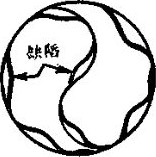
(A) "Let there be no place of defect" — in applying reeling-silk jin, whether forward or reverse, one must always bring the eight gateways of jin onto the back of the spiral's bow — that is, onto the spiral's contact surface — and must on no account be sometimes on the back of the bow and sometimes sunk inside the bow. This is the fault into which reeling silk most readily
- ① Spirit and qi may be stirred, and may also be restrained within. Hence the boxing discourse says, "If you would have the spirit-qi stir, you must first raise the spirit, so that the spirit does not scatter outward."
· 24 · falls. Once it sinks inside, it not only weakens the ward-off jin but also loses the frictional property in the reeling silk. Hence, if once there is a defect, the jin cannot reach the spiral's contact surface, and the pulling function of the reeling-silk jin is also lost (as in Figure 5).
(B) "Let there be no place of convexity or concavity" — in the path of application of reeling-silk jin, all processes must achieve a gentle curve and form a smooth and compliant posture; at the same time, they must be soft and yielding yet rich in elasticity, and this is one method of eliminating convexity and concavity. Even when issuing jin one must fling it out like a soft leather whip. In this way, because the body and hands are extended, the limbs and body are Figure 5 · Diagram of the defect in reeling silk — a place in the Taiji diagram caves in inward, beside it the label "defect".
Figure 6 · Diagram of the convexities and concavities of silk drawing — the reeling path shows many sharp convex-concave bends and notches.
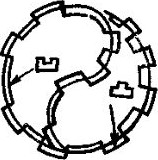
like an inflated tyre, and on contact with an object possess the sticking-and-following function of rising with the high and descending with the low. If the movement once has convexity and concavity, edges and corners are produced, the fault of butting-resistance arises, and the movement thereby loses the function of spiral rotation (as in Figure 6).
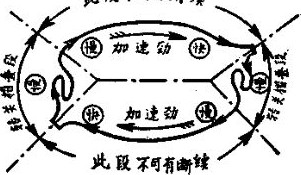
(C) "Let there be no place of break or continuation" — in every process of reeling silk, whether forward reeling or reverse reeling, one must always reel through to the end. What is called the "end" is reaching the point where this form displays its jin category — that is, the change-over place where the next form is taken up. Arriving here, one takes up the next reeling silk through the fold-and-repeat change-over ①, joining the jin into the next form. Since the jin is not broken, there is no need to continue it. If one has reeled halfway and the jin is broken, and then
- ① The meaning of fold-and-repeat may be seen in detail under Characteristic Six.
· 25 · joins it on again, this is not to be tolerated. For if the reeling silk has a break-and-continuation, that is a gap, and this gap not only loses the pulling function it should have, but also creates for the opponent an opportunity to gain the moment. Hence in terms of the reeling silk of movement this is not allowed (as in Figure 7). Next, even when issuing jin, although there may be break and continuation, there must still be the requirement "the jin breaks but the intent does not break; the intent breaks but the spirit may connect" — that is, what is called breaking and then rejoining.
Figure 7 · Diagram that reeling silk must have no break or continuation — a single circle of reeling-silk path, with "this section must have no break or continuation" marked above and below, and "related parts" marked at the two sides.
Looking over the three items listed above, they explain that in the process of reeling silk — that is, in the process of movement — one must on no account produce the faults of defect, convexity-concavity, or break-and-continuation. Of these three faults, even if one commits one, one can no longer develop the function that reeling-silk jin should have. This is a problem that must not be neglected in learning.
To make it easier to grasp, the essentials are now summarised as follows.
(1) Reeling-silk jin is the origin of the naming of Taijiquan; without reeling-silk jin one cannot make the jin rise joint by joint around the limbs and body and reach complete single breath.
(2) One must know that the requirement of "threading through" is not only that the movement must pass through the joints, but also that it must pass through the flesh above and below the whole joint; this is the function of spiral reeling silk.
(3) Taijiquan has one pair of basic reeling silks and five pairs of directional reeling silks, which are the · 26 · the best tool for [learning] Taijiquan.
(4) Movement as reeling silk can be realised only under the conditions of lightness-nimbleness and threading through; at the same time, in respect of spirit-qi there must be stirring and restraining within.
(5) In the application of reeling-silk jin, one must not produce the three faults of defect, convexity-concavity, and break-and-continuation.
Characteristic Four · The Substantial-Insubstantial Movement of an Upright, Centred Body with Upper and Lower Following Each Other The manuals lay down:
(1) "Intent and qi must be exchanged nimbly, and only then is there the delight of round liveliness — this is what is meant by saying that in changing and turning, substantial and insubstantial must be attended to."
(2) "Substantial and insubstantial should be clearly distinguished; each place has its own substantial and insubstantial, and every place always has this one insubstantial and one substantial."
(3) "Standing must be central, correct, at ease and comfortable, supporting all eight directions"; "when upper and lower follow each other, the opponent finds it hard to invade."
(4) "The coccyx is centred and the spirit runs through to the crown"; "upper and lower are one thread."
The four provisions listed above can explain that all the movements of Taijiquan must clearly distinguish substantial and insubstantial. If movement can clearly distinguish substantial and insubstantial in its change-over, then one can endure long without fatigue; this is the most economical kind of motive activity. Hence in practising Taijiquan both hands must have substantial and insubstantial, and both feet must have substantial and insubstantial; and what is especially important is that the left hand and left foot, and the right hand and right foot, must clearly distinguish substantial and insubstantial with upper and lower following each other — that is, when the left hand is substantial the left foot should be insubstantial, and when the right hand is insubstantial the right foot should be substantial. This is the central link in regulating inner jin so as to keep it central and correct. Moreover, in forming the landing-point, within the insubstantial there must be substantial and within the substantial there must be insubstantial, so that in every place there is always this one insubstantial and one substantial, and inner jin everywhere attains central correctness without bias. In the beginning one may use large-insubstantial and large-sub- · 27 · stantial, and afterwards gradually train into small-insubstantial and small-substantial, finally reaching the state where within there is substantial and insubstantial but without no substantial and insubstantial is seen; this is the deepest skill of adjusting substantial and insubstantial.
The core of the nimble exchange of substantial and insubstantial lies in the nimble exchange of intent and qi, and at the same time it must be accomplished under the condition of "the central earth not leaving its place" ① and of central correctness of inner jin. For this, in practising one must at all times adjust substantial and insubstantial by "the coccyx centred", "at ease and comfortable, supporting all eight directions", "emptying the collar and lifting the crown", and "upper and lower are one thread". Hence an upright, centred body and the adjustment of substantial and insubstantial with upper and lower following each other become the fourth characteristic of Taijiquan.
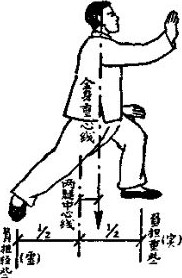
i. Proportions of substantial and insubstantial According to Taijiquan theory, in all movements substantial and insubstantial must be clearly distinguished, so in practising one must see that the movement has, in every place, this one insubstantial and one substantial. In order to adjust substantial and insubstantial well, one must first recognise the correct meaning of substantial and insubstantial. What is called insubstantial is not being wholly without force; what is called substantial is likewise not being wholly weighted down. Taking the two feet, the insubstantial is not that this foot bears no load at all, and the substantial is not that all the load is placed on that one foot (excepting such forms as lifting the leg, standing on one leg, and wrist-locking and seizing), but merely that the insubstantial is somewhat lighter in load than the substantial. The origin of these terms substantial and insubstantial is, mechanically speaking, that the centre of gravity of the body's total load constantly shifts. When the centre of gravity shifts to the right, then the right foot is substantial and the left foot insubstantial; when it shifts to the left, then the left foot is substantial and the right foot insubstantial (as in Figure 8). As said above, the motive power of Taijiquan is itself produced in the exchange of the shifting of the centre of gravity; if there is no shifting — that is, if the centre of gravity sits exactly on the centre-line — then double-weighting ② is formed, the motive power is lost, and the fault of sluggish heaviness arises. At this time, if the two hands are emptily lifted in ward-off, then
- ① "The central earth not leaving its place" means that the body's centre of gravity does not leave the middle third of the distance between the two legs; see Figure 9 in detail.
- ② Double-weighting is when the two feet do not distinguish substantial and insubstantial but become double-substantial, and the two hands too do not distinguish substantial and insubstantial but likewise become double-substantial. Hence double-weighting is formed, so that substantial and insubstantial are obstructed and the change-over is not nimble; therefore it is a fault.
· 28 · one can become a skilled adept of double-sinking ①, and can make the movement regain the motive power of change-over.
Substantial and insubstantial are not fixed; they change as the form changes. In beginning to learn, it is fitting to adopt the posture of large-insubstantial and large-substantial, like the ratio two-to-eight (the two-to-eight ratio refers to the proportions of load on the two feet: if the whole body weighs one hundred jin, one foot bears twenty jin and the other eighty jin). As one's skill becomes proficient, one turns to the posture of small-insubstantial and small-substantial, such as when the load on the two feet is distributed in a four-to-six ratio. After passing through this compact skill, because the degree of movement becomes smaller, substantial and insubstantial can be exchanged more nimbly. The inner reason for the nimble exchange is the nimbleness of the exchange of intent and qi, whereby one can avoid stagnating on one side and concentrating on one point: for example, if in some form one should pay attention to the left hand, one can with no effort immediately turn to the left hand ②. In this way one can have the sensation, in practising, of aid on every hand, producing the delight of round liveliness like a pearl rolling on a plate. In terms of posture, under any change-over one may never let "the central earth leave its place"; only without leaving its place can one change to front, back, left and right without obstruction. If the body leans to one side in making the change-over, it must be adjusted before it can become nimble. This Figure 8 · Diagram of the shifting of the centre of gravity — the diagram is labelled: the central coccyx line, the centre-of-gravity line, left foot load 1/2 (insubstantial), right foot load 1/2 (substantial), with e marking the shifting of the centre of gravity.
- ① Double-sinking is when the two feet, though not yet distinguished into substantial and insubstantial — that is, only slightly insubstantial and substantial — become double-substantial, but the two hands are wholly insubstantial, or only slightly insubstantial and substantial. In this way a leaning-to-insubstantial arises, as in Cross Hands, which is a double-substantial and double-insubstantial of upper and lower following each other — this is double-sinking. At this time, though the two hands and two feet are double-insubstantial and double-substantial, there is still within them a distinction of host and guest, and so it is not a fault.
- ② This refers to people's habit of mostly using the right hand; but sometimes when attention should be on the left hand, it is still on the right hand.
· 29 · is a gap of lost position, and because an extra procedure is added it makes the movement turn slow and lets slip a good opportunity. In Taijiquan terminology this is called losing the moment. Losing the moment and losing the position are grave faults in Taijiquan; hence the exchange of substantial and insubstantial can attain the requirement of nimble change-over only under the condition of standing centred — this is one of the important keys that must be grasped.
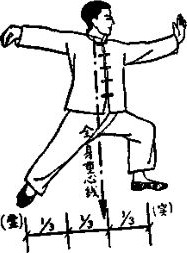
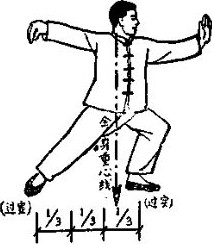
ii. The three basic substantial-insubstantial states (1) The substantial and insubstantial of the feet — the division of the feet's substantial and insubstantial is simply that one foot bears somewhat more and the other somewhat less. According to mechanical principles, if the centre of gravity of the body's weight is located in the middle third of the distance between the two legs, then both feet can have their footing, and this is called half-light half-heavy ① (as in Figure 9). If the centre of gravity goes beyond the range of the middle third, then the insubstantial foot, being too insubstantial, will produce the phenomenon of floating and swinging Figure 9 · Half-light half-heavy Figure 10 · Leaning-light leaning-heavy
- ① "Half" means that the centre of gravity of the body's weight is within the middle third of the distance between the two legs; at this time both feet have their downward jin settled on the ground, only differing in lightness and heaviness, and so it is called half having footing, or half-light half-heavy; this is the correct posture.
· 30 · phenomena, becoming the morbid phenomenon of leaning-light leaning-heavy ① (as in Figure 10).
Moreover, in movement or in issuing jin, the movement must achieve curved storage with surplus. Even after issuing jin, the four limbs should still not be fully straightened. For once straightened, in exchanging substantial and insubstantial one must first change the straight into bent before one can reverse the extension and contraction. But if the hands and feet are in the posture of curved storage with surplus, then on contact they can rotate freely, and one need not divide one's attention amid the reversing, which is the foundation enabling the movement to become automatic.
In sum, in Taijiquan's requirement of substantial and insubstantial for the two feet, at whatever time and place there must be the exchange of this one insubstantial and one substantial, and one must especially gradually reduce the proportion so as to hasten the turning of substantial and insubstantial. If the two feet exchange substantial and insubstantial not quickly enough, they cannot adapt to the changes of the hands, and upper and lower cannot follow each other; they will then split into two branches, destroying the requirement that the movement be of the whole body as one family.
(2) The substantial and insubstantial of the hands — whenever the jin is carried to the hand and lifted in ward-off, that hand is insubstantial; when it is carried to the hand and sinks down, that hand is substantial. The movements of the two hands in Taijiquan, like the movements of the two legs, must also be divided into substantial and insubstantial; even when both hands press together doubly, as in the form Six Sealing and Four Closing, it is likewise divided by the four-six proportion. But the proportions of substantial and insubstantial for the hands differ somewhat from those for the legs: after one's skill has become refined, its proportions, apart from a few individual forms, all lie between three-seven and four-six, the proportions being large. This is laid down in order to achieve steadiness and relaxed quietness, with one side taking charge, so that one side is host and the other is guest. What is especially important is that not only must the limbs exchange nimbly, but intent and qi must exchange nimbly even more, so that intent and qi do not stagnate on one hand, especially the right hand.
(3) The substantial and insubstantial of hands and feet — the division of substantial and insubstantial that takes the most skill is that of the upper and lower of one hand and one foot. And what is most effective in health care and in combat is likewise this upper-lower division of substantial and insubstantial of one hand and one foot. This is the core of making the stepping achieve connecting and following.
- ① "Leaning" means that the position of the centre of gravity has already gone beyond the range of the middle third, making one foot especially heavy while the other floats and swings on the ground, forming a leaning to one side; hence the other side is of course leaning-light. This is called leaning without footing, or leaning-light leaning-heavy, and is a kind of fault.
· 31 · Its requirement and method are: if the right hand sinks down and is substantial, then the right foot must be insubstantial; and when the right hand turns to the upper ward-off and is insubstantial, then the right foot follows the hand above and turns substantial. Doing this is called "dividing substantial and insubstantial with upper and lower following each other." Hence in the Taijiquan "Song of Hand-Pushing" it is said: "Ward-off, roll-back, press, and push must be done with care; when upper and lower follow each other, one is hard to invade" — one may well imagine its importance. Therefore, when practising the form, one must fully examine whether every movement has attained this requirement of upper and lower following each other. To take one round of practising the frame: the postures within are many and varied, and the changes of posture are so frequent that to achieve upper and lower following each other one must of course spend much effort before one can grasp it proficiently. In these changes, apart from changing substantial and insubstantial with the hand following the foot when stepping out, most are changes of substantial and insubstantial with the foot following the hand. In short, if one can achieve the upper-lower substantial and insubstantial of one hand and one foot, then the position of the centre of gravity will not go beyond the range of the middle third of the distance between the two legs, making both left and right legs have their footing; and thus the inner jin can attain central correctness. Once the inner jin is centrally correct, then one can support the eight directions. Reduced to the landing point of the foot on the ground, this kind of substantial and insubstantial is insubstantial-within-substantial and substantial-within-insubstantial. Only when one possesses this upper-and-lower-following substantial and insubstantial can the stepping be nimble and unclogged, advancing and retreating freely, and can one connect and follow the opponent without producing the morbid sign of losing and butting. At the same time, when pushing hands after proficiency, one need only pay attention to the one hand in contact with the opponent, while the other hand and both feet may thereby cultivate the habit of upper and lower following each other, without needing further divided attention; one can obtain the effect of automatic coordination, which is also the key to seeking stillness within movement and thereby attaining stillness.
Phần 2
III. The Grasping of Substantial and Insubstantial
As said above, Taijiquan takes the clear division of substantial and insubstantial and the eccentric moment produced by the shifting of the centre of gravity as its source of motive power; this is the most effort-saving mechanical action, and can make one tireless over long periods. In practising the form, one need only shift the centre of gravity once and one can set the movement going. The procedure of this training in substantial and insubstantial is: first the substantial and insubstantial of the two feet, next the substantial and insubstantial of the two hands, and finally, and most importantly, the upper-lower substantial and insubstantial of one hand and one foot.
· 32 · When Taijiquan practises one round of the frame, the two hands, in order to move in curved circles, must constantly change between sudden insubstantiality and sudden substantiality, thereby impelling the two feet to adjust their substantial and insubstantial in accordance with the substantial and insubstantial of the hands. Likewise, the two feet, in advancing and retreating, always step out insubstantially, and only on reaching their point do they settle and become substantial. This is the general stepping requirement of Taijiquan; hence the hands must change substantial and insubstantial following the substantial and insubstantial of the feet. All these belong to the requirement of upper following lower and lower following upper, of upper and lower following each other; in practising Taijiquan one must comply with this requirement and cultivate this habit. Through long and repeated practice, once it becomes a habit, then when a person comes one naturally produces the automatic "connecting", and when a person leaves one naturally produces the automatic "following", and one need no longer expend much intent in directing the movements.
Phần 3
IV. Light and Heavy, Floating and Sinking, and Substantial and Insubstantial
The division of substantial and insubstantial, at first glance, is not a complicated matter, but in fact it is an extremely minute and multifarious learning process. Therefore, in order better to learn substantial and insubstantial, one must further understand the relation of the four — light, heavy, floating, sinking — to substantial and insubstantial. The boxing treatise says: "If one does not exhaustively study the hand of light, heavy, floating, and sinking, one will have the sigh of digging a well in vain without reaching the spring" — this shows its importance.
In order to grasp this substantial and insubstantial minutely, one should in each boxing form carefully feel it out, find out its defects, and correct them one by one. At this point there are six keys that must be grasped; having grasped these six keys, one can basically be a skilled hand rather than a faulty hand.
(1) One should be "half", not "leaning" — what is called "half" means that the eccentric distance of the body's centre of gravity has not gone beyond the range of the middle third of the distance between the two legs; this is a kind of eccentricity located within the square-and-circle, and is the standard for correctly dividing substantial and insubstantial. What is called "leaning" means that the eccentric distance of the body's centre of gravity has already gone beyond the above range, so that the eccentricity has gone out of the square-and-circle — this is because substantial and insubstantial have been divided too far. Therefore "half" is having footing and is not a fault, whereas "leaning" has no footing and is a fault. Hence in dividing substantial and insubstantial one should be "half", not "leaning". (As in Figure 11.)
· 33 · is having footing and is not a fault, whereas "leaning" has no footing and is a fault. Hence in dividing substantial and insubstantial one should be "half", not "leaning". (As in Figure 11.)
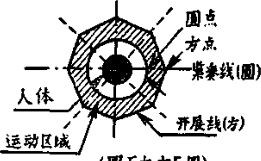
(2) One should be "sinking", not "heavy" — what is called "heavy" means the phenomenon of sluggishness produced by over-filling. What is called "sinking" means that although it is a sinking down, one can still "of itself soar into emptiness"; that is to say, sinking is produced within upper and lower following each other: if the foot sinks down and is substantial, while the hand lifts up in ward-off and is insubstantial, then one can make substantial-within-insubstantial. Hence "sinking" is not a fault, whereas "heavy" is a fault (except for half-light half-heavy). Therefore in dividing substantial and insubstantial one should be "sinking", not "heavy".
(3) One should be "light", not "floating" — "light" is to make the movement manifest nimble lightness with footing within the square-and-circle; whereas "floating" is going out of the square-and-circle, making the heel float up and drift without footing — that is, being insubstantial to excess. Hence floating is a morbid sign. Therefore in dividing substantial and insubstantial one should be "light", not "floating".
(4) The three faultless substantial-and-insubstantial — in practising the form one should learn and achieve the three faultless substantial-and-insubstantial: "double light①", "double sinking", and "half-light half-heavy". Among these three
- ① Under the movement of qi in which the intent is empty-and-nimble without delusion and clear brightness resides in the person, one drums and surges the top jin; above, the two arms are linked, and below, the two legs follow; substantial and insubstantial differ only by a minute amount, yet they can naturally and nimbly convert — this is double light, and therefore it is not a fault.
· 34 · faultless substantial-and-insubstantial, the skills of "double light" and "double sinking" are comparatively fine and hard to do; if not done well, there is the possibility of drifting into "double floating①" (hands insubstantial and feet also insubstantial) and "double heavy" (hands substantial and feet also substantial), and to this one must give full attention. In particular, the skilled hand of "double light" and "double sinking" and the faulty hand of "double floating" and "double heavy" differ by only a hair's breadth in the shifting of hands and feet; hence one should all the more guard against the possibility that this hair's-breadth difference becomes a thousand-li error.
Table 1. Faulty hands and skilled hands in the division of substantial and insubstantial
| No. | Name of faulty hand | Morbid sign | No. | Name of skilled hand | Function | Note |
|---|---|---|---|---|---|---|
| 1 | Double heavy | Fault lies in over-filling | 1 | Double light | Naturally nimble and light | This table is obtained from an analysis according to the boxing treatise "Explanation of Light, Heavy, Floating, and Sinking in Taijiquan". The whole division of substantial and insubstantial has twelve items, of which skilled hands are only three, while faulty hands are nine, occupying three quarters. Therefore a slight carelessness in practice easily produces faulty hands, and attention should be paid. |
| 2 | Double floating | Fault lies in drifting | 2 | Double sinking | Of itself soaring into emptiness | |
| 3 | Leaning-light leaning-heavy | Leaning without footing | 3 | Half-light half-heavy | Half having footing | |
| 4 | Half-floating half-sinking | Erring by insufficiency | ||||
| 5 | Leaning-floating leaning-sinking | Erring by excess | ||||
| 6 | Half-heavy leaning-heavy | Sluggish and not correct | ||||
| 7 | Half-light leaning-light | Nimble but not round | ||||
| 8 | Half-sinking leaning-sinking | Empty and not correct | ||||
| 9 | Half-floating leaning-floating | Vague and not round |
(5) The separating hand is an important measure for remedying leaning-heavy and leaning-floating② — in practising alone
- ① Double floating is when the two hands are insubstantial, and the two feet, because of excessive great insubstantiality and great substantiality, are such that in the process of movement not only does that insubstantial foot float up, but even that over-substantial foot, when changing, is dragged so that one stands unsteadily and floats up, so that the whole body drifts without footing — this becomes double floating, and is therefore a fault.
- ② What is called leaning-heavy leaning-floating arises from the hand and foot on the same side being both insubstantial above and below, or both substantial above and below, so that the jin is biased to one side. Therefore the dividing of substantial and insubstantial with upper and lower following each other is precisely proposed in order that leaning-heavy and leaning-floating may not occur.
· 35 · practice one can achieve the requirement of changing substantial and insubstantial without going out of the corner — that is, one will not go out of the square-circle and produce leaning-heavy and leaning-floating substantial-and-insubstantial. But when pushing hands with a person, two sides are already involved, and one absolutely cannot, by subjective wish, one-sidedly think that one can refrain from going out of the corner and thereby refrain from going out of the corner. If the opponent uses the separating hand of pluck and rend to seize hard and strike hard, then one will sometimes unavoidably go out of the corner. Therefore one cannot but use the separating hand to remedy this out-of-the-corner substantial-and-insubstantial, so as to make it return again within the square-circle and attain the substantial-and-insubstantial of half-light half-heavy. For example: the right hand goes out of the corner and the left hand strikes out; if the person meets the left hand, then the right hand can again return within the four cardinal directions of the square-circle. This is the technique of remedying one's own substantial-and-insubstantial going out of the corner. (As in Figure 12.)
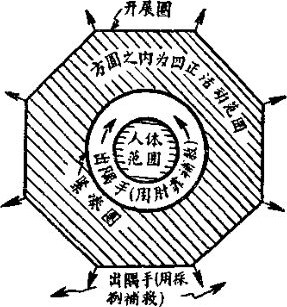
(6) To do substantial and insubstantial well, do not forget the separating hand — for example, when pushing hands, if the opponent is one who greatly opens and greatly spreads and leans and tilts, and often thinks to use the out-of-corner technique to control others, then at this time, if one does not dare or is not accustomed to use the separating hand to deal with his separating hand, but still thinks to use the four cardinal directions to deal with his four corners, and with him to stick, adhere, and draw circles, · 36 · pushing ceaselessly, then such a movement goes against the rule of corner hand dealing with corner hand, and will make one unconsciously produce the substantial-and-insubstantial of leaning-heavy and leaning-floating; one may say this is a defect produced by being habituated to using the four cardinal directions. Therefore the boxing treatise says: "Pluck, rend, elbow, shoulder are all the more marvellous; in doing them one need not spend mental effort" — this precisely explains the importance of the corner hand. If one forgets the grasp of the corner hand, then the leaning-heavy and leaning-floating of substantial and insubstantial cannot be corrected, and moreover one will be impelled further to go out of the corner. This is the defect produced by being habituated to the four cardinal directions and forgetting the four corners, becoming a "one-legged" person.
In order conveniently to grasp the fourth characteristic, its main points are summarized as follows.
(1) Clearly distinguish the three main substantial-and-insubstantial: namely the substantial-and-insubstantial of the feet, the substantial-and-insubstantial of the hands, and the substantial-and-insubstantial of one hand and one foot.
(2) Pay attention to adjusting the substantial-and-insubstantial of hand and foot in the left hand and left foot, and the right hand and right foot — this is the main key to "when upper and lower follow each other, one is hard to invade".
(3) According to the principles of light, heavy, floating, and sinking, constantly examine the defects in one's own division of substantial and insubstantial.
(4) One must achieve the three faultless substantial-and-insubstantial of double light, double sinking, and half-light half-heavy; this requires constant attention and long training before it can be formed.
(5) When pushing hands, do not forget the principle of "corner hand dealing with corner hand". The four-cardinal hand and the four-corner hand must convert into each other, and both must be practised.
Phần 4
Fifth Characteristic: The Joined-Segment Continuous Movement of Waist and Spine Leading, with Inner and Outer Mutually Fitting
The boxing manual lays down:
(1) "The waist and spine are the first rulers; when one moves, nothing does not move";
(2) "The whole body, segment by segment, is strung together, not allowing the slightest interruption";
· 37 · (3) "If one wishes the whole body to be one family, one must first have the whole body free of defects";
(4) "Move the qi like a nine-bend pearl, so that there is no subtle place it does not reach".
From the above four provisions one can see that, in order to attain "when one moves, all move", one must take the waist and spine as the centre, because the waist is the central axis of the left-right parallel turning, and the spine is the foundation of the up-down bending. Since the movements of Taijiquan require that when one moves all move, then on the movement path one cannot merely turn horizontally left and right, nor can one exclusively do bending movements up and down, forward and back; rather one must unite waist and spine so that the path of movement forms a spatial curve that is at once left-right and also up-down, forward-back, thereby establishing the foundation of "when one moves, all move". That is to say, only through taking waist and spine as the centre can one cause the nine main movement joints of the whole body② to be strung together in sequence. Moreover, one must achieve whole-body freedom from defects, strung together like a nine-bend round pearl; only thus can one's skill advance to the stage of the whole body as one family. Therefore the joined-segment continuous movement with waist and spine leading and inner and outer mutually fitting becomes the fifth characteristic of Taijiquan.
Phần 5
I. The Essence of Joined-Segment Continuity
In order to make clear the essence of joined-segment continuity, let us take the lower half of the body as an example for explanation. When the jin starts from the heel, passes through the ankle joint, circles around the calf and rises to the knee joint, then from the knee joint rotates and rises, circling the thigh to the hip joint, and one can do this without the slightest interruption — this is called the joined-segment continuity of the lower half of the body. This shows that the so-called continuity is not only moving at the joints, but should make the whole leg circle and rise in motion. If one does not pass through the large and small legs, but moves only through the joints of ankle, knee, hip, and so on, then that belongs to a movement leaping from one segment to another, and this is a kind of "zero-break jin". Therefore only the jin that rises through the large and small legs is the true "continuous jin"③.
- ① The nine main joints refer to: neck, spine, waist, hip, knee, ankle, shoulder, elbow, and wrist.
- ② "Zero-break jin" is only joint movement, whereas "continuous jin" is muscle and joint moving together.
· 38 · Once the continuous jin is made clear, one can find the point of application of force. If the leg is front-bowed and back-collapsed without left-right rotation, then no matter how one tries it is impossible to string joints and muscles together; at this time one can only manifest the joint's contraction and release, which has no direct relation to the lengthening of the muscle. If the arm straightens and retracts directly, the situation is likewise. Therefore this requirement of continuity cannot be attained except by using the reeling-silk spiral-style rising.
Phần 6
II. The Relation of "When One Moves, All Move" to Waist and Spine
The movements of Taijiquan first require that the nine main external joints can move in sequence and in continuity, for only thus can the internal organs be caused to produce a "massaging" action. When practising the form one must absolutely not have a few joints moving while other joints do not move. In order to make all the body's joints move in sequence and in full, one must find on the human body its central link and use it to lead the various joints to move in sequence; only thus will the movement become comparatively simple. Otherwise, one would have to use mental effort to attend to nine joints moving segment by segment together, which would cause one to attend to this and lose that, bustling without rest, and not only would one fail to attain the goal of continuous all-movement, but one would also lose the requirement of seeking stillness within movement.
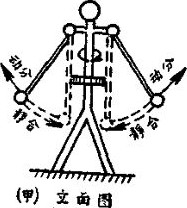
We know that the two organs, waist and spine, occupy the middle of the human body; they naturally · 39 · possess the function of a central axis. Therefore, if one can make waist and spine cooperate with the spiral movement of the third characteristic, one can attain the requirement of joined-segment continuity; hence in Taijiquan the waist and spine are called the first rulers. Because of this central axis, the two hands can use the unity of centrifugal and centripetal force to achieve "when moving then separating, when still then joining" (as in Figure 13).
Phần 7
III. Joined-Segment Continuity and Strengthening the Joints
When Taijiquan has been practised to the point of joined-segment continuity, one can then attain the skill of the whole body as one family. Having formed this skill, one need only simply move very slightly, and one can make all parts of the body, inner and outer, move in coordination. This movement of continuity through the various joints can strengthen the joints and prevent them from degenerating. According to the laws of human physiology, regular joint activity helps preserve the normal structure of the cartilage tissue on the joint surfaces; if one does not often move, the cartilage tissue will undergo the degenerative action of fibrous change. If one does not move for a long time, its accessory organs will further harden, and thus a stiff state of immobile joints is formed. The cause of these pathological changes lies in the decline of the secretion of the synovial fluid that lubricates the joint surfaces.
From this one can see that the requirement of joined-segment continuity in Taijiquan plays an important role in strengthening joint function. In general, in practising Taijiquan one first seeks extension, and extended movement also enlarges the range of the human skeleton's activity. Therefore, when practising Taijiquan, a series of sounds often comes from the joints, making one feel relaxed; this shows that the joints have been exercised. Not only can this preserve the normal function of the joints, but it can also make the function of the bones steadily increase and accelerate the blood supply to the joints and their surroundings; hence even in old age one may step as briskly as a youth.
Although Taijiquan requires joined-segment continuity, with one movement moving all, nevertheless the mobility of its movements · 40 · is of varying size. The influence of a person's daily movements on the joints is uneven: among the nine joints, the one that turns most easily and most often is the wrist joint, and the one that turns least and least often is the spine. Yet the requirement of joined-segment continuity in Taijiquan is exactly contrary to this: it requires that the wrist joint move as little as possible, while the spine is required to lengthen and to move rather more — that is, the mobility of straightening and bending must be made greater. When the mobility of the wrist joint is reduced, one is forced to enlarge the body method to help attain the requirement of joined-segment continuity, and is forced to take waist and spine as ruler; otherwise one cannot turn smoothly and freely. If the mobility of the wrist joint is not reduced, then at one turn of the wrist a movement can easily turn and slip past without relation to the spine, and of course the waist moves little. Therefore the famous masters of Taijiquan often say: "In practising Taijiquan one should practise on the body, not on the hands." As for the wrist joint, one must reduce its mobility, forcing every movement to use the body method and to come out from the waist and spine.
The author had a friend who had practised Taijiquan for years, but paid attention only to hand technique, and his movement did not reach the body; in movement one saw only the arms moving, while the body was like a wooden stick, advancing and retreating with the stepping. Later, on another's advice, he used two pairs of thin boards to clamp his two wrists (four pieces in all), bored two holes in each end of the boards, and tied the boards with rubber bands, allowing the wrist only a small degree of bending. After practising thus for no long time, he transferred the former movement of the hands onto the body; once it reached the body, then when one moved all moved, and the requirement of joined-segment continuity also made comparatively good progress, the temper also gradually surged, and the body and limbs produced the flavour of round livingness like a pearl. This is the result of reducing the mobility of the wrist joint in order to raise the body method.
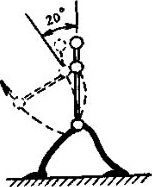
· 41 ·
Phần 8
V. The Grasping of Joined-Segment Continuity
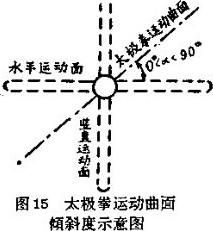
In movement one must use the waist and spine as the motor, with the waist and spine as the centre; only thus can one practise well the skill of joined-segment continuity. And in order to make waist and spine the ruler, not attending to this and losing that and not dispersing one's thought, one can only use the centrifugal force possessing an angle of inclination to initiate the movement (Figure 15); only then can one naturally carry the jin onto the waist and spine. Therefore when practising the frame one must certainly cultivate this habit of movement, so that in movement one does not disperse one's mental attention; not only can one achieve the movement of waist-and-spine leading, but one can also achieve stillness within movement. "When moving then separating, when still then joining" describes the action of centrifugal force's "moving-separating" and "still-joining". Although the centrifugal force makes the two arms spiral apart simultaneously, yet because the two arms are linked, within the opening there is still concealed the inner jin of closing. This belongs to the opening-within-concealed-closing of the whole body. Secondly, because it is not direct opening and direct closing, the arms also possess spiral-style opening; this is elbow-closing-wrist-opening and wrist-closing-elbow-opening, the opening-within-concealed-closing and closing-within-concealed-opening. The former is the mutual concealment of the whole body's opening and closing, the latter the mutual concealment of the arms' opening and closing. This opening-within-concealed-closing and closing-within-concealed-opening of the whole body and the arms is the concrete manifestation of the "Taiji" diagram (yin and yang). Only when one has formed this skill can one be free in length and breadth, front and back, finding the source on left and right, rotating freely on contact, changing in ten thousand ways, providing favourable conditions for training both inner and outer, and it is also the foundation for removing the four faults in combat of "butting, collapsing, losing, resisting" (as in Figure 13).
The first route of Chen-style Taijiquan is mainly movement jin. In the process of moving jin, transforming jin is simultaneously produced, and after transforming one must issue jin; this is the law of movement development. Modern Taijiquan, revised for health purposes, is almost entirely moving jin, with the issuing of jin largely deleted.
· 42 · But Taijiquan was originally a boxing that used moving and issuing together, and hence the eight gates and five steps① were constituted. Therefore some people change the bright jin of issuing jin into hidden jin, so as to attain the intent of issuing jin without the form of issuing jin — that is, changing issuing jin into releasing jin, in order to lower the rigidity of the issuing jin and suit the requirements of physical training. What is called issuing jin means: beneath sinking the shoulders and dropping the elbows, guiding the various inner jins of curved storage with surplus to be transmitted from the spine and back to the arms and then sent out. Therefore the boxing manual lays down: "The jin is issued from the spine" — that is, it is issued by the spine's undoing its buckle. Only this kind of issuing jin is centrally correct jin; it is issued by the whole body converging all the various joints. Therefore the principle of joined-segment continuity must run through moving jin, issuing jin, and releasing jin alike, because the moving jin of joined-segment continuity is precisely the foundation of the issuing jin of joined-segment continuity. Apart from the fact that issuing jin is somewhat unsuitable for the aged and the weak, if young and strong people can practise to the point of being capable in both moving and issuing, not only can they form the eight-gate functions of the four cardinal and four corner directions, but it is also greatly beneficial for strengthening physical strength.
From this one can see that the moving jin of joined-segment continuity not only can lay the foundation for the skill of the whole body as one family, but can also provide the conditions for the issuing jin of joined-segment continuity. Issuing jin must be joined-segment continuous in order to strengthen its jin, concentrating the jin in the spine and back and then issuing it. At the same time, this in turn promotes the movement; hence the two interact and mutually increase each other, and therefore they have an extremely good effect on both health and combat.
In order conveniently to grasp the fifth characteristic, its essentials are now summarized as follows.
(1) Waist and spine united as the central axis, and the arm movements must have an angle of inclination (about 45 degrees);
(2) The "moving separation" and "still joining" produced by the central axis are the central key to using centrifugal force to attain continuity;
(3) Opening-within-concealed-closing and closing-within-concealed-opening are the concrete
- ① The eight gates refer to the eight kinds of inner jin, namely ward-off, roll-back, press, push (also called the four cardinal) and pluck, rend, elbow, shoulder (also called the four corners); the five steps refer to the five kinds of stepping, namely advance, retreat, left-gaze, right-glance, and central settling.
· 43 · manifestation;
(4) The joined-segment continuity of issuing jin is the means of strengthening the continuity of moving jin;
(5) Reducing the mobility of the wrist joint is a necessary means of raising the effect of the body method.
Phần 9
Sixth Characteristic: The "One Breath Accomplished" Movement of Unbroken Connection and Endless Surging
The boxing manual lays down:
(1) "Going and returning must have folding and piling, advancing and retreating must have conversion";
(2) "Gathering is precisely releasing, releasing is precisely gathering";
(3) "When jin breaks the intent does not break, when intent breaks the spirit can connect";
(4) "Like the great Long River, surging endlessly, accomplished in one breath".
From the above four provisions one can see that Taijiquan is not satisfied with "when one moves, all move", but further requires that in practising the whole round of the frame one can further achieve accomplishment in one breath, with the inner jin unbroken. This is yet another method of increasing the amount of movement. Its concrete method is: in the hand technique, when going and returning are met, folding and piling must be fitted in; in the stepping, when advance and retreat are met, conversion must be fitted in; in opening and closing, gathering and releasing, there must be the intent and jin of "gathering is precisely releasing and releasing is precisely gathering". Of course, this characteristic, like the fifth, is realized with the aid of the spiral reeling-silk movement. If after issuing jin a phenomenon of broken jin appears, one must continue the remaining intent of this issuing jin. If by chance the intent also breaks①, then one must use the remaining spirit of intent and jin to continue it. In order to do this, the jin must have folding, piling, and conversion, and the movement must use intent and not force, so that the body method of unified gathering and releasing is like the endless surging of the waters of the Long River,
- ① What is called breaking of intent means that intent and movement are disjointed, inner and outer not one, the intent galloping outward and the movement without a master.
· 44 · with no room in between for unloading the jin, nor any time of intent-galloping, and thus one can naturally attain the requirement of accomplishment in one breath. Therefore the "one breath accomplished" movement of unbroken connection and endless surging can serve as the sixth characteristic of Taijiquan.
Phần 10
I. The Realization of "Accomplishment in One Breath"
This characteristic is, following the fifth characteristic, a concrete measure for further increasing the amount of movement on the basis of "when one moves, nothing does not move". The fifth characteristic emphasizes the requirement that the nine main joints must move all when one moves, thereby making the movement organs and the internal organs unite inner and outer, in order to raise the amount of movement of each boxing form. The sixth characteristic mainly requires, on the basis of "when one moves, all move", that from the first movement of a round of the frame right up to the end of practising the round of the frame, there be no place in between for unloading jin and no time of broken jin, nor any occurrence of dull spirit or thinking of other things, and still less any manifestation of taking a breather or departing from intent; rather one must achieve unbroken connection from beginning to end, wave-like surging and rising without cease — that is to say, one must accomplish a whole round of the frame in one breath. After this increase in the amount of movement, the calculation of the mobility of a whole round of the frame after practice should be the movement of the nine joints multiplied by the movements of one frame; supposing the frame's boxing forms to be seventy-two, then after practising a whole round of the frame one will have accomplished six hundred and forty-eight units of momentum in one breath. This is an outstanding and special creation of our ancestors in the field of physical culture. But in order to do this complex and ever-changing movement with unbroken connection from beginning to end, in broad terms one must accomplish the following two aspects.
(1) In hand technique — in movement, whenever a movement of one going and one returning is met, between the going and returning one must use folding and piling to fill the interval, so that the two movements, front and back, can be joined in a curved and gentle way. The method of this folding and piling is: when the movement has reached its end and one is about to do the next movement, if the next movement is to go downward and forward, then one must first fold once upward, then pile once backward, and then continue to do the next boxing form; thus one joins · 45 · naturally and in a curved and gentle way with the jin of the next movement. This is the statement laid down in the boxing treatise: "When the intent wishes to go up it must first lodge below, when the intent wishes to go forward it must first lodge behind." Doing this not only joins the jin of the former boxing form with the latter, but also makes the next boxing form, owing to the acceleration of the former boxing form, more steady and strengthened — exactly like the returning-tip brush technique in writing large characters with a brush. Therefore in Taijiquan movement, apart from a movement that can be completed within one circle, if in the movement there is a going and a returning (as at the junction of two boxing forms), then folding and piling must be added before the jin of the previous movement can be threaded without the slightest interruption into the next movement. This is the method of attaining unbroken connection in hand technique through folding and piling.
(2) In stepping — whenever moving the step to advance or retreat, between them one uses a "conversion" to fill the interval, so that the stepping before and after can likewise be joined in a curved and gentle way. The method of this conversion is: in stepping forward or retreating backward, one must not advance and retreat directly in a straight line; rather one must fit a conversion into the passage from the previous step to the next step. This conversion is the two steps of gaze and glance among the five steps of Taijiquan①. With the converting step of gaze and glance, not only can the jin of the legs be joined powerfully, but also the legs can be kept from leaving the reeling silk, and can be united in consistency above and below with the reeling silk of the two arms, performing the continuous function of movement arising from the heel and taking form at the fingers.
Within the entire routine of Taijiquan there are unceasing goings and returnings, and hence also unceasing foldings and pilings. With folding and piling fitted into the movement, practising the form shows a feeling of lingering attachment, producing an attitude of seeming-relaxed-yet-not-relaxed, about-to-extend-yet-not-extended, and manifesting the wave-like surging and rising appearance, as if one wave has passed and another wave surges without cease.
Within one round of the Taijiquan frame there are unceasing advances and retreats, and also unceasing conversions. With conversions fitted in between advance and retreat, advance and retreat are no longer direct advance and direct retreat,
- ① The gaze-and-glance stepping is so described by the two words "gaze and glance" of the eyes because Taijiquan moves on the principle that the step follows the body's turn and the body follows the eye's movement; hence the name. Left is gaze, right is glance.
· 46 · but can manifest a meandering whirl and endless generation. When we practise the form on muddy ground, after finishing one round of the frame many circles of the heel may be left on the mud; these are the correct traces left by the gaze-and-glance two steps of this conversion.
In short, when between going and returning the arms have folding and piling, and between advancing and retreating the legs have conversion, then not only can the inner jin before and after be joined, but also the jin used in the processes of going-and-returning and advancing-and-retreating can all be round jin, so that the faults of butting-and-resisting and losing-and-collapsing do not occur, and the two opposites of going-and-returning and advancing-and-retreating can also be unified.
Phần 11
II. Examples of Famous Masters Performing the Form
Around 1914, at the close of the annual meeting of the former Beijing Physical Education Research Society, martial artists of every style in the whole city — such as Ji Zixiu, Zhang Ce, Shang Yunxiang, Wang Maozhai, Xu Yusheng, and others — took part in an entertainment performance. In the Taijiquan field at that time, Yang Chengfu and Wu Jianquan performed Taijiquan together. Both used the large frame; in performing, the two made the audience feel only that they advanced and retreated amid finding the source on left and right, surging ceaselessly without cease, as if standing on a small rowboat crossing the Long River; their movements were on the surface extremely soft and pliant, yet within showed contained firmness and hardness; slow when just at the square, fast when reaching the circle, coordinating opening and closing with the utmost evenness and clarity, like a jade ring without end, so that one could not see clearly where the junction lay. In their advancing and retreating they did not appear to be advancing and retreating, and one felt only that they were step by step changing posture; the time to finish the performance was about eight minutes and more, and all present sighed in admiration, deeming it the utmost to behold.
That the famous masters could attain this profound and correct requirement in walking the frame was of course mainly the result of their diligent study and hard practice, with skill brought home. But if within it the folding and piling of going and returning and the conversion of advancing and retreating were lacking, it would be difficult to attain such ceaseless surging and accomplishment in one breath.
· 47 ·
Phần 12
III. Spirit-and-Qi Surging and Accomplishment in One Breath①
How, from the aspect of posture, to achieve unbroken connection has been stated above. This section focuses on describing how, from the aspect of spirit and qi, to attain unbroken connection, thereby making inner and outer one and truly attaining unbroken connection.
To examine whether the spirit and qi have broken, one need only look at whether the practitioner's spirit and qi are dull or surging; in other words, if the practitioner's spirit and qi, following the movement, manifest a surging bearing, that proves that at this moment this person has already poured his intent into the movement, proving that he is practising the form with intent; even if on the surface it looks as if the jin has broken, if consciousness still exists within the movement, one can only say that his inner jin has weakened in the movement, and cannot say the jin has broken. Therefore when practising walking the frame, one should pay attention to grasping the surging characteristic of spirit and qi, because this is the sole sign indicating that the inner jin is unbroken. Therefore from the very beginning of practising Taijiquan one should pay attention to lodging the inner intent and the outer spirit within the movement, without the slightest interruption; over time this can become a habit, so that if one does not walk the frame then nothing, but once one walks the frame, the spirit and qi must surge without cease, and the thought has no leisure to wander. In this way, even if by chance the thought wanders, one can still preserve the existence of the spirit as much as possible, and can quickly eliminate the phenomenon of broken jin and galloping intent.
The Taijiquan "Explanation of Correct Practice" says: "Taiji is the circle: no matter up, down, left, or right, one does not leave this circle. Taiji is the square: no matter up, down, left, or right, one does not leave this square. The circle's
- ① What is here called "spirit-and-qi surging" differs somewhat from the "spirit-and-qi drumming-and-surging" of the first characteristic. "Spirit-and-qi drumming-and-surging" states that in movement one must drum and surge one's spirit and qi within the application of the eight gate categories of jin, which in turn strengthens the inner movement of intent and qi. "Spirit-and-qi surging" means cultivating, in ordinary movement, the habit of spirit-and-qi surging: if one does not move, then nothing; but when one moves, the spirit and qi surge following the movement, showing that the inner intent has not left the movement and has not galloped outward.
· 48 · going out and coming in, the square's advancing and retreating, follow the round's gathering and the square's going and coming. The square is extension, the round is compactness①; the ultimate of the square-and-round rule — who can go beyond this?" This is the origin of Taijiquan's requirement that square and round generate each other. In the beginning of learning Taijiquan, all movements are required to be round; even the very smallest turning is required to move in a round path drawing a circle. Concerning the round, much has been said above, but one point should still be pointed out: after one's skill has been practised to a fairly proficient degree, when the movement reaches its end point, one should manifest the category of jin prescribed for this boxing form; and to manifest the category of jin, one must show squareness within the round movement — in other words, if one wishes to manifest the category of jin in the course of movement, one must have the square. Therefore the boxing treatise says: "Only round without square is slippery boxing; only square without round is hard boxing."
The boxing treatise also says: "Folding and releasing attained in timely centrality is the root of civil arts; storing and issuing properly suited to what is fitting is the foundation of martial affairs"; it also says: "Exhalation is opening, is issuing; inhalation is closing, is storing. For with inhalation one naturally can lift up, and can also lift a person up; with exhalation one naturally can sink down, and can also send a person out. This is to move the qi by intent, not to make the qi by force." This says that when skill reaches a profound height one need no longer use the posture of great opening and great closing to store and issue, but can store and release merely by using the expansion and contraction of muscle and skin. In Taijiquan terminology this is the function of "inch jin", and it is also the foundation of qigong. Having reached this skill, one need no longer worry about the occurrence of interruption and continuation, because at this time one has already reached the lofty realm where square and round generate each other.
In order conveniently to grasp this characteristic, its essentials are specially summarized as follows.
(1) When a movement has going and returning, folding and piling must be fitted in — this is a necessary measure for attaining unbroken connection in hand technique.
(2) When the body has advance and retreat, conversion must be fitted in — this is in stepping
- ① The extension and compactness in "the square is extension, the round is compactness" spoken of here differ from the "first seek extension, then seek compactness" spoken of in the "Heart Explanation of Moving Practice". The latter refers to the practice of Taijiquan beginning by enlarging one's circle and then, as one's skill becomes profound, compacting the circle. What the former refers to is: "On exhalation, the body and limbs expand, forming extension and attaining the releasing jin of the square"; "on inhalation, the body and limbs contract, forming compactness and attaining the ward-off jin of the round".
· 49 · a necessary measure for attaining unbroken connection.
(3) When the jin breaks, the intent must be present; when the intent does not arrive, the spirit must be present — this is the method of remedying a broken jin.
(4) If one can walk the frame with spirit-and-qi surging, that proves one has already poured intent into the movement. Intent being present is the sign of unbroken inner jin.
(5) The mutual generation of square and round in Taiji jin is produced from "exhalation is extension, is the square" and "inhalation is compactness, is the round".
Phần 13
Seventh Characteristic: The Firmness-and-Softness-Mutually-Aiding Movement from Softness to Firmness and from Firmness to Softness
The boxing manual lays down:
(1) "Move the jin like steel tempered a hundred times; what hardness can it not break?" — "Extremely soft, and then extremely firm and hard".
(2) "Outwardly cultivate softness, inwardly contain firmness and hardness; constantly seek softness on the outside, and over time one can naturally obtain firmness and hardness within; it is not intentional firmness and hardness, but truly intentional softness."
(3) "Taijiquan must absolutely not lose its pliancy. In the going and returning of the whole body, take spirit, essence, intent, and qi as the foundation; with long use it will naturally run through."
(4) "The work of moving jin: first transform hardness into softness, then practise softness into firmness. When it reaches its utmost, it is both soft and firm. When firm and soft attain the mean, then yin and yang are seen. Therefore this boxing cannot be named by firmness, nor can it be named by softness, but is directly named by the namelessness of Taiji."
From the above four provisions one can see that the learning of Taijiquan must first destroy the hard jin originally present in people's movements, making it transform into softness; this is the period of transforming to softness. The longer this period, the more thoroughly the rigidity can be destroyed. The essential point at this time is that one must still not lose pliancy, and beneath softness advance toward a more elastic firmness and hardness. This · 50 · firmness is not the firmness of "pig iron" produced from straining and bulging effort, but an elastic firmness produced from loosening and lengthening. Because the body and limbs lengthen and constantly twist back and forth in spiral fashion, this elasticity can be produced. Therefore it can also be named "ward-off-jin firmness". The more this tautness can be kneaded into softness, the more firm and hard the inner quality can be①. Only this elastic firmness can attain the requirement of "outwardly cultivate softness, inwardly contain firmness and hardness". This transformation of firm and soft is grasped through the concealment and manifestation of spirit, essence, intent, and qi. The saying "when concealed then soft, when manifested then firm" is precisely this principle. After one's skill becomes refined, the jin can be concealed extremely deeply within, making the outward form appear extremely soft, making one feel as if one has returned again to softness, while in fact the inner quality has become even firmer. Therefore the firmness-and-softness-mutually-aiding movement from softness to firmness and from firmness to softness becomes the seventh characteristic of Taijiquan.
Phần 14
I. The Boxing of Firmness and Softness Mutually Aiding
How to view firmness and softness in Taijiquan, and what counts as correct — this is a question that all practitioners wish to know. To answer this question, one must begin from the environment in which Taijiquan developed. The people of the Yellow River basin mostly like to practise hard-style boxing, and hence the Chen-style boxing transmitted in that region also has a tendency to develop toward firmness and hardness. But the Chen family's hereditary transmitters could still preserve the Taiji yin-yang principle and manifest the special feature of firmness and softness mutually aiding. In the Yangtze River basin, intellectuals learning Taijiquan for health occupied a very large proportion. To suit the needs of their constitutions, they gradually developed toward softness. But the Yang family's hereditary transmitters likewise still preserved the style of Taijiquan as "firmness concealed within softness, a needle hidden in cotton". In the various styles of Taijiquan popular today, viewed from the organisation of the frame, they are broadly the same, but viewed from firmness-softness and speed-slowness, each has its own special features. Therefore those generally learning Taiji
- ① Like the spring of a clock: it has the softest elastic firmness, and is also the firmness of the most solid quality.
· 51 · each boxer may learn what he loves according to his own needs. As for the saying of "pure softness without firmness" or "pure firmness without softness", no martial art whatsoever possesses it. Even in the so-called hard-style boxing, within it there is still both firmness and softness. How much more so Taijiquan, which is a boxing art that produces from yin and yang aiding each other a whole series of mutually aiding yet mutually opposed special features. Therefore the so-called "soft-art Taijiquan" or "hard-art Taijiquan" does not exist.
Phần 15
II. The Period of Seeking Softness and Destroying Rigidity
Whatever a person may be, whether or not he has practised martial arts or other sports, in his daily life he must often have carried heavy objects and used strength. Thus everyone's movements inevitably carry rigid bulging effort. If one wishes to learn the movements of Taijiquan well, then toward these original bulging efforts one must, with the drive of "temper a hundred times into steel; what hardness can it not break?", remove them — this is the initial requirement of practising Taijiquan.
In this period one should strive for softness, and must in the "hammering a thousand times and refining a hundred times" process of walking the frame transform the rigid jin inherent in people's movements into soft jin and cultivate this habit of softness. This is the period of destroying the original rigidity and establishing a new softness. The special feature of this period is to strive for softness with all one's might, moving slowly under the principle of using not the slightest force. The less force one uses at this time, the more easily one discovers the defects in one's movements, and the more quickly one can destroy the rigid jin in one's movements. Therefore one may say this is the best "steel-smelting furnace", able to practise the movement until the segments are softly strung together.
The requirement of the above period of seeking softness and destroying rigidity is the initial requirement for transforming hardness into softness. The present period is the period of transforming softness into firmness. In this period one must first make clear what kind of firmness in nature this firmness is, and how one can move softness to become firmness. The boxing manual says that in practising the form one must "with intent seek softness, without intention become firm"; therefore the movement must not use force, and requires the whole body to loosen. This kind of "looseness"
· 52 · is a conscious looseness, but not a looseness that is silent and without intent, and at the same time it has nothing in common with straining and bulging effort. What is called "looseness" means attaining looseness by lengthening the body and limbs, and by the lengthening of the loosening making the body and limbs produce elasticity. When the elasticity is strengthened, it becomes ward-off jin, and ward-off jin is precisely the spring jin required by Taijiquan. The strengthening of this spring jin is the firmness required by Taijiquan.
Now that the nature of firmness is made clear, let us speak further of how one can move softness to become firmness. The strengthening of firm rigidity is realized by the continuity of the inner qi. The raising of the quality of firm rigidity is realized by twisting the reeling-silk jin back and forth to strengthen the toughness of the elasticity. Therefore movement like reeling silk and the lengthening of the body and limbs become the key to attaining both the softest and the firmest. This is what the boxing manual says: "Constantly seek softness on the outside, and over time one naturally obtains firmness and hardness within"; "it is not intentional firmness and hardness, but truly intentional softness." Taijiquan is thus transformed from softness into firmness and hardness, and only this firmness and hardness transformed from softness can attain the proficient realm of sudden softness and sudden firmness, of both soft and firm.
Phần 16
IV. The Transformation of Firm and Soft
The transformation of firm and soft, in terms of spirit and qi, is manifested through concealment and manifestation — concealed then soft, manifested then firm; in terms of posture, it is through opening and closing — in the course of moving jin it manifests as softness, and when the movement reaches its landing point it manifests as firmness. Because of the coordination of the concealment and manifestation of spirit and qi with the opening and closing of the jin-posture, firm and soft can be fully manifested. The landing point is the point where the movement reaches its end, and is where spirit manifests and qi gathers; therefore at this time and place to use the firm method may be called hitting the mark exactly. Apart from this, in all processes of opening-closing and conversion, because they are all processes of spirit-and-qi drumming-and-surging and of round living conversion and change, at these times it is fitting to use the soft method. To sum up, every boxing form movement has opening and closing, and every process of opening and closing has the landing point of the movement; at the landing point one uses firm jin, and everywhere else uses soft jin, so as to achieve firmness and softness mutually aiding. This is the correct place for applying firmness and softness mutually aiding, and is a principle that must be observed · 53 · and is also the foundation for practising out the eight categories of jin. In this respect, one may follow the account in Chen Naizhou's boxing manual, in the "Discussion of Firmness and Softness Mutually Aiding", which sums up the transformation of firm and soft into five points, for reference.
(1) If one uses purely the firm method, then the qi spreads over the whole body, hauling and pulling are not smooth, and on reaching the landing point one certainly cannot manifest firmness and hardness.
(2) If one uses purely the soft method, then the qi scatters and does not gather, has no place of return, and on reaching the landing point one likewise cannot manifest firmness and hardness.
(3) If one should be firm but uses soft, then the qi that should gather does not gather; if one should be soft but uses firm, then the qi that should scatter does not scatter — in neither case does one obtain the wondrous function of firmness and softness mutually aiding.
(4) Therefore one who is good at using firm and soft: on reaching the landing point uses firmness, like a dragonfly touching the water, rising the instant it touches — this is the correct image of manifesting the firm point. In all movement and conversion one uses softness, like a cartwheel rotating and rolling on without stop — this is the correct image of manifesting the soft point.
(5) Only thus does one obtain the wondrous function of firmness and softness mutually aiding, and only thus can one remove the defects of qi-deficient insubstantiality and of clogged-and-unsmooth sluggishness.
Phần 17
V. The Grasping of Firmness and Softness Mutually Aiding
(1) Strive for softness — when first learning to walk the frame, one is mainly learning the various postures. Through learning these different postures, one first transforms away the rigid jin originally on the body, and this rigid jin everyone possesses. Therefore at this stage one should spare no effort in striving for softness as much as possible; for those who previously learned hard-style boxing and later switched to learning Taijiquan, this is all the more important.
(2) Strive to lengthen the body and limbs, in order to produce elastic firmness — after practising thus very softly and very slowly for one or two years, if the rigidity in one's movements has already been wholly removed and one has reached the degree of pliancy, and has already formed this habit, one can then shift to the next step of practice. At this time, one should first, in intent, have the intention of lengthening every place on the whole body, and in posture and movement · 54 · vigorously carry out the special practice of lengthening according to the boxing manual's provisions (such as hollowing the crown and holding up the top jin, sinking the qi to the cinnabar field, containing the chest and drawing up the back, and so on), thereby making intent and body-and-limbs, in close coordination, single-mindedly and whole-spiritually lengthen, in order to obtain elastic firmness. When first learning the form, for the various provisions of lengthening, such as containing the chest and drawing up the back, it is enough merely to use intent; but at this stage, one should carry it out jointly in intent and in body-and-limbs, because by now lengthening will no longer give rise to the contrary morbid sign of bulging effort.
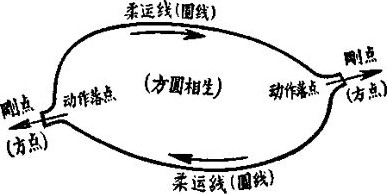
(3) Do well "softness moves the qi, firmness lands the point" — after the whole-body lengthening has met the requirement, one can further, at the landing point of each opening and closing, in conjunction with the outward manifestation of spirit and qi, form the square point, manifesting the jin categories of the four cardinal and four corner directions; this is the practice of the square within Taijiquan's "square and round generating each other". At the square point one must manifest extremely firm firmness (that is, one must make the body and limbs taut to the extreme and long), and after the firmness has passed, one requires that throughout the entire process of movement one manifest extremely soft moving of qi. The whole round of the frame should be carried out under such a condition of firmness and softness mutually aiding. Therefore when practising the form one should firmly remember the six-word essential: "softness moves the qi, firmness lands the point".
(4) The application of firm and soft and "vigorous spirit and bearing" — the application of firm and soft must be combined with the application of intent, spirit-and-qi, and breathing; that is, on the basis of "vigorous spirit and bearing"
· 55 · one coordinates the use of deep and long exhalation to make the body and limbs sink and lengthen, thereby strengthening elasticity and becoming elastic firmness (as in issuing jin); on the basis of quiet intent and gathered qi, one makes the muscles of the limbs loosen along with it, thereby forming a lively and unclogged softness, and from softness changing in ten thousand ways. Both of these are physiologically a kind of natural phenomenon.
In short, the firmness of Taijiquan is not the firmness of bulging effort, and the softness of Taijiquan is not an elasticity-less softness; rather, "vigorous spirit and bearing" manifested outwardly becomes firmness, and quiet intent and gathered qi concealed inwardly becomes softness. When intent moves, spirit and qi follow; as spirit and qi conceal and manifest, so firm and soft transform. Therefore in practising one round of the frame, spirit and qi should conceal and manifest suddenly, intent should unceasingly direct, and spirit and qi should also unceasingly conceal, manifest, and drum-and-surge; only thus can the muscles unceasingly transform firm and soft. This is an important path for grasping and practising the transformation of firm and soft.
In order conveniently to grasp the seventh characteristic, its essentials are summarized as follows.
(1) In the initial period one must transform away the original rigid jin, and the softer the better; the longer this period the better too, generally requiring one or two years.
(2) After the whole body has been practised to pliancy, one can then proceed to concretely practise the lengthening of the whole body, in order to practise firm jin.
(3) Moving the qi uses softness, the landing point uses firmness — this is Taijiquan's dividing line between firm and soft.
(4) Intent combined with the sudden concealment and manifestation of spirit and qi and with breathing is Taijiquan's rule for the transformation of firm and soft.
(5) Firmness and softness alike attaining a high level is the standard for the title of Taijiquan marvellous hand①.
- ① According to Chen Xin's "General Discussion and Elucidation": "Pure yin without yang is the soft hand, pure yang without yin is the hard hand; one yin and nine yang is the root-headed stick, two yin and eight yang is the scattered hand; three yin and seven yang still feels hard, four yin and six yang is akin to a good hand; only five yin together with five yang, yin and yang without bias, is called the marvellous hand; the marvellous hand in one movement is one Taiji, and when the traces are fully transformed it returns to nothingness." This is the Chen style's standard for the softness-firmness degree of Taijiquan. Because Chenjiagou lies in the Yellow River's slope, where many practise hard-style boxing, and hence people fear that they will be tempered by their environment into gradually tending to hardness, there are the names hard hand, scattered hand, good hand, marvellous hand, to serve as the standard limiting practitioners from tending to hardness.
· 56 ·
Phần 18
Eighth Characteristic: The Movement of Alternating Fast and Slow, from Slow to Fast and from Fast to Slow
The boxing manual lays down①:
(1) "When the opponent moves urgently then respond urgently, when he moves slowly then follow slowly";
(2) "When he does not move, I do not move; when he moves slightly, I move first";
(3) "When first learning one should be slow, but slow must not become idiotic; after practice one becomes fast, but fast must not become chaotic";
(4) "The form resists the five peaks, the posture presses the three summits; from slowness enter swiftness, from shallow enter deep".
From the above four provisions one can see that when first practising the Taijiquan routine (one round of the frame), the movements should be as slow as possible, and the time may be drawn out. Only when the movements are slowed is there opportunity to make corrections, and only thus can one examine the places that are not smooth. But slowness must not go so far that the face shows idiocy; this is the limit of slowness. Later, as one's proficiency increases, one may gradually speed up, shortening the time needed to walk one round of the frame. But in turning from slow to fast there must likewise be a limit, namely that although fast, the movements must still be steady, still be able to manifest the categories of jin, and must not give rise to floating and drifting or chaotic phenomena. This refers to the length of time needed to practise one round of the frame. On this premise of being able both to be slow and to be fast, when applying it to each boxing form one must unify this pair of opposites, fast and slow, into
- ① In the boxing manual, the meaning of fast and slow has two contents:
The first meaning refers to the length of time needed to practise one round of the frame. If A takes twelve minutes to practise one round of the frame and B takes fifteen minutes, then we say "A is fast and B is slow".
The second meaning refers to the speed of movement within each boxing form. It is slow at the conversion, gradually quickens after passing the conversion, is fastest when carried to the landing point, and after issuing returns again to slowness.
Among the four lines of principle quoted here, the first two refer to the second meaning, and the latter two to the first meaning. This is a question that must be distinguished clearly when learning.
· 57 · a single boxing form: that is, at the conversion it must be slow, after passing the conversion it gradually quickens, it is fastest when carried to the landing point, and afterward slows again, and so on in a cycle. (As in Figure 17.) Therefore every boxing form of Taijiquan must undergo the training of being able both to be slow and to be fast; only thus can one, in pushing hands, "when he moves slightly, I move first" and "when he moves urgently then respond urgently, when he moves slowly then follow slowly", creating conditions favourable to oneself, and can attain the unity of alternating fast and slow.
Therefore the movement of alternating fast and slow, from slow to fast and from fast to slow, becomes the eighth characteristic of Taijiquan.
Phần 19
I. The Development Sequence of Fast and Slow
At the initial stage of learning Taijiquan, one must absolutely not be fast, and must strive for slowness with all one's might, the slower the better. Because slowness allows one to carefully ponder the correctness of the postures, proceeding from coarse to fine, and there is ample time to examine the ins and outs of every movement; thus the postures are easily corrected, and at the conversion one can examine whether it is smooth. But slowness is not to be slow without limit; generally after one or two years of learning, imitating, checking, and correcting, it will do. On this point one must have a correct notion when first learning. This is the period of seeking only correctness of posture, not distinctness of jin categories.
The slowness of this period must further have a condition, namely that the slowness must be sought on the premise of raising the spirit and not letting the spirit scatter. If in the movements one is so slow that in spirit and qi one manifests dullness and rigidity, and in action manifests sluggishness and immobility, then this is contrary to the requirement of Taijiquan's intent-and-qi movement. Therefore slowness must be sought under the drumming-and-surging of spirit and qi and the nimble conversion of intent and qi; this is Taijiquan's standard for slowness. For this reason, when first learning one must absolutely not contract this habit of sluggish intent and dull spirit, causing difficulties for later improvement.
Later, as one's proficiency increases, one may gradually quicken the speed; but fast must not be chaotic — this is the period of training the categories of jin. Finally, after one's skill has become refined, the boxing forms may develop from extension to compactness, so that the speed of movement gradually slows again, while at the conversion · 58 · its angular velocity is even faster. This is the three-layer skill of first slow, then fast, then again slow, and is also the three stages of the development of fast and slow.
Phần 20
II. The Time and Conditions for Turning from Slow to Fast
At what time and under what conditions is it most suitable to turn from slow to fast? To answer this question, one must first clarify the two standards for turning from slow to fast.
(1) Movement steady — within the whole round of the frame, even if one moves somewhat faster than before, one still must not change the original steadiness of the movement; this is correct speeding up. If one cannot, and floating and drifting appear, then it shows the movement has been speeded up too much, and one should at once slow down somewhat. Under the guidance of this standard, one can gradually speed up as proficiency increases.
(2) Being able to manifest the categories of jin — Taijiquan is composed of the eight gates and five steps. In moving jin one should fully manifest one of the eight jins (such as the four cardinal's ward-off, roll-back, press, push, or the four corners' pluck, rend, elbow, shoulder). If the movement is too fast, it slips past in a single turn, and it is not easy to manifest the required category of jin. Therefore if one feels it is very hard for one to manifest the category of jin again, it shows the movement has already been speeded up too much, and one should slow down somewhat. This is also a standard for turning from slow to fast①.
The above two points are the two standards for turning from slow to fast. With these two standards, one can be guided correctly to grasp the time and conditions for turning from slow to fast, making the speed of movement turn from slow to fast just to the right degree. The fast referred to here does not mean changing all the movements of Taijiquan into fast movements, but rather that in the opening and closing of every boxing form, at the conversions and foldings and pilings, one must manifest, in a manner of relaxed-yet-not-relaxed and about-to-extend-yet-not-extended, the lingering attach-
- ① However much one speeds up, in order to manifest steadiness and the categories of jin, the first route's thirteen-posture frame is at fastest no more than eight or nine minutes. This was the speed at which teacher Yang Chengfu publicly performed Taijiquan at the annual meeting of the Nanjing Physical Education Research Society in 1914.
· 59 · ment and vermicular soft slow movement. Therefore the so-called fastness is manifested only in the process of turning from round to square. (As in Figure 17.) This accelerated movement is the foundation from which the eight categories of jin arise; without this angular acceleration, one cannot manifest the categories of jin of the four cardinal and four corner directions, nor can one suit the requirement of "when he moves urgently then respond urgently". The issuing jin of Taijiquan is realized precisely by using this accelerating process: under the condition of closing concealed within opening and with the inner jin curved-stored, when one reaches near the target object, one suddenly shakes and issues like a bowstring released from its catch, sending the inner jin out from within a short distance. Martial artists call this "inch jin"①.
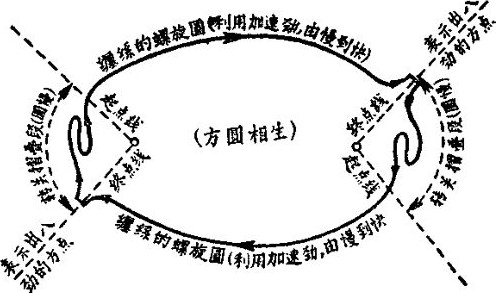
Phần 21
III. Alternating Fast and Slow, and Evenness-and-Clearness, and the Categories of Jin
From the above theory one can know that any isolated slow movement or isolated fast movement does not conform to the requirement of Taiji yin and yang aiding each other. Secondly, as regards man's attention,
- ① "Inch jin": any storing and issuing of jin within a distance of one chi is called inch jin.
· 60 · in terms of stability, from the psychological and physiological basis one can see that it is impossible to make attention engage in long-term attention of equal intensity without destroying its stability. To make attention stable and the intent not scatter, one must make the intensity of attention high and low. Now Taijiquan is an intent-and-qi movement, and it requires pouring intent into the movement; therefore, in order not to let the intent scatter, the movement must alternate fast and slow, and only thus can it suit the rising-and-falling characteristic of intent and qi, impelling attention to become stable and spirit and qi to drum-and-surge. In fact, the alternation of fast and slow in movement is also a natural instinct of mankind; it is both necessary for health and indispensable for combat. Therefore, taking a single boxing form, one requires the attainment of alternation of fast and slow (as in Figure 17). Yet taking one round of the frame, this alternation of fast and slow of each boxing form further requires an even range of variation. That is to say, from the beginning of the movement to its end, when slowness is needed it is all equally slow, and when fastness is needed it is all equally fast; in Taijiquan terminology this is to achieve "evenness-and-clarity". If one can attain this requirement, then one's breathing will certainly be regulated very "evenly and clearly", and there will be no phenomenon of gradually becoming urgent. This skill of making both movement and breathing attain "evenness-and-clarity" is a concrete manifestation of being well cultivated in Taijiquan, and is the true skill obtained from long practice. Therefore when first turning from slow to fast, one must not fear urgency of breathing and so not dare to do the speeding-up movement — that would be to give up eating for fear of choking. In short, Taijiquan should be like the waves of the great Long River, surging endlessly and yet with even clarity, rising and falling in movement.
Taijiquan is composed of the eight gates and five steps. When first learning, in order to transform away the original rigid clumsy force of the body and limbs, one may temporarily not manifest the categories of jin, and may be only round without square. The reason why it is permitted in this period not to manifest the categories of jin is that one has not practised enough, one's skill is not deep, and the habit is not yet formed; it is because if at this time one were required to manifest the categories of jin, one would easily produce the fault of straining and bulging effort, and would no longer be able to produce the elastic jin of lengthening the body and limbs.
After practising for one or two years the skill of seeking softness and destroying rigidity, and when one feels the rigid jin has been wholly removed, one may then manifest the categories of jin when walking the frame. Manifesting the categories of jin is the practising · 61 · This is indispensable to Taijiquan and is also what the eight jins require — namely that the accelerating force, on reaching the landing point, must manifest:
(1) Outward there is ward-off jin, inward there is roll-back jin, double closing there is press jin;
(2) Downward there is push jin, double separating there is pluck jin, issuing out there is rend jin;
(3) When the wrist has gone out of the square-and-circle there is elbow jin, and when the elbow and arm again go out of the square-and-circle there is shoulder jin.
Only movement like this can be called a Taijiquan composed of the eight gates and five steps. For this reason, after practising the form for a certain period, when walking the frame one should fully do well this movement of alternating fast and slow. By long practice of alternating fast and slow, one can make the eight-gate jin go from nothing to having, and from having to strong, becoming eight gates and five steps in name and reality.
Phần 22
IV. The Grasping of Alternating Fast and Slow
(1) When first learning, strive for slowness with all one's might — when first learning, in order conveniently to check and correct every movement, one must be slow, and must progressively pass through this period of seeking slowness; one must not be impatient, lest one create difficulties for later improvement.
(2) One must seek slowness under the conditions of raised spirit and nimble conversion of intent and qi — when first learning, one cannot but be slow in order to check and correct the postures. But as said above, slowness must have a limit; that is to say, one must not be so slow as to seem to move and seem to stop, with fixed eyes and dull spirit, as if there one were thinking of something else. This kind of slowness is close to the standing skill of standing the frame, and is not what is needed for moving. Therefore slowness must be sought on the premise of raised spirit and nimble conversion of intent and qi; only thus will one not produce the faults of idiocy and scattering of spirit.
(3) One must seek fastness under the conditions of steady movement and being able to manifest the categories of jin — seeking fastness, like seeking slowness, is likewise not going toward fastness without limit; it likewise must have a limit: although fast, the movement must still be steady. Steady fastness is the fastness required by Taijiquan; unsteadiness is a morbid sign. At the same time, one must seek fastness under the condition of being able to manifest the categories of jin, because manifesting the jin limits the fastness. Such fastness is beneficial and harmless · 62 · fastness — it will not float and drift without sinking, nor be indistinct in the categories of jin, nor lose the function of square and round generating each other.
(4) Slow at the conversion, quicker when turning toward the square point — the above three points explain the measure of fast and slow one should grasp in walking one round of the frame; now let us speak further of the principle of fast and slow for each boxing form. Taijiquan lays down that at the conversions and foldings and pilings one should be slow, and after passing the conversion one uses accelerating jin to move toward fastness, and carries on thus in a cycle. At the same time, within one round of the frame, this transformation of alternating fast and slow further requires attaining "evenness-and-clarity". This is the foundation for training the eight categories of jin, making them go from nothing to having and from having to strong.
In order conveniently to grasp the eighth characteristic, its essentials are summarized as follows.
(1) When first learning one must be slow, in order to have opportunity to check and correct.
(2) Seeking slowness must take raised spirit and nimble conversion of intent and qi as its premise.
(3) As proficiency increases, one should gradually shorten the time needed to walk one round of the frame. But seeking fastness must take steady movement and being able to manifest the categories of jin as its premise.
(4) The principle of alternating fast and slow is: slow at the conversions and foldings and pilings, and after passing the conversion gradually quicken, and after passing the square point slow again. At the same time, at the conversion moving the qi must be slow, and at the landing point at the end must be fast.
(5) Within the whole round of the frame, the range of variation of alternating fast and slow is required to achieve evenness-and-clarity.
Phần 23
Conclusion
The eight characteristics of Taijiquan are selected and refined from the Taijiquan manuals, again and again. The precious form-practising experience left by our predecessors has long since become the principles for practising Taijiquan at present, and is also the standard that people unanimously follow in practising Taijiquan.
It should further be pointed out that although the characteristics are divided into eight, their essence is one; therefore when practising the frame or pushing hands, one must not treat these characteristics in isolation, and must in every movement gradually come to conform to these characteristics. Because every boxing form or movement must use concentrated consciousness to direct the whole course of the movement (characteristic · 63 · one), making the body and limbs elastic on the premise of raised spirit (characteristic two), and, amid nimble transformation of substantial and insubstantial (characteristic four) and forward-reverse spiral reeling silk (characteristic three), bringing about the union of inner and outer, attaining the joined-segment continuity of "when one moves, nothing does not move" (characteristic five) and the accomplishment in one breath of unbroken connection (characteristic six), manifesting the quality of firmness and softness mutually aiding (characteristic seven) and the speed of having both slow and fast (characteristic eight) — these are the special features that Taijiquan should possess.
From the above analysis one can see that these characteristics are mutually dependent, mutually constraining, mutually promoting, and mutually transforming. Therefore, if one treats them in isolation and attempts to carry out only one characteristic while abandoning the others, then one not only harms the latter but also affects the former. Hence these characteristics are not peculiar to one particular movement, and still less is it that a certain movement has only a certain one characteristic; rather, they are characteristics that every boxing form constituting the entire Taijiquan routine should possess.
In the Taijiquan popular today, whatever the style, and regardless of whether the postures are extended or compact, and regardless of whether the frame has a few more or a few fewer boxing forms, one need only observe carefully: these Taijiquan frames, though differing in outward appearance, all possess these common characteristics more or less within. The only difference is that some manifest them clearly on the outside, while others conceal them within by way of hidden jin. This also explains why Taijiquan, popular for several hundred years, has not been assimilated by other martial arts and can still stand alone as a style of its own — it is these common characteristics that have served as the mainstay. Therefore when learning Taijiquan one must not treat it lightly.
But when first learning, to wish to grasp these eight characteristics all at once is impossible. When first learning, one need only recognize these characteristics, know that they are the summary of experience left by predecessors, and understand that they are the basic elements constituting Taijiquan; then it is not difficult, following the predecessors' experience and proceeding steadily along the direction they have already pointed out, to obtain the efficacy that Taijiquan should have.
· 64 · Chapter Two: Illustrated Explanation of the First Route of Chen-Style Taijiquan
Phần 24
Sequence of the Form Names of the First Route of Chen-Style Taijiquan
| No. | Form name | No. | Form name |
|---|---|---|---|
| 1st form | Preparatory Form | 16th form | Draping-Body Punch |
| 2nd form | Vajra Pounds the Mortar | 17th form | Back-Bending Shoulder |
| 3rd form | Lazily Tucking the Robe | 18th form | Green Dragon Emerges from Water |
| 4th form | Six Sealing and Four Closing | 19th form | Double Push Hands |
| 5th form | Single Whip | 20th form | Three Changes of Palm |
| 6th form | Second Vajra Pounds the Mortar | 21st form | Punch Beneath the Elbow |
| 7th form | White Crane Spreads Its Wings | 22nd form | Reversed Rolling of the Arm |
| 8th form | Diagonal Twisted Step | 23rd form | Retreating Step Pressing Elbow |
| 9th form | First Gathering | 24th form | Central Plate |
| 10th form | Forward Crossing Twisted Step | 25th form | White Crane Spreads Its Wings |
| 11th form | Second Diagonal Twisted Step | 26th form | Diagonal Twisted Step |
| 12th form | Second Gathering | 27th form | Flash through the Back |
| 13th form | Forward Crossing Twisted Step | 28th form | Concealing-Hand Arm Punch |
| 14th form | Concealing-Hand Arm Punch | 29th form | Six Sealing and Four Closing |
| 15th form | Third Vajra Pounds the Mortar | 30th form | Single Whip |
· 65 ·
| No. | Form name | No. | Form name |
|---|---|---|---|
| 31st form | Moving Hands | 58th form | Moving Hands |
| 32nd form | High Pat on Horse | 59th form | Swinging Foot and Dropping into the Split |
| 33rd form | Right Brushing Foot | 60th form | Left and Right Golden Rooster Stands on One Leg |
| 34th form | Left Brushing Foot | 61st form | Reversed Rolling of the Arm |
| 35th form | Kick with One Heel | 62nd form | Retreating Step Pressing Elbow |
| 36th form | Forward Crossing Twisted Step | 63rd form | Central Plate |
| 37th form | Striking the Ground Punch | 64th form | White Crane Spreads Its Wings |
| 38th form | Turn Body Double Kick | 65th form | Diagonal Twisted Step |
| 39th form | Beast-Head Posture | 66th form | Flash through the Back |
| 40th form | Whirlwind Kick | 67th form | Concealing-Hand Arm Punch |
| 41st form | Kick with One Heel | 68th form | Six Sealing and Four Closing |
| 42nd form | Concealing-Hand Arm Punch | 69th form | Single Whip |
| 43rd form | Small Capturing Strike | 70th form | Moving Hands |
| 44th form | Clasp Head and Push the Mountain | 71st form | High Pat on Horse |
| 45th form | Three Changes of Palm | 72nd form | Cross-Shaped Lotus Sway |
| 46th form | Six Sealing and Four Closing | 73rd form | Punch Pointing at the Crotch |
| 47th form | Single Whip | 74th form | White Ape Offers Fruit |
| 48th form | Front Beckon | 75th form | Six Sealing and Four Closing |
| 49th form | Rear Beckon | 76th form | Single Whip |
| 50th form | Wild Horse Parts Its Mane | 77th form | Sparrow Earth Dragon |
| 51st form | Six Sealing and Four Closing | 78th form | Step Up Seven Stars |
| 52nd form | Single Whip | 79th form | Retreating Step Straddling the Tiger |
| 53rd form | Double Stamp of the Foot | 80th form | Turn Body Double Lotus Sway |
| 54th form | Jade Maiden Works the Shuttle | 81st form | Cannon Facing the Head |
| 55th form | Lazily Tucking the Robe | 82nd form | Vajra Pounds the Mortar |
| 56th form | Six Sealing and Four Closing | 83rd form | Closing Posture |
| 57th form | Single Whip |
· 66 ·
Phần 25
A Few Notes on the Illustrations
1. The action-breakdown diagrams in the illustrations of the first route were drawn from photographs of the postures of fellow student Chen Zhaokui. The action-breakdown diagrams in the illustrations of the second route (Cannon Fist) were drawn from photographs of the postures of teacher Chen Fake; in addition, according to the needs of the action breakdown, some diagrams were added, drawn according to fellow student Chen Zhaokui's build.
2. To make it convenient for readers to check the directions of the boxing forms, the directions of the postures in the photographs are agreed as follows: facing the reader equals facing south, the back to the reader equals facing north, the reader's right of the facing figure equals east, and the reader's left of the facing figure equals west. After the reader has practised proficiently, he may choose any direction according to the shape of the ground, and need not necessarily begin the preparatory form standing facing south.
3. All arrows in the diagrams, whether drawn with a solid or a broken line, indicate the direction of the action of the hand or foot, and the arrows in all the diagrams indicate the direction of action passing from this diagram to the next. Where a movement is relatively simple and can be explained by the text, its direction of action is no longer shown in the diagram, and one may refer to the text and the following diagram to understand it; moreover, for a boxing form identical with some earlier form, where the action-breakdown diagrams are abbreviated from several to one or two, one may refer to the breakdown diagrams of the same earlier boxing form, and no longer show its direction of action in the abbreviated one or two diagrams.
4. Arrows drawn with a solid line indicate the direction of action of the right hand or right foot, and arrows drawn with a broken line indicate the direction of action of the left hand or left foot.
5. Because the movement of the feet in Taijiquan is also fairly fine, in order to show the feet and the ground, shadows are drawn beside the feet to distinguish them. (See the diagram below.)
· 67 · (Continuation of point 5 of the notes on the illustrations — the method of showing the shadow of the foot on the ground)
a. A shadow joined as one body beside the foot indicates that the whole foot is on the ground.
b. Where there is no shadow beside the foot, it indicates that the whole foot is off the ground.
c. Where the shadow beside the foot is joined only at the heel, it indicates that the heel is on the ground.
d. Where the shadow beside the foot is joined only at the toe, it indicates that the toe is on the ground.
Phần 26
Chen-Style Taijiquan, First Route
Stand with the body upright and centred, with the two feet a little wider apart than the shoulders, the two toes turned slightly outward, the two arms hanging naturally down, and the eyes looking level ahead. (Figure 1)
Essential points:
· 68 · The preparatory form is the preparation in consciousness and in posture before beginning the movement; it requires: solidifying the spirit within and showing ease without; hollowing the crown and holding up the top jin — that is, the head must be upright and the crown must be hollowly held up, holding the top jin as if suspended; the lips lightly closed, the teeth lightly together, the chin slightly drawn in; sinking the shoulders — that is, the two shoulders slightly rolled forward and relaxed and sunk; containing the chest and drawing up the back — that is, the chest contained without being concave inward or convex outward, and the spine and back having the intention of pulling and lengthening upward and downward; the crotch must be open and have a feeling of round emptiness; the two knees slightly bent, standing without being stiffly straight, with the knee joints keeping a margin; the whole body relaxed, the breathing natural, and the intent stored in the cinnabar field.
The above essential points must be attended to at every moment, not only when doing the preparatory form but also when doing any movement in the entire set. Moreover, as said above, although each aspect has its own requirement, they also each influence one another. For example: because the shoulders are slightly rolled forward and relaxed and sunk, it is easy to achieve containing the chest and drawing up the back, solidifying the spirit within, sinking the qi to the cinnabar field, and hollowing the crown and holding up the top jin; because the knees are slightly bent, the crotch is easily opened and rounded (the crotch is the perineal part between the two excretory openings; opening the crotch means feeling that there is qi lifted up and that the skin of this part does not sag).
Action one: The body slightly squats, the two elbows slightly bent, the two palms facing down (the two hands having the intent of closing strength), and the eyes looking level ahead. (Figure 2) The body turns slightly to the left; at the same time the two hands, the left reeling reverse and the right reeling forward, are raised toward the left front diagonal to the height of the shoulders, the two palms still facing down. (Figure 3) The body turns to the right and continues to squat, with the whole weight shifted onto the right leg, and the left foot lifted; while turning the body, the two hands still with the left reeling reverse and the right reeling forward open out toward the right rear, palms facing the right rear, and the fingers stretched out and not soft. (Figure 4)
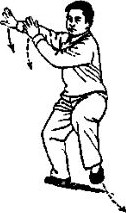
Action two: The left foot's toe is raised, and with the inner side of the heel touching the ground one thrusts toward the left front · 69 · out, and as the centre of gravity moves forward one gradually comes to the left foot firmly planted; at the same time the two palms still with the left reeling reverse and the right reeling forward, open out in reeling silk toward the right rear and sink slightly, and at the same moment as the left foot is firmly planted, the two hands follow the body weight shifting forward. (Figure 5A, Figure 5B) The centre of gravity moves forward onto the left leg, and the body turns left along with it; the right foot steps forward one step and touches the ground with the toe; at the same time the two hands, from the rear forward, the left reeling reverse and the right reeling forward, with the left hand's palm facing down and the elbow bent, press forward, and the right hand, as the right foot steps up, sweeps forward, so that the two hands form closing strength. (Figure 6)
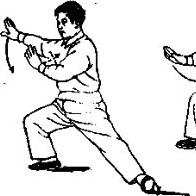
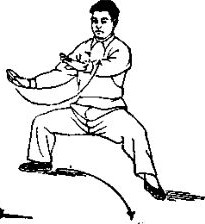
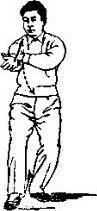
· 70 · Action three: The right palm changes into a fist, reeling forward from outside upward, and the left palm reels forward from inside downward; at the same time the right foot is lifted and drawn back. (Figure 7) The left palm drops to in front of the abdomen, and the right fist thereupon drops into the left palm; at the same time the right foot stamps the ground beside the left foot. (Figure 8)
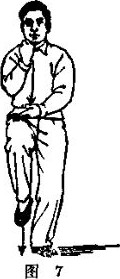
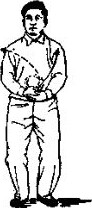
Essential points:
1. Reeling-silk jin is Taiji jin, and is the core constituting Taijiquan. It is unified from two opposed basic reelings. No movement in the entire set of Taijiquan may ever depart from reeling-silk jin. Therefore reeling-silk jin runs through the whole course of every movement. Forward and reverse reeling are universally possessed by the movements of the entire set, and each movement within a boxing form has forward and reverse reeling; therefore forward and reverse reeling are the universal basic reeling. Whereas inside-outside, up-down, left-right, front-back, and large-small — these five pairs describe the points of difference in direction and size of each movement's reeling, and therefore belong to the particular directional reeling. But it does not follow that on the universal forward-and-reverse reeling there is merely a single pair of directional reelings; rather, according to the requirements of each movement, some are single, such as left-right forward-reverse, while some have both the difference of up-down and the difference of inside-outside, as in action three (Figure 7), which is just this. Concerning reeling-silk jin one may refer to the third characteristic, and in · 71 · For reeling-silk diagrams one may refer to those in the third characteristic.
2. This form is the first posture of Taijiquan's thirteen postures; in the midst of it the application of five pairs of reeling-silk jin is passed through, and the final pound (the stamping of the foot and the right fist striking down into the left palm) indicates that this boxing form is at an end.
3. The function of stamping the foot is to make the whole body's qi sink downward, and it also benefits the blood circulation. For example, when one has stood too long and feels fatigued, and circumstances do not allow one to walk about, one may touch the ground with the toes of both feet, raise the heels, and then let them drop with a slight stamp; moving thus several times likewise produces the effect of recovering from fatigue. Moreover, the force of the foot stamp may be decided according to the practitioner's age and the strength or weakness of his body; but whether light or heavy, the sinking jin must be whole. Whether the jin is whole or not may also be judged from the sound of the stamp.
4. Every movement of Taijiquan requires "sinking the shoulders and dropping the elbows". "Sinking the shoulders" has been explained in the essential points of the preparatory form; "dropping the elbows" means that in any movement the two arms must keep the elbow joint bent to a certain degree and must not be held straight, and that the tip of the elbow has the intent of dropping down.
5. The palm in Chen-style Taijiquan requires the fingers to bend backward — that is, apart from the thumb, all the remaining four fingers curve slightly toward the back of the hand (refer to the palm shapes in the various diagrams). This can make the qi pour into the spaces between the finger pads (qi reaching the two tips), and can also guard against and eliminate the fault of the arms using clumsy force.
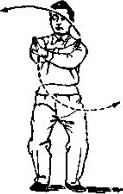
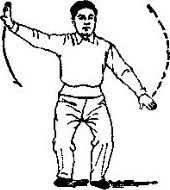
Action one: The body first turns slightly left, then turns to slightly right, and thereupon turns back to centre; at the same time the two hands, in front of the lower abdomen and following the turning of the body, circle a small circle from left outward and up and to the right and down (returning again to the posture of Figure 8). Then the body again goes from slightly left-turn to slightly right-turn; at the same time the two hands, the left reeling reverse and the right reeling forward, cross with closing strength in front of the chest; from the left leg substantial it turns to the right leg substantial. (Figure 9) The two hands enlarge the reeling-silk circle and separate, the right reeling forward upward and the left reeling reverse downward, forming opening jin; at the opening, from the right leg substantial it changes to the left leg substantial. (Figures 10–11) The whole weight shifts onto the left leg, and the right foot is lifted and then thrust out along the ground to the right with the heel; at the same time the two hands · 72 · Continue drawing the arc, turning from the great opening into the great closing of double forward reeling (Figure 12A); the centre of gravity gradually shifts right, the right toes press down firmly, the body turns slightly left, and the right hand extends slightly to the left. (Figure 12B)
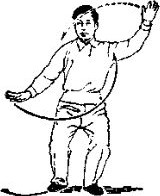
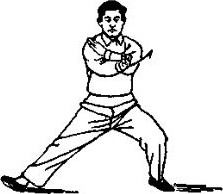
Movement Two: The body turns slightly right, and as the centre of gravity shifts right, the right leg gradually becomes solid; at the same time the two hands go from closing to opening again — the right hand winds its arm out to the right with a large forward reeling, while the left hand, after a small reverse reeling, turns its palm over and places it before the left waist, the left palm facing up. (Figure 13) The body turns straight, the rear kua is adjusted, the whole body relaxes and opens, and the qi sinks downward. (Figure 14)
Key points: 1. When the right foot steps out, it must be exactly the moment when the right hand sinks with a leftward forward reeling, so that there is a right · 73 · of the hand sinking to the left and pressing the right foot out to the right. When the left reverse and right forward reelings have closed again, this movement fully expresses the requirement of the fifth characteristic, "when one part moves, no part is without movement."
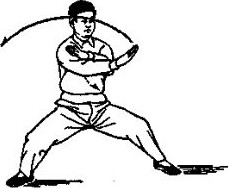
2. In Chen-style Taijiquan, at the beginning of every posture the inside must lead the outside into motion; hence in outward form there is a small circle that draws along the movement that follows. For example, when Vajra Pounds the Mortar is begun from the preparatory posture, the two hands at the sides of the kua bend at the elbow and lift slightly, that is, the palms press down lightly facing downward, forming a closing jin, and only then does the movement begin; when Lazily Tucking the Robe is begun from Vajra Pounds the Mortar, the two hands make a small circle before the abdomen (as shown by the broken lines of the two hands in Figure 8). At the completion of every posture there is an adjusting movement: the last movement of Vajra Pounds the Mortar is a pound, while the last movement of Lazily Tucking the Robe is the body turning straight and the rear kua being adjusted.
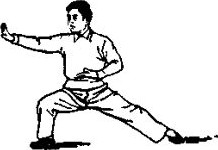
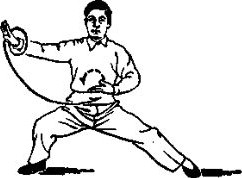
3. This posture fully expresses the relation of upper and lower following one another (hands with feet). Draw a · 74 · When the circle turns to the upper ward-off, the hand is insubstantial, and the foot beneath that hand becomes substantial; the reverse is also true. This too is the key to seeking the centre-correctness of inner jin (but the case of lifting one leg and standing alone is excepted: because one foot stands, in order to keep centre-correctness and balance the centre of gravity, the single standing foot is substantial, and the hand above the substantial foot must still be substantial). This is shown most clearly in Figures 10 and 11.
4. Lazily Tucking the Robe is one of the basic postures of Chen-style Taijiquan; it is formed by the left hand's small inner reverse reeling and the right hand's large outer forward reeling. It requires that there be no hollows, no defects, and no breaks in the inner jin; the small inner reverse reeling is especially difficult, and only much attention and practice will meet the requirement. In this posture one must above all take note that within the closing (when the circle is contracted) there is opening, and within the opening (when the circle is released) there is closing jin; the secret lies in adding more of the inner-and-outer reeling within the process of closing and opening, which makes this requirement easy to attain; only when this requirement is met can one "draw along the coming and going so that the qi clings to the back."
5. The two arms' ward-off turns into a closing jin: because the qi clings to the spine and the two upper arms strike one another, the ward-off jin is not lost, and there arises the wondrous use of "opening hidden within closing"; likewise, because the two upper arms strike one another, when the two arms separate and become an opening jin, there is inwardly nonetheless a closing jin, and there arises the wondrous use of "closing hidden within opening."
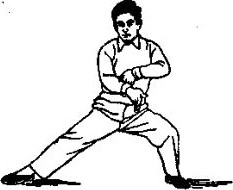
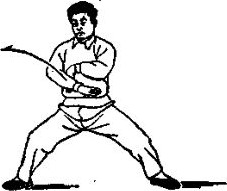
· 75 · Movement One: The body turns slightly left, the centre of gravity shifts left, and the left leg becomes solid; at the same time the two hands, each in its own place, first wind the arm and draw a small circle (to initiate the movement): the right hand winds its arm with a large forward reeling and wards off to before the abdomen, while the left hand with a small reverse reeling wards off to before the chest, and the two hands form a closing jin; the body turns slightly right, the centre of gravity shifts right, the left hand with the side of the thumb presses close to the right ribs and rolls inward, until the palm faces left, while the right hand reels reverse and turns the palm to face downward (Figure 15A, Figure 15B). The body turns slightly right, the centre of gravity shifts right, and the right leg becomes solid; at the same time, the right hand winds its arm with a forward reeling and the left palm makes a small reverse reeling, the two hands holding their jin together and pressing out in an arc up and to the right (Figure 16).
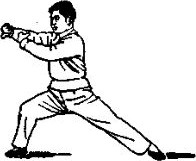
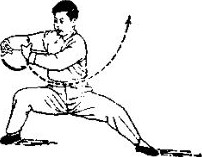
Movement Two: The body turns slightly left again, and the centre of gravity shifts back again to the left leg, which becomes solid. At the same time, the right hand reels forward and supports upward, its jin penetrating to the palm and fingers — the fingers must not be soft; the left hand reels reverse and winds its arm, and with the back of the hand at the wrist joint arcs up and to the left in ward-off, its jin penetrating to the back of the hand, the five fingers hanging slantwise downward — the fingers must not be soft. (Figures 17–18) The body continues to turn slightly left; at the same time the two hands reel forward, turn their palms over, and place them separately beside the two ears, the palms slanting outward. (Figure 19) Immediately the two palms close their jin and press down to the right (begin to exhale deeply — when the deep breath is finished, the double press has exactly reached the bottom; exhalation is the host and the accompaniment of the movement is the guest); at the same time the body follows the two hands' rightward press and turns right, and the centre of gravity shifts accordingly onto the right leg, the left foot stepping in abreast to the right and touching with its toes beside the right foot. (Figure 20)
Key points: · 76 · 1. Whether the two hands go from closing to opening or from opening to closing, both must be led by the waist and spine as the axis (the turning of the body); when turning left and right the upper body must still stand upright, not leaning forward or backward; when the two palms press down, the qi must cling to the spine, the armpits round and empty, with the right hand as host and the left hand as guest.
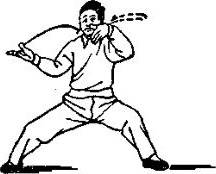
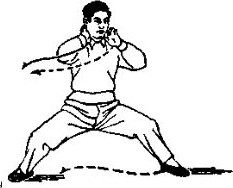
2. The posture Six Seals and Four Closings means six parts sealing and four parts closing. Its function resembles the "Vajra shaking force" in Hua Tuo's Five Animal Frolics. When the two hands press down, one must purse the lips and slowly breathe out one deep, long breath; this greatly helps to regulate the respiratory system.
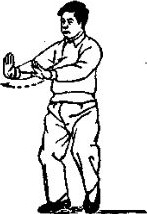
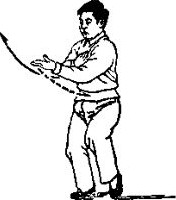
Action one: The body turns slightly right and thereupon turns back to the left; at the same time the right hand reels forward inward, and the left · 77 · The hand reels reverse and turns over one circle outward each; thereupon the right hand changes into a hook hand and is raised to the right, and the left palm arcs across to before the abdomen; while the body turns left and right, the left foot also follows, pivoting on its toes. (Figures 21–22)
Action two: Next, the whole weight shifts onto the right leg, the left foot is lifted, the body squats, and the left foot is thrust out with the left heel along the ground, insubstantially, to the left; at this moment the kua root opens wider, and as the centre of gravity shifts left, the left toes gradually come down to the ground and the left leg becomes solid. (Figures 23–24)
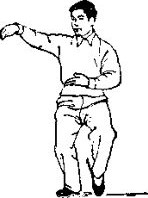
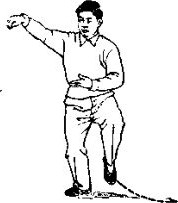
Action three: The left palm supports upward slightly to the right from before the abdomen, thereupon arcs to the left in a forward reeling, and when it has reeled to the left side level with the shoulder, the palm root presses down slightly; when the left palm has reeled to the left side and turns to press, the right hand accompanies it with a slight forward reeling outward, forming an opening jin; at the same time the proportion of substantial and insubstantial between the two legs is increased, and once the Single Whip is formed the rear kua is loosened and the body is turned straight. (Figures 25–26)
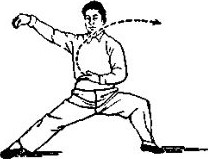
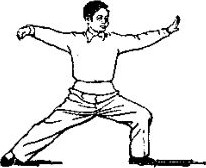
· 78 · when [the left palm has reeled to the left side], the right hand accompanies it with a slight forward reeling outward, forming an opening jin; at the same time the proportion of substantial and insubstantial between the two legs is increased, and once the Single Whip is formed the rear kua is loosened and the body is turned straight. (Figures 25–26)
Key points: 1. In action one, when the two hands each turn over one full circle at the right of the body, one must use the waist and spine as the axis to lead them, and only then can it be done with round jin and grace; and this movement must be made to show that the jin rises from the right heel through the spine and takes form in the left fingers, and then the rear kua is loosened, and when it turns straight again it shows the jin running from the left fingers across the spine and even to where the right hand closes its ward-off and hooks up. In this movement the left heel touching the ground is taken as solid, but one must note that "insubstantial" is not being wholly without force, and "substantial" is not standing wholly dead, because while the left heel is on the ground and pivoting, the centre of gravity on the left leg also increases and decreases with the turning of the body.
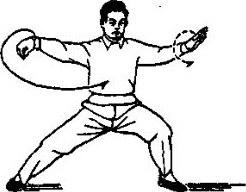
2. In action two, 3. Taijiquan requires that intent and qi be changed nimbly; the Single Whip is a good example: when the left hand reels to the left, the intent is fixed on the left hand, and when the body has been turned straight, the intent is again fixed on the right hand. Hence Figure 25 differs from Figure 26: the former has the intent on the left hand, the latter has already shifted it to the right hand.
4. This posture is dominated by the movement of the left hand, enlarging the amount of the left hand's movement, because in the whole · 79 · set of forms the left hand moves less than the right. Moreover, the left hand is required to wind its arm to the left and fling out like a supple whip, carrying the jin to the middle finger of the left palm (as in Figure 25). Because this posture is the counterpart of Lazily Tucking the Robe, in which the right hand's movement dominates, Lazily Tucking the Robe and the Single Whip are the second posture of Taijiquan, called the two-prime posture. Moreover, although both take practising one hand as the main thing, one must draw on it so that "when one part moves, no part is without movement," attaining joint-by-joint threading-through. This requirement is harder than practising all movements with both hands, and one must take the application of the fifth characteristic as the key point.
5. The eight characteristics of Taijiquan must be manifested in every movement; it may also be said that Taijiquan is a boxing of the eight characteristics moving in unison. However, as far as any one movement is concerned, one particular characteristic is taken as the main content and the rest as secondary — but this does not mean the remaining characteristics are no longer used. Hence one must be clear that the fifth characteristic mentioned above merely means that in this posture that characteristic is dominant.
6. Every movement of Taijiquan requires that "the jin be stored with the curve and yet have a surplus", and therefore in doing this posture one must take note to keep the right upper arm and the right knee joint slightly bent, and not straightened.
Action one: The body turns slightly left and the crotch opening widens; at the same time the two arms sink, the left heavy and the right light, and the left palm at the left side reels reverse one full circle, while the right hook hand changes into a palm and reels forward outward until the palm faces outward and upward; the two arms ward off outward and close their jin together. (Figure 27)
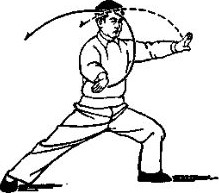
Action two: The two hands enlarge the reeling-silk circle and, with the left reeling reverse and the right reeling forward, close their jin and carry it from the left upward and around to the right; the left hand moves to before the right chest, palm facing right, and the right hand is carried to the right side level with the head; when the two hands begin to carry to the right, the centre of gravity shifts right and the right leg becomes solid. (Figure 28) What follows is the same as · 80 · the latter part of the explanation of action two of the Second Form, "Vajra Pounds the Mortar", except that the direction differs: when this posture is completed one faces due east.
Action three is the same as action three of the Second Form, "Vajra Pounds the Mortar", except that the direction differs: this posture faces due east. (Continues with Figures 7–8)
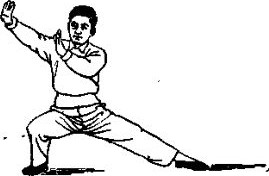
Key points: 1. In action one, the two hands each reel a small circle to draw on the movement that follows, as the preparatory movement of this posture.
2. The closing jin of the two hands in Figure 27 differs from the closing jin in the closing postures above: it is a closing jin within an opening posture, and should be clearly distinguished.
3. The posture in Figure 28 is formed after the two upper arms, linked one to the other, have each reeled one circle, the left reverse and the right forward; at the same time it is the two upper arms linked and closing their jin below, completed by applying the body method with the waist and spine as the axis.
4. The rest is the same as the key points of the Second Form, "Vajra Pounds the Mortar".
Action one is the same as action one of the Third Form, "Lazily Tucking the Robe", except that at the junction of this movement with "Vajra Pounds the Mortar" the two hands do not circle a small circle above the lower abdomen but directly make the movement of crossing before the chest. (Figures 29–31)
Action two: As the right foot steps out to the right side, the centre of gravity then shifts onto the right leg, and the left foot draws in toward the right foot, touching with its toes insubstantially beside the right foot; at the same time that the centre of gravity shifts right, the two hands both reel reverse, the right hand separating in an arc up and to the right and the left hand down and to the left. (Figure 32—) All the movements of this posture should be done facing due east; from the four plates Figures 29–32 it is · 81 · (to show their front faces)
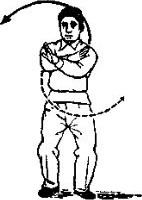
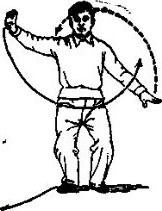
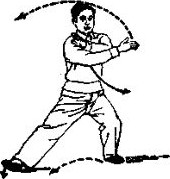
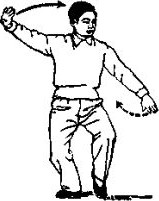
Key points: 1. This posture and the Third Form, "Lazily Tucking the Robe", both join on to "Vajra Pounds the Mortar", but the joining movements differ: this posture does not join on by circling a small circle with the two hands before the abdomen, but requires the qi to cling to the spine and the two arms first to open slightly and then to close and cross; in this way it connects with the jin of the preceding posture, and at the same time shows that intent to close must first leave off, attaining the characteristic · 82 · — the sixth, "linked and unbroken". When the closing reaches its end, one must again first close slightly and then open, which again shows that intent to open must first harbour closing. In both opening and closing one must take note of the palm root, and only then will the fault of hollows and protrusions not arise.
2. This posture is completed after two closings and two openings. The characteristic of the latter opening-and-closing is: when the two feet open, the two hands close; when the two hands open, the two feet close again; the two hands close by double forward reeling and open by double reverse reeling.
3. In doing this posture one may check whether it conforms to the requirements of "empty the collar and lift the top", "sink the shoulders and drop the elbows", "contain the chest and draw up the back", "bend the knees and round the crotch", and check whether in this posture, with the left toes touching the ground and the right foot planted firmly, it possesses the momentum of supporting the eight directions. This posture is required to manifest principally the fifth and fourth characteristics.
Action one: The body turns slightly left; at the same time the two hands, the right reeling forward and the left reeling reverse, each make a small circle at the left and right sides, the left hand winding its arm and raising up to before the forehead and the right hand pressing down; when the two hands have each reeled half a circle, the body turns back to the right and straight; the centre of gravity is still on the right foot, the right leg is solid, and as the body turns the left foot pivots on its toes. (Figures 33–34)
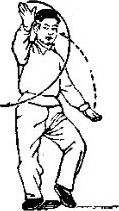
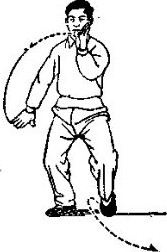
· 83 · Action two: The body continues to turn right; the left foot is lifted and thrust out to the left front (northeast) diagonal with the heel lightly along the ground. At the same time the right hand reels reverse slightly to the right rear (southwest) diagonal and extends upward until it is level with the shoulder, the palm slanting toward the right front; the left hand reels forward and pushes out in an arc toward the front of the right shoulder (southeast), the elbow still kept bent. (Figure 35)
Action three: The body turns left, the centre of gravity shifts left, and the left leg becomes solid. At the same time the left hand continues to reel forward and downward, passes before the abdomen and sweeps across the left knee, thereupon changing into a hook and raising up to the left until level with the shoulder; the right hand goes from outward to inward reeling and turns reverse, bending the arm and reeling past the right ear, the palm facing the right ear. (Figure 36)
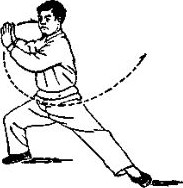
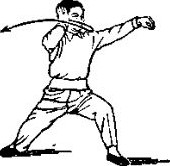
Action four: The body turns slightly right; the right hand, passing beside the right hand, continues to reel reverse from the left front to the right, separating from the left hand. (Figure 37) Loosen the right kua, turn the body slightly left, sink the two shoulders, the right hand presses down slightly, and the left hand suspends. (Figure 38 — All the movements of this posture are done facing due east; the landing place of the left foot should be the same as in Figure 39; Figures 33–38 show their front faces)
Key points: 1. In action two the right hand, the left hand, and the left foot must extend simultaneously in three directions (for the directions see the movement description).
· 84 · 2. In actions one and two, when the two hands move, it seems as though the left hand reels across the body to the right and the right hand reels across the body to the left; in fact both hands rotate at the left and right sides, completed by the body method with the waist as the axis. Therefore one must not merely swing the arms.
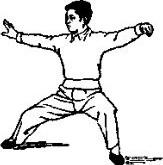
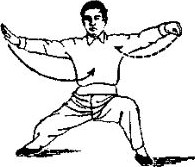
3. The jin of the right palm as it reels past the right ear must have the feeling of coming from the left hand forming a hook and the left leg forming a bow. As the right palm passes beside the right ear, winds its arm and reels reverse out, the spine must be drawn taut, producing the function of the qi clinging to the spine.
4. Figures 37 and 38 appear alike, but in fact the inner jin of the former is a double opening, while the latter, through the sinking of the elbow, makes the whole body's qi sink downward and the inner jin becomes a double closing.
5. This posture is left hook and right palm, exactly opposite to the "Single Whip". This posture makes reeling silk in the left and right directions, one forward and the other reverse; they act each on its own under unified conditions, and can make the body feel light and joyful.
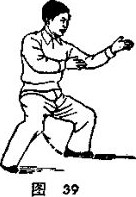
· 85 · Action one: The two toes turn slightly right with the body; at the same time the left hook hand changes into a palm and reels forward together with the right hand, closing their ward-off with the palm roots toward the front of the left chest, the left hand in front and the right hand closed beside the left elbow. (Figure 39)
Action two: The body turns slightly right and drops with a downward thrust to the right, the whole weight shifts onto the right leg, and thereupon it turns and rises, drawing the left leg back and up, the left toes hanging naturally, the right knee slightly bent, forming the right single-leg-standing posture; when the body turns right the two hands reel with the left reverse and the right forward, and as the left foot is raised the two hands change to a double reverse reeling downward, closing their jin, the two palms slanting toward the front and down. (Figures 40–41 — From Figure 39 to 45 the direction of the postures in the plates has been turned to conform to the direction in the movement descriptions)
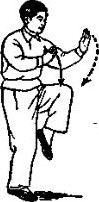
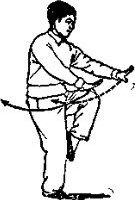
Key points: 1. In action one (Figure 39), the two palms must, with the two upper arms linked, close their jin facing one another front and back. The body turns right, and as the two hands reel half a circle to the right with the left reverse and the right forward, the two palms face downward and at the same time the right leg gradually drops; after the half circle, the two hands begin to raise, and the two palms again face one another front and back; the left foot is lifted, the body stands up, and it becomes the right single-leg-standing posture, the two palms · 86 · and again the hearts of both palms slant toward the front and down, closing their jin. In double reverse reeling one must take note of the little fingers of the two hands.
2. This posture is the meaning of drawing back the lute for the first time: it requires using the elastic jin after the right leg drops, together with the slight reeling-silk jin of the two hands (left reverse, right forward), to make the body turn and rise into the single-leg-standing posture.
3. This posture is a single-leg-standing posture of closing jin; to attain stability in it is harder than attaining stability by an opening jin. The key lies in lifting the top jin, sinking the qi to the cinnabar field, reeling the two hands reverse, and fixing the intent on the little fingers of the two hands — thus it is easy to attain stability.
Action one: Next, the left foot begins to descend; at the same time the two hands fall to the right side with the left reeling forward and the right reeling reverse downward (the inner jin must not be lost; continue from the preceding posture). (Figure 42) The left foot's reeling jin descends forward (east), the toes slanting toward the left front, and the body turns left. At the same time the left hand reels forward, winds its arm to before the chest, the palm facing the right front; the right palm reels reverse to above the left forearm, the palm facing the left front; the two arms cross. The body continues to turn left. (Figures 43–44)
Action two: The centre of gravity shifts onto the left leg, and the right foot strides one step across to the right front (southeast) diagonal; at the same time the two palms reel reverse and separate, extending to left and right, the two palms both facing outward and the fingers pointing up. (Figure 45 and the front view of Figure 45)
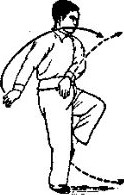
Key points: 1. From the falling of the two palms at the right side until they reel to before the chest, the inner jin must be unbroken; when the two arms cross they must tighten and close together, and then separate to left and right and extend; when extending, take note of the two · 87 · the thumbs of the palms.
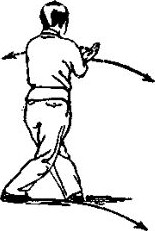
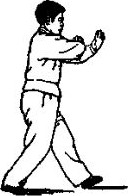
2. When turning to the left from the single-leg-standing posture, the step must be steady, and in the process of turning from up-and-down to left-and-right reeling silk all is closing jin, and there must be no breaks or hollows-and-protrusions.
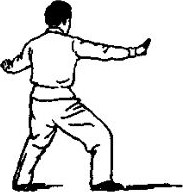
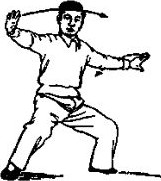
The movements are the same as those of the Eighth Form, "Diagonal Brush Step"; only the joining movement differs slightly, but the explanation of the Eighth Form may still be used, in conjunction with the plates. (Figures 46–48, then Figures 35–38. Figure 46 is the foot descending in the direction of the front view of Figure 45; in fact the move- · 88 · ment and the direction of the left foot's stepping are still the same as the Eighth Form's: stepping up toward the northeast diagonal)
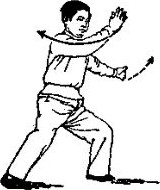
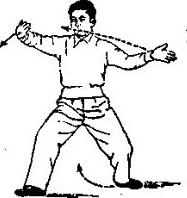
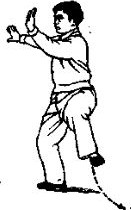
Key points: the same as the key points of the Eighth Form, "Diagonal Brush Step".
The movements, directions, and key points are all the same as the Ninth Form, "First Herding". (Figures 39–41)
The movements, directions, and key points are all the same as the Tenth Form, "Forward Treading Brush Step". (Figures 42–45)
Action one: The body turns slightly left, the centre of gravity shifts onto the left leg, and the right leg is lifted; as the body turns and the centre of gravity shifts left, the right palm changes into a fist and reels forward to before the chest; the left palm reels reverse and closes on the upper side of the right arm, crossing with the right arm, the palm facing the right shoulder. (Figure 49) The two hands reel forward and sink, and the crossing point of the two arms moves forward; at the same time the right foot stamps on the ground with a stomp as the qi sinks. (Figure 50)
Action two: The left foot steps toward the left front (northeast) diagonal, and the centre of gravity gradually shifts left; at the same time the crossing point of the two arms continues to move forward, and thereupon the two hands, the left reeling reverse and the right forward, reel to the left · 89 · up and to the right and down, separating in arcs, the right palm facing down and the left palm facing outward. (Figures 51–52)
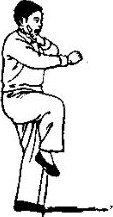
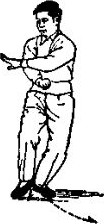
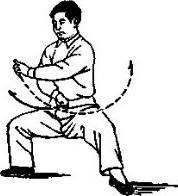
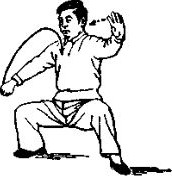
Action three: The body turns slightly right, and the whole body's qi sinks downward. At the same time the right fist reels forward, goes to the right and up past before the chest, and is drawn back to the right side of the ribs; the left hand goes from reverse reeling to forward reeling and moves to before the chest. (Figure 53)
Action four: The body turns slightly left; at the same time the two hands reel forward and close before the chest, the left palm and the right fist both facing up, the right fist placed on the left palm (seemingly stopping yet not stopping, the body continuing to sink to store jin). The centre of gravity shifts rapidly left, forming a left bow stance, the right leg slightly bent and not straightened · 90 · straight. At the same time the right fist is issued swiftly toward the right front (east, slightly south), its fist-heart turning to face down; the left hand is also swiftly drawn back to the left side of the ribs. (Figure 54 — From Figure 49 onward the foot descends in the direction of the front view of Figure 45; in fact the direction of the left foot's stepping in the movement is the northeast diagonal; Figures 49–54 show their front faces)
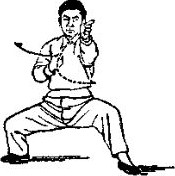
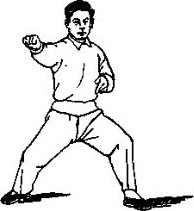
Key points: 1. This posture (Figures 51, 52) is required to manifest the covering-and-releasing jin; when covering, the crotch opening is required to sink, and only then can the jin be tightened; when releasing, one must first tighten and then separate to make the releasing jin. The covering-and-releasing jin is a drawing-along jin, and must not go beyond the circle of the hands and feet; moreover it is the basis of storing and issuing.
2. The storing jin of Taijiquan must be like drawing a bow: it must be tightened to become a store. Storing does not mean increasing the bend, but means storing to the full the elasticity before issuing and having no defects; it requires the five bows (that is, the one spine bow, the two hand bows, and the two foot bows) to ward off together. The "defect" spoken of here does not mean the jin is broken, but that the jin has not reached the back of the bow, and hence the elasticity is insufficient. Only when one has practised joint-by-joint threading-through, the whole body as one family, can one become a bow of abundant tenacity, possessing powerful elasticity.
3. In this posture, stamping the right foot and issuing the right fist must manifest the firm jin of Taijiquan. Taijiquan lays equal stress on moving jin and issuing jin. Although the Chen-style first routine takes softness and moving as its main thing, · 91 · The second routine (Cannon Fist) takes firmness and issuing as its main thing; but in the first routine too there are movements of firmness and issuing as auxiliaries (such as Cover-Hand Forearm Punch), and in the second routine too there are movements of softness and moving as auxiliaries (such as Lazily Tucking the Robe); this is in order to attain the goal of firmness and softness aiding each other and of nimble conversion used together.
4. The boxing treatise requires that "force be issued from the spine", that "issuing jin be like loosing an arrow", that "issuing jin must be calm, settled, relaxed, and quiet", and that one "concentrate on one direction". Therefore one must first "draw the bow" to store the jin, then "release the catch" from the spine and issue, the jin concentrating on the "arrowhead" side, and finally quiver like the jin of an arrow penetrating the target, to complete this movement. From the posture, at the moment of issuing jin, although one hand goes forward and the other backward (or one up and one down, one left and one right) to keep balance, the jin force still takes one side as host (substantial) and the other as guest (insubstantial), and it is not double-weighting.
Action one: The body turns slightly right; at the same time the right fist changes into a palm and reels forward, drawing back slightly to the right rear, while the left palm still at the side of the left ribs reels reverse slightly to accompany it. (Figure 55) Then the body turns slightly left; at the same time the two hands, the right reeling forward and the left reeling reverse, arc toward the chest and cross, closing their jin, the left hand above with the palm facing down and the right palm facing up. (Figure 56)
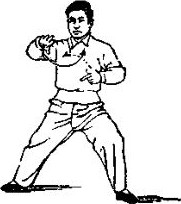
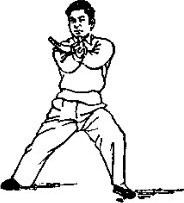
· 92 · Action two: The body turns right and the centre of gravity shifts right onto the right leg; at the same time the right palm reels forward to the upper right and the left palm reels reverse to the lower left, extending. (Figures 57–58 — From Figure 55 to 57 the left foot is still at the northeast diagonal, and the position of the left foot should be the same as in Figure 58; from Figure 58 to 76 the direction of the postures has been turned to conform to the direction in the movement descriptions) The whole weight shifts onto the left leg, and the right foot is drawn back and pointed forward with its toes before the left foot. At the same time the two hands reel, the left reverse and the right forward, the left hand bending its elbow with the forearm across before the chest, the palm facing down; the right hand, as the right foot comes forward, sweeps up toward the chest, and the two hands form a closing jin. (Figure 59)
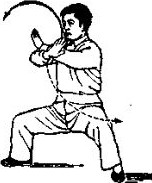
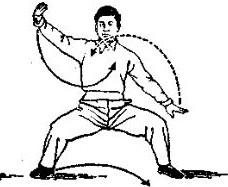
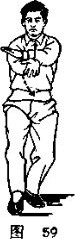
Action three is the same as action three of the Second Form, "Vajra Pounds the Mortar". (Continues with Figures 7–8)
Key points: 1. Turning from the opening jin and issuing jin of the preceding posture, Cover-Hand Forearm Punch, into the closing jin of this posture, the right hand must draw in slightly and then give a small ward-off forward in the direction of the issuing jin, to tease the broken jin back into connection, so that the inner jin is unbroken and threads through into the closing jin of the double closing that follows.
2. In this posture each half-circle movement that opens as wide as possible changes into a contracting movement that closes into an extremely small half circle; it is required to feel full throughout the body, with majestic momentum.
3. This posture differs from the first two Vajra Pounds the Mortar in that: the first time manifests the ward-off jin of the five paired directions in Taijiquan; the second is the opening jin that follows on from the Single Whip, turning · 93 · into a closing jin; the third mainly teases back into connection the broken jin after the issuing jin of the previous posture. It is the close of the fifth posture of the thirteen Taiji postures.
Action one: The two hands reel reverse and extend to left and right, the five fingers hanging down and the palms facing inward. (Figure 60) The two hands continue to raise and turn to forward reeling, and when they are level with the shoulder the palms turn to face front and up. (Figure 61) The whole weight shifts onto the left leg, the right foot is lifted and thrust out with its heel along the ground to the right, and thereupon the centre of gravity shifts right, forming a horse stance; at the same time the two hands continue to raise slightly, and as the right foot steps to the right they reel forward toward the chest and cross, closing together, the left palm outside. (Figures 62–63)
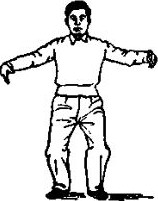
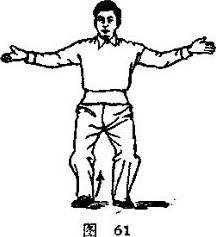
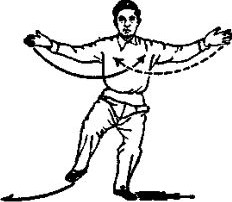
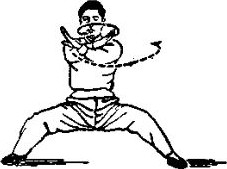
· 94 · Action two: The two hands change into fists; the right fist, before the face, reels reverse from inward to the right and opens, thereupon turning from right to forward with a forward reeling and closing, circling one full circle, the fist-heart facing inward; the left hand reels reverse to the left and opens, thereupon turning to forward reeling and closing slightly as the right hand closes, the fist-heart facing right; when the right hand has circled half a circle to the right, the centre of gravity shifts slightly right and the body turns slightly right; when the right hand has circled one full circle, the centre of gravity shifts back and the body turns straight. (Figure 64)
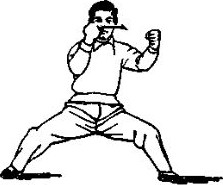
Action three: The body turns slightly left, the centre of gravity shifts left, and the left leg forms a bow. At the same time the two fists reel forward, the right fist moving to before the left ear level with the head, the fist-heart facing inward; the left fist at the original place on the left side reels forward in a small circle to accompany the right fist's closing jin, the fist-heart facing the left front. (Figure 65) The centre of gravity shifts right, the right leg forms a bow, and the body turns right. As the body turns, the right fist arcs down to the right with a forward reeling to beside the right leg, the fist-heart facing up; the left fist reels forward from left to right passing before the face, level with the head, the fist-heart facing inward, closing its jin together with the right fist. (Figure 66)
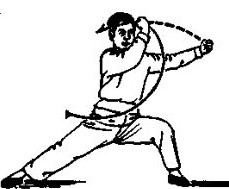
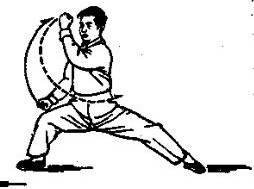
· 95 · Key points: 1. This posture turns from the closing jin of the preceding posture, Vajra Pounds the Mortar, into a double reverse opening jin; after opening it changes to double forward reeling, the two palms turning to face outward in a closing jin of the two hands, and thereupon the two hands reel forward and cross, closing together; during these openings and closings one must take note of the substantial and insubstantial of the two hands and of the two feet, and especially of the substantial and insubstantial between hand and foot. On this point see the fourth characteristic.
2. Actions two and three (Figures 64–66) are movements after the two palms change into fists; they must be made continuous as one, and performed under the requirement that the qi cling to the spine and the waist be the axis; the key lies in specially enlarging the inner-and-outer reeling silk and in letting the earlier reeling silk lead the later reeling silk; only thus can the movements in the three figures be joined into one, and the inner jin be not lost, changing over without any hollows or protrusions. On this point see the fifth characteristic.
3. Throughout all the processes of this posture's opening-and-closing and closing-and-opening, it is rich in soft jin; it is the soft jin of the four corners, serving as an auxiliary within the four cardinal frame.
Action one: The body turns left by 90 degrees. At the same time the right hand reels reverse and raises in an arc, the fist-heart facing left; the left hand winds its arm with a forward reeling and descends in a left arc to the side of the left waist, the fist-heart facing back. (Figure 67)
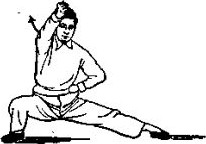
Action two: The body continues to turn slightly left. At the same time the right fist winds its arm, changing from reverse reeling to forward reeling, and the right arm is bent before the top of the head; the left fist, after a very small forward-reeling circle at the left side, presses its fist face close to the left waist; thereupon the body turns slightly right and leans back to the right rear with the back near the right shoulder; at the same time the crotch opening sinks further, and the eyes look at the top of the left foot. (Figure 68)
· 96 · Key points: 1. The two upper arms must be linked one to the other with ward-off jin, so as to attain the jin of "opening hidden within closing"; as long as the waist is taken as the central axis, the right back can naturally turn over, and there is no danger of attending to one and losing the other.
2. Figure 68 shows the use of the right arm before the top of the head; a small reverse reeling must be used to turn the arm to before the top of the head; the key of this posture is to press the left fist close to the left waist, making the right back draw even tauter and manifesting the shoulder jin of the back.
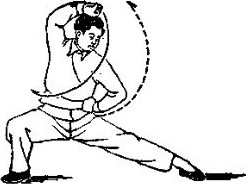
3. The shoulder jin issued by the posture Back-Bending Shoulder is plentiful in the second routine, Cannon Fist. This posture is one of the shoulder jins among the four-corner hand; it serves as an auxiliary within the four-cardinal frame.
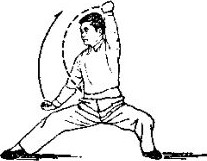
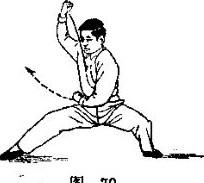
Action one: The centre of gravity shifts left, and the body turns slightly right. At the same time the right fist winds its arm with a forward reeling and descends in an arc from above, past before the chest, to the right side of the right leg, the fist-heart facing up; the left fist leaves the left waist with a reverse reeling and raises in a left arc, the fist-heart facing inward. (Figure 69) The right fist changes to reverse reeling and from the right arcs · 97 · in an arc upward, and turning again to forward reeling, reels until the fist-heart faces left; at the same time the left fist changes to forward reeling, bends its elbow with the forearm across, and descends past before the chest to be placed before the abdomen, the fist-heart facing up. (Figure 70)
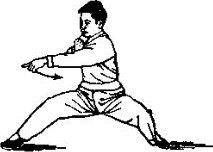
Action two: The body turns slightly left. At the same time the left fist changes into a palm and extends with a reverse reeling toward the right front, the palm facing the right rear; the right fist reels forward, bends its elbow, and descends to be placed before the chest above the left arm, the fist-heart facing inward. (Figure 71) The centre of gravity shifts slightly right. At the same time the left hand reels forward and sinks, the palm facing the right rear; the right fist reels forward and gathers in beneath the chest, closing its jin together with the left palm, drawing the spine taut. (Figure 72) The body turns slightly left, and as the kua jin sinks, the right fist winds its arm with a reverse reeling and suddenly "releases the catch" from the spine, issuing jin toward the right front with the ulnar side near the wrist; the left hand reels forward and is drawn back at the same speed as the right fist's issuing, to be placed at the side of the left waist. (Figure 73)
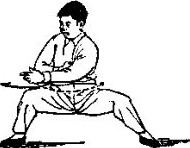
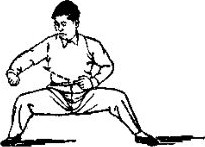
Key points: 1. Chen-style Taijiquan applies reeling-silk jin not only in the two hands; in fact the two legs also simultaneously ap- · 98 · ply it. Because this posture has a long stride and a wide crotch opening, it is the clearest example of the legs manifesting reeling-silk jin. Leg reeling silk is: when the hand on one leg reels forward, that leg likewise generally reels forward with the knee turning out; conversely, the knee turns in with a reverse reeling (for the principle of leg reeling silk see the second key point of the Twenty-first Form, "Punch Beneath the Elbow"). From the posture in this figure, the two legs seem not to have moved at all, and one sees only the two arms changing movement; in fact the legs too are reeling silk.
2. Taiji jin is the inner jin that arises from the heel, is issued from the leg, is governed by the waist and spine, and takes form in the fingers; reeling silk is a fairly long path of movement through which this inner jin passes. In the whole body there are two such paths, namely from the left heel to the right fingers and from the right heel to the left fingers, and they cross each other on the spine, one after the other.
3. To thread all the joints of the whole body through like a single line, one must complete it by the spiral of reeling silk. Reeling silk is governed by the waist and spine, leads the two arms, and has its foundation in the two legs; if the legs have no reeling silk, one cannot attain the realm of the whole body as one family. On this point one should take note.
4. The reason this posture is called "emerging from water" is that this kind of issuing jin is like "a thing about to be raised being given a downward check" — that is, at the end of the downward half circle there is an upward jin, and so it is also named the shaking jin of emerging from water.
5. The issuing jin of this posture belongs to the rend jin among the four-corner hand; the reason it is not called a "strike" or a "blow" is that rend jin is a short-distance strike, and so some also call it "inch jin".
Action one: The centre of gravity shifts slightly right, and the body turns slightly right. At the same time the right elbow bends slightly, the right fist gathers slightly, the fist-heart facing inward; the left palm extends forward to the inner side of the right wrist, and thereupon the two hands ward off outward slightly (to draw on the movement that follows). (Figure 74) Then the centre of gravity shifts onto the left leg, and the body turns slightly left; at the same time the right arm reels forward and wards off down to the left to before the abdomen, and the left hand with a small reverse reeling accompanies the right arm · 99 · in drawing it in and warding off. (Figure 75) What follows is the same as the latter part of the explanation of action one of the Fourth Form, "Six Seals and Four Closings". (Continues with Figure 16)
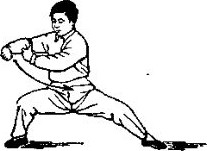
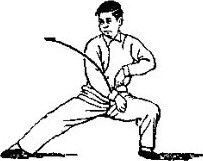
Action two: The same as the former part of the explanation of action two of the Fourth Form, "Six Seals and Four Closings". (Figure 77, continuing with Figure 76; the difference is that in this posture the left palm passes the waist before pressing down again) Then the left toes turn out, the body turns left (the chest going from facing south to facing east), the whole weight shifts onto the left leg, the right foot is drawn back and touches the ground with its toes toward the left front (south, slightly east). At the same time the right palm continues to reel forward with the palm supporting upward; the left palm reels reverse and is drawn back to the side of the left ribs, braced with the back of the hand, the palm slanting upward. (Figure 77 — From Figure 77 to 85 the movements in the plates are all done with the body facing east, and the plates show their front faces)
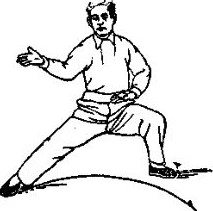
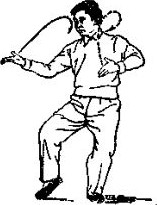
· 100 · Action three: The body continues to turn slightly left; at the same time the two hands reel forward, turn their palms over, and are placed separately beside the two ears, the palms slanting outward; the right toes pivot on the ground, and the right knee turns with the body. (Figure 78) The right foot lifts slightly and steps to the right (south), the centre of gravity thereupon shifts onto the right leg, the left foot steps in abreast to the right and touches with its toes beside the right foot, and at the same time the body turns right; the two palms close their jin, and as the body turns they press down to the right. (Figure 79)
Key points: 1. This posture is basically the same as the movements of Six Seals and Four Closings, only the conversion in the stepping and the path of jin of the double push differ. The push jin of this posture is firmer, and when the push reaches its end the rear palm root must manifest a downward-sinking rend jin, and hence the speed of the sinking is also faster.
2. This posture joins on immediately after the issuing jin of the previous posture. Because issuing jin seeks a break in the jin, the jin cannot be unbroken, cannot go beyond the body and apply to the outside, yet it must be linked continuously without break with this posture. The former part of action one (Figure 74) plays the role of catching the issuing jin, and draws on the movements that follow. The requirement "broken yet reconnected, able to break and able to connect" is detailed in the sixth characteristic.
3. After the issuing jin of the previous posture, it turns to closing, and after closing it opens again; within this closing-and-opening · 101 · the body turns with a waist-wringing jin, turning into a double support (shuang tuo) with the left rear and right front; the double support is required, within the double forward reeling, to produce a closing jin, preparing the way for the double push.
Action: The body turns right; at the same time the right palm draws back inward lightly past before the chest with a forward reeling, the palm facing inward; the left palm reels reverse, winds its arm, and extends forward level, turning to face the palm upward. (Figure 80) The body turns slightly left; at the same time the right palm reels forward and pushes out with ward-off jin, the palm slanting outward; the left palm, as the body turns, reels reverse and is drawn back to before the abdomen, the palm facing up. (Figure 81) The body turns right again; at the same time the right palm reels forward and is drawn back to before the abdomen, and the left palm, from before the abdomen, reels reverse upward and forward past above the right arm, pushing out with ward-off jin. (Figure 82) During the movement, as the body turns, the left toes pivot in place on the ground, and the left knee turns in the direction the body turns.
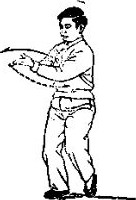
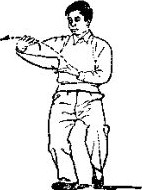
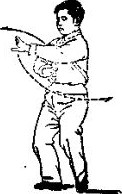
In this posture, Three Palm Changes, when the two palms alternately extend and draw back the movement must be round and lively: when the waist and kua turn slightly right the left palm extends, and when the waist and kua turn slightly left the right palm extends; the waist and kua rotate two round trips, the left palm extends forward twice and the right palm once, hence it is called Three Palm Changes. Three Palm Changes is a method of reeling-grasp, and therefore the palms extending forward are not strikes but round-turning reeling-grasps of the opponent's jin path and joints. Although the centre of gravity is always on the right leg, because of the opening and closing during the to-and-fro of the movement, the waist and kua open and close in rotation, drawing the knee joints of the two legs also to open and close in rotation, still · 102 · still "when one part moves, no part is unmoved".
Because the movement of this posture and that of the next are joined closely without the least interruption, and because the two postures share certain essential points, the essential points of this posture are accordingly given together in the next.
Action: Immediately the body turns left again; at the same time the two hands, the left reeling reverse and the right reeling forward, open out separately, the left hand down-left and the right hand up-right. (Figure 83) The body continues to turn slightly left; at the same time the two hands, the left reeling reverse and the right reeling forward, reel slightly until level with the shoulders, both palms facing down (this is the opening stage of Punch Beneath the Elbow). (Figure 84) The body turns slightly right. At the same time the two hands, left reverse-reeling and right forward-reeling, close with jin; in the course of closing, the left arm changes from reverse reeling to forward reeling and, as it reels, the left forearm is raised upright, the palm reeling round to face right; the right palm becomes a fist, reels forward, and from the right bends its elbow forward-left with closing jin, describing a small circle beneath the left arm, and comes to rest below the left elbow, the palm facing inward. (Figure 85)
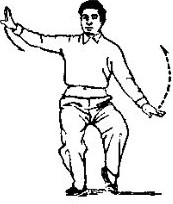
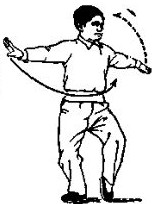
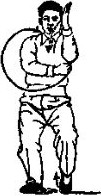
Essential points:
1. The distinguishing feature of the previous posture and this one is that within compact movement they attain joint-by-joint continuity and the principle that when one part moves no part is unmoved. For this reason the left knee too pivots with the left toes touching the ground, as an axle, rotating in step with the turning of the body; but note that "empty" is by no means wholly without strength, and "full" is not · 103 · wholly planted dead; on this point, see essential point 1 of the fifth form, "Single Whip".
2. To attain the requirements of Taijiquan — joint-by-joint continuity and the principle that when one part moves no part is unmoved — the key lies in employing the silk-reeling jin of the whole body; only through silk-reeling can the jin start from the heels and travel joint by joint to the fingers. Therefore the silk-reeling of the legs and that of the hands occupy equally important positions; the action descriptions do not mention the silk-reeling of the legs because the silk-reeling of the legs and that of the arms (except in lifting a leg to stand alone and in breaking free of a lock) are always consistent above and below. The principles are as follows: (1) whenever the hand reels forward, the leg (knee) below that hand also reels forward from inside to outside; (2) whenever the hand reels reverse, the leg (knee) below that hand also reels reverse from outside to inside; (3) whenever the right leg reels forward outward, the left leg reels reverse inward, and vice versa; (4) compare the reverse reeling of the hand with that of the left heel: issuing to the leg it is of course reverse; rising to the kua it naturally passes on the slant through the waist and spine, forming a spine whose left side is drawn taut and whose right side is relaxed, then passing on to the right arm, whereupon the right hand becomes forward-reeling. Thus the silk-reeling of hands and feet passes crosswise front and back through the spine, naturally forming the effect of the whole body as one family.
3. The previous posture attains joint-by-joint continuity and total movement within a compact double closing; this posture manifests the principle that when one part moves no part is unmoved in a large, expansive movement. Finally, by the closing that accompanies the turn of the body, the silk-reeling circles are reduced and the two close tightly together; although the quality of jin within differs, the drawing of coming and going and the adhesion of qi to the spine are the same. Therefore attention should be paid to the use of the spine.
4. When going straight from the previous posture to the double closing at the end of this one, one must further cause the crown jin to be raised with emptiness; after long practice, practising to this posture will make the joints and the joints of the upper thoracic vertebrae crack, and this is a phenomenon naturally produced after long practice and should not be forced, lest it give rise to abuses. Only when this realm is attained does it suffice to prove that in this posture's movement one has reached the requirements of total movement and of the joints being opened and relaxed.
Action one: The centre of gravity shifts right. At the same time, the left palm passes reverse-reeling downward before the face; the right fist becomes · 104 · palm, from below the left elbow, passes before the abdomen and then upward to the right, changing from forward reeling to reverse reeling, and reels in an arc to beside the right cheek, the palm slanting toward the left front. (Figure 86) The left foot is lifted and, passing beside the right ankle, steps back in an arc to the left rear (northwest); the centre of gravity shifts back with it and the left leg becomes full. At the same time, the right palm reels reverse and pushes forward; the left palm crosses before the chest beneath the extended right forearm, that is, from the lower left, as the left foot steps back, it opens out in an arc to the left rear. (Figures 87–88; the front views of attached figures 87 and 88. The direction of the postures in figures 87 and 88 has already been turned to agree with the directions in the action description. The earlier figure 86 and the later figures 89–92 all show their front aspect, but in fact all should have the same direction as figures 87 and 88, performing the movement with the chest facing due east.)
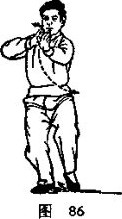
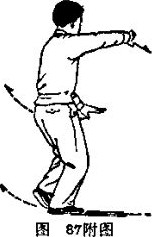
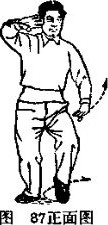
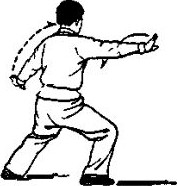
· 105 · Action two: The two hands and the two legs each reel forward in a small circle (by a turning jin), and then the centre of gravity shifts left. At the same time, the left palm, from the left, goes upward, changing from forward reeling to reverse reeling, and reels in an arc to beside the left cheek, the palm slanting toward the right front; the right palm, from small forward reeling to large forward reeling, reels from right to left past before the chest and downward. (Figure 89) The right foot is lifted and, passing beside the left ankle, steps back in an arc to the right rear (southwest); the centre of gravity shifts back with it and the right leg becomes full. At the same time, the left palm reels reverse and pushes forward; the right palm crosses before the chest beneath the extended left forearm, that is, from the lower right, as the right foot steps back, it opens out in an arc to the right rear. (Figure 90)
Action three is the same as action two, only left and right are reversed. (Figure 91, then follow the front view of 88)
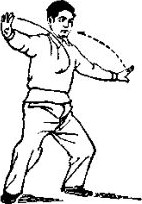
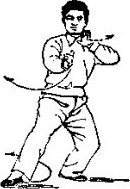
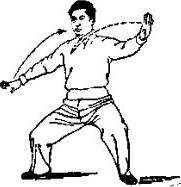
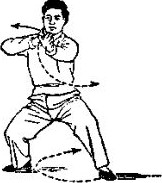
· 106 · Essential points:
1. This posture opens and then closes, and again closes and then opens. This peculiar movement that harbours a closing within the opening and a parting within the closing is accomplished during the continuous step-back.
2. In the continuous stepping back it is not a straight, unbroken retreat. In accordance with the requirement that "advance and retreat must have conversion", amid the two backward-stepping movements there is interposed a double-opening posture and a conversion of inner jin. Only thus does it not feel like a straight unbroken retreat, but rather like the opening jin applied before and after the silk-reeling. At the same time, having conversion, it becomes a retreat that contains advance — advancing is retreating, retreating is advancing, advance and retreat at ease — making it a Taijiquan retreat method able to support all eight directions.
3. Step Back and Roll the Arm is the only form in Taijiquan that retreats continuously; it requires that amid the retreat there be a slight forward and reverse silk-reeling, and that it be done round and smoothly, so that it has no defect of gaps or bumps nor any interruption of inner jin, meeting the requirement of the sixth characteristic.
5. This posture can also be done as an outwardly manifested issuing of jin: that is, when one has stepped back and reached the landing point, the heel stamps the ground with a sound, and at the same time the forward hand issues jin outward while the rear hand holds it down with sinking jin.
Action one: The body turns slightly left. At the same time, the left palm turns its arm forward-reeling and opens out to the lower left, the palm facing down; the right palm reels reverse and opens out slanting to the upper right, the palm facing outward. (Figure 92. This figure continues downward from the front view of figure 88, and therefore although figures 92–96 all show the front aspect, in fact the movement should still be performed with the chest facing east.) The body turns slightly right. At the same time, the right palm reels forward toward the front and inside, changes to reverse reeling, and circles once to the right; the left palm, as the right palm circles from the front right, shifts slightly left, that is, as the right palm circles right it reels forward and draws an arc to the right to before the right ribs. (Figure 93)
Action two: The centre of gravity shifts onto the left leg, the body turns left, the right foot lifts its heel and, with the toes touching the ground, passing inside the right ankle, steps back in a slant to the right rear (south, slightly west); on reaching the landing point the heel comes down and stamps the ground, and the centre of gravity shifts back, the body turning right at the same time. As the body · 107 · body turns left, at the same time the right palm reels forward and is drawn back in an arc, its fingers adhering to the left abdomen; the left elbow presses up past the inner side of the right palm, and the left palm reels reverse, its finger-backs adhering to the right ribs and rising; as the body turns right and the right foot stamps, at the same time the left palm pushes out on the slant toward the left front, and the right palm, its fingers adhering to the body, moves to the right abdomen. (Figures 94–95)
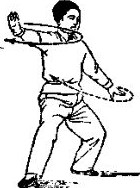
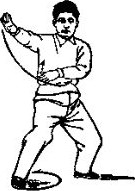
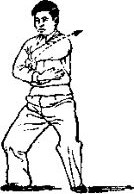
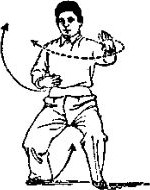
Essential points:
1. In this posture, when the two arms embrace and close as a single whole circle (figure 94), it must become a tough, elastic press jin; its emphasis is that, with the qi adhering to the back, the skin of the spine is drawn taut to knead and move the spine; at the same time it is the moment of storing in readiness to issue.
· 108 · 2. Although figure 94 has already drawn the right foot back, it has not yet stamped it; the stamp must be coordinated and made one with the issuing of the left palm, so as to form the opening jin, as in the posture of figure 95.
3. Step Back and Press the Elbow is a short-range supplementary issuing of jin, requiring softness harbouring hardness; when the moving jin is well set, in the instant the dantian jin is issued with sinking jin through the left palm, it must coincide with the sound of the right heel stamping the ground, so that the whole body's jin force is complete.
Action one: The body turns slightly left, then right. The left palm, as the body turns left, shifts slightly left, that is, as the body turns right, the arm reels reversely from the left up to the right to before the right ribs, the palm facing up; at the same time the right palm reels reverse and is raised to the right rear, the palm facing right. As the right palm is raised, the right foot is lifted. (Figure 96)
Action two: The body turns slightly left; the right foot comes down beside the left foot, first touching with the toes, then immediately the heel kicks out to stamp the ground, and the centre of gravity immediately shifts onto the right leg, the left heel lifting. As the right foot comes down, the right hand reels reverse (bending its elbow so the elbow tip passes above the right palm) and draws an arc from above to before the left eyebrow; the left palm reels forward and shifts down to below the left ribs, the palm facing up, and the two arms cross before the chest. (Figure 97, the front view of attached figure 97. The direction of figure 96 agrees with that of the front view 97, and therefore figure 96 too should be performed with the chest facing east.)
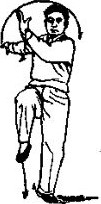
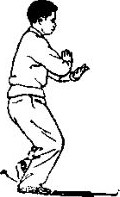
· 109 · Action three: The body turns slightly left; the left foot opens one step sideways to the left rear (north, slightly west) on the slant, bending the knee and squatting down; at the same time, the two hands reel forward and press outward, the palms turning outward and down, and as the left foot opens the two arms close slightly, the two palms turning inward; immediately the two hands, the left reeling reverse and the right reeling forward, open out separately, the left hand to the upper left and the right hand to the lower right, both palms facing down. (Figures 98–99, and attached figures 98 and 99)
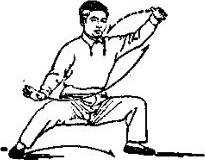
Essential points:
1. At the beginning of this posture, attention should be paid to the size of the forward and reverse silk-reeling. In order that the movement gain posture and gain jin, when the right palm passes below the left elbow it should tighten the diameter of its circle; this is also the time when the large and small forward and reverse reeling begins to form. Before the double opening one must inhale, and on changing to the double opening one must exhale, exhaling all the way until the two hands have opened to their fixed point; this too is what brings this movement to a state of spirits-and- · 110 · one of the methods.
2. In the double closing (figure 98), it is required that the closing harbour an opening; the key is that before the double closing the qi must adhere to the back, and when the two palms cross and close the palms must turn outward and down, for thus the closing can harbour opening jin; if one has not attained parting within the closing, the jin will be balled up and stuck on the body, losing its elasticity and becoming the defect of collapsing.
3. In this posture, when the body squats down squarely upright, the kua opening must be broad. Thus the qi of the perineum will naturally rise from the coccyx, which is very beneficial. But when squatting, the height of the kua opening must not be lower than the knee, lest a sagging crotch form; if there is a sagging crotch it will make the outer sides of the two feet float emptily, and thereby cause sluggishness in the transformation of empty and full, so at the same time one should also avoid the defect of double weighting in the legs.
Action one: The body turns slightly left; the right foot steps up beside the left, touching its toes beside the left toes. At the same time, the right palm turns its arm forward-reeling and draws an arc leftward past before the abdomen, the palm facing up; the left palm reels reverse, passes before the face, and bending its elbow to the right joins above the right arm. (Figure 100, the front view of attached figure 100) The right foot steps out on the slant to the right front (southeast). What follows is the same as action two of the seventh form, "White Crane Spreads Its Wings". (Continuing to figures 31–32)
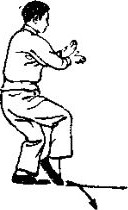
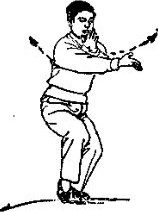
· 111 · Essential points:
See the essential points of the seventh form, "White Crane Spreads Its Wings".
The action and the essential points are both the same as the eighth form, "Diagonal Twist Step". (Continuing to figures 33–38)
Action one is the same as action one of the ninth form, "First Withdrawal". (Continuing to figure 101)
Action two: The centre of gravity shifts onto the right leg; pivoting on the right heel, the body turns to the left rear (the chest turning to face north), and the right foot follows the turning body back in an arc, coming down with its toes beside the left foot. At the same time, the right hand reels forward, turning over so the palm faces outward; the left hand reels reverse, closes with jin rightward past before the abdomen, and adheres with its palm below the right forearm, the palm facing inward. (Figure 102, the front view of attached figure 102)
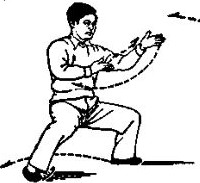
Action three: The body squats slightly; at the same time, the two hands reel forward slightly and close a little, then change to reverse reeling and open out separately to left and right (note the little fingers): the left hand turns its wrist inward so the palm faces inward, and the right hand is held as a horizontal palm with the wrist tilted up so the palm faces outward. (Figure 103, the front view of attached figure 103)
Action four: Pivoting on the right heel, the body turns right; the left toes touch the ground and pivot, the left knee turning with the turning of the body. At the same time, the right hand closes leftward and inward to the left side of the abdomen, the palm · 112 · faces up; the left hand reels forward and, as the body turns, bends its arm and pushes forward and down, the palm facing forward. (Figure 104, another side view of attached figure 104) The left foot steps forward one step, and the centre of gravity immediately shifts forward, the left leg becoming full. At the same time, the left palm passes before the chest leftward and then is placed beside the left kua, the palm facing down-right; the right palm reels forward and extends forward, the palm facing up. (Figure 105, another side view of attached figure 105)
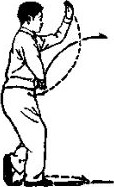
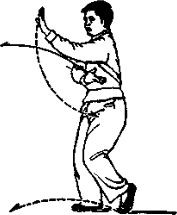
Action five: Pivoting on the left heel, the body turns rapidly to the right rear; the right foot, its ball of the foot adhering to the ground, turns half a circle to the right rear with the turning body, and then its heel kicks out to stamp the ground. As the body turns, · 113 · The right hand reels forward and turns inward until its palm faces outward, and as the body turns it presses down in an arc to beside the right kua, the palm facing down; the left palm, bending its arm, turns upward and pushes out forward and down past beside the left ear. (Figure 106, the front view of attached figure 106)
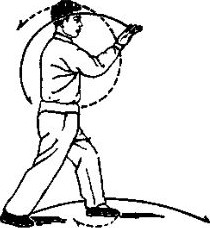
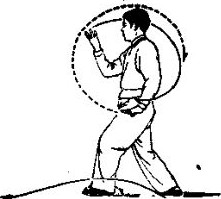
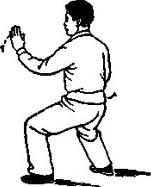
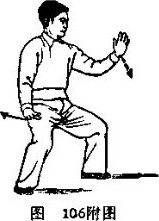
Essential points:
1. In action four (figure 105), the left foot's stepping up and the palms' extending forward must be in accord; in action five (figure 106), the right heel's landing and stamping the ground must be in accord with the right hand's pressing down and the left hand's pushing forward.
· 114 · 2. What qigong calls "opening the three passes" requires the qi to pass through the tailbone pass, the squeeze-spine pass, and the jade-pillow pass, and it involves the whole sympathetic and parasympathetic nervous system of the spine. The sitting, lying, and standing exercises of qigong use a still method to let the qi pass the three passes spontaneously, whereas this "moving exercise" of Taijiquan seeks stillness within movement: in the process of when one part moves no part is unmoved, through single-minded motion one concentrates the will, so as to obtain "stillness" within movement. The boxing theory says: "If the mind is not still, then it is not single-minded, and the movements have no fixed direction at all." In the Taijiquan moving exercise, because of the mutual assistance of a movement with a definite direction and the intention, and because at the same time in the course of the moving exercise the inner jin and the outer form must attain the tailbone-centred and spirit-through-the-crown, qi sunk to the dantian and the sea's bottom, and chest-contained and back-raised, kua opened and crotch rounded, causing the qi to pass through the crotch — thus is this great circular path from the front-below to the back-above of the whole body trained. After days, it makes the qigong "opening of the three passes" come about of itself without being sought.
3. This posture is an exercise based entirely on opening through the spine. Figure 101 is the posture in which the cervical vertebrae pass through, figure 102 is the posture in which the upper thoracic vertebrae pass through, figure 104 is the posture in which the lower thoracic vertebrae pass through, figure 105 is the posture in which the lumbar vertebrae pass through, and figure 106 is the posture in which the sacral vertebrae pass through. This is to say only that a given figure acts mainly through certain joints, not that the other joints do not move, for Taijiquan is such that when one part moves no part is unmoved.
4. In the "Compendium of Chen-Style Taijiquan" (this book was written by Chen Xin and edited and printed by Chen Jifu, in two volumes, upper and lower), the form "Needle at the Bottom of the Sea" has the two legs opened sideways, with the right palm's tiger's mouth spread open and dropped between the two legs; this is definitely helpful for the effect of opening through the back and for the qi passing from the crotch backward and rising through the tailbone up the spine.
Action one: The two hands part to left and right with opening jin. (Figure 107, the front view of attached figure 107) What follows is the same as actions one, two, three, and four of the fourteenth form, "Cover Hand and Forearm Punch", only the directions differ: when the fourteenth form is completed the left foot is in the northeast and the right foot in the southwest, whereas · 115 · when this form is completed the left foot is in the southwest and the right foot in the northwest. (Figures 108–109, then continuing to figures 52–54)
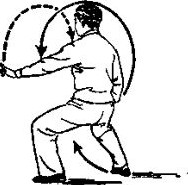
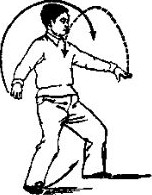
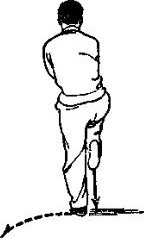
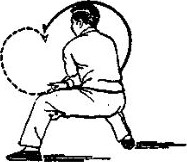
Essential points:
The same as the essential points of the fourteenth form, "Cover Hand and Forearm Punch".
Action one: The body turns slightly left, the centre of gravity shifts back slightly; at the same time the two hands first each turn their arms in place and draw a small circle (to set the movement going), then the right hand in a large forward reeling turns its arm and reaches to the abdo- · 116 · forward, and the left hand with a small reverse reeling circles to before the chest, the two hands forming a closing jin. (Figure 110) The body turns slightly right, the centre of gravity shifts forward, the left leg becomes full; at the same time, the right hand turns its arm forward-reeling and the left palm reels slightly reverse, and the two hands, holding jin together, squeeze out in an arc to the upper right. (Figure 111)
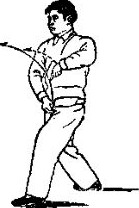
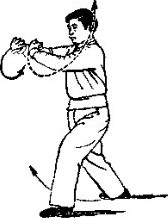
Action two: The body turns left, the whole centre of gravity shifts onto the left leg, and the right foot is lifted forward. At the same time, the right hand reels forward and supports upward; the left hand reels reverse, turns its arm, and with the wrist joint on the back-of-hand side makes an arc warding-off to the upper left, the five fingers hanging down. (Figure 112) The body continues to turn slightly left, and the right foot steps forward one step; at the same time the two hands, reeling forward and turning over the palms, are placed beside the two ears, the palms slanting outward. (Continuing to figure 19) What follows is the same as the explanation in the latter part of action two of the fourth form, "Six Seals and Four Closings". (Figure 20)
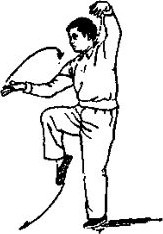
Essential points:
See the essential points of the fourth form, "Six Seals and Four Closings".
· 117 ·
The action and the essential points are both the same as the fifth form, "Single Whip". (Figures 21–25, then continuing to figure 113)
Action one: The body turns left, the right knee slightly extended and not straightened. At the same time, the right hooked hand becomes a palm and reels forward, moving in an arc leftward up to before the right forehead, the palm facing left; the left palm reels forward from inside to outside-left, extended slightly, the arm not straightened, the palm facing down. (Figure 114) The body turns slightly right and the left foot draws half a step toward the right, touching with its toes, the right leg becoming full. At the same time, the right palm changes from forward reeling to reverse reeling and opens out to the right, its palm changing from facing down to facing right; the left palm, from the left, goes down and reels forward rightward past before the abdomen to the right of the body, the palm slanting to the upper right. (Figure 115) The body turns slightly left, and the left foot opens half a step sideways to the left. At the same time, the right hand falls in an arc, the palm facing down; the left hand changes from forward reeling to reverse reeling, turns its arm and turns the palm to face outward, and draws an arc upward. (Figure 116)
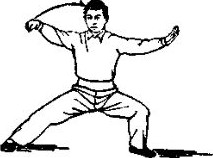
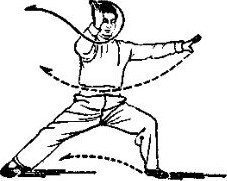
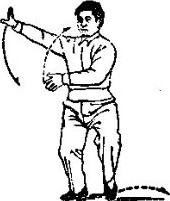
· 118 · Action two: The centre of gravity shifts onto the left leg; the right foot steals a step to the left (east) from behind the left foot, and the body turns slightly right. At the same time the two hands reel forward: the left palm turns its arm, passes before the face, and reels reverse to transport leftward, its palm turning to face left; the right palm turns its arm, passes before the abdomen, and reels reverse to transport leftward and upward, its palm turning over to face the upper left. (Figure 117) The body continues to turn slightly right, and the left foot opens one step sideways to the left (east). At the same time the two hands reel forward: the left palm turns its arm and, from the left, goes down and reels reverse rightward past before the abdomen to transport upward, its palm slanting to the upper right; the right palm turns its arm and, from the left, goes up and transports rightward past before the face, its palm facing right. (Figure 118) The centre of gravity gradually shifts left, and the body turns slightly left. At the same time, the right palm transports downward in an arc, the palm facing down; the left hand reels forward, turns its arm and turns the palm to face outward, and reels reverse to transport upward (see figure 116).
Actions three and four both repeat action two. (According to figures 117–118, then continuing to 116–118, then continuing to 119)
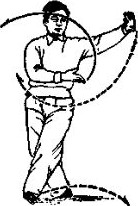
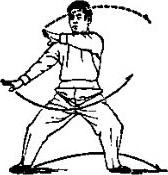
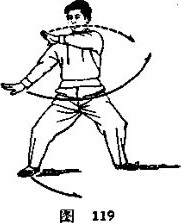
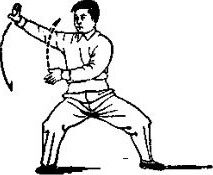
· 119 · then continuing to 119)
Essential points:
1. In this posture attention must be paid to the empty-full requirement of upper and lower following one another; check whether one has clearly manifested this requirement: that is, when a certain hand rotates to ward-off upward as empty, the centre of gravity must gradually shift onto the leg below that hand, and that leg then becomes full; as soon as the upward ward-off has passed and changed to a downward ward-off, that leg must then change to empty. In this way the empty and full of the two hands and the empty and full of the two feet are unified within the whole of upper-lower empty-full, forming everywhere always this one empty and one full (except when lifting a leg to stand alone or breaking free of a lock), attaining the requirement of nimble exchange of intention and qi, and producing the flavour of round liveliness like a pearl.
2. Because this posture steps laterally, it very readily manifests the requirement for a rounded crotch. A rounded crotch is the form that must obtain for the screw-like hidden jin of the legs to arise. A correct and standard rounded crotch is simply not to form a pointed crotch when standing high nor a sagging crotch when standing low; it requires that the movement be performed neither pointed nor sagging, so as to attain a correct rounded crotch.
3. Wave Hands is the only form in Taijiquan that trains the great silk-reeling of double-forward changing to double-reverse. This posture must fully manifest the function of waist and spine united as one, becoming a spherical axle; the key is that it is not a planar left-right silk-reeling, but has a component of inner-outer silk-reeling, which leads. Through this requirement, one can further check whether the "qi adhering to the back" adheres tightly and whether the waist, like a round axle, is roundly alive.
Action one: The body turns left, the centre of gravity shifts left, and the right foot steps slanting half a step to the right front (southwest). At the same time, the left hand reels reverse and is drawn back to before the chest; the right hand reels forward, closes and gathers leftward past before the abdomen, and the two arms cross before the chest, the right arm outside. (Figure 120) The two arms first close slightly, contracting the crossed circle, and then the two hands reel reverse and open out separately to left and right, the palms slanting down; the centre of gravity shifts slightly right while the two arms close slightly, and shifts left again when the two hands open out. (Figure 121)
Action two: The body turns left, the centre of gravity shifts onto the right leg. At the same time, the right hand turns its arm re- · 120 · reels to beside the right hand, the palm slanting inward; the left hand reels slightly forward and closes rightward, the palm facing up.
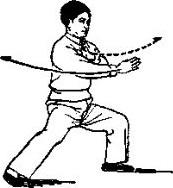
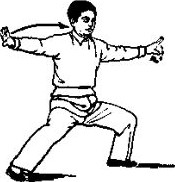
(Figure 122) Pivoting on the right heel, the body continues to turn left, the whole centre of gravity shifts onto the right leg, and the left foot is drawn back, passing inside the right ankle to step back (west), touching with its toes beside the right foot, the distance between the two feet equal to shoulder width. At the same time, the left palm bends its arm and reels reverse to draw back to the left side of the waist, the palm facing up; the right palm reels forward and pushes out, the palm facing outward. (Figures 123–124, the front view of attached figure 124)
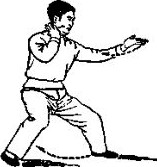
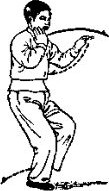
Essential points:
1. In the latter part of action two, the right palm's pushing out, the left palm's drawing in, and the left foot's stepping back · 121 · must be coordinated and made one.
2. This posture follows directly upon the double opening of Wave Hands, and therefore in doing the closing-and-opening movement one must pay attention to the requirement that "when you intend to close you must first part, and when you intend to open you must first let go". That is, before closing, first sink the roots of the two palms down, then close them together; and after closing, before opening again, one must first tighten the closing circle a little, then open out doubly to left and right.
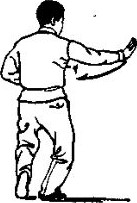
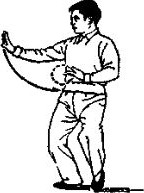
3. When the right hand circles a small circle and draws back beside the right ear, one must have the qi adhering to the back and first use supporting jin. Only when the support is full and then released can one let out a kind of rotating pressing jin.
4. In this posture, when the right hand pushes forward in the high pat, it must have the force to support all eight directions. The difference between this posture and the Diagonal Twist Step is that in the Diagonal Twist Step the right hand, passing beside the right ear, uses jin that separates to left and right; whereas this posture uses jin that opens front and back while harbouring a closing, and it requires that there be no defect of gaps or bumps nor interruption of inner jin in the silk-reeling path.
Action one: The right hand reels slightly forward and turns over downward to before the abdomen, the palm facing left, the fingers pointing down; the left hand, from the side of the waist, turns its arm and reels reverse to before the chest, the palm facing up. (Figure 125, the front view of attached figure 125. The posture in figure 125 comes after the front view of figure 125, and is already at the moment of being about to kick out to the right.) The body turns slightly right, the centre of gravity still on the right leg; at the same time, · 122 · with the two hands, the left reeling reverse and the right reeling forward, and the left hand adhering to the inner side of the right forearm, ward-off outward with the right forearm, at shoulder height. (Figure 126, the front view of attached figure 126)
Action two: The body turns slightly left. At the same time, the left hand reels reverse, goes down from the right and opens out leftward past before the abdomen, the palm facing right; the right palm reels forward and shifts slightly downward, the palm facing down, and the two arms open out (at this point the elbow tips sink downward, which is opening harbouring closing). (Figure 127, the front view of attached figure 127) The body turns slightly right, the right hand turns its arm forward-reeling and closes inward to the left of before the chest, and the left hand, from the left, goes up and draws an arc rightward to above the right arm, the two arms crossing; at the same time the left foot, passing before the right foot, steps across sideways to the right, the toes pointing forward. (Figure 128, the front view of attached figure 128)
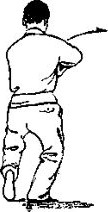
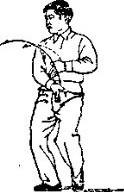
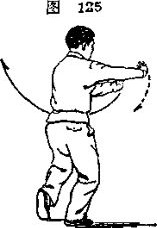
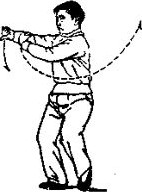
· 123 · Action three: The right foot, its instep stretched flat, kicks up to the right front; at the same time, the two hands reel forward and go up, opening out to left and right past before the face, the palms facing down, and the right palm immediately reels reverse to meet and strike (brush) the right instep, while the left palm also follows, reeling reverse to pat down to the left rear. (Figure 129, the front view of attached figure 129)
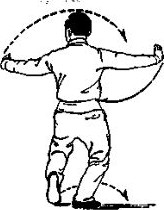
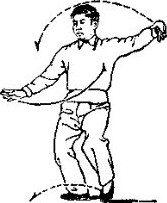
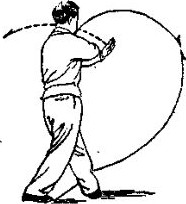
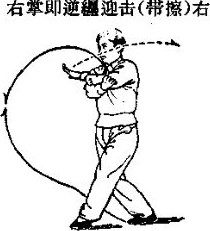
Essential points:
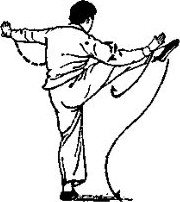
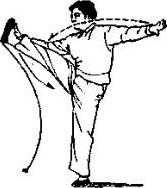
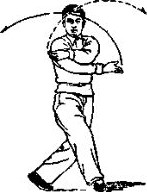
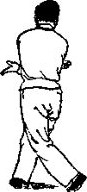
The main action of Brush-Foot is the opening of a large inner double forward reeling changing to the closing of a large double forward reeling; when the two arms close doubly, the left leg steps across, changing from empty to full; at the same time, the right leg changes to · 124 · be empty, that is, one kicks up with the right foot, and at this moment the two arms change to a large double reverse reeling, patting and brushing to left and right; at this time attention should be paid to the little fingers of the two hands. In the course of this brush-foot with large forward and large reverse reeling, The key to making the left leg stand alone steadily lies in the flat, straight action of the right instep that kicks up.
Action one: The right foot is drawn back and comes down to the right (east) with its toes turned out and planted, the body turning right at the same time, the centre of gravity shifting onto the right leg, and the left heel lifting off the ground; at the same time, the two hands reel forward, going down from left and right, and gather and cross before the chest. (Figure 130, the rear view of attached figure 130) The body turns slightly right; at the same time, the two hands reel forward and go up, opening out to left and right past before the face, the palms facing outward. (Figure 131)
· 125 · Action two: The left foot, its instep stretched flat, kicks up to the left front; at the same time, the left palm reels reverse to meet and strike (brush) the left instep, and the right palm also follows, reeling reverse to pat down to the right rear. (Figure 132)
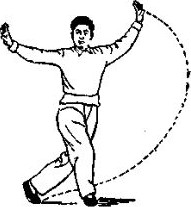
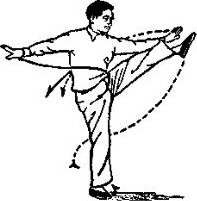
Essential points:
1. In the conversion of one closing and one opening, one must maintain stability; that is, when the centre of gravity moves onto the right leg, one must raise the left leg by the closing jin of the two hands. At the same time, when the centre of gravity shifts right, the body must be centred and upright.
2. One must raise the left leg when the two hands open out to left and right, and then kick the left foot upward; the direction of the kick is midway between the left side and the front, that is, it is best at 45 degrees to the boxing path.
Action one: The left foot is drawn back and lifted, and, pivoting on the right heel, the body turns 135 degrees to the left rear; at the same time, the two hands cross before the chest with forward and reverse reeling; as the body turns, the two palms become fists, reeling reverse one circle and crossing with closing jin before the chest. (Figure 133, the front view of attached figure 133)
Action two: Immediately the left toes tilt up and the left heel kicks out to the left (west); at the same time the two fists are raised and, passing before the chest, are issued separately to left and right, the fists' centres facing down. (Figure · 126 · 134, the front view of attached figure 134)
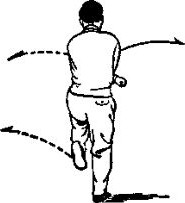
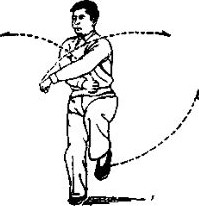
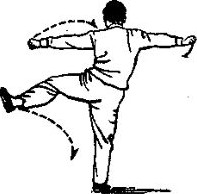
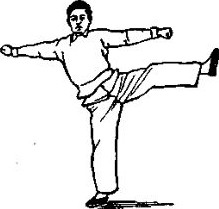
Essential points:
1. When the body turns, one must remain stable; in turning, the instep of the lifted left foot must be stretched as flat as possible so that the toes point down, to lighten the sagging weight of the left leg. The turn must use the momentum of the two arms' double reverse reeling to carry the body around. For this reason some call it "Hanging on the Tree and Kicking the Foot", because as the two arms reel doubly reverse above, it is as though the two hands were hung on a tree. In this posture one must also pay attention to the requirements of standing with the body centred and upright, qi sunk to the dantian, and the crown jin not lost.
· 127 ·
Action one: The left foot is drawn back and lifted; at the same time, the two hands become palms, the left hand reeling forward and drawing an arc to before the chest, and the right hand reeling slightly reverse, both palms facing right. (Figure 135) The left foot's toes turn out and come down to the left (southwest), and the body turns left. At the same time, the left hand reels forward and turns its arm to before the chest, the palm facing right-front; the right palm reels reverse to above the left forearm, the palm facing left-front, and the two arms cross. (Figure 136)
Action two is the same as action two of the tenth form, "Forward Wading Twist Step", only the direction differs. In the tenth form the right foot steps out on the slant to the southeast, whereas in this posture the right foot steps out on the slant to the northwest. (Figure 137)
Essential points:
The same as the tenth form, "Forward Wading Twist Step".
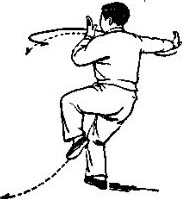
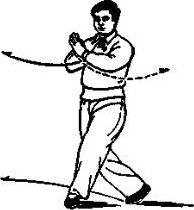
Action one: The body turns right, the right toes turn out, the centre of gravity shifts onto the right leg, and the left foot is lifted and, passing inside the right ankle, steps up on the slant to the left front (southwest), whereupon the centre of gravity shifts left. At the same time, the left palm reels forward, moves rightward from the left past before the face and becomes a fist, the fist's centre facing inward; the right · 128 · palm changes from forward reeling to reverse reeling, draws an arc to the right rear and becomes a fist, the fist's centre facing front-up. (Figure 138)
Action two: The body turns slightly left. At the same time, the right fist reels forward to beside the right ear, the fist's centre facing inward; the left fist reels forward, passes downward before the chest and drops to the left side, the fist's centre facing up. (Figure 139, the front view of attached figure 139) The body continues to squat slightly, and the left leg continues to bow forward. At the same time, the left fist reels reverse, bends its elbow and is raised to the upper left, the fist's centre facing down; the right fist reels reverse and strikes downward to the front (reeling reverse one small circle from outside to inside), the fist's centre facing inward. (Figure 140, the front view of attached figure 140)
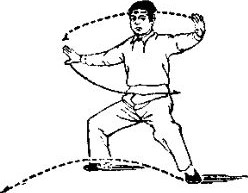
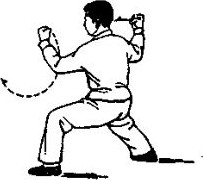
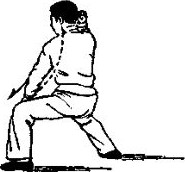
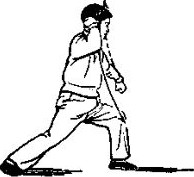
· 129 · Essential points:
1. The emphasis of this posture is that in the prone crouch one must attain the requirement that "the tailbone is centred and the spirit passes through the crown": only when the tailbone is centred will the body not topple forward; that is, because the tail vertebra presses down, the whole spine can be threaded through; so long as the spine has sufficient elasticity (with the great road of the three passes opened), one can spring up with a single bounce, and no heavy pressure can hold it down; whereas if the tailbone topples over and loses its elasticity, then one who has crouched to the ground can rise no more.
2. In the prone crouch the crown jin must not be lost; that is, because the two fists, with the jin of double forward reeling, draw a circle against the ground in opposition, this not only kneads and moves the back but also turns a small circle on the crown of the head as well. Hence it is also called "The Immortal's Single Grasp", which is that after grasping one circle it becomes a fist, and then turns another circle on the ground and strikes downward, just as, after brushing aside the dust on the ground, one plants a thing into it; therefore it is also called Planting Fist.
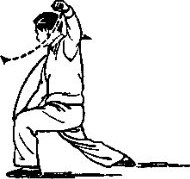
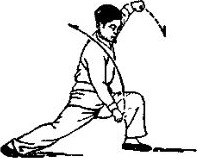
Action one: The body turns right, the centre of gravity is on the left foot, and the right leg is slightly extended and not straightened; at the same time, the left fist, bending its arm, shifts slightly downward as the body turns, and the right fist turns its arm, bends its elbow and bends its wrist and is raised, both fists' centres facing inward. (Figure 141, the front view of attached figure 141) Pivoting on the left heel · 130 · heel, the body continues to turn right, and the foot is drawn back half a step with the turning body, touching with its toes. At the same time, the right fist reels forward and drops to the right side of the body, the fist's centre facing up; the left fist reels reverse, comes from the left to the front, bends its elbow and is raised, the fist's centre facing inward. (Figure 142) The centre of gravity shifts onto the left leg, and the left leg squats down (strengthening the elasticity of the left leg); at the same time, the right fist turns its arm, reels reverse and is raised in an arc from behind the body, and the left fist reels reverse and drops to the left side of the body. (Figure 143)
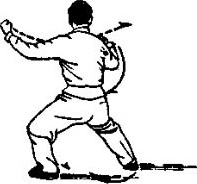
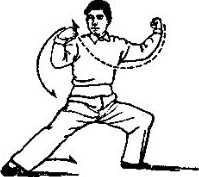
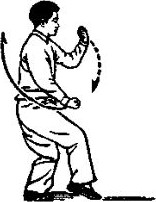
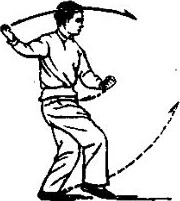
Action two: The centre of gravity shifts forward, the right heel lands and is planted firmly, and the left foot, its instep stretched flat, kicks up forward and upward; at the same time the two fists become palms and reel reverse, the right hand forward and up, the left hand back and down · 131 · arcs, the right palm's centre facing forward and the left palm's centre facing inward-down. (Figure 144, the front view of attached figure 144) Before the left foot has landed, the right foot pushes off the ground and leaps up, kicking up forward and upward with its instep stretched flat, and the right palm immediately meets and strikes the right instep to the front, whereupon the left foot lands and the left palm, as the right palm strikes the right instep, is held level to the left. (Figures 145–146, the front view of attached figure 146)
Essential points:
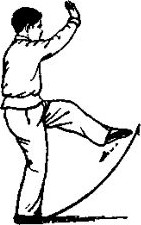
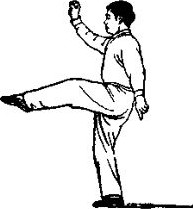
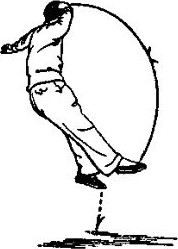
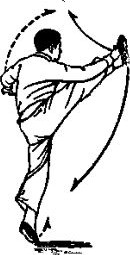
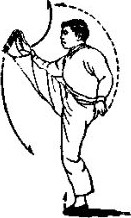
· 132 · Kick Twice is an exercise for training the leap: the two feet leave the ground one after the other and kick out, and so it is also called Kicking Twice. The Kick Twice of Chen-style Taijiquan has four methods of practice, which may be chosen according to the practitioner's bodily strength and purpose. Here they are listed in order from easy to difficult:
(1) Using a single kick in place of the double kick: that is, kicking up with the right foot alone and meeting the right instep with the right palm, without the process of both feet leaving the ground — but in practice one must still have the lifting jin of the double kick;
(2) Practising by the method given in the action description above, whose distinguishing feature is that the body's leap and the second kick are assisted by enlarging the silk-reeling circle with a great opening and expanding;
(3) Reducing the movement and shrinking the silk-reeling circle to a single reel, so that the two feet leave the ground and kick up one after the other;
(4) After Strike the Ground with the Fist, turning the body over once, whereupon the two feet leave the ground and kick up one after the other; this is the simplest kind, and also the most difficult kind.
(Also called Guarding-the-Heart Punch, or Tiger-Beating Posture)
Action one: The right foot falls but has not yet touched the ground when the left foot leaps up; at the same time the two hands, from the left, go up and reel forward warding-off to the upper right (the two hands must have leading jin, leading the body to rise into the air, like the shooting posture in basketball. If the practitioner is weak, he may land the right foot first and then lift the left foot, omitting the process of leaving the ground). (Figure 147. This figure continues downward from the front view of figure 146, and therefore from figure 147 to 151 one should still perform the movement with the chest facing east.) Immediately the right foot lands and the right leg squats down, and then the left foot steps out sideways to the left rear (northwest) on the slant, the left leg dropping low with the left knee slightly bent; the body turns right at the same time; and the two palms, as the body turns, drop to the right front, the palms facing down-right. (Figure 148) The body turns left, the centre of gravity shifts left, the left leg bows and the right leg is straightened with the right knee slightly bent; at the same time the two palms become fists, and turning their arms, the left reels reverse and the right reels forward: the left fist, passing before the abdomen, reels to the upper left so that its centre faces left, and the right fist reels from the right · 133 · to before the chest, its centre facing upper-left (forming the Left Tiger-Beating Posture). (Figure 149)
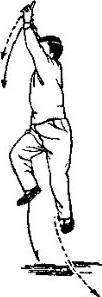
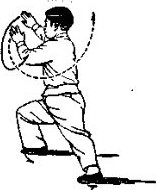
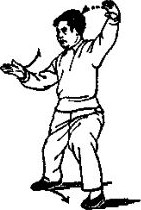
Action two: The body turns slightly right, the right foot shifts slightly left and touches with its toes; at the same time, the left fist reels reverse, bends its arm and is drawn inward to head height, and the right fist reels forward, bends its arm and is drawn inward to before the chest. (Figure 150) The body continues to turn slightly right, the left leg squats down, and the right heel, its inner side adhering to the ground, sweeps out to the right front (south, slightly east) into a low stance; at the same time the two fists, the left reeling reverse and the right reeling forward, sink down as the body squats. (Figure 151) The body continues to turn slightly right, the centre of gravity shifts right, and the right leg bows. At the same time the two hands turn their arms and reel reverse: the left fist shifts right with the turning body, its centre facing right-rear; the right fist, passing downward before the chest, reels to the right side of the abdomen, its centre facing inward. (Figure 152. The posture shown in this figure is the front aspect, but in fact the places where the two feet stand are still the same as in the previous figure, unmoved, and from figure 152 to 154 too the movement is still performed with the chest facing east.) The body continues to turn slightly right. At the same time, the left fist, passing before the chest, reels forward leftward to before the left waist, its centre facing inward; the right fist, from the right rear, goes up, turns its arm, bends its elbow and reels reverse to beside the right ear, its centre facing down. (Figure 153) The body turns left, the centre of gravity shifts slightly left, the left knee bends slightly, and the left fist is drawn slightly inward to before the abdomen, · 134 · The right fist turns its arm and bends its wrist inward, extending forward, both fists' centres facing inward. (Figure 154)
Essential points:
1. This posture requires a larger component of inner-outer silk-reeling, and requires that within the inner-outer movement one attain joint-by-joint continuity and the whole body as one family. Compared with the previous postures, this needs further practice. This form readily and clearly manifests the requirement that when one part moves, all move.
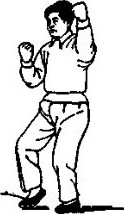
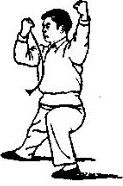
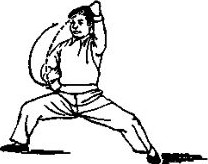
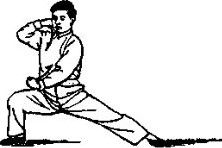
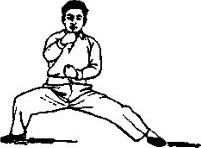
2. Because the inner-outer silk-reeling component is large, it promotes the governing function of the waist and spine acting together, and within that governance the back holds first place (as the chief · 135 · silk-reeling). Therefore this posture is one of the main forms in Taijiquan for training the inner-outer and forward-reverse silk-reeling jin.
3. When this posture is performed, the crotch opening is required to be low (but not lower than the knee); when it changes the empty and full of the legs, one especially readily feels the qi of the perineum (the middle part between the front and rear yin) rushing up to the tailbone. This is the main requirement of the rounded crotch manifested in this posture.
4. In this posture, the ward-off jin of the outer forward reeling and the ward-off jin of the inner reverse reeling require that, in turning the corners and changing the warding-off silk-reeling surface, the spiral action can reach the skin, with no defect existing within; that is to say, only a spiral on the skin can attain the pulling-and-moving effect of silk-reeling jin (whether the silk-reeling jin can reach the skin surface without defect is most readily manifested in this posture).
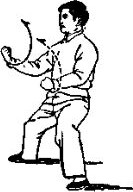
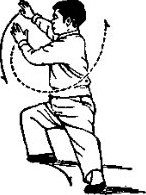
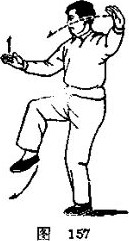
Action one: The body turns slightly left, the centre of gravity shifts left, and the left leg bows slightly. At the same time the left hand reels forward and turns over downward to before the left abdomen, its centre facing up; the right hand reels forward and turns slightly to the right front to before the abdomen, its centre facing inward-up. (Figure 155. In this figure the places where the two feet stand are still the same as in the previous figure, unmoved, and the chest still faces east; the movement of this posture begins from the chest facing east.) The body turns right, the centre of gravity shifts right, the right leg bows and the left leg is extended but not straight; at the same time the two fists become palms and reel re- · 136 · reel, and open out to the right past before the chest. (Figure 156) The two hands reel reverse, going right and down, then change to the right reeling forward and the left reeling reverse and turn upward on the ground: the left palm, passing before the abdomen, draws an arc to the upper left until level with the head, the palm facing outward; the right palm reels in an arc to before the abdomen, the palm facing left. At the same time the centre of gravity shifts left, and the right foot is lifted forward. (Figure 157)
Action two: The right toes turn out and the right foot steps forward half a step, the body weight shifts forward, and the left foot is lifted with it; as the right foot is lifted and steps up, at the same time the two hands reel forward, the right palm pushing forward and the left palm dropping in an arc rightward past before the face, the left forearm coming to rest on the right forearm, the two arms crossing with closing jin, both palms facing down. (Figure 158) The two arms reel forward and open out to left and right, both palms facing back; at the same time, the left foot, from the lower rear, wraps up in an arc with wrapping jin, meeting and striking with its inner side against the left palm. (Figure 159. At this point the chest should face south.) Pivoting on the right heel, the body turns to the right rear (180 degrees, the chest facing north); as the body turns, at the same time the two hands change from opening to closing inward, crossing before the chest with the left arm on top; and the left foot, too, sweeps around from above to the right rear with the turning body. (Figure 160) The body continues to turn slightly right, and the left foot lands; at the same time the two hands shrink the closing-jin circle, the left palm facing down and the right palm facing inward. (Figure 161, the front view of attached figure 161. The front view of figure 161 continues immediately after figure 160, and in fact the chest faces north, but from figure 161 onward it already agrees with the direction in the action description.)
· 137 · Essential points:
1. Whirlwind Kick is a sweeping-leg jin with one foot standing and one foot in the air; the first four circles manifest the opening and closing before the whirlwind sweep (figures 158–161 complete the whirlwind kick's sweeping action).
2. Figure 159 shows the whirlwind kick's sweeping lift: after the left palm strikes sideways with the left foot, the body turns; in the course of the turn, the left leg is required to turn across slightly bent and not straight, but it is not permitted to turn across with the leg bent up; this is training for leg jin and for balance on the right hand, and needs some time of practice.
3. In order to suit different practitioners, Chen-style Taijiquan divides some movements into easy and difficult methods of practice. Another method of practice for this posture is (beginning from figure 158): first step the right leg forward half a step and lift the left heel, with the two hands crossed before the chest; then the left foot kicks up forward (not a sideways sweep), and after the kick one bends the knee, draws the leg in, turns the body and drops down (not turning across with the leg straight); after the left leg is planted, the right foot is lifted and kicks out sideways with the heel. Its difference is that the sweeping jin is removed, changed into the two movements of kicking the foot and heel-kicking.
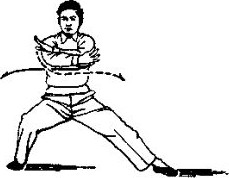
· 138 · the sweeping jin is removed, changed into the two movements of kicking the foot and heel-kicking.
Action one: The body turns slightly left, the centre of gravity shifts slightly left; at the same time, the two palms' centres turn over to face forward, and the crossed circle contracts, whereupon the two palms reel reverse and open out to left and right past before the abdomen (the mind dwelling on the two little fingers); the body turns back to square as the two hands separate, and the crotch opening sinks further. (Figure 162) The body turns slightly left, the centre of gravity shifts left, the right foot is drawn back and touches with its toes beside the left foot; at the same time, the two palms become fists and reel forward, going down from left and right to hold jin together before the abdomen, the two forearms crossing with the left arm on top, both fists' centres facing inward-down. (Figure 163, the front view of attached figure 163) The body continues to turn slightly left (the whole body's ward-off jin not lost), the two arms shrink the crossed circle (to store jin), and the right foot is lifted. (Figure 164, the front view of attached figure 146)
Action two: The two fists reel forward and issue jin to left and right; at the same time the right foot hooks up its toes and kicks out to the right side with the heel, issuing jin. (Figure 165)
Essential points:
1. The difference between this posture and the thirty-fifth form, "Heel Kick", is that the former form kicks the left foot while this one kicks the right foot. In doing this Heel Kick, one must first prepare a full storing of jin before kicking, and then issue, so as to attain the requirement of "storing and then issuing".
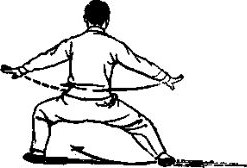
· 139 ·
Action one: The right foot lifts its knee and is drawn back, the left leg standing alone; at the same time, the right fist reels forward and falls before the crotch, and the left fist reels forward and drops slightly downward. (Figure 166) With the left heel as pivot, the body turns right (east). At the same time, the right arm turns outward and reels forward inward, going up from before the crotch, and following the body's turn rolls down in an arc to the right side beside the right leg, the right arm hanging down with the fist's centre facing up; the left fist turns its arm and reels reverse from inner-low to outer-high, raising the left forearm upright with the fist's centre facing inward. (Figure 167)
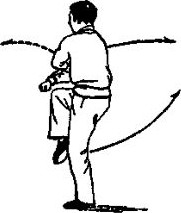
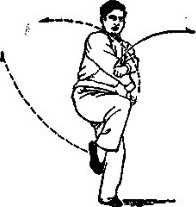
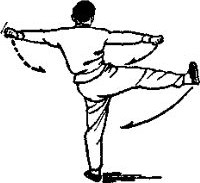
Action two: The two fists become palms and meet before the chest, both reeling forward and dropping, the right hand slightly lower than the left, the right leg still lifted. (Figure 168) The two palms rise from left and right, leading the body up (like the double leading jin of two hands shooting a basketball), the right toes lifting up. (Figures 169–170; after the body is led up in the two figures, it should still face the same direction as figure 168, and the two · 140 · figures show its front and side) the right foot presses the ground flat with the palm of the foot and extends, the body turns slightly right, the left foot steps forward-left (northeast), both legs bend at the knees and squat; at the same time, the right palm becomes a fist and reels reverse to before the left abdomen, and the left palm reels reverse and draws in to ward-off before the chest, the left palm placed crossed above the right elbow. (Figure 171)
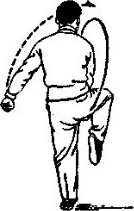
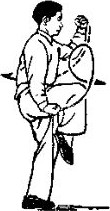
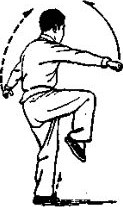
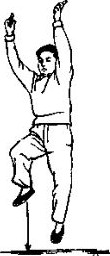
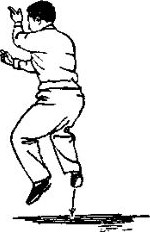
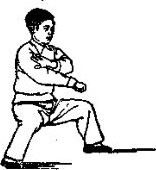
· 141 · Action three: The right fist turns its arm and reels forward to the lower right, and the left palm reels reverse and separates in an arc to the upper left, the right fist's centre facing down and the left palm's centre facing outward. (Continuing from figure 52; figure 51 is the changed posture of figure 171)
Action four is the same as action three of the fourteenth form, "Cover-Hand Forearm Punch". (Continuing from figures 52–54)
Essential points:
1. The right leg, after the kick, does not land. Because the two fists reel forward and are drawn back, they lead the right leg to be drawn back; in the course of drawing back, because the two fists turn over — the left forward and the right backward — the drawn-back right leg and the standing left leg are stabilised.
2. One must raise the crown (ding jin), sink the qi downward, drop the shoulders and drop the elbows, and set the left foot flat and firmly planted. Then one is naturally stable in standing alone.
3. The emphasis of this form and of the fourteenth form, "Cover-Hand Forearm Punch", lies alike in issuing jin; only the ward-off and connecting movements differ.
4. In this form, after turning the body and kicking, it turns into the two hands turning up and down to hold jin together (figure 167); after holding, the two hands separate, producing opening jin (figure 168); after separating, the two hands immediately rise and the two palms lift up, like holding a basketball and leaping up and throwing it into the basket — in this way the body can be led up.
Action one: The body turns right. At the same time, the right fist becomes a palm with a large reverse reeling and a bent elbow, the palm's centre facing down and the tiger's mouth open; the left palm goes from the left flank with a small reverse reeling to below the chest. (Figure 172, the other side view of attached figure 172) The right foot's toes turn outward and step forward; at the same time, the right palm reels forward and turns over so that its centre faces up, and the left palm reels forward and lays across the right forearm. (Figure 173) Immediately after, the left foot takes a big step forward, the toes turning slightly inward, in a low stance; at the same time the two palms reel reverse and turn over, the right palm downward and the left palm forward-down separating, chopping out suddenly with the heel of the palm. (Figure 174)
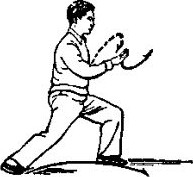
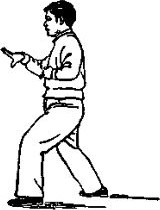
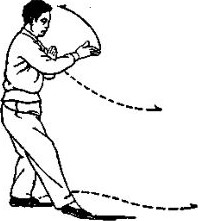
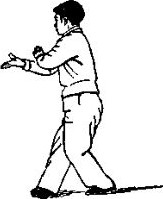
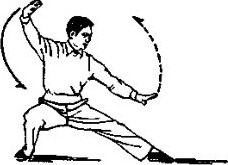
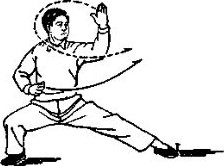
· 142 · · 143 · Action two: Immediately after, the body turns slightly right. At the same time, the right palm reels forward and falls from the upper right beside the right ribs, its centre facing the ribs; the left palm reels forward and turns up from below, the forearm raised upright with its centre facing forward-up. (Figure 175) The centre of gravity shifts left, the left leg forms a bow stance, and the body turns slightly left. At the same time, the left palm reels reverse, turning its arm and dropping slightly, and the right palm reels forward from above to the left, the two palms crossing and closing inward to issue jin to the left (east). (Figure 176)
Essential points:
1. The movements of this form must be completed in one continuous run without the least pause; the aim is to give way along the demanded jin — that is, to follow the demanded direction without butting against it, and to free it through the two palms' reverse reeling and double splitting.
2. The last movement of this form must, without pausing, shift the centre of gravity left, form a bow stance with the left leg, bring the two palms together to the end point, and suddenly strike crossed to the left; at this moment one must attend to the heels of the two palms.
3. The fist form Small Catch and Strike divides into left and right parts of movement, yet it is expressed as one whole; the aim is to employ the reeling-silk spiral, complying with the demanded jin, going from the two palms' double forward reeling and double reverse-reeling opening jin, then turning into double forward closing jin and double reverse issuing jin.
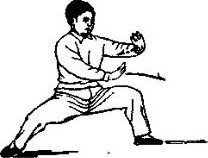
Action one: The body turns slightly right. At the same time, the two palms become fists, the right fist turning its arm and reeling reverse, extending forward-down with its centre facing down; the left fist reels reverse and is drawn back from the lower left, drawing a small circle and closing to lay on the right arm, its centre facing down; the centre of gravity is still on the left, the left leg forming a bow stance. (Figure 177) The centre of gravity shifts onto the left leg; with the left heel as pivot, the body turns to the right rear, the right foot drawing in half a step, its · 144 · toes touching the ground; at the same time the two fists with a small forward reeling hold jin together before the chest, both centres facing inward-up. (Figure 178) The two fists become palms and, with a double forward reeling, tighten the crossed circle and then drop; then they turn their arms into double reverse reeling and separate to left and right, and as they are about to reach the end point they turn into double forward reeling, releasing jin with the backs of the hands, the two palms' centres facing each other; the right toes still touch the ground. (Figure 179)
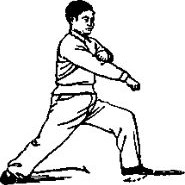
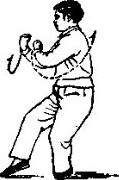
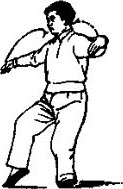
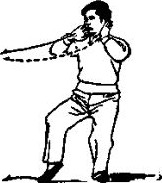
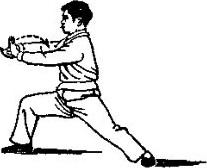
Action two: The body turns left; at the same time, the two palms shift slightly left with the body's turn, the two elbows sink, and the two palms are drawn back to beside the two ears — the right reeling forward and the left reeling reverse — with their centres facing the two cheeks; at the same time the centre of gravity shifts slightly further left, the right toes still touching the ground. (Figure 180) The right foot steps forward half a · 145 · step, and as the centre of gravity moves forward the right leg bends at the knee and becomes solid and the body turns right; at the same time, the two palms drop slightly to the right from beside the two cheeks, and then with the body's turn reel forward and push out; the mind dwells on the two little fingers, the palms' centres facing outward. (Figure 181)
Essential points:
1. The essential point of this form lies in reaching the end point by changing from double reverse opening into double forward reeling. One uses the release of the two backs of the hands and the sinking of the elbows, and by sinking the elbows turns the two palms to beside the two ears, forming the first half of the Embrace-the-Head form.
2. Among those that use the two palms joined to press jin forward, there are three kinds of jin in the first-route fist set: (1) "Six Seals and Four Closings", which is the two hands showing forward a jin of four parts closing and six parts sealing; (2) "Double Push Hands", which is the two hands pushing jin out forward with the heels of the palms; (3) "Embrace the Head and Push the Mountain", which is the two hands pressing forward, storing slightly, opening into a big step with the right knee in a bow stance, the buttocks not extending or contracting, and issuing jin from the spine.
3. These forms that press the two palms forward differ in their inner jin, as stated above. In addition, while pushing the mountain and releasing jin, one must also use exhalation (emitting a "xu" sound) to match the sinking down of the heels of the palms and let it out together, so that the push of the mountain is exactly right.
Action one: The body turns right. At the same time, the left hand reels forward and turns over, extending slightly forward so that its centre faces up; the right hand reels forward, bending its elbow and drawing in to the upper side of the left arm. At the same time one coordinates with the left knee reeling inward and the right knee reeling outward. (Figure 182) The body turns slightly left. At the same time, the right palm reels forward and turns, turning its wrist and reeling reverse, and pushes out with the palm held sideways; the left palm reels forward, bending its elbow and drawing in to before the chest with its centre facing upper-right. At the same time one coordinates with the right knee reeling outward and the left knee reeling inward (completing the first palm change). (Figure 183)
Action two: The body turns slightly right again. At the same time, the left palm, going up past before the chest, reels forward and turns into reverse reeling, pushing out with the palm held sideways; the right palm reels forward, bending its elbow and drawing in to before the chest with its centre facing upper-left. At the same time one coordinates with the right knee reeling outward and the left knee reeling inward (completing the second palm · 146 · palm). (Figure 184) The body turns slightly left, the right knee bows further forward; at the same time, the right palm, going up past before the chest, reels forward and turns into reverse reeling, pushing out with the palm held sideways; the left palm turns its arm and reels forward, dropping with its centre slanting inward-right. At the same time one coordinates with the right knee reeling outward and the left knee reeling inward (completing the third palm change). (Figure 185)
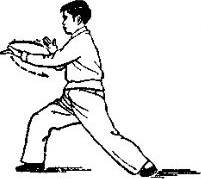
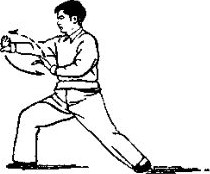
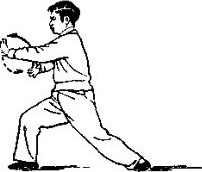
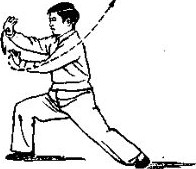
Essential points:
1. This form is performed without moving the feet, and without any big opening or closing; it changes hand technique only within a very small range before the chest. Its turning of the arm to draw back is forward reeling, and when it turns to push it is reverse reeling — this is the characteristic of the palm change.
· 147 · 2. In the course of the three palm changes, one must not only attain the requirement of "when one part moves, no part is unmoved" within this small range before the chest, but also have no flaw in the ward-off jin (no concavity or convexity in the form, no interruption in the jin) during the left and right changes of the changing head; the crux lies entirely in the transformation within the chest and the waist.
3. In the three palm changes, the first is pushed out with the right palm, the second with the left palm, and the third again with the right palm; it forms three conversions without changing the leg. During the conversions, because of the alternation of waist and buttocks and the screw rotation of the legs, the substantial and insubstantial of the jin in the waist, crotch and legs also converts three times, so that it still meets the requirement that upper and lower follow one another; but one leg supports the whole body rather long, so the amount of exercise is greater. This form can not only raise the physical-training effect but also raise the transforming-jin skill for combat (this is a masterpiece of Teacher Chen Fake's later years).
The movement is the same as action two of the fourth form, "Six Seals and Four Closings". (Continuing from figures 18–20)
Essential points:
See the essential points of the fourth form, "Six Seals and Four Closings".
The movements and essential points are the same as the fifth form, "Single Whip". (Continuing from figures 21–26)
Action one: The body turns slightly left, the centre of gravity shifting slightly further left. At the same time, the right hook hand becomes a palm, bending its elbow and turning its arm, raising the forearm upright and reeling forward to before the face with its centre facing upper-left; the left hand reels reverse and presses to the lower left, its centre facing down. (Figure 186)
Action two: The centre of gravity shifts right; with the right heel as pivot, the body turns right and the right toes turn outward; the left foot is lifted and, with the body's turn, drawn close beside the right foot, touching with its toes beside the right foot. At the same time, the right hand turns its arm and reels reverse, spreading outward in an arc to the right with the palm held sideways, its centre facing outward; the left palm turns its arm and drops, moving right in an arc with the body's turn, its centre facing right. (Figure 187)
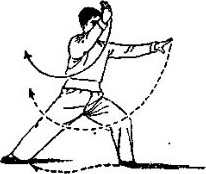
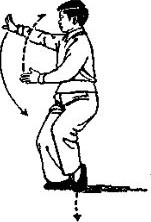
· 148 · Essential points:
The movements of this form are like dancing while holding a long spear, the two arms forming a closing jin. First the left palm, like holding the spear shaft, leads up to the upper left, and the right palm, at the right and to the upper left, holds across like holding the spear pole, carrying the right leg up; at this moment the skin on the left side of the waist is tight and the right side is relaxed — this is a special movement that uses the waist to give a feeling of comfort.
Action one: The left foot steps out sideways to the left, the centre of gravity immediately shifting left with the left leg in a bow stance. At the same time, the left hand turns its arm and reels reverse, turning over to the upper left with its centre facing outward; the right palm turns its arm and reels forward, dropping from the right with its centre facing lower-left. (Figure 188)
Action two: The body turns left, the centre of gravity continuing to shift left, and the right foot is drawn close beside the left foot, touching with its toes before the left foot;
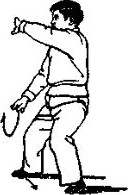
· 149 · the left hand reels reverse one circle. (Figure 189) The body turns slightly right. At the same time, the right palm turns its arm and reels reverse, turning over in an arc with its centre facing outward; the left palm turns its arm and reels forward, moving right in an arc from above downward, the two hands holding jin together above and below on the right side. (Figure 190)
Essential points:
1. The main point of Front Move is a single turn after the right palm supports; practising this turning jin raises the function of the right side of the waist, while Rear Move raises the function of the left side of the waist — hence they are called Front and Rear Move together, and may also be combined into a single fist form.
2. Front Move is placed after Single Whip; joined with Rear Move, it is also called Slanting Single Whip, meaning that after Single Whip one immediately performs a slanting-form Single Whip. It uses a small body method to knead and move the waist and spine. The emphasis is on flexible left-right alternation, giving one a sense of round-and-live interest.
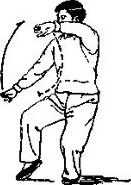
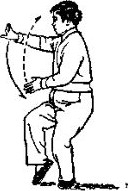
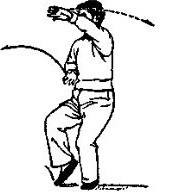
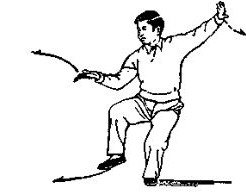
Action one: The left hand turns its arm and reels reverse, going up past before the chest and turning over to the upper left with its centre facing left; the right hand turns its arm and reels forward, going down from the right, bending its elbow and lifting up to the right with its centre slanting inward-up, the two hands holding jin together above and below on the left side; the centre of gravity is still on the left foot. (Figure 191) The body squats slightly, the right foot moving slightly forward with its toes lifted off the ground. At the same time, the left palm goes to the left rear · 150 · Action two: The body turns left; at the same time, the right palm bends its elbow and turns its arm, reeling forward to before the face, while the left palm turns its arm, bending its elbow slightly and reeling reverse to press to the lower left; the centre of gravity is still on the right leg. (Figure 194) With the right heel as pivot, the toes turn outward and the body turns right. At the same time, the right palm turns its arm and reels forward, turning up to the upper right and spreading outward with its centre facing forward-down; the left palm draws an arc forward with the body's turn. (Figure 195) The body continues to turn right, the right toes continue to turn outward, the whole centre of gravity shifts onto the right leg, and the left foot is lifted forward. At the same time, the right palm, following the body's turn, reels reverse and spreads sideways in an arc to the right rear (east); the left palm drops slightly, turning its arm and bending its elbow to lift forward-up. (Figure 196) The left foot moves forward · 151 · stepping forward; as the centre of gravity moves forward the left leg forms a bow stance and becomes solid. At the same time, the left hand reels forward and lifts forward following the forward movement of the centre of gravity; the right hand reels reverse and props outward to the rear at shoulder height with its centre slanting rear-down, completing the second Wild Horse Parts Its Mane. (Figure 197)
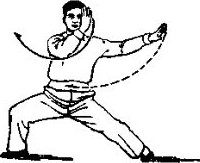
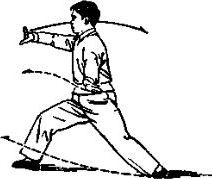
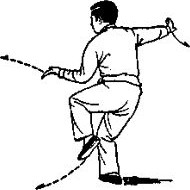
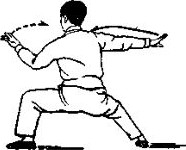
Action three: The body turns right, the centre of gravity shifts slightly left, and the left leg bows further forward; at the same time, the left palm follows the body's turn, reeling reverse and turning over to press out to the left front, and the right palm reels reverse and draws in from the right in an arc to before the chest. (Figure 198) The body turns right, the centre of gravity shifts right, and the right leg forms a bow stance. At the same time, the left palm turns its arm and reels forward, pressing right past before the chest; the right palm turns its arm and reels reverse, spreading out to the right with its centre facing right. (Figure 199) The body turns slightly left, the centre of gravity shifts left, and the left leg forms a bow stance. At the same time, · 152 · the right palm reels forward and falls to before the right abdomen with its centre facing left-front; the left palm goes down past before the chest, reeling reverse, bending its elbow and lifting to the left up to shoulder height with its centre facing left. (Figure 200) The body turns slightly right, the centre of gravity shifts right, and the right leg forms a bow stance; at the same time, the left palm reels forward, reeling down from the left to before the abdomen, and the right palm reels reverse to the right up to abdomen height, the back of its centre slanting to the lower right-rear. (Figure 201) The body turns left, the left toes turn outward, the centre of gravity shifts left, and the left leg forms a bow stance. At the same time, the left palm reels forward, bending its elbow and wrist, turning out to the left in an arc past before the chest with its centre turning to face inward-up; the right palm, from the right past before the face, reels reverse and extends to the left with its centre edge facing forward-down. (Figure 202)
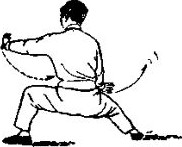
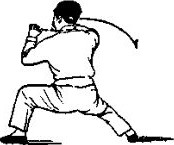
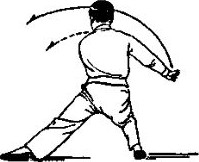
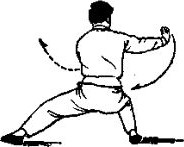
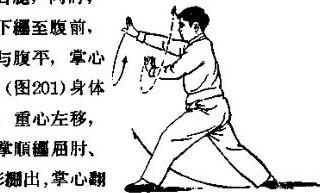
· 153 ·
1. Wild Horse Parts Its Mane is a great spreading body method that makes the qi reach the four tips, like a wild horse galloping without restraint. The sole requirement of this form is that the skin and muscle on both sides of the chain of vertebrae from below the chin down to the spine must have the meaning of a double opening-and-separating jin, as a horse parts its mane; for in this part of the body "lengthening is easy but separating is hard", and the movement is so slight that it is difficult to separate it, so one must practise repeatedly to left and right.
2. This form most easily shows the great forward and reverse reeling-silk jin. Under the requirement of standing upright, centred, at ease, and supporting the eight directions, all its movements must relatively show the Taiji six reeling-silk jins; the two hands turn with this one up and that one down, this one down and that one up, this one inside and that one outside, this one outside and that one inside, this one forward-reeling and that one reverse-reeling, this one reverse-reeling and that one forward-reeling, opening containing closing and closing containing opening. Hence it can well serve as one example representing the Taiji six reeling-silk jins.
3. Taiji demands that all movements be governed by the waist and spine, so that the qi adheres to the back of the spine is the core of the movement. But the back of the spine (such as the seven vertebrae of the neck region) is the hardest part to separate and knead; therefore this fist form was included in the set precisely to meet this requirement.
The movement is the same as action two of the twenty-ninth form, "Six Seals and Four Closings". (Figure 203, continuing from figures 19–20)
Essential points:
See the essential points of the fourth form, "Six Seals and Four Closings".
The movements and essential points are both the same as the fifth form, "Single Whip". (Figures 21–26)
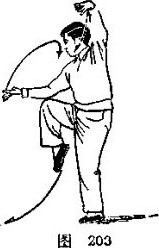
· 154 ·
Action one: The body turns left, the centre of gravity shifts left, the left leg forms a bow stance, and the right leg extends slightly without straightening. With the body's turn, the right hook hand becomes a palm and reels forward, reeling from the right down past before the abdomen to the left to before the left flank (note: the inner jin is not lost and not flattened), its centre facing left; the left hand reels forward and extends to the left with its centre facing down. (Figure 204) The body turns right, the centre of gravity shifts right, the right leg forms a bow stance, and the left leg extends without straightening. At the same time, the right palm turns its arm and reels reverse, going up from before the left flank past before the face and spreading out to the right with its centre facing forward; the left palm turns its arm and reels reverse, bending its elbow and lifting slightly with the body's turn, its centre facing up. (Figure 205)
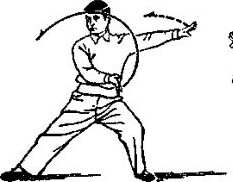
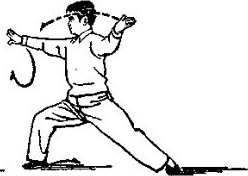
Action two: The body continues to turn right, the left toes turn inward, the centre of gravity shifts back onto the left leg, and the right foot draws in slightly, touching the ground with its toes. At the same time, the left palm, from the left past before the face, reels reverse and drops to the upper side of the right elbow; the right palm turns its arm and reels forward, going down from the right and sweeping forward-up to before the chest. (Figure 206) The two hands reel reverse before the chest, leading the whole body up with reeling-silk jin, lifting the right leg, as the left foot pushes off the ground and leaps up. (Figures 207–208) The two feet land left first and right after (hence also called Double Landing Foot), stamping the ground and shaking the foot, the left heavy and the right light; the two palms press down as the foot stamps, their centres turning to face down. (Figure 209)
Essential points:
· 155 · 1. The inward closing of figure 207 is for storing jin, to strengthen the elasticity of the body's limbs and trunk's ward-off jin; one must, with the leading jin of the two arms slightly spread and closing and the upward springing jin of the left leg, use a single leading of the body's limbs to leap up, and then land naturally one after the other.
2. The function of the foot stamp has already been seen in essential point 3 of the second form, "Vajra Pounds the Mortar". In addition, in the old society, if someone had been injured by such techniques as "joint locking, seizing, grasping and closing" so as to fall into a swoon or become dull-witted, the usual way to restore them to normal was to lift the patient's body upright and bump it down onto the ground; the shock could restore the circulation in some part.
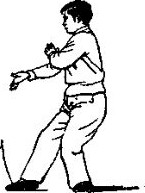
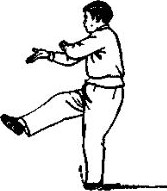
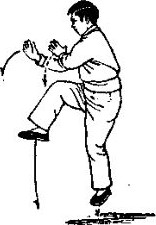
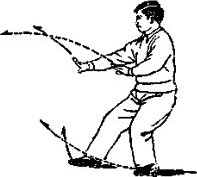
· 156 ·
Action one: The right foot lifts slightly, the right hand raises slightly, and the left hand coordinates before the chest to hold jin together (the posture is like figure 206). The right foot leaps forward half a step; at the same time, the right palm pushes forward level and issues jin, and leads the left foot to leap forward a big step, the body turning right accordingly, and the left palm also pushing forward accordingly (forming the process of both feet leaving the ground, as in figure 210; if one is old and weak, one may omit the airborne process, as in attached figure 210). The body, in the air, continues to turn to the right rear through 270 degrees; the left foot lands, and then the right foot also lands in a crosswise step to the right with the body's turn; at the same time, the two hands — the right reeling forward and the left reeling reverse — the right hand to the upper right and the left hand to the lower left, open out apart, forming opening jin. (Figure 211)
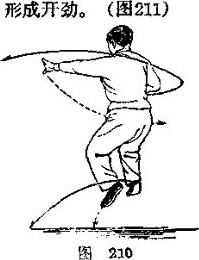
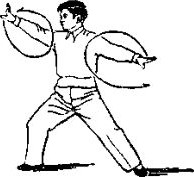
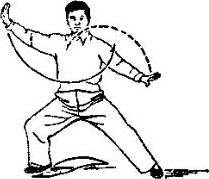
· 157 · Action two: The body turns square to the left (facing south), the left knee bending slightly; the two palms close with forward reeling and separate with reverse reeling, the right up and the left down. (Figure 212)
Essential points:
1. This form joins two movements into one. Its essential point lies in linking up three successive steps — namely, the right foot leaping forward half a step, the left foot jumping forward a big step, and the right foot landing again in a crosswise step. These three steps must be completed in succession, like the shuttle on a loom passing very swiftly through two layers of thread — this is a shuttle jin worthy of the name, and it differs from the movement in the later-developed form of Jade Girl Works the Shuttles with its turnings to the four corners.
2. This form is like a special kind of triple jump, accomplished by rotating the body during the three leap-steps; in combat terms, it is suited to breaking out through an encirclement, breaking out in a posture both attacking and defending.
3. If the practice ground is small, or one is old and weak, or one wishes to reduce the amount of exercise, one may delete the airborne leaping movement and change it to a practice method of turning the body and stepping.
Action one: The whole centre of gravity shifts onto the left leg, the right foot lifts back, and after its toes have touched once beside the left foot, it turns out with the heel against the ground to the right; at the same time the two hands draw arcs, turning from a great opening into a double forward-reeling great closing. (Continuing from figure 12)
Action two is the same as action two of the third form, "Lazily Tucking the Robe". (Continuing from figures 13–14)
Essential points:
The same as the essential points of the third form, "Lazily Tucking the Robe".
The movements and essential points are both the same as the fourth form, "Six Seals and Four Closings". (Figures 15–20)
The movements and essential points are both the same as the fifth form, "Single Whip". (Figures 21–25, then continuing to figure 113)
· 158 ·
The movements and essential points are both the same as the thirty-first form, "Moving Hands". (Figures 114–119)
Action one: The body turns right, the centre of gravity shifts left, and the left knee bows out; at the same time the two palms, joined to each other, reel the right reverse and the left forward, shifting level to the right side of the body at shoulder height, both centres facing right. (Figure 213) The whole centre of gravity shifts onto the left leg, the body rises, and the right foot is lifted, going up from the left past before the chest and swinging across to the right; at the same time, the two palms — the left reeling reverse and the right reeling forward — go from the right shoulder side to the left, the left palm first and the right palm after, moving across to meet and slap the outer side of the right foot's instep, striking with two successive sounds, both palms' centres facing left. (Figure 214)
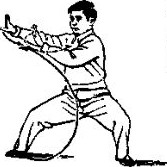
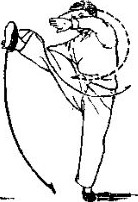
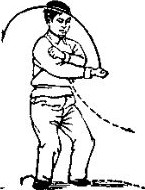
Action two: After the two palms slap the foot's instep they become fists — the left hand reeling reverse inward, going down from the left and drawing an arc to the right past before the chest, and the right hand reeling forward outward, falling before the abdomen, the two arms holding jin together and crossing before the chest with the left fist stacked on the right arm; after the right foot has swung across and fallen from the right, it stamps the ground and shakes the foot beside the left foot, the whole body's qi sinking down, and the left heel lifts slightly. (Figure 215) The right leg bends at the knee and squats, the left toes point up, and it thrusts out to the left with its heel against the ground; the right knee turns inward, the hips loosen, the crotch closes and sinks, and the buttocks, the inner side of the right knee and the rear side of the left leg all touch the ground. At the same · 159 · time, the right fist goes up past before the face and is raised to the right in an arc with its centre slanting to the upper right; the left fist goes down along the inner side of the right arm and extends forward as the left foot thrusts out, its centre facing up. (Figure 216) The body rises forward, pushing off the right leg and bowing the left leg to form a left bow stance. At the same time, the left fist thrusts up forward with its face, its centre facing inward; the right fist turns its arm and reels forward, falling beside the right hip. (Figure 217)
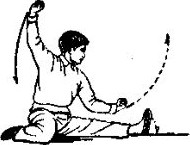
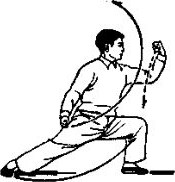
Essential points:
1. This form divides into two stages, the swinging foot and the falling split. In the swinging-foot stage, when the foot swings it looks as though the two hands are going to slap the foot, but in fact the hands and the foot must meet each other; when the right foot swings outward and falls, the body must still be centred and upright, and when the foot stamps the sinking jin must be whole. In the falling-split stage, as far as its combat function goes, it is to guard against an inadvertent fall: one may use the buttocks to sink onto the ground and spring up — that is, push up with the rear foot and thrust up with the left fist (the two must act simultaneously and in unison) — and rise with a bound, gaining the effect of turning defeat into victory.
2. This form is rather hard to do; for those who have studied since childhood it is still easy enough. To suit different people such as the old and weak, and to suit practising on a concrete floor or in Western trousers, this form may also be changed to "Swinging Foot Low Posture" — that is, after swinging the foot, delete the fall of the later stage, changing it to the right leg bending at the knee and squatting while the left leg moves · 160 · a forward lunging low stance, and then perform the movement of figure 218 below.
Action one: The whole centre of gravity shifts onto the left leg, the body turns slightly left, the left leg stands up with its knee bending slightly, and the right leg is lifted with the right instep drawn flat and the toes pointing down. At the same time, the two fists reel forward — the left fist going down from the left front and the right fist going up forward from the right rear — and the two fists cross past each other before the chest; as the right leg is about to lift, the two fists become palms, the right hand reeling forward and lifting up from before the right chest while the left hand reels reverse and presses down (as in figure 222, but with left and right reversed); as the right leg lifts, the right palm reels reverse and opens out to the upper right and the left palm to the lower left, forming the left-style Golden Rooster Stands on One Leg. (Figure 218)
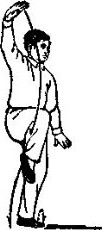
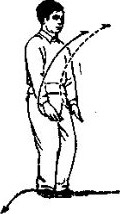
Action two: The left leg bends slightly (storing jin), then springs up with both feet leaving the ground; immediately the two feet land left first and right after, stamping the ground and shaking the foot (the left heavy and the right light; this is the Double Landing Foot), and the two knees bend slightly; the right palm, as the right foot lands, presses down at the same time to before the right hip, and the left palm also presses down to before the left hip. (Figure 219) The body turns slightly right and then turns left, and the right foot steps sideways to the right (south) in a big step, the left leg bending at the knee and squatting. The two palms, as the body turns slightly right, rise from the upper right, and then as the right foot steps out and the body turns left, they pass before the chest to the left with the left reeling reverse and the right reeling forward in a great reeling · 161 · up to shoulder height, both palms' centres facing left. (Figure 220) The centre of gravity shifts right, the left foot is drawn close to the right, touching the ground with its toes beside the right foot, so that the right leg is substantial and the left leg insubstantial; at the same time the two palms reel forward, falling respectively beside the two hips. (Figure 221)
Action three: Next, the left foot is set down solidly, the centre of gravity shifts left, the left leg becoming substantial; then the centre of gravity is shifted back onto the right leg, which again becomes substantial, and the left heel is still lifted off the ground. At the same time, the left palm turns its arm and reels forward, bending its elbow and lifting up, while the right palm reels reverse and presses down in coordination on the right side. (Figure 222) Immediately after, the left leg is lifted, and as the left palm goes to the upper left and the right palm to the lower right, both reeling reverse and opening out, one forms the right-style Golden Rooster Stands on One Leg. (Figure 223)
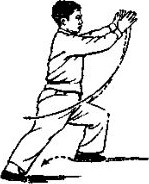
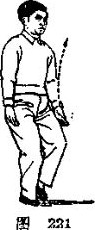
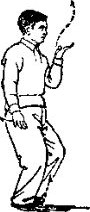
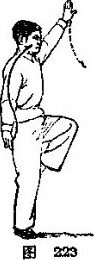
· 162 · Essential points:
1. After the previous form's falling split has sprung up (figure 218), one is ready for this form. The key to doing the stand-on-one-leg well lies in the instep of the lifted leg being drawn flat with the toes pointing down as far as possible, to lighten the weight of the leg hanging as a lever; and in the two arms spreading up and down, left and right, pulling against each other to keep balance — in this way the body can be made stable.
2. Between the first Golden Rooster Stands on One Leg and the second there are four circles, to gain stability in the course of changing position, and then one does the second Golden Rooster Stands on One Leg; in this way the second stand can, storing and then issuing, issue jin up and down together, showing the whole body's ward-off intent bursting outward.
3. Whether the previous form's falling split lands or is changed to a low posture without falling, both rise up from the lowest to reach the highest stand-on-one-leg form; it trains the elasticity of the legs and the lifting jin of the buttocks — this is the characteristic of this form. At the same time, in forming the stand, the crown jin must be suspended, the spirit must be roused, and the qi made to pervade the body, forming the image of "spirited and vigorous".
Action one: The right leg bends at the knee and squats. At the same time, the left palm reels reverse down past before the face; the right palm, from the right upward, turns from forward reeling into reverse reeling, reeling in an arc to beside the right cheek with its centre slanting to the left front. (Figure 224) What follows is the same as explained for figures 87–88 in action one of the twenty-second form, "Step Back and Roll the Arm". (Continuing from figures 87–88, and the front views of attached figures 87 and 88)
Actions two and three are the same as actions two and three of the twenty-second form, "Step Back and Roll the Arm". (Figures 89–91, then continuing to the front view of 88)
Essential points:
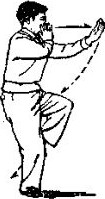
· 163 · The same as the essential points of the twenty-second form, "Step Back and Roll the Arm".
The movements and essential points are both the same as the twenty-third form, "Step Back and Press the Elbow". (Figures 92–95)
The movements and essential points are both the same as the twenty-fourth form, "Middle Plate". (Figures 96–99)
The movements and essential points are both the same as the twenty-fifth form, "White Crane Spreads Its Wings". (Figure 100)
The movements and essential points are both the same as the twenty-sixth form, "Slanting Step and Twist Step". (Continuing from figures 33–38)
The movements and essential points are both the same as the twenty-seventh form, "Flash the Back". (Continuing from figures 101–106)
The movements and essential points are both the same as the twenty-eighth form, "Cover-Hand Forearm Punch". (Figures 107–109, then continuing to figures 52–54)
The movements and essential points are both the same as the twenty-ninth form, "Six Seals and Four Closings". (Figures 110–112, continuing from figures 19–20)
The movements and essential points are both the same as the thirtieth form, "Single Whip". (Figures 21–25, then continuing to figure 113)
· 164 · The movements and essential points are both the same as the thirty-first form, "Moving Hands". (Figures 114–119)
The movements and essential points are both the same as the thirty-second form, "High Pat on Horse". (Figures 120–124)
Action one: Following the opening of the previous form, High Pat on Horse, the left foot is lifted back and touches the ground with its toes beside the right foot, the right leg still substantial and the left leg insubstantial; at the same time, the two palms turn their arms with the left reeling reverse and the right reeling forward, the left palm going from the left up to the right and the right palm from the right down to the left, drawing arcs, and the two hands cross at the wrists before the chest. (Figure 225) With the right heel as pivot, the body turns right, the left toes still touching the ground; at the same time, the two hands reel reverse, shrinking the crossed circle with the left hand inside, the two hands holding jin together. (Figure 226) The body continues to turn right, the right leg bends at the knee and squats, and the left foot is lifted and steps sideways to the left (northeast) in a big step, the centre of gravity shifting left into a left bow stance; at the same time, the two hands reel reverse, the right palm spreading to the upper right and the left palm to the lower left, both centres facing outward. (Figure 227)
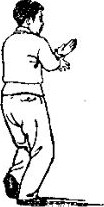
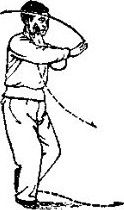
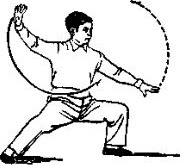
Action two: The body turns slightly left, the centre of gravity continuing to shift left, into a left bow stance. At the same time, the right · 165 · palm turns its arm and reels forward, going down from the right and reeling left past before the abdomen to under the left armpit, its centre facing rear-down; the left palm turns its arm and reels forward, bending its elbow so that the forearm is raised upright with its centre facing upper-right. (Figure 228) The body turns slightly right. At the same time, the left palm reels forward, going past before the neck to the right and closing onto the upper side of the right arm with its centre facing down; the right hand, under the left armpit, reels forward so that its centre turns to face down. At the same time the centre of gravity shifts further left. (Figure 229)
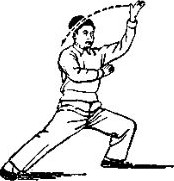
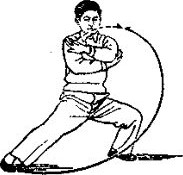
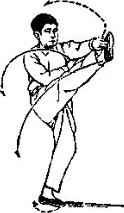
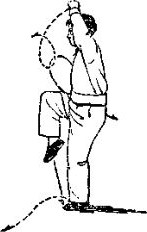
Action three: The right foot is lifted and swings outward to the right in a half circle, going up from the left front; at the same time the left palm reels reverse and moves to the left to meet and slap the outer side of the right foot's instep. (Figure 230) With the left heel as pivot, the body · 166 · the body turns right (west); at the same time the two palms become fists, the left reeling reverse and the right reeling forward; the right fist passes before the chest and goes right and down, while the left fist turns its arm, bends its elbow and, together with the other, issues energy from the left upward; the right fist is at hip height with its centre facing up, and the left fist is slightly higher than the head, with its centre facing right. (Figure 231)
Key points:
1. This posture passes from a tight closing to a great opening; at this time the momentum is required to sink. While turning left the two hips must be linked together — this is opening hidden within closing; afterwards it opens again — this is closing hidden within opening.
2. Because the left palm slaps crosswise against the outer side of the right foot's face, it is called Crosswise Lotus Swing . After the slap, the left fist lifts up and the right fist turns down, both issuing energy at the same time; the coordination of this energy-issue is what brings stability after the turn of the body.
3. In performing Crosswise Lotus Swing one often feels comfortable and the back becomes warm — this is the phenomenon of causing the chi to pervade the whole body.
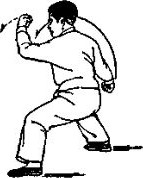
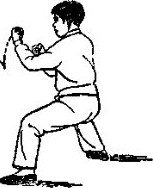
Action one: The left foot springs up slightly to the left, and the right foot falls to where the left foot had been, stamping the ground with a shock; the body turns right, the left foot steps diagonally forward-left (southwest), and the centre of gravity gradually shifts left. As the right foot falls and stamps, the left hand turns its arm and reels forward to the right of the chest; the right fist reels forward from the right upward and falls to the left, resting on the left forearm; as the left foot steps out, the left fist · 167 · reeling reverse as the body turns, rises from before the chest to the right, bends its elbow and raises the forearm, thrusting the forearm slightly forward, the fist's centre facing right; the right fist reels forward and turns over to the side of the right hip, its centre facing forward.
Action two: The body turns slightly right. The left fist turns its arm and reels forward, falling before the chest; the right fist turns its arm and reels reverse from the right upward, passing beside the right ear and falling before the chest onto the inner side of the left arm, the two hands joining their strength. (Figure 233 — this figure shows a side view; in fact the two feet remain where they were, on the spots trodden by the two feet in figure 233.) The body turns left, the centre of gravity shifts left, and the left leg is bent in a bow. At the same time, the left fist turns its arm and reels forward, drawing back to circle at the left ribs, its centre facing inward; the right fist turns its arm and reels reverse, striking out toward the lower front-left and issuing energy. (Figure 234, and the side view of figure 234 in the attached figure.)
Key points:
1. In this posture one must pay special attention to storing energy. When the two fists join strength before the chest, the two hips must be greatly opened, the crotch rounded, and the chi clinging to the back. In such a posture one can most easily check the five bows — the two hand-bows, the two foot-bows, and the back-bow — to see whether they all operate together through the crotch, and whether the backs of the five bows have increased elasticity; that is to say, whether one feels a tautness on the backs of the five bows.
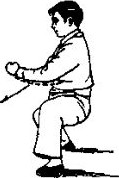
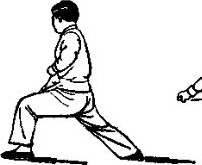
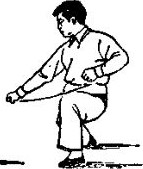
2. This posture is also a movement for practicing "hip striking" , whose source of motive power lies in · 168 · the right hip turns over, and the strength of the right fist is released, pointing at the opponent's crotch.
3. When this posture issues energy, its outward appearance is slanting to the right, as though the outer form were not upright; but the inner strength at the moment of issuing energy lies in the upward leading strength of the left hand leading backward, which is insubstantial, while the right hand that points at the crotch sinking down is substantial, and the right leg is in fact insubstantial. Because of this "upper and lower following one another", the inner strength is adjusted into balance and reaches central uprightness. This is correct central uprightness: though the outer form appears not upright, the inner strength is still central, upright and unbiased.
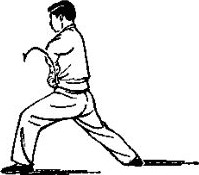
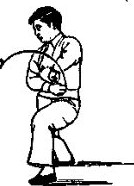
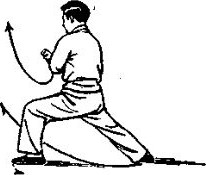
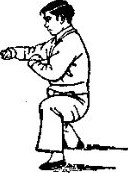
Action one: The body turns slightly left; at the same time the right fist reels reverse and is drawn in to the left, gathering at the left side of the waist, while the left fist reels reverse before the left ribs, cooperating to circle a small round, the two hands joining strength and not collapsing. (Figure · 169 · 235, and the side view of figure 235 in the attached figure.) The body turns right, the centre of gravity shifts right and then still shifts back to the left. At the same time the two hands reel reverse, moving from the left forward to before the chest at chest height; as the centre of gravity shifts back onto the left leg, the two fists turn over inward and outward, reeling and joining strength. (Figure 236, and the side view of figure 236 in the attached figure.)
Action two: With the left heel as the pivot, the body turns left, the right leg is lifted, the top of the right foot is stretched flat and the toes point down. At the same time the right fist turns its arm and reels forward, and as the right leg is lifted it spirals and thrusts upward from the right and below, rising to eye height, its centre facing inward; the left palm turns its arm and reels reverse one circle, gathering and placing at the left side of the waist. (Figure 237)
Key points:
1. In this posture, from "the left reeling reverse inward and the right reeling forward outward" one must, without hollows or bumps, make the body spiral upward evenly; the two hands turn into upward-and-downward forward-and-reverse reeling silk, reeling the right fist to before the face and the left fist to the waist, and this must be completed without the least flaw. This is the emphasis of this posture.
2. In this posture one must master the spiral ascent after the double joining. Moreover, the left hand placed at the left side of the waist must perform a correct reverse reeling, reeling back from the outer left to the waist — this is also the key to making the left leg stand upright, central and steady.
Action: The body turns slightly left, the right foot steps forward-right; at the same time the two fists become palms, reeling forward and turning over, placed respectively beside the two ears with the palm centres slanting outward. (Continuing from figure 19.) What follows is the same as the description in the latter part of action two of Posture 4, "Six Seals and Four Closes". (Figure 20)
Key points:
See the key points of Posture 4, "Six Seals and Four Closes".
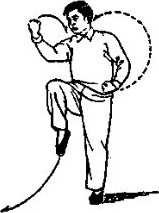
· 170 · Form Seventy-six: Single Whip The movement and the key points are the same as those of the fifth form, "Single Whip". (Figures 21–26)
Form Seventy-seven: Sparrow Dragon on the Ground (Que Di Long) Action one: The body turns left, the left leg forms a forward bow. At the same time, both hands change into fists and reel reverse; the right fist goes from the right downward, passes before the belly and sweeps up to the left, the fist's centre facing up; the left fist closes to the right onto the upper side of the right arm, the fist's centre facing inward, the two hands joining their strength. (Figure 238) The centre of gravity turns right, the body turns slightly right, the right leg bends at the knee and squats down; at the same time, the two hands reel forward on the right and reverse on the left, the left fist going from the inner side of the right arm to the left and downward, the right fist going from the outer side of the left forearm to the right and upward, each opening out separately, the left fist extending to above the left knee, the left fist's centre facing upper right, the right fist's centre facing upper right. (Figure 239)
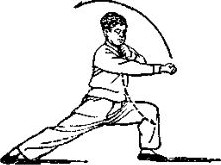
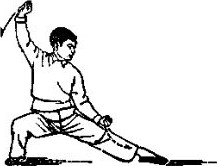
Action two: The body turns slightly left, the left leg sinks down into a crouching leg, the right leg continues to squat down; the left fist extends forward to above the left ankle, the fist's centre facing up, the right fist sinks slightly; the eyes look level ahead. (Figure 240) The left toes turn out, the body rises forward, the right leg pushes, the left leg bows, forming a left bow step. At the same time, the left fist thrusts up and forward with the face of the fist, the fist's centre facing inward; the right fist turns its arm and reels forward, falling beside the right hip. (Figure 241)
Key points: 1. The difference between this form and the Drop-into-Split is only that one does not fall; it is that the right fist, turning its arm and going from above · 171 · When thrusting to the right, the rear right leg does not touch the ground, but one must squat down as far as possible; in all other parts the requirements are the same as those of Drop-into-Split.
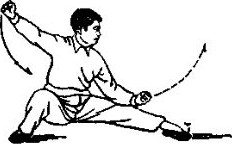
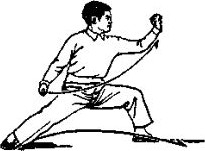
2. This form, like Drop-into-Split, may, to suit different people, be changed so that the left calf does not touch the ground while one crouches as low as possible, in the manner of figure 239. 3. In this form one first makes the double-closing Ward-off energy; after warding off, one releases it (using centrifugal force), and when it has opened to the extreme and gone to the lowest, one then uses the centripetal force of the two hands closing again after the release, applying the energy to the right fist, which serves to lead the body up.
Form Seventy-eight: Step Up to the Seven Stars Action: The left toes turn out, the body turns left, the centre of gravity moves forward so that it is entirely on the left leg, and the right foot steps forward half a step, touching the ground with its toes. As the body turns left, the left fist reels forward and closes inward; the right fist reels forward, and from the right downward, as the right leg steps up, thrusts up forward past the outer side of the left wrist, the two fists crossing at the wrists, both fists' centres facing inward. As the right foot steps up and touches the ground with its toes, the two fists, using the crossing point where the wrists are pressed tightly together as an axis, describe a small circle from above inward, downward and forward, then change into palms and extend slightly forward. (Figures 242–243)
Key points: 1. Every form of Taijiquan, when practised, requires that if one part moves, no part is still;
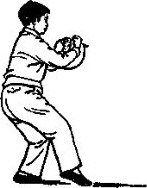
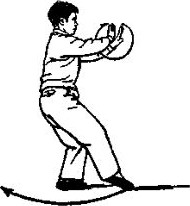
· 172 · and in every form there must be a main part of the movement; in this form it is the wrists, so the wrists are well trained. Of course in other forms the wrists are also active, and in this form the other parts are also active; here we speak only of which part is the main one. 2. Because Taijiquan requires that when the opponent moves quickly one responds quickly and when he moves slowly one follows slowly, and one must also adhere, connect, stick and follow, discarding the faults of butting, collapsing, losing and resisting, there are therefore more opportunities to apply joint-locks and holds on each other; this form is a kind of turning method for escaping when both hands are seized.
Form Seventy-nine: Step Back and Bestride the Tiger Action one: The two palms, before the chest, still use the crossing point where the wrists are pressed tightly together as an axis, and go from the front downward, inward and upward, still rolling the wrists back; at the same time, as the two palms turn over, and using the left heel as an axis, the body turns right (south) and the right foot steps back one step. (Figure 244) The two arms close slightly, and after contracting the crossing circle a little, give the two palms a shake, and they separate to the lower left and lower right, both palms' centres facing down. (Figure 245)
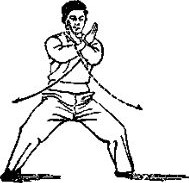
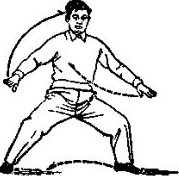
Action two: The centre of gravity shifts right, the left foot is drawn close to the right foot, touching the ground with its toes beside the right foot; at the same time the two hands reel reverse on the right and forward on the left, the right palm going from the right upward and describing an arc before the face, the left palm going from the left upward and describing an arc before the belly, the two hands joining their strength above and below. (Figure 246) The body turns slightly · 173 · squats down; at the same time, the two palms turn their arms and reel reverse, the right palm opening out to the upper right and the left palm to the lower left, the right palm's centre facing obliquely upper right and the left palm's centre facing obliquely lower left, forming Bestride the Tiger. (Figure 247)
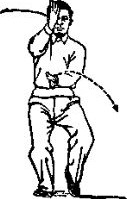
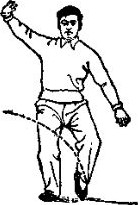
Key points: 1. The only form in this set that retreats continuously is Repulse the Monkey, and the only one in which, after stepping forward, one immediately steps back one step is Step Back and Bestride the Tiger. The preceding form follows the requirement of energy and steps forward, while this form likewise follows the giving of energy and steps back. This is a method of practising one advance to one retreat.
· 174 · 2. In the preceding form the two wrists roll from below inward and forward, and there is naturally a Ward-off energy issuing; in this form, after turning back through one circle, one gives a sudden shake, an energy like slipping off a handcuff, and then the two separate and open, while at the same time the breath and the blocking energy must sink down.
Form Eighty: Turn the Body and Double Sweep the Lotus Action one: Using the right heel as an axis, the body turns 180 degrees back to the right, and the left foot is lifted and swings back to the right with the turn of the body. At the same time, the right palm, with the turning of the body, also revolves horizontally through 180 degrees, reeling reverse and lying crosswise at the upper right, the palm's centre facing right; the left palm reels forward and sweeps horizontally back to the right until it is before the right elbow, the palm's centre facing right. (Figures 248–249)
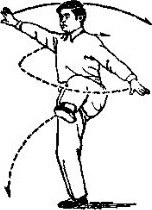
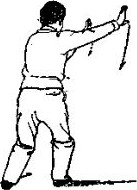
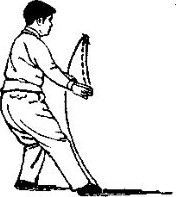
Action two: The left foot steps down forward (northwest) on a diagonal, and as the centre of gravity shifts left, the left leg bends at the knee and squats down while the body turns right at the same time; at the same time the two palms reel reverse on the left and forward on the right and sink slightly from the right. (Figure 250) The centre of gravity moves entirely onto the left leg, the body stands up, the right foot is lifted and swings crosswise to the right, going from the left upward, past the chest and upward; at the same time the two palms, reeling reverse on the left and forward on the right, move from right to left, the left palm first and the right palm after, sweeping crosswise to meet and slap the outer side of the right foot's instep, striking two sounds in succession, both palms' centres facing left. (Continuing to figure 214, only the direction is slightly different; in the figure the posture's chest faces south, whereas in this form the chest should face the northeast diagonal)
Key points:
· 175 · 1. In every turning movement in which one leg stands alone and one leg is lifted, one must, in the course of the turn, show both stability and that if one part moves no part is still. The key lies in the two arms closing and then opening (closing is both reeling forward, and when it turns to opening it becomes both reeling reverse); the opening energy carries the body round, and this is because the balancing action of the reverse reeling opening in opposite directions brings the body to stability. 2. Moreover, to gain stability one must also stand with the body centred and upright. And the key to being centred depends on the top energy being suspended empty; if the top energy is not suspended emptily, but leans slightly, one immediately cannot be stable, because the head occupies the highest peak of the body, and a slight lean above greatly affects the degree of lean of the whole body below. Therefore every movement of Taijiquan must have the top energy suspended empty; thus one not only reduces the weight of the head pressing down, but also produces the effect of correcting any lean.
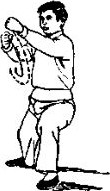
Form Eighty-one: Cannon Fired Point-Blank Action one: The right foot, after the outer swing, steps down toward the right rear (south); at the same time the two palms change into fists, turn their arms and reel forward, chopping down, then turn to thrust slightly forward and upward, the two fists' centres facing each other, the left fist in front and the right fist behind; with the thrusting fists the left knee forms a forward bow. (Figure 251) Action two: The centre of gravity shifts back, the right leg bends at the knee and squats down, becoming substantial, the left knee bends slightly, the body · 176 · turns right; at the same time, the two fists turn their arms and reel forward, going from the front downward, inward and upward, and are drawn back in an arc to the side of the right ribs, the left fist's centre facing inward and the right fist's centre facing left (Figure 252); the centre of gravity moves forward, the left leg bows and the right leg pushes to form a left bow step, the body turning slightly left; at the same time, the two fists turn their arms and reel forward with a shaking energy, the two elbows bending slightly, the left fist held somewhat crosswise in front, the left fist's centre facing inward and the right fist's centre facing left. (Figure 253)
Key points: 1. The whole set of Taijiquan begins with a civil image and ends with a martial image, so when one has practised to this form, Cannon Fired Point-Blank, one must, "with spirit and energy soaring", display the four energies of scattering, releasing, storing and issuing, and exert all one's ability to bring the four energies into play. ① 2. In this form one must make a last check of the dynamic aspect of Taijiquan energy, that is, whether in the course of scattering and releasing one has departed from the silk-reeling energy of Taijiquan; whether, in storing and issuing, the root is in the foot, and whether it reaches the two fists from the heel. 3. The energy issued in this form is shaking energy; shaking energy is a kind of short-range splitting energy. Shaking energy must display a startling energy like a spark landing on the skin, and must come out in a single shake.
Form Eighty-two: Diamond Pounds the Mortar Action one: The centre of gravity shifts back, the right leg bends at the knee and squats down, the right leg becomes substantial, the body turns right; at the same time, the two hands, reeling reverse on the left and forward on the right, open out toward the right rear, the palms' centres facing right rear, the fingers stretched out and not limp. (Continuing to figure 4, only the left foot is different; in the figure the left foot is off the ground, whereas in this form the left foot is set down emptily on the ground, and the direction is also different: the second form, "Diamond Pounds the Mortar", is performed with the chest facing south, whereas this form is performed with the chest facing north) Action two: The centre of gravity moves forward; at the same time the two palms, still reeling reverse on the left and forward on the right, move toward the right
- ① "Bumping" is the contraction of a large circle into a small one, generally used for strong energy, manifested in "going"; when it has gone to the end of the silk reeling, it becomes "storing" energy. "Releasing" is the expansion of a small circle into a large one, generally used for strong energy, manifested in "sticking"; when it is released into the opponent's empty place, it becomes issuing energy.
· 177 · afterwards continues to open slightly and sink down. (Continuing to figure 5, only the north-south direction is reversed) Then the same as the explanation of action two of the second form, "Diamond Pounds the Mortar", figure 6. (Continuing to figure 6, only the north-south direction is reversed) Action three is the same as action three of the second form, "Diamond Pounds the Mortar", only the direction is different, north and south being reversed. (Figures 7–8)
Key points: The first "Diamond Pounds the Mortar" within the set of the Chen-style First Road Taijiquan shows the five pairs of forward and reverse silk reeling of Taijiquan embodied in the beginning of the movement; the second "Diamond Pounds the Mortar" shows the end of the second form; the third "Diamond Pounds the Mortar" shows the end of the fifth form; this form is the fourth "Diamond Pounds the Mortar", showing the end of the whole set. Its key points are the same as those of the second form, "Diamond Pounds the Mortar".
Form Eighty-three: Closing Action: The body stands up, the two knees bending slightly; at the same time the two hands reel reverse and hang down separately to the two sides, left and right, both palms' centres facing back, restoring the preparatory posture. (According to figure 1)
Key points: 1. In returning to the static posture, one must still check once through the key points given in the preparatory form. 2. After finishing practice, according to the degree to which one's breathing rate has increased, one can judge how well one has "moved the body with the breath" during practice, and whether the regulation of the breath has been up to standard. If panting occurs, one should check whether the coordination of movement and breath is natural. 3. The Chen-style First Road Taijiquan and the Second Road Cannon Fist both begin practice, hypothetically, facing south, and both face north when closing. If one practises the First Road or the Second Road twice in succession, or practises the First Road and the Second Road in direct succession, then at the final closing one can return to facing south.
· 178 · Chapter Three: Illustrated Explanation of the Chen-style Taijiquan Second Road Order of the Names of the Forms of the Chen-style Taijiquan Second Road Form 1 Preparatory Posture Form 14 Slant the Body and Punch Form 2 Diamond Pounds the Mortar Form 15 Slicing Hand Form 3 Lazily Tuck in the Robe Form 16 Turn the Flower and Dance the Sleeves Form 4 Six Seals and Four Closures Form 17 Cover the Hand and Strike with the Forearm Form 5 Single Whip Form 18 Flying Step and Twist-the-Phoenix Elbow Form 6 Ward Off and Bar the Elbow Form 19 Moving Hands (first three) Form 7 Guard the Heart and Punch Form 20 High Pat on Horse Form 8 Twist the Step and Walk Aslant Form 21 Moving Hands (last three) Form 9 Settle the Waist and Press the Elbow Fist Form 22 High Pat on Horse Form 10 Draw Straight Up from the Well Form 23 Continuous Pearl Cannon (one) Form 11 Wind Sweeps the Plum Blossom Form 24 Continuous Pearl Cannon (two) Form 12 Diamond Pounds the Mortar Form 25 Continuous Pearl Cannon (three) Form 13 Shield the Body and Punch Form 26 Riding the Qilin Backward · 179 · Form 27 White Snake Spits Out Its Tongue (1) Form 50 Cover-Hand Forearm Punch Form 28 White Snake Spits Out Its Tongue (2) Form 51 Left Thrust Form 29 White Snake Spits Out Its Tongue (3) Form 52 Right Thrust Form 30 Sea Bottom Turns Over the Flower Form 53 Upside-Down Thrust Form 31 Cover-Hand Forearm Punch Form 54 Sea Bottom Turns Over the Flower Form 32 Turn Body Six Harmonies Form 55 Cover-Hand Forearm Punch Form 33 Left Wrapping Firecracker (1) Form 56 Seize Both Forearms (1) Form 34 Left Wrapping Firecracker (2) Form 57 Seize Both Forearms (2) Form 35 Right Wrapping Firecracker (1) Form 58 Linked Cannon Form 36 Right Wrapping Firecracker (2) Form 59 Jade Girl Works the Shuttle Form 37 Beast-Head Posture Form 60 Four Heads Block the Gate Cannon Form 38 Splitting the Frame Form 61 Jade Girl Works the Shuttle Form 39 Turning Over the Flower, Dancing Sleeves Form 62 Four Heads Block the Gate Cannon Form 40 Cover-Hand Forearm Punch Form 63 Slant-Body Punch Form 41 Subdue the Tiger Form 64 Twisting Phoenix Elbow Form 42 Wipe the Eyebrow Red Form 65 Following Phoenix Elbow Form 43 Right Yellow Dragon Stirs the Water Three Times Form 66 Piercing-Heart Elbow Form 44 Left Yellow Dragon Stirs the Water Three Times Form 67 Cannon in the Nest Form 45 Left Heel Kick Form 68 Well-Barrier Straight Entry Form 46 Right Heel Kick Form 69 Wind Sweeps the Plum Blossoms Form 47 Sea Bottom Turns Over the Flower Form 70 Buddha's Warrior Attendant Pounds the Mortar Form 48 Cover-Hand Forearm Punch Form 71 Closing Posture Form 49 Sweeping Lotus Leg (Twisting Shin Cannon)
· 180 · Chen-Style Taijiquan, Second Routine The "Second Routine" of Chen-style Taijiquan is the second set of forms, commonly called the "Second Set" and also known as "Cannon Fist" . The Second Set runs from the start all the way to the first Single Whip: that is, from the Preparatory Posture, Step-Up Buddha's Warrior Attendant Pounds the Mortar, Lazy Tying the Robe, Six Sealing and Four Closing, through to Single Whip — these five movements are exactly the same as in the First Routine. These five movements are repeated first so that the body performs several soft postures to stretch the sinews and bones, adapting it for the demands of the Second Set. Therefore, the movement descriptions of the Second Routine in this chapter begin after the first Single Whip (chest facing south). The description of the four postures before Single Whip is given in full under the First Routine and is not repeated here. For convenience of exposition, figures 1–26 and their descriptions from the First Routine diagram are not repeated in the Second Routine's diagrams; of these, figure 26 is here listed as figure 1 of this diagram section. Explanations of the diagrams are likewise given in full under the First Routine.
Form Six Pieh-Lan Elbow (Slanting Parry Elbow) (chest facing south)
Movement: The center of gravity shifts slightly to the right; at the same time, the right hooked hand on the right side changes into a fist with a small forward reeling, with the fist-heart facing up, and the left palm changes into a fist, reeling backward from the left downward to the front of the chest. Immediately afterward the center of gravity shifts left; as it shifts left, the left fist passes across the front of the chest and strikes leftward with a horizontal blow using the fist-eye to issue power, and the right fist strikes from right to left likewise with a horizontal blow using the fist-eye to issue power — the left fist-heart facing up, the right fist-heart facing down. (Figure 2) The center of gravity shifts right; as it shifts right, both hands — the left reeling backward, the right reeling forward — strike from left to right with horizontal blows using the fist-eyes to issue power, the left fist-heart facing down, the right fist-heart facing up. (Figure 3)
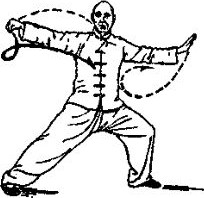
Key points:
This posture has two issuings of power, left and right, which must be performed in immediate succession. In the transition from Single Whip to the leftward issuance of power, the center of gravity must first shift slightly right, and then power is issued, in order to meet the requirement of "store first, then issue." When issuing power, the movement of the center of gravity and the power of the two fists must be as one, so that the power is whole.
Form Seven Guard-the-Heart Punch (chest facing northeast)
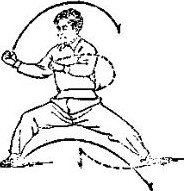
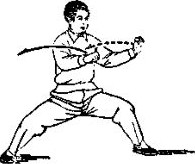
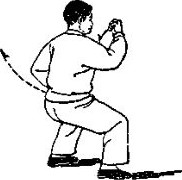
Movement: The entire center of gravity shifts onto the right leg; the left foot lifts, the body turns left, the right foot pushes off the ground and springs up, then the left foot lands, and the right foot follows with a step to the left-front (southeast) diagonal. As the body turns, at the same time, the left fist reels backward and is slightly lifted inward, then follows the turning of the body toward in an arc reeling forward to the left-rear-lower, down to the left side of the waist, the fist-heart slanting toward the upper right; the right fist, first reeling backward then forward, follows the turning of the body from the right upward, passes the front side of the right forehead and goes left, and strikes downward at the same time as the right foot lands. (Figure 4) The left fist reels forward and is raised to the left to the height of the shoulder; the right fist reels forward and draws inward. (Figure 5) The left fist goes from the left forward, passes the outside of the right fist, downward and inward; the right fist goes from the inside outward; the two fists cross past each other before the chest; then both hands reel forward, the left fist draws inward, and the right fist thrusts forward with the back of the fist near the wrist; at the same time the center of gravity sinks. (Figure 6)
Key points:
In Taijiquan movements, whenever a circle is to be enlarged, it must first be made smaller; this is to strengthen the "ward-off" energy , so that under the condition of "qi clinging to the spine" the internal power is threaded through and reaches the root of the palm. When the two hands perform the inside-outside, left-right double backward reeling and open up before the chest, the combining energy arises — right in front, left behind; finally, like the character ∞, the two circles meet before the chest to guard the heart; at the same time the circles are gradually made smaller, forming stored power like a drawn bow, to strengthen the ward-off energy.
Form Eight Slanting Twist-Step Walk (chest toward east, turning to southeast)
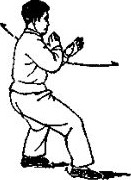
After the above, with the two fists guarding the chest, the two fists open into palms and perform silk-reeling — right forward, left backward — uniting before the chest. At this moment the right hand is above and the left hand below, with the right palm left, with the left palm-heart facing up. Then continue with the double division — right forward, left backward. (Figs. 7, 8, 9) Then the two hands again unite before the chest, but now the right hand has already turned downward and the left hand upward, both palm-hearts facing down. Then the right hand turns up again, the left hand turns left; at the same time the body rises, the right leg is lifted, the left leg stands alone, and the two palms hold the energy together. (Figure 10) When it next turns into issuing , the right foot is brought to the ground with a stamp and becomes full. Then the left foot takes a reeling step toward the northeast, and the right palm reels forward and sinks from front to right. At the same time the left palm reels backward, turning in an arc up to the right; when it turns to the point where the left palm opens to the left, the right palm is just then reeling forward upward to the right ear. At this moment the left leg is full — this is the rising posture. Then the right palm turns half a circle at the right ear and reels backward to release toward the right front.
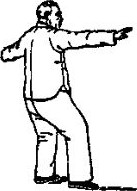
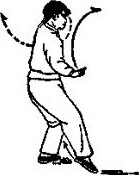
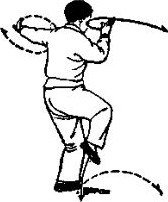
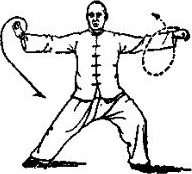
open; at the same time, the left palm, after reeling slightly backward to the right, opens forward to the left, forming a double opening energy. At this moment the chest faces south. (Figure 11)
Key points:
In this posture, when the right foot lands, the right hand opens and the left hand closes; when the left hand turns to open to the left-outside, the right hand again turns to the right ear to close. Because of the left-close right-open and left-open right-close, the internal qi is made to spiral and sink. Finally, when completing this posture, the left and right palms simultaneously open under the double backward reeling; when they have opened to the end, they close again with a double forward reeling. In the double closing, the fingers of both hands must point upward; at the same time, the internal energy of both elbows must also combine. Then, at once, the qi sinks to the dantian, and the center of gravity simultaneously shifts to the right foot. Because of the alternation of opening and closing, together with the stamping of the foot and the rotation of looking left and right, the qi is forced to descend — this is a basic exercise for moving the energy and training the qi to sink, and also the posture in which one most easily feels the qi finally settling in the dantian.
Form Nine Lower-the-Waist, Press-Elbow Fist (chest facing southeast)
Movement: After the two palms of the previous slanting posture have divided, the right palm on the right uses forward reeling; when it turns upward, the palm changes into a fist and is placed above the right knee. At the same time, the left palm on the left uses a small forward reeling on top and becomes a fist facing the right fist from a distance, combining energy at the upper left. The crotch sinks, forming a low round crotch; the foot changes from left-full to right-full. At this moment the chest faces south. (Figure 12)
Form Ten Well-Barrier Straight Entry (chest facing north)
Movement: The left foot is lifted and steps out 180° to the right, turning the chest to face north. The left fist changes to a palm, and with the left foot presses down diagonally from above toward the front-lower of the chest — the energy in the root of the palm. At the same time the right fist reels forward and also changes to a palm as it sinks.
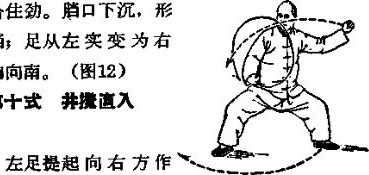
turn over the palm so that its heart faces up and brings it near the left of the waist. When rotating, the waist and spine serve as the central axis. At this moment the right foot is full. (Figure 13)
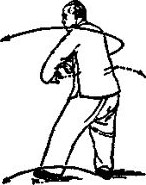
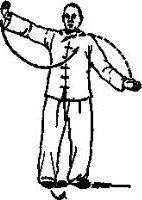
Form Eleven Wind Sweeps the Plum Blossoms (chest facing south)
Movement: After the left hand has completed the 180° press from above downward, the right hand then takes over the left hand's plucking-freeing energy, reeling forward from below and then upward, plucking and turning 180°; when it reaches the upper right, it again turns into a backward reeling and opens. At the same time, the left hand below reels backward and divides to the lower left, forming a double opening energy. At this moment the left foot is full and serves as the central axis of rotation; the right foot, following the body's right turn, takes a cross-step to the west of the left foot. Finally the posture of figure 13 is formed. At this moment both hands have already changed into double backward reeling.
Key points:
The function of the above three postures lies mainly in the right palm of the double opening of Form Eight: supposing it has been seized and held, one therefore, at the same time as making a small forward reeling to change the palm into a fist, follows the essential energy of the pluck, turns and presses downward, twisting the body around. This is the basis for using continuity and following to seek release. In turning the body, the downward-pressing energy of the left palm and the upward-lifting energy of the right palm are used at the same time, making the left and right hands shake up and down as one, in order to achieve the aim of release. In the course of such a large body turn, one must rotate with steady energy; the method is not to permit a flat (horizontal) rotation, but rather to make the rotation go from · 186 · above downward (in the closing), and then again from below upward (in the ward-off opening), so as to achieve, within steadiness, the freeing effect of the backward reeling. This kind of silk-reeling with a large body turn most easily produces the phenomena of "defect," "concavity/convexity," and "break/continuity." Therefore, to avoid the above shortcomings, the key point is to hold the ward-off energy with the two arms connected, and at the same time to use the waist and spine as the central axis, so that one can rotate with tension, producing a rotational momentum like that of a windmill. In the course of rotation, first press and close the energy 180° to the rear-lower, to strengthen its steadiness; at the same time, without stopping, ward-off and open the energy 180° to the rear-upper, finally completing the 360° great body turn. In the use of energy types, the upper half-circle is a closing energy rotating mainly by the left hand; the lower half-circle is an opening energy rotating mainly by the right hand. In this way the internal power continuously manifests outward and reaches the back, and no longer produces such shortcomings as defect.
Form Twelve Buddha's Warrior Attendant Pounds the Mortar (chest facing south)
Movement: When the previous posture is completed, the double opening energy of left and right backward reeling has been used. This posture changes from the opening energy of left-right double backward reeling into the closing energy of left-right double forward reeling, making the qi pour to the little fingers. At this moment the left foot is full. (Figure 15) After closing, it again changes into a double dividing energy of upward-downward backward reeling; when it reaches the end point of right-up left-down, the right palm turns and changes into a fist, then reels forward from above downward; at the same time the left palm reels backward to the front of the lower abdomen, palm-heart facing up; finally there is a closing energy that makes the right fist fall into the left palm-heart; at the same time, when the left foot is full, the right foot is lifted and stamps the ground. (Figure 16)
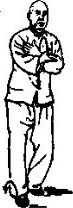
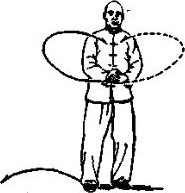
Key points:
After completing the 360° great body turn, the internal qi should be like a wheel agitating in all directions, and afterward descend into the dantian and be pounded solid — this is the main function of this posture. When it changes from the mutual opening and closing of left and right into the mutual opening and closing of above and below together with the foot stamp, the qi can be more firmly pounded solid within the dantian. This foot stamp may be light or heavy; what matters is mainly the ability to use intent and qi to send it down, and not the lightness or heaviness of the stamp itself. Therefore, besides using the sound of the stamp to test whether the power is whole or not, one must also see whether one can achieve the skill of uniting movement and stillness, so as to reach "when there is one stillness, there is nothing that is not still."
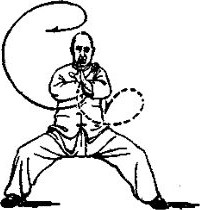
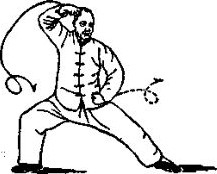
Form Thirteen Shelter-the-Body Punch (chest facing south)
Movement: Beginning from the closing energy after the previous posture, both hands reel backward and divide downward to left and right; at the same time as the double opening, the right leg takes a half-step sideways to the right; after opening, they close again — at this time the two hands continue reeling backward from below forward and upward, and finally the left hand is placed outside the right hand, joining before the chest, forming an open hip and round crotch, with the left foot empty. (Figure 17) This is closing then opening, and opening then closing again — a tight, small opening and small closing. Then the right palm turns to the right-rear and reels backward outward, becoming a fist; the left palm reels backward to the lower left and also becomes a fist. After the double division, the right fist reels backward from below to the upper right, then passes before the top of the head, and turns back to the left. When the left fist reeling backward arrives at the left hip, · 188 · The right fist suddenly withdraws the body and returns, issuing elbow energy to the upper right; the center of gravity shifts right, the right leg turns solid, and the whole body sinks to the right accordingly, the leg likewise lowering. (Figure 18)
Key points: With the chest contained and the back pulled up, the circles are tightened and loosened by the double reverse-twining silk to strengthen the elastic resilience within the warding (peng) energy of both arms; this produces a kind of body-wrapping, ring-shaped energy-storage action. It mainly trains the right hand and the lumbar spine, changing from a large circle to a small circle in order to strengthen the stored energy (at the same time it also contains a rightward shoulder-leaning energy); finally, from a single small circle it advances to no circle at all, threading the energy through to the tip of the elbow. It is therefore a compact, briskly moving posture, requiring that under the joining of the double reverse-twining silk one continue turning with the double reverse-twining silk. In the course of the turn one must achieve a state in which the internal energy has neither defect nor interruption. Hence its key point lies in using the lumbar spine as the central axis; when the right hand begins with reverse twining and turns to the front and then makes one large reverse-twining circle, it must be expressed as joined link by link. When it then passes from reverse twining to forward twining and suddenly reverses once more to reverse twining, issuing elbow energy outward to the upper right, one must be able to see that the energy arises from the heel and takes form at the tip of the elbow.
Fourteenth Posture P'ieh-shen Ch'ui (Swinging-Body Punch) (chest faces south, turning southeast) Movement: When in the preceding posture the left fist is placed at the crotch and the right elbow energy is issued, suppose that the left fist placed at the crotch is suddenly plucked; then following the essential force of the pluck, first with a small circle of right forward-twining and left reverse-twining, the torso turns slightly to the right, the right foot becomes solid, and then immediately with the left forward-twining and right reverse-twining the back of the fist is turned over to strike back out to the left side with warding energy. At the same time, the right hand, with a small reverse twining, releases energy toward the right rear in order to maintain balance (this is a double-opening issuance of energy). But the issuance of energy must concentrate on one side; in this posture the left side is the host and the right side is the guest, so the right fist belongs to the releasing of energy while the left fist belongs to the issuing of energy. At the same time, at the moment of issuing, the right leg is solid and the chest faces southeast. (Figure 19)
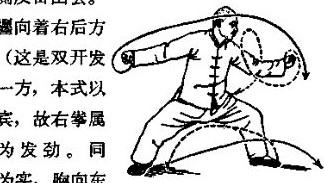
· 189 · Key points: When the left [fist] has turned to the left crotch and the left arm is again plucked, in order neither to lose nor to resist, one should adapt to the essential force of the pluck and, following the direction of the opponent's essential force, strike out to the left with energy. This is a direct and straightforward technique for seeking release. Therefore in this posture the left fist counter-strikes as the main action, but the root of the strike lies in the right fist, which rotates with forward twining at the upper right, and through it the internal energy is threaded and poured into the left arm.
Fifteenth Posture Chan-shou (Chopping Hand) (chest southeast, turning north) Movement: This posture supposes that in the strike of the preceding posture "P'ieh-shen Ch'ui" no release was obtained; then once more, following the direction of the essential force, step up with the right foot; the right hand, with forward twining, turns up from the right rear and over with the body, and joins above the left hand; at the same instant that the plucked left hand is suddenly lifted, the edge of the right palm chops down like a knife, forming the double-opening forward-cleaving posture of left high and right low, accompanied by a sinking stamp of the right foot. This is stepping up with the right foot so as to place both hands within one's own square-and-round circle; it is a technique of striking free in which two hands and one foot act simultaneously. At this moment the chest has turned to the north. (Figure 20)
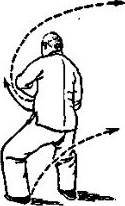
Key points: This is the method of releasing the plucked left hand a second time. The method most commonly used in plucking energy is the downward-pressing pluck, which forces the opponent to find it hard to follow, so that the plucked person cannot but tend toward a kneeling posture; hence he cannot but adopt a hand-leading-the-body step-up, so as to hasten the method of release in which the "right chop," the "left lift," and the "foot stamp" are all three applied together. Therefore, under the requirement that the right hand's energy be unbroken, one uses a small forward-twining rotation to step up with the right foot, bringing the plucked left hand within one's own square-and-round circle; this is the basic method of using lightness to overcome heaviness. Before stepping up and after stepping up, as well as · 190 · When chopping down, the tail gate (coccyx) must in every case be centered and upright; on no account may the downward strike cause the tail gate to topple forward.
Sixteenth Posture Fan-hua Wu-hsiu (Turning the Flower, Dancing the Sleeve) (chest north turning south, then turning northeast) Movement: Suppose the second release has still not succeeded, that is, beneath the lifting-up and chopping-down the opponent's plucking hand still cannot be chopped away; then one must, by a turning-over movement of the body, release further — that is, following the opponent's upward-resisting chop energy, suddenly leap up; the left hand, with reverse twining, lifts up and circles over the top of the head, and the body turns over. This is a great turning of the body from below upward. The inertial force of the turn is led by the left hand. At this moment the right hand also uses reverse twining from below upward to assist, and with double-opening energy the body leaps up and turns over. At the same time the left foot lifts, and brings the right foot to leap up along with it. This movement includes using the energy of both arms and the shoulder-leaning to release the plucked hand. (Fig. 21; this figure is the instant of leaping up and turning the face) Then, in the continuing top-to-bottom rotation, when the left hand on the left side passes from reverse twining to forward twining and moves downward, the left foot simultaneously lands with a foot stamp. This is an action performed by the left hand and left foot at the same time. When the left foot lands and the right foot steps forward to the right, the right palm must simultaneously pass from reverse twining at the rear-upper position to forward twining, and chop down forward with the edge of the palm (at the chop the energy is the same as the chopping energy of splitting the frame). At the same time, the left hand forms a fist and, with forward twining, strikes out to the left rear as the guest. At this moment the left foot is solid. (Fig. 22; this figure is the posture at the moment of rotating the body, landing, and giving one chop)
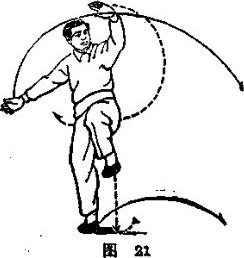
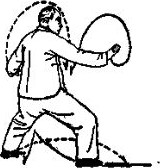
· 191 · Key points: The characteristic of the preceding posture's chopping-hand release method is that both parties' arms are at the front, and the distances from the point of application of force to both parties are equal; whereas the body-turn of this posture "Fan-hua Wu-hsiu" employs the rotating action of the body method and the lumbar spine, causing the distances of the force's point of application suddenly to form a striking contrast (near to oneself, far from the opponent). That is to say, the release point is made far from the opponent and near to oneself. This relationship of one near and one far forms a change in the magnitude of the torque. After turning the body, of the two feet the left foot lands first with a foot stamp and the right foot lands slightly later; in this way the inertial force of the rotation of the waist axis is strengthened, and consequently the downward-chopping energy of the right hand is also strengthened — this is where the key to yet another method of seeking release lies. This kind of release uses the downward chop of the edge of the right palm to take over the rotational inertia of the right hand's forward-twining turn-over. At the same time, the downward chop must be loosened and elastic, for only thus can the next posture be prompted to leap up nimbly. This kind of release is also another example of using lightness to overcome heaviness, and is the concrete expression of one technique serving two purposes, that is to say, a dual use in which release conceals a strike and the strike conceals a release. Therefore this posture consists mainly in one hand releasing while the other hand chops down following the rotation.
Seventeenth Posture Yen-shou Kung-ch'üan (Covering-Hand Forearm Punch) (chest northeast, turning east) Movement: This is a posture whose main purpose is the practice of storing energy and of issuing energy; within the frame of the Second Routine, it is mostly used to link things up whenever it follows a special posture. This is the first Covering-Hand Forearm Punch of the Second Routine. It borrows the elastic energy of the chop of the preceding posture: both hands, with double forward twining, leap the body up, and the front-rear positions of the left and right legs are exchanged; then the right foot lands with a foot stamp and becomes solid, and the left foot steps forward with a lifting (ch'ien/jian) movement and becomes empty. At the same time, with double reverse twining the whole body's energy is bent and stored, and the ring-circle of both arms is made smaller to strengthen the stored energy. At this moment the left hand is above and the right hand below, the right foot is empty and the left foot is solid. (Figure 23) Then, the latter half of the section is the issuance of energy. Before issuing, the right hand first makes a small reverse-twining circle and places it at the waist, the center of the fist facing upward; at the same time the left hand relatively does reverse twining, the center of the fist facing downward — this is the left storing of energy. When the right hand is at the right waist, the right hand sinks its energy, and amid that steadiness still uses reverse twining to sud- · 192 · With the momentum of the issuance, the energy is sent forward. At this moment the center of the fist faces downward. At the same time, the left hand relatively turns to reverse twining, releasing the fist backward to draw it back, and places it at the left waist. The center of the fist faces downward. When storing energy, the right foot is solid; when issuing energy, the left foot is solid. (Figure 24)
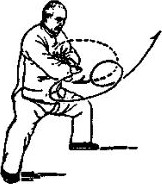
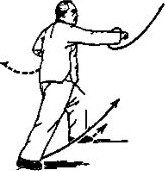
Key points: This posture is the one most frequently used (six times) in the second frame, and its key point lies in strengthening the practice of the energy of "storing energy like drawing a bow." It is led by containing the chest and pulling up the back, causing both arms to possess a joining energy shaped like the character 6. When practicing the issuance of energy, there must be the issuance energy of lifting a thing up and then bringing it down. Therefore the first half-section must be like drawing a bow to strengthen elasticity, and the second half-section must further have the twining energy of releasing an arrow deep into the target. This is the concrete expression of making the movement issue far and long. For this reason, before issuing energy there must be a sinking small circle, so that the drawn-out stored energy and the issued energy become one; one may not simply use a straight-line storing-and-issuing energy that has no drawing along with it.
Eighteenth Posture Fei-pu Niu-luan Chou (Flying Step, Twisted Phoenix Elbow) (chest east turning north, then turning south) Movement: After the issuance of energy of the preceding posture "Yen-shou Kung-ch'üan," both fists make a small reverse twining in their original position, joining energy front and rear; when the right fist with reverse twining goes forward and the left fist with reverse twining goes backward to open, the right foot is accordingly lifted, and leaps forward with a flying step, landing as solid. At the same time, with · 193 · With the right foot serving as the pivot of the turning heel, the left foot sweeps an arc past the right foot and comes to the east side of the right foot, causing the body to spin in the air through 270°. (Figure 25) This supposes that in the preceding posture "Yen-shou Kung-ch'üan," after the right hand has issued its energy, it is plucked by the opponent, and it is a posture adopted when there is no time to draw it back. The opponent is applying energy along the direction of the issuance, so one cannot but follow quickly, to adapt to the person, using a flying step to comply with and transform the energy. In the course of complying with the flying step, one naturally turns the body to the left, using the back-bending-and-leaning energy to release the plucked right hand; this is similar to the various "Jade Maiden Works the Shuttle" postures of the First Routine.
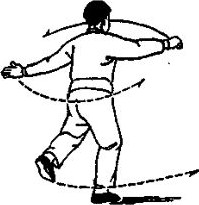
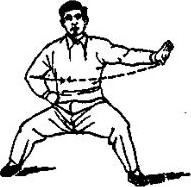
It is likewise a leaping step, but the hand method is different. (Figure 26) After the great 270° body-turn, suppose the back-bending-and-leaning energy of the great turn still cannot release the plucked right hand; then after the turn, both hands with double reverse twining unite as one, the center of the left palm presses upon the opponent's plucking hand, causing both arms to form a transverse ring, and the right elbow energy strikes forward. This is the final application of one technique to two uses: it is release and also advance-and-attack. After the turn, the right foot is solid; at the issuance of elbow energy, the left foot is solid. The Niu-luan Chou finally formed is as in Fig. 27.
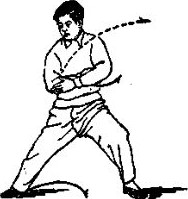
· 194 · Key points: This is the final method of using the back-bending-and-leaning energy to release the plucked right hand. Because of the rotation of the body, it can also cause the distances of the force's point of application suddenly to form a striking contrast favorable to oneself, so as to achieve overcoming heaviness with lightness; it is a posture and strike that releases without seeking to be released. At the same time, what distinguishes this posture from the preceding several is that the left palm is pressed at the right elbow, and the back and elbow are joined to strike the opponent transversely. This is a special posture that presses down the opponent's plucking forearm, fixing the opponent's plucking point so that he cannot change it, and throws the person out sideways. Therefore it is likewise one technique with two uses. Its key point lies in being able, after flying out with the step, still to land with the body established upright and centered. Most especially, one must note that after issuing, both arms must still be bent and stored with reserve, rather than extending the hands fully straight. Therefore one must use the flying step to come out in order to suit the essential energy. This is the method of final release in a whole series of release movements; that is, it is an example of the Second Frame's practice of plucking and of releasing from the pluck. Although this posture strikes forward with elbow energy, its root is still in the back-bending-and-leaning energy of the right side. For this reason, its essential requirement is that only on the basis of establishing the body upright and centered can the unity of using elbow and leaning together be obtained.
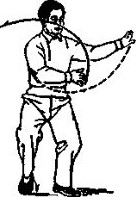
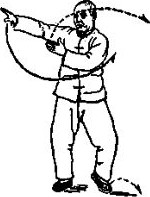
Nineteenth Posture Yün-shou (Moving Hands / Cloud Hands) (the first three, chest south) Movement: Both hands move simultaneously to the left, then simultaneously to the right, and then move to the left again, forming · 195 · These make three Moving Hands, slightly different from the Moving Hands of the First Routine. After the joining energy of the preceding posture Niu-luan Chou, the center of gravity shifts entirely to the left leg, the right foot steps up alongside, with the tip of the toe touching beside the left foot; at the same time the left palm with reverse twining moves and turns to the left, and the right fist becomes a palm and, with forward twining, moves to the left. (Figure 28) Then the center of gravity shifts right, the right foot becomes solid, and the left heel first leaves the ground and lifts; at the same time both hands, the right with reverse twining and the left with forward twining, move and turn to the right, the right palm passing before the face and the left palm passing before the abdomen. (Figure 29) Then the left foot opens half a step sideways to the left, the center of gravity gradually shifts left, the left foot becomes solid and the right foot becomes empty; at the same time both hands, the left with reverse twining and the right with forward twining, move and turn to the left, the left palm passing before the face and the right palm passing before the abdomen. (Figure 30)
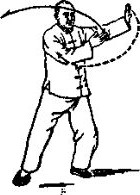
Key points: In this posture one must, under a smooth and gentle curved movement, perform the silk-twining transformations of left forward and right reverse, and right forward and left reverse, and must lift and lower the legs under the condition of not moving the step, fully expressing the requirement of the division of solid and empty in which hands and feet follow one another above and below; this is also the basic requirement of this posture. The Second Frame, having passed through the preceding several leaping and strenuous fist postures, can here adjust its breathing movement a little. Therefore in this figure-∞ movement of the hands, the speed of movement may be slow or fast; this is the place where the Second Frame is naturally divided into sections.
Twentieth Posture Kao T'an Ma (High Pat on Horse) (chest west) Movement: After performing the first three Moving Hands, with the left heel as the axis the body turns right, and the right heel leaves the ground; at the same time both hands, the right with reverse twining and the left with forward twining, move and turn to the right, the right palm passing before the face and the left palm passing before the abdomen; when the left palm has moved and turned to the right of the body, the center of the hand faces upward. (Figure 31) Then the right foot is lifted, and the body continues to turn right; at the same time the right palm, with forward twining, passes beneath the left palm · 196 · draws in from the side, the center of the palm facing upward, and the left hand with reverse twining pushes forward past the upper side of the right palm, the center of the palm facing outward and downward. (Figure 32)
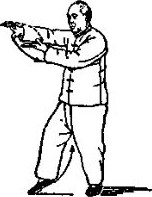
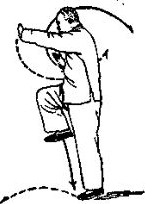
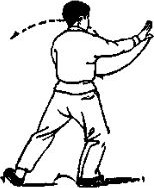
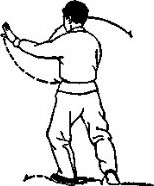
Twenty-first Posture Yün-shou (Moving Hands) (the last three) Movement: After performing Kao T'an Ma, then both hands, with right reverse and left forward twining, turn the right hand toward the right front, while the left hand turns toward the front of the chest. At the same time as this exchange of the two hands, the whole body, with the left foot as the turning axis, rotates 90°. At the same time, the right foot lands with a foot stamp and becomes solid, and the left foot opens one step sideways to the left, touching the ground first with the heel. (Figure 33) The center of gravity shifts to the left leg. The left foot · 197 · Steady the foot; the right foot steps half a step to the left, touching the ground first with the toe. At the same time, the two hands turn: the left hand with reverse (ni) coiling and the right hand with forward (shun) coiling; the left palm passes in front of the face and the right palm passes in front of the abdomen, moving to the left. (Figure 34) Then the right foot stamps firmly, and the left foot opens half a step sideways to the left; at the same time, the two hands turn: the right hand with reverse coiling and the left hand with forward coiling; the right palm passes in front of the face and the left palm passes in front of the abdomen, moving to the right. (Figure 35)
Key points: In the second routine (form) there are the first three and the last three "moving hands" (yün shou); the first three face the chest south, the last three face the chest north. Their basic requirements and functions are the same, so they will not be repeated. Therefore this form's key points no longer discuss the moving-hands action itself, but only the turn from doing the high pat-on-horse (kao t'an ma) after raising the leg to the front, into the turn toward the back. This action requires turning the body around within a gentle curve, with unbroken silk-reeling and continuous inner strength; therefore one must make a good small circle of the left hand drawn back in front of the chest in reverse coiling. Through this reverse coiling one shifts the torso, and the torso and the silk-reeling can be changed over suspended in the air. In this way not only is the inner strength kept unbroken, but it can also be threaded through into the next action. Hence this form is also a rather difficult action for practising the threading-through of section after section.
In order to make the turn-around easier, after Chen Fa-ke came to Peking, and to popularize Chen-style taijiquan, he added two boxing forms — cloud hands (yün shou) and high pat-on-horse — into this turn. Thus there was no longer the requirement of threading through while turning sharply in the air, and it became easier to do.
Twenty-second Form: High Pat on Horse (chest north turning northwest) Action: After the right turn-palm of the previous form, when the body turns left again, the two hands first both turn forward (shun) and close together, so that the two hands cross in front of the chest and pass each other; then both turn reverse (ni) and open.
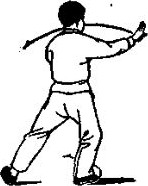
up. When closing, the left foot is full. (Figure 37) When opening, the right foot is full (Figure 38). This is a boxing form linking to the next, and its jin is the same as "white crane spreads its wings" in the first routine; only the hands are more evenly levelled in height, and the two legs straddle wider, so as to manifest a rounded crotch.
Key points: This is a boxing form that closes from double forward (shun) coiling and then opens from double reverse (ni) coiling; it requires that in the process of turning open after closing there be no corners, ridges or hollows, so that the silk-reeling jin is carried onto the back of the bow. At the same time, it requires that in the enlarged and expanded posture one strengthen the elastic training with section-after-section threading, so as to raise the taut (beng) jin. When closing, pay attention to the two thumbs, chiefly the left-hand fingers; when opening, pay attention to the two little fingers, chiefly the right-hand fingers.
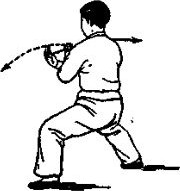
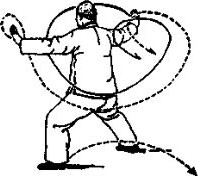
Twenty-third Form: Linked Pearl Cannon, part one (chest northwest turning west) Action: From the opening jin of the previous form to the closing jin of this form, it is a closing by double reverse coiling. At this time, the right hand reverse-coils to the right of the chest, palm facing outward left; the left hand reverse-coils to the front of the chest, palm facing outward right; the two hands close into one closing jin in front of the chest. At this time the left foot is full, the right foot empty. Then the two hands forward-coil and press out (peng) to the front; at the same time the right foot becomes full, and when the two hands press out and come down with double forward coiling, the left foot retreats one step and the centre of gravity immediately shifts left, sitting on the left leg as full. When the two hands sink down (t'a), the whole body forms a posture of storing jin. (Figure 38) Then the two hands again turn to double reverse press out (peng) forward and upward, rolling up and storing; the right foot becomes full. Then the two hands immediately come down again from the front, leftward and backward, with forward coiling. When the two hands sink down, the left foot again becomes full. This is to add one more store on the basis of the previous stored jin. Finally, with double reverse coiling, send out the pressing-out (peng) jin. At this time the right palm faces outward, the left palm faces downward. At the same moment as the jin is issued, the right foot advances half a step forward and the left foot follows with half a step, the heel grinding the ground with a sound. (Figs. 38, 39) This is the first "linked pearl cannon" action; this form has three linked-pearl-cannon actions in all.
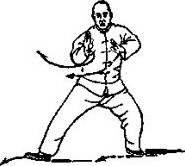
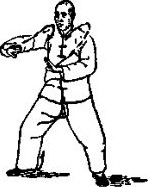
Key points: This form is suited to the taijiquan "opening-door" hand technique for entering and moving within the opponent's circle. Its characteristic is that it takes the actively rotating two hands as the boxing form for entering the circle. Its hand technique is like pushing a water mill: the left hand rotates on the inside to defend the pit of the chest, and the right hand rotates on the outside to attack forward. The two hands, thus combined inside and outside, keep using the left hand to add "ice" (material) and the right hand to turn the millstone in motion. At the same time, the two feet follow up with the "heel-following" (gen pu) step. Although one does not seek to adhere to the opponent, yet as long as some part of the rotating, attacking right arm touches a point on the opponent, that touched place can serve as the point of adhesion, and one may thereupon stick and change in ten thousand ways. This form adopts the "advance and retreat with the body" and the flexible, transforming, centred and upright body method, so that when objectively one must meet changes and make transitions, there is always leeway, and one is sufficient to support all eight directions. Its Next: since the previous form is the double opening of spread wings, this form must first roll it up and store it. This is in order to store and then issue. At the same time, in order to issue more crisply, before issuing the jin one shrinks one more small circle, to further strengthen its elasticity, and then calmly sends the jin out. When issuing the jin, although the right foot is full, yet for the sake of the centred and upright relation of "the central earth does not leave its position," the difference between the fullness of the front foot and the emptiness of the back foot is required to be slight, so that one may quickly rotate and advance forward.
Twenty-fourth Form: Linked Pearl Cannon, part two (chest west) Twenty-fifth Form: Linked Pearl Cannon, part three (chest west) Action: In doing the second and third linked pearl cannons, the right hand goes from front-above with forward coiling toward the front of the chest, and the left hand goes from left-rear-below with forward coiling to close with the right hand before the chest. At this time, sitting on the left leg, the whole body again forms a stored jin. (Figure 40) Thereafter the actions from Fig. 40 to Fig. 41 are the same as the first linked pearl cannon (that is, the same as the actions from Fig. 38 to Fig. 39).
This boxing form may, according to the practitioner's need, be done several more times in succession, or taken out for special practice; its action is the same as the previous linked pearl cannons. But in order that the whole set may return to the original spot at the end, after this form has been done several extra times, the later "white snake spits out its tongue" must likewise be done several extra times, so that the number of times the two forms are done is equal. The other key points are the same as the first linked pearl cannon.
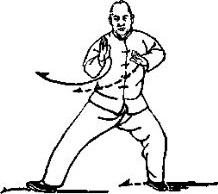
Twenty-sixth Form: Riding the Qilin Backwards (chest west turning east) Action: After the three advancing steps of the previous linked pearl cannon, the two palms close together in a double closing; first the left palm reverse-coils and turns toward the front of the chest, the fingers of the palm erect, palm facing right. At the same time, the right palm reverse-coils turning to guard outside the left forearm; the centre of gravity moves forward, the right leg is full (Figure 42). Then the right hand reverse-coils to the right-rear-above, and the left hand reverse-coils to the left-front-below; at the same time lift the left foot, the two hands separate, and with the right foot as the pivot of rotation, turn right 180° (Figure 43), turning the body to face east; when the turn reaches the east, the body is carried around by going from opening to closing. At this time the right hand is at the lower right, palm facing down; the left hand is at the upper left, the fingers of the palm erect. At this time the left foot, having been carried around with the turning body, is still lifted. (Figure 44)
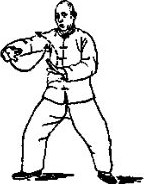
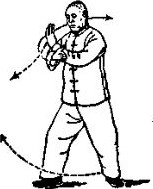
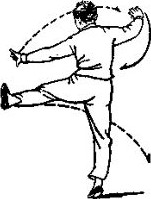
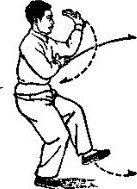
Key points: With the right foot as the axis, when the left foot strides over following the turning body, the upper body must still not lean forward or lean backward. Because the left foot, following the body's 180° turn to the right-rear, strides across backwards, one takes the meaning of "striding backwards (tao k'ua)" and names it "riding the qilin backwards."
Twenty-seventh Form: White Snake Spits Out Its Tongue, part one (chest east) Action: After the left foot has strided backwards across in the previous form, immediately follow with the right hand making a small circle chiefly of forward coiling to the front, striking out with the taut (beng) jin of the fingers. At the same time, the left hand behind still, with reverse coiling, coordinates with the right hand and issues together toward the left-rear. At this time the left foot steps forward half a step and lands full, and the right foot immediately follows up, grinding the ground with a sound, completing the first "white snake spits out its tongue" pressing-out and issuing. (Figure 45) This boxing form is an "opposite-step" (ao pu) action that people do not commonly have; it takes some effort before one can be thoroughly familiar with its jin, or one may take it out for special practice.
Key points: This form can likewise serve as an opening-door hand technique, as a way of entering the opponent's circle with the opposite step; both use the body to advance and retreat, and no leaning or tilting body method is allowed, to avoid the fault of being able to support only one side inside the circle. In order to be able to change flexibly lengthwise and crosswise, front and back, the division of full and empty within this boxing form is the same as in "linked pearl cannon"; it likewise requires "small empty, small full" (1), so that after entering the circle, on touching any part one obtains a smooth, adhering and sticking effect. The difference lies in that the previous linked pearl cannon is the forward step, while this "white snake spits out its tongue" is the opposite step (sometimes, to simplify it and make it easy, someone changes the second "white snake spits out its tongue" to (1) "Small empty, small full" refers to the ratio of weight distribution on the two feet: suppose the two legs bear a total of 100 catties, one leg 55 catties and the other 45 catties; thus with only a tiny movement one can quickly change full and empty over; therefore those of deep skill have a small difference between full and empty, and the externally visible circles are also small.
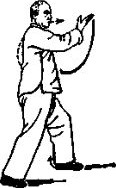
"covering-hand forearm punch (yen shou kung ch'ui)," and afterwards do the third "white snake spits out its tongue"; this makes it much easier to do). When practising the forward stride of the opposite step, at first it feels a little awkward, so one must practise a great deal. At the same time, this boxing form is a short-distance storing and issuing, so one must hollow the chest and raise the back, with the spinal column leading, so as to achieve section-after-section threading and the issuing of jin from the spine. This is the representative action of the whole set for issuing jin from the spine. If the curved issuing is manifested only by the two arms, it does not meet the requirement. It would be even better if one could take it out for special practice.
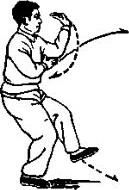
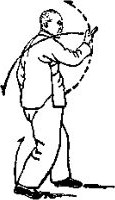
Twenty-sixth Form: White Snake Spits Out Its Tongue, part two (chest east) Twenty-seventh Form: White Snake Spits Out Its Tongue, part three (chest east) Action: The stored jin of the previous "white snake spits out its tongue" was completed by the closing posture of "riding the qilin backwards" splitting and turning and then one more closing jin. But the stored jin of this "white snake spits out its tongue" is stored after the issuing jin of the "white snake spits out its tongue." This is the point of difference between the two "white snake spits out its tongue." At the start, the right hand in front forward-coils and stores to the front of the chest, palm facing left. At the same time, the left hand, on the left, reverse-coils and turns to the left flank. When storing, the two arms hold the jin together, the centre of gravity shifts back, the right foot is full, and the left toe touches the ground as empty. (Figure 46) Then the right palm, in front, chiefly forward-coiling a small circle, strikes out with the taut (beng) jin of the fingers. At the same time, the left palm behind, with reverse coiling, coordinates with the right palm and issues together. At this time the left foot steps forward half a step and lands full, the right foot immediately follows up, grinding the ground with a sound, completing the second "white snake spits out its tongue." (Figure 47) This form also, according to the practitioner's need, may be done several extra times, the same number of times as the "linked pearl cannon."
Key points: Same as the first white snake spits out its tongue.
Thirtieth Form: Turning Over the Flower at the Bottom of the Sea (chest east turning west) Action: This is a special boxing form. After the previous form's right hand has issued the pressing-out (peng) jin forward, it immediately closes with the left hand behind in a double forward coiling that crosses. After closing, with the double opening jin of right forward and left reverse, the body is turned right 180°. At this time the centre of gravity shifts onto the left foot, forming an independent posture. In the course of turning to the west, the left and right hands become fists; the right fist strikes with the back of the fist downward and backward, the fist-heart facing forward. The left fist strikes upward and backward, the fist-heart facing right. (Fig. 48. From Fig. 48 onward to the last figure, because formerly when photographing Teacher Chen Fa-ke all the photographs of the action were taken from the reverse side, in all the following figures, facing the reader is north, back to the reader is south, the left side as one faces the reader is east, and the right side as one faces the reader is west. This will not be repeated hereafter.)
Key points: This boxing form chiefly exercises the elbow joint. The left fist striking backward and upward and the right fist striking backward and downward — striking up and down — is a rarely seen issuing backward, so its key point lies in requiring that the balance of the body be maintained when issuing up and down and backward.
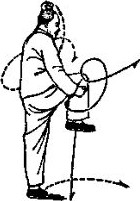
Thirty-first Form: Covering-Hand Forearm Punch (chest west) Action: In the previous form the right leg is raised, and the two fists strike backward to the sides, one above and one below backward, the right fist, after slightly lifting up with forward coiling, sinks down again with forward coiling, the back of the fist facing down, and the right foot simultaneously stamps the ground. At the same time, the left fist, coordinating with the right fist, after slightly sinking with reverse coiling, is immediately raised; the whole body's centre of gravity is all on the one stamp of the right leg. When the right fist forward-coils until the fist-heart faces up again, and after adding a sinking jin, then it changes to reverse coiling and sends the jin out. The issuing hand must still keep some leeway, and must not be fully extended. At the same time, the left fist, raised with reverse coiling, turns once into forward coiling and issues backward as the guest (secondary), so as to maintain a double issuing with host and guest. (Figure 49)
Key points: Same as the seventeenth form, "covering-hand forearm punch."
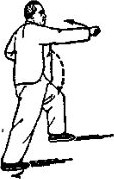
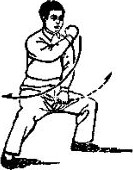
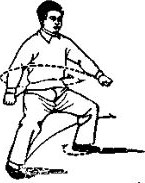
Thirty-second Form: Turn the Body, Six Harmonies (chest west, from north turning south) Action: From the opening of the previous form "covering-hand forearm punch," the right hand which had issued in front is gathered with forward coiling before the left shoulder; at the same time, the left hand reverse-coils and extends before the chest. At the same time the centre of gravity shifts right, and the body turns right. (Figure 50) Then, next, the two fists separate to left and right. (Figure 51) Then Shift the whole weight onto the left leg; pivoting on the left heel, lift the right foot and turn the body to the right-rear; at the same time, bring both fists together and cross them in front of the abdomen, the right fist inside, both fist-hearts facing inward. (Figure 52)
Phần 27
Form 33. Left Wrap-Whip Cannon (1)
Then the right foot lands with a stomp. (Figure 53) At the same time the left foot steps sideways to the left; both hands turn to double-reverse (shun), and issue power to the left and right outer sides, slightly backward. At this moment, the fist- hearts face forward and upward, and in issuing, the left hand and left foot are dominant. This is a variation within Wrap-Whip (bian). (Figure 54)
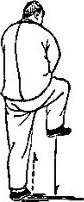
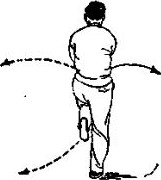
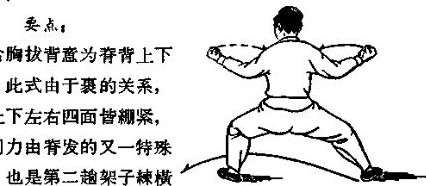
Key points: "Hollow the chest and raise the back" means the spine is drawn taut from top to bottom. Because of the wrapping (guo) relation in this form, the back is drawn taut on all four sides—up, down, left and right. It is another special fist-form for training the emission of power from the spine, and it is also the form in the Second Routine that trains the horizontal (heng) stepping method. This is a mass-combat type of stepping. When the leg and the arm cross · 207 · This is "wrap" (guo), the storing of power in the legs. When the two legs are separated it becomes "whip" (bian), the releasing of power in the legs, which can train a person to the skill of springing sideways with a light body. The key point of this form is that before issuing, one must wrap tightly once, making the qi sink further down, and only then can power be issued crisply to left and right, displaying a firm and resilient springiness. In this way one stores and issues twice in succession. At the same time, when the two hands go from the double-reverse opening to the double-reverse closing that makes the "wrap," the whole body is tightly wrapped and the qi clings to the spine, forming a moment of fully stored power; as soon as the foot lands with a stomp, that is immediately the left-and-right issuing of power in the "whip."
Phần 28
Form 34. Left Wrap-Whip Cannon (2) (chest facing south)
Movement: after "turn body six harmonies" and the preceding form "Wrap-Whip Cannon" have issued to left and right, both fists turn back to double-reverse, the weight first shifts right so that the right foot becomes solid, then both fists are brought together in front of the lower abdomen and the weight shifts left; at the same time the right foot is lifted and set down to the left of the left foot, so that both fists and both feet are crossed and wrapped. This is again a "wrap." (Figure 55) At this moment the two arms are tightly wrapped, with a sinking power, and the spine must also be drawn taut. Next both fists turn to double-reverse (shun), issuing power to the left and right outer sides and slightly backward, while the left foot steps sideways to the left—this is again a "whip." (Figure 56) This form may also be repeated several times in succession as needed, the movement being the same as Left Wrap-Whip Cannon (2).
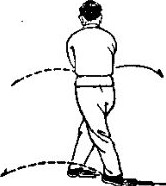
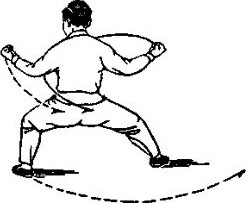
· 208 · Key points: This is a mass-combat fist-form that is both "moving" (zou) and "attacking" (gong). Its key point is that when springing sideways and dropping down one must appear calm and not buoyant; at the same time, through the process of one wrap and one change, the power must not be broken, so as to meet the demand of mass combat where no gap can be found. Therefore, at the connecting point after the double-opening issuing of power of the first Wrap-Whip, one must make a fold (zhedie), so that the inner motive force connects gently along a curve into the second Wrap-Whip.
Phần 29
Form 35. Right Wrap-Whip Cannon (1) (chest turning from south to north)
Movement: the double-reverse issuing of power of the second Wrap-Whip in the preceding form is a double-opening power; after opening, there is again a double-sinking power outward and down, and both fists change to double-reverse twisting and are stored up, brought together in front of the lower abdomen with the backs of the fists facing each other; at the same time, taking the left foot as the central pivot of rotation, lift the right foot, and using the double-closing power of both fists—the left arm making a small circle, the right arm making a large circle—carry the body turning 180° to the left, the left foot sweeping half a circle with the sole adhering to the ground as the body turns. (Figure 57) At this moment both fists also turn to double-reverse (shun) toward the left and right sides and issue firm power slightly backward. In issuing, the left hand and left foot are dominant, forming the first Wrap-Whip after the turn. (Figure 58)
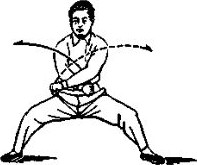
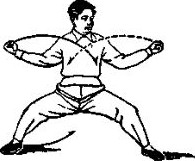
Key points: It takes the left foot as the central pivot of rotation, using the stored-power "wrap" posture to turn the body · 209 · body. The left foot sweeps half a circle sideways as the body turns, and throughout this process one must still keep the body steady—this is an important condition for whether the issuing of power of the "whip" after the turn is crisp or not. The remaining key points are the same as those of the two preceding Wrap-Whips.
Phần 30
Form 36. Right Wrap-Whip Cannon (2) (chest facing north)
Movement: this fist-form is the same as the second Wrap-Whip before the turn, except that the chest has now turned to face north. (Figs. 59, 60, 61)
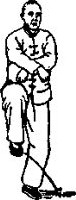
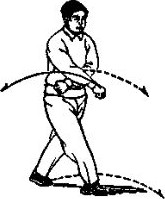
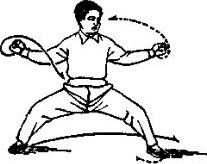
Key points: same as Form 34.
Movement: after the double-opening issuing of power of Wrap-Whip in the preceding form, the right foot arcs 90° to the right-rear, not made the same width as the left foot. Then the left foot arcs half a step to the left-rear, turning the body around. At the same time, the upper part of the body, with the right fist twisting shun, draws an arc from outside inward, turning to beneath the left elbow, the fist-heart facing inward. The left fist twists ni (reverse), rising up from outer-low to inner-high, the fist-heart facing right, forming the posture of double closing. At this moment the right foot is solid. (Figure 62) Next, the raised left arm, twisting shun, presses horizontally to the left, releasing power from right to left-rear as a feint (bin), while the left foot steps back to the left-rear, still keeping the right leg solid, so as to coordinate with the right hand turned beneath the elbow to bring the forearm forward horizontally, issuing the elbow power of the horizontal forearm with a shun twist. (Figure 63)
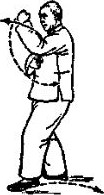
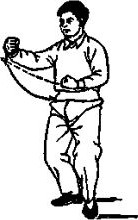
· 210 · Key points: At the beginning of this form one raises the left arm and strikes across with the right, forming a variation that stores power, and one is required to fill the body's internal power to the full. The right foot arcing half a circle and unloading a step to the right-rear can help the power fill out. This is the function of "retreating is advancing" and "defending is attacking." For once the raised left arm has been folded across, the closing power is reinforced, and the right arm at once passes above the left arm to issue elbow power—so-called striking where it is not expected and attacking where it is unprepared, making it hard for the opponent to defend. This fist-form, which issues elbow power with the forearm held across, is, apart from the later "Seize Two Arms" (duo er gong), the only form in the Second Routine for training the issuing of elbow power; there is no other such form in the Second Routine, and so it must be practised with care. (It is said this was selected from Qi Jiguang's boxing forms.)
Phần 31
Form 38. Splitting the Frame (chest facing northeast)
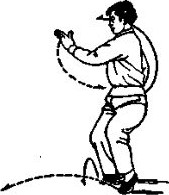
Movement: after the issuing of power in "Beast-Head Posture," the right fist twists shun in a small arc downward and back up. At the same time, the left fist twists ni in a small arc upward and back down. When the relative turning brings the left fist below and the right fist above into a single vertical line, the right foot springs up; at the same time, the left foot steps forward one step. Now both fists change into palms, which close together tightly crossed, and the crotch is rounded and sunk, concealing a close-range shoulder-leaning power. At this moment the left · 211 · foot is solid. (Figure 65) The preceding movement issued the left-shoulder leaning power from within the stored power; with- out needing to store power again, one need only release the stored power of the preceding form and that is the issuing; it is issued with the left hand twisting shun upward and outward, and is the only upward-striking power in taijiquan. The target struck is the opponent's lower jaw. This form may be done either with the fist or with the palm, and it is also a rear-striking method in which the right hand twists ni downward and inward as a feint. (Figure 66)
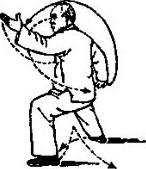
Key points: This is a fist-form which, after the peng issuing of power of the preceding form, turns to storing power and embodies a releasing of power within that storing. When the two hands cross and one steps sideways half a step, the chopping power of the right hand above striking the face to the upper left and the left shoulder's outward-left shoulder-leaning power must be used simultaneously. Of the two powers only one is a leaning power—one open, one hidden; one feint, one real—and this is the special characteristic of the form. For whenever the shoulder-leaning power is issued, the head is most easily controlled by the opponent. Therefore in this form, within a close distance of seven inches, one also uses the face-striking palm in a forward-striking posture; thus it not only protects the head but also makes up for the insufficiency of the shoulder-leaning power.
· 212 · In using the leaning power while storing posture and power, one must have a steady and upright power; if the leaning power misses, then on the leaning side the elbow strike and hand ward-off (peng) are both stored and ready to issue, and at any moment can remedy what is lacking.
Fig. 66 is one of the hand methods that uses peng as the principal element. After the peng issuing power, the palm-chopping power and the shoulder-leaning power, it adds a unique upward-striking power. This is a linked-pearl (lianzhu) style of issuing power, whose aim is to strike the opponent rather than to send him out. But striking the opponent's lower jaw likewise has the possibility of making him fall. This is a special striking method among the hand methods of taijiquan. At the same time, because the preceding fist-form had already stored power to the full in both hands and both feet, the key point of this form's upward strike lies in concentrating the power to an even higher degree within one sinking of it, so that the upward-striking movement can display a firm and steady internal power.
Phần 32
Form 39. Flower-Flipping Sleeve Dance (chest turning from southeast to northeast)
Movement: this follows the upward strike of the preceding form that divided its power in two, changing into a sinking body method. Before the movement, one must add another steady elastic power, and lead the body up under the guidance of the crown-top power (ding jin). This is the requirement that "when you intend to go up, you must first lodge downward." Therefore, coordinated with the swelling of spirit that turns from rear-low to front-high, one leads the right hand from rear-low, twisting ni, forward and down. At the same time, the left hand in front makes a small circle with a shun twist, joining its power with the right hand. Next, the right hand, still twisting ni, chops downward with the edge of the palm from front-high to front-low, like chopping firewood with an axe. When chopping, the whole body must be relaxed and open, using elastic power; at the same time, the left hand strikes to the left-rear as a feint. When both hands are toward the rear-right side, lift the left foot; when both hands reach the front-high, the left foot lands and becomes solid; at the same time the right foot steps forward one step. When the right hand chops down it is solid, and the right foot is empty. (Figure 67)
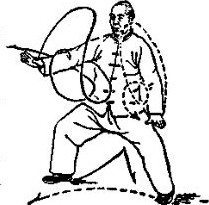
· 213 · Key points: This form too was selected from Qi Jiguang's boxing forms, and it differs from the preceding form: the preceding form strikes upward from below, whereas this one chops downward from above. To do the downward chop well, one must first close the power at the chest, then unite the body's internal power and chop down after turning a circle. At this time, hands and feet are required to be coordinated and smooth, and under the gaining of posture and power to display one firm chop. Therefore the two hands must, after turning through one large circle, then begin the downward chop—just like holding a large hammer, turning a circle, and then striking the iron. This is the only fist-form in the Second Routine that turns a circle and chops down. When issuing the downward chop, the body must be centered and unbiased, and must have an elastic openness; this is the concrete expression of using the inertial force of the one-turn circle to strengthen the downward-chopping power. One must bring both hands and both legs into simultaneous use, so as to attain a most highly coordinated requirement.
Phần 33
Form 40. Cover-Hand Forearm Punch (chest turning from northeast to east)
Movement: this form follows "Flower-Flipping Sleeve Dance," and differs from the earlier "Cover-Hand Forearm Punch": in this form one must lead the body up under the guidance of the crown-top power, lift the right leg, and set it down parallel to the left leg with a stomp to become solid; at the same time, the left leg stretches forward a small step and is empty. This form requires that on springing up, the front and rear legs exchange places. When the body is led up, the right hand twisting shun and the left hand twisting ni close together; at the same moment that the right leg lands, the two hands separate with a double ni twist, then turn and store up again. Now the right hand changes from palm to fist, placed at the right waist, and with one sinking of its power, power is issued with the right fist as principal. At this time, the left hand releases power backward with a ni twist as a feint. (Figure 68)
Key points: In doing the downward chop within the "Flower-Flipping Sleeve Dance" form, it is a relaxed chop, giving one the momentum of spreading power in all four directions, like a bag of ash falling to the ground and the ash scattering in all directions.
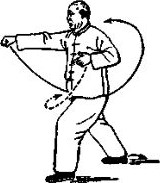
· 214 · open; because it is a relaxed chopping power, when doing the next fist-form one uses the elasticity of the downward chop to lead the body up, as if gathering the power from all four sides into a single point and lifting with it. And by the time the right foot lands with a stomp and the left foot stretches out in a step, there is again in the mind the intention of spreading the power out. This is the spirit this fist-form should have.
Phần 34
Form 41. Taming the Tiger (chest turning from east to southeast)
Movement: after the issuing of power of the right fist in the preceding form, the right fist is drawn back with a ni twist, while the left hand, twisting ni, becomes a fist and is released open toward the left-front. As the right fist twists ni to the rear, the right foot behind shifts a further half step to the rear-right and becomes solid; and when the right fist, twisting ni, has made one large circle to the right-outside and then a small circle, so that it reaches the left forehead corner, the fist-form of Taming the Tiger is completed. At the same time, the drawn-back left fist makes a small circle to the left-inside, and when it turns to the left waist side, it props at the left waist. Now the right foot is solid and the left foot empty. (Figure 69)
Key points: When this form rotates one large circle left and right, front and rear, up and down (a great storing of power), the body must sink ever lower as it turns, and at the same time the large circle must also turn ever smaller—this is the clearest example of forming a downward spiral of the body. What distinguishes this form from ordinary fist-forms is that it forms its stored movement in an open posture; for the lower the body turns, the greater the elasticity of the power stored in the legs. This stored power can prepare the elastic force for the light and nimble springing up of the next form. This is the lowest fist-form in the Second Routine, and also the clearest fist-form of the silk-reeling of the legs coordinated with the silk-reeling of the hands.
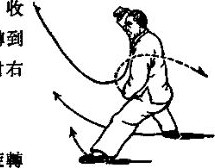
Movement: the preceding fist-form is a great body-storing method; in doing this form, then, it is on the basis of the preceding · 215 · The enlarged body method executed when the body method has been fully stored. On the basis of the fully lengthened and elastic right side of the spine, using the gathering process of the waist-spine's elastic recovery, the right hand makes a forward-twisting downward arc and flings forward-downward (assuming the left hand of the previous posture "Crouching Tiger Wiping the Waist" has been seized), while the left fist makes a reverse-twisting full circle upward from below-behind. Borrowing the centrifugal force of the right fist's forward fling, the torso is lifted, the right foot springs forward in a big step, and the left foot follows. At this moment both feet leave the ground. (Figure 70) Leaping to the opposite side, when the right foot lands as the solid point, the torso is made to rotate 180° to the left in midair, placing the left foot to the east side of the right foot. At this time the left fist also moves from the upper reverse-twisting downward to rest at the waist. (Figure 71) During the leap-and-turn process, a "back-breaking leaning" energy is naturally manifested, in order to shed the seized left hand and draw the left hand back to rest at the waist.
Key points: This posture is primarily based on the stored energy of the previous posture. Before leaping forward, the waist and legs must sit back once to strengthen the elastic energy. Then, borrowing the elasticity of the stored energy, the body springs forward and upward — this is the key to attaining lightness and ease of turning. When turning the body, one must keep it centered and upright; this is the guarantee for safely issuing the back-breaking leaning energy, and is also how one naturally escapes without seeking to escape.
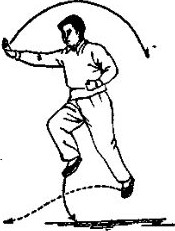
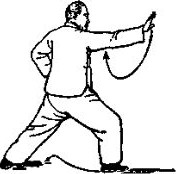
basis.
Fourth-three Posture: Right Yellow Dragon Stirs the Water Three Times (chest facing south)
Movement: After this posture leaps up and turns the body, the left fist props the waist, then the right hand makes forward-twisting circles in front of the chest. When the right hand circles downward, the right foot immediately lifts as empty. (Figure 72) When the right hand circles upward, the right foot again lands as solid, completing one "stirring the water." (Figure 73) Then continue by doing two more "stirring the water" movements. (Fig. 74, 73, then again 74, 73, 74)
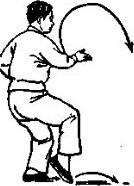
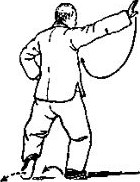
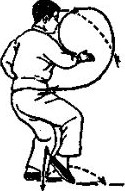
Key points: According to the requirements of motor skill, the simpler the fist posture, the harder it is to fulfill the requirement that one movement moves everything. In this posture only the single right hand circles, with the right foot coordinating in up-and-down division of empty and solid to carry out the movement; such a movement is comparatively simple, and therefore it is a basic exercise for training the silk-reeling energy to achieve joint-by-joint continuity. To achieve "one movement moves everything," the key still lies in the leading of the waist-spine and the loosening-open of the arm's energy, circling like a whip — this is where the crux of doing this posture well lies.
This is precisely the second segment of the second routine of the form, and it may be repeated several times as needed. Because before "stirring the water," a whole series of fairly intense movements has been performed in succession, so here one may obtain a certain rest and recovery.
· 217 · Forty-fourth Posture: Left Yellow Dragon Stirs the Water Three Times (chest facing south, turning north)
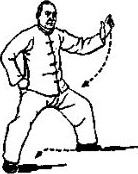
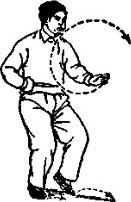
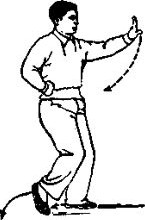
Movement: Continuing from the previous posture, turn the body around and change to the left hand "stirring the water" and circling. Its method is basically the same as the right hand's "stirring the water" movement; the difference is that when the left and right hands alternate and the body turns, the internal energy must be kept unbroken. In the previous posture, when the right hand has circled down and turned left, the left fist propping at the left waist opens and reverse-twists upward to the right to meet it, forming a joining with the left slightly lower and the right slightly higher. At this moment the right foot lifts as empty; as soon as they cross, both hands immediately become double reverse-twisting, and led by the waist-spine and drawn by the right hand, the body turns and carries a turn of 180° to the right. At the same time, the right foot lands as solid and serves as the pivot of the rotation. Following this, the left foot also immediately arcs around with the body and is placed to the west side of the right foot, completing the process of turning the body. At the same time, the left hand circles to the left side from reverse-twisting to forward-twisting, while the right hand, after a small forward-twist, is placed at the right side of the waist. (Figure 75) This is the starting point after "Left Yellow Dragon Stirs the Water Three Times" has turned the body. Thereafter, just as with "Right Yellow Dragon Stirs the Water Three Times," when the left hand circles downward, the left foot must lift as empty. (Figure 76) When the left hand circles upward, the left foot again drops as solid. (Figure 77), completing one "stirring the water." Then do two more "stirring the water" movements. (Fig. 78, 77, then again 78, 77, 78)
Key points: The requirements of this posture itself are the same as those of "Right Yellow Dragon Stirs the Water Three Times," but special attention must be paid to the fact that at the moment of turning the body and changing hands, one must not only turn with a gentle curve, but at the same time must also keep the movement threaded through as one breath, allowing no interruption and no hollows or bumps to occur. The crux lies in that when the left hand opens and joins with the right hand, forming a mutual linkage of the two arms, one can, upon separating again for one turn, pass the energy from the right hand over to the left hand.
Although the key points and movement of this posture are the same as the previous posture, in order to give the left hand the same degree of nimbleness as the right hand, this posture may be done several or a dozen times; in this posture the position of the right foot does not change, so doing it several times in place does no harm to the structure of the entire form.
Forty-fifth Posture: Left Kick with One (Single) Leg (chest facing north)
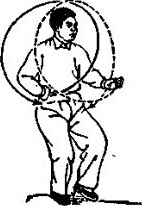
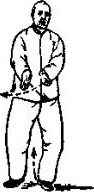
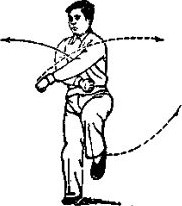
Movement: After the above "stirring the water," when the left arm forward-twists and arcs from inside to outside, the right hand propping the waist opens and takes the opportunity to join in a circling that is at once opposed and at once divided; when turning after passing one circle and then turning downward, it becomes a double closing energy. At this moment palm faces palm, both hands opposed and slightly narrower than the shoulders, placed in front of the abdomen. When the right hand joins in and finally closes, the left foot goes from solid to empty. (Figure 79) With the two hands ceaselessly circling, continue to tighten into a single closing with a double forward-twist, making both palms become fists crossing before the chest. At this moment the left hand is outside and the right hand inside; at the same time, raise the left leg. (Figure 80) After reaching the end point of the crossing, issue the energy with both hands and the left foot together, each with full force to left and right. This is kicking out the left foot with energy while standing on the right foot alone. At this moment the left hand is host and the right hand is guest. (Figure 81)
Key points: The elastic energy of this posture is a double opening energy produced within the double closing, because when the two hands are in a double closing, the elbows and upper arms have a double opening energy. At the same time, when the two feet bend slightly and close doubly, the rounding of the crotch gives the legs a double opening energy as well. This shows that both arms and legs have a linked outward-bracing energy; this is the crux of being able to issue energy crisply. When the two hands and the left foot split and issue to the left and right sides together, because of the stabilizing effect of the two hands' splitting, the torso obtains a certain stability at the moment of issuing. This kind of energy issuance is a good method for training the joint ligaments and strengthening their elasticity.
Forty-sixth Posture: Right Kick with One (Single) Leg (chest facing north, turning south)
Movement: After the previous posture "Left Kick with One Leg," the two hands close to the left with reverse-twisting, drawing the torso to turn left; at the same time the left foot lands with a stamping of the foot, and the right leg is raised, forming standing on the left leg alone, with the two hands closing their energy on both sides of the right knee. (Figure 82) Then issue the energy with both hands and the right foot together, each with full force to left and right — this is kicking out the right foot with energy while standing on the left foot alone. At this moment the right hand is host and the left hand is guest. (Figure 83)
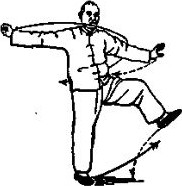
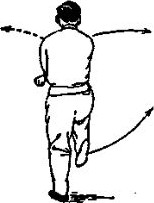
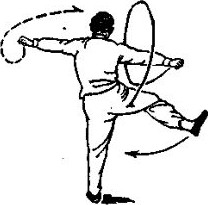
· 220 · Key points: This posture is performed by lifting the left leg and pivoting horizontally to the left; during the horizontal pivot it is not easy to attain a stable turn, therefore the key lies in the lifting of the crown energy and the two hands' reverse-twisting so as to close energy mutually, making the spine taut, with the left toe pointing down, in order to lighten the sinking weight of the left leg suspended in the air. This is the stored-energy posture one should master when turning the body before the right kick. After the left foot lands with a stamping of the foot, immediately raise the right leg, and issue the right foot and both hands to the two sides together.
Forty-seventh Posture: Sea Bottom Turns Over the Flower (chest facing west)
Movement: Same as Posture 30 "Sea Bottom Turns Over the Flower," only the extent of the body turn is smaller; all else is the same. (Figure 84)
Forty-eighth Posture: Cover-Hand Forearm Punch (chest facing west)
Movement: The right foot drops with a stamping of the foot as solid; at this time the right hand is forward-twisting and the left hand reverse-twisting. When the left hand turns toward the left front, the left foot advances one step to the left front; at the same time the right palm becomes a fist, turns to reverse-twisting and issues energy, while the left fist, after turning with reverse-twisting, issues energy to the left rear as guest. (Figure 85)
Key points: Same as Posture 17.
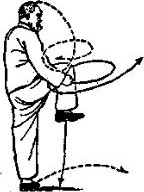
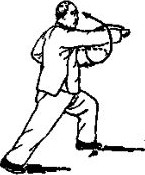
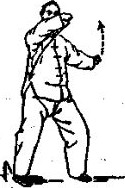
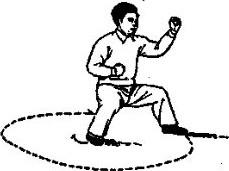
· 221 · Forty-ninth Posture: Sweeping-Leg (turning the waist and smashing, chest facing east, turning north, then turning south and again turning north)
Movement: After the energy issuance of "Cover-Hand Forearm Punch," the right hand in front draws back with reverse-twisting and then makes a circle forward, while the left hand behind circles forward and then backward with reverse-twisting. (Figure 86) When the right hand again draws back with reverse-twisting from the front to before the right waist, the right foot stamps the ground with a stamping of the foot; at this moment the left fist raises forward-upward with reverse-twisting. (Figure 87) Immediately after the stamping of the foot, the right toe turns outward and steps out a small half-step to the right rear, forming a rotational momentum, carrying the body to turn toward the right rear · 222 · about 280°; the right leg squats down, and the left foot follows by extending the leg and arcing around to sweep-turn 280°, sweeping to the northwest of the right foot. (Figure 88)
Key points: This posture is for practicing the ankle-striking energy when the foot sweeps horizontally. In order to rotate the left leg stably and sweep one full circle horizontally, one must make the intent and energy manifest as though the right foot had taken root in the ground. Second, in order to strengthen the leg's horizontal sweeping energy, one must use the right foot's stepping a small half-step to the right rear with the toe turned out, to drive the rotation of the torso and form a rotational momentum. Third, one must coordinate upper and lower consistently, so that the torso can rotate nimbly yet steadily; this applies mainly to the first half-circle of the movement, where the change of posture goes from high to low, while in the latter circle of the movement the internal energy must again go from low to high and then land. This is also a comparatively difficult movement, a movement of leg-leading-body, which can lengthen and strengthen the leg muscles. In order to strengthen the leg's horizontal sweeping energy, it may be singled out for specialized free-hand practice, and one may also do two 360° sweeping-legs.
Fiftieth Posture: Cover-Hand Forearm Punch (chest facing north, turning east)
Movement: After the previous posture has turned through 280°, both hands cross and close before the chest ; then the two palms change and separately arc upward and spread out to the left and right sides; at the same time, the right foot lifts off the ground, and the left foot immediately pushes off the ground and springs up. Then the right foot lands to the southwest, and the left foot follows to land to the northeast. Both hands from above close before the chest with double reverse-twisting, then open with forward-twisting and close with reverse-twisting; then the right fist strikes out, and the left fist is drawn in beneath the left ribs. (Figure 90) What differs between this posture and the previous seventeenth posture is only the leaping-step movement; once both feet have landed, it is the same as the other "Cover-Hand Forearm Punch" postures.
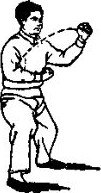
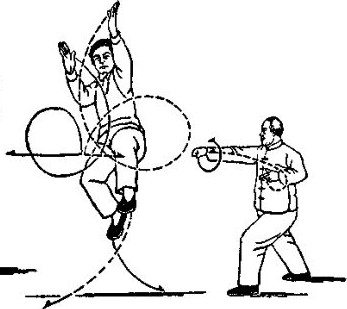
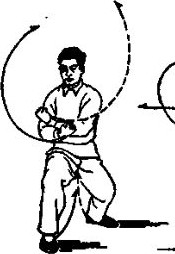
· 223 · Key points: This is a stabilizing movement at the moment when the form's spiraling ascent reaches its end point; it is a practice of spiral ascent after the great rotation of the body, and is also a good athletic training for the vestibular apparatus; to achieve this stabilizing effect, one must stand centered and upright at the conclusion of the sweeping-leg. Key points: Same as Posture 31.
Fifty-first Posture: Left Charge (chest facing east)
Movement: Because the movement begins with the left leg in front, it is named "Left Charge." After the energy issuance of the previous posture "Cover-Hand Forearm Punch," the right fist draws back with forward-twisting, and the left fist extends forward with reverse-twisting; the two fists close their energy, forming two fists opposed. (Figure 91) Then, borrowing the forward-extended left hand, both hands together sink downward and make a circle past the right rib side; when they have circled to the rear-upper, draw back the left foot and lift it as empty. (Figure 92) When the two fists again turn from above to the left waist side, the left foot lands with a stamping of the foot. When they circle to the front-lower, step out the right foot; the two fists turn to the left · 224 · Sink the energy toward the rear of the ribs (Figure 93); this is the gathering posture for the thrust punch. Then issue the shaking energy forward and upward with both forearms. When sinking after the circle, the rear left foot is full; when the two fists shake out the energy forward, the right foot is full. (Figure 94)
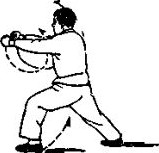
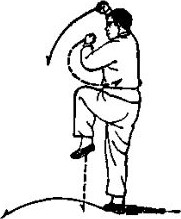
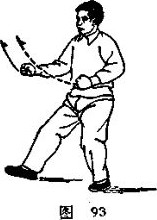
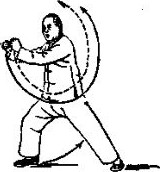
Key points: In this form the two fists travel from the right side to the left side, describing two complete large circles, front-back and up-down. The movements must be continuous and completed in one breath; therefore the rotational momentum must be used, so that the energy can run through to the final shake. If there is a break in between, the energy-strengthening effect is lost. At the same time, this is a necessary form for practising shaking energy. For beginners, after swinging the two large circles, the shaking energy is then issued; later one may gradually— · 225 · —the swings gradually grow smaller, reducing step by step to a single circle; finally, as soon as the intention is aroused, the shaking energy can be issued in the same way. This is the deepest skill in issuing shaking energy.
Fifty-second Form — Right Thrust (chest facing east)
Movement: Because the movement begins with the right leg in front, it is called "Right Thrust". In this form the right leg is in front first, and finally changes to the left leg in front; the two fists first travel from the left rib side to the right rib side, and after describing two large circles they shake out the energy. In these two respects this form is exactly the opposite of the previous form, so its movement path is symmetrical to that form. (Figs. 95, 96, 97)
Key points: Same as "Left Thrust".
Fifty-third Form — Reverse Throw-Down (chest facing east, turning northeast)
Movement: After the previous form has issued the double shaking energy, suppose the right hand is plucked (this kind of plucking energy often makes the one plucked kneel down); in order to achieve sticking, adhering, connecting and following, so that there is no opposing resistance, the right hand follows downward with reverse twining, bringing the right hand together with the left hand. As they join, the left hand is placed beneath the plucking hand, and the right hand presses down, making a preliminary release. At this moment the right hand is full downward, the right foot steps up as empty, standing alongside the left foot with the toes touching the ground, so that the two hands are close to the upper and lower parts of one's own body; this is "release within joining", another example of overcoming weight with lightness. (Figure 98)
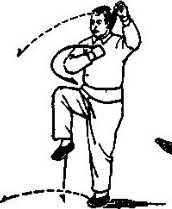
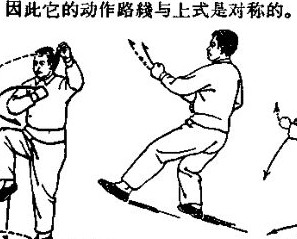
· 226 · Fifty-fourth Form — Turning the Flower at the Seabed (chest facing east)
Movement: If in the previous form the reverse insertion cannot achieve "release within joining", then sink further and suddenly turn, lengthening the body, and change into opening the hands above and below. This is done with the energy adhering to the spine, the body led up by the crown energy, as a second release; it is the method of "release within opening" after "release within joining". Simultaneously with this "opening release", the right hand twines with forward twining to the upper right and then turns to the lower right, the left hand twines with reverse twining to the lower left and then turns to the upper left; the whole body lengthens, the left foot stands alone, the right foot is lifted (as preparation for a kick); the left fist releases energy upward to the left, with the fist centre facing right; the right fist releases energy downward to the right waist side, with the fist centre facing forward. Its movement is the same as the previous "Turning the Flower at the Seabed" forms, except that this form turns the body only slightly, whereas the previous forms turned the body through a larger range. (Figure 99)
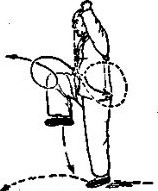
Key points: Taijiquan often uses downward plucking energy, so that the opponent cannot easily use connecting and following to gain release; for this reason the right hand twines with reverse twining downward, the right foot steps forward, and the left hand is placed beneath the plucking hand. Because the right foot steps up in "Reverse Insertion", one's own two hands are brought close to one's own centre of the circle, thereby increasing the moment applied to the opponent while reducing one's own moment; one large and one small — this is again a model of overcoming weight with lightness, and can make one · 227 · —"gain the advantage". This kind of release by pressing above and padding below is the preliminary form of seeking release. If one still cannot obtain release and opposing resistance arises with the opponent, then one should follow the energy of his resistance and reverse its path, turning the left hand onto the opponent's plucking hand, and cause the left hand to chop down and the right hand to lift up, making it the same as "Chopping Hand". At the same time give the left foot a shake, so that the whole body lengthens and rises, and both hands open out their energy. This is the transformed form of release, showing that in the seabed region there are turnings and changes of double opening and double closing; it is also a technique of striking and releasing combined in one movement.
Fifty-fifth Form — Covering Hand and Forearm Punch (chest facing east)
Movement: With the right leg lifted from the previous form, continue into issuing energy; the movement is the same as the fifty-first form. (Figure 100)
Key points: Same as the thirty-first form.
Fifty-sixth Form — Seizing the Two Arms (one) (chest facing east, turning south)
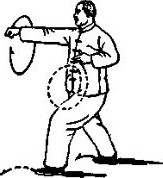
Movement: After the previous form "Covering Hand and Forearm Punch" has issued energy, first slightly open the two hands; thereupon the left fist twines with reverse twining and the right fist with forward twining, turning back from the right side into a joining energy. At this moment the right fist is below and outside, the left fist above and inside; at the same time the right foot follows up half a step, bringing it close to the left foot. Then the two fists change to double forward twining: the right fist is drawn upward back to the chest, the left fist sinks down to in front of the left knee; at the same time the left foot steps forward half a step (Figure 101). Next, the centre of gravity moves forward, making the left foot full; at the same time, owing to the joining energy, with the left foot as pivot the body turns 180° to the right. The rear right foot is simultaneously lifted and steps back to the left rear side (moving sideways half a step). During the turn the two fists continue to twine forward in the chest area, turning over inside and out with joined energy. When the turn brings the body to face east, the right fist is just at the inner front upper position and the left fist at the outer front lower position. As the right fist turns from the inside downward to the outside and then upward to the inside, the right foot is lifted accordingly and drawn along the ground · 228 · —back, the two arms joining their energy. At this moment the right fist is bent to the outside and the left fist bent to the inside. (Figure 102) The movement described above is storing energy; the movement that follows is the issuing of energy after storing. Beneath the encirclement of the two fists fully expanded with energy, the right fist lifts slightly upward, and after turning to the inside of the left fist immediately sinks its energy downward. At the same time the right foot gives a shake, and darts out along the ground; when it has darted to the centre of the opponent's circle, the right arm, held horizontally, issues energy from the forearm, while the left fist twines with reverse twining and releases energy to the left rear. This is a special movement in which the right hand and right foot advance together; it is also the upper and lower following one another in posture. When energy is issued, the left foot is full. (Figure 103)
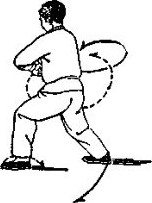
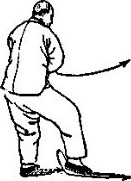
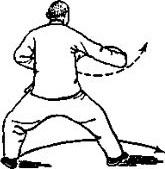
Key points: The key point of this fist form is to turn the body round within joining energy, which differs from the preceding forms that turn the body within opening energy; this is therefore the main content practised in this form. In this form, supposing an attack comes from behind, one turns the body to dissolve that attack, and uses the turning of the body to strengthen the stored energy, so that the next fist form can be issued more crisply; this is the special function of this form. In the turn— · 229 · —ing the body, one must keep the tailbone centred and the spirit threaded to the crown; that is, the crown energy is not lost and the tailbone does not lean.
After turning the body, when the right arm is held horizontally to join energy, suppose the right wrist joint in front is plucked; then there is no need to seek another method of release — the right fist and right foot can together give a shake and dart out forward along the ground, and the right forearm issues energy outward horizontally (warding-off energy is spring energy, first of the eight energies of Taijiquan, a defensive energy. If it can be used within the issuing of warding-off energy, it amounts to two uses in one movement; this kind of strike can be issued with a single shake of the hand, so the distance is short and the effect great, making it the simplest way of issuing energy). This too is the combined action of release and strike in one movement. Its key point is that release must be obtained under "the central earth not leaving its position" and "advancing and retreating with the body"①; it is also a striking method for entering the opponent's circle, and in particular the use of warding-off in striking is the most concise method of two uses in one movement.
Fifty-seventh Form — Seizing the Two Arms (two) (chest facing south, turning west then south)
Movement: After the warding-off energy has been issued in the previous form, suppose one has still not obtained release; then one must continue to do a second "Seizing the Two Arms"; therefore there should be an upward step in the shape of the Chinese character for "person" (ren). This is a movement of stepping forward two paces following the opponent's warding-off lock; it is rarely seen within the boxing frame, so it must be practised as a single movement. This movement begins with the right fist twining forward, drawn upward and inward, while the left fist moves from below and outside upward, and the left foot follows with a step forward. (Figure 104) When the left fist has reached the outside of the right arm and presses upward, and the right arm twines downward inside the left fist, and they are brought close to one's own body with the upper and lower energies opposed, the plucked right arm has already been released. At the same time as the release, the right foot has also stepped forward; this too prepares the way for the warding-off issuing movement of the right arm—
- ① "The central earth not leaving its position" and "advancing and retreating with the body" are Taijiquan terms, meaning that when the hands and feet advance in succession, one should move like a great banner, standing erect and not falling.
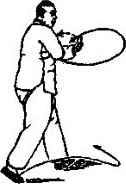
· 230 · —preparation for storing energy. (Figure 105)
After the left step has been taken in the previous form, the second right step is taken in succession; this is the final step of the ren-shaped upward step. The two fists, like a windmill, twine over one another inside and outside in front of the chest through one large circle. In the previous movement, when the right fist twines forward, upward and inward with forward twining, the right foot is drawn back half a step with the toes touching the ground. Then the right fist sinks its energy downward in front of the chest in coordination with the left fist moving upward, so as to release the plucked right hand a second time. At the same time the right foot shakes downward in a stamp, and taking advantage of the momentum darts forward along the ground. Simultaneously the right fist, arm held horizontally, moves forward and issues energy horizontally outward. (Figure 106)
Key points: If the warding-off issuing energy of the previous form is still not enough to release the plucked right hand, then to avoid opposing resistance one must use connecting and following and, dragging along, step up in succession. Therefore the main content of practice in this form is to step forward two paces in succession without any break in energy occurring, and to have at all times the opportunity to release and to strike. To attain this requirement, the key point is that the two arms are linked together so that the two fists turn over up and down in the course of advancing, shaking the spine to shake off the plucking of the right hand.
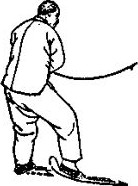
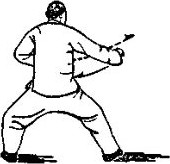
Because the first "Seizing the Two Arms" still cannot obtain release, one must follow the required energy and, in the course of pushing the opponent backward, issue energy outward horizontally, releasing and striking at once. This is the unified action of pushing and releasing. Therefore, whether it steps with the left foot or the right foot, it must · 231 · —turning the spine and advancing. This is the key to whether, when warding-off energy is issued, the stored energy of the spine can be released like a bowstring slipping its catch.
Fifty-eighth Form — Linked Pearls Cannon (chest facing west)
Movement (one): After the right hand has issued warding-off energy in the previous form, the left fist stored at the left rear strikes and shakes out like a bowstring slipping its catch, while the right fist twines forward, drawn back to rest at the right rib side. When the strike is issued the left leg is full. (Figure 107)
Movement (two): Movement (one) is the shaking energy of the left fist; movement (two) is the shaking energy of the right fist. The two are basically the same; the difference is the shaking of the spine. When the left fist is drawn back with forward twining to rest in front of the chest, the right fist is sent out like linked pearls. When the right fist is sent out the right leg is empty. (Figure 108)
Movement (three): Same as movement one. (Figure 109)
Key points: "Thrust Punch" is shaking energy issued by both fists together; this form is shaking energy issued by each fist separately. Its key point lies in loosening the limbs, then suddenly shaking outward; it is a short-range hard energy. After issuing, the arm must still be bent and stored; the degree of bending and storing is determined by the ability to issue again.
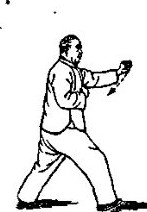
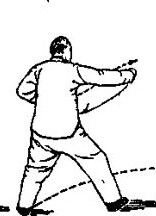
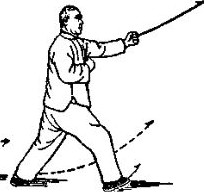
· 232 · The use of energy in movement (two) is like a carpenter boring a hole with a hand drill, having the effect of striking in linked succession; this is a special fist form for training the waist and spine and the elasticity of both arms.
Fifty-ninth Form — The Jade Girl Works the Shuttle (chest facing west, turning north then east)
Movement: After the previous form has issued energy, suppose the left fist is plucked; the left fist is drawn slightly inward and then immediately extended, and the left foot steps out and leaps forward with a flying step. (Figure 110) At the same time the right foot follows and advances, and the body is carried round to the right through 180°, placing the right foot to the west of the left foot, so as to release the plucking of the left fist; and with this turn of the body one strikes the opponent with back-breaking leaning energy. At the same time the two fists press down with double reverse twining in front of the chest, joining their energy. (Figure 111)
Sixtieth Form — Turning the Head to Face the Cannon (chest facing east)
From the turn of body in the previous form the left foot is full; passing through the elbow stage the right foot is full; then the fists twine with double forward twining and shake energy out forward and upward; at this moment the left foot is full. (Figure 112)
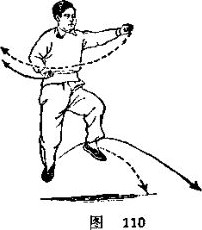
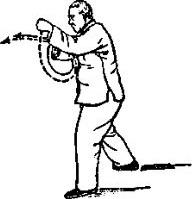
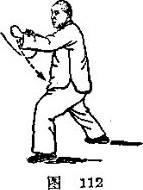
Key points: The back-breaking leaning energy of Taijiquan is always for the sake of connecting and following; it is an energy used only when unavoidable, and one does not lightly adopt body methods to strike. Because in the course of the flying body connecting and following in "The Jade Girl Works the Shuttle"— · 233 · In this, by using the lean (kao) of the turning body, one can not only free the hand that has been seized (cai), but can also promptly attack the opponent with the "turn the head and cannon at the door" (huitou dangmen pao) posture. This is the simplest method that serves both to escape and to strike, and therefore in the course of turning the body one often uses the back-bending lean (beizhe kao) to seek release. The flying-step turn of "Jade Maiden Weaves the Shuttle," striking the opponent with lean energy, is yet another example of the application of the above principle. Its key point is that before springing out one first sinks the energy in the right leg, then steps out with the left foot and springs forward. In the course of "landing" one must still take care to keep the body centered and upright—this is a necessary condition for applying lean energy. Then both fists are sent out with a shaking energy in the forward (shun) coil.
Phần 35
Form 61: Jade Maiden Weaves the Shuttle (chest toward east, turns to north, then turns to west)
Movement: This form, like the preceding "Jade Maiden Weaves the Shuttle," is a leaping, flying advance, and in the course of the leaping turn it uses the attack of back-bending lean energy in order to seek release. The difference is that in the previous form the left fist was seized, so the back-bending lean energy of the left shoulder was used while turning to the right; in this form the right fist is seized, so the back-bending lean energy of the right shoulder is used while turning to the left. The back-bending lean of the left turn and of the right turn should be paired together. After the release of energy in the previous form, supposing the right fist is seized, draw the right fist slightly back and then extend it, while the left fist is withdrawn to the waist; at the same time the right foot immediately springs forward one large step. (Figure 113) Then the left foot follows in, and the body is turned to the left.
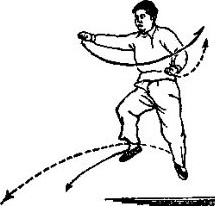
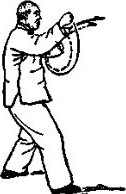
· 234 · Bringing the turn through 180°, circle the left foot to the east side of the right foot, in order to free the right fist from being seized. (Figure 114)
Phần 36
Form 62: Turn the Head and Cannon at the Door (chest toward west)
Movement: After turning the body and landing from the previous form, both fists sink with a backward-downward reverse (ni) coil; then immediately shake the energy out toward the right-forward-upward direction. While sinking the energy the left foot is full (solid); when releasing energy the right foot is full. (Figure 115)
Key points: Same as Form 60.
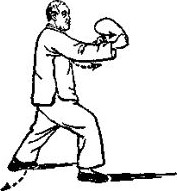
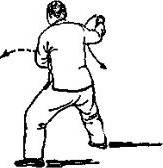
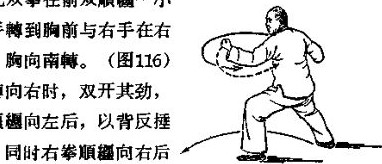
Movement: In the previous form the right foot is forward and the left foot behind; after both fists have sent energy forward with a double forward (shun) coil, the two arms hold each other and slightly store the posture. Supposing there is an attack from the left or right rear, both fists therefore make a small forward double forward-coil, causing the left hand to turn to the front of the chest and to join energy with the right hand at the upper right, the chest turning south. (Figure 116) When the two fists again turn to the right, both open their energy, and the left fist is sent with a forward coil to the left rear, releasing its energy as a back reverse hammer. At the same time the right fist releases energy with a forward coil to the right rear, and the weight shifts to the left leg, which becomes full. When releasing energy the left fist is the host and the right fist is the guest. (Figure 117)
· 235 · Key points:
This is the fist-form adopted after the previous form has sent both fists shaking out to the right-front, when suddenly on the left side a possible attack is discovered. Its requirement is that as soon as one glances back, the left fist quite naturally sends out energy as a back reverse hammer. To do this strike well, the main thing is that on the basis of the crotch sinking, as though a small circle has turned in front of the lower abdomen, then led by the waist and spine, centrifugal force is used to fling out the back of the left fist.
Phần 37
Form 64: Twisted Phoenix Elbow (chest toward south, turns north)
Movement: After the left fist in the previous form has sent energy out to the left rear, supposing that after sending it the left fist is again seized, then without the least delay sink both fists' energy, turn both backward in reverse coil, and the two arms join energy. At the same time carry the body turning 180° to the left, and the right foot also follows up one large step to the east side of the left foot. The left fist opens into a palm and presses on the opponent's seizing arm (that is, it is placed on one's own right fist), making the two arms join as one arm in ring form, and using the right fist pressed within the left palm as the center of rotation, the right forearm sends elbow energy with a reverse coil toward the right of the chest. At the same time the left palm also turns upward following the rotation of the right fist, palm center facing up, and the left foot is full. (Figure 118)
Key points:
After the previous form releases energy the left fist is seized; in order not to resist or oppose, one has no choice but to turn through one large step, turn the body around, press down on the opponent's point of seizure to serve as the central axis of the rotating arm, and send elbow energy forward. This is a short-range elbow energy, and also a simple method of freeing oneself from being seized. Press the palm on the opponent's seizing palm, and with this as the center, make it difficult for the opponent to change the seizing hand, then strike sideways to the right with the right elbow. This is a fierce striking method—another fist-form in which, without seeking to escape, one escapes of itself.
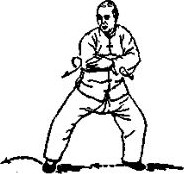
· 236 ·
Phần 38
Form 65: Forward Phoenix Elbow (chest toward north)
Movement: This continues from the previous form "Twisted Phoenix Elbow," after the horizontal elbow has struck out from the front of the chest inward to the right; if one still cannot free oneself from its seizure, then continue following the required energy, separate one's two hands, and with the tip of the right elbow in reverse coil and the tip of the left elbow in forward coil make a small circle, sending energy downward. Because the right foot is in front at the right and is empty, it quite naturally drills in along the ground, while the left foot follows and advances behind. (Figure 119)
Movement: This continues from the previous form "Forward Phoenix Elbow," after the two elbows have sunk and released energy; with the left palm guarding the chest, use the tip of the right elbow in reverse coil to make a small circle, and unfold the step to the right side in order to strike out. The right foot drills in along the ground while the left foot follows and advances behind. The right foot is in front and is empty. But when the elbow energy is released, the right foot immediately becomes full. (Figure 120)
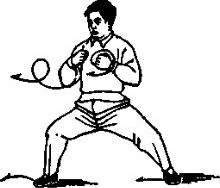
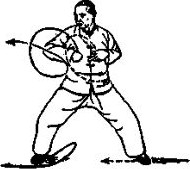
Key points:
Whenever an arm goes beyond the square-round circle, it is called "going out to the corner"; whenever it enters within the square-round circle, it is called "entering the corner." Going out to the corner requires the use of seize-and-split (cai/lie); entering the corner requires the use of elbow and lean. Therefore the use of elbow and lean is like short weapons meeting in close combat—a quick battle quickly decided, with no room for delay. For this reason one must have continuous · 237 · measures used bead by bead, so as to obtain the final release. This form is the continuation of that measure. When the right hand still cannot get free, following the required energy, the right foot drills in along the ground and the right elbow strikes out to the right; at the same time the left foot kicks back along the ground behind—this forms the momentum of a bowstring slipping its catch, and forms the key point of using lightness to control heaviness and of striking with linked-bead elbows.
Phần 39
Form 67: Cannon in the Nest (chest toward north)
Movement: This follows from the left hand of "Withdraw the Body and Punch" being seized; a whole series of linked-bead strikes using elbow energy frees the seized left hand, and this is the release of energy immediately following that release. It uses the right in forward coil and the left in reverse coil, both storing their energy in front of the chest, so that the right fist is below and inside, the left fist above and outside; at the same time the forward right foot is drawn back, forming the bent-and-stored posture with energy adhering to the spine and back. After storing the posture, the right fist immediately turns outward and strikes out toward the right front with the back of the fist; at the same time the left fist coils in reverse to the left rear to the left side of the waist and releases energy, to coordinate with the strike of the right fist. When the right fist strikes forward, the right leg presses out, the weight moves forward, and the left foot also follows up a half step. (Figure 121)
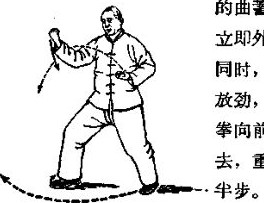
Key points:
Form 63 "Withdraw the Body and Punch" is a back reverse hammer of the left hand; this form is a back reverse hammer of the right hand. The key point of this form is that, following the drilling forward along the ground of the previous form, one takes the near and discards the far; while the foot-sole sinks and centrifugal force is used, one makes the dropping elbow the pivot and counter-strikes out with the back of the fist; the right foot also follows drilling in along the ground. In order that the energy be released more crisply, one must, under the joined energy of the two fists—right forward, left reverse—shrink the circle, to strengthen the stored energy, and then, led by the elbow and carrying the body, counter-strike out to the right and outward. This form requires that one movement moves the whole body; and this can only be done just right on the basis of the waist and spine working as one, using inertial force.
· 238 ·
Phần 40
Form 68: Well-Curb Straight Entry (chest toward north, turns south)
Movement: Continuing the previous form, after the right fist releases energy, and after joining in front of the chest with the right in forward coil and the left in reverse coil, the two fists again open outward to the right with a right-forward, left-reverse energy, carrying the body turning 180° to the right with the right foot as the central pivot of rotation; the left foot also arcs round accordingly to the east side of the right foot. When the chest turns to face south, the two fists make forward coils inward-outward and upward-downward in front of the chest, rotating one circle with bent arms like a windmill. When the right fist turns inward and upward, the right foot is full. (Figure 122) When the right fist turns outward and downward and the left fist turns inward and upward, the left foot is full. (Figure 123)
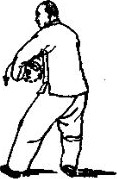
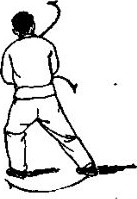
Key points:
This form is chiefly performed with the crotch-opening of the horse-riding stance, the two fists turning before the chest with abundant energy, making one forward-coil circle up-down and in-out, rubbing and moving the spine and back, in order to train the skill of energy issuing from the spine. In doing this form the two parallel legs must also coil inward and outward, and must express the manner of energy rising from the heels and reaching the tips of the fists. This is a fist-form for correcting movements and attaining correct posture.
Movement: After the previous form "Well-Curb Straight Entry," in order to turn to face north, the two fists become two palms, and the two palms, with right forward coil and left reverse coil, split upward and downward into two and then join together before the chest;
· 239 · Then, with left reverse and right forward coil, turn and open the circle, causing the body to turn 90° to the right. At this time the left foot is full, and with the left foot as the central pivot of rotation, the right foot accordingly sweeps horizontally to the right to the east side of the left foot. When the right palm, coiling forward, comes downward, and reaches the front of the lower abdomen, the palm center has already turned to face upper left. At the same time the left palm, with a reverse coil, presses downward with energy from upper left to lower right, joining with the right palm in front of the lower abdomen. (Figure 124) Then the left palm presses down on one point and coils in reverse to the left rear, the weight remaining on the left foot; the right palm accordingly coils forward and opens its energy upward, carrying the body turning another 90° to the right. At this time the left foot is still the central pivot of rotation. (Figure 125)
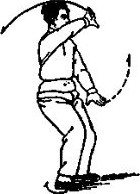
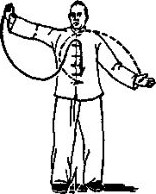
Key points:
The "Wind Sweeps the Plum Blossom" of this form is basically the same as the "Wind Sweeps the Plum Blossom" of Form 10; the difference is that the "Wind Sweeps the Plum Blossom" of Form 10 rotates 360°, while this form rotates 180°. Its function is chiefly to bring the practitioner finally to face north and so conclude the second routine (form-set).
Phần 41
Form 70: Buddha's Warrior Attendant Pounds the Mortar (chest toward north)
Movement: This form is a "Buddha's Warrior Attendant Pounds the Mortar" performed without pause after "Wind Sweeps the Plum Blossom." It is the same as the "Buddha's Warrior Attendant Pounds the Mortar" done after the 360° turn of Form 12, and therefore is not described again. (Figure 126)
· 240 · Key points (2): Same as Form 12.
Phần 42
Form 71: Closing Posture (chest toward north)
Movement: Following the previous form "Buddha's Warrior Attendant Pounds the Mortar," this form then separates the two hands to left and right, and brings the two hands together before the chest with a double reverse coil; after the fingers of the two hands touch, the palm centers face down, and then, with a reverse coil, the two hands split forward and downward, stopping at the two sides of the thighs, with the palm centers facing backward, returning to the preparatory posture. (See Fig. 1)
Key points:
The second routine likewise begins with the "civil aspect" and ends with the "martial aspect," starting facing south and ending facing north; if one does not practice the first and second routines linked continuously, or if the second routine is not to be practiced twice in succession, then one must add these two fist-forms, "Buddha's Warrior Attendant Pounds the Mortar" and "Closing Posture."
· 241 · Chapter 4: Chen-Style Taijiquan Pushing Hands The two-person pushing-hands method of Chen-style Taijiquan was originally called "throwing hands" or "hitting hands." It is an original competitive exercise created by the Taijiquan school through inheriting and developing the martial technique methods of Ming-dynasty folk martial arts. It comprehensively inherited and developed the three methods of "seizing, throwing, and casting-and-striking," and therefore its original martial character is extremely intense. Silk-reeling sticking-following and silk-reeling spiral movement are the central content of its creative achievement. On the basis of the theory that "the Taiji has two modes, with softness and with hardness," it requires that the internal energy—flexible in change, rich in elasticity and toughness, with "hardness and softness assisting each other, lightness and heaviness both complete"—serve as the commander.
Chen Wangting said in the "General Song of the Boxing Classic": "Let go, bend, extend—no one knows; the various leans and entanglements I all rely on" ("the various leans" refers to two people leaning their arms against each other, applying the eight methods and kinds of energy: ward-off, roll-back, press, push, seize, split, elbow, lean). These two lines summarily explain the characteristics and methods of pushing hands. The original four lines of the "Song of Hitting Hands": "Ward-off, roll-back, press, push must be done in earnest; upper and lower following each other, the person is hard to invade; let anyone with giant strength come to strike me—four ounces deflect eight thousand catties"—this explains the function of "the various leans" and the principle of taking ward-off, roll-back, press, and push, the four hands, as the basic skill.
Toward the end of the eighteenth century, Wang Zongyue of Shanxi, and in the mid-to-late nineteenth century Wu Yuxiang and Li Yishe, master and disciple, of Yongnian in Hebei, all developed the theory of Taijiquan and the techniques of pushing hands, and on the basis of their own experience in practicing boxing wrote summarizing essays on Taijiquan and pushing hands. These boxing treatises, concise in words but comprehensive in meaning, were widely copied and circulated, and became in modern times · 242 · Guiding theory for practitioners of taijiquan and push-hands; Chen Zhong-shen and his son Chen Xin of the Chen family, contemporaries of Wu and Li, likewise expounded the taijiquan and push-hands theory accumulated over generations of the Chen family.
Phần 43
1. General Essentials of Push-Hands
Since the Yang-style taijiquan became widespread and "xieshou" (joining hands) or "dashou" (hitting hands) came to be called "tuishou" (push-hands), the term "push-hands" has become a common name. Push-hands is a method in which two people join hands and coil around each other, using the unique training method of taijiquan movement, which is like a screw. According to the principles of "adhere, connect, stick, follow; neither lose contact nor resist; neither overshoot nor fall short; yield and extend," one uses the eight methods and kinds of jin -- peng, lu, ji, an, cai, lie, zhou, kao -- to train the sensitivity of the tactile sense of the whole body's skin and of the internal feeling, to detect the size, hardness or softness, solidity or emptiness, length, speed and direction of the opponent's jin. One selects a sticking point that accords with the lever principle as the fulcrum, uses the pulling action of elasticity and friction (the point of application of force), brings into play the skills of "draw in and let him fall into emptiness," "follow his force and borrow his power," and "overcome heaviness with lightness," grasps the strategy and tactics of "if he moves quickly, respond quickly; if he moves slowly, follow slowly" and "if he does not move, I do not move; if he moves slightly, I move first," pulls the opponent's center of gravity, and at the moment when time and point of force are most appropriate "strikes the light with the heavy, breaks the empty with the solid," issuing the jin. This kind of issuing must be "calm and steady, relaxed and quiet, concentrated on one direction," going from a curved arc straight forward at the target, steady and accurate -- just as when an arrow is shot its head sinks deep into the target -- and thereby sends the opponent out cleanly. The overall requirement is to be able both to neutralize and to issue; to neutralize with relaxed purity, to issue with crispness. This competitive sport can train strength and endurance, and can also train such physical qualities as sensitivity, skill and speed.
In order to avoid accidents of injury, the modern developed push-hands method restricts the use of such methods as grabbing, seizing, throwing, wrestling and striking; hence it has become a martial art that men, women, the old and the young can all practice.
· 243 · The practice of the taijiquan routine originally went hand in hand with "push-hands." Once the routine is practiced to mastery, fine and delicate, centered and full, with inner and outer united and with emptiness and solidity, hardness and softness all complete, one can then fully bring out the skills of push-hands. While practicing the routine, if one also practices push-hands, one can both apply the kinds of jin obtained from walking the form harmoniously within the push-hands of paired practice, and at the same time test how correct one's practice of the taijiquan routine is, making it easy to correct and enrich its postures and movements. Holding push-hands competitions can correct certain ways of practice that distort taijiquan theory and correct one-sided understandings of push-hands, so that the technique of taijiquan is restored and developed.
Phần 44
2. Chen-Style Push-Hands Methods
The basic footwork of Chen-style push-hands is one step forward and one step back; one may also advance continuously or retreat continuously. The hand methods are peng, lu, ji, an, called the four cardinal hands; each time four hands have pushed through one circle, there is one advance and one retreat -- the advancing one does ji and an, the retreating one does peng and lu. Once the push-hands of the four cardinal hands is familiar, one then mixes in cai, lie, zhou, kao; these are the four corner hands, also called the great lu or great kao. Once the basic footwork is familiar, one may practice "strolling" push-hands, that is, moving steps without restriction of direction, also called "randomly treading flowers."
In Chen-style push-hands, if A has the right (left) foot forward, then B has the left (right) foot forward, so that the two hands of the upper limbs push each other and the front foot of the lower limbs also sticks and neutralizes with each other, training hand and foot at the same time to be sensitive in touch. Whenever one advances, the front foot is placed on the inner side of the opponent's front foot. The two parties' front feet lean and stick to each other; this can serve as the method for later using the foot-lock, and as basic training for developing the techniques of throwing.
Before the two people join hands, they stand facing each other, centered, stable and comfortable, in the position of attention. Facing · 244 · The distance at which they stand is measured by both parties raising their arms forward level (fists clenched) until the faces of the fists touch. If A steps forward with the right (left) foot, then B steps forward with the left (right) foot, forming the bow stance, but the center of gravity falls between the two legs, so that when attacking one may sit solid on the front leg and when neutralizing or drawing in one may sit solid on the back leg. At the same time each pushes the right (left) hand forward in peng, no higher than the eyebrows, palm facing outward (the palm faces outward to make it easy to pluck and seize); the two shoulders relax, the elbows hang down, and the outer sides below the wrist joints stick to each other and peng. Whenever joining hands, the arms must be relaxed and soft, but the sticking point of the main attacking and defending hand must be peng'd firmly with jin led by intention, and must not be softened. Wu Yu-hsiang correctly summed it up: "in every movement, only the hand first exerts force, then immediately relaxes"; the force he refers to means the relaxed force that has elasticity and toughness, not the inflated, stiff, clumsy force. Therefore Li I-yu's "Five-Word Formula," in the entry "quiet the mind," says: "when he has force, I too have force, and my force is first; when he has no force, I too have no force (the peng jin is not lost), and my intention is still first." Chen Xin says: "one must not have force, nor must one have no force; simply strike the mean." The wrist joint faces the midline of one's own chest: when the palm faces inward, the thumb points toward the tip of the nose; when the palm faces outward, the little finger points toward the tip of the nose. At the same time the lower (right) wrist joint's ulna lightly touches the upper-arm portion above the opponent's elbow joint. (See Figure 1: Double Joining Hands.) Then one party actively attacks with the an method, the other neutralizes and draws it in with peng, and the practice of peng, lu, ji, an begins, going round and round, continuous and unbroken.
Peng jin Because the body and limbs are lengthened, a kind of elasticity is produced, just as the bowstring is stretched by the elastic force of the bow's back and produces elasticity; this forms a spring-like jin, called peng jin. Whenever intention is poured into any part of the limbs and they rotate forward and extend (following the silk-reeling), it is the action of peng jin.
In push-hands, peng is using the right (left) hand to peng the opponent's double an; the sticking point makes an axial rotation, and following the axial rotation of "the master is in the waist and spine," one takes a silk-reeling spiral arc to neutralize and dissolve, and also plucks and seizes the opponent's palm to draw him in (plucking and seizing is at present used only in Chen style). At the same time the ulna side of the left (right) hand lightly pengs the opponent's right (left) hand · 245 · the upper arm and draws him in. The plucking and the lie are combined into one, the aim being to make the opponent's stance unsteady. The body gradually sits back; at the same time the hips are drawn in, the waist turns, the foot pushes; the back foot gradually becomes solid, the front foot gradually becomes empty, forming the posture of "kicking down and swinging outward." (See Figure 2: A does an, B does peng.)
Lu jin Lu jin is also produced under the condition that the body and limbs are lengthened: when the body and limbs move inward-left or inward-right and make the reverse silk-reeling spiral, lu jin is produced. Because of the spiral, the contact surface is enlarged, and thus the friction is increased. Whenever intention is poured into any part of the limbs and it rotates backward, or left, or right, to dissolve, it is the action of lu jin.
Lu jin is the reverse side of peng jin. In push-hands, when the opponent does a double an, and after my peng neutralization he cannot get jin and so changes to ji to continue the attack, I still gradually draw an arc and peng him back, drawing him near to the left or right side of my body and dissolving him, making him fall into emptiness (drawing him in toward oneself with lu is falling into emptiness so as to lure him deep, but the hand must peng firmly, and one must take care that when lu-ing back one's own arm does not stick to one's own body -- "the elbow does not stick to the ribs" -- and the tip of the elbow must not move behind the body, lest one be pressed so that one cannot issue jin and counter). When lu-ing, sit solid on the back leg, turn the waist and drop the hips, with the crotch step kicking down and swinging outward. (See Figure 3: A does ji, B does lu. Figure 5: B does ji, A does lu.)
Ji jin The two jin of peng and lu are the principal jin of the four cardinal hands; an and ji are the auxiliary jin of peng and lu. Sometimes the elasticity of lu jin is insufficient; in order to avoid the fault of flatness, one adopts crossed hands to strengthen lu jin, joining the two arms into a ring shape -- in mechanics this is called the resultant force. In this way one can find a way out left and right, issuing jin with emptiness and solidity mutually changing; this is called ji jin. In push-hands, when my double an has been peng-neutralized and lu-drawn by the opponent and I feel I have lost the advantage, I then change the front hand (the hand that was peng'd or lu'd is the front hand) to a bent elbow, palm slanting outward and down, and push forward in a flat circle (hand and elbow level) or a vertical circle (hand below, elbow above); the rear hand sticks below the front hand's elbow joint, palm outward, to assist the front hand's force (the rear palm slants forward and up, serving as a defensive method to guard against the opponent striking the face, and also making it easy for the opponent to take over the hand and seize or lu, or to change to an, gradually forcing the opponent's stance to become unsteady, sitting forward, with the front foot solid).
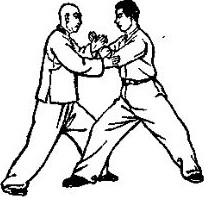
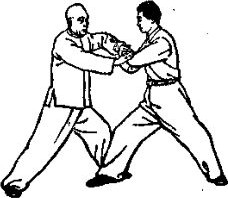
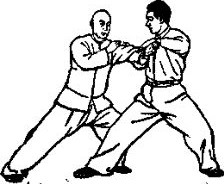
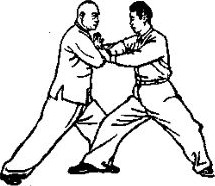
· 246 · An jin An takes the center of the palm as the axis; using the four sides of the palm it rotates and presses in order to seek out the opponent's emptiness, striving to go upstream, to be above the opponent's hand. In this way not only is there much use and wide range, but the field is large, and it easily turns into the other three jin of the four cardinal hands, and also easily turns into the two jin of cai and lie of the four corners. In push-hands, an is using my two palms to press the opponent's one arm and to alternate emptiness and solidity within the double an, one hand controlling the wrist joint, one hand controlling the elbow joint, so that it is not easy for the opponent to change lively or to counter; sink the shoulders, hang the elbows, sit the wrists, and enclose emptily, not using clumsy force. The long jin goes forward, lightly pressing onto the opponent's body; the hand has both lightness and heaviness. Not only do the two palms alternate emptiness and solidity, now hidden now appearing, but around a single palm too emptiness and solidity change with every breath; the palm center · 247 · rotating around above the opponent's arm -- that is, ceaselessly shifting the point of force, imagining countless forward pressings, gradually forcing the opponent's stance to become unsteady and the body to sit gradually forward, with the front foot solid. (See Figure 4: B does an, A does peng.)
In sum, the two jin of peng and lu are the hand methods of neutralizing jin: the lu jin must go down, the stepping foot must kick down and swing outward, sitting solid on the back leg; when the waist and hips shift the center of gravity, one must likewise make the shoulder and hip vertical and the two breasts and the two corners of the belly vertical, not letting the body lean forward or back or tilt, always maintaining the body centered and upright. One's own arm must be light, nimble and soft, yet must not lose the peng jin, lest one lose the momentum of "relaxing my jin and not letting it bend." Therefore the arm and elbow must never stick to one's own body; one must leave room for rotating and dissolving, and under the armpit one must always keep a gap of about a fist's width. At the same time the tip of the elbow must not move behind the body, lest one be pressed so that one cannot issue jin and counter.
The two jin of an and ji are the hand methods of attack: sit solid on the front leg; the hand should not reach out beyond the tip of the foot; the elbow joint hangs down, always bent and not straight; at any angle strive to make the shoulder and hip vertical, the two breasts and the two corners of the belly vertical, not letting the body lean forward or back or slant, and maintain "the body centered and upright" and "one line from top to bottom."
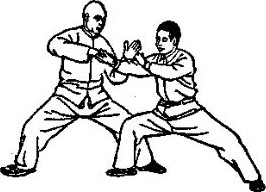
Cai jin Cai jin is the opposite of ji jin: ji is a double closing, while cai is a double opening; its form is like one hand gripping a tree branch while the other hand plucks the fruit. Cai jin is the foundation of chin-na (seizing and locking). The chin-na hand developed out of cai jin. Its main function is to come out of the corner to control the corner and to pull the opponent. The boxing treatise says: "cai the sky and kao the earth, seeking each other in response." The cai method is to use the palm and fingers emptily · 248 · enclosing the opponent's arm, and, following his force and borrowing his power, suddenly plucking downward from lightness to heaviness. The speed is fast, the distance short, the point of landing accurate; a fierce pluck, not a sudden dead grip that is sluggish and heavy -- this is a method of startling and shaking, most easily pulling the opponent's heel, but it also easily jars the opponent's cranial nerves; therefore it should not be used lightly. Those of comparable skill may use it on each other to test whether the jin is applied appropriately.
Lie jin The distinguishing feature of lie jin is the use of the tip points of the fingers and palm, in the manner of a sudden attack, to shake out a kind of jin at close range; it is the foundation of the closed-cavity strikes within the former chin-na. Lie mainly uses shaking strikes rather than issuing jin, and is often used when the hand has reached its point and the situation for issuing has already changed, so that issuing is impossible, and one then changes to lie jin and shakes it out. If, when using lie, one feels that the opponent has been pulled, one may then follow the momentum and turn to issuing jin. This lie jin, like an jin, is a hand method of rather wide application. Besides the shaking strike that is its main function, lie jin also has an action in the opposite direction to peng jin: it is a curved-form simultaneous neutralizing and striking, only in the opposite direction. Peng is drawing and dissolving backward or to the left or right; lie is curving and slightly dissolving, then rotating and peng-ing out slantwise forward at an oblique angle, like the shape of a parabola. Peng is to make the opponent topple toward the back or left or right of me; lie is to make the opponent fall backward, spinning to his own left or right.
In sum, lie jin and cai jin are a pair of opposites. In the process of cai, when meeting obstruction, one may turn to lie; when lie meets obstruction, one may turn at once to cai. This is the unity of cai and lie, just like the two jin of peng and lu among the four cardinal hands. But cai and lie are unified within peng and lu; between them peng and lu are the host, cai and lie the guest.
Zhou jin Although zhou, kao, cai and lie are all corner hands, cai and lie are used when the wrist has gone outside the square-and-round circle, while zhou and kao are used when the hand method enters the inner circle of the square-and-round circle (see Figure 12 of Chapter 2); this likewise belongs to coming out at the corner. Therefore cai and lie are like "long weapons" engaging in battle, while zhou and kao are used as "short weapons." In the course of push-hands, if a slanting-forward out-of-circle form arises, one remedies it with cai and lie; if a leaning-back entering-the-inner-circle form arises, one uses zhou and kao as reserves.
In the use of the elbow, the other arm must come up to the forearm of the elbow that is issued forward, so that one elbow becomes two · 249 · in the use of the elbow. Forms of the second routine such as "ao luan zhou" (twisted phoenix elbow) and "shun luan zhou" (following phoenix elbow) can attack to the left and right. The use of elbow and lie is at the middle "man" position, unlike cai-the-sky and kao-the-earth; it is like the function of the advisers and ministers in Chinese chess. An elbow strike is struck by pressing the tip of the elbow or the surrounding part of the elbow tightly to a person's body; because striking a person's ribs with the elbow tip easily injures him, it is no longer permitted to apply it to the ribs. In push-hands, when using the elbow to attack the opponent's ribs, one may only press tightly against the opponent's arm and use the elbow method to release jin.
Kao jin Whoever uses some part of the body to strike a person with a shaking, vibrating, springing force is called kao jin. Kao jin is like the general or marshal in chess going personally into battle, majestic on all eight sides, overawing in momentum. There are also cases where one arm on the left or right comes out at the corner and the other arm cannot support it in time; only in such a forced situation does one use the body method to strike with the shoulder kao. Shoulder kao has the distinctions of front shoulder, side shoulder and rear shoulder. Shoulder kao must achieve that when kao-ing out the center of gravity is not biased to one side, and that one strikes out aimed at the opponent's center of gravity, lest there be the risk of falling into emptiness and losing the advantage. When doing shoulder kao, the top jin must sink; the body method is centered and upright; when the front shoulder or side shoulder kao's out, the shoulder must not go beyond the tip of the knee.
Besides shoulder kao, there is also the "seven-inch kao": when one has been peng'd or lu'd, leaning forward and losing the advantage, one then follows the momentum, advances the step, inserts into the opponent's crotch, and bends the body to lift the opponent's lower abdomen with the shoulder to meet and fell him (only one with waist-and-leg skill can do this). There is also the "back-fold kao," which is leaping up, folding and turning the body to strike with the back -- this is when one meets with being cai'd and asked for jin; in order to comply with the asked-for jin and give it, in the process of giving one turns the body with the back, which is a natural method of extricating oneself from the cai situation. At the same time one can also get an opportunity to attack: in the impact one suddenly turns and folds to issue jin -- one move with two uses; therefore it is called back-fold kao jin. In the use of the kao method, the waist, legs and body must follow the momentum and stick to the opponent's body and limbs; when the opponent moves slightly, one issues jin at once; when necessary one must also follow up slightly with the footwork, invade and occupy the opponent's position; only then can one release jin cleanly without losing one's own center of gravity.
Elbow strikes and shoulder kao are both used in push-hands by following the momentum. Some of the Chen family's senior boxers were famous for specializing in elbow strikes and shoulder kao, but generally there are also those who, when pressed and losing the advantage, then use elbow and shoulder. That is, when the wrist enters within the inner circle of the square-and-round and loses the advantage, one then uses the elbow method; when the elbow method loses the advantage, one then follows with · 250 · shoulder, the shoulder kao and the back-fold kao are all methods of striking by sticking to the body. Striking the opponent with the hip also belongs within the scope of the kao method. This method of attacking with the body -- entering the tiger's den, wading into danger with a short stretch -- is usually the manifestation of "a rogue's boldness and pure skill," of daring to press close to the opponent. It is like the marshal in chess going personally into battle: it has its definite power, but if used poorly, the crisis appears at once, and so it is not a normal method. Although taijiquan push-hands has eight methods and eight jin, its basic skill is based on the four cardinal push-hands. Therefore in the "Push-Hands Song" there is the saying "peng, lu, ji, an must be (truly) recognized; top and bottom follow each other, and it is hard for the man to enter." From this too one can see the principal-and-subordinate relation between the four cardinal push-hands and the four corner push-hands. This is precious experience summed up by earlier practitioners of the art, and is a matter worthy of our attention in practice.
Moreover, one must also recognize that: within the four cardinal push-hands, the two jin of peng and lu are the principal ones. Peng is the following silk-reeling (shun chan); lu is the reverse silk-reeling (ni chan); the reverse comes from the following, opposites completing each other. Peng and lu are mutually contradictory yet unified. The spiral following silk-reeling is centrifugal force; the spiral reverse silk-reeling is centripetal force.
Phần 45
3. Two Evolutions of Chen-Style Push-Hands
Chen-style push-hands originally combined seizing, throwing, and throwing-and-striking (issuing jin), applying them together and changing lively with the momentum. The seizing method originally consisted mainly of seizing the pulse, grabbing the sinews, and bending back the bones; later, in order to avoid accidents of injury, it was no longer lightly taught or applied. When the seizing method is used in push-hands, one also stops at the appropriate point, and it developed into mainly seizing the opponent's jin path; once the seizure achieves the right opportunity and advantage, one stops. One of pure and refined skill, with a single raise of the hand or a single placement of the foot, controls the opponent's jin path roundly, softly and nimbly, and can at once make the opponent lose the opportunity and advantage, leaving him no way to change, and one can then issue jin; or one may let him change freely and then, at the point of the change, issue jin accordingly. This is the high-level technique of seizing the opponent's jin path.
In Chen-style push-hands, when one originally retreats and uses peng jin to dissolve the opponent's ji jin or kao jin, · 251 · Sink the body and sit down, yet the body method remains centered and upright, until the calf of the front leg touches the ground and the toes are raised, rising and falling with the movement (because the front foot extends far, it can serve to control the opponent's feet; when executing a falling technique this is extremely ingenious). But with such a low stance, rising and falling, coming and going, the amount of movement in the waist and legs is enormous; it is therefore not easy to achieve unless one has practiced since childhood. At present the general principle is not to sink the body and sit down, so that it is better suited to the general public.
Phần 46
4. Taijiquan Push-Hands Combines Both Yin and Yang
The philosophers of ancient China held that in the world there exist two mutually inseparable yet mutually opposing forces, namely yin and yang. The two are the root of the change and development of all things; the harmony of yin and yang is the transformation and unity of the opposing sides of a contradiction. Taiji (the Supreme Ultimate) is precisely a theory of yin and yang encompassing the two forces of yin and yang. Yin and yang stand for such opposing things as movement and stillness, hardness and softness, emptiness and fullness, lightness and heaviness, slowness and speed; as for the relation between the two opposing sides, the two have a unified relation of mutual dependence, mutual restraint, and mutual use.
Taijiquan adopts the theory of yin and yang as its theoretical basis, requiring the simultaneous presence of movement and stillness, hardness and softness, emptiness and fullness, lightness and heaviness, slowness and speed, and also requiring that yang not depart from yin, nor yin from yang, with yin taking yang as principal and yang taking yin as root, so as to reach the stage of "understanding energy" (dong jin) in which hardness and softness surge together and yin and yang aid each other; and further requiring arrival at the stage of "divine illumination" (shen ming) in which yin and yang alternate without trace. Hence in practicing Taijiquan and push-hands one must not lean toward softness, nor may one lean toward hardness; yin and yang must aid each other. Whatever leans toward softness obtains only one side of Taiji and can be called only a soft fist, not Taijiquan; whatever leans toward hardness can be called only a hard fist, and is likewise not Taijiquan. Only that which can be both soft and hard, has both lightness and heaviness, achieves both emptiness and fullness, responds urgently and follows slowly, and suits both movement and stillness, is the complete Taijiquan.
The classical Taijiquan treatise says, "Extremely soft, and only then can it be extremely hard and firm," and "Transport energy like steel tempered a hundred times, nothing is too hard to break." This correctly explains that in practicing Taijiquan one must develop the soft— · 252 · —side to the extreme, and at the same time one must also develop the hard side to the extreme, so that hardness and softness surge together and interweave in manifold change; only then can one be like what the "Appended Remarks" of the Zhouyi (Book of Changes) says: "Change and movement do not abide fixed, they flow through the six voids, above and below are without constancy, hardness and softness exchange with each other, one cannot make of them a fixed rule, only change is what one adapts to." To raise the skill of Taijiquan push-hands, yang-hardness and yin-softness must both be present; only then can one finally attain the comprehensive high-level skill of being able both to neutralize and to issue, that is, "the neutralizing energy is loose and clean, the issuing energy is crisp and dry."
Phần 47
5. Essential Points of the Push-Hands Movements
In push-hands one must stand with the body centered and upright, neither leaning nor inclining, with the crown suspended and the top energy placed, the qi sunk to the cinnabar field (dantian), the tailbone centered, the "striding energy" (tang jin) full, the shoulders sunk and elbows dropped, the chest held in and the back rounded, upper and lower following each other, with the baihui point at the crown of the head and the huiyin point within the crotch always maintaining a vertical line ("one line from top to bottom"); the spine must be relaxed and sunk joint by joint while also being emptily aligned, and the waist must be relaxed, sunk, and straightly vertical; there must be slight turning, and one must not be soft and collapsed, nor sway; the body method must remain centered and upright through any transformation, able to give support in eight directions; the joints of the spine and the ribs of the chest and back must be relaxed and sunk joint by joint, while the intention turns upward (the internal energy turns up from within the crotch to the spine, which is called "qi adhering to the back," "strength issued from the spine," "the ruler is in the waist"), avoiding leaning forward, or leaning left and listing right, and especially avoiding leaning backward; when hands and legs go forward, the mingmen point of the waist and spine presses backward, and the striding energy must sink — this is consistent with the requirements of practicing the form. Taking the mingmen point of the waist and spine (the rear dantian) as the axis for regulating the balance of the whole body, and as the source of the explosive power of which the waist is the ruler — we have proved in practice that it is the key to practicing push-hands technique well.
The key to the transformation of emptiness and fullness in body method lies in the drawing and exchanging of the left and right waist crevices (the two kidneys) with the mingmen point of the waist and spine as axis; when the waist crevice draws to the left, the left is full and the right empty; when the waist crevice draws to the right, the right is full and the left empty; the drawing and exchanging of the left and right kidneys with the mingmen point of the waist and spine as axis (outwardly the drawing and exchanging of the two sides of the waist) — this change of emptiness and fullness is where the total emptiness and fullness of the whole body resides, and is also where the secret lies of "the source moves in the waist and spine" and "inner movement is not known to others."
· 253 · Under the above requirements of body method, Taijiquan employs "adhere, connect, stick, follow," taking not losing and not resisting, not collapsing and not opposing as the principle: when the opponent presses, I ward off (peng); when the opponent squeezes, I roll (lu) — only these four characters, peng, lu, ji, an, cycling without end; moreover one must keep the distinction of energy clear, practice over the long term, follow the rules and regulations, and lay a solid foundation of roundness, fullness, softness, and smoothness.
Both Taijiquan and push-hands first pay attention to body method: only when the body method is upright can one control others without being controlled by them; if the body method deviates, then everywhere one gives openings to others — how could one control them? What is called "when one's person is upright, it works without giving orders; when one's person is not upright, even with orders it does not work" is precisely this principle. In Taijiquan and push-hands, emptiness and stillness are the highest attainment, and centered upright body method is the foundation: being empty, there is nothing it does not contain; being still, there is nothing to which it does not respond; when the body method is centered and upright, one can both give support in eight directions and transform in eight directions, and above and below, in four quarters, the transitions are nimble — hence the traditional theory of Taijiquan and push-hands both emphasize constant centered uprightness. The famous boxer of Chenjiagou, Chen Changxing (1771–1853), was renowned for standing centered and upright, and people of the time called him "the Great King of the Spirit Tablet." Chen-style boxers take standing centered and upright as the first essential, and the Yang and Wu style boxers who developed directly from the Chen style also strictly observe this rule; it is worth our studying where the principle lies.
When first learning push-hands, the silk-reeling circling must be wide and large, striving for roundness, fullness, softness, and smoothness, with no place of concavity or convexity, defect, break, or resistance (see the third characteristic of Chapter One); the movements must be slow and not fast, for when fast one easily slips past everywhere; after the skill deepens, gradually make the circle smaller, being able to be both slow and fast, suiting the requirement "when the movement is urgent, respond urgently; when the movement is slow, follow slowly."
The shoulder joint must always be relaxed, soft, round, and lively, and sunk; the elbow joint must always be dropped, with the intention poured in. In attacking and neutralizing, the arms must always be relaxed and soft, using intention and not force, so that one can be nimble and without obstruction, making it hard for the opponent to perceive my movement. With the spine relaxed and sunk, the sacrum powerful, and the striding energy well sunk, one is naturally steady yet nimble. In all these, the constant value is in being strict and careful.
The secret of neutralizing and advancing to attack lies in the internal energy not being known to others, with the intention ahead of the person, and in rotating about the contact point as axis, gradually attaining "first neutralize, then advance," "half neutralize, half advance," "imme— · 254 · —diately lead and advance." As Chen Xin said, "the two hands turn like a screw thread," and "make the bones of the arm turn, and only then can one move the opponent with true energy," so that the opponent "wishing to advance, cannot find the position; wishing to retreat, does not dare — this is the wondrous state of leading and advancing." "First neutralize, then advance" is to neutralize the incoming energy so that it falls into emptiness and then advance to attack; "half neutralize, half advance" is when the part of the arm above the elbow moves back slightly while the lower dantian (lower abdomen) moves forward slightly, and from the elbow down to the wrist and palm advance accordingly, forming the posture of storing-inhaling and then issuing with exhaling; "lead and advance at once" is a small circle turning at the pass, crisp and direct, what Chen Xin called "empty encirclement and feigned enticement, all for a single turn," which is also the method of intercepting the incoming energy. Practice the form on one hand and push-hands on the other, correcting hand method, body method, step method, and eye method; in attacking and retreating, transforming and neutralizing, upper and lower follow each other, so that each accords with the essentials of Taijiquan training; know the rules and keep the rules, then leave the rules and accord with the rules; hold to principle, not taking victory or defeat to heart, not recklessly using clumsy force — only then can skill develop.
Begin from looseness and stillness, softness and lightness, the same steps as practicing the form; with time the skill deepens, and the whole body becomes one, passing from looseness and stillness, softness and lightness into steadiness; the two shoulders are relaxed, soft, and nimble, the two elbow tips sink; the front hand goes and the rear hand follows; one hand returns and the other follows, "the two hands turn like a screw thread." The two arms control the opponent's two hands, controlling their joints (the wrist joint is the tip joint, the elbow joint the middle joint, the shoulder joint the root joint), making them hard to change flexibly. Among these there are also the arts of seizing and grasping, adhering and following without disengagement, in the hand seemingly soft yet not soft, seemingly hard yet not hard, outwardly like cotton, inwardly like steel rod; able to employ the method of leading into emptiness, and only then to seek the emitting of energy; a small circle turning at the pass, crisp and direct (Chen Xin says, "empty encirclement and feigned enticement, all for a single turn"), like a flash of lightning, incomparably fast. All this is intention, not outward form; when the opponent's energy has just touched my skin, my intention has already entered his bones; with intention always ahead of the person, one will not lose or resist or clash hard, will not rely vainly on the courage of blood and qi, nor will one stiffly seek only nimbleness and lightness without seeking the fullness of internal energy (just as Chen Xin says, "seize and release the silk-reeling energy; one must understand the heavenly mechanism within this"). Thereafter, the more one practices the finer, denser, nimbler, and more skillful it becomes; responding to circumstances as they arise, the whole body nimble and light, wherever one is touched, there one moves; everywhere one can curve softly to neutralize, everywhere one can go straight to issue hardness; seek straightness within the curve, store and then issue; storing and issuing follow the heart's desire.
· 255 · The moving step must be nimble and light; the two legs must be divided into empty and full, and again within emptiness there must be fullness, and within fullness emptiness, emptiness and fullness interpenetrating, so that transformation can be nimble. In dividing the two legs into empty and full, the key lies in the drawing and exchanging of the two hip joints; the drawing and exchanging of the two hip joints accords with the drawing and exchanging of the waist crevices — that is, the step method must change along with the change of body method. When about to take a left step, the waist crevice first draws to the right and settles; the qi sinks to the right side of the abdomen; the right hip joint, following, draws in and sinks; the right foot is full; and then the left foot steps out — and the reverse is likewise so.
The step method must also echo the hand method, and must make upper and lower follow each other. What is called "above, the two arms are connected; below, the two legs follow" — and again there must be the intention of mutual attraction and connection between hand and foot. The outer three harmonies — hand with foot, elbow with knee, shoulder with hip — must be attended to, so that upper and lower are complete and not disordered. When moving, one must advance the step; when advancing, one must "cover and insert" (tao cha). Covering is when the front foot controls the outside of the opponent's front foot; inserting is when the front foot inserts between the opponent's legs and step. With cover sealing, insert pressing, the foot advancing and the shoulder following, the method of great opening and great leaning (employing the four energies of cai, lie, zhou, kao) is contained therein.
Cover-seal and insert-press are, in push-hands, methods of controlling the lower body's feet and seizing position when using the falling technique; the inward buckle and outward flare of the knee joint serve to jolt the opponent's step with springing energy, and also serve to dissolve the opponent's use of the knee joint to jolt my step. Chen Xin says, "In boxing, pushing is to be a falling method; if one does not understand the falling method, the body labors in vain." The falling method is still maintained today in Chen-style push-hands. The emptiness and fullness of the two legs must change nimbly, and one must sink the waist and drop the hips; the energy of the full leg winds and sinks as if deeply planted in the ground, so that one can be stable in the step during neutralization and transformation, and not have one's body method broken by being pressed or drawn; when adhering and neutralizing and then striking back, the hips sink first, then arc slightly upward and press forward, in accord with the spiral movement of the hand method — only then can one, when emitting energy, better use the ground's reaction force, so that the energy can rise from the heels, be poured into the waist, pass through the spine, and take form in the fingers.
In push-hands, the intention must be continuous, the form must be continuous; when about to emit energy, the step must advance secretly; victory lies in advancing the step, not being defeated lies in retreating the step; hand, body, and step must have upper and lower following each other; if the hand advances but the body does not, or the hand and body advance but the step does not, not only is the sticking and sealing not achieved, but the emitted energy will be floating and not sunk, unable to emit energy in linked succession, and moreover one will easily be pulled off balance by the opponent. When emitting energy, the body, hand, step, and eyes must · 256 · —all arrive together: the tip of the knee, the tip of the foot, the tip of the nose, the tip of the hand, and the gaze must all be aimed in the same direction, so that the point of force is concentrated.
Among the various schools of boxing, the eye spirit is held most noble: the one who issues the order is the brain, the one who transmits the order is the eye spirit, and the subtle points depend entirely on the eye method. That my intention can enter the opponent's bones depends entirely on the eye power's being able to "know the enemy's situation beforehand," what is called "seeing through at a glance." The ancient boxers also valued "first subduing the opponent with the eye method"; in the changes of leading energy and issuing energy, the intention leads, and the gaze changes accordingly, and body, hand, and step transform with the movement of the gaze. When about to strike upward, one must first harbor a downward intention, and the gaze must first look slightly downward and then shoot forward and upward — then the direction of the issued energy is correct and the intention is far and the energy long. To control which hand is principal in the opponent's energy path, the gaze must look at that place. The gaze must never deviate from the direction of movement.
Having emitted the person out, the gaze must still be fixed forward, and only then is there the effect of "a single conquest like the first battle," "the energy breaks but the intention does not break," "the spirit and qi are not allowed to be cut off," "the emitted energy is like entering wood three parts deep." The eye spirit must also attend to the whole body up and down, so the gaze should be focused, yet the eye spirit must never stare fixedly — it must be like the eye spirit of a cat catching a mouse. Some think that the subtle points of Taijiquan lie in the sensitivity of touch and do not value the use of the eye method, and some even tilt the head and look aside to show that they are concentrating on listening to energy in the hands — this is a misunderstanding. One should know that sight, hearing, and touch are organically coordinated together, and are not to be separated.
In push-hands, not only must the two hands adhere, connect, stick, and follow, but the body method and step method must also have the intention of adhering, connecting, sticking, and following, neither first nor last, acting in coordination. This is the manifestation of achieving, in movement, upper and lower following each other, the whole body as one family. The form must be continuous, the intention must be continuous; extend and withdraw, advance and retreat, following the opponent's movement, able to not lose, not resist, not collapse, not oppose — this is called the skill of "understanding energy" (dong jin). Understanding energy comes from "yielding self and following others," being able everywhere to perceive and accord with the objective laws of change. If one can achieve upper and lower following each other in emptiness and fullness, then in attacking and retreating, transforming and neutralizing, one can yield self and follow others and · 257 · —turn round freely; while following others, the mastery still remains with me, and if I do not lose my centered uprightness without deviation, I can control others without being controlled by them. This is the function of hand method, body method, and step method having attained adhere, connect, stick, and follow.
Neutralization and transformation lie first in the waist and legs, next in the chest, and next in the hands. Therefore it is said, "The essential lies wholly in the transformation of chest and waist," and "wherever one cannot obtain the advantageous position, the body at once becomes disordered, and must end in leaning to one side; the fault must be sought in the waist and legs — and so it is with up and down, front and back, left and right." Among these, the bending and extending, coming and going of the silk-reeling spiral is the principal function of "lead in, fall into emptiness, and issue on joining." The hand, at the sticking point, does not leave the supporting surface, and makes a rotating movement about the axis, and can turn freely; from sticky neutralization one knows beforehand the opponent's emptiness and fullness. The surging energy function of the sticking point of body and hand is the marvelous use of "reeling but not reeling," and in sticky neutralization one does not lose one's own opportunity and position. When emitting energy the hand does not pass beyond the tip of the foot, the energy can sink through, and one's own body does not lose its center of gravity, so that one can maintain the stored posture of "support in eight directions," and then be able to be "ceaseless like a flowing river," with energy unbroken, and able to emit energy in linked succession.
Chen-style push-hands requires both that one not let the opponent touch one's own body while one can control the opponent's center of gravity, and also that one dare to let the opponent come close to one's own body, attaining the state of having a method the moment hands meet, and having a method when close in body. The skill of adhere, connect, stick, and follow is in the hands, and also in the body. Slightly leading at hand contact and then issuing energy is one method; at hand contact drawing the opponent to come close, receiving him and controlling him, controlling him and crushing him; using the body to receive the hands so that one or both of the opponent's hands are placed in a useless position, while my hands can still change flexibly: this is another method. Fearing neither distance nor closeness, able to be both far and near, able both to store and to issue, able both to be soft and hard — then one has exhausted the capabilities of push-hands.
When push-hands reaches the stage of understanding energy, the transport of energy must be now hidden, now appearing, seemingly present yet actually absent, seemingly absent yet actually present; when one's skill is pure, one can, following the direction of the opponent's energy movement, stick and move without the slightest error. The internal energy subtly transforms, with the intention ahead of the person; others do not know me, I alone know others; but wherever one is adhered, there one issues energy in that direction (Chen Xin says, "Strike wherever one is adhered to, form transformation without mind like a round pearl; this is the local scenery, the hardest of the hard"). Responding as one is moved, one will naturally no longer be bound by the eight methods and eight energies of peng, lu, ji, an, cai, lie, zhou, kao; this is the arrival, from adhere, connect, stick, and follow, at understanding · 258 · —energy stage, and further to attain the skill of "reaching the divine illumination," in which wherever one touches it becomes round, and one can both neutralize and issue. The general principle is: when the opponent comes with hardness, I respond with softness, and within softness harbors hardness, making it hard to guard against; at all times preserve a store of living mechanism, everywhere closely adhering to the opponent, sticking and moving giving rise to each other, with intention ahead of the person.
Chen Zhongshen said, "Vast and surging it flows, naturally one breath. Light as willow catkins, firm as metal and stone. Fierce as the tiger's might, swift as the eagle's soar. In movement like the flow of water, at rest like the standing of a mountain. Its tidings are between the not-near and not-far; its spirit is at the moment of leading but not yet issuing." Wu Yuxiang in his "Treatise on Taijiquan" also said, "Still as a mountain peak, moving as a river." "Still as a mountain peak" expresses the stability and heaviness, the strict order and power, in a settled posture; and within stillness there is the momentum of pre-movement, which is called "seeing stillness as if moving," that is, "the spirit is at the moment of leading but not yet issuing"; "moving as a river" expresses that in movement there are waves rising and falling, ceaseless like a flowing river, forming the nimble transformation of emptiness and fullness, the unceasing arc-like yielding transformation, the unceasing straight advance and sticky press, and in the transformation the whole body still accords as one with the rules, which is called "seeing movement as if still," that is, "its tidings are between the not-near and not-far." What the anonymous "Song Formula for Practicing the Thirteen Postures" says, "Within stillness is touched movement, and in movement there is yet stillness; to change according to the enemy is the divine and marvelous," all expounds that in push-hands one must, as "still as a mountain peak, moving as a river," make the whole body one family, fulfilling the requirement "store energy like drawing a bow, issue energy like loosing an arrow." In the oral secrets of the Chen and Wu families, the mutual transformation of storing and issuing of the whole body's integrated energy requires "one body prepared with five bows." Now let us attempt to synthesize the concrete operational method of "one body prepared with five bows" of the Chen and Wu families and narrate it briefly as follows.
One body prepared with five bows means that the torso is like one bow, the two hands are two bows, and the two feet are two bows. The five bows uniting as one is the integrated energy of the whole body, "still as a mountain peak, moving as a river," able to store and to issue, ceaseless like a flowing river.
In the body bow, the waist is the bow grip; the mingmen point of the waist and spine behind the navel is always poured through with intention, centered and settled, neither leaning nor swaying; when issuing energy the mingmen point must press backward, and the "closing gate" (the seventh cervical vertebra · 259 · —section) and the tailbone serve as the bow tips, symmetrically above and below, regulating the degree of energy, strengthening the posture of storing and inhaling (in the Wu-style body bow, the great vertebra is taken as one bow tip, and the regulated degree of energy is smaller than that of the "closing gate"). When the body bow is prepared, then the waist is pliant, centered and settled, and sunk; above, the "closing gate" is emptily vertical, and the great vertebra bulges slightly with the intention of lifting up (that is, the function of pulling up the back and adhering qi to the back); below, the tailbone is sent forward while the internal energy has the intention of turning upward. The tailbone must be sent forward, then there is no fault of protruding the buttocks; the buttocks must again have the intention of floating upward, then the internal energy turns up from within the shoulders, passes through the spine to the top of the head and then descends, the qi falls to the dantian, and after a long time the ren and du channels naturally connect.
In the hand bow, the elbow is the bow grip, with the intention poured into the elbow joint, making it steady, relaxed, and still, and having a fixed direction. The wrist and the collarbone below the neck are the bow tips; the bow tips must be fixed, symmetric front and back. The hand, in being relaxed, soft, and nimble, is fixed by "sitting the wrist" (the root of the palm slightly exerting force and sinking; when the wrist joint is soft but not floppy, it is called "sitting the wrist"). The collarbone is fixed by intention, not letting it lean or sway; the collarbone governs the movement direction of the two hands, and the fixing of the collarbone is the precondition for the fixing of the two hands.
In the foot bow, the knee is the bow grip, and the hipbone and the heel are the bow tips. When the foot bow is prepared, then the knee joint is powerful and slightly thrust forward, the hipbone is relaxed and sunk and presses back, the heel sinks while the energy turns upward, and the energy of waist and legs naturally accords and follows — this is called "where there is up there must be down, where there is front there must be back, where there is left there must be right," opposites completing each other, mutually pulling in even balance; naturally the energy can rise from the heels, be ruled in the waist, pass through the spine, and take form in the fingers.
Of the five bows, the body bow is primary, and the hand bows and foot bows are auxiliary; thus the waist is the axis, above the two arms are connected, below the two legs follow, upper and lower follow each other, and the middle naturally follows. In each standing posture, the five bows are complete, forming the stored posture of support in eight directions. With the source moving in the waist and spine, and the whole body's energy integrated, one can have "the opportunity issued by oneself, the force borrowed from others," arc-like yielding transformation, straight-line issuing, mutual transformation of storing and issuing, ceaseless like a flowing river. For one whose skill is extremely deep, wherever one touches it becomes round, but wherever one is adhered, from there one issues energy.
The unification of the five bows is the concrete regulation of the integrated energy of inside and outside. In practicing the form and in push-hands alike, as soon as one moves, the five bows should be complete. When the five bows unite as one, then "still as a mountain peak, moving as a river,"
· 260 · "When the standing body is centered, upright, at ease and comfortable, it can support from all eight sides"; "power is stored through bending, and thus has surplus"; and the posture of "seeking the straight within the bent, storing and then issuing" can then appear.
(7) The lifting-gathering-storing and releasing-issuing of fa-jin In practicing push-hands, one should first become thoroughly familiar with the four hands of peng, lu, ji, and an, striving for suppleness, smoothness, and completeness, so that the whole body is one family; first learn soft neutralization, and afterward seek to issue power. In issuing power, one should strive to make the opponent's two feet leave the ground, and to throw him backward (or to the left or right) and upward through the air — that is best. In the stage of practicing fa-jin, one must study the method of combining lift and release with the breath, so that the inhale stores sufficiently and the exhale issues thoroughly. Suffering to store reveals one's skill; issuing thoroughly reveals one's excellence. Only one who can store skillfully can begin to issue excellently.
Inhaling is lifting, closing, storing; exhaling is releasing, opening, issuing. Ordinarily, one must practice the method of lift-and-release both singly and in pairs. Single practice is to take a few fist-forms and practice storing and issuing continuously on both the front and the back side; the shock and spring power of the chest, shoulders, back, hips, and buttocks all require single practice until thoroughly skilled, and one must have [point]. Paired practice is the "feeding" method for studying the correct degree of storing and issuing power. In issuing power one must be concentrated and fiercely penetrating, and especially must be deep and heavy, so that the issued power cuts in sharply and keenly. Motion values brevity; intent values distance; power values length. Concentration brings focused attention... only in this way is the power penetrating; speed takes advantage of the momentum without losing position — go when it is time to go, without falling into the fault of hesitation — then the opponent cannot easily change; heaviness controls his power and prevents him from changing nimbly; shortness of motion means that it issues at a touch, and before he can escape or neutralize, one has already sprung out. One whose skill is high and marvelous can make the opponent not see his motion while he is thrown through the air. When the intent is far and the power is long, the farther one sends the opponent. One whose skill is pure: his motion is extremely subtle, his drawing-out extremely long, his issuing extremely sudden; on the inhale he can naturally lift up the opponent's heels, profiting from his counter-force and moving his center of gravity; on the exhale he can naturally sink down and send the opponent out crisply. When inhaling and lifting, the breath sinks to the lower abdomen (the lower dantian, the Zhongji point); on exhaling, part of the breath is exhaled, part sinks to the lower abdomen, and part shifts to the chest region (the middle dantian, the Shanzhong point). On exhaling, half is spit out and half sunk — only then is there surplus that never runs out, flowing on unceasingly. The upper dantian is at the Baihui point; always keep the top of the head suspended loosely, so as to maintain the centered uprightness of the standing body during inhaling-lifting and exhaling-releasing.
Modern masters of taijiquan such as Chen Fake and Yang Chengfu, when transforming and neutralizing, are light and soft · 261 · round and alive, receiving no force at all, causing the opponent to lose balance and feel as if suspended in emptiness and weightless. In issuing power, because the speed is fast, the landing point accurate, and the internal power sufficient, one suddenly issues power at the adhering point; before the opponent can feel it or escape and neutralize it, he has already been thrown through the air — this attains the high-level skill in which storing and issuing transform into each other.
(8) Breathing, and square-and-round, hard-and-soft The application of the coming and going of the breath is nothing other than the mutual transformation of square and round and the mutual exchange of hard and soft. Adhering, joining, close and clinging, receiving and turning softens into round; gaining the time and gaining the position, the hard power pushing forcibly becomes square. The rotation of power is round; the issuing is square. The adhering-following power, like glue and like lacquer, comes precisely from the friction produced by the centripetal and centrifugal acceleration of the spiral. The core point of the adhering-following surface is a point on the axial center of the spiral. Forward (shun) rotation is the action of centrifugal force; reverse (ni) rotation is the action of centripetal force. The intricate changes of forward and reverse rotation — the more subtle and nimble they are, "seeking the straight within the bent," "storing and then issuing" — the more the application of round-within-square and square-within-round displays its refinement. The "Song of Striking Hands": "Draw in, let it become empty, and issue as it closes; adhere, join, stick, follow, neither losing nor resisting" — this most perfectly explains the action of breathing with square-and-round, hard-and-soft. In issuing power, "seek the straight within the bent," square without and round within, bent and stored with surplus, flowing on unceasingly; on the exhale the limbs open out as square, on the inhale the limbs draw in tight as round, following the force and going along with the round in coming and going; the inhale lifts the power as soft, the exhale releases the power as hard. The highest requirement is a quick battle and a quick decision; therefore one must also cultivate the skill of victory and defeat being decided in a single inhale and exhale. Yang Banhou, who received the transmission of the Chen family, held that "a single heng and a single ha, and victory or defeat is immediately decided." Thus, because breathing affects the mutual transformation of square-and-round and hard-and-soft, one gradually trains the breath until it is extremely natural; though one uses no strength at all, one can lift and make the opponent come, so that he cannot but come; one can release and make him go, so that he cannot but go. Abandoning oneself to follow the other, and yet holding and releasing is in me; abandoning oneself to follow the other, and yet still it is from oneself; holding and releasing being in me is "from oneself," and from oneself yet still following the other. Moving in this way, one can manifest unceasingly the round within the square and the square within the round, so that its roundness responds without end. Within, the substance is hard yet soft, soft yet hard, now suddenly soft, now suddenly hard, both soft and hard; when at last hard and soft leave no trace to be sought, and square and round no form to be seen, this is to attain within push-hands the marvelous · 262 · realm of the hand.
Chen Zhongshen's quatrain "In Praise of Taijiquan" says: "Movement and stillness have no beginning, turning with the momentum; drawing in and making empty, letting whoever comes come. Were it not obtained within the taiji diagram, how could there be a divine mechanism to embrace the breast?" When one's skill reaches this stage of "ascending to the divine and luminous," the breath naturally keeps time, and hard and soft, square and round are not only all present, but also leave no trace to be sought — merged into the single round image of a taiji diagram.
(9) The role of internal power (nei jin) in push-hands Internal power is a kind of power stored within (see Chapter One); it is a term used exclusively by the taijiquan school. It is a kind of "spring power" and "tenacious power" tempered out from the relaxed softness of "spirit at ease, body still" by the infusion of intent. Hard within soft is spring power; soft within hard is tenacious power. The saying "when there is hardness within softness, it cannot be broken; when there is no softness within hardness, it is not firm" dialectically explains the character of spring power and tenacious power and their unity of opposites. Internal power has the characteristic of "by spirit knowing what comes, by wisdom storing what has gone"; it is hidden within and does not show without, changing direction ceaselessly with the opponent's movement, neither losing nor resisting, not the slightest bit off; the internal movement is not made known to others — hence it is called "internal power." When internal power is full, elasticity and tenacity are sufficient. This is a unique power produced by the combination of the taijiquan routine and push-hands. As to the substance and operation of taijiquan's internal power, Chen Xin held that it is to move qi by intent, moving lightly, issuing from the dantian, operating within the bone joints, then from within the bone joints operating to the skin and flesh, pouring into the four extremities (the two fingers and the two toes), and returning again to the dantian, winding to and fro, light, nimble, and roundly turning, gradually producing a kind of internal power that is cotton-soft yet heavy, outwardly like cotton and inwardly like steel bars. The deeper one's skill, the higher the quality of the internal power. Wu Yuxiang, who received the transmission of the Chen family's Old Frame and New Frame, described this power as "seeming relaxed yet not relaxed, about to unfold yet not unfolded"; "moving qi like a nine-bend pearl, reaching every subtlety"; "moving power like steel tempered a hundred times, unbreakable by any hard thing."
Internal power silently and imperceptibly rotates in a spiral fashion; it flows with extreme speed, like mercury. In outward form, it is nimble without drifting into floating, steady without falling into sluggishness, rich with the interest of winding silk. Internal power comes mainly from practicing the fist-frame · 263 · tempered out; it is an extremely heavy yet extremely empty-and-spiritual kind of thick, vigorous, and lively power. In push-hands, if there is no internal power, even if one has already achieved the "whole body furnished with five bows" and grasped the organic connection of storing and issuing with the breath, it is still impossible to make the opponent "come when drawn, unable not to come; go when released, unable not to go." Chen Xin said: "But to draw without striking, following the momentum to pull him forward and shake his power with a shake; when the shake is complete his power disperses of itself, his whole body lacks strength, he wishes to advance but has no momentum, wishes to retreat but dares not — this is the marvelous realm of drawing in." This shake-power comes precisely from abundant internal power, and also explains that taijiquan's need for internal power in its winding operation is connected with the practice of push-hands.
In push-hands, if one relies only on sensitive touch while lacking a thick and nimble internal power of "extremely soft, and only then able to be extremely hard and firm," "moving power like steel tempered a hundred times, unbreakable by any hard thing," then one is as if having the passive but not the active, having light weapons but no heavy weapons; it is very difficult to draw the opponent into motion and issue power crisply — on the contrary, one is easily drawn into motion by the opponent.
The yin-soft and nimble side of taijiquan may be likened to a gentle breeze and fine rain; the yang-hard and steady side may be likened to thunder and thunderbolts. Only with both present and mutually used does one attain the completeness of "taiji's two modes, having both soft and hard." The fusion of yang-hard and yin-soft without seam is the two modes returning again to taiji. Whoever is partial to hard without soft must guard against falling and losing; whoever is partial to soft without hard finds it hard to face a strong enemy. When in every movement the light-soft and the heavy-hard are issued together, one can everywhere control the opponent's center of gravity and make him lose balance; everywhere one can pass over the opponent's defensive point and advance and retreat nimbly, making the opponent not know where my hand comes from, attaining the realm of "issuing the hand yet not seeing the hand; the hand arrives and he cannot leave." Only then is one a marvelous hand of taijiquan. Internal power contains the whole grand function of yin-yang merged into one, of soft transformation and hard issuing. Chen Xin said: "If one's skill is pure and mature, from its 'great beyond-outermost' circle one creates the realm of its 'small within-inner,' and if one does not meet an enemy that is that; but if one meets a strong enemy, the internal power bursts out suddenly, like a sudden thunder and fierce wind destroying the withered and breaking the rotten — who can withstand it?" If the adhering-joining-sticking-following of the winding power has no sufficient internal power, then on issuing the hand there is no might, and neither the neutralizing nor the issuing is done well; one wishes to draw the opponent into motion but it has no effect, and one cannot gain the opportunity and the position to control him; one wishes to neutralize the opponent's motion · 264 · when the other's power comes, one is again easily flattened and one's body-method is destroyed; thereby one falls into a passive situation of lost opportunity and lost position and is controlled by others. Chen Xin points out: "If qi is not issued from the central dantian, then qi has no root and falls into wildness, and one will surely fail. This internal power is something that must be studied and trained; if one can study and train to this point, then one's skill is divine."
Internal power is without fixed direction and yet has fixed direction: "without fixed direction" is "round"; "with fixed direction" is "square." The two transform into each other and are each other's root; it is "hard and soft both arriving and merged without trace," and is lively and ever-changing. But the method must be correct: the hard-soft and substantial-empty of taiji's two modes must both be present, and with ceaseless bitter practice can skill come upon the body and gradually reach refinement. To talk emptily of "drawing in and making empty," of "four ounces deflecting a thousand catties," while one's skill is not on the body and hard and soft are not both present — the so-called "a fist without skill is an empty show" — cannot withstand the test of push-hands competition. Chen Xin said: "Storing and transforming are formless and endless; endless skill lies in a hundred practices; not swift yet swift, attaining the true master — only thus can it be called taijiquan." In push-hands, the adhering-joining-sticking-following of silk-reeling power is the soul, but one also needs internal power, which possesses both hard and soft, as the commander. This is the training principle of the earlier generations of taijiquan masters, most dialectically carrying through the meaning of taiji. Only when the silk-reeling power has the infusion of internal power within it can it play the role of "being able to gather ten thousand methods into one and to unfold one method into ten thousand." The postures are methods; methods number thousands and tens of thousands; using one method to govern one method is like one key opening one lock. The power running through the center — this power being one kind of internal power possessing both hard and soft — one governs ten thousand, using the simple to drive the complex, which is like grasping the master key. Therefore Wang Zongyue said: "Though the transformations are ten thousandfold different, the principle is one throughout." "Transformations ten thousandfold different" are the postures; "the principle is one throughout" is the internal power of "adhere, join, stick, follow, neither losing nor resisting," with hard and soft, substantial and empty all present, that "seems relaxed yet is not relaxed," "yields and then extends." Taijiquan emphasizes internal power; gaining the one, all things are complete. Push-hands for medical or recreational purposes need not seek internal power, but push-hands as a competitive sport must seek internal power.
· 265 · Six. The guiding role of the "Taijiquan Lun" in principle for push-hands The "Taijiquan Lun" is a classic work of taijiquan theory; for push-hands too it is a very good theoretical guide. To study its content carefully and use it to guide the practice of push-hands yields twice the result with half the effort.
(1) The four basic principles of taijiquan push-hands skill (1) The "Taijiquan Lun" says: "Taiji is born of Wuji; it is the pivot of movement and stillness, the mother of yin and yang; when moved it divides, when still it closes." What the ancients called "taiji" is the symbol of the unity of opposites, the pivot of all movement and stillness; from taiji yin and yang are born, as with forward and reverse, soft and hard, light and heavy, round and square, substantial and empty, opening and closing, and so on. In movement, centrifugal and centripetal force are fully utilized; therefore "when moved it divides, when still it closes": dividing is yang, closing is yin. Chen Xin said: "Taiji's two modes, heaven and earth, yin and yang, closing and opening, movement and stillness, the soft and the hard" — this refers to just this law. This contradiction exists throughout the whole process of push-hands, and runs through from beginning to end of every action process. Therefore the first basic principle of push-hands is that it must accord with the law of contradiction of the movement of things, namely "contradiction and opening-closing."
(2) The process of the two parties joining hands and practicing together in push-hands is also a process of ceaselessly producing contradictions and resolving them. What the "Taijiquan Lun" says — "neither overstepping nor falling short, yield with the bend and extend" — refers to the fact that the action must accord with the following four points:
- ① One must "not overstep"; not overstepping is called "adhering power," while overstepping is called "the fault of resisting";
- ② One must "be able to reach"; being able to reach is called "sticking power," while not reaching is called "the fault of flatness";
· 266 ·
- ③ One must "yield with the bend"; yielding with the bend is called "connecting power," while bending without yielding is called "the fault of losing";
- ④ One must "extend with the reach"; extending with the reach is called "following power," while extending too early is called "the fault of resisting."
All processes of push-hands require the possession of the four skills of "adhere, stick, connect, follow," and the non-occurrence of the four faults of "resisting, flatness, losing, resisting." Chen Xin said: "Adhere, connect, stick, follow — gather the spirit and concentrate the essence, move my empty spirit, and increase steadiness and weight." Therefore the second basic principle is "adhere, connect, stick, follow."
(3) The "Taijiquan Lun" says: "When the other is hard and I am soft, this is called walking; when I am forward and the other is backward, this is called sticking. When he moves urgently, respond urgently; when he moves slowly, follow slowly; though the transformations are ten thousandfold, the principle is one throughout." This is the measure for achieving the four skills and avoiding the four faults. That is to say, when the other is hard then I am soft, using "walking" to draw him in — this is the application of "rolling and closing" under a passive situation. At the same time, in order to probe his power, one uses a smooth, compliant momentum and power to force the opponent into being "backward," transforming into my being hard and the other soft, using "sticking" to press him. When sticking and walking, if the opponent moves urgently one responds urgently, if he moves slowly one follows slowly — in this way there can be the four skills and no four faults. Chen Xin said: "Front and back, left and right, above and below on all four sides, the turning and joining is nimble, the slow and urgent accompanying each other." Therefore the third basic principle is "urgent and slow sticking and walking."
(4) The "Taijiquan Lun" says: "From familiarity with the postures one gradually awakens to understanding power; from understanding power one ascends to the divine and luminous; yet without long effort, one cannot suddenly penetrate through." In push-hands, after having skillfully grasped the first three basic principles, one can apprehend the opponent's power and detect his direction of movement — this is the so-called understanding of the opponent's power. At this point, one can respond at will with the hand, attaining the automatic realm of "divine luminosity." This is the result of many years of repeated pondering, practice, and theoretical study, finally attaining sudden penetration. Therefore the fourth basic principle is "the unity of practice and theory."
· 267 · The four basic principles of push-hands skill
| No. | Basic principle | Concrete practice |
|---|---|---|
| 1. | Contradiction and opening-closing | The movement must contain closing within opening and opening within closing, so as to attain the unity of contradictory opposites. |
| 2. | Adhere, stick, connect, follow | One must attain lifting and pulling up, lingering and winding, abandoning self without separation; when he walks, respond accordingly. |
| 3. | Urgent and slow sticking and walking | Make the movement such that sticking is walking and walking is sticking, and that when he moves urgently respond urgently, when he moves slowly follow slowly. |
| 4. | Unity of practice and theory | Combine deep study of the experience of predecessors with much effort of one's own. |
(2) How to arrange oneself to apply the four basic principles The "Taijiquan Lun" says: "Empty the neck and raise the top power, sink qi to the dantian; neither leaning nor inclining, now hidden now manifest; when the left is heavy then the left is empty, when the right is heavy then the right is obscure; when he looks up it is higher still, when he looks down it is deeper still; when he advances it is longer still, when he retreats it is more urgent still; a single feather cannot be added, a fly cannot alight; others do not know me, I alone know others; the hero is invincible wherever he turns — all this is attained from this." Therefore, in order to apply the four basic principles, one must, according to the above fist-treatise, do the following six points well:
(1) The top power must be raised emptily; then the spirit is naturally lifted, and at the same time qi sinks to the dantian. Because of the lifting above and sinking below, the body is even lengthened and produces elasticity, becoming peng power. Chen Xin said: "Along the way winding, moving quietly without fluster, skin and flesh and bone joints opening everywhere." If it is a stiff and rigid power, then the peng power is lost, and one can no longer seek understanding of power through adhering and sticking.
(2) The standing body must be centered, upright, at ease and comfortable, possessing the momentum of supporting from all eight sides, so that in push-hands the body does not lean to one side or depend upon the opponent's body and hands, lest one's own power be understood by him. If one leans to one side, one cannot easily and smoothly apply the skill of sticking and walking.
(3) On the premise that when spirit and qi are hidden within one is soft and when manifested without one is hard, in push-hands one must possess · 268 · a function of hard-soft transformation that is now hidden, now manifest — this is precisely the manifestation of ceaselessly probing power in the course of seeking to understand power.
(4) In push-hands one must attain the state in which the two hands have substantial and empty, the two feet have substantial and empty, and each hand and foot, above and below, must also be divided into substantial and empty, forming everywhere this one empty and one substantial. Chen Xin said: "Substantial and empty both arriving, now seen now hidden"; "within the substantial there is the empty, and man and self mutually interpenetrate; within the empty there is the substantial — who can fathom the mechanism?" Once the switching of substantial and empty is skillful, one need only attend to one hand; the other hand and the two feet, because of the mutual following of above and below, naturally also change nimbly along with it. Therefore Chen Xin also said: "A thousand ages as one day, the supreme principle cycles; above and below mutually following — this cannot be spoken of emptily." This is the foundation of probing power, neutralizing power, and the skill of understanding power.
(5) When the opponent comes up, then lead him higher, so that he has the feeling of height unattainable and loses his center of gravity; when the opponent comes down, then lead him further down, so that he feels as if on the brink of a deep abyss, tottering as if about to fall; when the opponent presses forward, then lead him ever emptier, so that he feels a length unattainable; when the opponent retreats, then stick and press so that he feels pursued and pressed. This accords with the requirements of the neutralizing power and issuing power of adhere, stick, connect, follow; in this way one can avoid the four faults of resisting, flatness, losing, resisting.
(6) In push-hands the spirit must be lifted; only thus can the whole body be nimble and spiritually threaded through, and one must be nimble enough to possess the sensitivity of "a single feather cannot be added." At the same time one must ceaselessly change in a spiraling, silk-reeling manner, and must revolve so as to form the momentum of "a fly cannot alight." If the movement shows sluggishness and heaviness without nimbleness, then it is hard to understand power; if the movement has no silk-reeling, then the neutralizing power is lost, and the silk-reeling skill of half-neutralize-half-advance, openly neutralize and secretly advance, neutralize-and-advance-at-once is also lost. Without neutralizing power, it degenerates into a contest of strength, and is no longer taiji-style push-hands. To be able to neutralize but not issue, to be able to be soft but not hard, and hard and soft unable to aid each other — these are all not the completeness of taiji's two modes.
With the above six functions, one can carry through the four basic principles of push-hands, attaining the skill of understanding others' power while others cannot understand one's own, so that in competition one can be in an invincible position.
· 269 · The Concrete Application of the Four Basic Principles
| No. | Item | Explanation |
|---|---|---|
| 1 | Empty the collar and raise the crown, sink the qi into the cinnabar field | This must be realized under the conditions of the spirit being lifted, the qi descending, and the whole body being lengthened. |
| 2 | Neither leaning nor inclining | One must stand with the body centered and upright, bracing the eight directions, the tailbone centered and the spirit threading to the crown. |
| 3 | Now hidden, now manifest | When hidden it is soft, when manifest it is hard; now hidden, now manifest — softness and hardness aid each other. |
| 4 | When the left is heavy, then the right is empty; when the right is heavy, then the left is void | The two hands divide into empty and full, the two feet divide into empty and full; one hand and one foot follow each other above and below, and the ground divides into empty and full. |
| 5 | Raise it and it grows higher; press it and it grows deeper; advance and it grows longer; retreat and it grows more urgent | The four preceding items must be carried out accordingly, and one must never go against them; they describe the direction of adhering, connecting, sticking and following. |
| 6 | A feather cannot be added, a fly cannot alight | So light and nimble that a feather cannot be added; so revolving that a fly cannot alight. |
| 7 | Not known by others, yet good at knowing others | Sticking is yielding, yielding is sticking; others do not know whether it is sticking or yielding; by the drawing-in of sticking and the emptying of yielding, through sticking and yielding one comes to know others. |
(3) Push-hands in Taijiquan requires human force to overcome nature The "Taijiquan Lun" says: "This art has many side branches; though the postures differ, none goes beyond the strong bullying the weak and the slow yielding to the fast. The powerful striking the powerless and the slow hand yielding to the fast hand — these are all innate natural abilities, and have nothing to do with what is achieved through study. If we examine the phrase 'four ounces deflect a thousand catties', it is clearly not a victory of strength; and if we observe the form of a venerable elder able to hold off a crowd, what can speed do?" Thus it can be seen that push-hands in Taijiquan is not a contest of strength but of skill. "The strong bullying the weak, the slow yielding to the fast" is a natural instinct, not the function of skill. What is called skill is to comply with nature in order to overcome nature, attaining "the weak defeating the strong, the slow defeating the fast". The principles of the lever's fulcrum and spiral transformation in the natural world possess exactly the function of "four ounces deflecting a thousand catties". By applying this principle in push-hands, one can neutralize and dissolve all heavy force, which is called neutralizing energy (hua jin). With this neutralizing skill, one can use lightness to control heaviness. At the same time, the movement of Taijiquan employs centrifugal force, and by means of the waist · 270 · take the spine as the central axis, so that all movements travel the inner circle; travelling the inner circle, and with a slower "linear speed", one may still overcome the fast movement that travels the outer circle. This is the reason for "others arrive first, yet I arrive earlier" — and it is also the key to the slow defeating the fast.
(4) How to Prevent the "Double-Heaviness Fault"
The "Taijiquan Lun" says: "Stand as a balance-beam, move like a wheel; if one side sinks, then follow; if double-heavy, then one is stagnant. One often sees those whose years of pure practice cannot transform and neutralize — they are invariably made subject by their opponent; it is simply that they have not awakened to the fault of double-heaviness." The so-called double-heaviness fault refers to the pathological sign in which both parties in push-hands remain deadlocked and immobile. This is formed by the occurrence of head-on resistance in both the posture and the direction of energy. In order to remove this fault, in the limbs and body one must "stand as a balance-beam", and in the stepping method one must "move like a wheel". What is meant by a balance-beam is that the head is like the pointer, the waist is like the root and stem, and the two arms are linked to each other and move as two plates, so that one forms a body method like a spirit-level. Probing the opponent with such a body method, the opponent's lightness and heaviness, floating and sinking are all clearly distinguishable. If one side sinks to oneself, then yield to draw it in; if one side sinks to the opponent, then stick to follow it. This is the function of "standing as a balance-beam" in the body method. The revolving of the upper two linked arms, and the shifting and changing of the lower two following legs, are like a spirit-level mounted on a spherical wheel, which can rotate to the left and right, forward and backward, upward and downward. The step follows the body's turn, the body follows the eye's movement, the eye and body follow each other, and then revolving, advancing and retreating are all free and easy — this is the result of "moving like a wheel" in the stepping method. Therefore, when one can draw in and follow, the body method and stepping method can avoid the pathological sign of double-heaviness.
Measures for Preventing the "Double-Heaviness Sign"
| No. | Item | Explanation | |
|---|---|---|---|
| 1 | Stand as a balance-beam | The whole body possesses a certain peng energy; only under standing centered and upright can one attain a balance like that of a spirit-level. | Probing the opponent with such a body method, its lightness and heaviness, floating and sinking are all clearly distinguishable. |
| 2 | Move like a wheel | With the waist and spine as the central axis and the two arms linked to each other, the key to movement lies in the upper and lower empty and full following each other. | The other function of moving like a wheel is that when the opponent is about to move, one follows and gives accordingly; when the opponent gives energy, one revolves to receive it. |
· 271 · (5) The Requirement to Attain Understanding of Energy while Avoiding the "Double-Heaviness Fault"
The "Taijiquan Lun" says: "If one wishes to avoid this fault, one must know yin and yang; sticking is yielding, yielding is sticking; yin does not leave yang, yang does not leave yin; only when yin and yang aid each other is it called understanding energy." To prevent the double-heaviness fault, in terms of the direction of energy one must first understand the principle that sticking is yielding and yielding is sticking, so as to attain the unity of sticking and yielding. The unity of sticking and yielding comes from the spiral; once sticking and yielding are unified, one may mutually change at any time, and nimbly change the direction of sticking and yielding. At the instant of this change it is called "listening energy①". Listening energy is the use of touch and inner bodily sensation to probe the direction of the opponent's energy: if the opponent turns slightly back-left or back-right, one immediately adopts the sticking of forward coiling; if the opponent turns slightly left or right, one immediately adopts the yielding of reverse coiling. This is the requirement of "when the other does not move, I do not move; when the other moves slightly, I move first." Because sticking and yielding are unified, yin and yang aiding each other is then formed; because of adhering, connecting, sticking and following, the skill of understanding energy is then obtained. This is the marvellous use of attaining understanding of energy through avoiding double-heaviness.
The Skill of Attaining Understanding of Energy in the Process of Preventing the Double-Heaviness Fault
| No. | How to Avoid Double-Heaviness | How to Attain the Skill of Understanding Energy |
|---|---|---|
| 1 | One must know yin and yang | One must know the ins and outs of the opponent's movement and the size of his energy, and must achieve the unity of sticking and yielding, such as slowness and speed, lightness and heaviness, hardness and softness, etc. — this is the basic mode of understanding energy. |
| 2 | Sticking is yielding, yielding is sticking | This is the central link of push-hands; it embodies the principle that gathering is releasing and releasing is gathering. It requires that in sticking and yielding one be like a ring without beginning or end. If sticking and yielding cannot generate each other, then push-hands has no understanding of energy to speak of. |
| 3 | Yin does not leave yang, yang does not leave yin | Sticking and yielding are the path; yin and yang are the substance. Their concrete manifestations are: fast and slow alternating, soft and hard aiding each other, round and square generating each other, light and heavy exchanging, empty and full corresponding, opening and closing connecting. All such things are contained within the concrete movements of sticking being yielding and yielding being sticking. |
(6) The "Spiritual Illumination" Stage after Understanding Energy, and the Boundary of Yielding Oneself to Follow Others The "Taijiquan Lun" says: "After understanding energy, the more one practises the more refined one becomes; silently recognizing and pondering,
- ① What is called listening energy is the use of the tactile sense of the skin and inner bodily sensation to probe the size, length and direction of the opponent's energy.
· 272 · gradually reaching the state of following the desires of the heart. This is originally yielding oneself to follow others, but many mistakenly abandon the near to seek the far. As the saying goes, 'a difference of a hair's breadth leads to an error of a thousand li' — the student cannot but distinguish this." On the foundation of proficiency, one must further undertake theoretical study; through objective feeling and subjective pondering, one brings the subjective and objective into unity. The dynamic pattern formed through practice gradually reaches the state of following the desires of the heart, attaining the automatized "spiritual illumination" stage. This is the highest skill in push-hands. At this stage, one must still clearly distinguish the boundary of yielding oneself to follow others, in order to attain correct application. Push-hands requires yielding oneself to follow others; this is the basic requirement for producing adhering, connecting, sticking and following. But in following others one must have proper measure, and must not blindly follow in every case. Its principle is: "follow the near, not the far." Going far means a lone army penetrating deep, causing oneself to go beyond the square and circle. This is to be used by others to control oneself; it is to hand others the handle. Chen Xin said: "If the enemy feigns and lures, do not pursue closely; if one exceeds the boundary, the situation is hard to turn back, and once one loses the position, though one regret it, what can be retrieved?" This is to say that in this respect, though the difference is small, it is of great importance to the final gain or loss.
· 273 · Chapter Five: The Boxing Treatises of Chen-style Taijiquan Chen Xin left behind many works on the theory of Chen-style Taijiquan; he explained in detail, posture by posture, the principles and the movements, and this became the specialized learning of the Chen family through successive generations. But the theories expounded by Chen Xin are scattered among various pieces, neither systematic enough nor concentrated enough. The author (Gu Liuxin) has always loved Taijiquan and exhaustively investigated its principles, and so he extracted Chen Xin's boxing treatises by category from several books, to serve as reference and study-material in practising the art.
The boxing treatises extracted by category below are based mainly on Chen Xin's "Illustrated Explanation of Chen-style Taijiquan" and on the Chen Xin writings contained in Chen Jifu's "Compendium of Chen-style Taijiquan". The latter's collation is careless, with many erroneous and missing characters; fortunately a manuscript copy based on the original text (originally titled "The True Classic of Taiji") was obtained from the old gentleman Li Jianhua, by which the text could be corrected, so that it is nearly free of error.
A hundred or two hundred years ago, Taijiquan was also a martial art of combat; hence many parts of the ancient boxing treatises take the movements of the Chen-style old frame as examples and expound them from the standpoint of combat. To make it convenient to study and organize Taijiquan theory, and especially to promote push-hands in Taijiquan, this book has also selected these boxing treatises as appropriate, and it is hoped that readers will accept them critically, achieving the principle of "using the ancient for the present".
· 274 · Brief Biography of Chen Xin Chen Xin, courtesy name Pinsan (1849–1929), was a man of Chenjiagou, Wen County, Henan. His grandfather Chen Youheng and his grand-uncle Chen Youben were both famous for the family-transmitted Taijiquan. Youben also created the Chen-style new frame. His father Chen Zhongsheng (1809–1871) and his uncle Chen Jisheng (1809–1865): Youheng drowned in Dongting Lake in middle age, and so Zhongsheng and Jisheng changed to study boxing under their uncle Youben.
Zhongsheng had an ape's back and a tiger's neck, and was more stalwart than ordinary children; at the age of three he already practised martial arts, and when grown he and his younger brother Jisheng both entered the military academy. During the Xianfeng era, among the boxing masters of Chenjiagou, Zhongsheng, Jisheng and Chen Changxing's (1771–1853) son Gengyun were the best in skill; Zhongsheng could wield an iron spear weighing thirty catties in battle, and was especially famed for martial valour. Chen Xin and his elder brother Yao studied boxing under their father. Yao entered the military academy at nineteen, · 275 · He made an agreement with Chen Ziming to go to Chenjiagou to collect materials on Taijiquan, and seeing his surviving manuscripts, thought them excellent. In the early spring of 1931 he proposed to Guan Baiyi, curator of the Henan National Martial Arts Institute, that his books be purchased; Guan accordingly raised seven hundred yuan and bought a copy from Chunyuan, handing it to the Kaifeng Kaiming Book Company, which published it in 1933 in four thread-bound volumes. After Chen Xin's death, because the family was poor the coffin remained interred but unburied for many years; only after Chunyuan received the manuscript fee was the burial carried out. In 1935 Chen Jifu (Zhaopi) compiled the "Compendium of Chen-style Taijiquan" (Nanjing edition, two volumes), which also incorporated his illustrated explanations, but the version adopted was a different manuscript, its content slightly less than the earlier book, and the text also differing here and there. The "Primer for Entering Taijiquan" is a concise version of the "Illustrated Explanation of Chen-style Taijiquan"; the "San San Boxing Manual" is a Xingyi boxing manual revised according to Taijiquan principles and methods — Tang Hao once leafed through this book at Chunyuan's place, and was only permitted to copy the table of contents, and it is said that what he revised amounted to about three-tenths of the original Xingyi manual. Chunyuan died in 1949, and it is not known into whose hands Chen Xin's manuscripts have passed. Since Chen Wangting of the ninth generation of the Chen family of Chenjiagou created Taijiquan, the Chen family has practised this boxing through the generations, with famous masters emerging in succession, yet writings were extremely few. Only after seven transmissions, with Chen Xin, did attention begin to be paid to written records.
(This biographical material has been compiled from Chen Ziming's "The Chen Family's Generations-transmitted Taijiquan", Zhang Jiamou's "Tomb Inscription for Mr. Chen of Wen County", Chen Xin's "Chen Family Genealogy", and what Tang Hao related in his lifetime.)
One. The Classic Manual of Taijiquan Chen Xin Taiji and the two modes, heaven and earth, yin and yang, closing and opening, movement and stillness, the soft and the hard. Bending and extending, going and coming, advancing and retreating, surviving and perishing, one opening and one closing, there is change and there is constancy. Empty and full both reached, now appearing now hiding, vigour and compliance half and half, drawing in and advancing with fine detail. Now gathering, now releasing, now relaxing, now expanding, intricately changing, to suppress first raise. There must first be something to do, neither helping nor forgetting; truly accumulating strength over long time, plain yet ever more advanced. Fullness and emptiness have form, coming and going have no direction; the spirit knows the future, the wisdom stores the past. Host and guest clearly distinguished, the central way vast and bright; the constant and the expedient used mutually, cutting the long to supplement the short. Divine dragon transformations — who can fathom their vastness? Along the way lingering and continuous, moving quietly without fluster. Skin, muscles and bone-joints, everywhere open and extended, neither first nor last, welcoming and sending off in proper measure. Front · 276 · and back, left and right, above and below, the four sides, turning and connecting nimble and sharp, slow and urgent together. Raising high and taking low, as one wishes it is fulfilled; not stagnant in traces, not falling into emptiness; moving with utmost sincerity, capturing and releasing at will, the heavenly mechanism lively, the vast qi flowing. Feigning defeat and false retreat, the balance of victory; following what comes and reversing what goes, making the opponent unable to fathom. Adapting to the times and fitting the circumstances, marvellous secrets stored within; striking upward and hitting downward, never one-sided. Sounding east and striking west, left and right both suitable; cold departs and heat arrives — who knows its beginning? A thousand ages as one day, the highest principle cycles; upper and lower following each other, not to be spoken of emptily. Advancing in order and gradually, studying carefully — one who can endure hardship will at last reach firmness and solidity. To the swiftest and most rapid, winding and revolving, leaving the form yet gaining the likeness — is it not all the full moon? Refined to the utmost, the smallest is also a circle. When the sun reaches noon it declines, when the moon is full it wanes. Therefore if the enemy feigns and lures, do not pursue closely; if one exceeds the boundary, the situation is hard to turn back. Moreover, once the position is lost, though one regret it, what can be retrieved? I guard my own territory, neither servile nor overbearing; the nine-winding sheep's gut path, not the least to be yielded. If one yields to others, the other stands and I fall; urgently contend for the advantage, able to go up, do not go down. Seizing one more part, I hold the advantageous position; one man guarding the pass, ten thousand lose their courage. Adhering, connecting, sticking, following, gathering the spirit and concentrating the essence; employing my empty spirituality, all the more whole and heavy. Fine and smooth, the middle power and the rear strength; empty encirclement and feigned luring, all for a single turn; having gained the position on the incoming line, what difficulty is there in turning the pass? Within the substantial there is the insubstantial, self and other mutually interpenetrate; within the insubstantial there is the substantial, who can fathom the mechanism? Neither blocking nor parrying, neither butting nor lingering (delaying), neither soft nor hard, neither separating nor sticking, coming suddenly, others do not know why it is so, only feeling as if a wind topples them — the throw is exquisite, a spiritual realm hard to convey in words. Let me try to depict it: in the hand there is authority, when light is fitting then be light, weighing without bias; when heavy is fitting then be heavy, like a tiger descending the mountain. Draw and observe the other's coming, advance by my own going; when the other comes, listen truly; when going, value divine speed. Once one spies the situation, once one peers at the gap, if there is a gap to exploit, dare not fail to enter; losing this opportunity, it will be hard to gain again; this one point of spiritual realm, I point out for you. As for the body method, it is originally not fixed; un-fixed yet fixed, in one's own application. Horizontal and vertical, inverted, standing, sitting, lying, crouching, leaning forward and bending back, the strange and the upright generating each other. Turning, leaning, sidelong, gathering and leaping all hit the mark (all having the central qi's gathering and releasing, governing within.) A thousand changes and ten thousand transformations, hard to depict their form. Qi does not leave principle, one word can exhaust it: opening, closing, empty and full — this is the boxing classic. With long application of strength, suddenly it penetrates through; daily renewing without cease, one naturally reaches the divine-sage. Utterly without trace, the marvellous hand is empty; as if there were ghosts and spirits aiding my empty spirituality — who knows my heart? Only guarding one reverence.
· 277 · Two. The Boxing Manual of Taijiquan Chen Xin When the central qi (that is, the primordial qi of great harmony, neither leaning nor inclining, neither excessive nor deficient) is fully permeated, the spirit is a hundredfold (ten years of effort, ten years of nurturing the qi). On the battlefield engaging in combat, by all means avoid advancing first; if there is no alternative, taste lightly and draw in, wait quietly for movement, fortify my ramparts. A stately array, orderly banners, prepared against danger, let the other raid the camp; one drawing-in, one advance, the strange and the upright generate each other; feign defeat and false retreat, turn defeat into attack. One drawing-in then advance, turn (turning means suddenly turning from the drawing-in) and advance like the wind; advancing to seven parts, swiftly halt. The army moves by stratagem, strictly guard against rear invasion (front and back are both enemies); front, back, left and right, all must be attended to. Advancing the step, do not be slow, neither straight nor following-through, the foot moves with the hand, revolving like a spirit. Suddenly up (hands and feet upward), suddenly down (hands and feet downward), sometimes forward-coiling (using the forward-coiling method, its energy is compliant), sometimes reverse (using the reverse-turning method, its energy is contrary); the sunlight shines everywhere, not falling to the margins (the above is the enemy invading me). When I advance and strike the opponent, make him unable to guard; if he can guard, it is certainly not a marvellous method (these four lines are my invading the opponent). A great general facing the enemy is cautious at every point; though he be surrounded, all advance together; beheading the general and seizing the banner is the true mark of the hegemon. The highest principle of Taiji is hard to exhaust in one word; the transformations of yin and yang reside in the person. A trace of falsity (study and thought used together, one must apply solid gongfu) and the marvellous principle is hard to find. (Boxing methods have the constant and the expedient; the living mechanism is endless; change is by me, without waiting for deliberation.)
Three. Classified Records of Chen Xin's Taijiquan Theory① 1. The Mind Quiet and the Body Upright, Moving by Intention "When the student enters the ground to practise boxing, he stands upright and reverently, closes his eyes and calms his breath, both hands hanging down, the body post upright, the two feet parallel; in his heart there is nothing at all, not a single thought is thought; solemn and august,
- ① All the collected records have been transcribed according to the manner and method of practising the Chen-style old frame, but may serve as reference when practising the new frame, and can prove that the old frame is generally difficult to practise and complex.
· 278 · undifferentiated like the great chaos of the Limitless — hence its form cannot be named, and it is named the Limitless, as a depiction."
"Taiji is born from the Limitless. Yin and yang go from the subtle to the manifest, cycling without beginning — this is its mechanism of ceaseless generation. ... When one enters the ground to practise boxing, though hands and feet have not yet moved, within the upright and reverent stance the mechanism of yin-yang opening and closing, the numbers of waxing and waning, fullness and emptiness, are already all lodged within the heart and belly. At this time one concentrates the will and gathers the spirit, devoted solely to reverence, while yin-yang opening and closing, waxing and waning, fullness and emptiness, are merely not yet manifested. The time cannot be named, and is likewise named Taiji. This is said to show the student that when first entering the ground he should first wash the heart and cleanse the thoughts, discard his deluded notions, calm the heart and quiet the qi, awaiting movement. Only thus can he then learn boxing."
"Boxing is named Taiji because it is truly the natural operation of the heavenly mechanism, the natural opening and closing of yin and yang, not the slightest bit forced; whatever is forced is not the natural principle of Taiji, and cannot be named Taijiquan." "The spirit is valued for being stored and accumulated; it must not outwardly reveal its edges."
"Be still in order to await movement." "When the primordial qi of great harmony reaches stillness, without stillness one cannot see the marvel of movement."
"Neither self-praising nor displaying, dignified and composed in bearing; though it is called practising martial arts, the civil is within it."
"The body must take uprightness as its foundation."
"The body method is upright and steady, not leaning; to gather and restrain the spirit, there is no other secret — when the heart is calm and the qi harmonious, it is attained."
"When the body method is correct, the body post is upright, without any leaning, the empty spirituality held within, and hence one does not fear being pushed over by others."
"Neither leaning nor inclining, neither excessive nor deficient."
"Neither leaning nor inclining' is not said of physical traces, but is said of the spirit naturally attaining the center." "If one also brings in the methods of bending, raising, extending and contracting, then the rules are completely unified. After long practice and proficiency, then rising and falling, advancing and retreating, revolving are free, while light and heavy, empty and full, hard and soft all issue together."
"Practising boxing is originally for the sake of the body method. The body method has the upright and the oblique, the straight and the curved, the compliant and the contrary; there is leaning forward, leaning backward; leaning left, leaning right; leaning up, leaning down;
· 279 · there is sitting on the ground, there is flying in the air; there is binding together, there is scattering apart; all kinds of body methods cannot be enumerated, yet all have the central qi to thread through them. This one must grasp by intuition at the time and know for oneself."
"Though the body is sometimes crooked and slanting, within the crookedness and slanting there is naturally lodged the centered and upright; one must not be rigidly attached."
"The stance, even if the body method is sometimes crooked and slanting, is also a deviation of the centered and upright; within the deviation there is the upright, possessing true intention; with true intention its whole piece of lingering and continuous feeling is not the same as stiffly thrusting and dominating, flowing into the hard school."
"With the vast qi in the heart, operating through the whole body, though sometimes the bodily form leans and tilts, within the leaning and tilting there is naturally the qi of centered uprightness to govern it."
"As for the body method, it is originally not fixed; un-fixed yet fixed, in one's own application — horizontal and vertical, inverted, standing, sitting, lying, crouching, leaning forward and bending back, the strange and the upright generating each other, turning, leaning, sidelong, gathering and leaping all hit the mark (all having the central qi's gathering and releasing governing within); a thousand changes and ten thousand transformations, hard to depict their form."
"Of the body method, whether the great body method turning the pass or the small body method passing the corner, nimbleness and agility are what is esteemed."
"One who can master this method of shifting the body has the divine mechanism of transformation within it."
"In practising boxing, the mind is the master."
"With the mind as master, the five sense organs and hundred bones none fail to obey."
"When the heavenly lord has governance, the hundred bones obey."
"Application lies in the mind — this is the true secret." "The central harmonious primordial qi follows wherever intention goes; where intention points, the whole spirit is poured in."
"Movement and stillness, slowness and urgency, revolving and turning follow the mind."
"Transformation and neutralization lie entirely within one mind."
"The four limbs operate according to the mind, and the organs and bones all joyfully comply and follow — yet all must be carried out with the upright qi of heaven and earth."
"When the heart has not a single thing, it is extremely empty and spiritual; once there is any attachment, then it is neither empty nor spiritual, · 280 · Only by upholding it with quietude, and nurturing one's sincerity until movement and stillness are both fitting, are its transformations unfathomable."
"The subtle mechanism is fundamentally issued from the heart."
"It is asked: what is the sovereign of movement? Answer: the sovereign is in the heart. When the heart wishes the left and right to alternate in movement, then the left and right hands and feet at once alternate in movement; when the heart wishes to use the silk-reeling energy to turn the circle with the grain, then the left and right hands at once use the silk-reeling energy to turn the circle with the grain; when the heart wishes to sink the elbow and press the shoulder, the elbow at once sinks, the shoulder at once presses; when the heart wishes the chest and belly to close at the front, the waist energy to plumb down, the chest-opening to be round, then the chest closes to the front, the waist energy plumbs down, the chest-opening at once becomes round—nothing fails to accord with the intent. When the heart wishes to bend both knees, both knees at once bend; the right foot moves with the right hand, the left foot moves with the left hand, and the knees with the left and right feet all follow—otherwise many flaws and entanglements arise. This is why the body and limbs cannot but obey the heart. Hence I say: the heart is the sovereign of the movement of the whole body."
"Someone asks: the general outline of the boxing has been heard and understood, yet when it comes to striking one cannot bring out the spirit and expression—why? Answer: this lies in ordinarily casting off the desire for speed. As Mencius says, one must have the matter at heart yet not force it aright; the heart must not forget, nor must it help it grow. On the ground, first cast off the breath of levity and fluster, clear the heart and lessen the desires, calm the heart and quiet the energy, and let every posture follow rule and measure. When practice is long and skill mature, then the layered twists and turns within—having passed through every difficult stage—sorrow departs and sweetness comes; wit and delight spring up abundantly, irrepressible, and within the heart there is feeling and there is scene, and of itself one brings out the spirit and expression. In sum, all this is within human power; as for transforming without deliberate mind, that lies in nurture—over long days of effortless wandering, awaiting its coming of itself, and then one attains it."
"One shred of numinous mechanism depicts the Great Harmony; it is wholly by the square inch [the heart] that changes come in plenty. When intent has run to the place beyond intent, the clear autumn water lets the Tai'e [great sword] emerge."
"Though boxing be a small art, it is all rooted in the correct principle of the Great Ultimate."
"Though boxing be a martial art, when one gains its correct way (the way of the mean—neither leaning nor tilting, neither excess nor deficiency), there is nowhere it is not fitting."
2. Opening and Closing, Substantiality and Emptiness; Breathing Comes Naturally "Opening and closing, substantiality and emptiness—this is the boxing classic."
"Take the primal energy inherent in my body and move it within my body; its bending and stretching, coming and going, gathering and releasing, seizing rolling—nothing more than one opening and one closing, one emptiness and one substantiality, that is all."
"One opening and one closing—the art of boxing is exhausted in this."
"Movement and stillness cycle—how could there be any interval! What I mean is: one movement and one stillness, one opening and one closing, suffice to exhaust the subtlety within the boxing."
"One opening and one closing, the subtlety enters the minute; above, below, and the four sides all dissolve into the mechanism of transformation. Even if the six children [the six senses] all had cunning tongues, they could scarce depict the flying snowflakes."
"Opening and closing are originally without fixity; bending and stretching—the postures are linked. The Great Ultimate divides into yin and yang; the spirit dragon transforms without fixed direction."
"Shutting and opening, hard and soft, accord with the natural; one lifting, one lowering—principle cycles."
"One opening and one closing—there is change and there is constancy, substantiality and emptiness both attained, now appearing, now hiding."
"Within opening there is closing, within closing there is opening; within emptiness there is substantiality, within substantiality there is emptiness."
"Within substantiality there is emptiness, within emptiness there is substantiality—the natural wondrous function of the Great Ultimate. Only when the result is reached does one awaken to the exquisite subtlety of this principle."
"When the whole body closes together into one piece, and the spirit and energy do not scatter, only then can the single energy flow unimpeded and guard the whole body."
"In practicing the boxing one regulates and nourishes the blood and energy, and breathing follows its own nature. ... Regulate the breath softly and continuously, hold firm and guard within, attend to the mysterious gate. ... Move ever so lightly, stop silently, and only let the intent move."
"Head upright, eyes level in gaze; shoulder joins with shoulder, elbow with elbow, hand with hand, the thigh root with the thigh root, knee with knee, foot with foot. Calm the heart and quiet the energy; on closing, above and below close together as one; the energy returns to the cinnabar field; in all closing methods use the reverse (contra) silk-reeling method."
"When opening, all opens together; when closing, all closes together." "At the moment of closing, the energy must return to the cinnabar field."
"One opening and one closing—nothing is not natural."
"Not only should one close with posture, one ought first to close with spirit."
· 282 · "He who closes, closes the spirit of the whole body, not merely closing the four limbs."
"One opening and one closing—yin and yang complete; the four limbs (two hands, two feet) earnestly stretch the joints."
"Day by day closely contemplate the diagram of the Great Ultimate; one opening and one closing are within my own body."
"The heart must be empty; when the heart is empty, the four limbs are all empty. The cinnabar field, the waist energy, and the sole of the foot must be substantial. When these three places are substantial, what is empty in the four limbs all becomes substantial—this is called empty yet substantial."
"The principle of yin and yang in heaven and earth is nothing more than waxing and waning, fullness and emptiness; hence Confucius esteemed waxing and waning, fullness and emptiness. Practicing Taiji boxing is likewise waxing and waning, fullness and emptiness. 'Xi' (waxing/breath) means to breathe, the breath of inhalation and exhalation, and also growth; hence one's child is called 'xi' (son), because it is what one begets; and because the energy is faint, it is called 'xi'. 'Xiao' means to decrease, to recede. 'Ying' means the middle is filled full. 'Xu' means the middle is void."
3. Light and Nimbly Round-Turning; the Central Energy Fills and Suffices "To be able to revere and to be able to be still—thereby one preserves the empty spirit."
"The heart and body must not be forced with energy; move ever so lightly."
"Take nimbleness of spirit and swiftness as the standard."
"Moreover, when the heart is once empty, then the whole body is empty; only when empty is it numinous, and numinous it is enough to respond to the opponent."
"He who practices the boxing keeps the hands supremely empty and supremely numinous; when anything touches them he at once knows it, and at once can respond to it according to the moment. Not only the hands—the back and the whole body are all empty and numinous."
"Coming and going, bending and stretching, like wind blowing the willow; the heavenly mechanism stirs and surges, lively and quick, with no stagnancy whatsoever."
"With the empty and numinous heart, nourish the energy that is firm within."
"As for the movement of hands and feet, it is nothing beyond one circle; there is never going straight out and straight back." "The circles drawn have upright and slanting, but all are one circle, one Great Ultimate." "Along the way, silk-reeling; move quietly without flurry."
"Feet move with the hands, turning round as if divine."
"Departing from form yet attaining the likeness—what is not the full moon? When refining is brought to its utmost, the very smallest is also a circle." "The circle is the whole body turning—not only the hands and feet; but the hands and feet are outwardly visible, so we speak of it in terms of the hands turning."
· 283 · "The smaller and smaller it becomes, until there is no circle—only then does one return to the true divine subtlety of the Great Ultimate."
"When the central energy in practicing the boxing goes forth, who can stop it!"
"Conduct it with the vast and flowing energy, and there is nowhere it is not fitting."
"When the energy of the heart is once issued, there is nothing in the sinews, vessels, bones, and joints of the whole body that does not follow; whatever is outwardly formed is all issued from within—hence it is called inner energy."
"How is inner energy issued, and how does it move? It is issued from the heart, moves through the marrow of the four limbs' bones, and fills the flesh and skin of the four limbs."
"Not stagnant, not blocked, not perverse, not departing, not leaning, not tilting—this is the central energy."
"When the central energy is filled to the full ten parts, the energy and momentum are abundant and full."
"When the boxing moves by the central energy, men then submit in heart—and thus one transforms the whole world."
"Take drawing the foot as the stop. Learners are mostly impatient of nature; before having put in the work, they first love to strike others, not knowing where the incursion reaches—so from whatever place it reaches, one draws and strikes, not bound to a fixed pattern."
"When the central energy fills and suffices, things coming are met with compliance, and nothing can go against it."
"When the boxer's hands are complete, he can level his will, and of himself there is no wayward energy."
"Only when the central energy is carried to the hand is the carrying complete."
"The big toe waits until the hand's energy has traveled to the full, then joins together with the hand as one; only at this time can one plant it firmly."
"Its energy is all issued from within the heart, enters the bone marrow, and reaches outwardly to the flesh and skin—it is one single thread of energy, not several threads; that is, the energy issued from within the heart. When one attains its central correctness, it is the central energy; to nourish it is the vast and flowing energy."
"The central energy runs through the middle of the spine."
"If you would ask the true tidings herein, you must seek it in the joints of the spine and back."
"The central energy goes up from the Baihui point and runs down through the Changqiang point, as if threaded through by a single line."
"The central energy runs through the midst of heart and kidneys, connecting upward to the crown of the head and downward reaching the Huiyin. ... When the central energy is full and substantial within, then in opening and closing, seizing and releasing, there is of itself no obstruction." "The central energy must pass slowly through the middle of the arm slowly move, and one must not be flustered or negligent, but follow the natural rule of what is so of itself and move according to nature, not allowing leaning or tilting; and so to move the heart's energy through the middle of both arms—this is the central energy."
"When its form seems to stop, its intent does not stop; gradually fill out the inner energy, and one must cause the energy to fill from the bone marrow out to the flesh and skin, and to the fingertips. When the inner energy is filled to the full ten parts, then the mechanism of the next posture moves of itself."
"In the single energy's movement there is never any pause; it is purely the vast energy flowing and turning through the whole body, a momentum that cannot be checked."
"Only rely on the whole body being empty and numinous; one thread of central energy rises with the posture."
"When two people are opposed, it is a matter of life and death; outwardly observe the other, inwardly observe oneself; know the other and know oneself, and a hundred battles yield a hundred victories—and all is governed by the central energy, never losing the way of the great central correctness."
"Move the central energy within the heart through the middle of the four limbs; this is a place that others cannot see and only I know—one must constantly apprehend it with the spirit, and in time it becomes clear of itself."
"Raise the crown energy (crown energy: the central energy of the heart. To raise, as in lifting up). Where is the crown energy? At the Baihui point; the intent must slightly hold it (holding is holding the whole body's spirit, causing it not to lean or tilt)—that is all. It must not be overdone; if overdone, then the jaw hangs upward and one stands unsteadily. This is a key of the whole body, where the central energy passes—one cannot fail to know it. The central energy runs upward to Baihui and downward through the twentieth vertebra; when this place is once opened, then above and below are all opened, the energy and vessels of the whole body all pass through, and of itself there is no fault of toppling. The two sinews behind the head are things that assist the central energy; the place between the two sinews where there is no sinew is the path of the central energy's up-and-down flow, going down the middle of the spine to the twenty-first vertebra. Even the Ren and Du vessels, front and back, are likewise all supporting my central energy.
The central energy is the hardest to name, and the path along which the central energy moves is also the hardest to name—without form or sound. Unless one has put in long practice, one cannot know it. Therefore 'not leaning and not tilting' does not refer to outward traces, but is the name for the spirit naturally attaining the center. The central energy moved in the four limbs is also merely a side-flow of this central energy—there is not another separate central energy. When this place is not tilted, then afterward the central energy in the four limbs is all untitled; although the four limbs' outward traces show many tilted postures, yet the central energy flowing in the limbs is of itself untitled. This meaning can · 285 · be apprehended with the spirit and made clear."
"The energy is not twofold: the one that is soft yet energetic is the central energy; the one that is purely hard is wayward energy. As for its function—not leaning, not tilting, neither excess nor deficiency—this is the function of the central energy, not its substance. The substance of the central energy is the upright energy of yin and yang within my heart, that which Mencius called the vast and flowing energy that is matched with righteousness and the way."
4. Silk-Reeling Movement; Loosening and Smoothing the Channels "All the channels and vessels are beneficial to the boxing."
"In practicing Taiji boxing one must understand the silk-reeling energy; silk-reeling is the method-gate for moving the central energy. Without understanding this, one does not understand the boxing."
"Taiji boxing is the silk-reeling method. Advancing silk-reeling, retreating silk-reeling, left and right silk-reeling, up and down silk-reeling, inner and outer silk-reeling, great and small silk-reeling, with-grain and against-grain silk-reeling—yet in every case it is nothing but drawing while reeling, advancing while reeling; they cannot each be their own separate movement. If each were its own separate movement, it would not be yin and yang making each other their root."
"The whole body is all reeling energy. Broadly, inner reeling and outer reeling are both issued with the movement: there is the left hand forward, right hand back; the right hand forward, left hand back, joined in one smooth harmony; there is also the left reeling inward and the right closing at the back; there is also using the reverse-back energy to close toward the back face—each according to how its posture is, moved in the natural way. Its energy is all issued from within the heart, enters the bone marrow, and reaches outwardly to the flesh and skin—it is one single thread of energy, not several threads. That is, the energy issued from within the heart: when one attains its central correctness it is the central energy; to nourish it is the vast and flowing energy."
"In the delight of this, do not sever the spirit and energy; when the spirit and energy are unbroken, the blood and vessels naturally flow and pass through."
"Between heaven and earth there is nothing that goes forth and does not return; nor has there ever been anything straight without bending."
"For things have their counterparts, and postures have their turning back—a principle unchanging through past and present." "The root of guarding life is the wondrous formula of returning the energy. He who can skillfully move the energy can then guard his life."
"One ought naturally to follow a good teacher, and also to seek out worthy friends; everywhere follow rule and measure; one thread opens the numinous clarity. One layer deepens another, layer upon layer with endless meaning; one opening links to one closing, opening and closing succeeding and inheriting each other."
"The five movements and six energies govern transformation; the martial art that gains this of itself communes with the spirit."
· 286 · "The Ren vessel arises at the Huiyin, runs upward along the inside of the belly to the Tiantu and stops at the Lianquan. The Du vessel likewise arises from the Huiyin, passes the Changqiang, runs against the grain up the spine to the Baihui, and descends to stop at the Renzhong. ... The Ren and Du of the human body, spoken of as belly and back, ... are both located in the center, and can be divided and can be joined. To divide them is to see that yin and yang never part; to join them is to see that the undifferentiated whole has no gap. ... If a person can understand the Ren and Du in order to move the energy and guard the body, ... practicing the arts of guiding and drawing, and take this as the root of (warding off illness and prolonging life). In practicing the boxing to regulate and nourish the blood and energy, breathing follows its own nature; sweep away deluded thoughts, unload all turbid energy, first establish the foundation, draw in the sight and turn back the hearing, hold the light silently, regulate the breath softly and continuously, hold firm and guard within, attend to the mysterious gate (that is, the cinnabar field). When practice is long, then in an instant fire is issued within the water, and flowers bloom in the snow; the two kidneys are hot like soup, the bladder burns like fire, and the true energy suffices of itself. The Ren and Du are like a cartwheel; the four limbs are like mountain stone. Without a thought being issued, the heavenly mechanism moves of itself. Each time one strikes a posture, move ever so lightly, stop silently, and only let the intent move—then water and fire naturally blend and fuse. ... After refining for ten years, the whole body is an undifferentiated whole, supremely empty and numinous; one does not know the body as myself, nor myself as the body; nor does one know that spirit is born of energy, that energy has its own spirit. Turning accords with the compass, bending accords with the square; without thinking one attains it, without effort one hits the center, ... not knowing why it is so yet being so; nor does one know the Ren as the Du, the Du as the Ren, nor the central energy as the central energy. When the timing and application all fit, it naturally keeps time. This speaks of the Ren and Du's rising and descending, with-grain and against-grain, assisting the central energy to accomplish its work. When the energy moves, it is born from the kidneys; when still, it still returns to the kidneys. In each exhalation and inhalation, the going out and coming in of the true energy is all here. ... In sum, though one say a thousand words and ten thousand phrases, none is better than clearing the heart and lessening the desires, nurturing one's original source, and thereby nourishing the primal energy. When the body is originally strong and robust, one's boxing will of itself surpass others by a head."
"This energy is all issued from within the heart; on the surface of thighs and arms it seems like silk reeling. Slanting reeling, with-grain and against-grain, originally have their fixity; it most repays deep and careful study. When the study of the work has truly accumulated long, in one moment it opens suddenly into Taiji boxing; every place in the human body is then the Great Ultimate, and every movement and stillness is wholly undifferentiated."
"The arm's energy is issued from the heart, moves to the shoulder, passes the elbow, and reaches the fingers—this is the with-grain silk-reeling method. From bone to flesh and skin, from shoulder to fingers, this is issuing energy. From fingers to shoulder is the reverse (against-grain) silk-reeling method; what is called entering energy is to draw it in and come, causing the opponent to draw near to me."
· 287 · "The energy of the two legs is led up from the big toes, passes the Yongquan, rises over the outer ankle, reels inward, and moves slantingly upward, passing the Zusanli, crossing the knee, passing the Xuehai, to the thigh root. The place between the two thigh roots is called the crotch, which is the Huiyin point (for the two energies facing each other have their junction there; this place is the home to which the leg energy returns. The waist energy sinks slightly downward; when it sinks to this thigh root and opens out, the crotch energy is of itself round). After moving the foot, the heel plants on the ground, and gradually the toes pass the Tonggu, Dazhong, Waifei, as well as the Yinbai, Dadun, and Lidui, and one truly and solidly plants on the ground (the toes and sole must grip the ground; the Yongquan must be empty; if not empty, the toes do not get leverage and one cannot exert force—this is 'substantial front and back, empty in the middle').
The energy of the body and limbs each moves along its own channels and vessels, without the slightest deviation."
"One going, one coming, moving one round; the energy mechanism of above and below never pauses. From ancient times the Great Ultimate has always been thus—why need one vainly seek and scheme outside the body?"
5. Above and Below Follow Each Other; Inside and Outside Join Together "The whole body must cause above and below to follow each other, and the single energy to run through."
"Inside and outside, above and below must follow; its energy cannot be opposed or reversed."
"The one who issues the command is the heart; the one who transmits the command is the hand; the one who observes the color is the eye. This is the saying of the three arrivals of heart, hand, and eye—none may be lacking."
"Above and below, hands and feet each follow; when the rear advances and turns forward, do not delay."
"Neither first nor last, meeting and sending each other fittingly; front and back, left and right, above and below and the four sides, turning and connecting with nimbleness, slow and urgent keeping pace with each other."
"However the upper hand moves, the lower body's feet move likewise; above and below follow each other and naturally keep time."
"The essential of the hand lies wholly in the palm; the fingers lead up the movement of the whole body, and the feet following the hands is especially crucial." "The feet move with the hands, turning round as if divine."
"The chest and belly in the middle move with the hands and feet; above and below the single energy runs through—when it is said to move, all move together; when it is said to stop, all stop together."
· 288 · "Strike the head and the tail moves, the spirit and energy running through; strike the tail and the head moves, the network of vessels opened; strike the center and head and tail both move—above and below and the four sides are linked like a bow."
"Inside and outside, the single energy flows and turns."
"The eight bodies (crown, crotch, heart, eye, ear, hand, foot, waist)—close them tightly, sir, you must remember; human strength moved to completion seizes the work of heaven."
"Taiji boxing has a thousand changes and ten thousand transformations; there is nowhere that is not energy. Though the postures are not equal, the energy returns to one. That which is called the one: from crown to foot, within there are the organs and bones and sinews, without there are the flesh and skin and muscle; the four limbs and hundred bones are linked and made into one. Strike it and it does not split; ram it and it does not scatter. When above wishes to move, below of itself follows; when below wishes to move, above of itself leads; when above and below move, the middle part responds; when the middle part moves, above and below harmonize. Inside and outside are linked, front and back require each other—this is what is meant by 'one thread running through it all'!"
"The heart and body must not be forced with energy; lightly keep to rule and measure, and move by following the natural momentum. Lead the elbow with the hand, lead the shoulder with the elbow; below, lead the knee with the foot, lead the thigh with the knee. The crucial point lies wholly in leading and moving with the fingers and toes. Someone asks: if the hands and feet do not use energy at all, how do they move? Answer: the energy in the hand merely leads and holds the shoulder and arm, no more; it must not be overdone, for if overdone it is not numinous. As for the feet, they are only slightly heavier than the hands."
6. Sticking and Penetrating; Posture Following Posture "The single way of boxing is ceaseless advance and retreat, with spirit and energy running through, never interrupted." "Beginners at practice should first seek the hidden response; the incoming vein and the turning of the gate—the single energy begets one another." "Upper posture and lower posture, one energy receives and continues; do not let the spirit and energy be interrupted." "Practicing the boxing lies wholly in the starting posture; once the start gains momentum, all that follows gains momentum. Even with no opponent, moving the hands in empty air, one also feels the receiving-and-continuing to gain momentum, and the mechanism and momentum are nimble and lively. Therefore I say every posture lies wholly in the joining: at the place where bone meets bone and peg meets socket, how the previous posture falls, how this posture rises up—one must carefully ponder this. And it lies wholly in this: at every fall one must think how to walk it out to the full ten parts, with no little lack. When spirit and energy already suffice and this posture seems able to stop, yet the mechanism of the next posture has already moved, and one wishes to stop yet cannot stop; for its mechanism of wishing to stop and being about to stop has already called up · 289 · the lower posture. Hence I say: the state at this time seems to stop yet does not stop (not stopping means the spirit is not yet full), and does not stop yet stops (what stops is only one thread; the lower posture at once rises)."
"In studying Taiji boxing, one should carefully ponder every posture; if one posture is not pondered, then the mechanism and inner reason of this posture remain forever dim. In particular, at the place of continuing the above and raising the below, one should especially be attentive; if one is not attentive here, then the incoming vein is not true, and the turning of the gate is not nimble either; each posture becomes its own isolated posture, and one cannot from first to last run through with the single energy. If one cannot run through with the single energy, then with the Great Harmony's primal energy one can never find the ford."
"In ordinary practice of the boxing, everything lies in the one rise and the one turn—what is called 'gaining the momentum, contend for the incoming vein; the marvel lies in the turning of the gate.' At the moment when this posture's hand is about to rise, one must first cause the hand how to receive and continue the previous posture, not letting the spirit, energy, blood, and vessels be cut off. After having received and continued, one must think how the hand gains the mechanism and gains the momentum. When the incoming vein is true and the mechanism and momentum gained, the turning of the gate is naturally nimble and lively. If one can be thus, then another day when crossing hands with a person, one can of oneself stand first on ground that is not defeated, commanding as one wills."
When each posture is about to complete, "the trace seems to stop, yet the energy does not stop; one must wait for the inner energy to slowly move to the full ten parts of sufficiency, and the mechanism of the next posture to leap and stir, before the upper posture and lower posture can be opened through to each other, with no partition in between, the single energy flowing—not only is one posture thus; from first to last in the boxing, at the end of every posture, it is all thus."
"Where bone meets bone and peg meets socket, carefully ponder it."
"The principle is refined, the method is dense; the threads of order are unravelled and analyzed."
"Layer piled on layer, twist upon turn—all are brought to their utmost."
7. Emptily Raise the Crown Energy; Sink the Energy to the Cinnabar Field "It is asked: where is the key of practicing the boxing? Answer: below the Baihui point, from the Dazhui behind the head through to the Changqiang; its place of movement is at the Ren and Du vessels."
"The Baihui point leads the whole body."
"The crown energy is the central energy rushing upward to the crown of the head. If not led, the energy collapses; if led to excess, not only is all the body's energy then above, and the soles of the feet unsteady, the fault hanging upward, but even the crown loses firmness, — being twisted and unable to turn, thereby revealing clumsiness — lies simply in holding to the middle between "as if present" and "as if absent."
"Boxing is entirely a matter of the top-head energy (ding jin). When the top-head energy is well guided, the spirit of the whole body is roused as one."
"The whole guiding principle lies in the top-head energy; thus when the top-head energy is once guided up, the spirit of the whole body is roused." "The central energy (zhong qi) of the top-head energy is a righteous energy; the moment the intention in the heart is raised, it travels to the top of the head, and the central energy naturally rises up — it is not something lifted by any object, but simply the intention working thus."
"From first to last in boxing, the top-head energy must never be lost. Once the top-head energy is lost, the four limbs seem to have nothing to attach to, and there is no spirit; therefore it must be guided upward, to serve as the guiding principle of the whole body."
"The top-head energy is guided upward; the intent is as if the top of the head were piercing the sky — one must not use energy to excess."
"When the top-head energy is guided upward, the slanting carries the upright; the hollow of the knee props open (knee opens out) and the energy closes (joins and holds), like the half-moon."
"The central energy ascends from the Baihui point above and descends through the Changqiang point below, as if threaded by a single line."
"To guide up the top-head energy — guiding the top-head energy does not mean stiffly forcing the two great tendons behind the head and between the ears; rather it is the lifting of the central energy. As if intending, as if not intending; neither light nor heavy; as if existing, as if not existing. A single spark of sudden nimble energy in the heart flows into the back of the crown — it must not be lifted too far, nor must it fall short. Lifted too far, it hangs suspended above; falling short, the energy lingers in the chest and is hard to bring down. This is the style of the top-head energy."
"The central energy runs through the midst of the heart and kidneys; it communicates upward with the top of the head and reaches downward to the Huiyin point."
"The top-head energy is guided up, the turbid energy descends, and the central energy is stored and settled into the cinnabar field (dantian)."
"In man's body the waist is the middle boundary; energy travels up and down, and the waist is the boundary between them."
"Mencius said: The will is the commander of energy; energy is the filling of the body. The heart is like a general, energy like soldiers; when the general issues one command, the officers and men all obey. The clear energy rises and travels to the hands, the turbid energy descends and travels to the feet; all energy travels to the fingertips and then stops. The cinnabar field is the resting place to which the whole body's energy returns, like the encampment of troops. The upward and downward travel of energy seems like two separate stubs, but in truth it is one energy running through."
"The Baihui point leads the whole body; one must make the clear energy rise and the turbid energy descend. How does the clear energy rise? Without calming the heart and quieting the energy, it cannot. The turbid energy must descend to the feet. Once one posture is complete, the upward [energy...] · 291 · [...] so that the clear energy of the body all returns to the cinnabar field; for once the heart's energy descends, then not one of the whole body's energies fails to descend with it."
"All the energy of the whole body that is issued outward is issued from the cinnabar field; all that is drawn inward is gathered into the cinnabar field. Yet all is governed by the heart, and everywhere one sees the air of the great harmony and primal energy." "When energy returns to the cinnabar field, the upper is empty and the lower is full; the central energy abides in the middle, and the empty spirit is contained within."
"Once the posture is complete, the heart is calm and the energy harmonious; the central energy returns to the cinnabar field."
"The energy of the cinnabar field divides into five places, yet in truth it is one energy running through; above and below it must not collapse — this is the one point. When the heart's energy leads once, the cinnabar-field energy rises: six parts reach the heart; of the remainder, one part splits into two strands, three parts rising to the left shoulder and three parts rising to the right shoulder, all threading through the seams of the shoulder bones to reach the fingertips on left and right. That which is within the bone seams is called the central energy; that which takes form in the flesh and skin is called the silk-reeling energy (chan si jin). The remaining four parts also split into two strands: two parts travel in the left leg, two parts travel in the right leg, all threading through the marrow of the bones to reach the toes on left and right.
"As for the saying that the central energy returns to the cinnabar field — one need not cling to it rigidly; it is enough to let the energy descend to the lower abdomen below the navel. If one examines it closely, the cinnabar field is not the source of energy — why then speak only of returning here? This is but a rough statement of the general sense. If one traces it to its source, the primal energy of the whole body all issues from the kidneys: when the kidney water is sufficient, energy is naturally strong. It is nourished in the stomach: when the stomach receives its nourishment, energy too is strong. It is stored in the liver: when liver energy stirs once, contrary energy arises crosswise, and energy loses its evenness. It is steeped in the heart: when the heart has no delusive thoughts, then the heart being calm, energy is naturally harmonious. The lungs govern voice, but truly it is the heart that sounds it; wherever the heart's mechanism goes, one need not sound it from the mouth — the heart understands first. It is strengthened in the gallbladder: when the gallbladder knows no fear of what lies ahead, energy likewise follows. It is transported in the spleen: this channel has much energy and little blood; hearing a sound it stirs, and stirring it transforms without ceasing — the heart stirs once and the spleen stirs at once. It is aided by the large intestine, which has much energy and little blood and is the officer of transmission; and further assisted by the small intestine, which lies above the front of the navel and clings behind to the spine, where dregs and impurities do not remain — turbid energy departs and clear energy arrives. The above channels all benefit boxing, and so they are mentioned. If one speaks only of the kidneys: the kidneys are the officers of strength, from which skill and dexterity emerge; this channel has little blood and much energy, stores essence in the will, is the lodging of spirit, the root of nature and life. The kidneys are two in number, each with two [ducts]: one ties to the heart, one communicates upward to the brain. The place where energy is generated truly begins here, and its final return must come back to here. As for the gate of life (mingmen), it is truly the gate through which the energy between the two kidneys comes and goes; hence it is called the gate of [...] · 292 · [...] gate."
"The life pulse is the kidneys, and it is whence the central energy comes. When moving it goes out, when still it enters. Now fixed, now not fixed — meaning that since the postures change unceasingly in time, the changes of the two energies of yin and yang are likewise not fixed." "To go out from the kidneys and enter the kidneys is the true formula."
"Cross-Tiger posture, settled form: above the waist, at the back, the Pohu and Gaohuang points turn forward toward the ribs to close; at the front of the chest, the first row on the left and right ribs — Yuanye and Dabao — belong to the triple burner; the second row — Zhejin and Riyue — also belongs to the lesser yang and triple burner; the third row — Yunmen, Zhongfu, Shidou, Xiongxiang — belongs to the lungs and spleen; the fourth row — Jueyin, Qimen, Tianchi — belongs to the liver and gallbladder; the fifth row — the yang brightness large intestine's Quepen, Qihu, Liangmen, Guanmen — belongs to the stomach and intestines; the sixth row — the lesser yin's Yufu, Shencang, Youmen, Tonggu — belongs to the heart and kidneys; and the middle row — Huagai, Zigong, Yutang, Danzhong, Zhongting, Jiuwei.
On the left and right ribs, from Yuanye and Dabao down to Youmen and Tonggu on both sides, all close toward Yutang and Danzhong; the left and right ribs each respond to one another — this is the form of the left and right ribs above the waist.
Below the waist, on the left and right, Qichong and Weidao all close toward Qihai, Guanyuan and Zhongji — this is the form of the left and right soft parts below the ribs."
"What is called the flashing-through-the-back (shan tong bei)? The central energy descends from the heart past the navel to the cinnabar field, then from the cinnabar field reverses along the conception vessel (ren mai) upward past the navel, past Shangwan, Huagai, Tiantu, Lianquan to Chengjiang (the lower lip); the governing vessel (du mai) catches it and reverses up Shuigou, Renzhong, Suliao (the tip of the nose), past Shenting, Shangxing, Xinhui, Qianding to Baihui, then descends past Houding, Qiangmen, Naohu, Fengfu, Yamen, Dazhui, Taodao, Shenzhu, Shendao, Lingtai, Zhiyang, Jinsuo, Jizhong, Xuanshu, Mingmen, Yangguan, Yaoshu, down to Changqiang (all are the points of the spine and back), and further to Huiyin, where it ends (this is the starting point of the two vessels at the lower end, the conception vessel in front and the governing vessel behind). The central energy descends from Baihui through Changqiang and Huiyin — this is called penetrating the back. 'Flashing' (shan): it is as when a man embraces you about the back of the waist; the front of the waist bends forward with a sudden jerk, head and shoulders drop down once, while the Changqiang and Huantiao behind (that is, the outer bone of the thigh) use force to pry up his lower belly, and with one upward fling his hands open of themselves, and he flashes headlong over before the front from above the tongue, falling supine before me. This is called flashing through [...] · 293 · [...] the back."
"How is the back penetrated? When the head and shoulders drop down, the buttocks fling up, and so the governing vessel reverses upward from the Changqiang point through to Baihui and on to Renzhong, and the conception vessel catches it and descends to the cinnabar field — this is the first circuit, leading yang into yin. The right hand rises from the upper arm; the conception vessel then reverses from the cinnabar field upward to the Chengjiang point; the right hand turns back with the body, the hand comes down, the governing vessel reverses from Renzhong past the crown of the head and the back of the crown, and travels down along the Dazhui and back to Changqiang — this is another circuit, from yin clinging to yang. When the right foot retreats to behind the left foot, and the right hand rises from below to above, then the governing vessel again reverses upward from Changqiang and has already reached the crown of the head at Baihui. Thus the governing vessel has traveled upward more than half a circuit; when the succeeding posture, the Shooting-Hand Fist, closes and holds, then the governing vessel goes down from Baihui to Renzhong point, and the conception vessel goes down from Chengjiang to the cinnabar field — this is the third circuit. By the one posture of penetrating-the-back, the governing vessel travels up and down three times across the back — this is called penetrating the back.
The right hand from head to upper arm is the forward silk-reeling method; from the upper arm rising, turning the body over with the hand coming down, then rising from below to above at the back, on to the succeeding posture of Shooting-Hand Fist — all are the reverse silk-reeling method."
"Shooting-Hand Fist posture: in this posture the right foot presses backward with force; the force reverses upward from the back press, reaching the crotch, then rises past Yishe, Hunmen, Shentang, Gaohuang, Pohu, to Jianyu; then from Jianyu it descends into Xiaohai, splits into Shousanli, descends to Hegu (second finger), Zhongzhu (fourth finger), Wangu (little finger), and on to the third joint of the fourth finger. The force of the right foot uses the reverse silk-reeling method: from below it reverses and reels upward to Huiyin, slants into Yishe, straight to Jianyu, and again uses the reverse silk-reeling method to reel to the fist head, the back of the hand facing upward — this is the closing force. The governing vessel reverses upward, from Changqiang up past Baihui, down to Renzhong; the conception vessel catches it at Chengjiang and descends into the cinnabar field, turning one circuit front and back, to assist the force of the right fist. Moreover the guidance of the top-head energy also depends entirely on this governing vessel. The right knee and right [leg] close and hold inward. Within the chest one must be empty; only when empty is one nimble, and the force closes forward. When the foot's force goes down and the buttocks turn upward, then the front — Qihai, the cinnabar field and the crotch — naturally close and hold the force forward. If the crotch does not close, then the lower body and the soles of the feet are both unsteady; if one is not empty, then turning left and right is not nimble. Therefore one must close and hold the force forward, and at the same time keep it empty and round.
· 294 · In the Shooting-Hand Fist, the force of the five organs and hundred bones all gathers in the fist.
He who shoots the hand easily covets forward; he does not know that if the forward coveting goes too far, not only do the left and right easily lift up, but the turning left and right is not nimble and one easily loses. Therefore it is better to fall short by one or two parts, and never to cross the boundary by a hair — this is what is meant by "the force of a strong crossbow at its last, unable to pierce even Lu's thin silk"; it is the fault of going too far. Those who shoot the fist should take warning."
8. Contain the chest and raise the back, sink the shoulders and drop the elbows "The chest must close and hold the force, and must also be empty."
"The chest must be empty and contained, like a sounding stone (qing)."
"The chest is as if bowing forward with a slight bend, encompassing and containing on all sides."
"The middle chest and belly, from the Tiantu point down to below the navel at Yinjiao, Qihai, Shimen, Guanyuan, are like a bent sounding stone and the form of bowing — this is what is called containing the chest, and this is closing and holding the force; it must be empty."
"Calm the heart and quiet the energy; do not let crosswise energy fill and block the chest."
"The chest must be reserved and contained; energy descends to the cinnabar field, and no crosswise energy lingers above."
"The crosswise energy of the chest and diaphragm is unloaded to the soles of the feet; if that cannot be, it should at least be unloaded to the cinnabar field."
"Open and loosen the chest: once the chest is loose, the whole body is at ease. One must not be intentional, nor must one be unintentional. From Huagai to Shimen one must emptily contain; one must not let crosswise energy run crosswise in the chest."
"The chest also turns circles following the hand."
"(White Goose Spreads Wings posture) The force in the chest likewise follows the right hand and the left hand — first from right going down, then left going up to the right, circling one great circle."
"The inner force in the chest is like the great-harmony primal energy turning circles."
"The great-harmony primal energy moves within the chest; each movement and each stillness accord with light and heavy."
"In boxing, all movement is led by the hands; all turning of the joints lies in loosening the shoulders. When practice is long, the bone seams of the shoulders open of themselves — it cannot be forced. If the left and right shoulders do not loosen and sink, then the turning of the joints is not nimble. Moreover, loosening the shoulder is not drooping the shoulder; when the bone joints open, the shoulders naturally sink and loosen."
"The shoulders sink down; they must not be held up."
"The mechanism of turning circles lies entirely in the shoulders; therefore the bone seams in the shoulders should be made to open and stretch."
· 295 · "The arm is as if hung upon the shoulder."
"The Jianyu, Jianjing, Futu points are all loosened and sunk."
"The bone seams at the head of the shoulder and upper arm must open. At first they are not open; one must not force them open. Before the practice has reached the point, when they open of themselves, if in the heart one says they are already open, in the end they are not open; one must toil bitterly for many days, and then they naturally can open — only then does it count as open. Once this place opens, then the coming and going, bending and stretching of the whole arm is like wind blowing the willow; the heavenly mechanism stirs and moves, lively and brimming with no sluggish mechanism at all — all depends on this. This is the pivot of the upper arm, where nimbleness hinges; one cannot be unaware of it."
"The two shoulders must always be loosened and sunk. If one sees them float up, immediately loosen and sink them; yet if they cannot but float up, let them float; when the floating is done, immediately loosen. If not loosened, the whole arm's turning is not nimble. Therefore float when it should float, loosen when it should loosen. When each posture is done, the chest closes forward, and the two shoulders respond to one another. This is the form of the two shoulders."
"Bow the shoulder and one lean breaks the bronze wall."
"The two elbows should sink down; if they do not sink, the shoulders rise, and it is unfit for use."
"The elbows' tips point downward... the knees and the elbows' tips face one another above and below."
"The elbows, whether front and back, left and right, above and below, must respond and close and hold the force."
9. Transport softness into hardness; hardness and softness aid one another "In boxing the nose is the middle boundary; the left hand governs the left half of the body, the right hand governs the right half, and each foot moves with its own hand. The heart and body must not use energy; move lightly, leading the elbow with the hand, leading the arm with the elbow. The energy in the hand should only lead up the hand and the arm, no more; if it goes beyond, it errs into stiffness. However the upper body's hands move, the lower body follows; above and below accompany one another, and the middle naturally all follows — this is one energy running through. The crotch force must be open and empty; once the crotch opens, then the heart's energy is roused."
"The skin, flesh, bones and joints — everywhere open and stretched."
"To be hard, first be soft; to lift up, first press down."
"The people of the world do not know, and all take (tai chi chuan) to be a soft art; they little realize that from the time one begins to practice, through a thousand hammerings and a hundred refinements (refining this body a hundred times into an iron man), hardness returns into softness, and softness reaches the utmost [...] · 296 · [...] hardness — hardness and softness leave no trace to be seen. But viewed from its outside, it seems like softness, and so it is named by softness; yet how could this be so? Moreover, 'soft' is only said in contrast to 'hard.' This art cannot be called soft, nor can it be called hard; it can only be named tai chi (the supreme ultimate). Tai chi means hardness and softness both arriving, blended without trace. Its achievement is much, and so its completion is hard."
"Yin and yang are each the root of the other; they cannot be divided into two stubs."
"To overcome hardness is easy; to overcome softness is hard."
"Softness can overcome hardness; to advance by retreating is the way of Kun. Kun mates with Qian; Qian is hardness. Kun is utterly soft, yet in moving it is hard. This boxing appears soft outwardly, but in truth is utterly hard."
"Therefore boxing uses softness to overcome hardness, and thereby hits the center."
"How could boxing ever not use energy? If it did not use energy, how could the whole body move? Only, it is founded on the utmost great and utmost hard energy, and by straight cultivation does it no harm — that is all."
"One yin, one yang — one must surely turn them by the central fist (zhong quan). The central fist is neither leaning nor tilted; that is, the central energy of my heart (not stagnant, not ceasing, not awry, not departing, neither leaning nor tilted — this is the central energy), the so-called flood-like vital energy."
"This energy travels within the hands and feet; neither hard nor soft, it is naturally at ease."
"Vast and flowing, naturally one energy — light as willow catkins, firm as metal and stone; in tiger-fierceness it rivals ferocity, in eagle-soaring it rivals speed; in moving it is like the flow of water, in stopping it is equal to a mountain standing." "With an empty and nimble heart, cultivate the hard-within energy."
"A ball of great-harmony primal energy in the chest fills and encircles the four limbs, utterly soft and utterly hard, truly possessing the virtue of Qian's vigor and Kun's compliance. When it is still, yin and yang are stored there, with no trace to seek; when it moves, it seems utterly soft, yet in truth is utterly hard. Hardness and softness both present — this is called: yin and yang joining in virtue."
"In movement seeming soft yet truly hard, the spirit hidden within and not revealed — this is the highest grade."
"Kun is utterly soft, yet in moving it is hard." "Softness and compliance are aided by hardness and straightness."
"Qian is hard, Kun is soft; yin and yang are used together, neither leaning nor tilted, with no excess and no falling short."
· 297 · "Yin and yang used mutually — this is what the heavenly way stores; movement and stillness without bias — therein is your strength."
"When long practiced and utterly familiar, then rising and falling, advancing and retreating, and turning are free, and light and heavy, empty and full, hard and soft all issue together."
"Let men come to insult from all four sides: this body relies wholly on empty nimbleness, and the organs and frame have nothing they do not take heed of... let your cunning and trickery spring up as it may, hardness and softness arise of themselves."
"Boxing is named after tai chi. The ancients must have deeply understood the principle of tai chi, and then, throughout the whole body's above and below, left and right, front and back, with the hands and feet turning and moving, made manifest what tai chi contains; they established the name and fixed it as an established rule. Its meaning is most refined, its method most strict... Though it is said that boxing is a minor art, yet the great way of tai chi is present in it... Later men, in their affairs not taking the ancients as masters, either drift into wild arrogance or fall into leaning and bias; and to seek one who is neither hard nor soft, exactly fitting and just right, in accord with the principle of tai chi — this too is high and hard indeed."
"Yu's court held to the center; the Confucian school had its one thread running through; beyond this there is nothing more contained... To be divinely clear about it rests with the man."
"Yet since hardness and softness are divided, their issuing and use differ. When the four limbs are stirred and energy appears in the outward form, while within one holds still and heavy — this is the hard posture. When energy gathers within and outwardly appears light and harmonious — this is the soft posture. In using hardness one must not lack softness; without softness, the encirclement is not swift. In using softness one must not lack hardness; without hardness, the pressing advance is not quick. When hardness and softness aid one another, then sticking, wandering, connecting, following, soaring, flashing, shaking, emptying, rolling, throwing, squeezing, pressing — all attain their naturalness. Hardness and softness must not be used one-sidedly; in martial use, how can this be neglected!"
10. Slow first, then fast; fast and again slow "From beginning to end, one must move slowly and gently. As slow as one can be, be slow; when slowness reaches ten parts of practice, one can be nimble to ten parts. Only when nimbleness reaches the ten-parts mark can the enemy not keep up with me, and instead find my art strange and extraordinary — this is man's constant feeling; yet they little know it is the effect of the work of being slow first."
"In each technique, the five organs and hundred bones follow the natural momentum, and the energies of yin-yang and the five elements [...] · 298 · [...] move within it, as it is said: 'In movement yang is born, in stillness yin is born; one movement, one stillness, each is the root of the other.' And as it is said: 'Within yang there is yin, within yin there is yang.' This is precisely the original nature of tai chi chuan."
"There are three levels of practice in the steps of training tai chi chuan: the first step, when learning, one should be slow, but slow must not mean dullness; the second step, after practice one becomes fast, but fast must not mean confusion; the third step, after fast one again becomes slow — this is softness; when softness is long, hardness is naturally within it, and this is hardness and softness aiding one another." (This one item is a saying of Chen Fuyuan.)
11. Darting, running, leaping; suddenly up, suddenly down "Green Dragon Emerges from Water is the method of advancing straight and level-leaping; the left foot follows the right foot in leaping forward. In the crotch, the Huiyin and Changqiang forces rise along with the top-head energy; the forward leap is like a nimble cat pouncing on a rat — pure spirit, both empty and nimble."
"Guidance for beginners: after wringing down the fingertips, immediately follow with Green Dragon Emerges from Water. In the seam between the two postures, first loosen and sink the right shoulder, the right half of the body sinks along with it, and the lower foot again surges up to leap forward. Before the leap, the right hand grips like the tip of a whip, wishing to strike forward; first draw back, then from behind turn up and forward, circling one great circle to strike, and the body leaps forward along with it. The secret of the leap: the front hand leads forward, and the rear right foot's Yinbai, Dadun, Lidui, Qiaoyin, and Xiaxi all use force. The force passes from the sole of the foot through Yongquan to the heel, turns up, and reverses upward: Weizhong, Dianmen, Chengfu, Huantiao, slanting into Fubian, rising past Hunmen, Pohu, to Fufen, then slanting up again, from Quyuan through Xiaohai, slanting into Zhigou, Yangchi, turning over all along the way. Spread the hand open, bind the five fingers together, the right hand leads the body leaping forward, the left foot presses down with force, and following the right hand all reach forward; the left hand also follows the body forward. After the foot lands, the left hand settles to rest in front of the right breast.
Inner force: the whole right half of the body uses the right-turning force (right-turning is forward-turning, turning from inside outward). The right hand uses the silk-reeling force rising from the armpit, winding slantwise from inside outward to the fingertips; the right foot likewise uses the silk-reeling force, winding forward to the root of the thigh, rising to meet Fubian, all rising together to Fufen, dividing to the armpit, winding slantwise to the fingertips. The left hand and left foot must use the reverse-turning force, and only then can they follow along · 299 · The right hand and right foot turning in a circle and then leaping forward arise wholly from the heart. When the heart's force lifts once, above the top-head energy holds and guides, in the middle the cinnabar-field force issues, rising toward the right half of the body; below, the two feet — the right foot uses the leaping method, the right sole pressing hard and pushing back. Before the leap, all is stored force, gathering essence and concentrating spirit, binding together its energy. At the moment of leaping, it is purely a forward pouncing force, going straight on. The right hand carries the turn and carries the advance, like a sparrowhawk pouncing on a quail, a goshawk seizing a cunning rabbit — its will single, its spirit concentrated, its advance swift, its energy (energy is daring power) steady. The Jade Maiden Works the Shuttle's level-leaping body method: this too is a level-leaping method, and the farther the better. All must be done according to one's own strength; one must attain an easy, untroubled air, and not reveal any straining effort — that is best."
"Its inner force has its source farthest away: from Pucan it reverses upward, crossing the back and behind the shoulder to Fufen, and on to the right fingers."
"Jade Maiden Works the Shuttle is the forward silk-reeling level-leaping method... its advance is like the wind... the hand method, the step method, the turning method — the faster the better... Though above one relies on the hand, below one relies even more on the foot; when the foot is swift, the hand's swiftness is even more manifest... From the beginning posture to the end posture, though the right hand and right foot use the forward silk-reeling method, yet the method of the whole body is all reverse-turning force, advancing three times in succession, all as advancing steps. As for the inner force, from the top-head energy down to the five toes, the method is all the same as before; from first to last the right hand and right foot are the master, and the left hand and left foot assist them. When the right hand turns forward, the left hand must be turning in reverse — the silk-reeling force is that which one cannot for a moment depart from. The right hand takes turning a great circle as its form; when the practice is long, naturally small is better.
This posture is a great turning-the-body method; it follows on from Part the Wild Horse's Mane. The right hand, taking advantage of its being below, cannot pause for a moment, and so at once uses the silk-reeling force with the right hand to grip from below upward, flying slantwise like the wind toward the east all along the way, the fingers like steel awls; it also relies entirely on the right foot behind keeping up with the right hand, also using the forward silk-reeling force to hold to the rising posture, spreading the body method greatly, striving to advance three great steps eastward in succession, only then completing one great circle of about eight or nine feet. Especially one must raise the top-head energy well; the crotch force must not be full, and the body follows the right hand like a phoenix bird flying swiftly in advance, unable to be checked, the foot landing sticking to the ground and rising at once.
The completed posture of Jade Maiden Works the Shuttle seems much like Robing and Tucking the Garment, but in truth it is greatly different: that one does not turn the body, concentrating the mind on working the right hand and right foot, its energy tranquil, its spirit [...] · 300 · …calm; here, however, one turns the body and moves the hands and feet to protect oneself and repel the enemy, and since speed is the aim, the breath is fierce and the spirit hurried. Unless one ordinarily possesses real skill, and in the crisis drives breath through the whole body above and below, one cannot attain complete safety. Why? Because one goes out among a great crowd and with few opposes many, as though no one were beside him. Only one born with divine courage, whose gall is upright, whose breath is firm, and whose practice is thoroughly ripe, can therefore sweep all before him with ease."
"He turns, draws, turns and strikes, breaking out of the heavy encirclement, like the Weaving Girl working her loom. This body advances straight; who can match its swiftness? A single sliver of spirit moving—rare since ancient times."
"The two-rising kick (erqi tui) is a leaping method… What is meant by 'two risings'? The left and right feet in succession, together, leave the ground four or five feet and spring up; hence it is called 'kicking two risings.' …Yet one must first kick the left foot up with fierce force, and afterwards the right toes kick high, the instep level. The two-rising is purely a method of the whole body rising and lifting; the body method and the mind's strength lift upward, the whole body's spirit is roused, all leap up into the air, and only when the right foot can rise above the head-top is the form correct. The body follows the crown-strength and is urged upward; the higher the better; there are those who leap above the head-top—this cannot be done without a light body and great strength. …The upper body rises upward, and the lower body the more must use force to follow it up; the method of rising is that both feet must first stamp downward with force—the heavier the stamp, the higher the body rises."
"When the mind's strength once takes the lead, the five organs and hundred bones all rise with it."
"Both feet rise in linked succession; the whole body leaps into mid-air."
"The central breath is raised, the backbone strength is firm; the linked two-risings soar upward."
"What is meant by 'falling into the fork' (diecha): the body falls down from mid-air, the two legs split apart—this is 'falling into the fork.' In this figure the left leg extends open, the right leg is bent and held; this is the 'single falling fork.' As for the 'double falling fork,' without using the leaping method one cannot rise; it is not like the single falling fork, where one need only bring the left heel forward in a closing movement, open the right knee outward, and with force flip the right heel—then one rises and falls at once. It is somewhat easier than the other; hence used it too can overcome. And today all boxing masters do thus; for the present we follow it."
"The falling fork and the two-risings echo and answer each other: the two-risings go from below upward, flying into mid-air; this one comes from mid-air downward, the two legs touching the ground. A natural echoing, not forced to fit—such was the strictness of the ancient men's law of creating boxing."
"Strike high to alarm, take low—you must remember this; the left foot grazing the ground, the stamp benefits itself."
"It is not the shoulder and elbow that can defeat the enemy; a single foot kicks down the Phoenix Terrace."
"Were this body not made a man of iron, how would there come a sound of metal and stone when it is cast to the ground?"
"Breaking the encirclement lies in a single stamp; without great skill one cannot overcome a man with one foot."
"Stamping one heel (deng yi gen): I kick the enemy with my left foot; the enemy, with his right hand, strokes and holds my foot, wishing to twist it, to make me cry out in pain and fall to the ground, or lifting my foot, wishing to raise my whole body off the ground and then to bounce it up and strike it. I then follow the momentum, turning both hands over to press the ground, and with the right foot following the left leg, walk backward and upward, oversetting the enemy's right hand that presses my left foot—the difficulty is at once resolved. Or again, if the enemy presses my left foot, I then with my right foot stamp the enemy's right elbow-tip, or stamp his wrist-joint—both can resolve it. This is the general outline of 'stamping one heel.'
If a man comes to stamp me, I then take my left foot and step back one pace, to guard against his stamping my dove-tail (jiuwei) and below the chin-receptacle (chengjiang) down to the throat.
Yet to be cautious at the moment of the stamp is already late; better to be cautious at the moment when the previous posture is about to kick—if you see it can kick, then kick; if it cannot kick, then do not kick; do not rashly use its kick.
Even if there be a crack to seize, in kicking speed is prized, not slowness; it is prized to kick the tightly-closed acupoints, not to kick the broad thigh and thick flesh where it does not touch the painful, itching spot. This is the essential secret; the kicker must know it."
"The posture 'Wild Horse Parts its Mane': both hands grasp the ground and turn like flying, a single thread running through the middle with no leaning. Both hands brush upward along the ground, and the whole body above and below can guard itself; the central breath rises from the hundred-meetings point (baihui) above and runs down through the long-strength point (changqiang), as though threaded on one line. The two hands are like two rings, one above the other, dancing in alternation; its firmness cannot be broken, its sharpness has no equal, its turning has no interval—hence it can repel the enemy."
"The posture 'Spread-Brocade on the Ground' (pu di jin) echoes and answers the falling fork: the falling fork hangs in the air and drops straight down, the right foot stamping the ground with a sound of metal and stone, to stamp the enemy's foot; the left foot stamps the enemy's shin-bone, which can break his courage. The right hand spreads open the arm and brushes up along the ground, the left hand thrusts forward to push the enemy's chest; here, then, one sits back with the buttock and thigh to sit upon the man's knee, the right hand's fist bends with intent to strike forward, and the left leg spreads open—if one cannot win thus, both hands · 301 · …such was the strictness of the law of boxing."
"Strike high to alarm, take low—you must remember this; the left foot grazing the ground, the stamp benefits itself."
"It is not the shoulder and elbow that can defeat the enemy; a single foot kicks down the Phoenix Terrace."
"Were this body not made a man of iron, how would there come a sound of metal and stone when it is cast to the ground?"
"Breaking the encirclement lies in a single stamp; without great skill one cannot overcome a man with one foot."
"Stamping one heel (deng yi gen): I kick the enemy with my left foot; the enemy, with his right hand, strokes and holds my foot, wishing to twist it, to make me cry out in pain and fall to the ground, or lifting my foot, wishing to raise my whole body off the ground and then to bounce it up and strike it. I then follow the momentum, turning both hands over to press the ground, and with the right foot following the left leg, walk backward and upward, oversetting the enemy's right hand that presses my left foot—the difficulty is at once resolved. Or again, if the enemy presses my left foot, I then with my right foot stamp the enemy's right elbow-tip, or stamp his wrist-joint—both can resolve it. This is the general outline of 'stamping one heel.'
If a man comes to stamp me, I then take my left foot and step back one pace, to guard against his stamping my dove-tail (jiuwei) and below the chin-receptacle (chengjiang) down to the throat.
Yet to be cautious at the moment of the stamp is already late; better to be cautious at the moment when the previous posture is about to kick—if you see it can kick, then kick; if it cannot kick, then do not kick; do not rashly use its kick.
Even if there be a crack to seize, in kicking speed is prized, not slowness; it is prized to kick the tightly-closed acupoints, not to kick the broad thigh and thick flesh where it does not touch the painful, itching spot. This is the essential secret; the kicker must know it."
"The posture 'Wild Horse Parts its Mane': both hands grasp the ground and turn like flying, a single thread running through the middle with no leaning. Both hands brush upward along the ground, and the whole body above and below can guard itself; the central breath rises from the hundred-meetings point (baihui) above and runs down through the long-strength point (changqiang), as though threaded on one line. The two hands are like two rings, one above the other, dancing in alternation; its firmness cannot be broken, its sharpness has no equal, its turning has no interval—hence it can repel the enemy."
"The posture 'Spread-Brocade on the Ground' (pu di jin) echoes and answers the falling fork: the falling fork hangs in the air and drops straight down, the right foot stamping the ground with a sound of metal and stone, to stamp the enemy's foot; the left foot stamps the enemy's shin-bone, which can break his courage. The right hand spreads open the arm and brushes up along the ground, the left hand thrusts forward to push the enemy's chest; here, then, one sits back with the buttock and thigh to sit upon the man's knee, the right hand's fist bends with intent to strike forward, and the left leg spreads open—if one cannot win thus, both hands · 302 · …the right brushes toward the ground, using the sweeping-ground whip to sweep the lower shins of the crowd of enemies; then the difficulty resolves itself. Thus it echoes with things of its own kind. Again it echoes with 'Golden Rooster Stands on One Leg': the Golden Rooster raises the left leg upright, while here the left leg lies crosswise; the Golden Rooster knees a man with the right knee, and here too the right knee is bent and held; the Golden Rooster lets the left hand hang down and stretches the right arm upward, while here the right hand is bent and held and the left hand is stretched upward—hence they echo each other above and below. Again it echoes with the two-risings: the two-risings lift the body flying into mid-air, while here the body drops to the ground—hence again they make an echo above and below."
"Front and back, left and right, above and below, on all four sides—the turning and joining are nimble; slow and urgent keep pace together; strike high and take low, and each wish is gratified. …Rising to strike and dropping to strike must never be one-sided; feint to the east and strike to the west—left and right are both suitable. …Horizontal and vertical, toppled and leaning, sitting and standing tilted and upright, bowing forward and leaning back—the strange and the orthodox beget each other; whirling and leaning to the side, gathering and leaping all hit the mark (all have the central breath's release and gathering, governed within them)."
"The foot follows the hand's movement, revolving like a spirit—now up (hands and feet upward), now down (hands and feet downward); sometimes with-turning (shun) (using the with-twining method, its strength follows), sometimes against (ni) (using the reverse-turning method, its strength opposes)."
"'Tipping the Red Robe' (dao juan hong) is a retreating movement to evade left and right; 'White Goose Spreads its Wings' is a right-draw left-strike, and at the same time an upper-draw lower-strike method; 'Brush the Knee and Twist the Step' is six-sealings (above and below, front and back, left and right—all doors sealed) and four-avoidings (the four avoidings are east, west, south and north, leaving a man no crack to attack); 'Flash Through the Back' is a forward-flash (from behind flashing forward), backward-slip (when the rear cannot be pressed down, pressing hard makes one slip and fall) advancing-strike method; 'Grasp the Robe' and 'Single Whip' are both draw-one advance-one methods (this word 'advance' means advancing to strike); 'Moving Hands' is a left-right draw-one advance-one striking method; 'High Pat the Horse' is a left-arm back-bending elbow method; 'Left and Right Plant the Foot' is a lower-body forward-attacking stamping method; 'Middle Single Whip' is a left-right up-down hands-and-feet striking-together method; 'Strike the Ground Blow' is an attacking-low method, and behind the body at the same time a slipping-falling method. The secret is that the life-gate (mingmen), between the two kidneys in the middle of the two loins, is the hinge and pivot of the upper and lower body. Above and below the hinge all is reverse-turning strength; the body carries a sideways lean and holds; the right rear flank goes up, the left rear flank goes down; when the downward strength is good and the foot is planted firm, if a man is struck on the back, the body at once twists and turns—the swifter the better. If one can follow the foot method, then the man slips and falls of himself. The two-rising kick, the single kick, and the stamping of one heel are reverse-turning great body-turn methods, and with both feet · 303 · …attack methods (the hand serves as the foot, and the foot serves as the hand); 'Rolling-Hand Hammer' and 'Small Capture and Strike' are forward-attacking upper-and-lower methods; 'Embrace the Head and Push the Mountain' is a reverse-turning (referring to the body) advancing-pushing method; 'Single Whip' is a with-turning (with-turning also refers to the body method) left-and-right draw-strike method.
The above several tens of postures are for one man fighting a great battle against several tens of men; as for the method of evading the enemy, it does not go beyond above and below and the two sides—whichever side is tight, first loosen the encirclement on that side; when they come all together, as soon as the central breath moves, all are at once made to scatter. Without skill this cannot be done."
(Note: All the boxing postures mentioned above are postures of the Chen-style old frame; recorded here for reference.)
12. Firmness and Softness Both Extinguished, a Single Piece of Spirit Moving "When the skill of movement matures, then one transforms firmness into softness, and refines softness into firmness; when firmness and softness attain the mean, then yin and yang appear. Hence this boxing cannot be named by firmness, nor named by softness; it is simply named by the nameless name of the Supreme Ultimate (Taiji)."
"When it is still, what yin and yang store leaves no trace to be seen; when it moves, it seems supremely soft, yet in truth is supremely firm; it seems supremely firm, yet in truth is supremely soft. Firmness and softness alternate in operation, with no end to be found."
"The principle of Taiji circulates, handed down who knows how many years; within it there is essential meaning—movement and stillness both without bias… Opening and closing are originally without fixity (lively and flowing), bending and stretching are linked in posture (yet have a definite order). Taiji divides into yin and yang; the spirit-dragon transforms without limit; heaven and earth are father and mother; they rub and wash softness and firmness; production and production truly never cease; the strange and the orthodox are no common thing. Qian and Kun are like the bellows-pipe; Taiji is one great bellows-bag; the causes of fullness and emptiness, waxing and waning, are all stored within it. To the very end it again begins from the start; one breath moves tension and slack; the formed returns to tracelessness; things and self are both forgotten."
"Closing and opening, firmness and softness follow nature; one raising and one lowering, the principle circles."
"Ending then beginning again, beginning then ending again; only beginning and ending, circling without end."
"Taiji is nothing but the undivided chaos of yin and yang. …Faint to the point where sound and scent are both absent, yet every fine subtlety is complete—this is the work of nature (huagong). Truly, no carving is performed."
· 304 · "One coming, one going, moving a full circuit; the breath's mechanism above and below never pauses."
"The heavenly mechanism is lively; the vast breath flows; movement and stillness, slow and urgent, turn and revolve following the mind. …Extremely swift, extremely fast, winding and whirling; leaving the form yet attaining the likeness—what is not the full moon? When refinement is complete, even the smallest is a circle."
"When purely natural, then in boxing all follows the heavenly mechanism's stirring—nothing is not so of itself, lively and flowing; the original image of Taiji all pours forth from my own body."
"Every place in the human body is Taiji; every movement and every stillness is wholly undivided."
"Utterly empty, utterly numinous; every single movement is the round image of Taiji."
"Turning round and freely, vast and flowing, with no stagnation at all; each posture, when finished, still returns to the wholly undivided single Taiji manner—with no trace to seek, no thread-end to point at."
"When one has practiced boxing until thoroughly ripe, it can no longer be likened to any form or trace; like the spirit-dragon's transformations, it cannot be grasped; movement follows the intent, and of itself becomes a measure—unfathomable. When skill reaches this, it is truly of the divine rank. The principle of Taiji issues from no beginning, is completed without trace, without start or end, held out on a living platter—ah! Here one may rest in contemplation! Though boxing is a small way, what is called 'seeing the great through the small'—surely this boxing is not easy to speak of!"
"Therefore when my body's operation is sometimes high, sometimes low; sometimes reversed, sometimes upright; and now slow, now swift; now hidden, now manifest; sometimes opening wide and closing wide; now moving and now stopping—is it not all one piece of vital spirit (lingqi), displayed in visible form, truly like the kite flying and the fish leaping, the transforming mechanism lively? One who is good at observing boxing will surely not deeply admire only the drumming and dancing of ears, eyes, hands and feet amid traces and images. Therefore the student must first study its principle: when the principle is clear, then the breath of itself becomes lively and nimble—it is not that the breath can of itself be lively and nimble; in truth the principle makes it lively and nimble. Only after knowing this can one speak with him of inner strength. If one merely takes 'issuing from within outward' as inner strength, that discussion is still shallow."
"Sincere within, formed without, the thousand changes and ten thousand transformations are of themselves endless; when the fire-timing reaches pure blue, the method is dense and the principle fine; the whole body is light and numinous; left and right everything comes out, responding, responding, responding."
"The spirit reverent and deep, the appearance august, the manner wholly undivided; empty and numinous, it embodies one mind; the ten thousand images store the five · 305 · …store. Still and unmoving like a foolish man—who knows that yin and yang are joined in this body? Let him be surrounded on four sides and eight directions, hard for men to approach; even though he be braver and stronger than others and come suddenly to invade, the toppling man topples, the falling man falls, none can fathom his spirit; and moreover, to go away is hard and to advance is hard—like standing on a round stone, he cannot stand firm, truly steep and hazardous, and regret is hard to avoid. Where is there another method? Only that skill be pure; all relies on this: one opening and one closing, and one stroke sweeps across the army of a thousand men."
"Taiji's yin and yang create and transform; the kite flies and the fish leaps—let the lord watch."
"A low-grade boxing is kicking with the foot and striking with the fist; the wondrous hand—nowhere is it not wholly undivided. Let him be surrounded on all four sides by enemies; as soon as this body moves, all are toppled and laid low. Nowhere in my body is not Taiji; without mind it forms into a round pearl; whatever place is struck, that place strikes—I myself do not know the mystery of mysteries."
"One breath revolves without ever stopping; the upright breath of Qian and Kun moves through the vast chaos. When one has learned to bring the formed back to the traceless, then one knows the mystery lies in the work of heaven."
13. Cultivate the Original Root, Study Diligently and Practice Bitterly "The heart is the master of the whole body, the kidneys are the source of nature and life; one must purify the heart and reduce desires, nurture this ground of the root, and not let it be injured. When the root is firm, then the branches and leaves flourish; all things can be done; this is of the utmost importance."
"However one may speak a thousand words and ten thousand phrases, nothing compares to purifying the heart, reducing desires, nurturing its original root, in order to nourish the original breath. When the body is originally strong, in practicing boxing one will of oneself surpass others by a head."
"In doing the work, each according to his own strength moves; as for the number of repetitions, one round is acceptable, ten rounds is also acceptable—do not be bound by the number of rounds. If you have strength, then by all means move; if without strength, then stop. There is no need to force the movement so that you exceed the rules; only follow nature and you will get it."
"Each single posture of boxing—often a thousand words cannot exhaust its wonder, yet once one has demonstrated it in person it feels quite easy. What is hard is the work; what is especially hard is long-lasting work. There is a proverb that says: 'Strike the boxing ten thousand times, and the spirit and principle will of themselves appear'—truly so."
"Play the boxing postures in the air—there is originally no fixed form. …In ordinary practice one must not fail to keep to the established rules, nor may one rigidly adhere to the established rules; this lies in the student's ability to make good use of his inner strength. As for the outward traces, when restricted by the terrain, one may consider and apply it according to the terrain."
· 306 · "From the first posture to the last, what is depicted is all boxing with form; only when one has made the formed reach to the formless, and the mind's mechanism enters the wondrous, finally returning to no-mind—only then can one speak of boxing. One sees that boxing is in my heart; in my heart the heavenly mechanism flows, and lively and flowing, wherever it touches is boxing—not to be compared with those in the world who take boxing as boxing. This is an art never exhausted in a lifetime; it is not knowing it that is hard, but doing it that is hard. The postures depicted are all the natural mechanism within Taiji. …A thousand changes and ten thousand transformations, interlacing without end—hence in a lifetime one cannot exhaust it. Let the student strive."
"When in boxing one's skill is already ripe, one is upright, reverent and solemn, respecting one's undertaking, not daring to be self-satisfied. …Not boastful, not ostentatious, with a bearing calm and unhurried—though it be called practicing martial arts, the civil is within it."
"Mencius said: 'The great craftsman teaches men, and must use compass and square.' Compass and square are the ultimate of round and square. To teach men by them is what the great craftsman can do; as for skill, the great craftsman cannot give it—it lies only with the student. If one reaches skill, then one follows the compass and square without being stuck to them, leaves the compass and square yet of oneself hits the compass and square. But the will must not be full. There is a proverb: 'Beyond heaven there is still heaven; as soon as one is full, one invites loss.'"
"Or someone says: 'This boxing cannot strike a man.' That it cannot strike a man is only that one's skill has not arrived. If the skill is thoroughly ripe, then from the circle 'great with nothing outside it' one fashions the realm 'small with nothing inside it.' If one does not meet an enemy, then so be it; but if one meets a strong enemy, then inner strength bursts out suddenly, like a swift thunder and fierce wind snapping withered branches and rotting wood—who can withstand it?"
"Students today, before doing the work, first expect the result; after a little effort, at once expect completion. What of Confucius's saying of 'first the difficulty, afterwards the obtaining'? One asks: How is the work to be done? One must, as Mencius said, 'surely have affairs, yet not be set upon them; the mind must not forget, nor must one force its growth'—only then may one succeed. If the principle is not clear, invite a clear teacher; if the road is not clear, seek a good friend. When the principle is clear and the road is clear and yet one still cannot, then add the effort of daily unremitting diligence, advancing without stopping; in time one will arrive of oneself. One asks: How long does it take? Small completion takes three years, great completion takes nine years; at the time of nine years, one can observe it. Still further, after nine years, of oneself one cannot stop though one would; daily ascending, in a lifetime there will be no place to halt. Were the divine hand to arise again, it would not alter my words. Let the impatient take heart."
· 307 · "Men say this art has a separate secret, and often will not reveal it to others. I say this art has nothing very wondrous; from youth it is hard to practice until old age. Practice until old age and one naturally awakens, suddenly threading through the wondrous spirit and principle. Looking back, one tries to think of the times of laziness—it is not that the foreknowledge did not speak of it, but that what was spoken did not enter my heart, and my heart on the contrary felt much affliction. Day after day it is spoken and day after day forgotten; if the heart is not used, when will one understand? If one can for a single day seek with effort, the waxing and waning of yin and yang will of themselves be true. Each day closely play with the Taiji diagram; one opening and one closing are in my own body. Advancing step by step, the work grows long; in time one will of oneself smell the true fragrance. Only let the work be long and without interval, and Taiji will show its round light everywhere. This is the true secret within boxing; let the lord calmly and carefully consider it."
"Every man each embodies one Taiji; only look at whether he applies effort or not. Only let the days be long and the practice without slack, and the wondrous principle circling will of itself be penetrated."
Phần 48
Four. Chen Xin's Sayings on the Thirteen Body Parts ①
"The head is the chief of the six yang, the master of the whole body; the five organs and hundred bones—none but takes this as its facing and turning."
"If the crown-strength leads too much, then it hangs upward; if it cannot lead up, then it topples."
"As for the head: the ears can hear the sound of the enemy's coming, the eyes can see the color of the enemy's issuing, the head can touch front, back, left and right, and the left and right hands can again rise up to assist it."
"Where is its spirit? It is said: in the pupils. When the heart moves, the pupils transmit it—never is there any error."
"The operation is rooted in one heart, and the spirit is looked at in the eyes and pupils; the eyes are the officers that transmit the heart. Hence if the eyes do not look aside, it proves the heart is not used in two ways."
"The spirit of the eyes is especially important: it should follow the movement of the chief hand; one must not look aside—looking aside, the spirit scatters and the will is likewise not single."
- ① Among these, the six items of crown, shoulder, elbow, chest, hip and knee have already been cited above and are not separately recorded.
· 308 · "Hand and eye are the living parts; they must not be moved rashly."
"The eye's spirit is fixed on the middle finger of the (chief) hand, without sidelong looking."
"The eye looks forward at the middle finger of the front hand, namely the middle finger, and hence must look at this—one must not look aside, letting it become scattered with nothing to rest on. The whole body's employment lies entirely in one heart, and the transmission of the spirit lies entirely in the eyes; hence one must concentrate the spirit and gaze. In the 'Grasp the Robe' (lan ca yi) posture the right hand is the chief and the left hand is the guest; the right hand initiates, the eye must look at it. The eye follows the right hand's movement; when the right hand stops, the eye must fix on the nail of the right hand's middle finger. The five fingertips must use force—this is the resting place where the front and rear hands complete their movement, hence force must be used. At this moment the moving hand seems to stop, yet its moving vital spirit in truth does not stop; once it stops, then its breath ceases, and it is cut off from the next posture. This is exactly the ceaseless revolution of heaven and earth's yin and yang—how could the two breaths alone, in my own body, rest? Only because it does not rest does the breath grow more substantial as it moves; when it moves to full satisfaction, then the next posture immediately arises. This is the meaning of 'when yang is extreme, yin is born; when yin is extreme, yang is born.'"
"The eye can shoot its light in four directions."
"The eye not looking forward, its light shoots in four directions."
"The eyes glancing left and right must be quick."
"Gather the gaze and return the hearing; concealing the light, silent."
"The ears hear behind the body and to both sides."
"The ears hear behind the body, to guard against the enemy's secret plot."
"When the enemy comes, there must first be wind: if urgent, the wind is great; if slow, the wind is faint. Even without wind there must be an omen. If the enemy is in front, the eye can see him; if he is on the right, on the left, or behind the body, that is the omen… only rely on the ears to hear and the heart to guard."
"The ears hear the left and right and the back, for fear there be an unforeseen encroachment. When a man comes from behind, there must first be a sound—one can hear his sound. Sound is of itself different from no sound; hence when the heart is calm and the breath still, the ears are of themselves clear and sharp."
· 309 · "Breathing follows its own nature."
"Regulate the breath, continuous and unbroken."
"Heart and breath lean on each other."
"In practicing boxing, the nose is the middle boundary."
"Lips lightly closed, the tongue-tip lightly touching the upper palate."
"The neck stands straight and must not be stiff."
"The neck must be upright and erect, like the pillar in mid-stream, neither forward nor back, neither left nor right, and must not topple—then it is right."
"The neck must be nimble; being nimble, turning left and right is of itself easy."
"Use the heart to move the hand, following the momentum to turn circles."
"When the hand leads upward, the waist and the crotch all descend together; the upper body's revolution feels lively, and the lower body is likewise not dead-stiff."
"When the hand leads up and turns circles, the circles drawn by the fingers and the twining strength of the arm are one single strength—they must not be regarded as two segments."
"The hand loosely encloses." "The strength moves to the finger-tips."
"The eye looks at the middle fingernail; the middle finger corresponds with the nose-tip."
"The middle finger takes the nose-tip as its standard. Using the silk-reeling strength, twine from the shoulder to the hand; only when the central breath travels to the tip of the middle finger is the movement complete. When the middle finger's strength arrives, the other fingers' strength also arrives. Soften and hold the strength; one must not leave the slightest hard breath."
"When using the hand to move and stop things, there must be firm breath moving within it."
"The hand is like iron coming from a red furnace—men dare not touch it."
"When going out, release the hand; on striking the man, it becomes a fist."
· 310 · "Fist-power is like wind and also like thunder."
"A single blow is like a thunderclap, one crash, too quick to cover the ears."
"The hammer-strike goes from behind to the front, striking like thunder from the mountain, too swift to guard against; its advance is faster than a bird's flight."
"When close to the body, bend the elbow and use stored force; how can one fail to extend the arm when going far?"
"Use the whole body's full strength to strike with the 'seizing' (na) energy, without betraying crudeness—only then does it accord with the rules. …The energy starts from the heel of the rear foot, passes over the calf, runs up along the spine to the shoulder and arm, and turning, is conveyed along the back of the arm to the back of the hand; therefore a strike made with 'held' energy is powerful. Yet although the energy starts from the heel, its use lies fundamentally in the mind; the instant the mind moves, the central qi issues from the dantian to the hand, and the whole body's full strength gathers there. As for striking a man, one judges his distance: if far, extend the arm so as to reach him; if near, the arm cannot be extended, so one strikes with a bent elbow and joined hammer-fist, which is full of restraint, showing no outward trace, and the one struck falls at once—this is the highest order. For it is easy to strike at a distance and hard to strike close in; hence one must put in much practice to be able to do so."
"The inner energy passes down from the dantian past the crotch, then runs up in reverse from the Changqiang point to Baihui, descends to the shoulders, and advances to the hammer-fist; when the whole body's spirit gathers in the hammer-fist, then there is power. The left and right feet planted on the ground, steady as a mountain on the earth, unable to be shaken—then there is power."
"In boxing, it is purely a vast vital qi circulating through the whole body, an irresistible momentum."
8. Belly "When the waist energy pushes down, the tailbone slightly rises, and the lower belly naturally holds its energy."
"When chest and belly are broad and vast, closing together forward, the central qi running through, the whole spirit above and below, there is truly the aspect of the face covering the back. When one has practiced long and reaches this realm, one naturally knows its spirit; even upon reaching that realm, it can only be grasped by the mind, not conveyed in words."
"Regulate the breath softly and continuously, hold the inner firmly and guard it, attend to the mysterious gate; after long practice, in an instant fire issues within water, a flower blooms in snow, the two kidneys are hot as boiling broth, the bladder as if scorched by fire, and the true qi is naturally full."
9. Waist · 311 · "The waist is the pivot and turning-gate where upper and lower body meet; it must not be soft, nor may it be hard—fold to its middle, then it is right."
"The waist is the key to the upper and lower body: above the waist the qi travels upward, below the waist the qi travels downward, seeming like a two-way contest above and below, yet in truth it is one qi running through, moving in parallel without conflict."
"The waist energy should be valued for going down, valued for being firm and solid."
"The waist energy pushing down must not be soft."
"When the waist energy goes down—the waist is where upper and lower join; if it does not go down, the upper body's qi floats and the feet are unsteady."
"The waist energy must go down, and going down must have energy; the two knees brace open, the hips close together, wanting to be round and wanting to be empty—then naturally the lower body is empty, nimble and steady, unable to be shaken."
"When the waist turns, the upper body naturally turns, matching the lower body—this is how the waist is the pivot of upper and lower body."
"The waist must be empty; once empty, both above and below are nimble."
"If the waist energy does not go down, the qi cannot return to the dantian; if the qi does not return to the dantian, then Zhongji and Huiyin lose their lightness and become buoyant, and therefore the transverse qi in the chest fills and blocks it full; even behind, at Taodao, Shenzhu, and on both sides of Lingtai, the transverse qi likewise fills and blocks abundantly, and front and back alike become stagnant and obstructed. For if one does not close forward, the flaw is a leaning back; if one closes forward, then the crotch energy becomes light and buoyant, the sole of the foot is unsteady, and the upper body is not empty and nimble either."
"The secret lies in the Mingmen between the two kidneys, in the midst of the two flanks of the waist, as the key and pivot of the upper and lower body."
10. Spine, Back "The spine is the key to the left and right of the body."
"Turn inside and out slowly (all turns are inward or outward), the central qi running through the midst of the spine."
"If you would ask the true secret herein, you must seek it in the joints of the spine and back."
"The back is held through by the central qi."
· 312 · "The back folds and opens out; the top energy and the crotch energy are then full."
11. Crotch and Buttocks "The two sides of the scrotum are called the 'crotch' (dang); it is valued for being round and for being empty; it must not be clamped shut."
"The crotch must be round; round, then steady."
"The two thigh-roots must open the crotch; the opening does not lie in its size—even the faintest sliver counts as open, for the moment the mind-and-intent opens, the crotch is open. One who cannot open the crotch: though his legs be split three feet wide, if it is not open, it is still not open. Herein the student must ponder with care."
"The crotch indeed must open, yet Huiyin must be empty and the lower belly must be solid."
"The crotch braced round, emptily closing together. …(when holding a posture, the left and right foot) in the method of silk-reeling energy, from the toes it winds spirally upward from inside outward to the thigh-root, and to Huiyin, …If it does not join at Huiyin, there is no crotch energy, and it cannot brace round; this silk-reeling energy must not be departed from."
"Lower the waist energy, the tailbone slightly turns up, and the crotch energy naturally closes together."
"The crotch especially must be empty; empty, then all turns are nimble."
"The turbid qi descends, the crotch energy closes together."
"The lower plate is steady, and the upper plate is likewise nimble."
"The buttock-bones turn up, the front crotch closes together, and the rear buttocks naturally turn up."
"The tailbone, the Huantiao points, and the muscles spring up; the inner thigh-roots brace open, and the crotch opens of itself; the two knees close together, and the crotch is naturally round."
"In the middle the crotch opens round; it must be empty, and must not splay like the character for "person" (a splayed shape)."
"If the hip-bones do not float up, then the front crotch cannot close and hold its energy."
"The flesh of the two buttocks must float upward; if it does not float up, the front crotch cannot close together. The soft part below the ribs is the waist; if the waist energy cannot be kneaded down, then knees and feet lack power. The tailbone, the Huantiao points, and the inner bones must join inward; if they do not join, the two thighs lose their cohesion and scatter."
"If the top energy leads too much, the upper part hangs suspended; if it cannot lead up, it topples—this is failing to lower the waist energy and the crotch energy, so that the body loses its own mastery."
· 313 · "When the crotch energy and the waist energy are both well lowered, but the buttocks do not float up, not only can the front crotch not close, but even the upper body cannot close and hold; if above and below cannot hold their energy closed, then the soles of the feet lack power, and any external thing can push me over."
12. Feet "The thousand changes and ten thousand transformations are moved by me; the two feet of the lower body fix the foundation."
"In performing the 'hammer-fist' posture: the left and right feet planted on the ground, steady as a mountain on the earth, unable to be shaken—then there is power."
"If the feet are steady, the body cannot be shaken."
"Front, back, left, right—apply energy evenly and steadily, and one naturally stands firm."
"The emptiness or solidity of the feet follows the hands: if the hand is empty, the foot is also empty; if the hand is solid, the foot is also solid."
"A solid foot must be planted level and firm on the ground with force at both front and back of the sole, while the Yongquan point must be empty."
"Though above one relies on the hands, below one relies especially on the feet; when the feet are swift, the hands' swiftness shows all the more."
"The kidney stores the will; let the feet follow the will, and likewise follow the turning circle."
"The feet move with the hands, circling as if divine."
"After the qi of the hand has traveled fully to the feet, then the big toe joins as one with the hand; at this moment only may one plant firmly."
"Apply the art of 'drawing in and counter-striking' within the movements of hands and feet."
"As for the movement of hands and feet, it is nothing but a circle—there is never straight going or straight returning."
"The transverse qi of the diaphragm is discharged down to the soles of the feet."
"Though the energy starts from the heel, its use lies fundamentally in the mind."
"A single spirit-spark rises from the mind, going up into the blue sky and down into the earth; this qi moves within the hands and feet, neither hard nor soft, naturally at ease."
"'Cloud Hands': the two feet turn alternately, the mechanism never pausing. The left foot steps out sideways; the right foot follows, and although it also steps out sideways, the right foot, as it nears the edge of the left foot, turns back from above another five or six inches before it lands—only thus is the movement seen to have no straight step. Each time the left foot steps out, the right foot follows it, all · 314 · is so. …For instance, when the right hand turns a forward silk-reeling circle, in the first half-circle the central qi winds obliquely from within the armpit outward to the fingers; in the second half-circle it returns from outside, the energy winding obliquely from outside to beneath the armpit. The left hand is likewise. As for the feet: when the right foot turns the first half-circle, it winds from within the thigh-root outward to the toes; returning, it winds from outside inward to the thigh-root. The left foot is likewise."
"When the foot steps out, it is as if there were a deep abyss before it; when told to return, it returns at once—supremely empty, supremely nimble."
"The movement of the foot is extremely winding and never straight, and it can also move with the hand, never losing the screw energy."
"The harder the foot stomps, the higher the body rises."
"If one does not stomp, then never mind; but if one stomps, it must make the opponent fall."
"As for the feet: when [the attack] comes from the left, sway left; from the right, sway right; use kicking to guard the front, stomping to guard the rear; raising the foot is like a sudden thunderclap too quick to cover the ears. Whenever an enemy invades my lower body, the feet accomplish the most—great indeed is the use of the feet!"
"When about to kick, see whether it can be kicked, then kick; if it cannot be kicked, do not kick—one must not recklessly use the kick. Even when an opening can be seized, a kick is valued for its divine speed, not for its slowness; it is valued for kicking the closing acupoints, not for kicking broad buttocks and thick flesh where it is neither painful nor itchy. This is the essential secret; the kicker must know it."
"Kicking with the foot and striking with the fist is a low-grade boxing; where does the master not blend [all] into one?"
"The four limbs and hundred bones govern movement, but in truth it is the step that carries them out; the step is the foundation of the whole body and the pivot of movement. …The hammer-fist is judged by its posture, yet what grasps the essentials is the step; whether one is lively or not lies in the step, whether one is nimble or not also lies in the step—great indeed is the use of the step."
13. Joints (Bone-Joints) "The joints loosen and open."
"Skin and flesh, sinews and joints—let every place open and stretch."
"Let the whole body together close and hold its energy, and moreover let each joint of the whole body correspond and join each to each, as the hand does with the foot."
"When we speak of closing, the whole body closing together is what is good; as for the body's joints—such as the left and right elbow, the left and right shoulder, above and below—where the names correspond, each and all must close together appropriately."
· 315 · "Hand and foot, elbow and knee, shoulder and hip—above and below, left and right, front and back—when revolving and when halting a posture, each also must respond and align; when one opens, all open; when one closes, all close."
"The joints must be matched; if not matched, there is no power."
"The joints sound in unison."
V. Discourse on Push-Hands (Rushou) 1. A Compilation of Discourses on Push-Hands "Adhere, connect, stick, follow; gather spirit and concentrate essence; exercise my empty nimbleness, and make it all the more whole and weighty. …Fine and smooth, pressed close; the middle holds the balance, the rear carries the power."
"Neither approach nor depart, neither stick nor slip away; join bone to bone as a tenon to its mortise—ponder it with care."
"Qian is hard, Kun is soft; yin and yang used together; neither leaning nor tilting, neither excess nor deficiency."
"Neither first nor last, meeting and sending off in due measure; front and back, left and right, above and the four sides—turning and joining with nimbleness; the slow and the urgent are each given their due."
"By spirit one knows what comes; by wisdom one stores what has gone."
"The two hands turn like the whorls of a screw, one up one down, most even; it all depends on the true secret of Taiji—four ounces deflect eight thousand catties."
"When the central qi is full, above all avoid advancing first; taste lightly and lead; be still, awaiting movement."
"Closing and opening, movement and stillness, the soft and the hard; bending and extending, coming and going, advance and retreat, survival and ruin. One opening, one closing—there is change and there is constancy; empty and solid both attained, now appearing, now hidden. Hardness and compliance each half; drawing in and advancing, subtle and complete; now gathering, now releasing, now loosening, now stretching."
"Inwardly, discuss with a sincere mind; outwardly, with the qi of softness and compliance, lead the opponent onward—thus the hard qi lies hidden within the soft."
"When I engage the opponent, it is purely with the qi of harmonious blending that I lead him forward."
"One must not use hard qi, nor may one be too soft—fold to the middle and that is all."
"Again: half drawing in, half advancing; leading while advancing; drawing in and at once advancing; taking drawing-in as advancing—yin and yang · 316 · "are used together as one—this is what is meant by: the Way moves in parallel without conflict. Unless yin and yang unite in virtue, one cannot have the mind-mechanism move and the hand arrive at once—faster than this there is none."
"As for the method of half drawing-in and half advancing: above the elbow, draw him to advance; below the hand, send energy forward to advance. The back of the arm is yang, the inside is yin—so this is the method of yang drawing and yin advancing; unless they are mutually each other's root, it cannot be done."
"When the hand uses drawing-in energy to draw aside the opponent's hand, one must use silk-reeling energy to draw it, causing his stance to become unsteady."
"Who understands that within extension lies bending? Rare is the one who knows that within bending lies extension."
"Slowly drawing him in, men do not understand; gradually halting, the intent grows deep of itself; the right is solid, the left is empty, hiding a sudden strike; lifting above and striking below conceals release and capture."
"Drawing in first, then advancing—who recognizes it? Taiji circles round in one full revolution."
"Drawing him in and letting him fall into emptiness is foremost of all."
"When the enemy comes with his hand, I draw with my hand—drawing and striking at once; it is not striking after having first drawn. Herein is fully proven the truth that yin and yang are each other's root."
"The energy of drawing-in cannot be fully told; in one yin and one yang, watch within the hand. The true principle is: to press down, first raise up; striking a man does not lie in seizing the first whip."
"When two hands engage, I guard my own territory, neither servile nor overbearing, through nine turns of a sheep's gut; I must not yield the slightest—if I yield to another, he stands and I fall. Press the contest urgently; if you can go up, do not go down; seize one extra part, and I hold the advantage of position."
"Coming, one should listen truly; going, one values divine speed."
"Supremely swift, supremely fast—coiling and whirling round."
"Power is valued for swift issuance, the mechanism for divine speed; one delay and you lose, one swift rush and you gain the advantage."
"Advance like a fierce wind blowing a man down, like lightning flashing fiercely—the faster the better."
"Issuing the hand must be quick; if not quick, it is delayed and missed. Striking the hand must be ruthless; if not ruthless, it does not succeed."
"The momentum is like the hand pushing over a mountain, wishing to make it topple... Lead the top energy well, lower the waist energy well, brace the crotch energy round, plant the soles of the feet firmly with force, use the arm's strength up into the palm, and the whole body's strength altogether · 317 · rests upon the left and right palms; in pushing, power is valued for divine speed. Even if one cannot push him over, one can still make him retreat several paces."
"A man comes to affect me, unwilling to lightly let me go; when I affect a man, how could I be willing to lightly let him go? The momentum must reach the point of using the whole body's strength, wishing to push with the force that topples a mountain."
"This body's strength must be united as one, and one must moreover keep the mind on the region of the spine."
"Refine yourself into the Vajra, the Taiji worthy one; the whole body together applies a thousand catties of force."
"Yet it is not merely done by making the qi great; rather it is truly by the central and upright original qi revolving and pressing, so that he cannot but retreat—and moreover by applying the art of drawing-in and counter-striking within the hands and feet, so that he cannot come near my body."
"When mind, hand, eye, and foot are one qi, the enemy's being captured by me is foreordained."
"When the hard is lodged within the soft, men find it hard to guard against."
"Empty encirclement and feigned enticement—all for the sake of one turn."
"A sudden turn—men do not understand it."
"Turning to draw in, turning to strike... a single stretch of spirit-movement."
"To be hard, first be soft; to raise up, first press down; the qi of great harmony lies hidden, undifferentiated, within."
"The central qi moves within the mind; once issued, none can compare in venom; how much more when one advances like the wind—who can match such swiftness? The bodily frame is as other men's; the method of use is mine alone. It is not that there is some other secret—only that the central qi is full."
"Only rely on attaining the whole body's empty nimbleness; a single strand of central qi rises with the momentum."
"Boxing (quan) means weighing (quan). It is that by which one weighs things and knows their light and heavy. Yet its principle is truly rooted in Taiji, and its use is not confined to the two fists; moreover, in a man's single body, the whole body above and below is Taiji—that is, the whole body above and below is 'boxing'; one must not regard a single fist as 'boxing'."
"Eye-power and hand-method together with body-method—wherever it sticks, there it moves."
"When spirit and essence gather round the whole body, one is strong; turning heaven and reversing earth lies within the hand."
"After long practice one becomes nimble, and that nimbleness is beyond compare; whatever one touches, one knows; naturally there is response—neither approaching nor departing, adhering, connecting, sticking, following; like a fly fallen on glue, though it have wings it cannot fly. The subtlety herein is finer than · 318 · is subtle."
"If one's skill is mature, from the circle that is great beyond all outside, one builds up to the realm that is small beyond all within. If one does not meet an enemy, then so be it; but if one meets a strong foe, then the inner energy bursts out suddenly, like a swift thunderbolt and fierce wind snapping withered wood and rotting reeds—who can withstand it!"
"Capture at once, release at once—the silk-reeling energy; herein one must grasp the heavenly mechanism."
"Question: What use is the silk-reeling energy in practicing the boxing? Answer: One who meets hardness directly is easily dodged and easily escaped from; but if one receives with softness, then the other is easily made soft and has no fear in his heart—because he has no fear, he does not dodge. Only by receiving him with the soft silk-reeling method: if one has not yet stuck to his body, never mind; but if one has stuck to his body, then he cannot dodge. If he dodges, follow with the hand, like lacquer-glue sticking to a hard object—the object cannot dodge of itself. If he withdraws, use the winding method to wind around his arm, like a spider winding a fly with silk, or like a screw already driven in—try to pull it out by force and you cannot. Therefore, before sticking to a man's arm, never mind; but once stuck, then I use the silk-reeling method to twist and hold his flesh, and as it winds I coil it, adhere to it, connect with it, stick to it, follow it, so that he cannot advance when he would advance—if he advances he falls into the pit; and cannot retreat when he would retreat—if he retreats he fears my counter-strike, and so does not dare to break away by force. This silk-reeling energy is the most essential secret within the boxing."
"When one has reached completion, however the enemy comes, so one responds—without waiting for thought, there is naturally a method. …But wherever it sticks, there use that place (this is the scenery of one's own place—the hardest of the hard) to draw and strike him; whatever the timing, all is fitting, indescribably wonderful—truly attaining without thinking, hitting the mark without effort. Yet one who has not completed [the training] cannot do this."
"Question: When is one to be reckoned as accomplished? Answer: The levels herein are infinite, and to the end of life one does not exhaust them. But speaking in rough terms of what lies before one's eyes: great accomplishment takes nine years, small accomplishment takes seven years; as for the refinement and subtlety, it too is a study one does not exhaust in a lifetime."
"The one who closes first is struck by closing; the one who opens afterward is struck by opening. Wherever hand and foot are, there is no time that is not a time of turning circles, and thus no place that is not a place for striking a man. …How could I have the mind to strike a man! I simply practice my own boxing, doing nothing [deliberately] and that is all. When the boxing reaches this, the art is more than half [mastered]."
· 319 · "The masters of boxing created the method of silk-reeling energy, silently moving the unceasing spiral line of heaven and earth, cycling without end, divinely wondrous in all things—it reaches the very decree of life! Can it be [merely] a skill?"
2. The Sixteen Items of Push-Hands (1) Compare (jiao)—to compare and measure superior and inferior.
(2) Contact (jie)—the two men's hands come into contact.
(3) Adhere (zhan)—hand adheres to hand, as in the line "adhere-clothes desires to dampen the apricot-blossom rain."
(4) Stick (nian)—like the sticking of glue and lacquer; once the man has stuck to my hand, he cannot leave.
(5) Follow-cause (yin)—to follow-cause is to follow the other's coming.
(6) Rely (yi)—to rely is for me to lean upon the other's body.
(7) Connect (lian)—hand connects continuously with hand.
(8) Follow (sui)—to follow the other's momentum in advancing and retreating.
(9) Draw (yin)—to entice him to come, drawing and pulling him near to me.
(10) Advance (jin)—to make the man advance, not letting him escape.
(11) Fall (luo)—as in "the completion of a building" (luocheng); eaves-water dripping down to the ground; or as a leaf falling to the ground.
(12) Empty (kong)—should be read in the departing tone; when a man comes wishing to strike my body, he falls into an empty, void place.
(13) Gain (de)—I gain the mechanism and gain the advantage.
(14) Strike (da)—when mechanism and advantage permit striking, strike at the opportunity.
(15) Swift (ji)—swift and swifter still; the least delay and one cannot strike—the mechanism is valued for its divine speed.
(16) Decisive (duan)—decisive judgment; once hesitation enters, the opportunity is lost, and past this one cannot strike.
3. The Thirty-Six Faults of Push-Hands · 320 · (1) Drawing back (chou — chou means that one cannot gain the advantage in advancing, knowing oneself to be about to be defeated, one wishes to draw the body back)
(2) Pulling out (ba — ba means to pull out, to pull back and flee)
(3) Screening (zhe — zhe means to screen a man with the hand)
(4) Propping (jia — jia means to prop up a man's hand with the arm)
(5) Knocking-striking (keda — keda is like striking one thing with another)
(6) Fierce ramming (mengzhuang — mengzhuang means to ram forward suddenly, coming rashly, relying on brave force to ram hard forward; it does not arise from naturalness, but seeks to seize victory rashly)
(7) Dodging and evading (duoshan — duoshan means to dodge a man's hand with the body, wishing by the feint to trip him)
(8) Encroaching and oppressing (qinling — qinling means wishing to enter a man's territory and oppress him)
(9) Slashing (che — like chopping a thing with a knife)
(10) Grasping-in (lou — lou means to grasp a man's body with the hand)
(11) Striking down (dao — dao means to strike the hand downward)
(12) Rubbing (cuo — cuo is like the rubbing of two hands together; to rub the enemy with the hand and elbow)
(13) Bullying and pressing (qiya — qi is to fool a man; ya is to press down a man's hand hard with my hand)
(14) Hanging (gua — gua means to hang a man with the palm of the hand, or to hook a man with the bent foot)
(15) Separating (li — li means to leave a man's body, lest he strike me)
(16) Feinting (shanzhuan — shanzhuan means to deceive and fool a man in order to strike him)
(17) Wrenching aside (bo — bo means to wrench a man aside hard with my hand)
(18) Pushing (tui — tui means to push aside with the hand)
(19) Awkwardness (jianshe — jianshe means the hand is not ripe and skilled)
(20) Crudeness (shengying — shengying means to fight relying on breath, with roughness, seeking to win)
(21) Shoving (pai — pai means to shove aside)
(22) Blocking (dang — dang means being unable to lead and so blocking hard with the hand)
(23) Stiffening (ting — ting means hard, rigid)
(24) Domineering (ba — ba means to domineer by force afterward, as a tyrant subdues men by force)
· 321 · (25) Soaring (teng — teng means, for example, receiving a man with the right hand and then propping his hand with the left, freeing the right hand to strike the enemy)
(26) Lifting (qie — qie means, for example, lifting a man by bearing against his joints)
(27) Straightness (zhi — zhi means being too blunt and direct, without the sense of winding and turning)
(28) Solidity (shi — shi means being simple and too honest, and so being cheated by others)
(29) Hooking (gou — gou means to hook and take with the foot)
(30) Flicking up (tiao — tiao means to flick from below upward)
(31) Propping hard (shuo — shuo means propping up a man's hand with hard breath, not receiving a man's hand with central breath)
(32) Resisting (di — di means stubbornly resisting a man with strength and force)
(33) Rolling (gun — gun means fearing to be hurt oneself and rolling over to one side, and also like a round object rolling away)
(34) Root-end cudgel (gentou gunzi — in root-end cudgel I grip the small end, and am struck with the big end)
(35) Stealing a blow (touda — touda means to strike a man without clear warning, stealing a blow where the man does not guard)
(36) Scattered mind (xintan — xintan means that one's skill cannot strike a man; the mind, like food, seeks and takes; in striking a man one is certain to fail)
The above thirty-six faults: some commit all of them, some commit four or five, some commit one or two; whoever commits any of them is not a finished hand. When the hand has reached completion, no matter what the fault, none at all is committed—because it is enriched with the great harmony and original breath, which is fundamentally without perversity. Then how shall one meet a hand? It is also said: "When a man brings his hand, I lead it with my hand and make it advance, so that he cannot strike with advantage; this is called 'yielding' (zou); zou is another name for leading. Why is it both called leading and called yielding? Leading means to lure him to advance; yielding means that when the man comes I go, not meeting his force head-on—this is called yielding. Yet within the yielding there naturally carries the energy of leading-in (one whose skill is pure leads him to advance; he dare not not advance, and if he advances, then I am smooth and the other is contrary, and the seizing and releasing are in my hands). This is the subtle secret in the boxing; without long practice it cannot be done.
Zhuang's note: The sixteen items of 'grabbing the hand' and the thirty-six faults of 'grabbing the hand' are the original manuscript text of Chen Xin's Illustrated Explanation of Chen-family Taijiquan. When Tang Hao, in January 1932, together with Chen Ziming, went to Chenjiagou to investigate the history of taijiquan, he picked out these two passages and included them in Chen Ziming's Chen-family Hereditary Taijiquan. Here, with reference to what is recorded in The Collected Chen-family Taijiquan, they have been collated and supplemented. (Gu Liuxin)
· 322 · 4. Two Songs of Grabbing the Hand In grabbing, rending, squeezing and pressing you must be earnest; lead in, drop into emptiness, and let the man invade as he will. With the whole body following, the enemy cannot come near; four ounces of yielding sets eight thousand catties in motion.
Strike above at the throat, below at the groin; in the middle, the two ribs and the pit of the stomach; below, the two shins and the two knees; one palm behind the back takes the true soul.
Note: The former song is an old transmitted Chen-family formula; as seen in the Chen-family Liangyitang manuscript boxing manual it reads: "In squeezing, grabbing, rending and pressing you must be earnest; upper and lower follow one another, and a man cannot enter. Let him come striking with giant force—pull four ounces and deflect a thousand catties." The text copied by Chen Ziming from another manuscript is titled "Formula of the Grabbing Hand" and has six lines: "In grabbing, rending, squeezing and pressing you must be earnest; with the whole body following, a man cannot enter. Let a man attack with giant force—pull four ounces and deflect a thousand catties. Lead in, drop into emptiness, and issue as they join; sticking, connecting, adhering and following, one bends and extends." What the three Chen-family texts record also differs in places from the manuscript hand-copied by Li Yiyu and revised by Wang Zongyue of the salt shop of Wuyang county. Xu Zhen's Record of Verification of Taijiquan says: "For in Chenjiagou it was at first only transmitted orally by ten mouths; in time it came to differ slightly, and each, according to what he heard, wrote it down, and so it could not all agree." This too is a conjectural statement: where four lines have variant readings and are expanded to six, it may likewise be judged a blemish of later men's revision of the text.
The second song is a method of fighting to the death, seen only in Chen Xin's writings; it may be that Chen Xin collected and recorded an old formula and appended it after the four old-transmitted lines.
Phần 49
Six. A Selection of Short Essays on Boxing by Chen Xin and Others
The principle of taiji cycles round; handed down, one counts not the years. Within it there is essential meaning; in movement and stillness there is no transgression. What is drawn in is called leading; what is sent out is an arrow leaving the string (of these two lines, the first speaks of leading in and dropping into emptiness, the second of seizing the moment to strike). The tiger and leopard crouch deep in the mountains; the dragon flies in the pool's abyss (the first line speaks of stillness, the second of movement). Opening and closing are fundamentally without fixity (lively and brimming); bending and extending—the forces are linked (yet there is a certain measure). Taiji divides into yin and yang; the spirit-dragon transforms without limit. Heaven and earth are its father and mother; in their friction, the soft and the hard. Generation upon generation is fundamentally unceasing; the orthodox and the strange are not as usual. Qian and Kun are as bellows; taiji is one great bag. The causes of fullness and emptiness, waxing and waning, are all hidden within it. At the end it returns again to the beginning; one breath moves in slackening and tautening, and gives form · 323 · It returns without trace; thing and self are both forgotten (united with the Way). In the middle road of taijiquan, skill comes first; advance in order without skipping grades, and every man will of himself accord with Heaven. Idle talk is all swollen ink; actual practice is the true exposition. The kite flies up to the sky; the fish leaps down into the abyss. Above and below are both true delight; the mastery lies in fine study. If you ask what is meant within, the principle is subtle and dark; coming and going like day and night; sun and moon shine in bright roundness. If you can grasp the true secret, this is taijiquan; all things are like this, not only in [the matter of] time. After returning to simplicity and plainness, one is simply a living immortal; wherever one is, one finds the self; the great uncarved block of itself completes the spirit (returning again to taiji).
2. Poems on the Silk-Reeling Method of Taijiquan Ancient seven-character verse: three poems Movement begets yang, stillness begets yin; one movement and one stillness are each other's root. If truly you know the delight within the ring, turning and turning you see the heavenly truth at will.
Yin and yang have no beginning and no end; coming and going, bending and extending, hold the workings of creation. If you truly penetrate the message within this, round turning is at will, moving the primal vastness.
A while of clarity, a while of confusion; the linked closing and opening depends on lifting and tearing. Only when the threefold flavor of the principle is threaded does it shine; the spirit-realm is a single pane of glass.
Ancient five-character verse The realm of principle is fundamentally endless; it begins from gathering like ants in sincerity. Three years not peering into the garden; single-minded and spirit-concentrated. One should follow a good teacher, and also visit lofty friends. Everywhere observe the compass and square; one thread opens the spirit's brightness. One layer deeper than another; layer upon layer, the meaning is endless; one opening linked to one closing; opening and closing hand on to one another. Sometimes one leads in to the point of fascination; the work would stop but cannot. Constantly practice with earnest effort; daily one rises, evaporating of itself; once without obstruction, suddenly one awakens to the great void.
3. On the Silk-Reeling Energy in the Beginner's Primer of Taijiquan — Chen Xin Taijiquan is a method of winding. The winding method moves like the shape of a screw upon the skin. In ordinary practice one constantly uses this energy; therefore when crossing hands with a man, this energy naturally moves upon the skin, and one does not know it—without long practice in its Way it cannot be so. Its methods are: advancing winding, retreating winding; left winding, right winding; upper winding, lower winding; inner winding, outer winding; forward (shun) winding, reverse (ni) winding; large winding, small winding.
· 324 · —but all must be done with the central breath moving within it; leading is striking, striking is leading—all is the principle that yin and yang are each other's root. Some take it for a soft hand; but how can a soft hand receive things and answer affairs? If one looks only at the outward signs, it seems not to fall short of hardness, and so it is taken for a soft hand. Its rules for the whole body: the crown-strength leads upward; the crotch-strength goes down (it must prop round, must close and hold); the two shoulders loosen downward; the two elbows sink down; the two hands close and hold; the chest closes forward; the eyes must not glance aside—take the hand in front as the target; the crown may not topple; in the chest, sink the mind and quiet the breath; the two knees close and hold strength; the waist-strength goes down; the two feet constantly use the hooking strength, and front and back must close and hold strength. As to the outward form, it is elegant as a maiden; one may not carry an arrogant air—a whole stretch of leisurely spirit; all is the model of great refinement. As for the hands, their weighing is all rooted in the mind; when things come, respond accordingly, and one naturally accords with the fitness of advance and retreat, slowness and urgency, lightness and heaviness. This is the taiji's yin and yang at rest with each other, without the least leaning, and it makes the wondrous use of opening and closing. Is its Way shallow and scant!
4. An Explanation of the Origins of Taijiquan — Chen Xin Boxing is weighing; it is by it that one weighs things and knows their lightness and heaviness. Yet its principle is truly rooted in taiji, and its use does not leave the two fists. And in a man's one body, the whole body from top to bottom is taiji; that is, the whole body from top to bottom is boxing—one may not take a single fist as boxing.
Its pivot is in the one mind; the mind governs reverence and also governs stillness; if one can be reverent and still, one naturally preserves the empty spirit; when the heavenly lord holds sway, the hundred bones obey. Movement begets yang; stillness begets yin; one movement and one stillness are each other's root. Clear breath rises up; turbid breath descends down; the hundred-meetings point and the central pole—one body's bolt and key.
In the beginning of effort, first seek to submit and respond; the coming pulse turns at the gate, one breath begets another, hand and eye are alive, and one may not move rashly. As for its breath: it is utterly great and utterly firm; nourish it straight and it does no harm; it fills heaven and earth; matched with righteousness and the Way, it begins from gathering righteousness; vast and flowing, it is naturally one breath.
Light as willow catkins, firm as metal and stone; fierce as the tiger's might, swift as the eagle's soar. Moving, it is like the flow of water; resting, it equals the standing of a mountain. Advancing, one is beyond what a man can know; retreating, one is also beyond what a man can name for speed.
The principle is fine, the method dense; the order is analyzed thread by thread. Released, it fills the six directions; rolled up, it retreats and hides in secrecy. Its great has no outside; its small has no inside. The central harmony and original breath follow wherever the mind goes; whither the mind inclines, · 325 · Concentrate the whole spirit. In transformation like a dragon, no man can fathom it; the use lies in the mind—this is the true secret.
Neither leaning nor tilting, without excess or deficiency; inwardly to cultivate the self, outwardly to subdue the enemy. Meet the moment and suit the measure, only because one is unhurried and ample. Neither close nor apart, neither sticking nor leaving; joining bone to joint; with careful pondering, and long accumulated strength, one ascends the hall and enters the chamber.
5. The Substance and Function of Taijiquan The Substance of Taijiquan The Way of taijiquan is exhausted by the two words 'opening' and 'closing'; the one yin and one yang is called boxing, and its wonder lies wholly in each being the other's root.
The Function of Taijiquan In the movement of boxing there is only the soft and the firm; when the other comes with firmness, I go with softness; when the other comes with softness, it all lies in weighing and measuring (taking my hand to weigh and hold a man's hand, as a balance weighs a thing; taking my mind to measure a man's mind, weighing whether he is up or down, fast or slow, or changes his opportunity halfway). Within firmness lodges softness, and one is not matched with the man; within softness lodges firmness, which a man finds hard to guard against. The use lies in the mind; neither vaunting nor displaying; when there is a master within, one does not give way to wildness; responding to the moment and changing accordingly, one is never alarmed.
6. A General Discussion of Taijiquan and the Boxing Classic One. General Discussion Pure yin without yang is a soft hand; pure yang without yin is a hard hand. One yin and nine yang is a root-end cudgel; two yin and eight yang is a scattered hand; three yin and seven yang still feels hard; four yin and six yang clearly shows a good hand; only five yin together with five yang, yin and yang without leaning, is called a wondrous hand. In the wondrous hand, each touch is one taiji; the empty emptiness of traces transforms and returns to nothingness.
Two. The Boxing Classic Taiji is yin and yang, with softness and with firmness; within firmness lodges softness; within softness lodges firmness; firmness and softness aid each other, and transform without limit.
7. Chen Fuyuan's Discussion of Taijiquan — Chen Ziming My late honored father, whose given name was Fuyuan and whose style was Xuchu, first studied under Gengyun Gong, and after his skill was complete studied again under Zhongshen · 326 · The duke practised the new frame, and so his issuing hand could be soft as silk and firm as steel; going and coming beyond the passes for several tens of years, he never met a rival. When Ziming was small he attended at his side and habitually heard the principles of boxing; here, from what he remembers, he writes down one or two things to make this piece. Dull and narrow as I am, I cannot express one ten-thousandth of it.
Opening and Closing, and Yin and Yang Movement is yang, stillness is yin; one movement and one stillness—this is opening and closing. Yin changing to yang is opening; yang changing to yin is closing. This is spoken with regard to the whole body of taijiquan. With regard to movement and transformation: when the left hand leads the left half of the body to move and transform toward the left, the opening is greater-yang (taiyang), and the closing is greater-yin (taiyin). When the right hand follows it and opens, that is lesser-yang (shaoyang); closing is lesser-yin (shaoyin); the right side is likewise so. Firmness and softness are contained within this, and so taiji gives birth to the two modes, and the two modes give birth to the four images. The two modes are yin and yang, which is also opening and closing. The four images are greater-yang, greater-yin, lesser-yang and lesser-yin. Yin and yang, opening and closing, transform and beget one another; attaining their utmost, they are the undifferentiated one breath, cycling without end, changing beyond fathoming. Therefore one who does not understand yin and yang, opening and closing, does not understand how firmness and softness, movement and stillness, are each other's use; leaning to firmness or leaning to softness, unable to aid each other, he departs far from the root of taijiquan. And my teacher Master Pinsan said: "The Way of practising boxing is exhausted by the two words 'opening' and 'closing'; the one yin and one yang is called boxing, and its wonder lies only in each being the other's root." He also made two seven-character poems. The first says: "Movement begets yang, stillness begets yin; one movement and one stillness are each other's root. If truly you can know the delight within the ring, turning and turning you see the heavenly truth at will." The second says: "Yin and yang have neither beginning nor end; coming and going, bending and extending, hold the workings of creation. If you truly penetrate the message within this, taiji lies only within one ring."
Movement-Transformation and Turning the Gate Movement-transformation is the prior mechanism of turning the gate. The gate is the joints of a man's whole body, and so turning the gate is also called turning the joints. All beginners mostly esteem clumsy force and lack the spirit-energy; therefore by movement-transformation one removes their stagnant breath, and makes the turning of the gate reach empty spirit. For if empty, one has whereby to gather; if spirit, one has whereby to respond. The empty gathers; the spirit senses. The gathering is stillness; the sensing is movement. Rising and falling, revolving and turning, opening and closing, changing—none can depart from movement-transformation and turning the gate. What is called movement-transformation and turning the gate is going from softening the sinews and enlivening the joints to fitting bone to joint-mortise (pronounced sun). If one does not know this, one is not fit to speak of the empty spirit of movement and stillness.
· 327 · Empty and Full In the instant of movement and stillness in taijiquan, there is nowhere without empty and full. Therefore in its practice method, in advancing forward, retiring back, turning left, revolving right, raising the foot is empty, and setting the foot down is full; turning left, the left is full; turning right, the right is full; advancing, the rear is empty; retiring, the front is empty. If one is careless and does not distinguish empty and full, one is sure to commit the fault of pulling the foot and dragging the leg. Seek it in refinement, and each place has its own empty and full. In practice it is so; when facing an enemy it is likewise so: when he is empty I am full; when he is full I am empty; when he is empty, fill it; when he is full, empty it. Facing the enemy and seizing the moment, by no means cling rigidly to fixed methods—this is to attain the essential meaning.
Change and Transformation As for change and transformation: there is the change of one hand, the change of one move, the change of one posture. Yet no matter whether one hand, one move or one posture, its changing and transforming all proceeds from the simple gradually to the detailed and dense. Taking opening and closing as the change of one hand, and turning the gate as the change of one move—this is the meaning of sending up and joining down. Only the body method and the step method—revolving, turning, tightening, gathering—and changes of direction belong to the change of one posture. From expansion to tightening, by no means overstep the bounds or disorder the sequence; then of oneself one can accumulate hands into moves, join moves into postures, and link postures into sets. At the beginning of practice one seems to feel boundaries; after long practice, when the skill is ripe, one can of oneself suddenly penetrate through, moving and turning freely; a thousand changes and ten thousand transformations, following the heart's desire.
Steps and Stages The ancient sages said: "Things have root and branch; affairs have end and beginning. Know what is first and what is after, and one draws near the Way." If there is no distinction of shallow and deep, no order of first and after, then one loses the root; no matter how strong the teacher's ability, the student certainly cannot make his art surpass the crowd. Therefore the steps of practising taijiquan have three levels of skill: the first step—when learning, one should be slow, but slow must not become dullness; the second step—after practising, then be fast, but fast must not become disorder; the third step—after being fast, return again to slowness; this is softness, and when softness is long, firmness is of itself within it—this is firmness and softness aiding each other. The teacher must teach by this, and the student must learn by this; then one may be nearly without error.
· 328 · For one who practises taijiquan, though the slower and the softer the better, and one should not use force or carry breath, one must also know at what point one may change the energy, and at what point slowness may become swiftness and softness, and at what point it may become firmness. This concerns the responsibility of instruction; one should explain its beginning through to its end, and then put it into practice in method, so that the order of its use is easily known and it becomes the stairway for entering the gate. If one can set the progress in advance and issue it according to the person, making the learner's spirit shine and his interest arise all around, he will surely easily find the path, and advance swiftly.
The Opening and Closing of the Waist and Crotch The practitioner of taijiquan cannot but know the key points of the two parts, waist and crotch; in each opening and closing, each movement and stillness, the waist and crotch each have their own focus, and it is prized that they be used together; therefore they should be analyzed clearly.
The key points of the waist are: wringing the waist, enlivening the waist, collapsing the waist.
The key points of the crotch are: loosening the crotch, closing the crotch, buckling the crotch.
When wringing the waist, the crotch must buckle; if it does not buckle, it scatters. When enlivening the waist, the crotch must loosen; if it does not loosen, it stagnates. When collapsing the waist, the crotch must close; if it does not close, it floats.
Generally, collapsing the waist and enlivening the crotch is storing energy; enlivening the waist and loosening the crotch is soft energy. Only when issuing energy must one buckle the crotch and wring the waist.
Here we explain by the various postures and moves: for example, among the boxing postures, Cover-Hand Punch, Drape-Body Punch, Green Dragon Emerges from Water, Peep Fist beneath the Elbow, Flash through the Back, Green Dragon Plays in Water, Two-Risings, Kick One Foot, Stamp One Heel, Small Capture, Embrace-Head Push Mountain, Forward Trick, Backward Trick, Wild Horse Parts its Mane, Jade Girl Works the Shuttle, Swing Foot Fall-Fork, Cross Foot, Point-at-Crotch Punch, Green Dragon Stirs Water, Swing Foot, Cannon-Facing-Head, and so on—all belong to buckling the crotch and wringing the waist. Buddha's Warrior Pounds the Mortar, Lazily Tuck the Robe, Single Whip, White Crane Spreads its Wings, Brush Knee and Twist Step, and the Closing Posture, Joining Posture, and so on—all belong to loosening the crotch and enlivening the waist.
Generally, when a boxing posture is completed, the crotch should close and the waist should collapse; its meaning is chiefly stillness; that is, when this move has stopped and the next move has not yet begun, the empty-spirit energy is stored within in advance, and when movement comes it must surely change and surely issue—hence its efficacy is boundless. Its time and the direction it tends cannot be fixed in advance: meeting left, it responds left; meeting right, it responds right; up and down, front and back, firm and soft, slow and urgent, light and heavy—it knows them all.
· 329 · The Circle of Taijiquan I heard from my late father that in the skill of taijiquan, having no circle is the summit of attainment; it cannot be reached in one step. One must advance in order: from the large circle contract to the small circle, from the small circle contract to no circle, and then take the inner energy as its commander, linking and threading the changes; when the use is wondrous and the skill reaches this, in form there is no longer any way to seize hold of it.
8. The Key Points of Taijiquan — Chen Ziming On the basis of my father's and teacher's words I have made three essays on the essentials of taijiquan; and fearing that beginners may not grasp their main points, I do not shrink from repetition, and respectfully set out the key points as a reference for those who first study it.
1. Nature: As for the nature of taijiquan, though my teacher Pinsan said, "Within firmness lodges softness; within softness lodges firmness; firmness and softness aid each other, transforming without limit"—this speaks of the skill when one is a finished hand. The beginner should take natural softness and liveliness as the main thing; softness should be loose, liveliness should be led. If soft but not loose, lively but not led, then it is not natural—how can one bring about firmness and hardness in the future?
2. Method: As for the method of taijiquan, its most essential is the eight characters: "empty and full, opening and closing, rising and falling, revolving and turning." The beginner should distinguish them clearly.
3. Order: The order of practising taijiquan must be: first slow then fast; after fast, again slow; first soft then firm; only then can firmness and softness aid each other.
4. Posture: The frame at the moment when movement stops is called the posture. The key points of taijiquan posture are nothing beyond: the hand leads and the eye follows; the body is upright and the step steady; the shoulders level and the body joined; and one must especially attend to the energy of the two parts, crown and crotch, not letting there be any loss—otherwise one will surely bring about the faults of top-heavy and bottom-light, the whole body askew, and unsteady standing in profusion.
5. Movement: In the movement and stillness, the making of postures in taijiquan, one purely follows nature; the movement and transformation are nimble, cycling without end. One must know that its empty and full, opening and closing, rising and falling, revolving and turning all come from the round form. In first entering the gate, take the large circle as the method: at first softening the sinews and enlivening the joints; advancing, fitting bone to joint-mortise. If the student truly understands this, with the body acting and the mind pondering, morning and evening, seeking it in refinement, his progress will of itself be swift.
6. Breathing: Regulating the breath with breathing is enough to develop the lungs; if after the morning breathing one practises · 330 · …practise the boxing art, or if during boxing practice one has a fitting breath, regulating the breath by exhaling and inhaling along with the movement and stillness, then the muscles and the lungs will surely develop at the same time, and one will naturally have no affliction of weak lungs.
7. Spirit: The spirit of taijiquan takes empty spirit as its utmost; the beginner certainly cannot reach this realm, yet if he can hold to the key points set out, and cleave to them without letting go, in time the water will arrive and the channel be formed.
8. The whole body following: when the four limbs and hundred bones move in concert, this is called the whole body following; therefore in taijiquan, when one thing moves, nothing is unmoved; when one thing is still, nothing is unstilled.
9. Changing the move and turning the posture: In taijiquan, "changing the move" and "turning the posture" originally belong to two explanations. (One) When the previous move has stopped and the next move has not yet been made, the movement between them forms a posture and is called "changing the move"—for example, the right closing form after the pull-down of Lazily Tuck the Robe, and again the right gathering form after the pull-down of Brush Knee and Twist Step, and the two left gathering forms before Wild Horse Parts its Mane and Jade Girl Works the Shuttle—all are "changing the move." (Two) The one movement between when this move stops and the next move is to be made is called "turning the posture"—for example, the left turn after Single Whip, and again the right turn after Cover-Hand Punch, and the like—all belong to "turning the posture," and all must be distinguished clearly.
10. The body acts, the mind ponders: The proverb says, "The mouth recites, the mind ponders." If reading books is so, how much more practising the martial art? Therefore to act with the body and ponder with the mind is one of the methods that most easily makes a man progress. In the body-acting and mind-pondering of taijiquan, the most essential is this: the body should act its roundness and liveliness; the mind should ponder its empty spirit.
11. Neither greed nor rashness: In practising taijiquan the greatest taboo is greed for much, and one must especially guard against rash movement. In all application and posture one must seek correctness; then after practice is complete one will not commit faults, and refined progress will of itself be easy. One who is greedy and rash rarely achieves anything; this fault is hard for nine beginners in ten to avoid—be careful to attend to it.
(The above two essays are excerpted from Chen-family Hereditary Taijiquan by Chen Ziming, Shanghai edition, 1932.)
(Selected, edited and arranged by Gu Liuxin)
· 331 ·