Chen Shi Taijiquan Tushuo — English Translation
…emphasize emptiness and fullness (虚实 xuēshí), hardness and softness issuing forth together (刚柔齐发 gāngróu qífā) — only then does one recognize that Taiji (太极 tàijí) truly has real form, and is not merely entrusted to empty words.
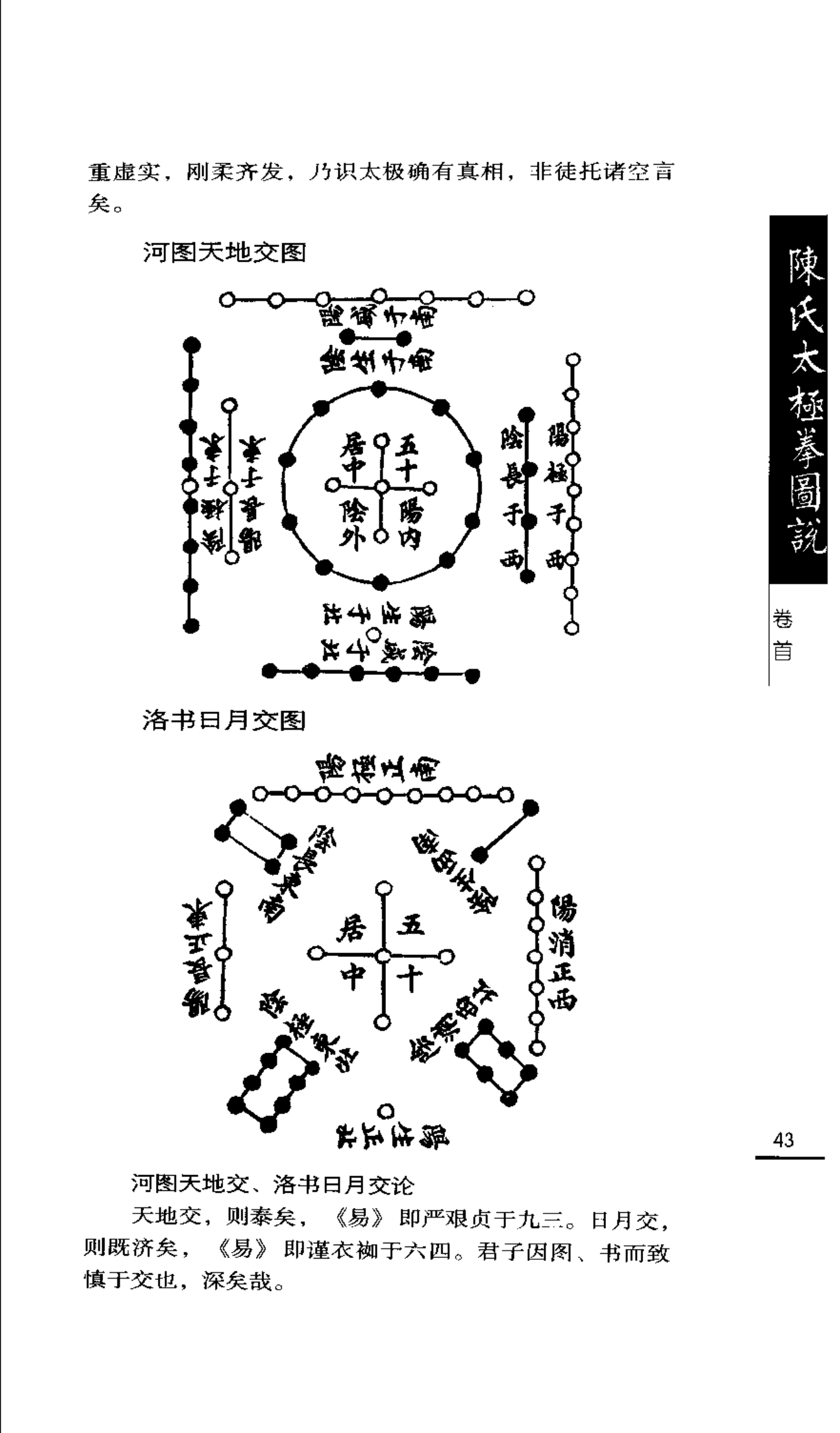
Hetu Diagram of the Interaction of Heaven and Earth (河图天地交图 Hétú tiāndì jiāo tú)
Residing in the center (居中), fifty (五十)
Yang within (阳内), yin without (阴外)
Born of yang, completed in yin (生于阳成于阴)
In the east, the child grows to extreme yin (东子长极阴)
Yang wanes in the west; yin grows in the west (阳消于西,阴长于西)
Luoshu Diagram of the Interaction of Sun and Moon (洛书日月交图 Luòshū rìyuè jiāo tú)
Residing in the center (居中), fifty (五十)
Yang wanes at due west (阳消正西)
Yin wanes at due east (阴长正东)
Yin at its extreme in the northeast (阴极东北)
Yang at its extreme in the southwest (阳极西南)
Chen Family Taijiquan Illustrated Explanation, First Fascicle (陈氏太极拳图说卷首)
Discourse on the Hetu's Interaction of Heaven and Earth and the Luoshu's Interaction of Sun and Moon (河图天地交、洛书日月交论)
When heaven and earth interact, there is Peace (泰 tài, hexagram 11); the Book of Changes accordingly speaks of hardship and steadfastness at the third line (九三 jiǔsān). When sun and moon interact, there is After Completion (既济 jìjì, hexagram 63); the Changes accordingly counsels vigilance against the leaky garment — the tattered rags — at the fourth line (六四 liùsì). How deep is the gentleman's caution, drawn from the Diagram and the Writing, concerning interaction!
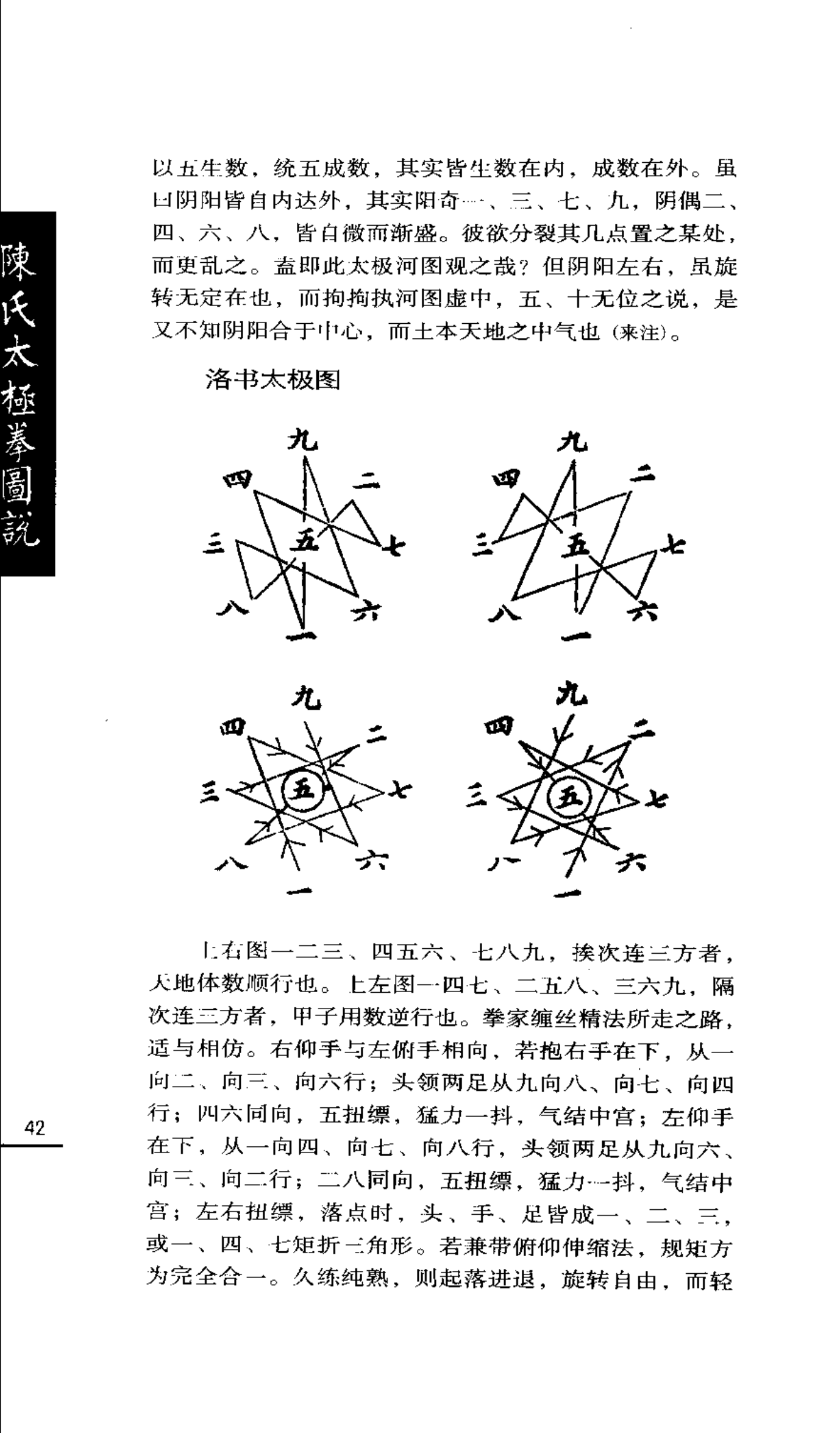
As for surveying the Hetu (河图 Hétú, River Diagram) as a whole: setting aside the central five and ten, the outer numbers total thirty; one diameter encircles three, hence round. To say the Diagram is the image of Heaven is acceptable. Surveying the Luoshu (洛书 Luòshū, Luo Writing) as a whole: setting aside the central five, the outer numbers total forty; one diameter encircles four, hence square. To say the Writing is the image of Earth is also acceptable.
The Diagram's numbers total fifty-five — odd and full: is that not the image of the sun? The Writing's numbers total forty-five — even and deficient: is that not the image of the moon? Can one who dwells in spirit upon the Diagram and the Writing be without the work of turning back upon oneself?
For the interaction of heaven and earth, sun and moon, is precisely the principle of our own nature and life, the pivot of Gou (姤 gòu, hexagram 44) and Fu (复 fù, hexagram 24). If one can truly with this wash the heart and retire to store oneself in secrecy: heaven and earth interact and the single yang is held within the six yins; sun and moon interact and one steadfastness completes the body of pure yang. Then heaven and earth unite in virtue, sun and moon unite in light, and the wondrous workings of generation, restriction, control and transformation reside no longer in the Diagram and the Writing, but in me. Otherwise, the Diagram and the Writing should not be dragged in at all — the Diagram stays merely a Diagram, the Writing merely a Writing, just figures and numbers of square and round, odd and even: what have they to do with the learning of exhausting principle, fulfilling nature, and settling the mandate of fate (Lai's annotation, 来注 Lái zhù)?
Taijiquan Internal Essence Round Diagram (太极拳内精圆图 tàijíquán nèi jīng yuántú)
The Hetu is in truth the ancestor of the essence of silk-reeling (缠丝 chánsī). Opened singly it is like the character 一. Joining the two ends and propping open the circumference yields the Taiji round diagram; crossed, it becomes the silk-reeling diagram; doubled, the narrow (褊 biǎn) diagram; doubled again, with the four corners propped open, the square diagram — down to three-, five-, six-, seven-, eight-, and nine-cornered figures, all square diagrams, all derived from one generating two. Even the round diagram of the sun and moon's courses and their interleaved reeling sequences recorded in the Canon of Yao (《尧典》 Yáodiǎn) — is it not all born from the single stroke 一? This is not discussed in full here. This diagram is devoted exclusively to the theory of silk-reeling energy (缠丝劲 chánsī jìng). Because the arms and legs (股肱 gǔgōng) of the quan (拳 quán) ought to employ it, it is extended to them here.
*From the preliminary volume (juanshou 卷首) of Chen shi Taijiquan Tushuo. No diagrams; pure theoretical prose.*
English translation
Yet what is drawn upon — whether the names of the hexagrams, the line statements (yaoci 爻辞), or passages on the generation and conquest of water, fire, wood, metal, and earth — is cited only because of superficial resemblance, used as supporting evidence. Such loose, shallow borrowings are no more than the dregs of the ancients' writing. Scattered and unordered, picked at will, they bear no likeness to the ordered sequence of the great numbers of generation in the [River] Chart and [Luo] Writing — how much less to the essence within them!
That said, one need not be rigid about this. The ancients' writings were not originally composed for the martial art (quan 拳); yet they are so all-embracing that it seems as if they had been written for it — whatever one picks up at random fits. This shows how subtle and lively the principle (li 理) of Taiji 太极 is: it makes the ten thousand things and affairs each fit their place, and whoever applies it finds it answers his intent. However minute the matter, the principle is never left out. However tangled and numerous the affairs of the world, the ten thousand differences all return to one — what wonder could be greater!
If later people can take even the dregs of the ancients' writing and, tracing the branches, seek the source, it cannot fail to benefit the learning of body and mind, of life and destiny. Though the martial art is called a small Way, the great Way of Taiji resides within it. And its uses are the broadest; those who practice movement should attend to it. Ponder it deeply, think it through finely, and in time you will gain your own insight. How the art benefits a person is by no means slight!
Taijiquan tuiyuan jie — An Explanation of the Origins of Taijiquan
A person has Heaven for father and Earth for mother; he is nothing but conceived and born of the qi 气 of Taiji's Yin and Yang (speak of qi and the principle is already within it). Heaven and Earth are governed by this very principle (speak of principle and the qi is within it); the unity of the three teachings is also this principle; and of the myriad things and affairs of the cosmos (the Four Directions above and below are called yu 宇; past and present, zhou 宙) — how could any not be this principle? How could the single art of the martial way stand outside this principle and possess another?
This is why the art is named Taijiquan. Quan 拳 here means "weight/scale" (quan 权): that which weighs things and thereby knows their light and heavy. Its principle is truly rooted in Taiji, and its application does not omit the two fists. Moreover, a person's whole body, from crown to heel, is entirely Taiji — that is, the whole body is entirely quan. One must not take a single fist to be all there is of the fist. Its pivot lies in the one heart-mind (xin 心). The heart governs reverence (jing 敬) and also stillness (jing 静). Able to be reverent and still, one naturally preserves emptiness and spirit-quickening. When the sovereign mind holds command, the hundred bones all obey orders. Movement generates Yang; stillness generates Yin; one movement and one stillness are each other's root. The clear qi rises, the turbid qi descends. Baihui 百会 above and Zhongji 中极 below are the bolt and bar of the one body.
The beginner's work: first seek the lurking response (fuying 伏应). Where the incoming line turns its pass, one qi generates all. Hands and eyes must be lively; do not move rashly. As for this qi: utmost great, utmost firm; nourish it straightly and no harm comes; it fills Heaven and Earth. It is paired with righteousness and with the Way — its source lies in accumulating righteousness — vast and flooding it circulates, naturally one qi. Light as willow catkins, hard as metal and stone; in awe compare it to a tiger's ferocity, in speed to a hawk in flight. In motion it is like flowing water; at rest it equals a mountain standing. In advancing it is beyond what others can perceive; in retreating none can name its swiftness. The principle is refined, the methods dense, their threads analyzed strand by strand. Released, it fills the six directions; gathered in, it retires and hides in the secret. In greatness it has nothing outside it; in smallness nothing inside it. The harmonized original qi goes wherever intention (yi 意) sends it; where intention points, the whole spirit is concentrated. Its changes are like a dragon — no one can fathom them.
Summary (3 lines)
Page 78 closes the discussion of borrowing from the Yijing for the art of quan and opens the "Taijiquan tuiyuan jie" (Explaining the origins of Taijiquan). Core claim: quan is rooted in Taiji — quan means scale/weight, the whole body is Taiji, and movement and stillness are each other's root. It ends on the beginner's method — first seek the lurking response, one qi generating all — and the consummate state of "changes like a dragon."
*Juanshou 卷首. Ends with a modern editorial footnote ①. No diagrams.*
English translation
The application lies in the heart-mind (xin 心) — this is the true secret. Neither leaning one way nor the other, neither exceeding nor falling short. Within, use it to cultivate the self; without, use it to control the enemy. Adapt as the moment requires, only because your resources overflow. Neither adhering nor parting, neither sticking nor leaving. Fit bone to bone and joint to tenon, examining with fine care. Truly accumulated strength over a long time, and one ascends the hall and enters the inner chamber.
Taijiquan zhu jie — An Explanation of the Postures of Taijiquan
In a person's whole body, the heart-mind is master and governs the flesh. The heart is called the Way-heart (daoxin 道心), that is, the heart of principle (li 心). Yet that which within principle can move and turn is called qi 气, and this qi is precisely Yin-Yang and the Five Phases (wuxing 五行). But without principle, qi has nothing to govern it; and without qi, principle has nothing to move it. Hence principle and qi do not separate from each other but adhere to each other — this is Taiji 太极 rooting in Wuji 无极.
Heaven generates man precisely by planting this principle and this qi in the heart. When one has gained a little knowledge, the principle and qi in the human heart are undifferentiated, without trace or sign. Yet within the heart, arising either from within or stirred from without, thought and meaning (yisi 意思) are born. Before it is born it is a vast undifferentiated mix, nothing at all there. As it is about to be born, the intention is almost imperceptibly slight, yet the principle of Yin and Yang lies stored within it. Following its natural springs (the heart's forming of a shape), it still remains within the human heart (this is what the Zhongyong 中庸 calls "not yet emerged" — wei fa 未发). When it is about to emerge, the shape formed in the heart presents itself outward — up or down, left or right, forward or back, oblique or upright — and the body-methods (shenfa 身法) of the whole frame are all there in readiness.
At the moment before it emerges and takes shape, see what shape the intention resembles and name it accordingly — picked up at will, with no pre-set mind. Naming from the shape at that moment is called a "posture" (zhuo 着, i.e. zhao 招). And within each posture, the five senses and hundred bones follow their natural momentum, while the qi of Yin-Yang and the Five Phases moves within them. This is what is meant by: movement generates Yang, stillness generates Yin, and one movement and one stillness are each other's root — Yang contains Yin, Yin contains Yang. This is precisely the natural constitution of Taijiquan.
If, within each posture, one insisted on pointing out what exactly is Yang, what is Yin, what is Yin-within-Yang, what is Yang-within-Yin, such talk would be far too rigid — more words than could be spoken. Even if one could say it, omissions would remain. It rests on the student examining with fine care and awakening of himself over time. The sages of old said: "One can give a person the compass and square, but cannot make them skillful." Drawing one inference from three rests with the learner: neither cling rigidly, nor cling one-sidedly.
Seven-character folk verse, the first
Peng 拥 (ward-off), zhi 摭 (pluck/seize), ji 挤 (press), na 捺 (push down) must be taken seriously;
Draw in the opponent and land on emptiness, let him intrude at will.
When the whole body follows itself in concert, the enemy can hardly come near;
Four ounces (四两) transform and move eight thousand catties.
① [Editorial footnote] In his Taijiquan Tuhua Jiangyi 陈鑫 (Chen Xin) called body, heart, principle, qi, intention, will, feeling, scene, and spirit the "rules of Taijiquan," noting specially that "the nine items from body to spirit were all composed by Pinsan" (Chen Pinsan 陈品三, Chen Xin's courtesy name). The book's "editor" Chen Chunyuan 陈椿元, besides revising and supplementing those nine items, added discussions of constancy (heng 恒), postures (zhuo 着), an appended discrimination of the central qi (zhongqi 中气), and transformation (hua 化). Compared side by side with the "nine items from body to spirit," the meaning is broadly the same with minor differences, but the language style and angle of exposition differ.
Summary (3 lines)
Page 79 closes the "true secret" — application lies in the heart, neither leaning nor exceeding — and opens the "Taijiquan zhu jie." It argues the heart governs the body, principle and qi adhere inseparably (Taiji rooting in Wuji 无极), and intention begets a shape from which postures are named. It ends with a seven-character folk verse on peng/zhi/ji/na and "four ounces moving eight thousand catties," plus an editorial footnote on the text's transmission.
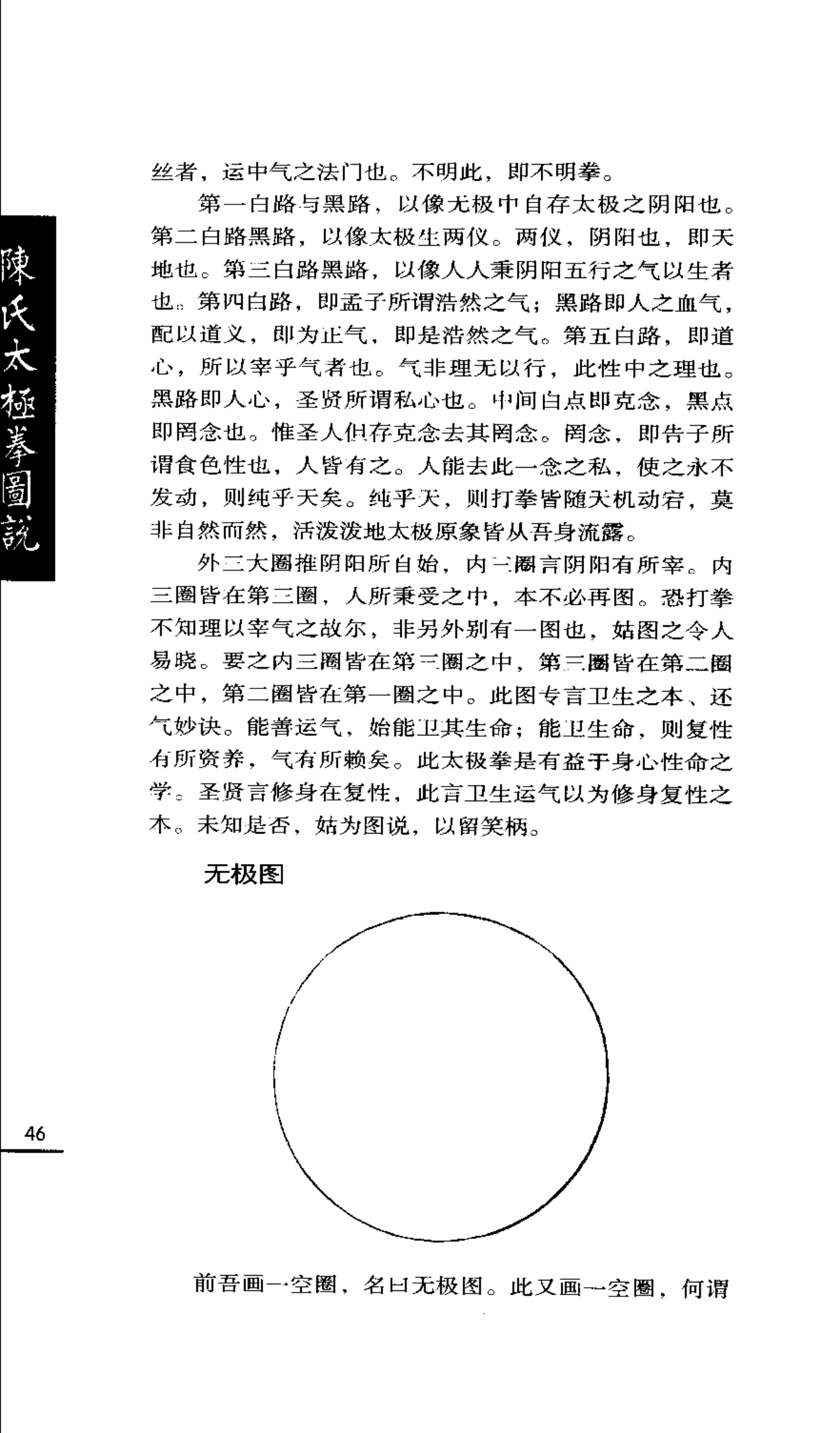
Heaven, earth, and the ten thousand things are all born from nothingness into being. Once there is being, things cannot be enumerated. Take, for instance, the art of practicing quan (拳): at first this technique did not exist; once it exists, there is no harm in using this being to arrive at the point where transformation is achieved without deliberate mind and leaves no trace of form — then what exists returns to nothingness. As it is said: form is emptiness, emptiness is form; emptiness and form, form and emptiness. The reason I again draw a circle is precisely this.
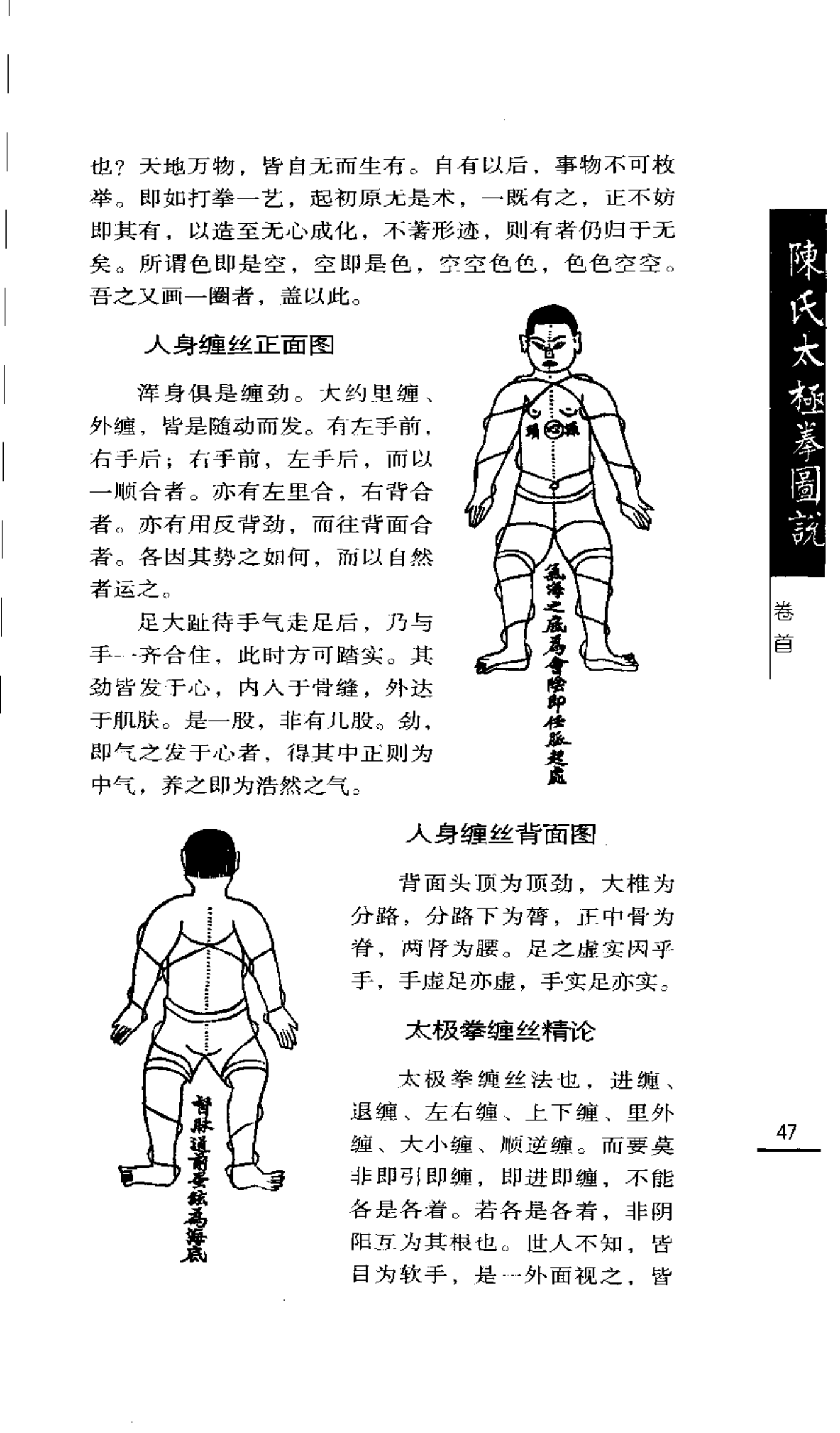
Front-view diagram of silk reeling (chansi, 缠丝) on the human body
The whole body is entirely reeling jin (劲). Roughly speaking, inward reeling and outward reeling are both issued in accordance with movement. There is the case of the left hand forward and right hand behind, or right hand forward and left hand behind, united in one smooth coordination. There is also the case of the left inward-coiling while the right coils behind, and the case of using reverse-backward jin that coils toward the back. Each follows the circumstances of the posture, executed in the natural way.
Wait until the qi (气) issued by the hands has traveled to the feet, then the big toe joins together with the hand, and only at this point may the foot press down firmly. This jin is all issued from the heart, entering inward into the bone seams and reaching outward to the skin and flesh. It is one stream, not several streams. Jin is precisely the qi issued from the heart; when it attains central correctness it becomes central qi (中气), and when cultivated it becomes the vast, flooding qi (浩然之气).
Back-view diagram of silk reeling on the human body
On the back: the crown of the head is ding jin (顶劲, top jin); the Dazhui point (大椎) is the fork of the routes; below the fork are the arms; the central bone is the spine; the two kidneys are the waist. The emptiness and fullness of the feet follow the hands: when the hand is empty the foot is also empty; when the hand is full the foot is also full.
Essential discussion of silk reeling in Taijiquan (太极拳)
Taijiquan is the method of silk reeling: reeling while advancing, reeling while retreating, reeling left and right, reeling up and down, reeling inward and outward, reeling large and small, smooth reeling and reverse reeling. In essence, none of it is anything other than reeling while drawing in, reeling while advancing — the techniques cannot each stand as separate moves. If each stood as a separate move, yin and yang would not serve as each other's root. People in the world do not understand this and all dismiss it as "soft hands" — judging only from the outside, they
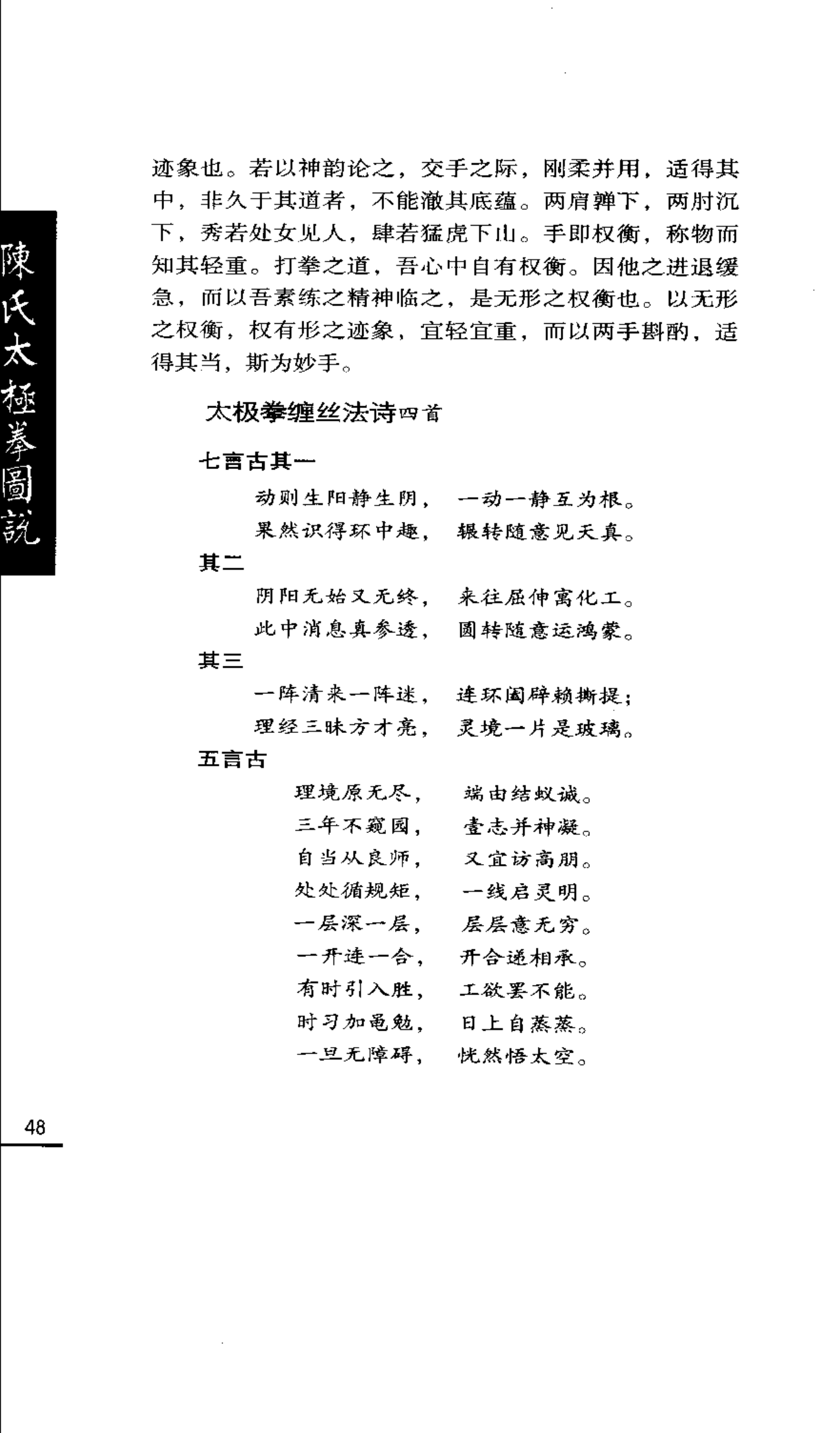
…outward signs (迹象, jìxiàng). If judged by spirit and rhythm (神韵), at the moment of crossing hands, hardness and softness are used together, hitting exactly the middle measure; only one long practiced in this way can fathom its depths. Both shoulders snap down, both elbows sink; refined as a maiden meeting people, unbridled as a fierce tiger descending the mountain. The hand is itself a balance (权衡, quánhéng): weighing a thing, one knows its light or heavy. In the way of practicing quan (拳), the balance resides within my own mind. According to the opponent's advancing, retreating, slowness, or haste, I meet it with the spirit I have long trained — this is the formless balance. Using the formless balance to weigh the tangible outward signs, whether light or heavy is fitting, and weighing it carefully with the two hands so that it is exactly right — this is what makes a marvelous hand (妙手).
Four poems on the silk-reeling method of Taijiquan (太极拳缠丝法诗四首)
Seven-character ancient verse, No. 1
Movement generates yang, stillness generates yin; one movement and one stillness are each other's root.
Truly recognizing the delight within the ring (环中), one turns and turns, and at will sees natural genuineness.
No. 2
Yin and yang have no beginning and no end; coming and going, bending and stretching embody transforming power.
Truly penetrating the secret within this, one circles at will and moves the primal vastness (鸿蒙).
No. 3
A moment of clarity, a moment of confusion; the linked rings of closing and opening depend on tearing and lifting.
When principle passes through samadhi (三昧) it shines forth; the spiritual realm is a sheet of glass.
Five-character ancient verse
The realm of principle is originally without end; it stems entirely from sincerity that binds like ants.
Three years without looking at the garden, single-minded purpose with spirit concentrated.
One must follow a good teacher, and also visit lofty friends.
Everywhere follow the rules and measures; one thread lights up the spirit.
One layer deepens another; layer upon layer, the meaning is inexhaustible.
One opening links with one closing; opening and closing follow one another in turn.
Sometimes it leads one into wonder; the work reaches a point one cannot stop.
Constant practice with diligence, day by day it rises like steam.
Once there are no obstructions, suddenly one awakens to empty space (太空).
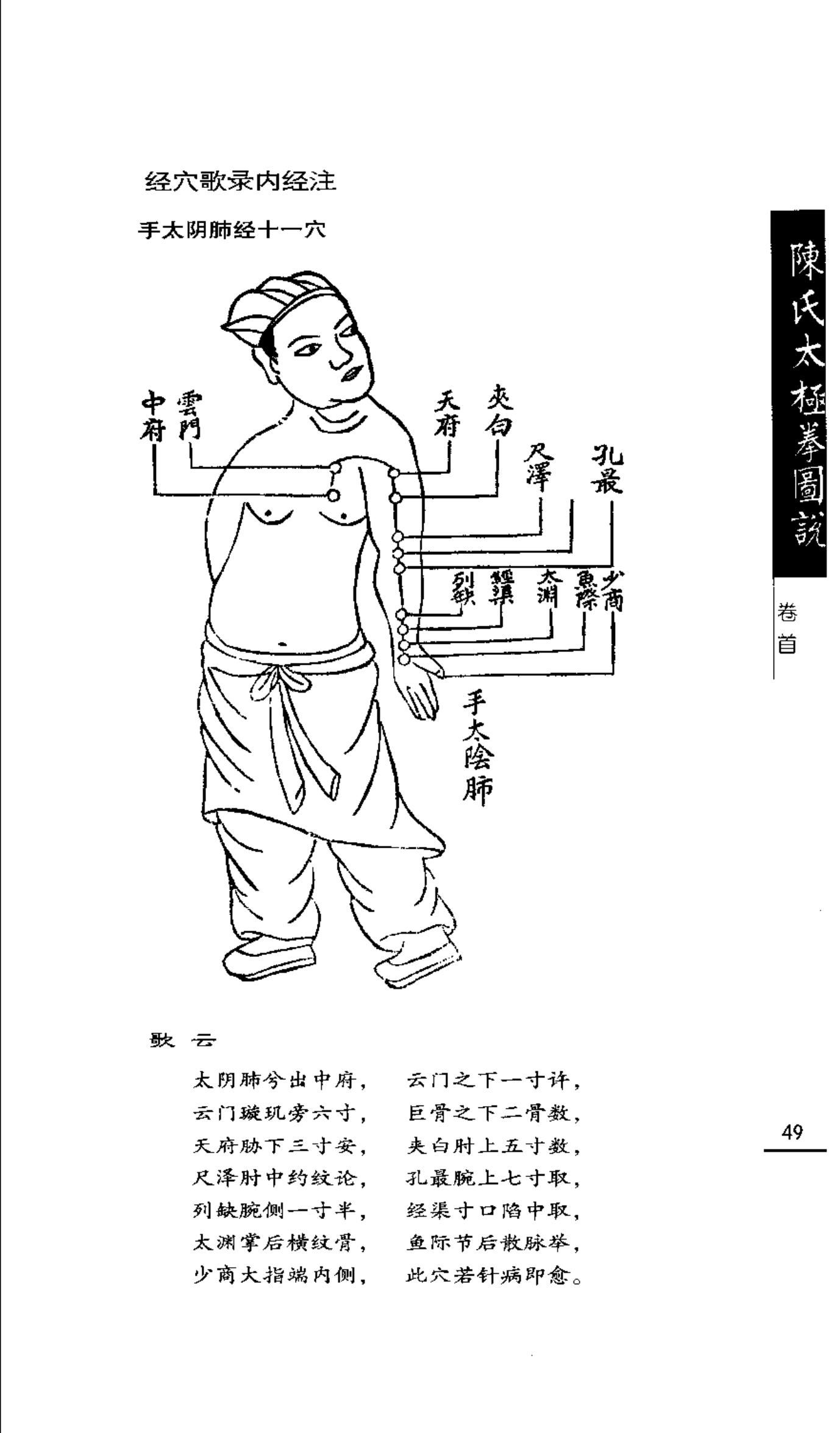
Illustrated Explanation of Chen-Style Taijiquan (陳氏太極拳圖說), Preliminary Volume (卷首)
Record of Meridian-Point Songs, with Notes from the Neijing (經穴歌錄內經注)
The eleven points of the Hand Taiyin Lung Meridian (手太陰肺經)
Points: Zhongfu (中府), Yunmen (雲門), Tianfu (天府), Xiabai (俠白), Chize (尺澤), Kongzui (孔最), Jingqu (經渠), Lieque (列缺), Taiyuan (太淵), Yuji (魚際), Shaoshang (少商).
The song says:
The Taiyin Lung emerges at Zhongfu; one cun or so below Yunmen.
Yunmen lies six cun beside the Xuanji; two bones' breadth below the Jugu.
Tianfu rests three cun below the ribs; Xiabai, five cun above the elbow.
Chize, at the elbow crease's middle; Kongzui, taken seven cun above the wrist.
Lieque, an inch and a half on the wrist's side; Jingqu, taken in the hollow at the wrist pulse (寸口).
Taiyuan, at the transverse crease behind the palm; Yuji, where the scattered vessel rises behind the joint.
Shaoshang, on the inner side of the tip of the thumb — if these points are needled, the illness at once heals.
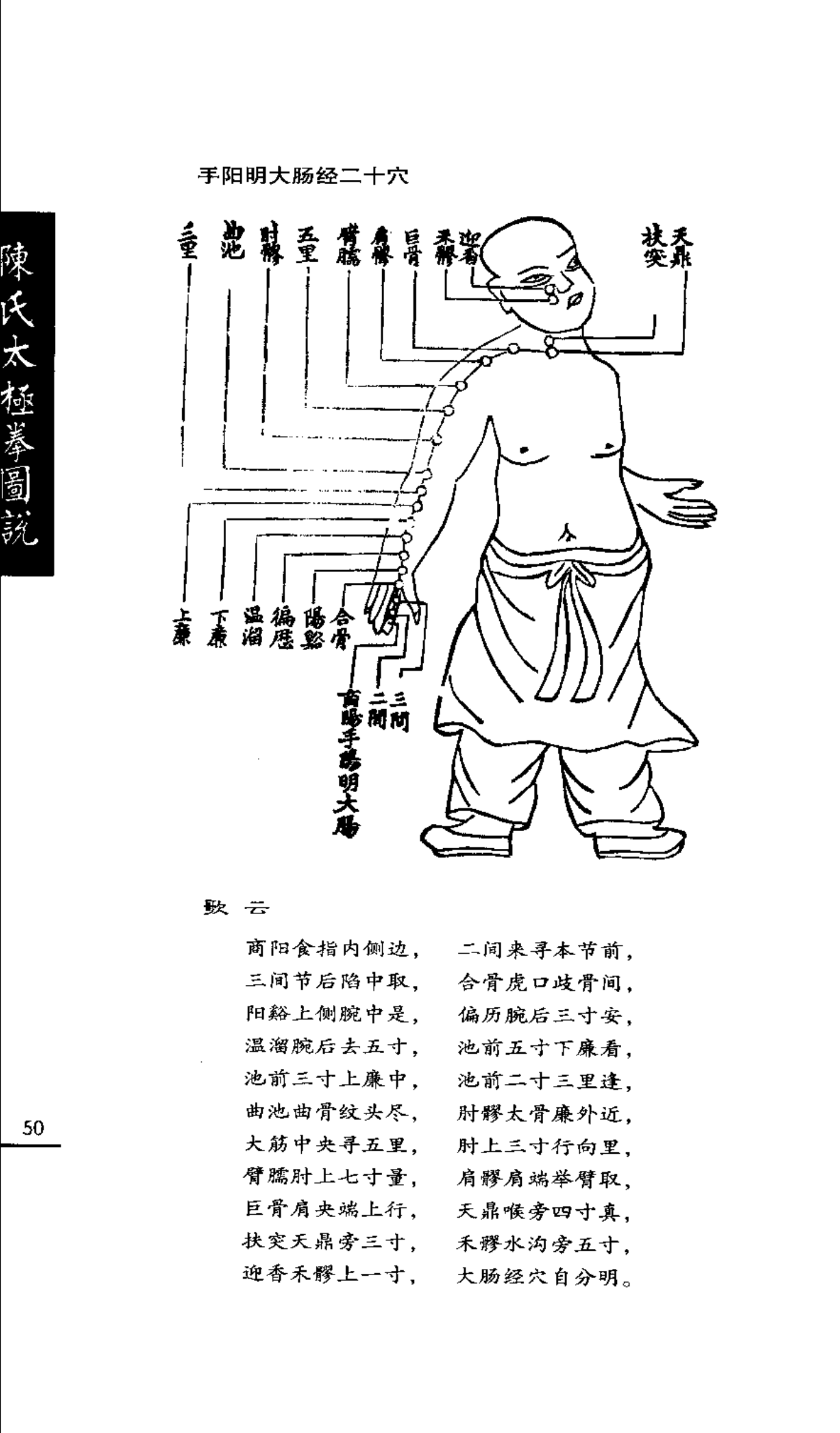
Hand Yangming Large Intestine Meridian (shou yangming da chang jing 手阳明大肠经) — Twenty Points
Song of the points (shangyang 商阳 ... yingxiang 迎香):
- Shangyang 商阳 — at the inner side of the index finger.
- Erjian 二间 — seek it in front of the proximal joint.
- Sanjian 三间 — take it in the hollow behind the joint.
- Hegu 合谷 (written 合骨) — between the bones at the tiger's mouth (web of the thumb).
- Yangxi 阳溪 — on the upper side of the wrist.
- Pianli 偏历 — three cun behind the wrist.
- Wenliu 温溜 — five cun behind the wrist.
- Xialian 下廉 — five cun below (in front of) Quchi.
- Shanglian 上廉 — three cun below Quchi.
- Shousanli 手三里 — meet it two cun below Quchi.
- Quchi 曲池 — where the bend ends at the crease of the elbow.
- Zhouliao 肘髎 — near the outer border of the great bone.
- Wuli 五里 — seek it in the middle, five li of the large intestine channel.
- Binao 臂臑 — measure seven cun above the elbow.
- Three cun above the elbow, going inward.
- Jianliao 肩髎 — at the shoulder end, take with the arm raised.
- Jugu 巨骨 — ascending from the shoulder end.
- Tianding 天鼎 — truly four cun beside the throat.
- Futu 扶突 — three cun beside Tianding.
- Heliao 禾髎 — five fen beside the philtrum (shuigou 水沟).
- Yingxiang 迎香 — one cun above Heliao.
- The points of the Large Intestine meridian are thus perfectly clear.
陳氏太極拳圖說 (Chen Family Taijiquan Illustrated Explanation)
Illustrated Explanation of Chen-Style Taijiquan (陳氏太極拳圖說), Preliminary Volume (卷首)
The forty-five points of the Foot Yangming Stomach Meridian (足陽明胃經)
Points (in meridian-flow order, face to foot): Touwei (頭維), Xiaguan (下關), Jiache (頰車), Chengqi (承泣), Sibai (四白), Juliao (巨髎), Dicang (地倉), Daying (大迎), Renying (人迎), Shuitu (水突), Qishe (氣舍), Quepen (缺盆), Qihu (氣戶), Kufang (庫房), Wuyi (屋翳), Yingchuang (膺窗), Ruzhong (乳中), Rugen (乳根), Burong (不容), Chengman (承滿), Liangmen (梁門), Guanmen (關門), Taiyi (太乙), Huaroumen (滑肉門), Tianshu (天樞), Wailing (外陵), Shuidao (水道), Daju (大巨), Guilai (歸來), Qichong (氣沖), Biguan (髀關), Futu (伏兔), Yinshi (陰市), Dubi (犢鼻), Zusanli (足三里), Shanglian (上廉), Tiaokou (條口), Xiaolian (下廉), Fenglong (豐隆), Jiexi (解谿), Xiangu (陷谷), Neiting (內庭), Lidui (厲兌).
The song says:
The Stomach meridian — the Foot Yangming: Chengqi is sought seven fen below the eye.
Sibai, one inch below the eye; Juliao, eight fen beside the nostril.
Dicang, four fen flanking the mouth-corner; Daying, three cun on the jaw below.
Jiache, the point eight fen below the ear; Xiaguan, where the pulse moves before the ear.
Touwei, four to five (fen) beside Shenting; Renying, an inch and a half beside the throat.
Shuitu lies in front of the tendon below Renying; Qishe, points to be sought below the prominence.
Quepen, inside the horizontal bone below Qishe; each lies an inch and a half from the midline, clearly.
Qihu, four cun beside the Xuanji; to the nipple, six cun and four fen.
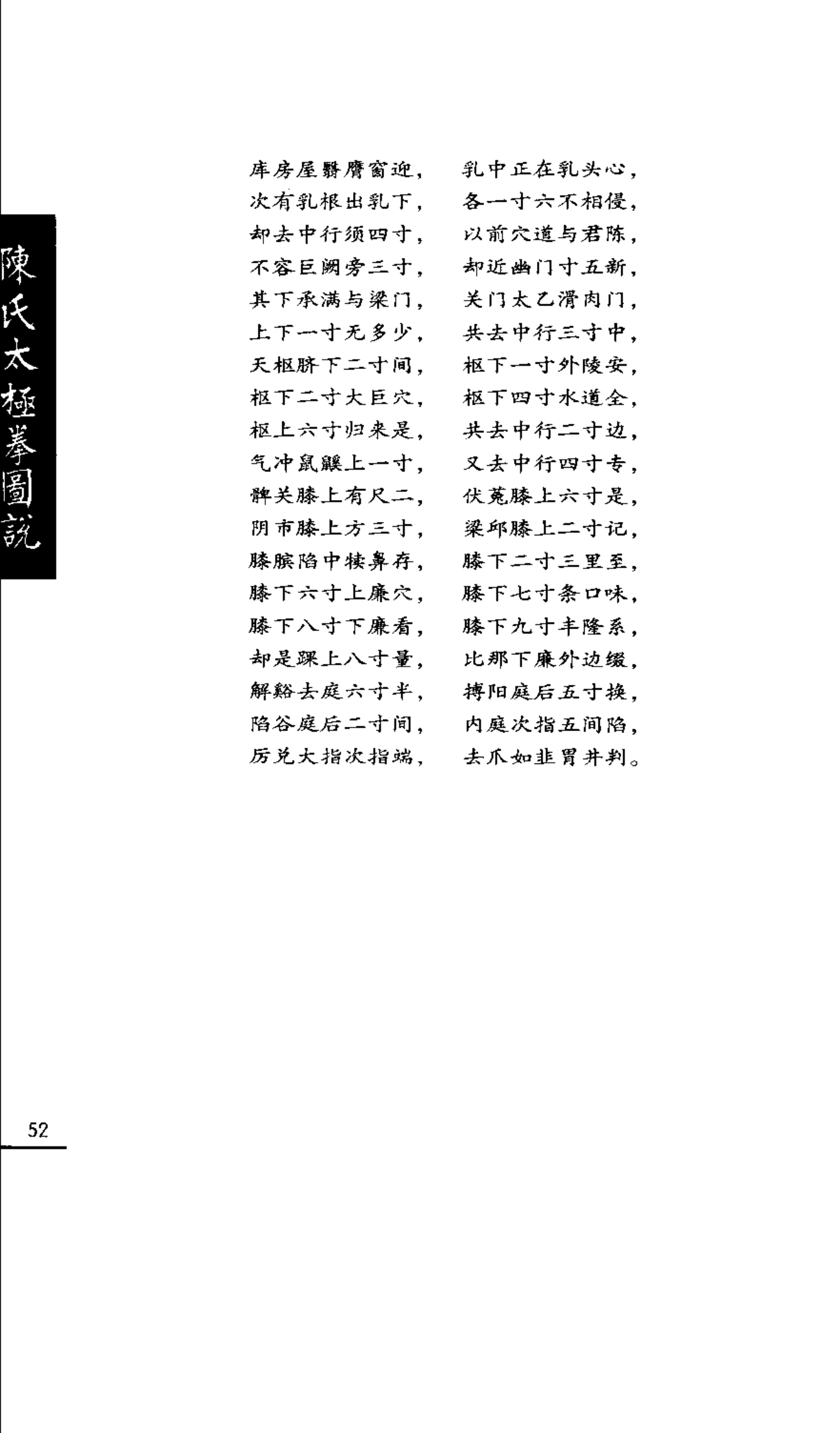
Verse catalogue of acupuncture points on the Foot Yangming Stomach meridian (足陽明胃經, Zú Yángmíng Wèi Jīng), continuing the rhymed locational mnemonic begun on the previous page.
Transcription (scan order, right block then left block):
乳中正在乳頭心,各一寸六不相侵,以前穴道与君陳,却近幽门寸五新,关门太乙滑肉门,共去中行三寸中,枢下一寸外陵安,枢下四寸水道全,共去中行二寸边,又去中行四寸专,伏菟膝上六寸是,梁邱膝上二寸记,膝下二寸三里至,膝下七寸条口味,膝下九寸丰隆系,比那下廉外边缀,搏阳庭后五寸换,内庭次指五间陷,去爪如韭胃井判。
库房屋翳膺窗迎,次有乳根出乳下,却去中行须四寸,不容巨阙旁三寸,其下承满与梁门,上下一寸无多少,天枢脐下二寸间,枢下二寸大巨穴,枢上六寸归来是,气冲鼠鼷上一寸,髀关膝上有尺二,阴市膝上方三寸,膝髌陷中犊鼻存,膝下六寸上廉穴,膝下八寸下廉看,却是踝上八寸量,解溪去庭六寸半,陷谷庭后二寸间,厉兑大指次指端。
English translation (readable stanza sequence)
Ruzhong (乳中, ST17) lies at the very center of the nipple; each is one cun six apart and does not encroach on the other.
The points described before are now set out for you anew: they lie close to Youmen (幽門, KI21), one cun five away.
Kufang (庫房, ST16), Wuyi (屋翳, ST15), Yingchuang (膺窗, ST14) follow in line; next, Rugen (乳根, ST18) emerges below the breast, four cun from the midline.
Burong (不容, ST19) sits three cun beside Juque (巨闕, CV14); below it come Chengman (承滿, ST20) and Liangmen (梁門, ST21), then Guanmen (關門, ST22), Taiyi (太乙, ST23), and Huaroumen (滑肉門, ST24) — a cun apart, no more and no less — all three cun from the midline.
Tianshu (天樞, ST25) lies level with the navel, two cun from it; one cun below the hub is Wailing (外陵, ST26), two cun below is Daju (大巨, ST27), four cun below is Shuidao (水道, ST28), and six cun above the hub is Guilai (歸來, ST29) — each two cun from the midline, and then four cun from the midline again.
Qichong (氣衝, ST30) lies one cun above the "rat cleft" (the groin, 鼠鼷). Biguan (髀關, ST31) stands twelve cun (a chi two) above the knee; Futu (伏兔, ST32) is six cun above the knee; Yinshi (陰市, ST33) three cun above the knee; Liangqiu (梁丘, ST34) two cun above the knee — remember it well; and within the hollow of the kneecap rests Dubi (犢鼻, ST35).
Two cun below the knee, Zusanli (足三里, ST36) arrives; six cun below the knee is Shanglian (上廉, ST37); seven cun below is Tiaokou (條口, ST38); eight cun below is Xiaolian (下廉, ST39); nine cun below the knee, Fenglong (豐隆, ST40) connects — it is measured eight cun above the ankle, joined to the outer side of the lower belly-line. Fenglong (豐隆, ST40) is eight cun above the ankle. Jiexi (解谿, ST41) is six and a half cun from the "court" (庭, i.e. Neiting); Xian'gu (陷谷, ST43) two cun behind the court; Neiting (內庭, ST44) in the hollow between the second and third toes; Lidui (厲兌, ST45) at the tip of the second toe, a shallow well a fen from the corner of the nail — the Well point (井) of the Stomach channel, thus determined.
Chen Shi Taiji Quan Tu Shuo (陳氏太極拳圖說, Chen's Taiji Boxing Illustrated Explanation) — Juan Shou (卷首, preliminary volume).
Foot Taiyin Spleen Meridian: 22 acupoints (足太陰脾經二十二穴)
Point labels on the diagram (from upper torso down to foot):
Shidou 食竇, Tianxi 天谿, Xiongxiang 胸鄉, Zhourong 周榮, Zhongfu 中府, Dabao 大包, Fushe 府舍, Fujie 腹結, Daheng 大橫, Chongmen 沖門, Dafu 大腹, Fuai 腹哀, Xuehai 血海, Jimen 箕門, Sanyinjiao 三陰交, Diji 地機, Yinlingquan 陰陵泉, Lougu 漏谷, Shangqiu 商丘, Gongsun 公孫, Taibai 太白, Dadu 大都, Yinbai 隱白
Mnemonic verse (歌云)
節后陷中求大都,(In the hollow below the joint seek Dadu,)
節后一寸公孫呼,(One cun below the joint is called Gongsun,)
踝上二寸三陰交,(Two cun above the ankle is Sanyinjiao,)
踝上七寸地机朝,(Seven cun above the ankle, Diji appears,)
血海膝臏上内廉,(Xuehai is on the inner aspect above the kneecap,)
動脉應于越筋間,(The pulsing artery lies between the sinews,)
腹舍期下九寸看,(Fushe is found nine cun below Qimen,)
大橫期下五寸半,(Daheng is five and a half cun below Qimen,)
期門肝經穴道現,(Qimen is the point of the Liver meridian,)
大指端内側隱白,(At the inner tip of the big toe is Yinbai,)
太白内側核骨下,(Taibai is below the inner bone of the joint,)
商丘内踝微前陷,(Shangqiu lies slightly forward in the hollow of the inner ankle,)
踝上六寸漏骨是,(Six cun above the ankle is Lougu,)
膝下内側陰陵泉,(Below the knee on the inner side is Yinlingquan,)
箕門穴在魚腹取,(Jimen is located on the fish-belly of the thigh,)
冲门期下尺五寸,(Chongmen is one chi five cun below Qimen,)
腹結期下六寸八,(Fujie is six cun eight fen below Qimen,)
腹哀期下方二寸,(Fuai is two cun to the side below Qimen,)
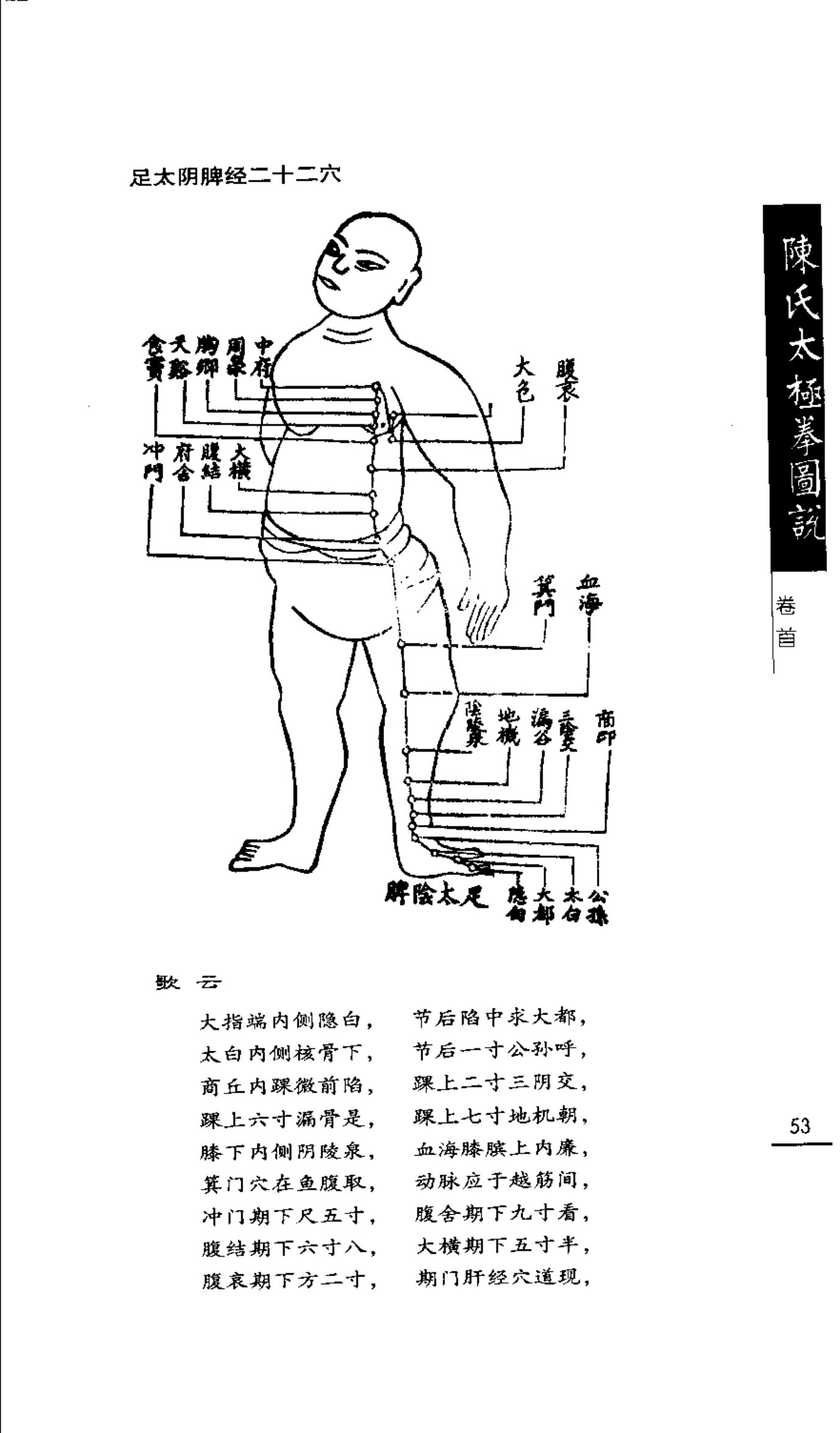
Chen Shi Taiji Quan Tu Shuo (陳氏太極拳圖說, Chen's Taiji Boxing Illustrated Explanation)
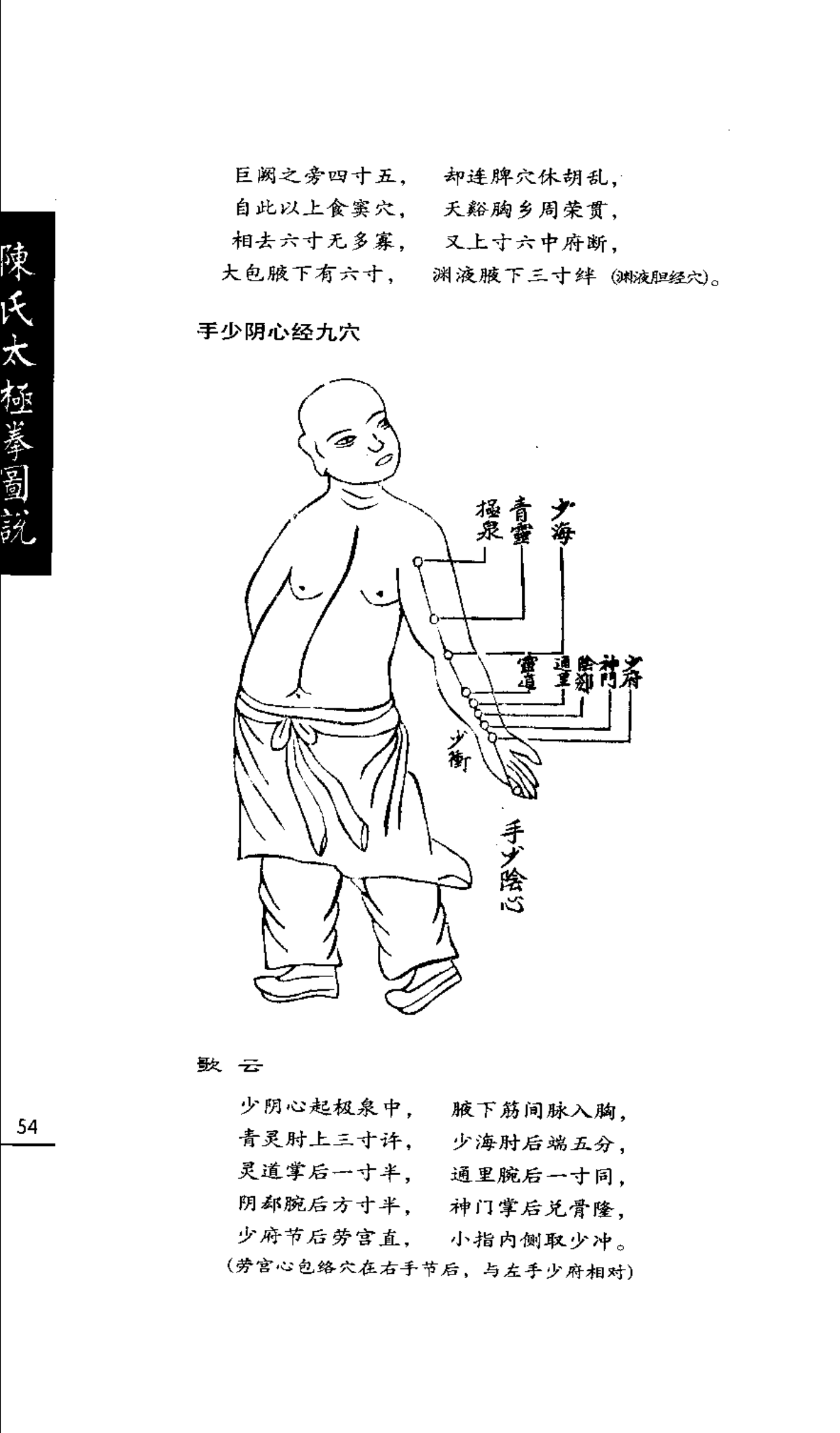
Hand Shaoyin Heart Meridian: nine acupoints (手少阴心经九穴)
Point labels on the diagram:
Shaohai 少海, Qingling 青灵, Jiquan 极泉, Tongli 通里, Lingdao 灵道, Yinxi 阴郄, Shenmen 神门, Shaofu 少府, Shaochong 少冲, Shou Shaoyin Xin 手少阴心
Mnemonic verse (歌云) — concluding lines on the Spleen meridian
却连脾穴休胡乱,(It then connects to the Spleen points — do not confuse them,)
天谿胸乡周荣贯,(Tianxi, Xiongxiang and Zhourong run through in succession,)
又上寸六中府断,(Ascending another cun and a half it ends at Zhongfu,)
渊液腋下三寸绊(渊液胆经穴)。(Yuanye, three cun below the armpit, marks the boundary — Yuanye is a point of the Gallbladder meridian.)
巨阙之旁四寸五,(Four cun five to the side of Juque,)
自此以上食窦穴,(Above from there is the point Shidou,)
相去六寸无多寡,(Six cun apart, neither more nor less,)
大包腋下有六寸,(Dabao is six cun below the armpit,)
Mnemonic verse (歌云) — Heart meridian
腋下筋间脉入胸,(From between the sinews below the armpit the vessel enters the chest,)
少海肘后端五分,(Shaohai is five fen beyond the end of the elbow,)
通里腕后一寸同,(Tongli is one cun behind the wrist likewise,)
神门掌后兑骨隆,(Shenmen is at the bony prominence behind the palm,)
小指内侧取少冲。(On the inner side of the little finger take Shaochong.)
少阴心起极泉中,(The Hand Shaoyin Heart starts at Jiquan,)
青灵肘上三寸许,(Qingling is about three cun above the elbow,)
灵道掌后一寸半,(Lingdao is one and a half cun behind the palm,)
阴郄腕后方寸半,(Yinxi is one and a half cun behind the wrist,)
少府节后劳宫直,(Shaofu is directly behind the joint, opposite Laogong,)
(Laogong 劳宫, a point of the Pericardium channel, lies behind the joint of the right hand, directly opposite Shaofu 少府 of the left hand.)
Chen Shi Taiji Quan Tu Shuo (陳氏太極拳圖說) — Juan Shou (卷首)
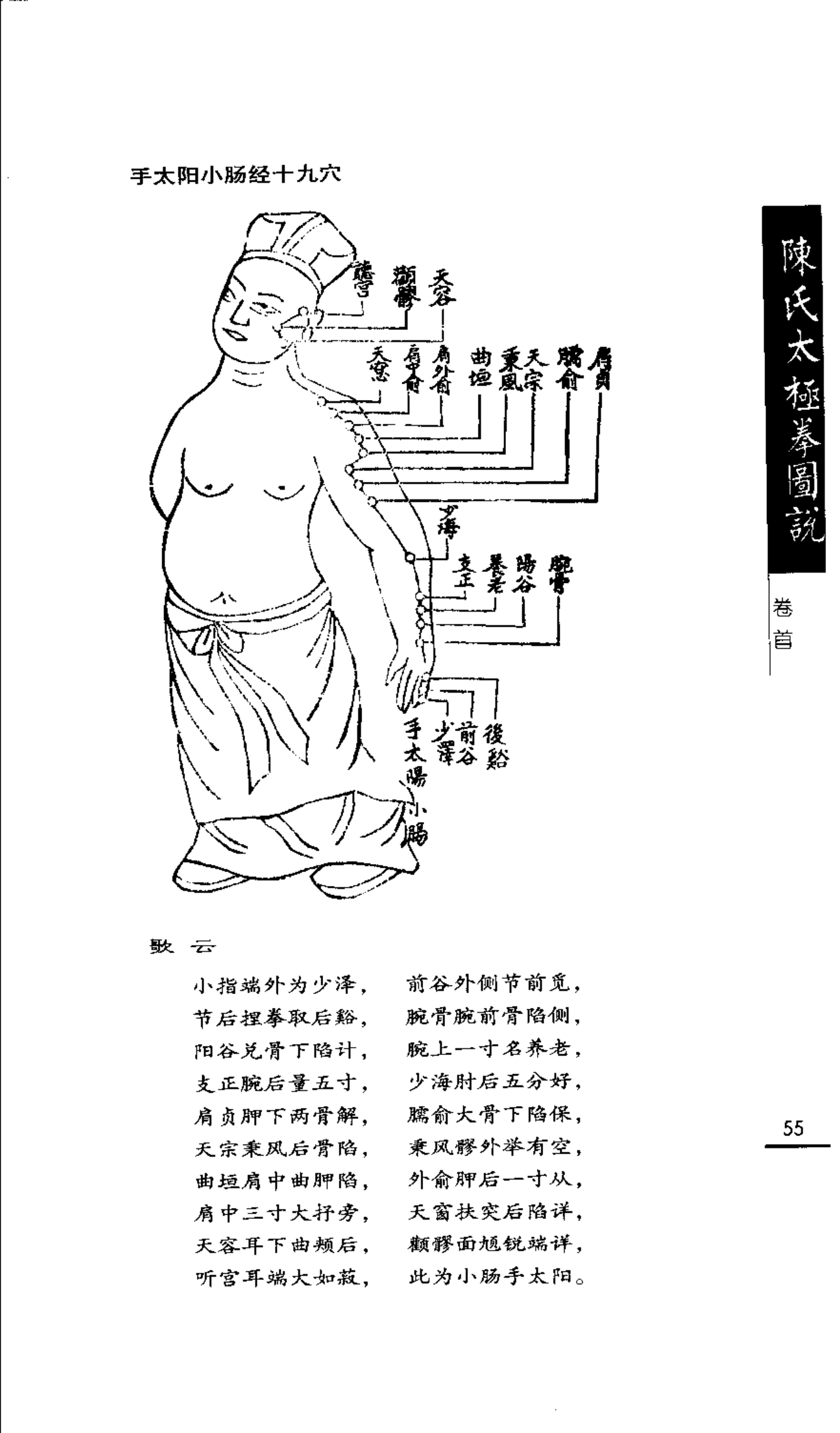
Hand Taiyang Small Intestine Meridian: 19 acupoints (手太阳小肠经十九穴)
Mnemonic verse (歌云)
小指端外为少泽,(On the outer side of the tip of the little finger is Shaoze,)
节后捏拳取后溪,(Clenching the fist, take Houxi behind the joint,)
阳谷兑骨下陷计,(Yanggu is reckoned in the hollow below the wrist bone,)
支正腕后量五寸,(Zhengzhi is measured five cun behind the wrist,)
肩贞胛下两骨解,(Jianzhen is below the shoulder blade where the two bones meet,)
天宗秉风后骨陷,(Tianzong is in the bone hollow behind Bingfeng,)
曲垣肩中曲胛陷,(Quyuan is in the hollow at the bend of the shoulder blade at mid-shoulder,)
肩中三寸大抒旁,(Three cun at mid-shoulder, beside Dashu,)
天容耳下曲颊后,(Tianrong is below the ear behind the curved jaw,)
听宫耳端大如菽,(Tinggong is at the ear opening, small as a bean,)
前谷外侧节前觅,(Qiangu is sought on the outer side before the joint,)
腕骨腕前骨陷侧,(Wangu is at the bone hollow in front of the wrist,)
腕上一寸名养老,(One cun above the wrist is named Yanglao,)
少海肘后五分好,(Shaohai is nicely five fen behind the elbow,)
臑俞大骨下陷保,(Naoshu is reliably in the hollow below the great bone,)
秉风髎外举有空,(Bingfeng is outside the Naokou hollow — raising the arm opens a space,)
外俞胛后一寸从,(Waishu follows one cun behind the shoulder blade,)
天窗扶突后陷详,(Tianchuang is clearly in the hollow behind Futu,)
颧髎面頄锐端详,(Quanliao is examined at the sharp end of the cheekbone,)
此为小肠手太阳。(This is the Small Intestine channel of Hand Taiyang.)
Chen Shi Taiji Quan Tu Shuo (陳氏太極拳圖說)
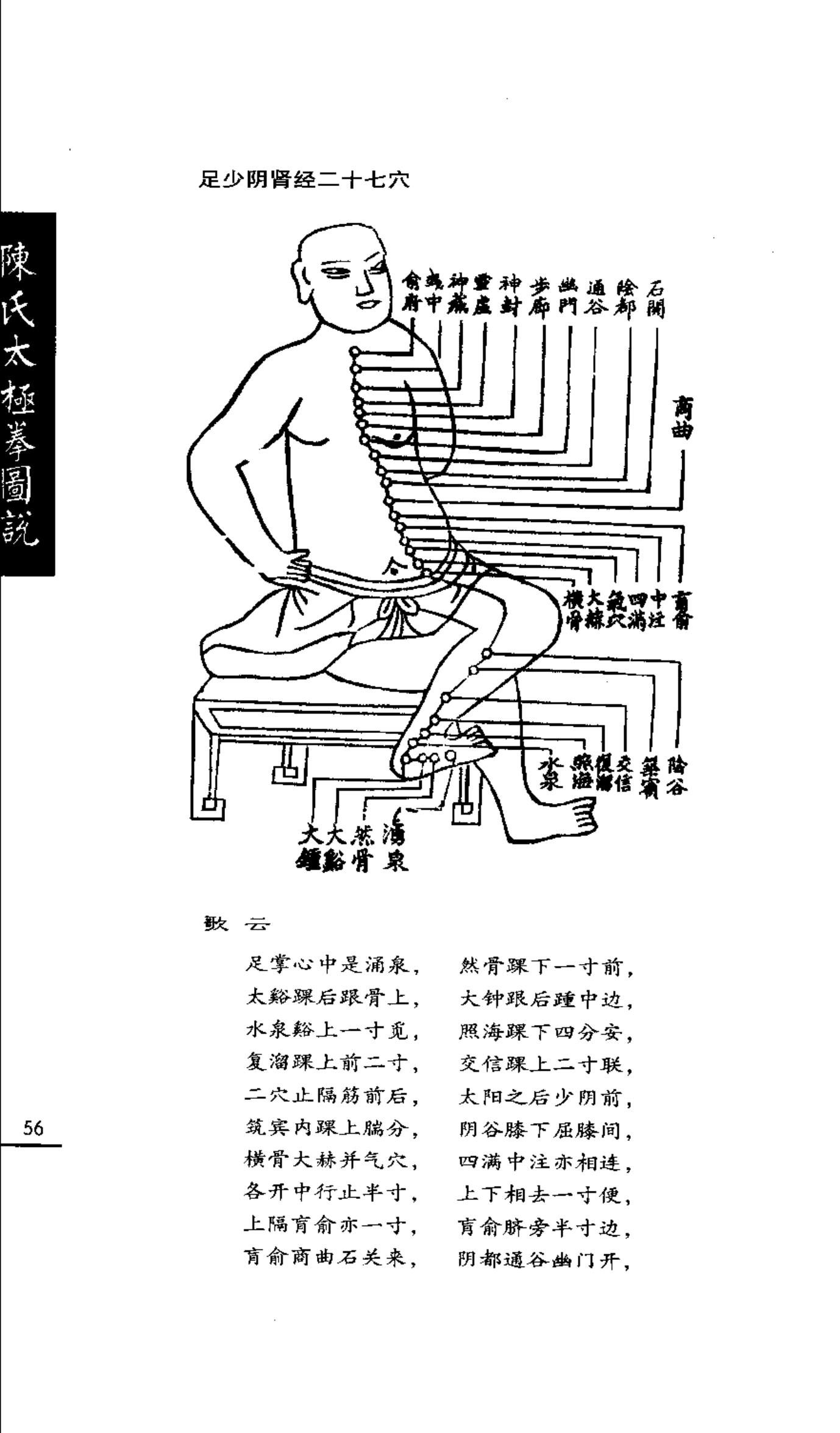
Foot Shaoyin Kidney Meridian: 27 acupoints (足少陰腎經二十七穴)
Diagram labels:
Youguan 右關, Shimen 石門, Tonggu 通谷, Youdu 幽都, Bulang 步廊, Shenfeng 神封, Lingxu 靈墟, Shencang 神藏, Yuzhong 彧中, Fuzhong 府中, Shicang 食倉, Shangqu 商曲, Huangshu 盲俞, Zhongzhu 中注, Siman 四滿, Qixue 氣穴, Dahe 大赫, Henggu 横骨, Yingu 陰谷, Zhubin 築賓, Jiaoxin 交信, Fuliu 復溜, Zhaohai 照海, Shuiquan 水泉, Taixi 太谿, Dazhong 大鐘, Rangu 然谷
Mnemonic verse (歌云)
然骨踝下一寸前,(Rangu is one cun forward below the ankle,)
大钟跟后踵中边,(Dazhong is behind the heel at the edge of the mid-heel,)
照海踝下四分安,(Zhaohai sits four fen below the ankle,)
交信踝上二寸联,(Jiaoxin joins two cun above the ankle,)
太阳之后少阴前,(Behind the Taiyang channel, before the Shaoyin,)
阴谷膝下屈膝间,(Yingu is below the knee, in the bend of the knee,)
四满中注亦相连,(Siman and Zhongzhu are also joined in sequence,)
上下相去一寸便,(Each is one cun from the next,)
肓俞脐旁半寸边,(Huangshu is half a cun beside the navel,)
阴都通谷幽门开,(Yindu, Tonggu and Youmen open in line,)
足掌心中是涌泉,(In the center of the sole of the foot is Yongquan,)
太谿踝后跟骨上,(Taixi is behind the ankle above the heel bone,)
水泉谿上一寸觅,(Shuiquan is sought one cun above Taixi,)
复溜踝上前二寸,(Fuliu is two cun in front of and above the ankle,)
二穴止止隔筋前后,(The two points are separated only by a tendon, front and back,)
筑宾内踝上腨分,(Zhubin is on the calf above the inner ankle,)
横骨大赫并气穴,(Henggu, Dahe and Qixue together,)
各开中行止半寸,(Each lies half a cun from the midline,)
上隔肓俞亦一寸,(Above, one cun apart from Huangshu likewise,)
肓俞商曲石关来,(From Huangshu come Shangqu and Shiguan,)
*Chen shi Taiji Quan Tushuo* (陳氏太極拳圖說), Juan Shou (卷首, preliminary scroll)
The Sixty-Three Points of the Foot Taiyang Bladder Meridian (足太阳膀胱经六十三穴)
Verse (歌, gē):
"The Foot Taiyang is the Bladder meridian (足太阳兮膀胱经);
It begins at the inner canthus of the eye at Jingming (睛明).
At the hollow of the brow, Zanzhu (攒竹) is taken;
Quchai (曲差) is five fen above the hairline.
Wuchu (五处) is one cun above the hair;
Chengguang (承光) is two and a half cun above the hair."
"Six points, each one cun apart, measured one above the other;
Shencang (神藏), Yuzhong (彧中), and Shufu (俞府) stand in honour.
Upper and lower, six cun for the same six points;
Taken with the right method, success follows of itself."
"Each opens five fen from the centre line;
Bulang (步廊), Shenfeng (神封), Lingxu (灵墟) are kept there.
Each opens two cun from the centre line by count;
Shufu (俞府) lies two cun beside Xuanji (璇玑)."
Diagram
Point labels: head/face — Jingming, Zanzhu, Quchai, Wuchu, Chengguang, Tongtian, Luoque, Yuzhen, Tianzhu, Dazhu; back (lateral line) — Fufen, Pohu, Gaohuang, Shentang, Yixi, Geguan, Hunmen, Yanggang, Yishe, Weicang, Huangmen, Zhishi, Baohuang, Zhibian; back (medial line) — Fengmen, Feishu, Jueyinshu, Xinshu, Dushu, Geshu, Ganshu, Danshu, Pishu, Weishu, Sanjiaoshu, Shenshu, Qihaishu, Dachangshu, Guanyuanshu, Xiaochangshu, Pangguangshu, Zhonglüshu, Baihuanshu, Shangliao, Ciliao, Zhongliao, Xialiao, Huiyang; leg — Chengfu, Yinmen, Fuxi, Weiyang, Weizhong, Heyang, Chengjin, Chengshan, Feiyang, Fuyang, Kunlun, Pucan, Shenmai, Jinmen, Jinggu, Shugu, Tonggu, Zhiyin.
*Chen shi Taiji Quan Tushuo* (陳氏太極拳圖說)
Verse on the points of the Foot Taiyang Bladder meridian (continued)
"Keep them evenly spaced, five fen apart, and observe;
Two cun within the hair, the occipital bone appears;
In the hollow outside the great tendon they present.
First of all, the two Fengmen (风门);
Xinshu (心俞) is discussed below the fifth vertebra;
Eleventh is Pishu (脾俞), twelfth Weishu (胃俞);
Infer below the sixteenth — Dachangshu (大肠俞);
Zhonglüshu (中膂俞) at the twentieth vertebra;
All the points above may thus be arrayed.
One, two, three, four — the lumbar gaps are good,
And with them the second line of back points is complete.
Below the second vertebra is Fufen (附分);
Below the fifth vertebra, Shentang (神堂) stands honoured;
Ninth is Hunmen (魂门), tenth Yanggang (阳纲);
Twelfth is Weicang (胃仓), the point already distinguished;
Fourteenth is Zhishi (志室), needing no further words —
Thus the third line of back points is even.
Chengfu (承扶) presides in the hollow;
Weiyang (委阳) is counted one cun six below Chengfu;
In the popliteal hollow, inside, where the two tendons meet;
Three cun below that, look for Heyang (合阳);
The point lies in the middle of the calf muscle.
Seven cun above the outer malleolus it rises high;
Kunlun (昆仑) is in the central hollow behind the heel;
Shenmai (申脉) spreads five fen below the malleolus;
Jinggu (京骨) is measured at the bone's edge on the outside;
Tonggu (通谷) is strong in the hollow before the joint —
And so the points of the Taiyang are set out in full detail."
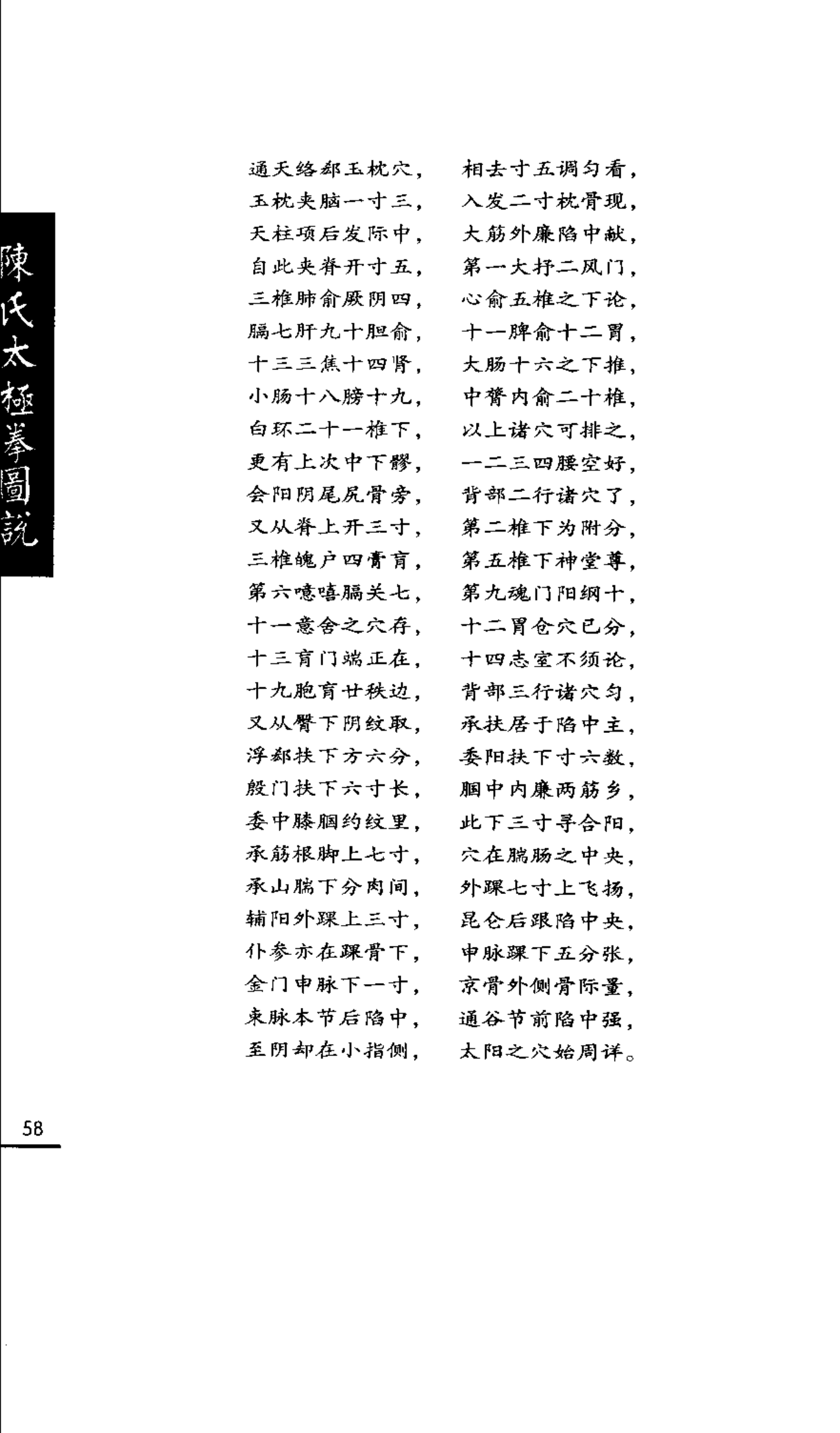
Tongtian (通天), Luoque (络却), Yuzhen (玉枕) as points;
Yuzhen flanks the brain one cun three;
Tianzhu (天柱) is at the hairline behind the nape.
From here, flanking the spine, open one cun five:
Feishu (肺俞) at the third vertebra, Jueyin at the fourth;
Geshu (膈俞) at seven, Ganshu (肝俞) at nine, Danshu (胆俞) at ten;
Sanjiaoshu (三焦俞) at thirteen, Shenshu (肾俞) at fourteen;
Xiaochangshu (小肠俞) at eighteen, Pangguangshu (膀胱俞) at nineteen;
Baihuanshu (白环俞) at twenty-one, below a vertebra;
There are further the Shang, Ci, Zhong and Xia liaos (上髎、次髎、中髎、下髎);
Huiyang (会阳) is beside the coccyx, in front of the tailbone.
Again, from the spine open three cun:
Pohu (魄户) at the third vertebra, Gaohuang (膏肓) at the fourth;
Yixi (噫嘻) at the sixth, Geguan (膈关) at the seventh;
Yishe (意舍) as a point is kept at eleven;
Huangmen (肓门) stands squarely at thirteen;
Baohuang (胞肓) at nineteen and Zhibian (秩边) at twenty.
Again, take them from below the buttock at the gluteal fold;
Fuxi (浮郄) is six fen below Chengfu;
Yinmen (殷门) is six cun long below Chengfu;
Weizhong (委中) is inside the crease of the knee's popliteal hollow;
Chengjin (承筋) is seven cun up from the heel;
Chengshan (承山) is below the calf, between the muscle bellies;
Fuyang (跗阳) is three cun above the outer malleolus;
Pucan (仆参) too lies below the malleolus bone;
Jinmen (金门) is one cun below Shenmai;
Shugu (束骨) is in the hollow behind the joint of the great toe-side;
And Zhiyin (至阴) is at the outer side of the little toe.
*Chen Family Taijiquan Illustrated Explanation (陳氏太極拳圖說, Chén shì tàijíquán túshuō), Preliminary Volume (卷首, juànshǒu)*
Right column (points of the first bladder line, from top to bottom): Dazhu (大杼), Fengmen (風門, Wind Gate), Feishu (肺俞, Lung Shu), Jueyinshu (厥陰俞, Pericardium Shu), Xinshu (心俞, Heart Shu), Geshu (膈俞, Diaphragm Shu), Ganshu (肝俞, Liver Shu), Danshu (膽俞, Gallbladder Shu), Pishu (脾俞, Spleen Shu), Weishu (胃俞, Stomach Shu), Sanjiaoshu (三焦俞, Triple Burner Shu), Shenshu (腎俞, Kidney Shu), Dachangshu (大腸俞, Large Intestine Shu), Xiaochangshu (小腸俞, Small Intestine Shu), Pangguangshu (膀胱俞, Bladder Shu), Zhonglüshu (中膂俞), Baihuanshu (白環俞), Shangliao (上髎), Ciliao (次髎), Zhongliao (中髎), Xialiao (下髎), Huiyang (會陽).
Center column: the five zang organs — lung (肺), heart (心), liver (肝), spleen (脾), kidney (腎).
Left column (points of the second bladder line): Fufen (附分), Pohu (魄戶, Po Door), Gaohuang (膏肓), Shentang (神堂, Spirit Hall), Yixi (噫嘻), Geguan (膈關), Hunmen (魂門, Hun Gate), Yanggang (陽綱), Yishe (意舍), Weicang (胃倉), Zhishi (志室, Will Chamber), Baohuang (胞肓), Zhibian (秩邊), Fucheng (扶承), Fuxi (浮郄), Weiyang (委陽), Yinmen (殷門).
Commentary on the correspondence with the five zang organs:
For example: Pohu corresponds to Feishu, Shentang corresponds to Xinshu, Hunmen corresponds to Ganshu, Yishe corresponds to Pishu, and Zhishi corresponds to Shenshu — these are the Five Spirits (五神, wǔshén). The Five Spirits are stored within the five zang organs, and therefore they correspond to the five zang. Considering what each of the Five Spirits stores reveals the reality: the lung stores the po (魄, po, the corporeal soul), the heart stores the shen (神, shén, spirit), the liver stores the hun (魂, hún, ethereal soul), the spleen stores the yi (意, yì, intention), and the kidney stores the zhi (志, zhì, will) — these are the five zang (五藏, wǔzàng).
Note at bottom of the chart: Baihuanshu is the same point as Yaoshu (腰俞).
*Chen Family Taijiquan Illustrated Explanation (陳氏太極拳圖說)*
The Nine Points of the Hand Jueyin Pericardium Meridian (手厥陰包絡經, shǒu juéyīn bāoluò jīng)
Points labeled on the figure: Xinbao / chest (心包), Tianquan (天泉, Heavenly Spring), Quze (曲澤, Marsh at the Bend), Ximen (郄門, Xi Gate), Jianshi (間使, Envoy), Neiguan (內關, Inner Pass), Daling (大陵, Great Mound), Laogong (勞宮, Palace of Toil), Zhongchong (中沖, Middle Rush). The meridian is identified as Hand Jueyin Pericardium (手厥陰包絡).
Verse (歌云, gē yún):
One cun and three [fen] below the armpit, behind the nipple;
Quze lies in the central hollow when the elbow is bent;
Jianshi is measured five cun behind the wrist;
Daling lies behind the palm between the two tendons;
At the tip of the middle finger, Zhongchong is best.
The pericardium channel begins between heaven and earth [chest and abdomen];
Tianquan is two cun below the bent armpit;
Ximen is just five cun from the wrist;
Neiguan is only two cun from the wrist;
Laogong is found by bending the middle and ring fingers [into the palm].
*Chen Family Taijiquan Illustrated Explanation (陳氏太極拳圖說), Preliminary Volume (卷首)*
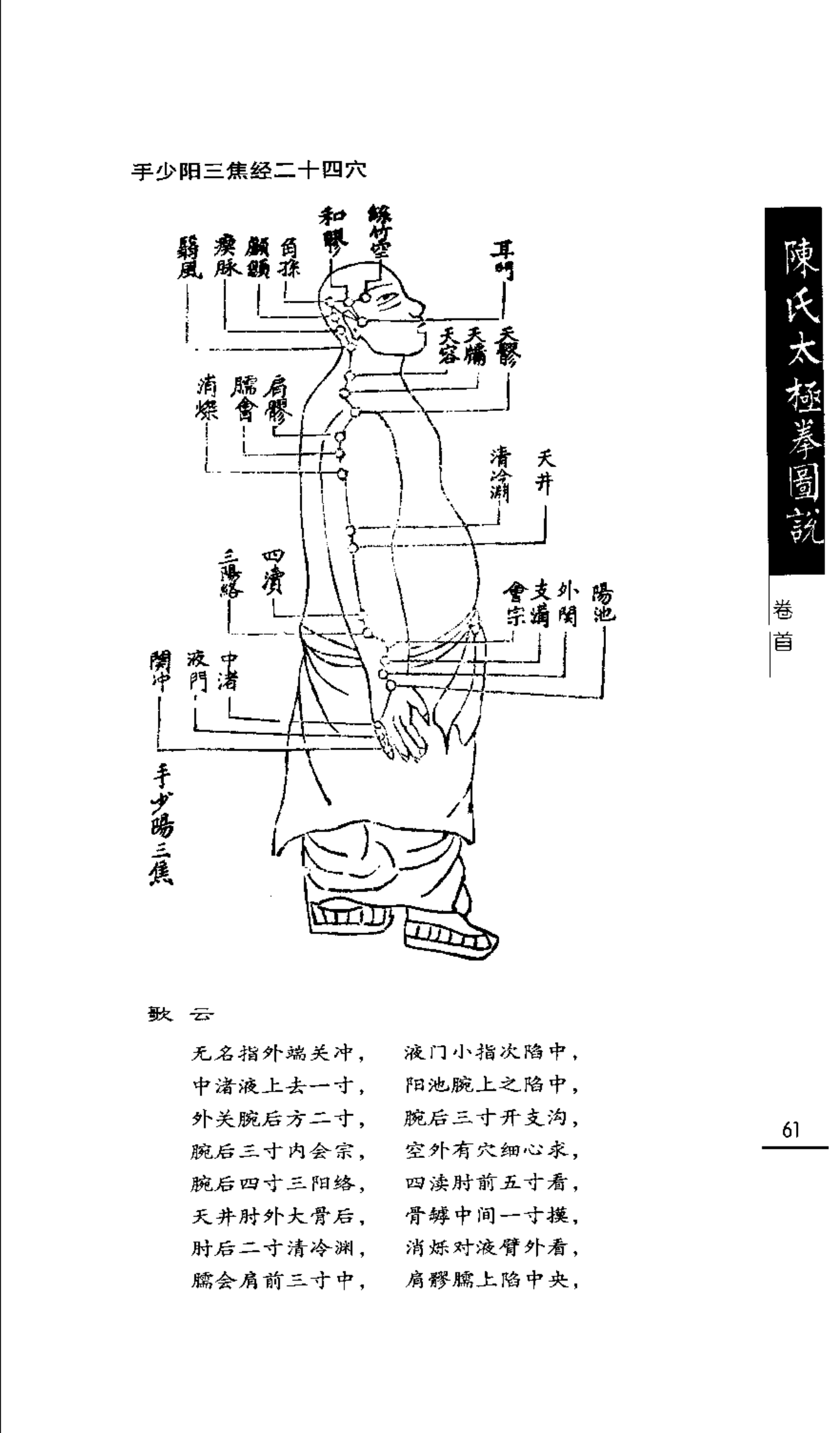
The Twenty-Four Points of the Hand Shaoyang Triple Burner Meridian (手少陽三焦經, shǒu shàoyáng sānjiāo jīng)
Points labeled on the figure (from the hand upward): Chongchong/Guanchong (關沖, Gate Rush), Yemen (液門, Fluid Gate), Zhongzhu (中渚, Middle Islet), Sanyangluo (三陽絡, Triple Yang Connection), Sidu (四瀆, Four Rivers), Waiguan (外關, Outer Pass), Yangchi (陽池, Yang Pool), Zhigou (支溝, Branch Ditch), Huizong (會宗, Meeting of Ancestors), Qinglengyuan (清冷淵, Cold Clear Deep), Tianjing (天井, Heavenly Well), Naohui (臑會, Upper Arm Meeting), Jianliao (肩髎, Shoulder Crevice), Xiaoluo (消爍, Dispersing Larder), Yifeng (翳風, Wind Screen), Chimai (瘈脈, Spasmodic Vessel), Luxi (顱息, Skull Rest), Jiaosun (角孫, Vertex Grandson), Heliao (和髎, Harmony Crevice), Sizhukong (絲竹空, Silk Bamboo Hollow), Ermen (耳門, Ear Gate), Tianrong (天容, Heavenly Countenance), Tianyou (天牖, Heavenly Window), Tianliao (天髎, Heavenly Crevice). The meridian is identified as Hand Shaoyang Triple Burner (手少陽三焦).
Verse (歌云):
Guanchong lies at the outer end of the ring finger;
Yemen lies in the hollow between the little and ring fingers;
Zhongzhu is one cun above Yemen;
Yangchi lies in the hollow above the wrist;
Waiguan is two cun behind the wrist;
Three cun behind the wrist opens Zhigou;
Three cun within behind the wrist lies Huizong —
Outside the hollow there is a point; seek it with care;
Four cun behind the wrist is Sanyangluo;
Sidu is seen five cun before the elbow;
Tianjing lies behind the great bone outside the elbow;
Feel one cun within the bone's interstice;
Two cun behind the elbow is Qinglengyuan;
Xiaoluo, opposite Yemen, on the outer arm;
Naohui lies three cun before the shoulder;
Jianliao lies in the central hollow above the upper arm.
*Chen Family Taijiquan Illustrated Explanation* (陳氏太極拳圖說, Chén shì tàijíquán túshuō)
Verse (continuation of meridian-point mnemonic):
> 天牖天容之后有 — Tianyou lies behind Tianrong;
> 痠脉耳后青脉现 — (Quan)mai appears where the green vein shows behind the ear;
> 角孙耳廓中间上 — Jiaosun is at the top, mid-ear helix;
> 和髎耳后动脉张 — Heliao where the artery pulses behind the ear;
> 眉后陷中仔细详 — Examine carefully in the depression behind the brow.
>
> 天髎缺盆陷处上 — Tianliao is above the Quepen depression;
> 翳风耳后尖角陷 — Yifeng in the hollow at the pointed angle behind the ear;
> 颅囟亦在青络脉 — (Lu)xin too lies on the green collateral vessel;
> 耳门耳前起肉中 — Ermen is in the flesh before the ear;
> 欲知丝竹空何在 — If you would know where Sizhukong is found…
The Foot Shaoyang (Gallbladder) Meridian: Forty-Five Points (足少阳胆经四十五穴, Zú Shàoyáng dǎn jīng sìshíwǔ xué)
Point labels on the diagram:
- Anterior head view: Linqi (臨泣), Dangchuang (當窻), Zhengying (正營), Chengling (承靈), Naokong (腦空), Fengchi (風池)
- Lateral head view: Benshen (本神), Yangbai (陽白), Toulinqi (頭臨泣), Muchuang (目窗), Zhengying (正營), Chengling (承靈), Naokong (腦空), Fengchi (風池), Fubai (浮白), Shuaigu (率谷, printed 率骨), Qubin (曲鬢), Xuanlu (懸顱), Hanyan (頷厭), Shangguan (上關), Tongziliao (童子髎), Tinghui (聽會), Tinggong (聽宮), Tianchong (天衝), Wangu (完骨), Qiaoyin (竅陰)
- Torso and leg: Jianjing (肩井), Yuanye (淵腋), Zhejin (輒筋), Riyue (日月), Jingmen (京門), Daimai (帶脈), Wushu (五樞), Weidao (維道), Juliao (居髎), Huantiao (環跳), Qiuxu (邱墟), Yangfu (陽輔), Xuanzhong (懸鐘), Guangming (光明), Waiqiu (外丘), Yangjiao (陽交), Yanglingquan (陽陵泉)
The Verse Says (歌云, Gē yún)
> 頭上廿穴分三折 — The twenty points on the head divide into three bends;
> 积数陈之依次第 — Tally and set them out in their due order;
> 耳前陷中寻听会 — In the depression before the ear seek Tinghui;
>
> 足少阳兮四十五 — The Foot Shaoyang, forty-five in all;
> 起自童子至风池 — Starting at Tongzi and ending at Fengchi;
> 瞳子髎近眦五分 — Tongziliao lies five fen from the outer canthus…
*(Printed page number: 62)*
*Chen Family Taijiquan Illustrated Explanation* (陳氏太極拳圖說, Chén shì tàijíquán túshuō), Preliminary Volume (卷首, juànshǒu)
Verse (continuation — point locations of the Foot Shaoyang Gallbladder meridian, 足少阳胆经, Zú Shàoyáng dǎn jīng):
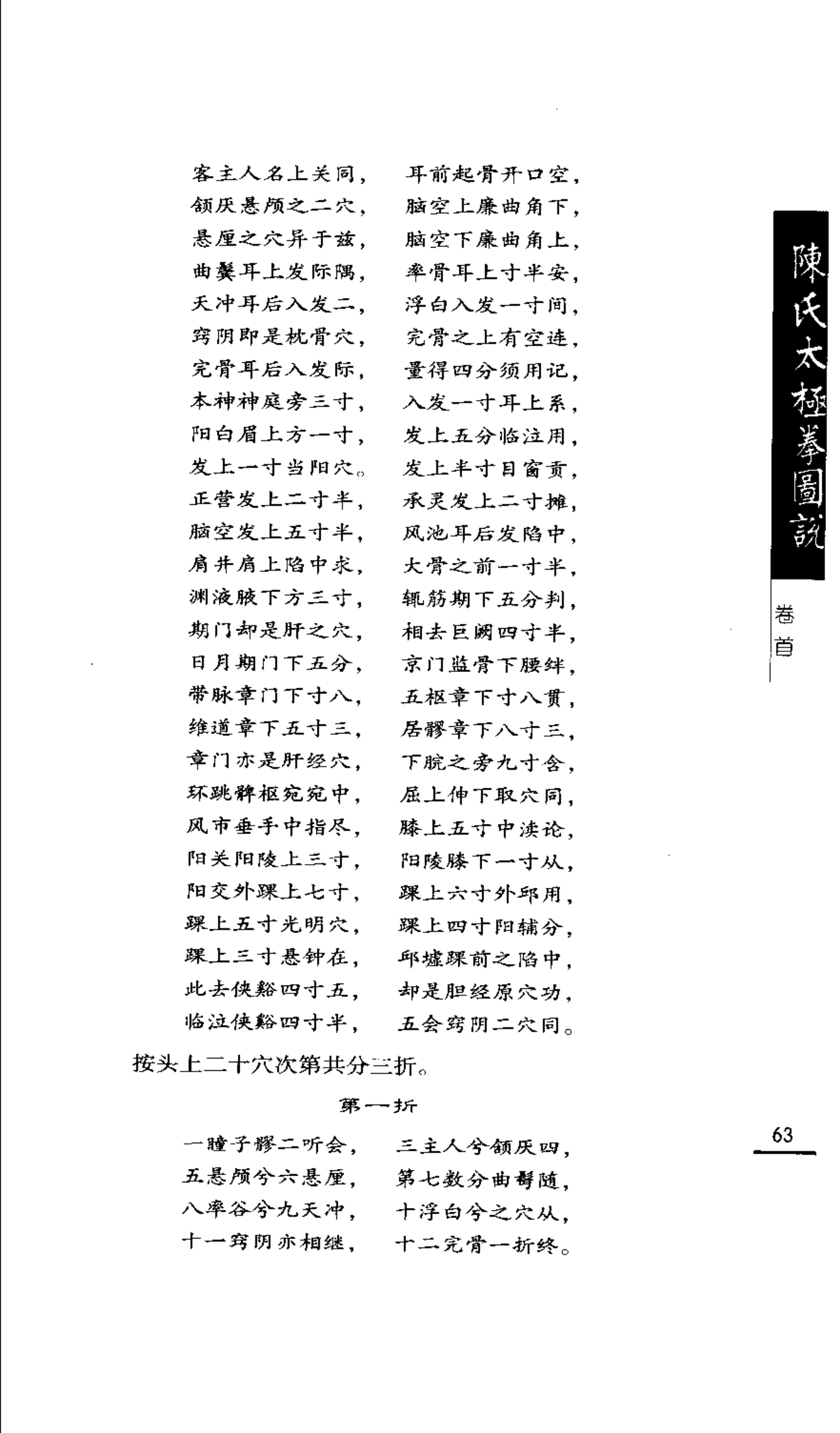
> 耳前起骨开口空 — Before the ear, on the rising bone, at the hollow that opens when the mouth opens;
> 脑空上廉曲角下 — Above Naokong's upper edge, below the bent angle;
> 脑空下廉曲角上 — Below Naokong's lower edge, above the bent angle;
> 率骨耳上半安安 — Shuaigu rests midway up the ear;
> 浮白入发一寸间 — Fubai one cun within the hairline;
> 完骨之上有空连 — Above Wangu a hollow connects;
> 量得四分须用记 — Measured at four fen, this must be remembered;
> 入发一寸耳上系 — One cun within the hairline, above the ear;
> 发上五分临泣用 — Five fen above the hairline serves for Linqi;
> 发上半寸目窗贡 — Half a cun above, Muchuang presents itself;
> 承灵发上二寸摊 — Chengling spreads two cun above the hairline;
> 风池耳后发陷中 — Fengchi in the hairline hollow behind the ear;
> 大骨之前一寸半 — One and a half cun before the great bone;
> 辄筋期下五分判 — Zhejin five fen below Qimen, so judged;
> 相去巨阙四寸半 — Four and a half cun from Juque;
> 京门监骨下腰绊 — Jingmen below the watchbone, at the waist's tether;
> 五枢章下寸八贯 — Wushu one cun eight below Zhangmen;
> 居髎章下八寸三 — Juliao eight cun three below Zhangmen;
> 下脘之旁九寸含 — Nine cun beside Xiawan;
> 屈上伸下取穴同 — Bend up, stretch down — the point is found the same either way;
> 膝上五寸渎论 — Five cun above the knee, as discussed;
> 阳陵膝下一寸从 — Yanglingquan one cun below the knee;
> 踝上六寸外邱用 — Six cun above the ankle serves Waiqiu;
> 踝上四寸阳辅分 — Four cun above the ankle marks Yangfu;
> 邱墟踝前之陷中 — Qiuxu in the hollow before the ankle;
> 却是胆经原穴功 — It is in fact the Yuan (source) point of the Gallbladder meridian;
> 五会窍阴二穴同 — (Xia)xi and Qiaoyin, the two points alike.
> 客主人名上关同 — Keruzhuren is another name for Shangguan;
> 颔厌悬颅之二穴 — Hanyan and Xuanlu, the two points;
> 悬厘之穴异于兹 — The point Xuanli differs from these;
> 曲鬓耳上发际隅 — Qubin at the corner of the hairline above the ear;
> 天冲耳后入发二 — Tianchong two cun into the hair behind the ear;
> 窍阴即是枕骨穴 — Qiaoyin is the point on the occipital bone;
> 完骨耳后入发际 — Wangu behind the ear within the hairline;
> 本神神庭旁三寸 — Benshen three cun beside Shenting;
> 阳白眉上方一寸 — Yangbai one cun above the brow;
> 发上一寸当阳穴 — One cun above the hairline, the Dangyang point.
> 正营发上二寸半 — Zhengying two and a half cun above the hairline;
> 脑空发上五寸半 — Naokong five and a half cun above the hairline;
> 肩井肩上陷中求 — Jianjing sought in the depression atop the shoulder;
> 渊液腋下方三寸 — Yuanye three cun below the armpit;
> 期门却是肝之穴 — Qimen is in fact a point of the Liver (meridian);
> 日月期门下五分 — Riyue five fen below Qimen;
> 带脉章门下寸八 — Daimai one cun eight below Zhangmen;
> 维道章下五寸三 — Weidao five cun three below Zhangmen;
> 章门亦是肝经穴 — Zhangmen too is a point of the Liver meridian;
> 环跳髀枢宛宛中 — Huantiao deep in the hollow of the hip joint;
> 风市垂手中指尽 — Fengshi where the middle fingertip falls when the arm hangs;
> 阳关阳陵上三寸 — Yangguan three cun above Yanglingquan;
> 阳交外踝上七寸 — Yangjiao seven cun above the outer ankle;
> 踝上五寸光明穴 — Guangming five cun above the ankle;
> 踝上三寸悬钟在 — Xuanzhong lies three cun above the ankle;
> 此去侠溪四寸五 — From here to Xiaxi, four cun five;
> 临泣侠溪四寸半 — Linqi to Xiaxi, four and a half cun.
Note (按, àn): The twenty points on the head are, in order, divided altogether into three sections (三折, sān zhé).
First Section (第一折, Dì yī zhé)
> 一瞳子髎二听会 — First Tongziliao, second Tinghui;
> 五悬颅兮六悬厘 — Fifth Xuanlu, sixth Xuanli;
> 八率谷兮九天冲 — Eighth Shuaigu, ninth Tianchong;
> 十一窍阴亦相继 — Eleventh Qiaoyin follows in turn;
>
> 三主人兮颔厌四 — Third Keruzhuren, fourth Hanyan;
> 第七数分曲鬓随 — Seventh in count, Qubin follows;
> 十浮白兮之穴从 — Tenth the point Fubai;
> 十二完骨一折终 — Twelfth Wangu ends the first section.
*(Printed page number: 63)*
Chen's Taijiquan Illustrated Explanation
Second fold:
Then from the thirteenth, Benshen (本神); the fourteenth, Yangbai (阳白), follows in the second fold.
Third fold:
The fifteenth, Linqi (临泣), the point below the eye; the sixteenth, the point Muchuang (目窗); the seventeenth, Zhengying (正营); the eighteenth, Ling (灵); the nineteenth, Naohu (脑户); the twentieth, Fengchi (风池). Measure and take them one by one with care, and the points of the Gallbladder meridian (胆经) on the head may be known.
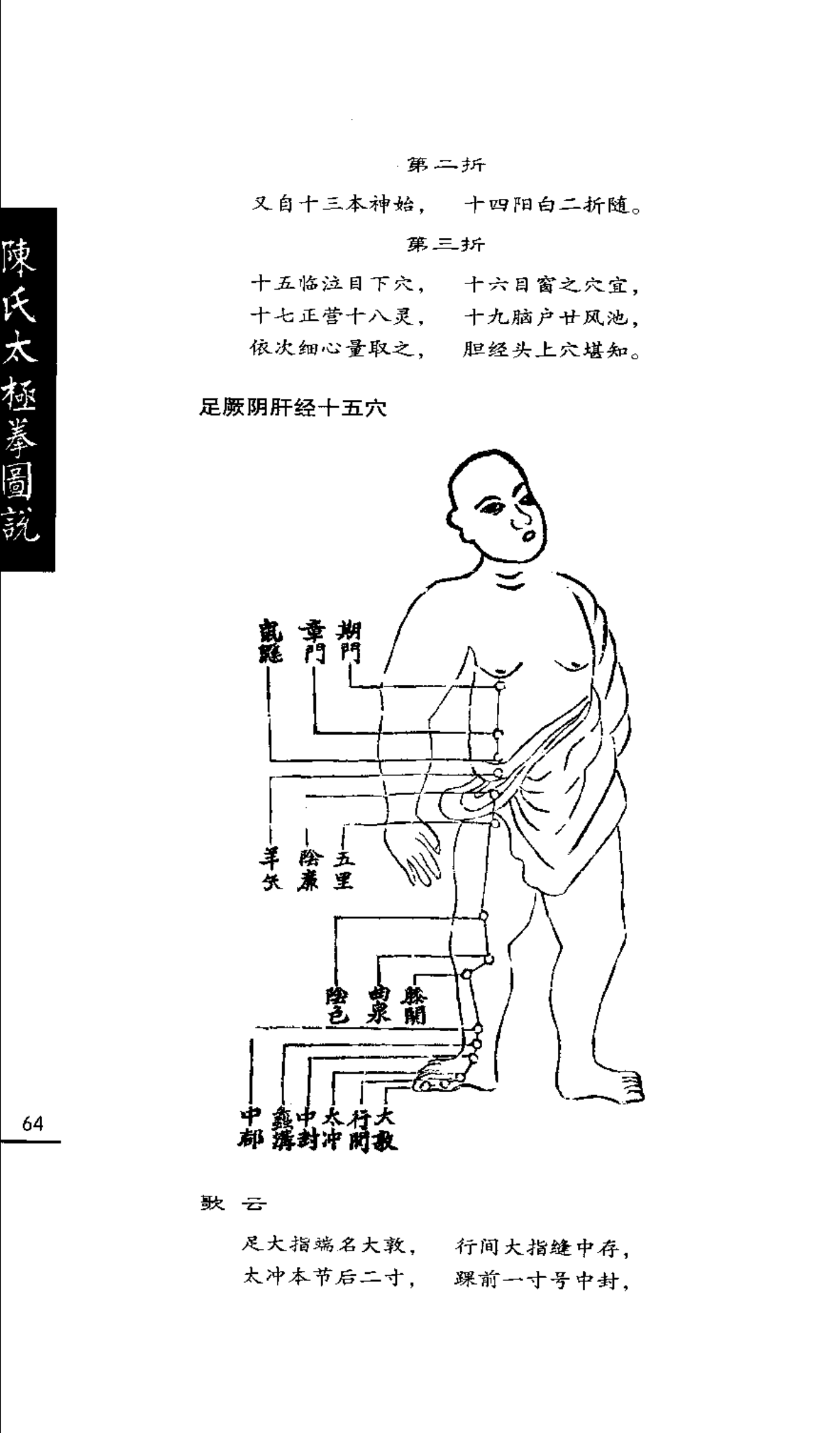
The Foot Jueyin Liver meridian (足厥阴肝经) has fifteen points.
The verse says:
The tip of the big toe is named Dadun (大敦);
Xingjian (行間) lies in the crevice of the big toe;
Taichong (太冲) is two cun behind the first metacarpophalangeal joint;
One cun before the ankle is called Zhongfeng (中封);
Chen's Taijiquan Illustrated Explanation, preliminary volume
Zhongdu (中都) is seven cun above the ankle;
Ququan (曲泉) at the inner knee where the transverse crease ends;
Five cun below Qichong (气冲) is Wuli (五里);
Yangshi (羊矢) is about one cun below Qichong;
Then Jimai (急脈) one cun further;
Four cun from the midline;
Taken lying on the side at the end of the short month;
Four cun five fen, without error.
Ligou (蠡溝) is five cun above the ankle;
Xiguan (膝關) two cun below Dubi (犊鼻);
Yinbao (陰包) four cun above the knee;
Yinlian (陰廉) two cun below Qichong;
Qichong, however, is a point of the Stomach meridian (胃经);
Jimai (急脈) at the end of the pubic bone;
Zhangmen (章門) nine cun lateral to Xiawan (下脘);
Qimen (期門) again beside Juque (巨阙).
Diagram of the Governor vessel (督脉, Dū mài) with twenty-eight points
The verse says:
The Governor vessel's Yinjiao (龈交) is inside the lip;
Duiduan (兑端) lies at the middle of the lip's edge;
Shuigou (水沟) is sought in the groove below the nose;
Suliao (素髎) is best examined at the tip of the nose;
Chen's Taijiquan Illustrated Explanation
First measure from before to behind the hairline;
Five fen above the hair is Shenting (神庭);
Two cun above the hair, Xinhui (囟会) is long;
Five cun above the hair, at the center, is Baihui (百会);
Three cun behind Xinhui, Qiangjian (强间) is clear;
Eight cun from the rear hairline lies Fengfu (风府);
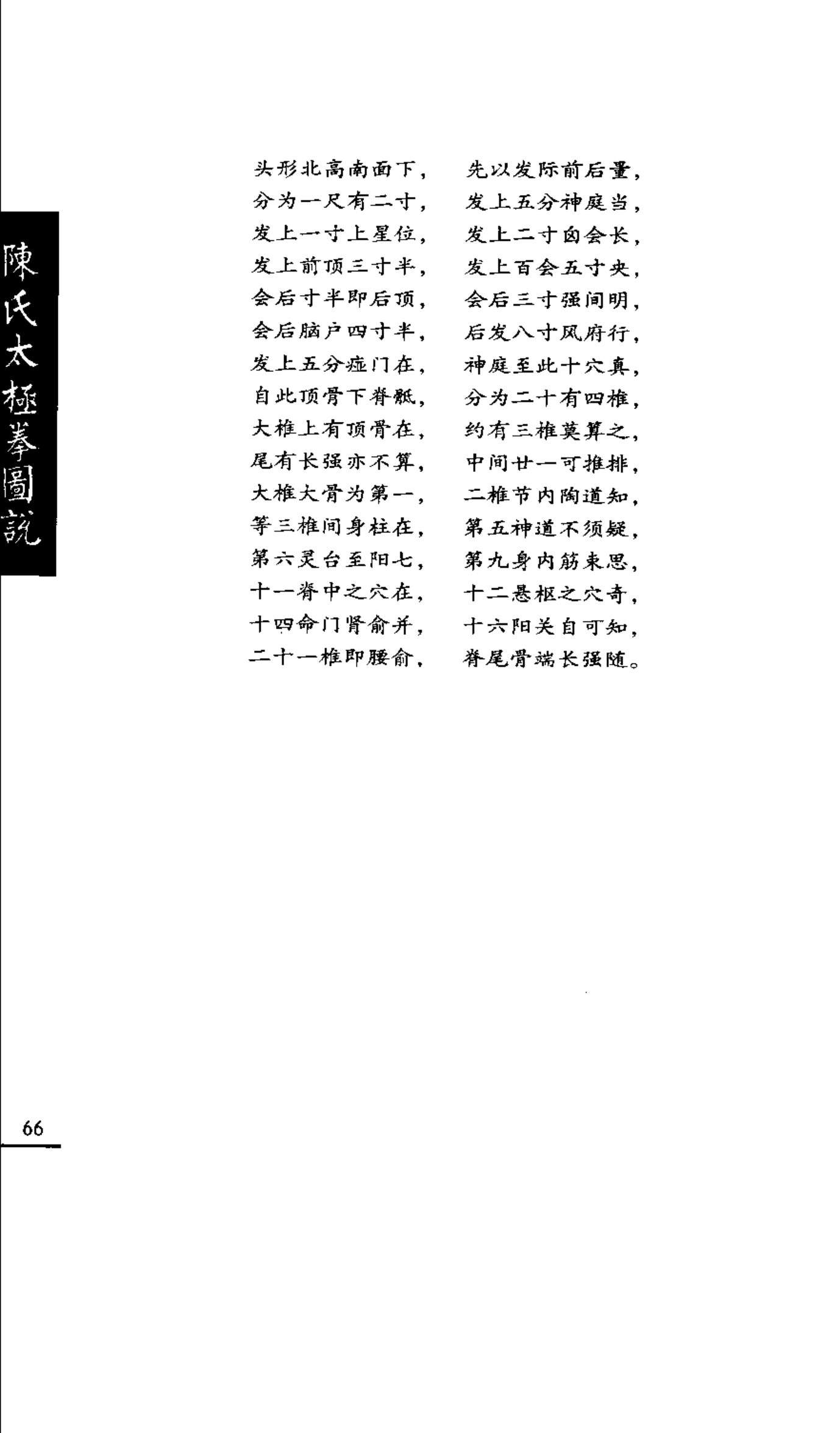
From Shenting to here, fourteen points true;
Divided into twenty-four vertebrae;
About three vertebrae are not counted;
The middle twenty-one can be arrayed in order;
Within the second vertebra, know Taodao (陶道);
The fifth, Shendao (神道), needs no doubt;
The ninth, within the body, consider Jinsuo (筋缩);
The twelfth, the wondrous point Xuanshu (悬枢);
The sixteenth, Yangguan (阳关) is naturally known;
At the end of the spine's tail bone follows Changqiang (长强).
The head's shape is high at the north, sloping down to the south face;
Divided, it is one chi two cun;
One cun above the hair is the position of Shangxing (上星);
Above the hair, Qianding (前顶) at three and a half cun;
One and a half cun behind Xinhui is Houding (后顶);
Four and a half cun behind Xinhui is Naohu (脑户);
Five fen above the hair is where Yamen (痖门) lies;
From here, from the skull bone down to the sacrum;
Above Dazhui (大椎) is the skull bone;
The tail has Changqiang, also not counted;
The great bone Dazhui is the first;
Between the third vertebra lies Shenzhu (身柱);
The sixth, Lingtai (灵台); the seventh, Zhiyang (至阳);
The eleventh, the point Jizhong (脊中) is there;
The fourteenth, Mingmen (命门) together with Shenshu (肾俞);
The twenty-first vertebra is Yaoshu (腰俞);
*Chen Shi Taijiquan Tu Shuo* (陳氏太極拳圖說, Illustrated Explanation of Chen-Style Taijiquan), Volume Preface (卷首)
Diagram of the Ren Meridian (任脉图), Twenty-Four Acupoints
Point names labeled in the diagram: Yutang (玉堂), Zigong (紫宮), Huagai (華蓋), Danzhong (膻中), Shenque (神闕), Shuifen (水分), Xiawan (下脘), Jianli (建里), Chengjiang (承漿), Tiantu (天突), Lianquan (廉泉), Xuanji (璇璣), Zhongwan (中脘), Shangwan (上脘), Jueque (巨闕), Jiuwei (鳩尾), Zhongting (中庭), Zhongji (中極), Qugu (曲骨), Huiyin (會陰), Guanyuan (關元), Shimen (石門), Qihai (氣海), Yinjiao (陰交).
The verse says (歌云):
The Ren meridian: Huiyin lies between the two yin;
Qugu rests in the hollow at the pubic hairline;
Guanyuan is joined three cun below the navel;
Half a cun below the navel is Qihai entire;
The very center of the navel is Shenque;
Two cun above the navel stands Xiawan;
Jueque is six cun five above the navel;
Zhongting is taken one cun six below Danzhong;
Six cun above Danzhong, Yutang presides;
Four times eight above Danzhong, Huagai is raised;
The Ren meridian runs through the interior of the abdomen along its midline.
Zhongji is taken four cun below the navel;
Two cun below the navel is named Shimen;
One cun below the navel is the point Yinjiao;
One cun above the navel is Shuifen;
Three cun above the navel is named Jianli;
Five cun above the navel, Shangwan is there;
Jiuwei is five fen below the xiphoid;
Danzhong lies right between the two nipples;
Two cun two above Danzhong is Zigong;
Chengjiang is below the lip ridge on the front of the chin.
*Chen Shi Taijiquan Tu Shuo* (陳氏太極拳圖說), Volume Preface
On the Wei Qi (卫气论, Defensive Qi)
The "Wei Qi Xing" chapter of the *Lingshu* (灵枢) says: The movement of defensive qi (wei qi, 卫气) completes fifty circuits around the body in one day and night. By day it circulates twenty-five times through the yang, by night twenty-five times through the yin. At dawn, when the yin is exhausted, the yang qi issues from the eyes. When the eyes open, the qi ascends to the head (along Jingming, 睛明), then descends through the Foot Taiyang Bladder meridian, the Hand Taiyang Small Intestine meridian, the Foot Shaoyang Gallbladder meridian, the Hand Shaoyang Triple Burner meridian, the Foot Yangming...
Twelve Meridian Drawings · Front View of the Eight Confluences (八会正面图)
Qi meets at the Triple Burner (气会三焦);
The vessels meet at Taiyuan (脉会太渊);
The bowels meet at Zhongwan (腑会中脘);
The organs meet at Zhangmen (脏会章门).
Back View of the Eight Confluences (八会背面图)
Bone meets at Dazhu (骨会大杼);
Blood meets at Geshu (血会膈俞);
Marrow meets at Juegu (髓会绝骨);
Sinew meets at Yanglingquan (筋会阳陵泉).
Points of the Chong Meridian (冲脉)
Youmen, Tonggu, Yinxi, Shiguan, Shangqu, Yushu (Youmen flanks Jueque half a cun to the side);
Zhongzhu, Suifu, Baomen, Yinguan, Xiaji (Zhongzhu lies below Yushu).
The Dai (belt) meridian binds the waist and has no points.
Diagram of the Seven Qi Gates (七冲门图)
Humen (door of the household — lips), Feimen (flying door — teeth), Ximen (door of inhalation — palate), Benmen (cardia), Youmen (pylorus), Lanmen (ileocecal gate), Pomen (anus).
Stomach, small intestine, large intestine.
*Chen Shi Taiji Quan Tushuo* (陳氏太極拳圖說, Chen Family Taiji Quan Illustrated Explanation) — Juan Shou (卷首, front matter).
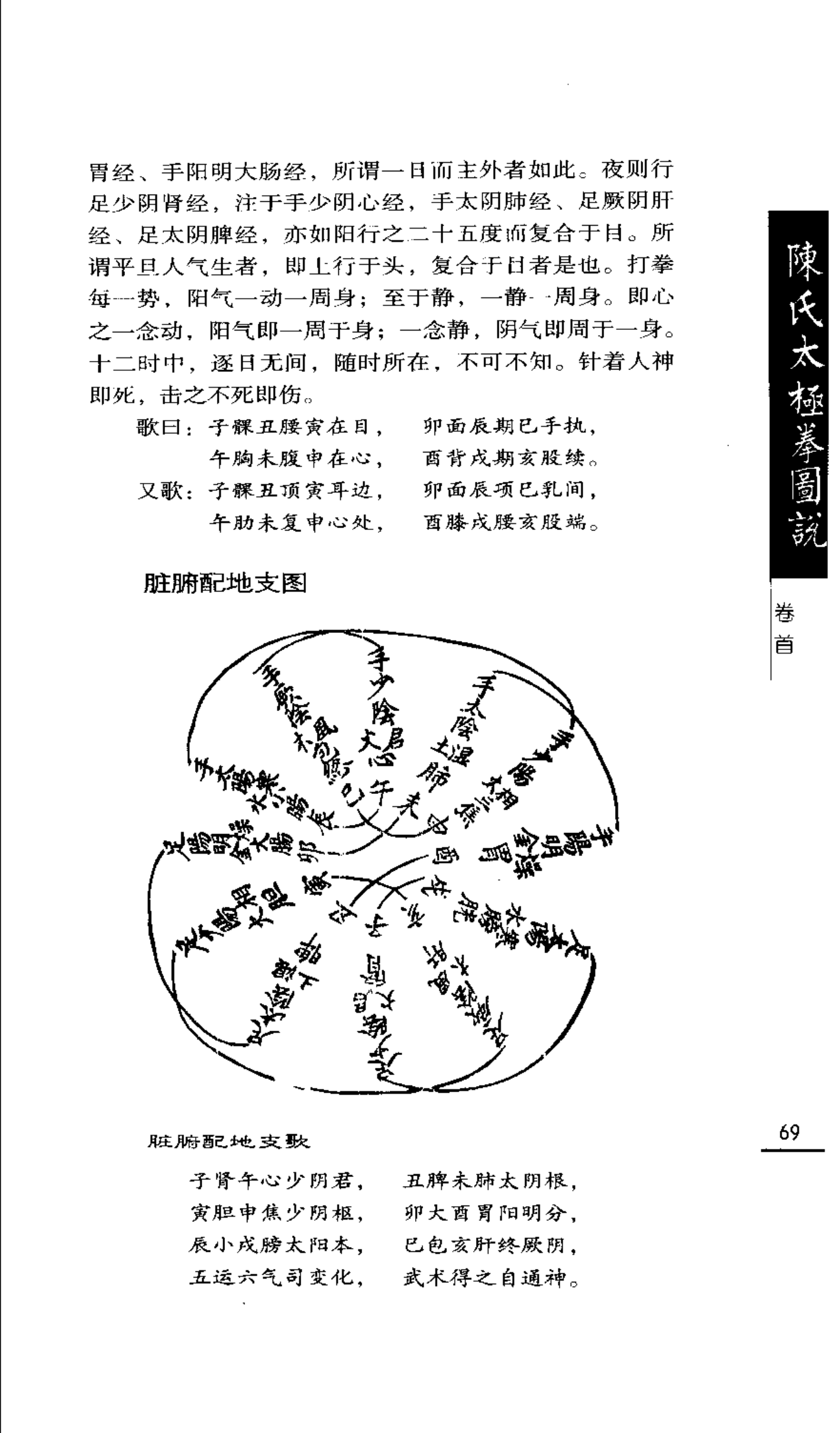
…stomach channel and the hand Yangming Large Intestine channel — such is how, within one day, [the qi] governs the exterior. At night it travels through the foot Shaoyin Kidney channel, pouring into the hand Shaoyin Heart channel, the hand Taiyin Lung channel, the foot Jueyin Liver channel, and the foot Taiyin Spleen channel, likewise completing twenty-five circuits as the yang did, and rejoining at the eyes. What is meant by "at daybreak the human qi arises" is precisely this ascending to the head and rejoining. In practicing quan (拳, boxing), each posture (勢 shi): when the yang qi moves once, it circuits the whole body; when it comes to stillness, one stillness is one circuit of the body. The moment a single thought of the mind moves, the yang qi immediately makes one circuit of the body; when a thought is still, the yin qi makes one circuit of the body. Throughout the twelve double-hours (十二時), day after day without interruption, wherever it resides at any moment — this must be known. Needling the point where the "human spirit" (人神) resides causes death; striking it, if it does not kill, will injure.
Song:
At zi the ankle, at chou the waist, at yin the eyes;
At wu the chest, at wei the abdomen, at shen the heart;
At mao the face, at chen…, at si held in the hand;
At you the back, at xu…, at hai the thigh continues.
Another song:
At zi the ankle, at chou the crown, at yin beside the ear;
At wu the ribs, at wei the abdomen, at shen the heart's place;
At mao the face, at chen the neck, at si between the breasts;
At you the knee, at xu the waist, at hai the end of the thigh.
Song of the zang-fu paired with the earthly branches:
Zi kidney, wu heart — the Shaoyin sovereign;
Yin gallbladder, shen burner — the Shaoyin pivot;
Chen small intestine, xu bladder — the Taiyang root;
Chou spleen, wei lung — the Taiyin basis;
Mao large intestine, you stomach — the Yangming division;
Si pericardium, hai liver — ending in the Jueyin.
The five movements and six qi govern transformation;
The martial arts that gain this reach the divine of themselves.
(Page 69)
*Chen Shi Taiji Quan Tushuo* (陳氏太極拳圖說).
Six Qi Governing the Year — Diagram (六氣主歲圖)
Song of the Six Qi Governing the Year (六氣主歲圖歌)
The second qi is Shaoyang fire as sovereign;
The fourth qi is minister fire, the fifth qi metal;
The sixth qi, in the spring (zai quan), ends by storing the true.
Jueyin wind-wood governs the first, spring;
The third qi governs heaven as Taiyin earth;
Within the overcoming, life emerges as dry-metal body.
Song of the Yang Zang-fu (陽臟腑歌)
Yangming — the large intestine; the foot [pairing] the stomach;
Jueyin — the pericardium; the foot [pairing] the liver;
Taiyin — the hand [is] the lung; the foot [is] the spleen.
Taiyang — the small intestine; the foot the bladder;
Shaoyang — the triple burner paired with the foot gallbladder;
Shaoyin — the hand the heart channel; the foot is the kidney.
Song of Exterior-Interior Pairing of the Zang-fu (臟腑表里歌)
Kidney with bladder, heart with pericardium;
Zang and fu, exterior and interior — distinguish yin and yang.
Heart with small intestine, lung with large intestine;
Spleen with stomach, and liver with gallbladder.
Song of the Nutritive Blood Circulating Through the Twelve Double-Hours (營血周行十二時歌)
Yin — hand Taiyin lung;
Mao — hand Yangming large intestine.
Chen — foot Yangming stomach;
Si — foot Taiyin spleen.
Wu — hand Shaoyin heart;
Wei — hand Taiyang small intestine.
Shen — foot Taiyang bladder;
You — foot Shaoyin kidney.
Xu — hand Jueyin pericardium;
Hai — hand Shaoyang triple burner.
(Page 70)
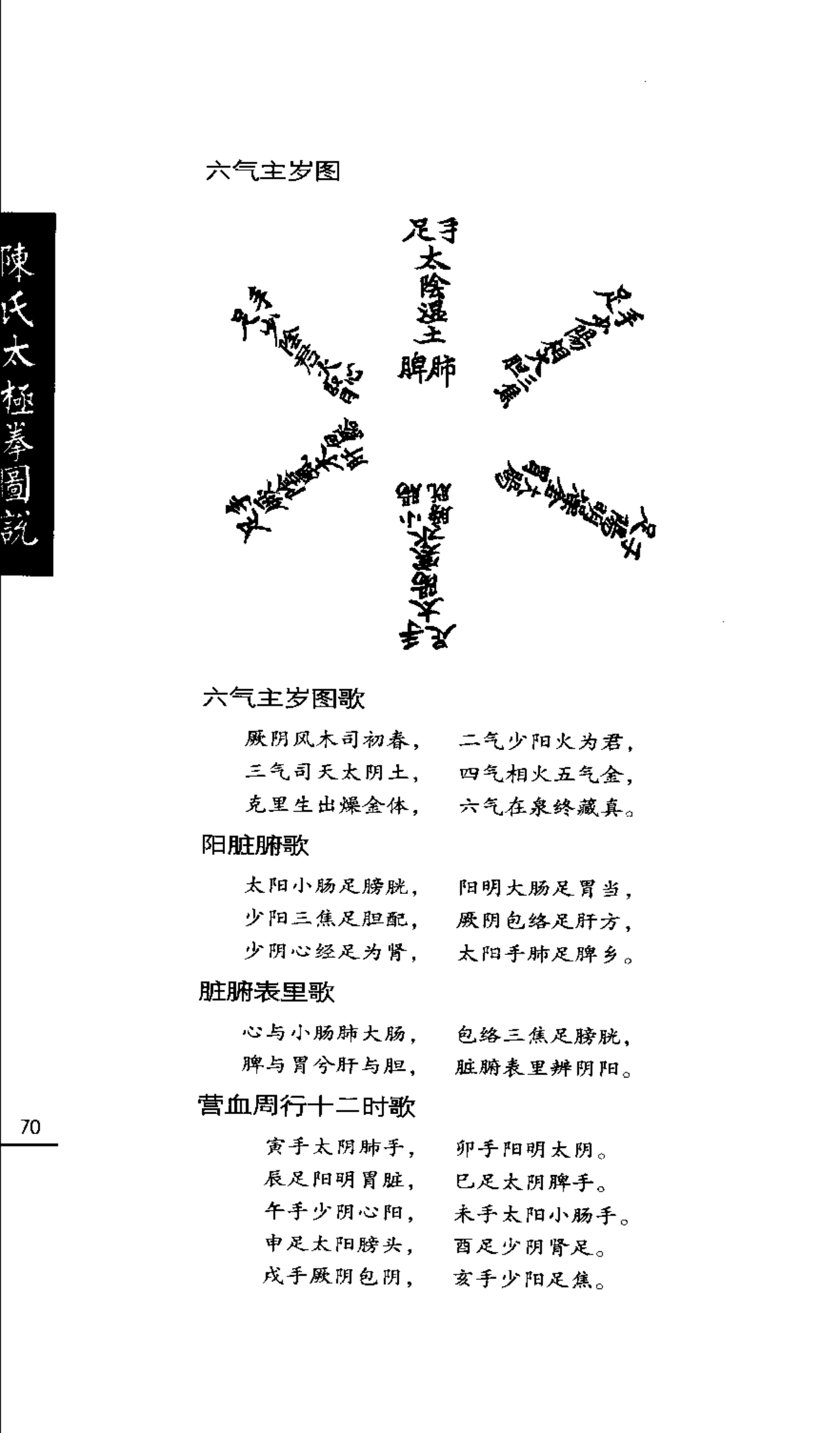
Table of Nutritive Blood Circulating Through the Twelve Time Periods (营血周行十二时表, yíngxuè zhōu xíng shí'èr shí biǎo)
Text of the chart
- 子 (zǐ, hour of the Rat): Foot Shaoyang Gallbladder (足少阳胆, zú shào yáng dǎn, fu-organ); 丑 (chǒu, hour of the Ox): Foot Jueyin Liver (足厥阴肝, zú jué yīn gān, zang-organ).
- Continuing to the head and feet.
- Hand Taiyin Lung Meridian (手太陰肺經) — 11 points
- Hand Yangyang Large Intestine Meridian (手陽明大腸經) — 20 points
- ↓ Foot Yangming Stomach Meridian (足陽明胃經)
- Hand Shaoyin Heart Meridian (手少陰心經) — 9 points
- ↓ Foot Taiyin Spleen Meridian (足太陰脾經)
- Hand Taiyang Small Intestine Meridian (手太陽小腸經) — 19 points
- ↓ Foot Taiyang Bladder Meridian (足太陽膀胱經)
- Hand Jueyin Pericardium Meridian (手厥陰包絡經) — 9 points
- ↓ Foot Shaoyin Kidney Meridian (足少陰腎經)
- Hand Shaoyang Triple Burner Meridian (手少陽三焦經) — 24 points
- ↓ Foot Shaoyang Gallbladder Meridian (足少陽胆經)
- Hand Taiyin Lung Meridian — (the cycle closes)
- Du Meridian (督脈, Dú mài / Du Mai) — 11 points
- Ren Meridian (任脈, Rèn mài / Ren Mai) — 11 points
- Chong Meridian (冲脈) — 24 points
- Dai Meridian (帶脈)
- The Yang Qiao governs the three foot-yang meridians (陽蹻統足三陽)
- The Yin Qiao governs the three foot-yin meridians (陰蹻統足三陰)
- The Yin Wei binds the three hand-yin meridians (陰維維手三陰)
- The Yang Wei binds the three hand-yang meridians (陽維維手三陽)
(Curved-arrow labels along the bottom:) 25 points, 24 points, 27 points, 63 points, 22 points, 25 points.
The twelve meridians together with the Chong, Ren and Du meridians make 351 points in all. This does not exactly match the 360 degrees of the circle; the matter awaits further examination.
Discussion of the Ren and Du Meridians (任脉、督脉论, rènmài dūmài lùn)
The Ren Mai (任脉, rènmài) begins at Huiyin (会阴), ascends along the interior of the abdomen, and ends at Tiantu (天突) and Lianquan (廉泉). The Du Mai (督脈, dūmài) likewise arises at Huiyin, passes through Changqiang (长强), and travels against the current up along the spine to Baihui (百会), then descends to end at Renzhong (人中).
That a human body possesses the Ren and Du is like Heaven and Earth possessing the Zi and Wu (子午, the north–south axis of midnight and noon). The Ren and Du of the human body…
(continues on the next page)
Speaking of it in terms of belly and back, and of Heaven and Earth; the Ren (任脉, Ren vessel, Conception vessel) and Du (督脉, Du vessel, Governing vessel) in terms of south and north — both occupy the middle position, and may be separated and may be joined. Separate them and you see that Yin and Yang do not part; join them and you see the undivided wholeness without seam. One becomes two, two becomes one. For if a person understands the Ren and Du in order to circulate the qi (气) and protect the body, it is like understanding how to love the people in order to secure the state. If the people perish the state falls; if the Ren vessel weakens the body declines. Hence the ancients practiced the arts of daoyin (导引, guided stretching and breathing) taking it as the very root of cultivating immortality.
Practicing the quan (拳, the boxing form) regulates and nourishes the blood and qi. Let the breathing follow its natural course, sweep away idle thoughts, expel the turbid qi. First establish the foundation: gather in the gaze and turn the hearing inward, hold the light in silence, regulate the breath continuously and unbroken, hold firm the inner guard, fix attention on the mysterious pass (玄关). With long practice, in an instant water and fire issue forth, flowers bloom in the snow, both kidneys grow hot as boiling soup, the bladder seems scorched by fire, and the true qi (真气) becomes naturally full. The Ren and Du are like a wheel turning; the four limbs are like mountain rock. When idle thoughts vanish, Heaven's mechanism moves of itself. Each time you perform a posture, move it gently, stop it silently, and let the intention alone do the moving — then water and fire will naturally blend. Over time their rising and falling becomes like the well-sweep drawing water, like dew condensing on rice flowers: suddenly one grain as large as a millet seed drops into the Yellow Court (黄庭). This is the true secret of the lead-gatherers casting in the mercury (采铅投汞, the alchemical act).
When the quan practice reaches this point, the attention must not scatter and the work must not stop. One scattering, one stopping, and the elixir (丹) is not formed. As the Purple Yang True Man (紫阳真人, Zhang Boduan) of old said: "True mercury is born in Li (离, the Fire trigram), yet its use lies in Kan (坎, the Water trigram); the fair maid passes the southern garden, holding in her hand the jade olive." This is precisely what is meant.
Practice it day by day without error or interruption. Refine it for one quarter-hour and you have one quarter-hour's celestial cycle (周天); one hour, one hour's cycle; one day, one day's cycle; one year, one year's cycle; a whole lifetime, a lifetime's cycle. After ten years of practice the whole body becomes one undivided whole, utterly replete with empty spirituality: you no longer know the body as "me" or "me" as the body; nor do you know that the spirit is born of qi or that qi naturally has spirit. Full, it conforms to the compass; bending, to the square; attained without thought, achieved without strain. Water arises though unsought; fire issues though unsought. The empty room grows bright; one threads a needle in the dark — it happens without knowing why, and one no longer knows the Ren as the Du or the Du as the Ren, or why the central qi (中气) is the central qi. Applied at every moment it is always apt, in rhythm naturally. This speaks of the rising and falling, the following and reversing of Ren and Du, assisting the central qi to complete the work. The qi, in motion, is generated from the kidneys; at rest it returns to lodge in the kidneys. In each breath and exhale, the exit and entry of true qi take place there.
The point Zhongji (中极穴), also called Qiyuan (气原), is one cun below Guanyuan (关元), four cun below the navel; it is the alarm point of the bladder and the meeting of the three foot-yin channels with the Ren vessel. Qihai (气海, "Sea of Qi"), also called Boyang (脖胦) or Xiahuang (下肓), lies in the small hollow one cun below the navel — the sea where a man's qi is generated. When people say the qi returns to the dantian (丹田), it is not without basis. In short, however many thousands of words one says, nothing surpasses clearing the heart and scantening desire, cultivating the original root to nourish the original qi (元气). If the body is fundamentally strong, then in practicing the quan you daily outdo others by a notch.
Important point list (重要穴目)
Houding (后顶, GV19): one cun behind Baihui (百会).
Fengfu (风府, GV16): one cun above the rear hairline at the crown.
Summary (3 lines):
- The Ren and Du vessels sit at the body's center like the axis between Heaven and Earth; separable and joinable, they show Yin and Yang never part.
- Quan practice nourishes blood and qi: natural breathing, no idle thoughts; with time water and fire blend, true qi fills, and the celestial cycle completes itself over instants, days, years, a lifetime.
- Nothing beats a clear mind and few desires to nurture the origin; the page closes listing the points Houding and Fengfu.
A list of acupuncture points (穴位, xuéwèi) of the human body with their locations and the consequences of striking them. No diagram on this page.
Points belonging to the Du Mai (督脈, Dū mài)
- Touwei (头维): at the corner of the forehead, where the hairline begins, 1 cun 5 fen beside Benshen (本神).
- Tinggong (听宫): in the middle of the ear, a bead the size of a red bean; striking it makes a person deaf.
- Naokong (脑空): one cun behind Naohu (脑户).
- Shuigou (水沟): in the center of the groove below the nasal column.
- Xinshu (心俞): two cun to either side below the fifth vertebra.
- Ganshu (肝俞): two cun to either side below the ninth vertebra.
- Danshu (胆俞): two cun to either side below the tenth vertebra.
- Pishu (脾俞): two cun to either side below the eleventh vertebra.
- Weishu (胃俞): two cun to either side below the twelfth vertebra.
- Sanjiao (三焦): two cun to either side below the thirteenth vertebra.
- Shenshu (肾俞): two cun to either side below the fourteenth vertebra.
- Pangguang (膀胱): two cun to either side below the nineteenth vertebra.
- Yaoshu (腰俞): in the hollow below the twenty-first vertebra; from Dazhui (大椎) to here measures three chi.
- Changqiang (长强): three fen below the sacrum.
The above belong to the Du Mai (督脉).
Points belonging to the Ren Mai (任脈, Rèn mài)
- Rugen (乳根): 1 cun 6 fen below the nipple.
- Qimen (期门): 1 cun 5 fen beside the nipple.
- Zhangmen (章门): two cun above the navel, six cun to either side; the measure is taken on the chest, where the span between the two nipples is divided into eight cun, of which these are the inner six.
- Danzhong (膻中): taken at the midpoint between the two nipples.
- Qihai (气海): 1 cun 5 fen below the navel.
- Shimen (石门): two cun below the navel.
- Guanyuan (关元): three cun below the navel.
- Zhongji (中极): one cun below Guanyuan.
- Huiyin (会阴): between the two private parts.
The above belong to the Ren Mai (任脉).
Vital points (要害穴, yàohài xué)
- Taiyang (太阳): beside the Sun and Moon corners of the temple; if struck so the skull breaks and the brain issues, death follows.
- Fenshui (分水): below the Kunmen (困门), where food and drink divide their paths. If struck heavily, food can no longer pass, and after a long time death follows.
- Ganmen (肝门): these are two points.
- Ermen (耳门): this is the ear itself. Struck lightly it confuses; struck heavily it kills.
- Doumen (斗门): on the breast-plate. If struck, inhaling causes pain beyond words, but it is not fatal.
- Feimen (肺门): struck lightly one lives; heavily, one dies.
- Yuguan (玉关): at the back of the head; if it is broken open, death follows within three days.
(continues on the next page)
End of list: vital points (xuedao) and consequences of striking them
Feidi (肺底): located at the center of the back, opposite the front of the chest. If struck, the victim laughs, coughs and vomits blood, and dies within two years.
Shenjing (肾茎): if struck on either side, the victim laughs and dies.
Xianmen (闲门): if the throat/wrist is broken open, death is instantaneous.
Mingmen (命门): in the middle of the spine, between the two kidneys.
Front and back heart points, correct positions (前后心穴正位穴): within the breastbone. Injury there causes death.
Shanghai (上海): below the elbow where hair grows. A heavy strike causes death.
Xiahai (下海): the large flesh of the shin. If struck, over time it yellows and the victim dies.
Front qi eye (前气眼): below the Doumen. Striking it is not fatal but brings grave misfortune.
Back qi eye (后气眼): below the Feishu point, aligned with the front qi eye.
One who strikes must know the vital points; not knowing them, one fears injuring people. For example, if Danzhong (膻中) or Shangwan (上腕) — any of these — is struck, the heart-qi rises and the heart-blood gathers, and one can at any moment cause a person to faint, even to the point of death. Therefore the acupuncture charts of the back and the charts of the Ren (任脉) and Du (督脉) meridians have been drawn earlier, so that students may observe the critical points and memorize them thoroughly.
The verse says: The body is like a bow and the jin (劲, power) like the bowstring; the vital point is the target and the hand is like an arrow. Striking on time (按时癸) must be judged precisely; above all never miss the vital point.
Taijiquan Classic in Rhyme (太极拳经谱)
Taiji (太极) and the two polarities (两仪) — the yin and yang of heaven and earth. Closing and opening, movement and stillness — the soft and the hard. Bending and extending, coming and going; advancing and retreating, survival and perishing. One opening, one closing — there is change and there is constancy. Empty and full both attended to — now appearing, now hidden. Strength and compliance in equal measure — drawing in the opponent with precision. Sometimes gathering, sometimes releasing; now slack, now taut. Intricate and interwoven changes — to suppress, first lift up. There must first be action — neither forcing (勿助) nor forgetting (勿忘).
When sincere accumulation lasts long, the substance shines ever brighter. Fullness and emptiness have their images; exiting and entering without fixed method. The spirit knows what is coming; wisdom stores what has passed. Host and guest clearly distinguished — the Middle Way majestic.
The constant (经) and the expedient (权) used together — mend the short, cut off the long. Changes like a divine dragon — who can fathom the vast ocean? Along the path, silky continuity (缠绵, cf. 缠丝 chans); moving in stillness without panic. Skin, flesh, bones and joints — everywhere opened and expanded. Neither before nor behind — meeting and sending in due measure. Front, back, left, right; above, below, the four sides — turning and connecting with agility, slow and fast supporting each other. Raise high, take low — fulfilled as one wishes.
Not stuck in traces, not straying into emptiness. Utmost sincerity (至诚 — that is, the li and qi of Taiji, per the editorial note) in motion — seizing and releasing at one's leisure. The mechanism of heaven is lively; the vast qi (浩气) flows freely. Feigning defeat, faking loss — weighing how to win. Compliant when they come, contrary when they go — making the opponent unable to predict. Adapt to the times — within lies the marvelous secret. Strike above by moving below — never be one-sided. Make noise in the east, strike in the west — awing left and right.
Cold departs, heat arrives — who discerns its beginning? A thousand ages like one day — the ultimate principle cycles on. Upper and lower follow each other — this must not be empty talk. Advance step by step in order (循序渐进) — study carefully. If one can endure hardship, one finally reaches the state of natural wholeness (浑然). Utmost speed and swiftness — coiling, entwining and revolving. Leaving the form, attaining the likeness — how is it not the full moon (perfection)?
Refined to the utmost, even the tiniest move is a circle (圈).
When the sun reaches mid-heaven it begins to decline; when the moon is full it wanes. If the opponent feints and lures (诈诱), do not press closely after him; if you cross the boundary, it will be hard to turn back. Moreover, once the advantage (势) is lost, what good is regret? I hold my own territory (我守我疆), neither humble nor overbearing. The nine-bend goat path (九折羊肠) must not be yielded one inch. If I yield to another, he stands and I fall. When vying for the advantage urgently, take the upper position, never the lower. Occupy one extra measure and I hold the superior position of terrain (形胜). One man holding the pass, ten thousand men lose their courage. Sticking, connecting, adhering, following (沾连粘随), gather spirit and concentrate essence. Move my emptiness and alertness (虚灵), yet all the more maintain integrity and weight. Delicate and fitting — the center holds the authority and the force comes at the rear (中权后劲). Empty-encircling and feigned luring (虚笼诈诱), only for the sake of one turn. Once the incoming momentum (来脉) is gained advantageously, what difficulty is there in turning the juncture (转关)? Within the real there is the empty — the opponent and I interpenetrate; within the empty there is the real — who can fathom the mechanism? Do not ward off, do not brace; do not prop up, do not delay (延 — that is, be late); neither soft nor hard; neither separating nor sticking — coming as if sudden, no one knows how it happened; one only feels like the wind, toppling and throwing one head over heels. A marvelous numinous state, hard to convey in words.
Let me try to describe it: in the hand there is authority (权); when lightness is fitting, be light, weighing without bias; when heaviness is fitting, be heavy, like a tiger descending the mountain. Draw so the opponent comes; advance proceeds from me. When he comes, listen to him truly; when going, value divine speed. At one glance, see his momentum (势); at one look, spot his gap. If there is a gap to exploit, dare not but enter. Miss this opportunity and it may never be gained again. This one point of the numinous state, I point out for you.
As for the body method (身法), originally there is no fixed rule. No fixation (though one says "no fixation") yet fixation (there is naturally fixation) — it lies in each person's own use. Horizontal, vertical, inverted, upright, standing, sitting, lying, straightening; bending forward, leaning back — the unorthodox (奇) and orthodox (正) generate each other. Revolving, inclining to the side, leaping and gathering — all hit the center (all involve the zhongqi (中气, central qi) releasing and gathering, presiding within). A thousand changes, ten thousand transformations — hard to depict its form.
The qi (气) never departs from principle (理) — one word exhausts it: opening and closing, empty and full — that is the classic of the quan (拳经). Apply effort daily and long, and suddenly it penetrates completely. Renewing day by day without cease, one gradually reaches divinity and sacredness (神圣). Undifferentiated and traceless — the marvelous hands empty of anything (妙手空空). As if ghosts and spirits aided my emptiness and alertness. But who knows my heart keeps only one thing: reverence (敬).
Taijiquan Quan (Expedient) Classic (太极拳权谱)
When the zhongqi (中气 — that is, the primal qi (元气) of supreme harmony (太和), neither leaning nor tilting, neither exceeding nor falling short) is threaded through fully, the spirit is a hundredfold (ten years of practice, ten years of nourishing the qi). Facing battle-array and crossing swords, above all avoid advancing first. If there is no alternative, merely lightly touch and lead. In stillness await movement; strengthen my ramparts.
An imposing battle-array, an orderly banner. With preparation there is no calamity — let him raid the camp stealthily. ... Lead once, then advance — the unorthodox and orthodox generate each other. Feigning loss and faking defeat, turn defeat into achievement.
Lead once and immediately advance; turn (turning means, from the lead, suddenly turning) and advance like the wind. Advance to seven-tenths, then stop swiftly. Warfare employs ruses — strictly guard against invasion from behind (front and back are both enemies). Front, back, left, right — all require attention. Advance without delay; neither straight nor predictable. The feet move following the hands,
Footnote
① The original edition reads 虚笼诈透 ("透" — "penetrate"); this is clearly a typesetting slip, correcting 透 to 诱 ("lure").
Circling and turning like the divine (圆转如神). Now up (hands and feet upward), now down (hands and feet downward); sometimes compliant (using the compliant coiling method, 顺缠 — the essence complies), sometimes contrary (using the reversed coiling method — the essence goes contrary). Like sunlight shining everywhere, not falling on any edge (the preceding lines concern the opponent invading me).
When I advance to strike a person, I make him fail to guard. If he can guard it, it must be no marvelous method (these four lines concern me invading the opponent).
A great general facing the enemy is careful in every place. Let him be surrounded on all sides — advance all together. Cut down the general and seize the banner — the true way of the Hegemon-King (霸王).
The ultimate principle of Taiji (太极) can hardly be exhausted in one word. The transformations of yin and yang reside in the person. Touch but a little falsehood (use both study and thought — one must put in real effort), and the marvelous principle is hard to find.
Discourse on the Taijiquan Classic (太极拳经论)
Since antiquity, after the primal chaos (混沌), when the first stroke opened up, there was only yin and yang. Heaven and earth have this yin-yang; the ten thousand things likewise have this yin-yang. Only the sage (圣人) can model himself on this yin-yang, governing the qi (气) by principle (理), and moving principle by means of qi, applying it within human relations and daily use — so that looking up he is not ashamed before heaven, looking down he is not ashamed before man, and becomes the utmost person (至人) of heaven and earth. The playful hands (耍手, i.e., the hand practice of taiji) likewise take principle as the master and move it with qi. Its effort is the same as that of the sages and worthies.
But what the sages and worthies practice is the whole body (of learning); this is merely one aspect within the whole — how could it suffice to be prized? Nevertheless, starting from one aspect to make constant one's effort, one may also thereby, through that one aspect, glimpse the whole. Therefore, in ordinary times one must take reverence (敬) as the master; when entering the arena, one must be still more reverent. In ordinary times one must first nourish the qi (养气); when entering the arena, one must all the more move along with the qi. Let no lazy qi (惰气) intrude; let no contrary qi (逆气) run rampant. As for exerting effort long, until one day interest springs up everywhere, the marvelous principles all appear — the ten thousand differences have one root — and suddenly it penetrates completely. Is this not a joy!
Students of today, before doing the work, already expect results; with a little effort they immediately expect completion. How does this compare with what Confucius called "first the hardship, later the harvest"? Ask how the effort is to be applied: it must be as Mencius said — "There must be something toward which one works, but do not expect it; let the heart not forget it, and do not help it grow" — only then is it acceptable. If the principle is unclear, engage a clear teacher; if the path is unclear, visit good friends. When the principle is clear and the path clear and one still cannot do it, add the effort of being vigilant all day long (终日乾乾), advancing without stopping — with time it comes of itself.
Ask how long it takes: small completion (小成) takes three years, great completion (大成) takes nine years. At the stage of nine years, it can be beheld. Or after nine years, one naturally cannot stop even if one wishes — steaming upward day by day, for the rest of life there is no place to stand still. Were a divine hand (神手) to arise again, he would not alter my words. Let the impatient-hearted take note and strive.
Discourse on the Taijiquan Quan (Expedient) (太极拳权论)
Heaven and earth are one great movement (运动). The stars, sun and moon hang down their images in heaven; thunder, rain, wind and clouds bestow their bounty on the earth; and spring, summer, autumn and winter take turns moving without cease. One day and one night, circulating without ...
*Chen Shi Taijiquan Tushuo (陳氏太極拳圖說) — Juan Shou (卷首, volume front matter)*
...this is the great movement (运动, yundong) of Heaven and Earth, and the great movement of the sages. They divided the well-field system (井田) to nourish the people's livelihood, established schools to perfect the people's nature, and managed floods, drought, and banditry with proper methods, aiding widows and orphans, the childless and the solitary with proper measures — this is the sages' great movement. As for the human body, does it alone lack movement? Born endowed with the primal qi (元气, yuanqi) of Heaven and Earth, all things are complete within me. Established through the sages' teaching and transformation, each person preserves their heaven-endowed nature; thus yin-yang and the five phases (阴阳五行), received at the very beginning of life, form the basis of the body's movement. Thereupon one hardens the will and toils the sinews and bones, making stillness and motion (动静) generate each other, closing and opening (阖辟) alternately appear, extending to advance and retreat, survival and peril, exhausting every transformation — this is the movement inherent in my own body.
If only all compatriots within the seas would each practice and ponder diligently, cultivating themselves... the myriad phenomena arrayed in order, manifesting their patterns; and could also calm the mind and steady the qi, nourishing the gongfu, letting the original substance of taiji (太极, 太极本體) be grasped by mind and spirit and penetrating through all at once — then the principles would be clear and the methods complete, with boundless benefit. For the individual, spirit and vitality would be strong and healthy, prolonging one's natural years; for the nation, bandits would be swept away and the borders defended. Inner and outer practical application, neither falling into emptiness; in harmony and joy, forever celebrating peace — how delightful!
Great indeed is the utility of movement! And yet there is still further: movement with form is not as good as movement without form; and movement without form is still not as marvelous as the one who does not move yet moves of itself. When movement reaches this point, it is wondrous movement indeed. Then the achievement of such movement shares the same substance as the sages and unites its virtue with Heaven and Earth; vast and undifferentiated, all traces vanish — one merely returns one's body to the taiji of one's own mind; and with the taiji of one's mind, returns it to the taiji of Taiji itself. How could there be any further separate function?
Marvelous indeed, taiji as taiji! Wondrous indeed, taiji as taiji! In my foolishness I have dared, by my own shallow opinion, to jot a few words to place at its head — surely inviting a smile from the experts.
Taijiquan Mingshuo (太極拳名義說) — On the Meaning of the Name "Taijiquan"
The quan (拳, fist/boxing) is named after taiji. The ancients must have deeply understood the principle of taiji before, in the whole body's up-down, left-right, front-back, using the hands' and feet's rotational movement (旋转运动), they revealed the hidden meaning of taiji and established this name as a fixed standard. The meaning is most refined; the method is most strict. Later people do not take the ancients as their model: if they do not lapse into wild arrogance, they fall into one-sidedness; to seek ... neither hard nor soft, of perfect appropriateness, so as to accord with the principle of taiji — this is indeed extremely difficult.
*(Note: the original print is smudged between "而求" and "不刚不", likely missing characters.)*
Yet I reflect that of the ancient sages who could reveal the principle of taiji, none surpassed Baoxi Shi (包羲氏, Fuxi) and the Xia Hou (夏后氏, the Xia house, i.e., Yu): the Hetu (《河圖》, River Chart) and Luoshu (《洛書》, Luo Writing) are clear proof. Alas, my learning is shallow and I cannot fathom their hidden depths; moreover those books are most profound and not easy to expound. Concerning the Hetu and Luoshu I have not been able to pierce through with a single word; but from the yin-yang interlacing and the changes of the six lines set out in the Yijing of Fuxi, and from the mutual generation and mutual conquest of the five phases transmitted by the great Yu, I have gleaned one part in ten thousand.
…What they took were sometimes hexagram names, sometimes line statements, or passages on the generation and conquest of water, fire, wood, metal and earth; citing whatever seemed approximate as supporting evidence. Such scattered superficiality is no more than the dregs of the ancients. Disordered and unstructured, picked at random, they bear no resemblance to the ordered sequence of the great numbers of generation in the *Tu* and the *Shu* [River Map and Luo Writing] — how much less to the essence within them?
Even so, one need not be rigid about it. The ancients' writings were not originally composed for the boxing art. Yet their scope is so vast that it is as if they had been written for it: pick up anything at random and it fits. This too shows how subtle, lively and precise the principle of taiji (太極) is, making all things each find their proper place, so that whoever uses it always gets what he intends. Though the affairs it repays may be minute, the principle never omits anything. Let the world be as tangled and complex as it may, the ten thousand differences all return to one — how wonderful is that!
If later people can, even from the ancients' dregs, trace the branch back to its source, it is not without benefit to the study of body and mind and of nature and destiny. Though boxing is called a minor art, the great Way of taiji is present in it. Moreover, its applications are the broadest; those who practice movement should attend to it. Ponder it deeply, think on it carefully, and in time you will gain something of your own. How slight is the benefit boxing brings to man — anything but!
Explanation of the Origin of Taiji Quan (太極拳推原解)
Man, whose father is Heaven and mother is Earth, is born of the fermenting of the qi (氣) of taiji's yin and yang (in speaking of qi, the principle [li 理] is contained within it). Heaven and Earth certainly possess this principle (in speaking of principle, qi is contained within it); the unity of the three teachings is also this principle; even the myriad things and affairs of the cosmos (taiji is the substance; yin and yang are the qi within that substance. The four directions plus up and down are called *yu* 宇 — space; past and present, coming and going, are called *zhou* 宙 — time) — how could any of them not be this principle? How much less could the single art of boxing lie outside this principle and possess another.
This is why this boxing is named "taiji." Quan (拳, boxing) also means *quan* (權, a weighing-scale weight): that by which one weighs things and knows their lightness or heaviness. Its principle is truly rooted in taiji, and its use never abandons the two fists [arms]. Indeed the whole body, from top to bottom, is all taiji — that is, the whole body, top to bottom, is all boxing. One must not regard a single fist as the whole of boxing. Its pivot lies in the one heart-mind (xin 心). The heart governs respect (jing 敬) and also governs stillness (jing 靜). Able to be respectful and still, one naturally preserves the empty and numinous. When the heaven-lord holds sway, the hundred bones all obey commands. Movement generates yang; stillness generates yin. One movement and one stillness are each other's root. The clear qi rises, the turbid qi descends. Baihui (百會, at the crown) and Zhongji (中極, at the lower abdomen) are the bolt and key of the one body.
For the beginner's practice, first seek compliance and response. Coming force and turning transitions generate one another in a single stream of qi. Hands and eyes must be lively; do not move rashly. As for this qi: supremely great and supremely firm; nourish it directly and it does no harm; it fills Heaven and Earth. It is paired with righteousness and the Way, arising from the accumulation of righteousness; it flows vast and unimpeded, naturally a single qi. Light as poplar catkins, hard as metal and stone; in awe-inspiring power compare it to a tiger, in swift soaring to an eagle. In moving it is like flowing water; in stopping it matches a mountain standing. Advancing, no one can tell how you do it; retreating, none can name your speed. Its principle is refined, its methods dense, its threads finely analyzed. Release it and it fills the six directions; gather it in and it retreats and hides in secrecy. In its greatness nothing contains it; in its smallness nothing is within it. The harmonized primal qi goes wherever the intention directs; where the intention points, the whole spirit concentrates. In change it is like a dragon: no one can fathom it.
The application lies in the heart-mind (xin 心): this is the true key. Neither leaning nor tilted, neither excess nor deficiency. Within, cultivate the self; without, control the enemy. Adapt as circumstances require, only because one's resources are abundant. Neither attaching nor separating, neither sticking nor letting go. Joining bone and fitting the joints (jiegu doussun 接骨斗筍) — ponder them carefully. Truly accumulated and long practiced, one ascends the hall and enters the inner chamber.
Explanation of the Writings on Taiji Quan (太極拳著解)
Of the whole body, the heart-mind is the master and governs the flesh. This heart is called the Way-heart (daoxin 道心), that is, the heart of principle (lixin 理心). Now that within principle which can move and act is called qi (氣); this qi is none other than yin-yang and the five phases (wuxing 五行). Yet without principle qi has nothing to govern it, and without qi principle has nothing to carry it. Thus principle and qi are never separate but adhere to each other — this is taiji (太極) rooting in wuji (無極).
When Heaven begets man, it is precisely with this principle and this qi that the heart is born. By the time one has a little awareness, the principle-and-qi in the human heart is whole yet without visible trace. But within the heart, whether stirred from within or moved from without, thoughts (yisi 意思) arise. Before they arise, all is undifferentiated混沌 — nothing at all. As they are about to arise, the intent is fainter than faint, yet the principle of yin-yang dwells within it. Following the natural trigger (the heart forming a shape), it remains within the human heart (this is what the *Doctrine of the Mean* calls "not yet emerged"). And when it is about to emerge, the shape formed in the heart displays itself outwardly — up or down, left or right, front or back, oblique or straight — and the body methods (shenfa 身法) of the whole frame are all present within it.
At the moment before it emerges and takes shape, look at what shape the intent resembles and name it accordingly — take whatever name comes freely, for there is no fixed predisposition. Naming according to that shape at that moment is called a "move" (zhuo 著/着). And within each move, the five sense-organs and hundred bones follow their natural configuration, while the qi of yin-yang and the five phases circulates within them. As is said: movement generates yang, stillness generates yin; one movement and one stillness are each other's root. This is what is meant by "within yang there is yin, within yin there is yang" — and this is the very nature of taiji quan.
If within each move one must specify exactly what is yang, what is yin, what is yin within yang, what is yang within yin — such talk is too rigid; words could not exhaust it. Even if one could say it, nothing would be left out only by omission; it rests with the student to ponder carefully and, with time, come to understand by himself. A former worthy said: "One can give a man the compass and square, but cannot make him skillful." Inferring three things from one example rests with the learner: neither cling rigidly, nor lean habitually to one side.
Vernacular verse in seven-character lines, No. 1
Peng (掤), che (掣), ji (擠), na (捺) must be taken seriously; lure him in to land on emptiness, let him invade at will; the whole body follows in concert so the enemy cannot get close; four taels neutralize and set in motion eight thousand jin.
[Note] ① In his *Taijiquan Tuhua Jiangyi*, Chen Xin listed body, heart, principle, qi, intent, will, feeling, scene, and spirit as the "rules of taijiquan," noting specially that "the nine sections from body to spirit were all composed by Pinsan." The book's editor Chen Chunyuan, besides revising and supplementing these nine, added discussions of constancy, moves, an appended discrimination of the central qi, and transformation. Compared side by side with the "nine sections from body to spirit," the meaning is broadly the same with minor differences, but the language style and angle of exposition differ.
Verse No. 2 (其二 èr qí):
"Strike the throat above, the groin below; in the middle, the two ribs and the heart; below, the two shins together with the two knees; a palm to the back of the head takes the true soul."
The Body (身 shēn)
Quan is a minor art, yet one may see the great through the small. Therefore when taking the floor, do not treat it as child's play: the body must take uprightness as its foundation. Once the body is upright, everything done is correct. Broadly, do not lean, tilt, or collapse. Moreover, this art works entirely by the heart moving the hand, the hand leading the elbow, the elbow leading the body. Though the hand leads the body, the body still has its own fundamental position. In terms of structure, the body governs the hand; in terms of what matters in the hand, the hand leads the body. Though the body may at times incline, within that inclination is inherent centrality and uprightness. Do not cling rigidly. Keep to the rules, do not recklessly invent complications, and it will naturally fall in rhythm; falling in rhythm, one is close to it.
The Heart-Mind (心 xīn)
Between heaven and earth, man is the most spiritual of the ten thousand things, and the heart is the spirit of the sense organs and the whole skeleton; thus the heart is the master of the body — once the heart moves, all five organs obey. When the organs and limbs do not follow the rules, the fault is not theirs but the heart's.
Mencius said, "It comes and goes without a fixed time, none knows its direction" — this speaks of the heart. And, "Though one man listens, the other's mind is on a swan about to arrive." From this we see that having a heart depends only on whether it is held or not. If held, the heart-spirit gathers inward: the feet are weighty, the hands respectful, the head straight, the eyes grave — every action lies within it. If not held, the heart races outward: one looks without seeing, hears without hearing, eats without tasting — every action lies outside it. Moreover, the way of quan has mostly been taught orally; written works are few. As for meanings and principles, they are fully recorded in the classics and histories and transmitted in the philosophers and collections — no need to repeat them here.
Yet in the postures of quan, no one realizes they all issue from Taiji (太极). The outer traces and the inner refined intent are often regarded as: the postures are the postures, the principle-pathway is the principle-pathway — unable to join into one. This is all because they do not know that the posture issues from the principle. That which moves the posture is qi (气); that by which the posture is moved is li (理). Its opening and closing, seizing and releasing admit no addition or subtraction, no shifting — movement accords with what is natural. This is all the natural necessity of heavenly principle. If one contemplates it closely — as the far journey begins from the near, the high climb from the low — one goes from shallow to deep, advancing without skipping steps, stopping not halfway. With my own intelligence and strength, exhaust the Way's ultimate aim. Concentrate the will, focus the spirit, refine without cease; through layered turnings all reach the summit. Even realms high and far beyond reach are nothing but the realm of the Mean before one's eyes. It lies in holding the heart.
Intent (意 yì)
Yi is the meaning conceived by our heart. What the heart sends forth is called yi. When a single thought issues — as in composing an essay or writing characters, where the descending brush carries intent — where is yi seen? It is seen in the hand.
This speaks of yi issuing outward. Yi issues from the heart and is transmitted to the hand — utmost in meaningful charm, utmost in expressive spirit.
If what the heart sends forth is upright, what the hand forms is also upright; if what the heart sends forth is skewed, what the hand forms is also skewed. If a person is calm and even-tempered, the hand method and body method are naturally correct; if one is rushed and flustered, or careless and slack, then nothing the hand forms fails to lean aslant. Only when agitation dissolves and arrogance settles does what the organs and limbs form naturally accord with compass and square. True principle pervades the whole, so there is no cluttered framework. Even when the body method sometimes inclines, it is the inclination of centrality — within the slant there is uprightness, containing true intent. With true intent, its continuous, lingering meaningful quality is nothing like the stiff, rigid, overbearing hard school.
This intent on the one hand issues from li (理), on the other is trained through qi (气). A hard hand is purely trained qi; qi trained to completion can indeed kill a man — but compared with li, it is lower after all. Thus my intent can be known, and his intent surmised. The student should attend carefully and discern where intent issues from.
Will (志 zhì)
Where the heart goes is called zhi — will. People must value establishing a will; without it not one thing is accomplished, and one stays beneath others all one's life. If one can establish a will, then all the orderly threads, from beginning to end, layer by layer, are thoroughly fathomed. Daring not to slacken, from effortful striving one reaches the unconditioned whole — the saying, "Where there is a will, the matter succeeds." Otherwise, failure. Can a person indeed do without establishing a will!
Constancy (恒 héng)
The Way of heaven and earth is simply one thing: constancy. Because of constancy, sun and moon attain heaven and shine forever; the four seasons transform and complete things forever; the sage abides long in his Way and the world is transformed — how much more a single art! If one is only earnest and diligent, without slack from start to finish, how could one sprout without flowering, flower without fruiting! The Book (of Documents) says: "In learning, constancy is prized." Confucius said: "A man without constancy cannot even be a shaman or physician." Clearly in applying effort, constancy is the most prized of all.
Will is the foundation's beginning; constancy is the work's completion. Constant, one succeeds; inconstant, one fails. These two characters, zhi and heng, are the key formula for doing anything. The student must know them and above all wake up sharply. One often sees people applying effort by fits and starts; what they did not plant will fall — yet they blame the teacher for not teaching. Why not turn and ask themselves: what was their effort like?
Technique (着 zháo)
Since antiquity, sages who had civil affairs necessarily had martial preparedness. But civil matters all have completed books — classics, histories, philosophers, collections, everything is there. As for martial preparedness, it is passed over without discussion. From the Yellow Emperor, Yao, and Shun down to the Tang, Song, Yuan, and Ming, those who commanded military affairs each produced military books, yet these covered no more than orderly foot formations; as for quan, none touched it.
The art of quan — when it began, none knows; no completed books are seen. Through Tang, Song, Yuan, Ming, and the Great Qing, even where books existed, they were no more than drawings, none detailing the principle to show the steps by which one might ascend. Moreover, those who practiced this art often erred toward hardness, because they valued blood-qi and not meaning and principle. When principle is unclear, matters inevitably slide into recklessness and deviance without end.
Our Chen family moved from Shanxi to Wen County carrying this art. Though a manual was transmitted, it too was only pictures; the meanings and principles were also not addressed. I am unlearned, my skill very shallow, and dare not presumptuously annotate the manual. But to guide beginners, I cannot help sketching the main points, to show students how to set to work.
For every technique (着 zháo), one must consider: where does the hand start, where does it pass, where does it stop; what form is outside, what jin-qi inside — passing finely through the center of the heart; and between the underside of this technique and the top of the next, how the seam carries the previous and initiates the next. You must make the blood-vessels connect through, so the two techniques above and below are not seen as two severed stumps. At first each technique stands complete in itself; then one qi threads through, and a hundred, a thousand techniques become as one.
Take Lan-ca-yi (懒擦衣, "Lazy about Tying the Coat"): the right hand starts in front of the left armpit, back of the hand upward, fingers rising obliquely from below, first circling a small loop; midway the hand passes in front of Shenting (神庭) and slowly descends. The arm may extend only nine-tenths; the hand stops level with the shoulder, its back seeming to face up, slightly closing forward. From start to finish the hand travels with the general intent of a drawn bow. Above moves thus; below, the foot likewise moves in unison with the hand on this intent. When the hand reaches the end of its ground, the toes then settle firmly. The inner jin in the hand issues from the heart, passes the right breast, crosses Zhongfu (中府), passes Qingling (青灵), surges through Shaohai (少海), runs Lingdao (灵道), ferries across Lieque (列缺), and stops at Zhongchong (中冲), Shaochong (少冲), Shaoshang (少商) and the other points. The foot first lands at Pucan (仆参), passes Yongquan (涌泉), up to Dadun (大敦), Yinbai (隐白) and the other points. Moreover the inner jin must go through the midst of the bone, fill upward into skin and flesh, travel to the five fingers, and only then stop. Top jin lifts; waist jin presses down; below Changqiang (长强) it turns upward; crotch (裆 dāng) jin drops; the right hand closes with the left, and knee, crotch, chest, and lower abdomen all close together. Closing (合 hé) means the spirit-qi gathers and is not allowed to scatter — not merely going through the motions with an empty frame. Only when one handles the matter reverently does spirit-qi arrive everywhere, and one does not tread on emptiness. The next technique, Danbian (单鞭, "Single Whip"), is roughly the same as this one.
Generally: hand moving is yang (阳), hand still is yin (阴); the back is yang, the chest is yin. There is also yang within yin and yin within yang. Whichever hand holds the moment is yang; whichever does not is yin. Also there is one technique first yang then yin; one hand yin outside yet yang inside. One yin, one yang — and both must be moved with the central-peak jin (中峰劲).
The central peak is neither leaning nor askew: it is the qi within my heart — what is called the flood-like qi (浩然之气) — with li (理) governing within and acting outward. Turbid qi descends; close up the crotch jin. The lower frame stable, the upper frame is likewise nimble. A thousand words cannot picture its subtlety; demonstrated on the spot, everyone can see and understand. Fallen onto paper and brush, it all becomes dregs; formed in hands and feet —
...it also becomes a trace, and yet is not the trace itself; without the trace nothing manifests the spirit — just as without dregs nothing writes out meaning and principle. This lies with the good learner. Mencius said: "One can give a man compass and square, but cannot make him skillful." That is surely what is meant.
Principle (理 lǐ)
Li is the ordered pattern of heaven and earth, the standard of human affairs. Follow the nature of what is natural to it, act according to what is proper in the matter, accord with what human hearts agree upon, and exhaust why heavenly principle is so. One opening, one closing with no strain at all; one movement, one stillness, fitting heaven's nature exactly. This is the purity of our Way.
Qi (气)
What is qi? It is precisely the character "moves" in "Heaven moves vigorously" (天行健). Heaven's body is supremely vigorous, and that by which it moves is qi. Unstagnating, unceasing; not diverging, not separating; neither leaning nor askew — this is central qi (中气). Add the effort of "nourishing it with uprightness and doing no harm" and it is the upright qi of qian and kun — the flood-like qi (浩然之气) Mencius spoke of. Once one goes against qi's naturalness and mixes in crosswise qi (横气), one is stiff and hard in the middle; the posture can hardly turn roundly and freely, and on meeting a nimble opponent one finds oneself helpless — unable to advance, not daring to retreat, simply awaiting whatever the other dispenses. How dull! Therefore do not rely on blood-qi alone, and do not mix in crosswise qi.
Appendix: Distinguishing Central Qi
Central qi: zhong is zhong, qi is qi. Zhong means neither leaning nor askew — the name for neither exceeding nor falling short. Speaking of qi in terms of li: heaven uses the qi of yin-yang and the five phases to transform and generate the ten thousand things. Where the form exists, the qi exists — it is the original qi (元气) man receives from heaven. Qi does not leave li; li does not leave qi. Without li, qi cannot be established; without qi, li cannot act. Qi and li are mutually necessary. Li has its deviations, and qi has its deviations. Where li deviates, selfishness intrudes; where qi deviates, crosswise force acts. Only when both attain the center, spoken of together, is it called central qi.
I privately hold that what cannot be described in words is central qi. Central qi is the flood-like qi Mencius spoke of — the original qi the Yijing calls "preserving the union of Great Harmony" (保合太和). Qi does not leave li: speak of qi and li is within it. In quan, moving the qi is primary, yet within it li naturally governs. The li that attains the center is harder still to put into words, so I speak only roughly of qi as it adheres to form.
Qi fills every part of the body, but its command is in the heart. When the heart's qi issues forth, the first to obey is the will in the kidneys (肾中之志). Once the heart's mechanism stirs, the will follows where the heart points, and the five organs and hundred bones all go along with it. Each part has its own essence and stops at the position its part travels to — this is all arriving together. Sometimes earlier and later are distinguished, sometimes not. It is what is meant by "small virtue flows like streams, great virtue transforms massively; the ways run in parallel without conflict."
*Chen Shi Taijiquan Tushuo (陳氏太極拳圖說)*
Take the Single Whip (单鞭, danbian) posture: at the start, when the mind intends first to close (合, he), the two hands immediately use reversed winding (倒转缠丝, daozhuan chansi) to bind together, and the left foot draws in beside the right foot, closing with it. When the mind intends to open out (开), the left hand uses forward winding (顺转缠丝, shunzhuan chansi), the right hand reversed winding; the two thighs apply winding, left forward and right reversed; the crown threads upward (顶劲, ding jin), the chest holds in (含), the waist jin sinks, the crotch opens fully. After this, between intending and not intending, when closure is spoken of, above and below close together as one.
Moreover, the jin of the various organs and body parts each runs along its own channel (经络, jingluo) without the slightest discrepancy. The mind is the "greater part" (大体, datí), the organs and frame the "lesser part" (小体); virtue (德) is the proper principle within both. Once the mind's mechanism stirs, the hundred bones take its commands — is this not what is meant by "the small virtue flows like streams, the great virtue transforms mightily, and the ways run in parallel without conflict"? This is what is called the flow of the central qi (中气, zhongqi), a single qi threading through the whole — just so.
Distinguishing the Central Qi (中气) from the Flood-like Qi (浩然之气) and the Blood Qi (血气)
The central qi differs slightly from the flood-like qi (haoran zhi qi), and greatly differs from the blood qi. The central qi is the primal qi (元气, yuanqi) of supreme harmony (太和, taihe) — what the Zhongyong (《中庸》, Doctrine of the Mean) calls "neither leaning to one side nor the other," the ordinary constant principle, ruling over an upright qi that is neither hard nor soft, perfectly apt. If you can use this qi to move into the hands (speaking of the hands, yet the whole body is included), no one in the world can defeat it. If someone is defeated, either their gongfu has not reached full heat, or they have lapsed into one-sidedness and lost the center. Lapsing into one-sidedness, it is not that others defeat me — I defeat myself. The value of this qi lies in attaining the center; that is why it is named central qi — not in the sense of a qi moving in the middle of the organs and frame (the middle of the body is the center in the spatial sense; the "center" of central qi is the principle of neither leaning nor tilting, neither excess nor shortfall, ruling over the upright primal qi in which hard and soft attain the mean).
The flood-like qi, by and large, leans toward the hard side. Observe the bearing of Confucius and Mencius and you will know: Confucius's words were utterly mild and harmonious, while Mencius's bearing carried edges and corners. Even in his own words he said: "Supremely great, supremely hard." So I say it mostly leans to the hard side; yet it is still inherited primal qi, only tinged with severity. To call it yuanqi is permissible; to call it the qi of supreme harmony is a slight falling short — this is where it differs a little from the central qi. If a practitioner of boxing can move with the flood-like qi, his skill already surpasses most; adding further cultivation and nourishment, he comes close to the central qi.
As for blood qi (血气, xueqi), it is the qi circulating in the blood vessels — what boxers call "crosswise qi" (横气, hengqi). It relies wholly on youth and fierce strength, oppressing the opponent without feeling and without principle. Most such people fail; even winning by chance through excessive strength, once they meet a skilled hand, great as their qi is, they too are defeated. If one can at least follow the rules (the established methods of boxing), one can indeed strike people — but only bend the opponent's body, not convince the opponent's heart. The central qi, however, can make the opponent dare not advance and dare not retreat, drained of strength everywhere, in extreme peril — as though standing on a round stone, not daring to move carelessly (moving, in level tone), nearly falling the instant the feet move. At that moment, even without striking, the opponent is convinced in his own heart.
The distinctions above — whether they are right, I do not know. I await correction from the discerning.
Chen's Taijiquan Illustrated Explanation · Juan shou (卷首, opening volume)
Qing 情 (Feeling)
When principle (li 理) and vital energy (qi 气) issue outward, that is feeling (qing 情). The comings and goings of people in their dealings with one another are called human feeling (renqing 人情); the rises and falls, the cadences of literature, are called literary feeling (wenqing 文情). In practicing the quan (拳) — when you wish to suppress, first raise; when you wish to raise, first suppress — throughout it there is the lively play of natural impulse (tianji 天机), full of feeling and charm. If the quan has no feeling or charm, it is like a wooden puppet, a dead snake sprawled on the ground — what scenic beauty is there in that? How could anyone see in it the vital dragon and living tiger, so that onlookers' eyes burn to see it, their mouths delight in speaking of it, their hearts wish to learn it? For this reason the quan cannot be without feeling and charm.
As for crossing hands with an opponent, one absolutely must not regard human feeling (renqing). The moment you look to human feeling, he will visit mercilessness upon you. How could that be acceptable?
Jing 景 (Scene)
A single expanse of spirit in movement — that is called scene (jing 景). Its opening and closing, gathering and releasing, its supple windings and turnings, each kind of it like a painting — that is called scene. Scene does not leave feeling, just as feeling does not leave principle (li 理); they are joined together. If the heart holds no subtle delight, then even in practicing the quan one cannot produce fine scenery. Ask how one produces scenery: at first one follows the rules (guiju 规矩); next one transforms within the rules; in the end one is numinous (shen 神) within the rules. On my side I play it so that flowers fall from heaven in wild profusion; in others it naturally brings a slap of astonishment on the table. Within there is feeling, without there is scene — just like a bright sky and clear air, a mild breeze blowing gently, the misted scenery of spring, the great creation's own composition (dakuai wenzhang): everywhere willows dance and blossoms grow proud; every move (zhao 着) is bright mountains and shining waters. Travelers' eyes stir their hearts; poets' minds are soothed and spirits expanded — what fine scenery indeed! When the scene of the quan reaches this point, it is worth beholding.
Shen 神 (Spirit)
Spirit is that numinous qi (lingqi 灵气) which issues outward from essential energy (jingqi 精气) without any flaw of difficulty or stagnation. Among all things between heaven and earth, wherever the vitality (jingshen 精神) is full, the spirited expression is naturally full. In a person, although it dwells within the organs and skeleton, it in truth overflows beyond the organs and skeleton. Generally speaking, when heart, hand, and eye all arrive together, there is spirit; without spirit it is dead and stiff, not alive, and cannot move people.
Spirit in a person is not confined to the eyes, yet in the eyes it is easiest to see. Therefore, when practicing the quan, the eyes must not glance aslant; they must follow the hands in their going and returning. For example, in playing Lan zha yi (懒擦衣 Lazy About the Coat), the eyes follow the middle finger of the right hand; when the hand of Lan zha yi reaches its end, the eyes also reach their end, fixed on the tip of the middle finger, and must not look elsewhere. When the eyes are fixed here, the spirit of the whole body is all fixed here. In this way the entire posture of Lan zha yi has spirit, because the spirit is gathered. In playing Dan bian (单鞭 Single Whip), the eyes fix on the place where the left hand begins, and follow the left hand slowly along; when Dan bian is finished, the eyes fix on the tip of the middle finger and must not move recklessly. In playing Pi shen chui (披身捶 Draping-Body Fist), the eyes fix on the tip of the rear foot. In playing Zhou di zhe quan (肘底着拳 Fist under the Elbow) and Xiao qin zhang (小擒掌 Small Seizing Palm), the eyes fix on the fist under the elbow. In playing Xie xing ao bu (斜行拗步 Slanting Oblique Step), when the right hand is in front, the eyes rest on the right hand. In playing Bao tou tui shan (抱头推山 Cover the Head and Push the Mountain), although both hands are in front, the right hand is primary; although the eyes fix on both, most of their attention is on the right hand. In playing Zhi dang chui (指裆捶 Fist to the Crotch), the eyes fix downward. In playing the next step, Kua hu (跨虎 Straddling the Tiger), the eyes fix upward. In playing Yan shou chui (演手捶 Displaying-Hand Fist), the eyes fix forward. In playing Hui shou chui (回首捶 Turn-Head Fist), the eyes fix backward. In general, of all directions — above, below, the four sides — wherever the command lies at a given moment, there the eyes…
(continued on next page)
…'[The spirit] fixes its attention on a certain spot — this is the great rule. There are also cases where the spirit is fixed here while the intent (yi) is actually directed elsewhere. This is precisely what is meant by "a great general whose awe radiates in eight directions": only when the gaze shoots forth in all four directions does the awe extend to all eight sides, with spirit present everywhere.'
In the way of quan (拳, boxing), originally there was no such posture, and yet this posture was created out of it — this is precisely "being from non-being." How divine that is! And how much more so the divine of the divine — is it not all that Taiji (太极) and yin-yang generate and set in motion? When quan reaches this point, one has already "entered the chamber." Movement and stillness, slow and fast, all turn at the heart's command — what fear is there of sluggishness and lack of spirit and expression!
Hua (化, transformation)
Hua means to transform the rules themselves (guiju). There are two realms of hua: zaohua (造化, creative transformation) and shenhua (神化, divine transformation). Zao speaks of the beginning; hua speaks of the end. Divine transformation is what the Master meant by "At seventy, I could follow my heart's desires without overstepping the bounds." When one's quan has become practiced again and again, so that there is no visible trace to model, like a divine dragon's changes that cannot be grasped — moving at will, spontaneously forming its own standards, beyond all measuring — the art has reached this: it is truly of the "divine grade" (shenpin).
The principle of Taiji issues from without origin and completes itself without trace, without beginning or end, presented all at once like a living plate laid out. Ah, this is perfection — "herein one may behold the ultimate"! Though quan is a minor art, this is what is meant by "seeing the great in the small." How could quan be easily spoken of!
On the Application of Taiji Quan (太极拳用说)
The five phases' generation and conquest (wuxing shengke) is present everywhere and constant at all times. For example, when two people cross hands: if the opponent comes with softness (rou), that belongs to yin, and yin should be conquered with yang; it belongs to water, and water should be conquered with fire — this is the natural principle, the ordinary configuration that everyone easily understands. But quan alone is not so: its application is entirely "the expedient (quan, 权) residing within the constant (jing, 经)," and the expedient never departs from the constant. Why is this so? When the opponent comes with softness, it is first to use softness in listening (ting, 听, i.e. gauging) how I will respond, and then to seize the opportunity to strike me. If I respond with hardness, I fall right into his scheme — nothing could be more foolish. How then should one respond? If he uses a soft method to listen to me (listening with the arm, not with the ear), I use a soft method to listen to him; each quan has its boundary. If he draws me in to advance, I may go only to the edge of my own boundary and no further; to go further is to lose position (shi, 势).
If one says, "If you do not enter the tiger's den, how can you obtain the tiger's cub," that is speaking of those born with great courage, not teaching ordinary people. Even for the greatly courageous, it would mean braving danger. How then should it be handled? If he draws me forward and, before I pass my boundary, he turns to hardness — that is he fears me and changes from soft to hard, showing he is not my equal; I should conquer him with softness. If this change arises midway, I still use the soft way of "drawing in and landing on emptiness" (yinjin luokong) to strike him. If he has drawn me to my boundary, then it is just the time to spy out his timing and disposition, observe his appearance and expression, and gauge his spirit and force. If there is an opening to seize, I suddenly change from soft to hard and strike. This is…
陳氏太極拳圖說 卷首
This speaks of conquering softness with hardness, water with fire. If, midway, the opponent has not yet changed his softness, and at the boundary forcibly props and braces, he too should be struck.
If he has drawn me to my boundary and there is no opening to seize, and his soft, finely attuned skill remains as before — that is a strong opponent, a true match, and one must not contend with him directly. I should withdraw and guard my own gate. Earlier, when I advanced in softness to listen (ting) to him, now I still listen by the soft way; gradually turning, I retreat, still leading him forward by the soft way. If he does not advance, he is a wise man. If, because of my leading, he rashly advances, mistaking me for timid — headlong, either coming in softness or suddenly changing soft to hard midway — I simply lower my hand slightly and slowly draw him on, making him advance and leaving him no choice but to advance. When he can no longer gain position (shi), his strength is exhausted, his wisdom is spent, and his very life-breath grows desperate. At that moment, my softness suddenly turns to hardness, and with little effort — one turn and he is conquered.
At that point, does he not know that an army advancing deep alone can hardly win? Yet by then regret comes too late: to advance, he dares not — advancing, he is defeated; to retreat, he dares not — retreating, he is defeated; even neither advancing nor retreating, he comes to defeat. It is like soldiers worn out, baggage all gone, with nothing left but to be bound hand and foot and surrender — how could they still fight!
The subtlety of striking a man lies wholly in this. This is called conquering hardness with softness, water with fire — still the way of the five phases' generation and conquest (wuxing shengke).
Heaven-One generates water (tian yi sheng shui). Water is yin without and yang within, soft without and hard within, and belongs to the kidneys. Its advancing in softness is like water's waves flowing and winding — not first relying on force, but using wisdom. Earth-Two generates fire. Fire is yang without and yin within, hard without and soft within, and in man belongs to the heart. Water and fire have form but no substance (质). Heaven-Three generates wood, Earth-Four generates metal — these have both form and substance. Heaven-Five generates earth; when water and fire are evenly matched in force, neither prevails.
That one speaks of fire conquering water is speaking of fire being more numerous than water. When the opponent advances softly and suddenly changes to hardness, that is the wood generated by water. Wood is yang-substance — the yang aspect within water, nourished until it becomes substance. Water and wood are fundamentally one continuous line, so the change from soft to hard is easiest — because both its form and substance belong to yang.
The foregoing on fire conquering water is because fire can generate earth and earth can generate metal. Fire is bright without and dark within — a yin nature. Metal is the substance formed of yin. Wood in man belongs to the liver; metal to the lungs. In all the world only metal can conquer wood; metal and fire are both of the yin class. The statement "conquer softness with hardness" means fire conquering water and metal conquering wood — spoken of their outer aspects. Fire's nature is violent, metal's substance hard. When heart-fire rises, the spleen's qi (气) is stirred; the angry qi vented outward, audible with sound, is the work of metal. When the spleen's qi stirs, my liver and kidneys are all set in motion with it. Though it is called conquering softness with hardness, its root is really conquering hardness with softness: the opponent is soft first and hard after, while I am hardness lodged within softness — inwardly civilized and bright, outwardly soft and compliant — and therefore I conquer him.
If the opponent first attacks with hardness (刚 gang), then subduing him feels even easier. How so? Suppose someone strikes at me with a very fierce momentum. I do not clash hardness against hardness; I align my forearm (肱 gong), body, and step in one smooth direction, sink my body down with the step, let my hand fall to his flank, and yield past the crest of his force. His sharp energy (锐气) rushes straight forward, heedless of left and right — and to suddenly divert his forward-driving strength sideways is very difficult for him. I then strike from the side. Using my smooth, compliant force to strike his sideways-bound and powerless posture — is that easy or not? So I say: "Conquering hardness is easy; conquering softness is hard."
Boundaries (界限 jie xian)
What is a boundary? Whenever land is enfeoffed, offices established and duties assigned — indeed in all movement and stillness, speech and silence — there are boundaries. One step over one's allotment, one careless word, is over the line; over the line, you are interfering with another. All affairs are so — how much more boxing? When a person walks, stretching fully the feet can open two chi five cun, but that is forced, not natural. Naturally, walking at ease covers no more than about one chi one or two cun. The hands of the upper body level with the toes of the lower body — that is the boundary. Roughly: extend the arms only four or five fen, use only half the internal essence (内精), and open the stance only a bit over one chi. Then the whole body, above and below, left and right, circles and turns without the least constraint. For movement never oversteps the boundary: like a general within his own territory, knowing mountains, rivers, terrain, local customs thoroughly in his heart, he attacks and retreats with ample room. Once inside another's territory, one must everywhere be extra careful in defense; the slightest carelessness sprouts the seed of defeat. This is why the gentleman "thinks not beyond his position" (思不出其位).
Practicing the form is fundamentally a means of self-preservation, so when practicing, treat it as facing an enemy and you will progress fastest. Yet fearing this might stir people's combative spirit, the first half of the routine speaks mostly of rules and not of application; only in the latter half are things said frankly, to show the method of use. Even so, it may only be known, not lightly tried. Only if unavoidable, for the sake of preserving one's life, may it be used.
By and large this boxing is a solo performance: moving empty-handed, with no enemy before, behind, or to the sides. Apply your own effort — the more repetitions the better. Though the root is not yet firm, the branches and leaves flourish; and for the way of nurturing life and preserving one's destiny, nothing is better. The learner need only accept the difficulty first. As for later harvest, set it out of mind — do not let even a hair's hope of quick results divide the single-minded devotion of your effort. The golden needle (金针) has already been passed across; may the learner strive on.
Key Essentials of Contending and Yielding (争走要诀 zheng zou yao jue)
When two people's hands engage, each harbors the will to win. They press each other until nine-tenths-and-nine-li of the ground is occupied, leaving only one li. Victory and defeat turn entirely on that one li of ground. If he occupies it first, I lose; if I occupy it first, he loses. Whether one gains the advantage (得势) or not hinges wholly on this. Here both have reached the point where mountains end and waters run out.
(Page: 88)
At this moment, what should one do? The answer: one must first take the upstream position (据上游). How to take the upstream position? The crown essence (顶精) lifts and holds the central qi (中气); the hand rises slightly, positioned above the opponent's hand; the body leans slightly forward, pressing him so he cannot gain the advantage. Strength values swift release; the moment values divine speed — one instant late is failure, one burst of speed gains the advantage. With the advantage gained, one forward push of the hand splits the bamboo without difficulty — as in splitting bamboo, the blade runs on of itself. Like two people playing chess: when the game reaches its endgame, victory and defeat turn on that single move. Like the pursuit of the deer (逐鹿): only the talented and swift-footed claim it first. Like two kingdoms raising armies: first seize the opponent's baggage and provisions. All these are methods of taking the upstream, seizing the head.
Therefore in everyday practice of the form, everything lies in one rise and one turn. As the saying goes: "To gain the advantage, contest the incoming pulse (来脉 lai mai); to produce the unexpected, lie in the turning point (转关 zhuan guan)." When the hand of a posture is about to rise, you must first make the hand receive and hold the preceding posture, not allowing the flow of spirit, qi, and blood-vessels to be cut off. Once the connection is made, you must consider how the hand may seize the moment and gain the advantage. When the incoming pulse is true, the moment and advantage are won, and the turning point moves nimbly of itself. Able to do this, then one day when crossing hands with another, you will naturally first place yourself on undefeatable ground and command at will. The incoming pulse and the turning point — can these be neglected?
(Page: 89)
陳 (Chen)
氏 (shi)
太 (tai)
極 (ji)
拳 (quan)
圖 (tu)
說 (shuo)
— *Chen shi Taijiquan Tushuo* (陳氏太極拳圖說), "Illustrated Explanation of Chen-Style Taijiquan."
(Page: 90)
陳氏太極拳圖說 (Chen shi Taijiquan Tushuo — "Illustrated Explanation of Chen-Style Taijiquan")
太极拳图说 (Taijiquan Tushuo)
卷 一 (Volume One)
(Page: 91)
Quyển I — Các Thế / Volume I
陳氏太極拳圖說 (Chén Shì Tàijíquán Túshuō) — *Chen Family Taijiquan Illustrated Explanation*
(This page is a title page only: a black vertical title block reading 陳氏太極拳圖說. The rest of the page is blank; no diagrams, verse, or commentary.)
陳氏太極拳圖說 卷一 (*Chén Shì Tàijíquán Túshuō*, juàn 1)
太极拳卷一 · 学拳须知 (Tàijíquán juān yī · Xuéquán xūzhī) — Things to Know When Learning Quan (拳)
1. In learning taijiquan (太极拳), one must not fail to be reverent. Without reverence one is outwardly disrespectful to teachers and friends and inwardly disrespectful to one's own body; if the heart is not gathered and restrained, how can one learn the art?
2. In learning taijiquan one must not be wild (狂, kuáng); wildness breeds trouble. Not only must the hands not be wild — speech too must not be wild. One's outward bearing must carry a scholarly, refined air; otherwise, wildness without must mean loss within.
3. In learning taijiquan one must not be complacent (滿, mǎn); complacency invites loss. As the saying goes, "Beyond heaven there is still heaven." If one can be humble, one receives teaching with an open mind — and who would not gladly tell such a person what is good? Gathering many goods into goodness, goodness becomes great.
4. In learning taijiquan, every single move (着, zhāo) must be studied with care. If one move is not pondered, the mechanism, intent, feeling, and principle of that posture remain forever obscure. The points that link what precedes and what follows especially demand attention; without it, the incoming line (來脈, láimài) is not genuine and the turning points (轉關, zhuǎnguān) lack agility. Each move then stands alone, and the whole cannot be threaded from beginning to end by one qi (一氣貫通); without that unbroken flow one can hardly approach the primordial qi of Great Harmony (太和元氣).
5. In learning taijiquan, first learn to read books. Once the principles of books are clear, learning the quan (拳) comes naturally.
6. In learning taijiquan one learns only the opening and closing of yin (陰) and yang (陽). The body inherently possesses its own yin-yang opening and closing; the teacher cannot add to or subtract from it. Restoring what is inherent is where teaching stops (the teacher teaches the standards and rules — the principle of the Great Mean and Perfect Uprightness).
7. Though taijiquan may seem to have no great use, in today's age of contending powers, without martial skill how shall we preserve ourselves? Take this book and practice it; for the army's methods of stepping and alignment it is not without small benefit. If everyone in our country practiced it, then even in hand-to-hand combat, however strong the enemy, what could they do to us! This too is a way of preserving the nation's integrity. Let those with heart not discard these words.
[Note ①: "Things to Know When Learning Boxing" was compiled and revised by the book's editors, Chen Chunyuan and others, from drafts left by the original author Chen Xin; its content is essentially the same as the "General Principles" (凡例).]
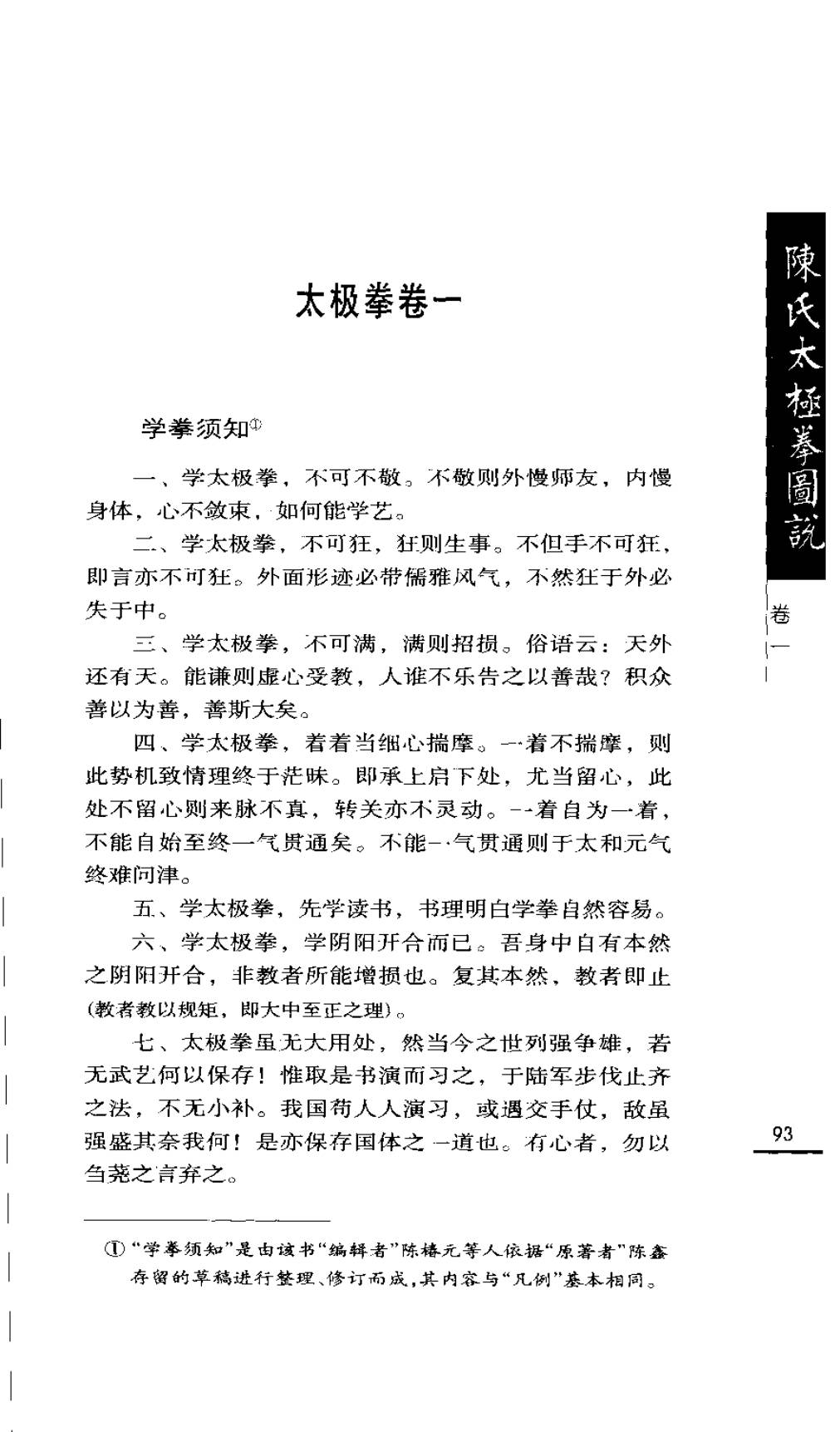
Eight: In learning Taijiquan (太極拳, Tàijíquán), one must not use it as a means for theft and robbery. If it is used for plunder, Heaven robs one of one's spirit (魄, pò), ghosts and spirits give no protection — how much less will people! Who in all the world could tolerate such a person!
Nine: In learning Taijiquan, one must not oppress or bully others with ferocity. The moment one bullies with ferocity one provokes the people's wrath — such a one is the chief of criminals.
The Thirteen Postures Divided into Sections (十三势分节)
First section: Jingang Dao Dui (金剛捣碓, "Buddha's Warrior Attendant Pounds the Mortar") — just one posture; it says that the principles of Taiji's yin and yang are all contained within it.
Second section: Lan Zha Yi (揽擦衣, "Lazily Tying the Coat"), Dan Bian (单鞭, "Single Whip"), Jingang Dao Dui — three postures in all; this is Taiji producing the Two Forms (两仪). Concluding again with Jingang Dao Dui means the intent never departs from the origin.
Third section: Bai E Liang Chi (白鵝亮翅, "White Goose Spreads Its Wings"), Lou Xi Ao Bu (搂膝拗步, "Brush Knee and Twisting Step") — two postures in all; the Two Forms produce the Four Images (四像). Bai E raises the posture, and Lou Xi Ao Bu corresponds to the positions of the four trigrams Qian, Kun, Kan and Li.
Fourth section: Chu Shou (初收, "First Closing"), Xie Xing Ao Bu (斜行拗步, "Slanting Twisting Step") — two postures in all. The Four Images produce the Eight Trigrams; the slanting walk corresponds to the four corner trigrams Dui, Zhen, Xun and Gen.
Fifth section: Zai Shou (再收, "Second Closing"), Qian Tang Ao Bu (前堂拗步, "Forward Hall Twisting Step"), Yan Shou Chui (演手捶, "Charging Fist"), Jingang Dao Dui — four postures in all. Rooting in stored essence (精, jīng), it proceeds to the issuing of essence, ending in a return to the original image of Taiji.
Sixth section: Pi Shen Chui (披身捶, "Draping-Body Fist"), Bei Zhe Kao (背折靠, "Backward Bent Lean"), Zhou Di Kan Quan (肘底看拳, "Fist Guarded Under the Elbow"), Dao Juan Gong (倒卷肱, "Reverse Roll Forearm"), Bai E Liang Chi, Lou Xi Ao Bu — six postures in all. Within them are the inverted-body method, the backward-body method, the bent-body method and the retreating method — these are all variant modes within the postures, and none is lacking.
Seventh section: Shan Tong Bei (闪通背, "Flash Through the Back"), Yan Shou Chui, Lan Zha Yi, Dan Bian — four postures in all. This is the inverted-turning body method returning to the level, even body method.
Eighth section: Zuo-You Yun Shou (左右云手, "Cloud Hands Left and Right"), Gao Tan Ma (高探马, "High Pat on the Horse"), Zuo-You Ca Jiao① (左右擦脚, "Rubbing Kicks Left and Right"), Zhong Dan Bian (中单鞭, "Middle Single Whip"), Xia Yan Shou (下演手, "Lower Charging Fist"), Er Qi Jiao (二起脚, "Double Kick"), Shou Tou Shi (兽头势, "Beast-Head Posture"), Ti Yi Jiao (踢一脚, "One Kicking Foot"), Deng Yi Gen (蹬一跟, "One Heel Press"), Yan Shou Chui, Xiao Qin Na (小擒拿, "Small Grappling Seizure"), Bao Tou Tui Shan (抱头推山, "Cover the Head and Push the Mountain"), Dan Bian — thirteen postures in all. Yun Shou is the sideways-moving method; in the rubbing kicks, the kick and heel-press both speak of foot methods; Xia Yan Shou is the crouching-body method; Er Qi Jiao is the flying-body method; Bao Tou Tui Shan is the whole-body method; Zhong Dan Bian uses hands and feet together; the kick and heel-press are two great turning body methods; Xiao Qin Na is the hidden-step method; Shou Tou Shi is the method of guarding the head, the heart and the knees. The thirteen minor postures above are for engaging a crowd of enemies — one great battle in a single breath, linked without interruption, with no gap in which to pause; therefore they are combined together as one section.
① In this book, for "Zuo Ca Jiao" and "You Ca Jiao" (left and right rubbing kicks), the discussions of boxing theory use both the character 插 (chā, "insert") and 擦 (cā, "rub"). Based on the discussions in the "Song of Long and Short Lines on the Left and Right Rubbing Kicks Combined" and the "Four-Character Verse on the Left and Right Rubbing Kicks," this edition has uniformly changed the character 插 to 擦 throughout.
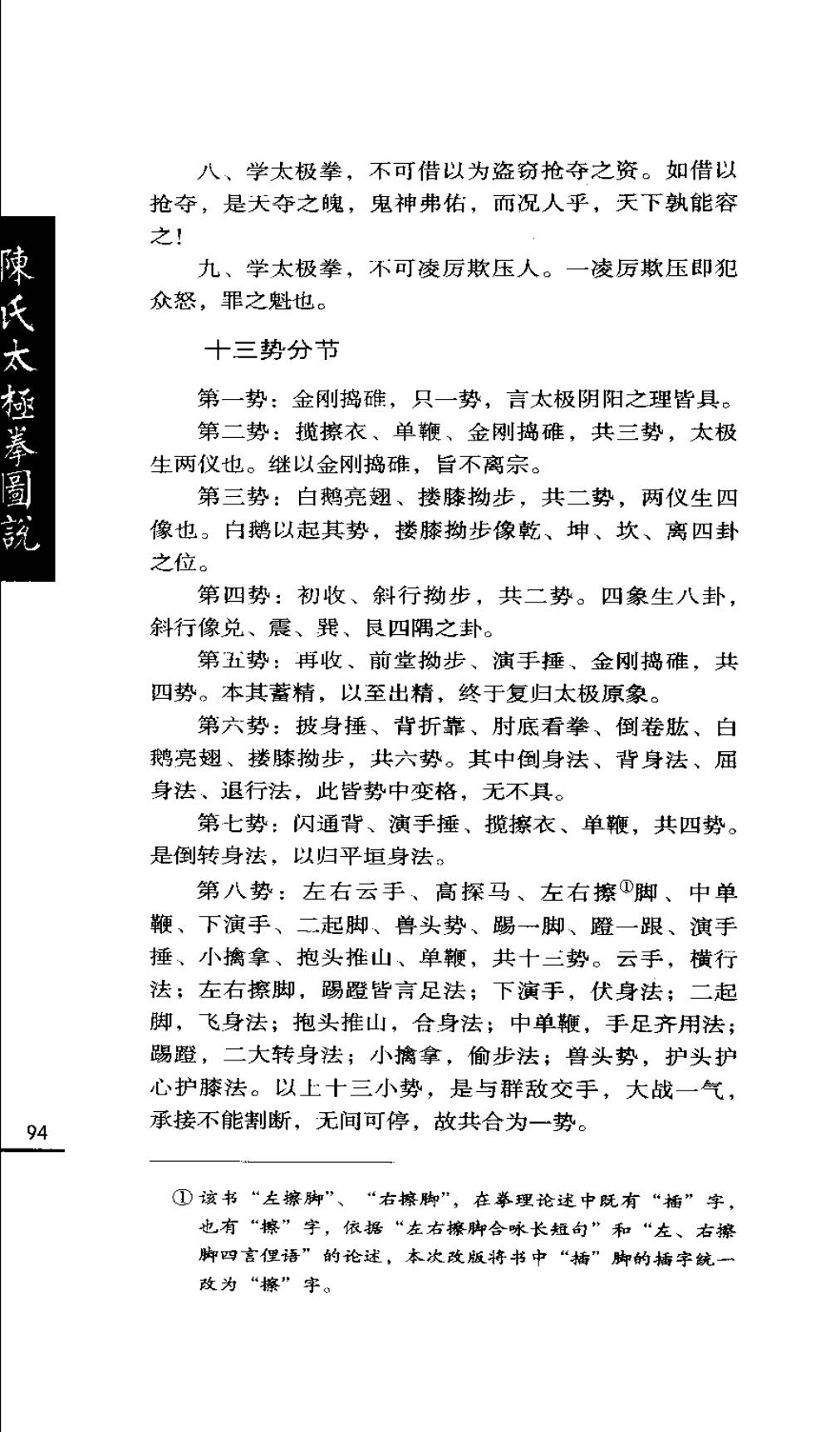
陳氏太極拳圖說 卷一 (*Chén Shì Tàijíquán Túshuō*, juàn 1)
The Posture List (Postures 9 through 13)
Posture 9: Front Zhaō (前昭)①, Rear Zhaō (后昭), Parting the Wild Horse's Mane (野马分鬃), Single Whip (单鞭), Fair Lady Works the Shuttles (玉女穿梭), Llanca Yi / Lazy-about Tying the Coat (揽擦衣), Single Whip — seven postures in all. Front and Rear Zhaō are the hand and eye methods of watching front and back; Parting the Wild Horse's Mane is the spreading body method with rapid advancing; Fair Lady Works the Shuttles is the right-turning body method and the level leaping body method; Single Whip is the method of letting the qi (气) return to the dantian (丹田), calming heart and qi. These seven postures are also methods of mutual combat.
Posture 10: Second Cloud Hands left and right (左右云手), Swing Kick (摆脚), One Hall Snake (一堂蛇), Golden Rooster Stands on One Leg (金鸡独立), Kick to the Heavens (朝天蹬), Reeling Backward (倒卷帘), White Goose Shows Its Wings (白鹅亮翅), Brush Knee and Twist Step (搂膝拗步), Flash Through the Back (闪②通背), Forearm Fist (演手捶), Lazy-about Tying the Coat, Single Whip — twelve postures in all. Swing Kick is a horizontal foot strike; the Split Fall (跌岔) is a low body method; Golden Rooster and Kick to the Heavens are high body methods, methods using the knee. The seven postures below are repetitions and need not be repeated. These twelve small postures are likewise linked by one qi (一氣), uncuttable, and so are joined as one posture.
Posture 11: Cloud Hands left and right, Gao Tan Ma / High Patting the Horse (高探马), Cross Feet (十字脚), Fist to the Crotch (指裆③捶), Azure Dragon Comes Out of the Water (青龙出水), Single Whip — six postures in all. Cross Feet are the cross leaning strike (十字靠); Fist to the Crotch is the method of subduing life (the decisive blow); Azure Dragon Out of the Water is a leaping advance of the body, needing no turn — it is also a leaping method (縱法).
Posture 12: Paved Ground Brocade (铺地锦), Step Up to the Seven Stars (上步七星), Step Down and Ride the Tiger (下步跨虎) — three postures in all. Paved Ground Brocade is the seated body method with the right leg extended; Step Up to the Seven Stars is the forward-stepping method; Step Down and Ride the Tiger is the body method of watching above and below. These three small postures form one posture.
Posture 13: Swing Kick and Bombardment to the Head (当头炮) — two postures. The Swing Kick is a reversed-turning body method, warding off above and striking below; Bombardment to the Head protects the face and the heart. Combined, the above make thirteen postures in all, beginning with the civil image (文象) and ending with the martial image (武象).
The Diagram of the Wuji Image (无极象图)
The wuji (无极) is when not a single thing yet exists. Above the Great Beginning (太初), all was vast, dim, and undifferentiated, an unbroken chaos — this is what is called the Great Chaos (大混沌). When the learner steps onto the floor to practice the quan (拳), he stands upright and respectfully, closes the eyes, rests the qi, lets both hands hang down, keeps the stance upright, and sets both feet together; the heart and mind…
[Note ①: The original edition has both 招 and 昭; following the lecture texts on Front Zhaō and Rear Zhaō ("What is front zhaō?", "What is rear zhaō?"), 招 has been uniformly changed to 昭. Note ②: The original read "闷通背", clearly a typesetting error; 闷 is corrected to 闪. Note ③: For the 裆 of "fist to the crotch" and "the crotch must be open and round", the original often used 膪 or substituted 当; this edition uniformly corrects to 裆.]
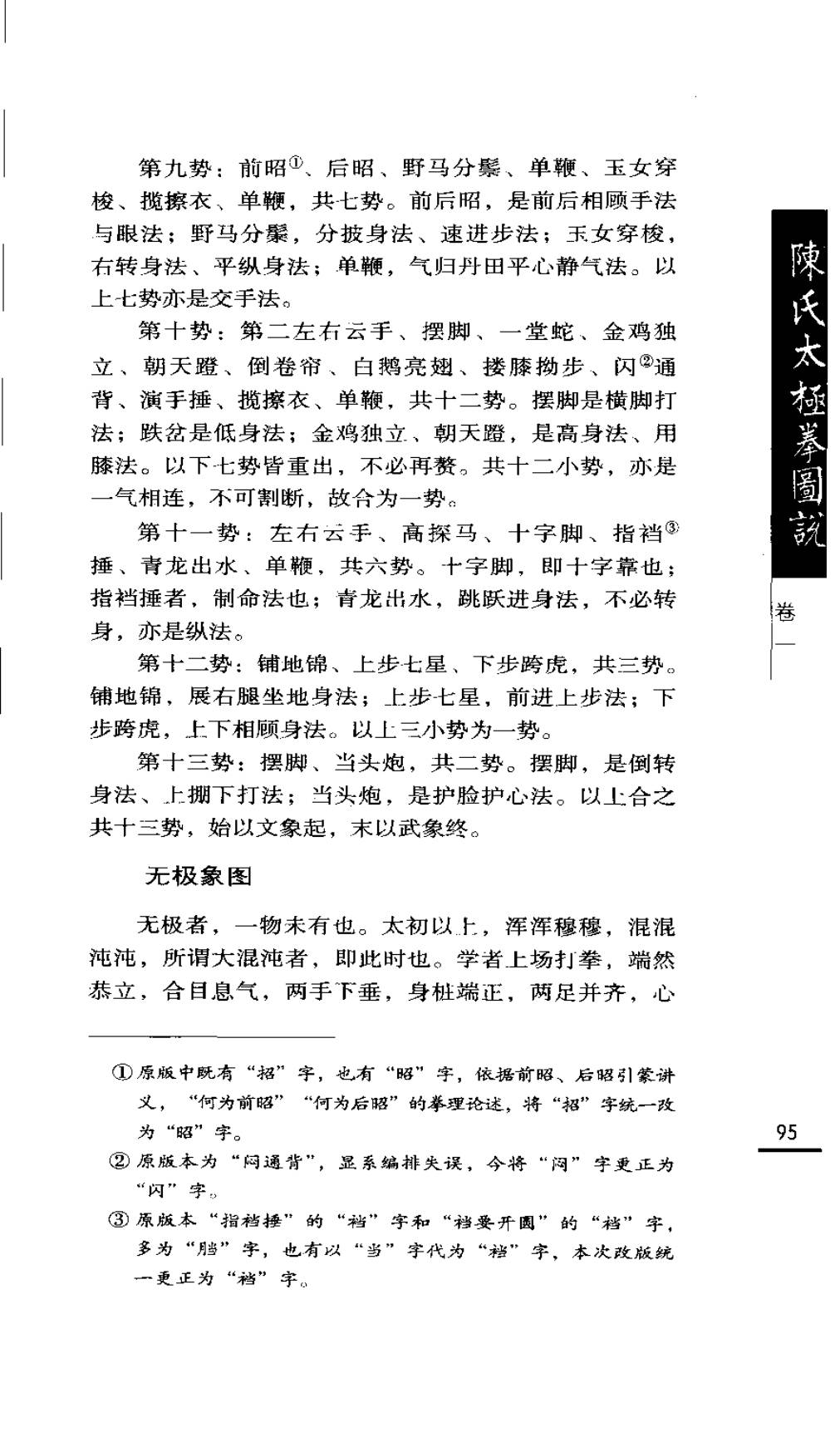
[Figure] "Form of Wuji" (无极象形, Wújí xiàngxíng): a front-facing standing figure, eyes lowered, arms hanging naturally at the sides, enclosed in a large circle; dots run down the center line of the torso, with one dot at the lower dantian (丹田, dāntián) — showing the undifferentiated, primal qi (氣, qì) before all division.
Not one thing is attached to in the center, not one thought arises; solemn and majestic (穆穆皇皇), it is wholly like the great primal chaos — the image of Wuji (无極, wújí, the Ultimate of Nothingness). Therefore its form cannot be named; it is named "the Form of Wuji."
Diagram of Taiji (太極象圖)
[Figure] A front-facing standing figure, standing still and composed, arms hanging naturally at the sides, with no circle and no markings — showing the state of Taiji (太極, tàijí) as movement is about to arise but has not yet moved.
Taiji is born from Wuji. Might one say Taiji already has form and sound? The answer: not yet. Why is it not called "Wuji" but called "Taiji"? Although Taiji has as yet no form or sound, its first signs (幾朕, jīzhèn) have already sprouted — like the kernel of a great fruit: its living momentum is about to move yet has not moved, only its vitality is not yet sufficient, and it has not emerged beyond the shell. Otherwise, from what would heaven and earth be born? After the great primal chaos, although yin and yang were not yet divided, the mechanism of their division had already stirred; once the division came, the clear qi rose to become heaven and the turbid qi sank to become earth. But at this moment the clear qi has not yet risen and the turbid qi has not yet sunk — therefore it is called Taiji. The ancients, tracing back to the mechanism of yin-yang and the Five Phases (五行, wǔxíng) before heaven and earth were born, had no name for it and called it "Taiji" — yet in essence yin, yang and the Five Phases were already complete. When the boxer steps onto the floor, although hands and feet have not yet moved, within upright and respectful composure the mechanism of yin-yang's opening and closing, the reckoning of waning and waxing, emptying and filling, already resides within the heart and belly. At this moment the will is unified, the spirit concentrated, devoted wholly to reverence (敬, jìng); yin-yang's opening and closing, the messages of waning and waxing, are simply not yet given form. Since the moment cannot be named, it too is named "Taiji." These words are to show the learner: when first stepping onto the floor, first wash the heart and cleanse the thoughts, cast off deluded notions, calm the mind and settle the qi, and await movement — only after this can one learn the quan (拳, quán, the boxing).
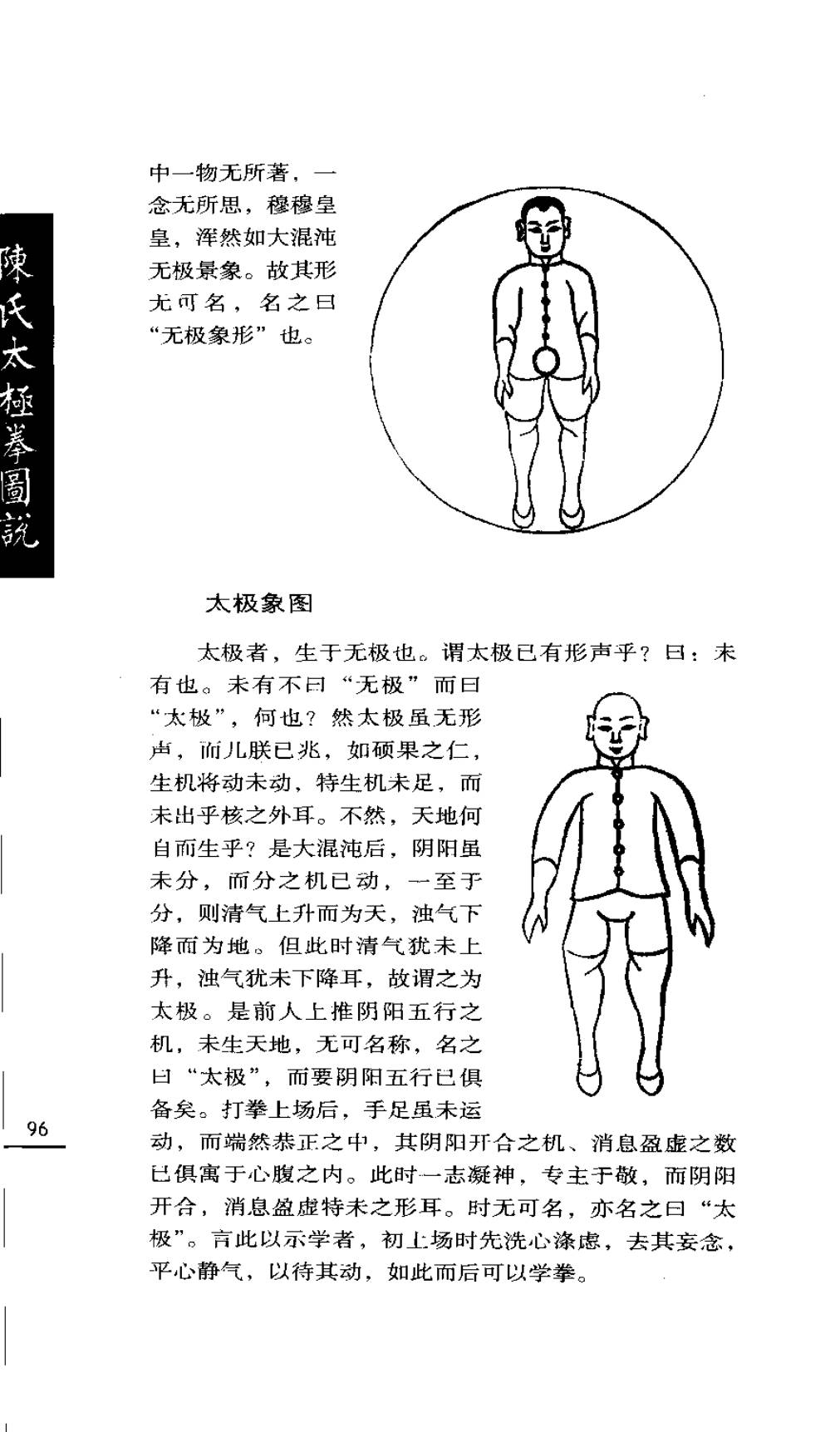
Heading
Posture One: Jīngāng dǎo duì 金剛搗碓 (the Buddha's Warrior Attendant Pounding the Pestle), also called "Protecting-the-Heart Fist" (一名護心拳, yī míng hùxīn quán)
Upper text block (instructions for the upper body)
- The left wrist faces upward (左手腕朝上), aligned vertically with the nose-tip (與鼻準上下相照, yǔ bízhǔn shàngxià xiāng zhào).
- The left elbow sinks down (左肘沉下); it must be held up lightly and attentively (須得輕輕擎住注意).
- The heart-mind values equanimity (心貴和平); when the mind is calm the qì 氣 is still, and when the mind is calm the qì is harmonious.
- The left shoulder releases downward (左肩松下); it must not ride up (不可上架).
- The eyes do not look sideways (目不旁視); looking sideways scatters the mind and confuses the will (旁視則分心亂志).
- The spirit of the whole body is tied entirely to the crown of the head (周身精神,全繫于頂); therefore when the crown-force (頂勁 dǐngjìn) is drawn up, it should be as if present and yet not present (似有似無之間).
- The ears must not listen to anything (耳不可有所聽); by not listening the mind becomes concentrated (勿聽則心專).
- The neck is upright (項端直).
- The right shoulder releases (右肩松).
- The right elbow sinks down (右肘沉下); there must not be the slightest intention of raising it (不可稍有上架意).
- The right fist falls into the left palm (右拳落左掌中), five or six inches from the chest (去胸五六寸).
Lower text block (instructions for the lower body)
- All the qì returns to the dāntián 丹田 (氣皆歸于丹田).
- The left knee is slightly bent (左膝微屈); if it is not bent, the crotch (襠 dāng) does not open.
- The left foot and the right foot stand level and even, upright and flat on the ground (左足與右足并齊,端正平立). The acupoints Púcān 僕參, Dàzhōng 大鐘, Yǐnbái 隱白, and Dàdūn 大敦 all press the ground with slight force.
- The two sides beside the scrotum are called the crotch (腎囊兩旁謂之襠); it should be round and void (貴圓貴虛), never clenched (不可夾住).
- The right knee is slightly bent; if it is not bent, the crotch does not open.
- The waist-force (腰勁 yāojìn) should sink down and be firm and solid (腰勁貴下去,貴堅實).
Diagram
A line drawing of a standing practitioner: both feet together and flat, both knees slightly bent, the left palm on top supporting the right fist held five or six inches in front of the chest and abdomen; head and neck upright, gaze forward. Thin leader lines run from the text labels to the crown, both shoulders, elbows, wrists, waist, crotch, knees, feet, and the dāntián. The figure faces north with the back to the south, right side east and left side west.
Bottom explanatory note
In ordinary practice, adapt to the ground and the situation: one need not fix a direction, but one must keep to definite positions. Yet the North Star (北辰) and the Big Dipper (北斗) are both in the north; the learner should turn his mind toward them and receive the mechanism of Heaven, for only then does the central qì 中氣 of a person have its true master (真宰). Therefore the diagrams take facing north and back to south, right as east and left as west, as the fixed standard, to show the rule.
(Book title in the margin: Chén shì Tàijí quán túshuō 卷一. Printed page number: 97.)
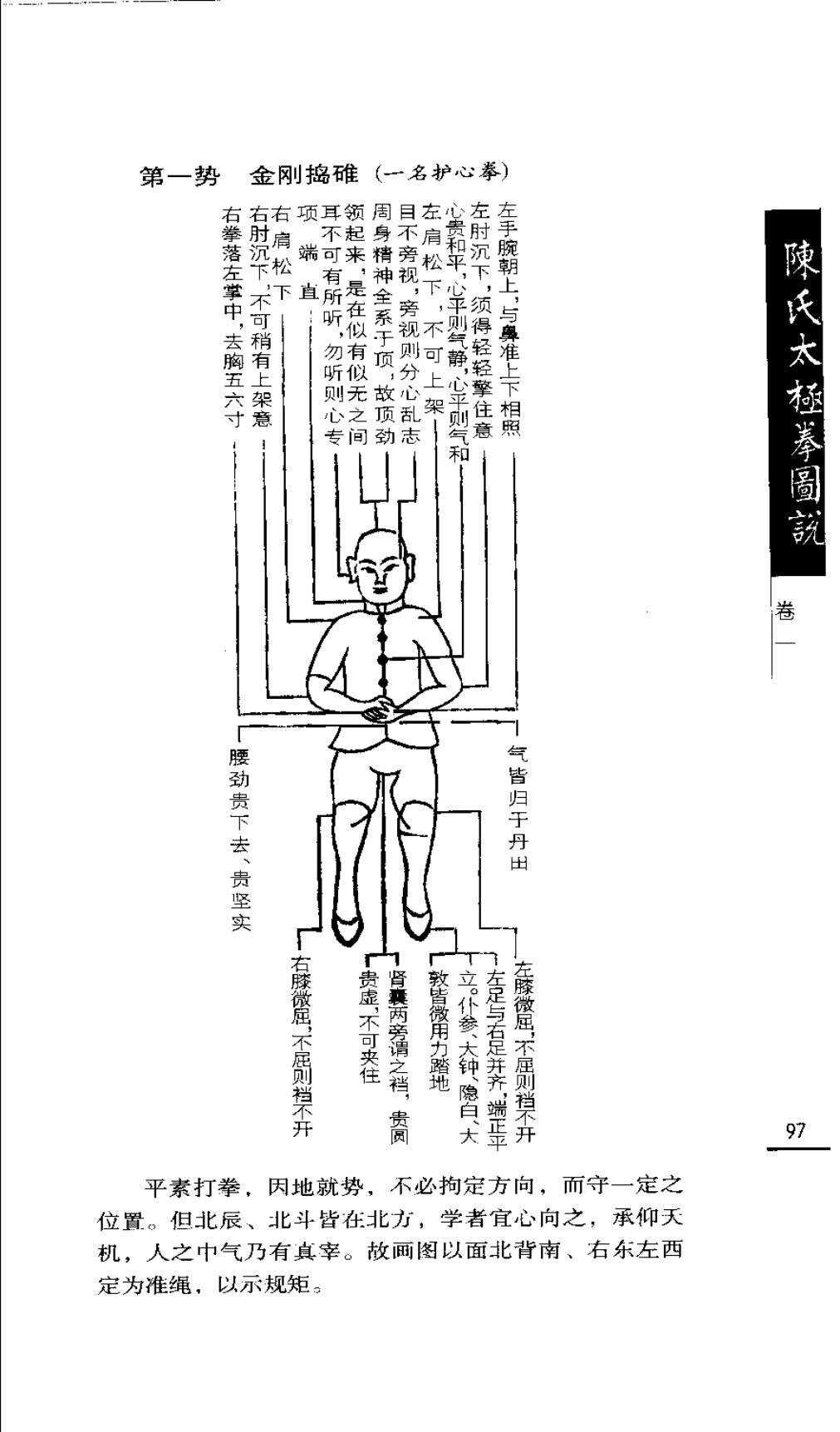
Text (English translation)
The way of Heaven is established in yīn 陰 and yáng 陽; the way of Earth is established in the yielding 柔 and the hard 剛; the way of man is established in humaneness 仁 and righteousness 義. The feet should carry themselves with weight (足容重), the hands with respectfulness (手容恭), the head with uprightness (頭容直), the eyes with gravity (目容肅); sit like an impersonator at a sacrifice (坐如尸), stand as if fasting in reverence (立如齋).
Confucius said: "Do not look at what is contrary to lǐ 禮 (propriety); do not listen to what is contrary to lǐ; do not speak what is contrary to lǐ; do not move contrary to lǐ." When practicing the form, hold to reverence (執事敬) in what you undertake, and naturally the whole circle will accord with the compass (規) and every bend with the square (矩); and all your seeing, hearing, speaking, and moving will lie within the compass and square.
Before practicing the form, the mind is calm and the qì 氣 harmonious — a complete image of Tàijí 太極. As one is about to practice, the spirit is at ease and the qì still down to hands and feet; only then, when movement begins, can restlessness be dissolved and self-importance leveled, so that one exercises the natural mechanism of Heaven (天機) within our Tàijíquán and moves with composure right at the center of lǐ propriety (every movement of the form embodies the natural articulation of Heavenly principle 天理).
The Book of Rites (禮) says: the qi of indolence and arrogance must not enter the body. Once indolence and arrogance enter, the movements must overflow beyond the compass and square, and a hundred ailments will sprout.
Lǐ propriety is grounded in reverence 敬 (jìng); music 樂 is grounded in harmony 和 (hé). Only when one can be reverent and can be harmonious can one then learn to practice Tàijíquán.
Someone objects: Tàijíquán is but one art. By your words the rules you lay down are too strict — even sages in their labors go no further; for the tail end of a single art, why must it be so? I answer: it is not so. Practicing the form is also a study of cultivating the person (修身) and guarding the nature and life-destiny 性命. Mencius said: "Without compass and square, one cannot make circles and squares."
The way of practicing the form, from beginning to end, does not go beyond the single word "reverence" 敬. With reverence one concentrates mind and will, and naturally no wild swan (distraction, as in Mencius' archery story) circles to confuse the breast. As for the laws within the form, they are each detailed below.
Diagram
Diagram of Left-Yang and Right-Yin (左陽右陰圖)
Two concentric circles, an inner and an outer ring.
This is the diagram of hand-and-foot rotation in Posture One. The left hand belongs to yáng, the inner circle: this is the circle traced by the left hand and left foot. The right hand belongs to yīn, the outer circle: this is the circle traced by the right hand and right foot. They do not turn by turns; in fact they move together at once. The left hand is slightly earlier, the right slightly later; the left hand is inside, the right outside. In the initiating of the mechanism (機), yáng is first and yīn after; in the manner of the movement, yáng is inside and yīn outside.
This diagram is like the meaning of the mingling of yīn and yáng in the ten thousand things — the functioning of yīn and yáng at one end.
(Margin: Chén shì Tàijíquán túshuō 陳氏太極拳圖說. Printed page number: 98.)
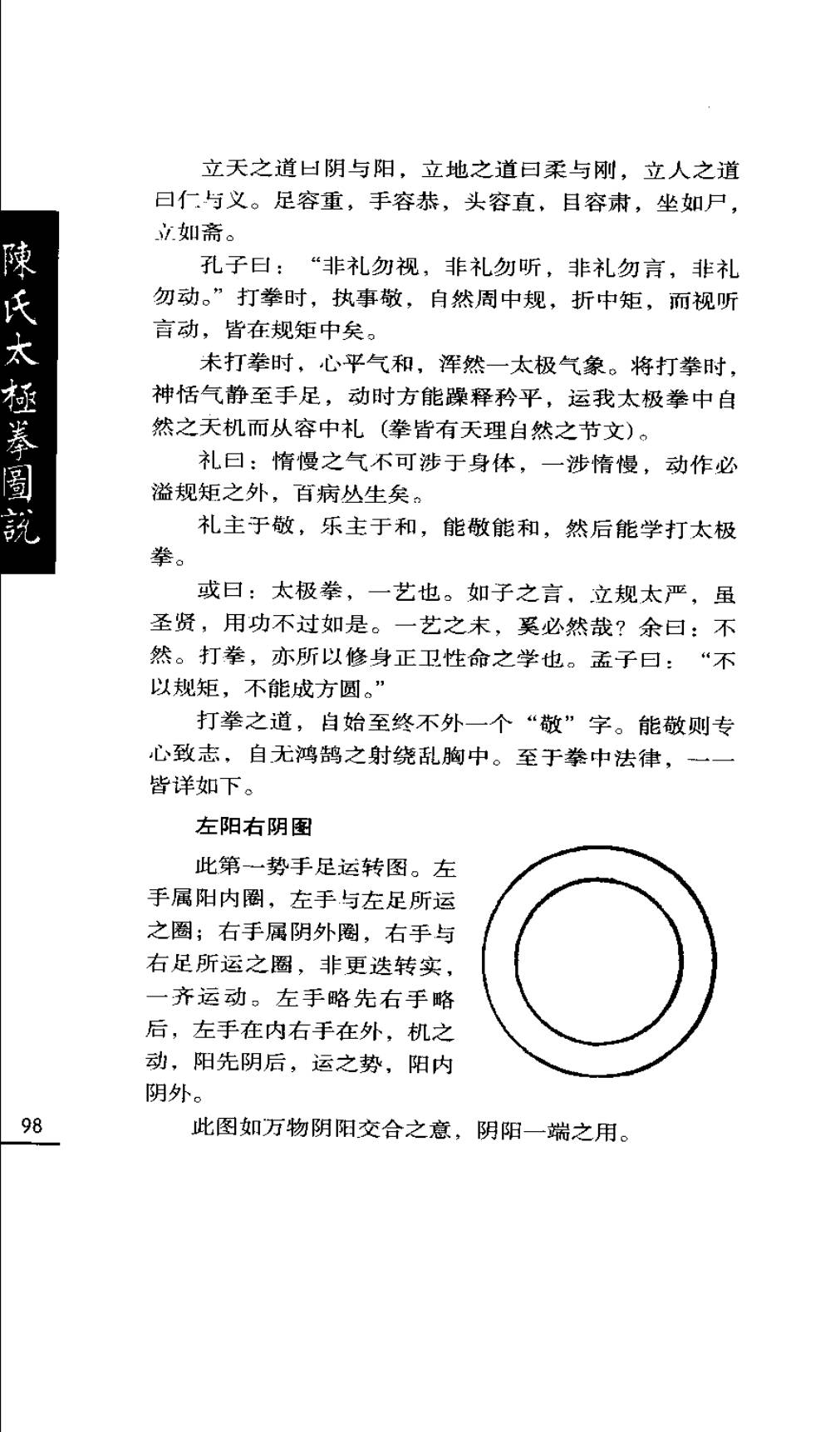
(Margin title: Chén shì Tàijíquán túshuō 陳氏太極拳圖說 卷一 — Chen-style Taijiquan Illustrated Explanation, Volume 1)
Diagram of the Movement of the Qì Mechanism (運動氣機圖, yùndòng qìjī tú)
Mencius said: the will (志 zhì) is the commander of the qì 氣; the qì is what fills the body (體之充). The heart-mind (心 xīn) is like a general (將軍), the qì is like soldiers; once the general gives the order, the officers and men all obey. The clear qì 清氣 rises and moves to the hands; the turbid qì 濁氣 descends and moves to the feet; the qì moves all the way to the fingertips before it stops. The qì's rising and its descending seem like two separate segments, but in fact it is one qì threading through everything.
Diagram labels
- 心 (heart-mind; above it: 傳令 — transmits the order)
- 將軍 (general)
- 意 (intention, yì)
- 丹田 (dāntián)
- 會陰 (huìyīn, perineum)
- 清氣 (clear qì, rising to the hands)
- 左手 / 右手 (left hand / right hand, rising 上升)
- 濁氣 (turbid qì, descending to the feet)
- 左足 / 右足 (left foot / right foot, descending 下降)
- 全體之氣歸宿處 (the place where the qì of the whole body returns to lodge)
- 如兵馬屯處 (like the encampment of soldiers and horses)
The figure is a schematic human form: at the center a circle labeled 心 (heart) with 意 and 丹田 below it and 會陰 beneath that; curved lines rise from the center to the two hands (labeled 清氣, 上升) and descend to the two feet (labeled 濁氣, 下降), the feet marked as the lodging-place of the whole body's qì.
Diagram of the Silk-Reeling Force of Hands and Feet (手足纏絲勁圖, shǒuzú chánsī jìn tú)
Where the qì mechanism travels inside the upper arm (肱), it is all silk-reeling force (纏絲勁 chánsī jìn); in speaking of the hands the feet are already included.
Diagram labels
- 橫骨 (hénggǔ, the horizontal/pubic bone; pelvis)
- 尖襠圖 (diagram of the pointed vs. rounded crotch), with the note: 此是襠,貴圓,最忌尖 — "this is the crotch: value roundness, most avoid a point"
- (一)手背 (back of the hand)
- (二)手面 (palm side of the hand)
The left figure shows a leg/pelvis outline illustrating the rounded crotch; the right figure shows the arm and hand with the two coiling directions.
Bottom explanatory text
(1) In this shape the internal force (內勁 nèijìn) goes from the shoulder and arm out to the fingernails.
(2) In this shape the internal force goes from the finger-pads back in to the armpit and shoulder. The first diagram is outgoing force (出勁); the second diagram is incoming force (入勁).
(1) The force of the arm issues from the heart, moves to the shoulder, passes the elbow and reaches the fingers — this is the forward-coiling method (順纏法 shùn chán fǎ). From bone to skin and flesh, from shoulder to fingers: this is the issuing of essence (出精).
(2) From fingers to shoulder is the reverse-coiling method (倒纏法 dào chán fǎ). What is called the incoming of essence (入精) means drawing the opponent in, making him come near to me.
The force of both legs is led by the toes, coiling upward past the ankle, past the knee, to the thigh.
(Printed page number: 99.)
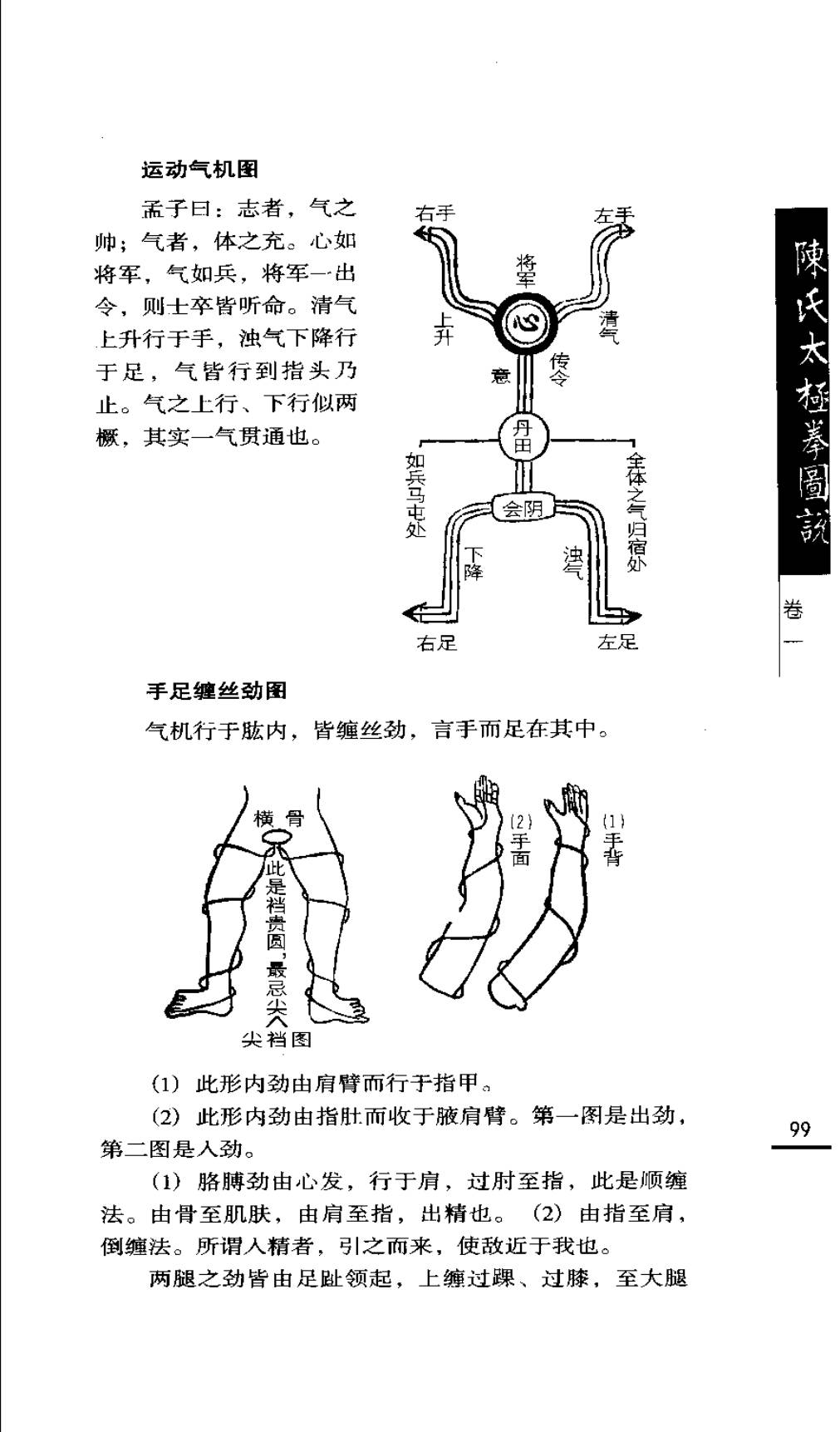
Chen Family Taijiquan Illustrated (陳氏太極拳圖說)
The root. The space between the roots of the two legs is called the kua (襠), that is, the huiyin point (會陰穴, huiyin xue). Move the heel of the foot, pressing the ground gradually reaching the toes — Tonggu (通谷), Dazhong (大鐘), Waifei (外腓) as well as Yinbai (隱白), Dadun (大敦), Lidui (厲兌) — firmly and solidly planted on the ground.
What is "Jin'gang Pounds the Pestle" (金剛搗碓, Jīn'gāng dǎoduì)? Jin'gang is the name of a deity. The "steel" (gang 鋼) is like refined gold, a hundred times smelted, hard and harder still; what the deity's hand holds is the demon-subduing pestle (降魔杵). "Pounding the pestle" (搗碓) is like grain in a mortar, pounded with a pestle. The right hand holds the fist like the demon-subduing pestle, the left hand is slightly bent like the mortar; this takes both its hardened heaviness and the fact that the two hands are gathered in one place to protect the heart — hence the name.
In practicing the form, the nose is the central dividing line: the left hand governs the left half of the body, the right hand the right half, and each foot moves following its own hand. The heart-mind and body must not force the qi (不可使氣); move gently and lightly, the hand leading the elbow, the elbow leading the arm. The qi in the hand merely leads up the hand and arm, no more; if it goes beyond, it becomes hard. When the upper body's hands move in a certain way, the lower body follows; upper and lower follow each other, and the middle naturally follows along with them — this is "one qi threading through" (一氣貫通, yī qì guàn tōng). When stepping onto the floor, one must stand upright and correct, the two hands hanging down, the two knees slightly bent; the kua jin (襠勁, kua energy) must be open and must be empty; only when the kua is open can the heart-qi then be aroused. First let the left hand lead up the left foot and step forward; then let the right hand lead up the right foot, the right hand from below circling a full turn upward around the outside of the left hand, the two hands interlocking like a turning ring for one circle; the right hand lands in the palm of the left hand, level with the heart, and together they halt. The right hand and right foot are all emptily, lightly enveloped (虛虛笼住); the left hand and left foot are all firmly, solidly planted on the ground, like earth settling into the earth. The Baihui point (百會穴, bǎihuì xué) leads the whole body: one must make the clear qi rise and the turbid qi descend. How does the clear qi rise? Only with a calm mind and stilled breath. The turbid qi must descend to the feet. Once a posture is complete, the clear qi of the upper body is all returned to the dantian (丹田, dāntián), for once the heart-qi sinks down, the qi of the entire body without exception sinks with it.
In Taijiquan, from beginning to end, this alone is the posture of the upright body (正身法): correct yet solemn, solid yet empty, soft yet hard; above, below, and on all four sides, whatever the opponent attempts, it is sufficient to respond to it — this is why it leads the multitude and stands at their head. The principle is real, the qi is empty; it revolves roundly and freely, vast and flowing, utterly without any mechanism of stagnation. Each time a posture completes, it returns again to the undivided atmosphere of a single Taiji (渾然一太極气象), with no trace to be found, no thread-end to be pointed at. Outwardly it seems to stop, yet within there is no interruption — this is why Taiji is Taiji.
The roots of the two thighs must open. The opening of the kua does not depend on size: even a breadth as slight as a single thread counts as open. For once the heart-intent opens, the kua opens at once. Those who cannot open the kua may spread their legs three feet wide and it is still not open. This lies in the student's careful discernment.
The way of practicing the form is nothing other than a circle. Circles may be straight or slanted, left or right, slow or fast, yin or yang, visible or invisible — all because of the posture presently being moved, cycling without end. For man receives the qi of yin and yang to be born; this body of ours is itself the body of Taiji. That the formless Taiji governs the visible Taiji, everyone knows. But to take the visible Taiji and make it carry out our formless Taiji, and instead to force and contrive it, not letting it be natural of its own accord — why is this? It is because one only knows to refine the qi, and does not know natural movement and rest. Furthermore —
*Translator's note: Pure text page, no diagram. Content: opening the kua (襠, the huiyin point), the meaning of the posture Jin'gang Pounds the Pestle (金剛搗碓, Jīn'gāng dǎoduì), the principle of "one qi threading through" (一氣貫通), opening the hips by intent rather than posture, and the fist way being only a circle.*
Chen Family Taijiquan Illustrated — Volume One
Like a man's eyes: open by day, closed by night — one opening, one closing, all the natural opening and closing of Taiji. In the form, one rise and one fall, one closing and one opening — how are these not all drawn from Taiji? People merely practice without perceiving it.
How could practicing the form not use qi? Without qi, how would the whole body move? But it uses the qi that is supremely great and supremely hard (至大至剛), nourishing it straight and without harm (以直養無害). People of the world do not know this and all consider it a soft art. They little realize that since one began training, through a thousand hammerings and a hundred refinings, hardness returns to softness and softness arrives again at hardness; the hard and the soft leave no visible trace. Viewed only from the outside, it appears soft, and so it is named soft — but is that really so? Moreover, "soft" is only spoken of in contrast to "hard." This art can be called neither soft nor hard; it can only be named Taiji. Taiji means that hardness and softness are both fully attained yet blended without trace. Its effort is abundant, therefore its achievement is certain. One must simply "be ever about it, but do not force it — do not forget it, do not help it grow" (勿忘,勿助長), and then one gains it.
From the first posture to the last, what is diagrammed is the visible form (有形之拳). Only by passing from the visible to the invisible, when the heart's mechanism enters the subtle, returning at last to no-mind (无心), may one then speak of the fist art. One can see that the fist art lies in my heart; when the heavenly mechanism in my heart flows, alive and brimming, then every place one touches is the fist — not like those in the world who take the fist to be merely the fist. This is an art that a whole lifetime cannot exhaust. It is not knowing that is hard; it is doing that is hard. The postures diagrammed are all the natural mechanism within Taiji. Qi and principle (理, lǐ): qi without principle has nothing to carry it; principle without qi has nothing to move it. Qi does not leave principle; principle does not leave qi. Principle and qi are one and yet two, two and yet one; their thousand changes and ten thousand transformations interweave without limit, so that a lifetime of practice cannot exhaust them. Let the student strive.
The heart is the master of the whole body; the kidneys are the source of life and nature (性命之原). One must purify the heart and lessen desires, cultivating the ground of the root, never letting it be harmed. When the root is firm, the branches and leaves flourish, and all things can be done — this is of utmost importance.
General Discussion (總論)
Pure yin without yang is a soft hand; pure yang without yin is a hard hand. One yin and nine yang is a root-end stick; two yin and eight yang is scattered-hand; three yin and seven yang still feels hard; four yin and six yang clearly shows a good hand. Only with five yin joined to five yang, yin and yang without bias, is one called a marvelous hand (妙手). The marvelous hand — every single move is a Taiji; emptily, its traces transform and return to nothingness.
For each posture of the form, often several thousand words cannot exhaust its subtlety; yet once it is demonstrated in person, it feels easy. What is difficult is the gongfu (工夫); what is especially difficult is long, sustained gongfu. The proverb says: "Do the form ten thousand times, and the spirit-principle appears of itself" (拳打万遍,神理自现). Truly so!
Taking the Image (取象)
The posture Jin'gang Pounds the Pestle (金剛搗碓) — yin and yang united in virtue; within the chest is a reservoir of the Great Harmony primal qi (太和元气), pervading the four limbs, supremely soft and supremely hard, truly possessing the virtues of Qian and Kun in their smoothness. When it is still —
*Translator's note: Pure text page, no diagram. Contains the discussion of hard–soft (concluding: Taiji is hardness and softness both fully attained yet blended without trace), the qi–principle relation, and the "General Discussion" verse (五陰五陽 — five yin and five yang makes the marvelous hand), together with the opening of the "Taking the Image" (取象) section on the posture Jin'gang Pounds the Pestle (金剛搗碓, Jīn gāng dǎo duì).*
What yin and yang store has no trace to be sought; when they move, they seem utterly soft yet are in fact utterly hard, seem utterly hard yet are in fact utterly soft — hardness and softness both complete. This is called yin and yang uniting in virtue (阴阳合德, yīnyáng hé dé), hence it draws on the trigrams qian and kun (乾坤).
Jingang Daodui 金刚捣碓 (Buddha's Warrior Attendant Pounding the Pestle)
First: Jingang Daodui gathers in the spirit (already concealing stillness without movement, the intent of the whole body as one undivided whole); above, below and on all four sides bending and stretching are harbored. Transformation without fixed method while still unlaunched (speaking of opening-closing, seizing-releasing); the undivided taiji is complete though there is no (fixed) body.
Second: A whole life free of affairs nourishing great harmony (太和, tàihé); brocade flowers in clustered abundance (a metaphor for the liveliness and interest of the quan). The Jingang of heaven carries a jade pestle, skilled at subduing the great demons of the human world.
Third: If it were not the Jingang's demon-subduing pestle, what demon or sprite would dare be stopped? Great opening and great closing return to tracelessness; only the beautiful, the great, the sage, the divine may be granted.
Fourth: Outwardly protecting the sovereign, inwardly protecting oneself — all depends on the true spirit of taiji. Having tasted through all the sweetness and bitterness herein, one is worthy to be called an unmatched person of today.
Fifth: First left then right is nothing remarkable; one movement, one stillness — it is a game of weiqi. When the surrounding play reaches where mountains end and waters are exhausted, suddenly one posture decides victor and vanquished.
Baihui 百会 (GV20, at the crown of the head), Yinbai 隐白 (SP1, at the big toe), Dadun 大敦 (LR1, at the second toe), Lidui 厉兑 (ST45, at the third toe), Qiaoyin 窍阴 (GB44, at the fourth toe), Zhiyin 至阴 (BL67, at the little toe), Tonggu 通谷, Dazhong 大钟 (both at the heel — all eight are acupoint names).
Chen Family Taijiquan Illustrated — Volume One
Second Posture: Grasp the Robe (揽擦衣, Lǎn cā yī)
The whole body joins its jin (合住劲) at once, and every joint and part of the body answers and joins with every other, as hand with foot, for instance. Each posture has its own host and guest (賓主): in this posture the right hand and right foot are the host, the left hand and left foot the guest. Every move rests wholly on the heart and chest. Using the heart-mind too much errs into constraint; not using it errs into slackness. It lies between having-mind and having-no-mind; only by governing everything with reverence (敬) can one attain the middle way and move the jin appropriately in every case.
The buttock bone turns up; the front kua joins closed, and the rear buttock naturally turns up.
The waist is the pivotal hinge of the greater body: it must be neither soft nor hard; striking the mean between them is what works.
The rear elbow forms the inner circle; its tip joins slightly forward with the left elbow.
The jin must not run counter; the spirit and expression must join — that is what works.
The shoulders press down and must not flip upward.
The neck stands vertical and must not tilt.
The top jin rises; the intention is like pushing through the sky with the crown — but do not use qi to excess.
The eyes fix on the middle finger of the front hand. It is the middle finger that serves [as the target], so one must look at it and must not glance aside, which would scatter and leave one without anchor. A man's whole body is used entirely through one heart, and the transmission of spirit resides wholly in the eyes; hence one must gather the spirit and fix the gaze. In this posture the right hand is host and the left hand guest; since the right hand initiates, the eye must look at it. The eye follows, pointing rightward as it travels; when the right hand halts, the gaze beforehand must fix on the middle fingernail of the right hand, and the pads of the five fingers must have their settling. At this moment the hand's movement — the hand seems stopped, yet the nimble qi of movement within it truly does not stop; if it stops, its breath is extinguished and it is cut off from the next posture. This is just like the ceaseless revolving of heaven's and earth's yin and yang: the qi grows ever more full the farther it goes, and when it has moved to the point of complete fullness, the next posture then issues forth. This is the meaning of "at yang's extreme, yin is born; at yin's extreme, yang is born" (陽極陰生、陰極陽生).
Notes around the diagram (one diagram):
The front hand first circles one full turn from the right ribs, moving around from the outside, extending until nine-tenths open and stopping. In between, the arm seems straight yet is not straight, seems bent yet is not bent; it rises and falls together with the rear hand, the middle finger being primary, joining its jin together with the rear hand.
The palm faces sideways.
The elbow tip sinks down, turning slightly outward one or two fen, bending slightly to join its jin with the rear elbow.
The chest relaxes open. When the chest relaxes, the whole body is at ease; there must be neither deliberate intent nor absent intent.
From Huagai (華蓋, huàgài point) to Shimen (石門, shímén point) must be empty — emptyly held, not letting crosswise qi lie crosswise in the chest.
The right knee joins its jin with the left knee; the waist bone joins together with the rear leg; the front leg is like a prop, the rear leg like a push.
This joining differs greatly from before; thus the stance holds its position steady.
Neither a T-stance nor an eight-stance ("ding bu ding, ba bu ba" — neither one thing nor the other), yet the rear toes should point slightly inward.
The feet are about one and a half chi apart.
The heels press firmly on the ground.
The five toes of each foot press with force to grip the ground.
As for this, the upper body sways [unclear].
The bend of the left leg must not go soft.
Labels on the diagram: 腰 (yāo — waist), 石门 (Shímén — the Shimen point), 膝 (xī — knee), 腰骨 (waist/hip bone), 腿骨 (leg bone), 裆要圆,圆则稳 (the kua must be round; round, then stable).
*Translator's note: Second page of the posture Grasp the Robe (揽擦衣, Lǎn cā yī) — the second posture. One diagram of a bow-stance, with meticulous notes on host–guest (right hand and foot are host, left is guest), shoulder, elbow, waist, crown, and the eyes fixed on the middle finger of the front hand.*
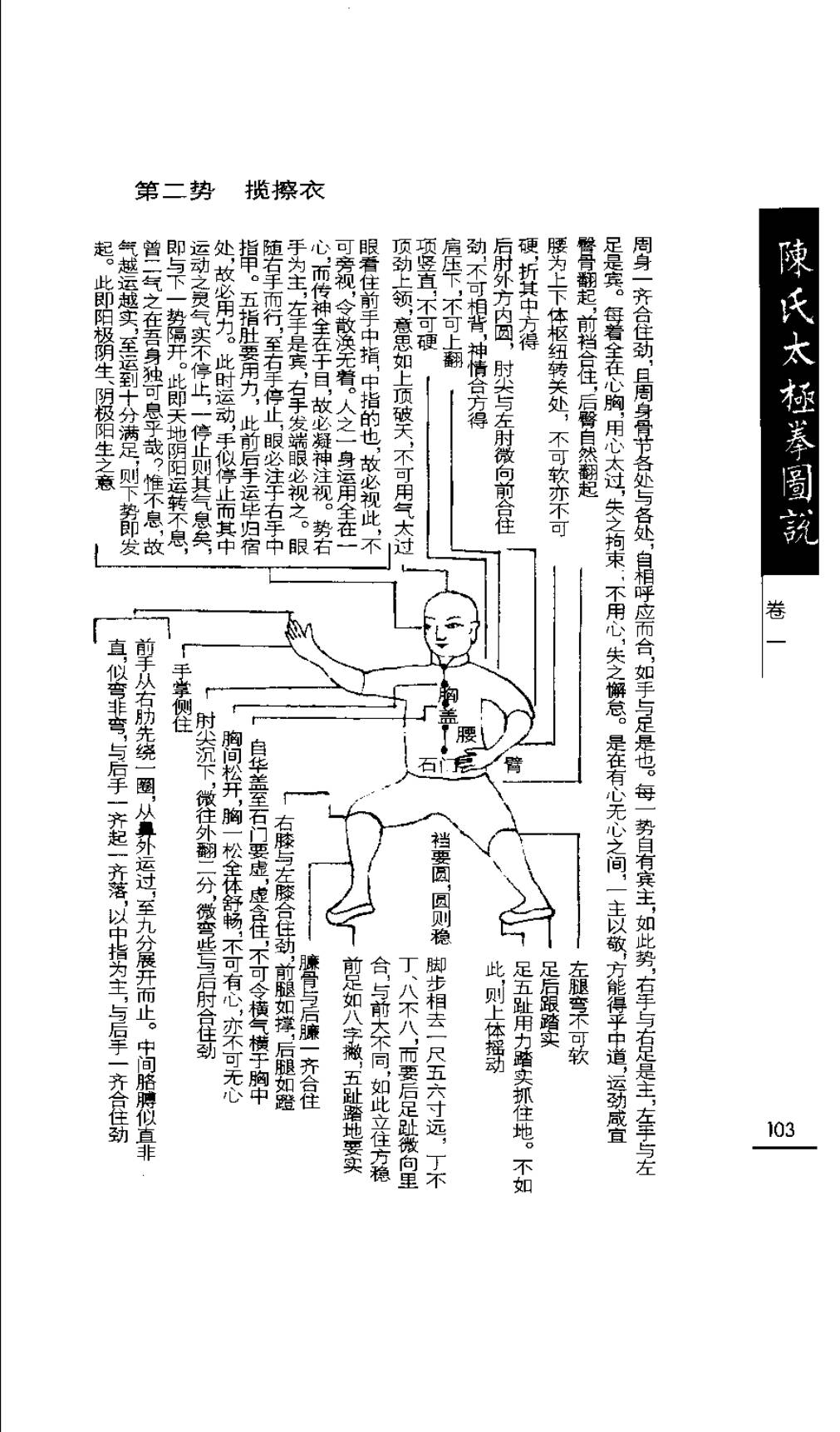
Diagram of the internal strength (neijin) as it travels from start to finish through Lan-Ca-Yi
This diagram is described with the practitioner facing north.
The left hand is in the west; as the right hand first begins to move, the left hand follows it. It first turns a small circle, then turns a large circle from below upward, sinks down to the left ribs and forks/holds at the waist. Most people use the right hand from childhood and use the left hand little, so the left hand is somewhat clumsier than the right. In practicing the quan, one should pay attention so that both hands move together and turn circles together; only then can the qi be gathered and settled.
In the middle it seems bent, like the shape of a new moon, winding with silk-reeling jin (chan sijin) outside the bones, between muscle and skin. The right hand uses the same method as the left; the right hand, right foot and left hand move in three places, while the left foot alone does not move.
The shoulder sinks down, the elbow tip presses forward to join, the back of the hand faces upward, the four fingers are in front of the ribs, the thumb behind the ribs.
Diagram labels (upper diagram — movement path)
- "At this point it moves forward, i.e., the east"
- Shoulder
- Turn
- "The left hand moves downward"
- Waist
- "The left hand arrives here"
- "Held fast here"
- Turn
- "The right hand sends out (forward)"
- "The left hand returns"
- Turn
- "The right hand returns"
Diagram labels (lower diagram — right-hand internal strength)
- "This is the diagram of the right hand's completed internal strength"
- Right shoulder / Right hand
- "Shoulder and upper arm join the force inward"
- "Start of the right foot" / "Stopping point of the right foot"
- North / South / Inner / Outer
- "The bend of the elbow faces north, the arm bent slightly three or four fen; do not let it scatter. The elbow tip faces south; the four fingers of the right hand gather the force inward, near in echo with the right shoulder, far in echo with the left hand. The internal strength seems to stop yet does not stop, led by the central (qi)."
Main text
What is Lan-Ca-Yi (揽擦衣, "Gathering and Brushing the Robe")? Lan means to gather as with the hand grasping a thing; ca means to brush close against; yi means the upper garment. The form is like gathering a thing with the left hand, close against the clothes. It means the left hand forks and holds at the waist, the elbow slightly joins forward, the thumb and the four fingers behind it spread apart, the hand slants down from the upper wrist, with the intention of pressing downward, the palm turned back, forking and holding at the waist. The left hand belongs to yang, while the bent elbow seems yin — this is called "yin concealing yang" (yin zhong cang yang, 阴中藏阳). The right hand, from the upper wrist, goes from above to the right, downward and around to the left in one circle, then upward, then slowly sends out to the right — the slower the better, no higher than the nose, no lower… (continues on next page).
(Page: 104)
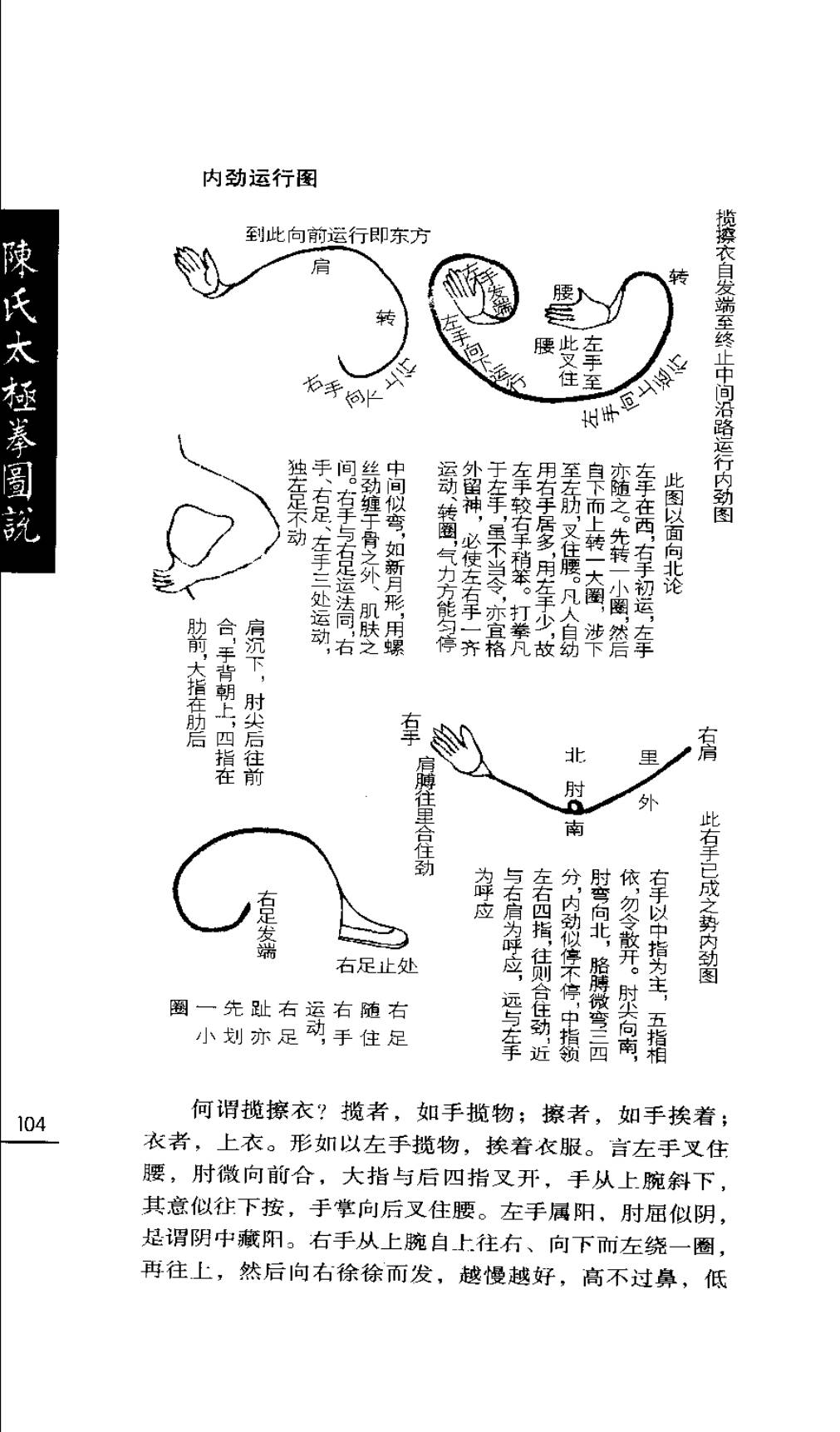
(Continuing from the previous page) …no higher than the shoulder; the hand travels to nine-tenths and stops. The internal strength (neijin) goes neither forward nor back but travels along the center: if it falls behind it splits apart, if it rushes ahead it collapses — both miss the center. The strength is governed by the middle finger: when the strength of the middle finger arrives, the strength of all the other fingers arrives too. It all issues from the heart/mind, passes the breasts and crosses the armpit, enters the bone within the shoulder and upper arm, and from the bone marrow fills the muscles and skin, moving slowly along. When the strength has traveled to the pads of the fingers, then hand matches hand, elbow matches elbow, shoulder matches shoulder, knee matches knee, foot matches foot. When we speak of matching, both halves of the body, above and below, match together all at once; meanwhile the crotch strength in the middle opens open, and yet must also be held in the match. Thus the closing strength (he jin) resides within the opening strength (kai jin); it is not that opening is merely opening and closing merely closing, as though opening and closing were two separate strengths.
When the right hand moves, the right foot sweeps a circle, moving together with the right hand, starting and stopping together. As the right hand is about to halt, the heel of the right foot lands first, then from the instep to the five toes touch down in sequence, placed in a figure-eight stance (ba zi shi). Speaking of the two feet: the right foot in front is the host — the host within the guest; the left foot behind is the guest — the guest within the host, because the right foot remains behind as the left foot's stationary guardian. The right foot is empty (xu), the left foot full (shi): this is "empty in front, full behind" (qian xu hou shi). Speaking of a single foot, it too is empty in front and full behind. The toes and ball of the foot must claw the ground, while the Yongquan (涌泉, "Gushing Spring," sole point) must be empty; if it is not empty the toes will not grip the ground and strength cannot be applied — this is "full at front and rear, empty in the middle." The leg strength rises from the big toe, spirals inward from the outer ankle, travels diagonally upward past the Sanli point (三里), crosses the knee and passes the Xuehai point (血海, "Sea of Blood") up to the thigh root. The winding method of the left leg's internal strength is the same; both legs' strength winds upward together to the Huiyin point (會陰, "Meeting of Yin," the point between the two yin organs) and stops at the central seam between them. The two strengths meeting head-on is their settling point; here is where the leg strength comes home to roost. The waist strength descends slightly, down to the thigh root; spread open the crotch and the strength naturally becomes round. The waist must be empty — once it is empty, above and below are both agile.
Arms and thighs must all use silk-reeling winding strength (chan sijin); never go straight out and straight back — straightness lacks the sense of winding continuity and bending turns. Without that sense of continuity, not only do bending and extending lack force; even when crossing hands with an opponent one cannot adapt to circumstances and excel in turning and spiraling. If the pivot turns sluggishly, one is a notch behind in awareness — how then to gain victory? Even if hard force could beat someone, the other is unconvinced in his heart.
The diagram above has already been drawn and described most fully; but if the learner does not practice, nothing happens — as soon as he practices, his mind forgets it. Therefore I do not shrink from drawing it again and using many words to make it plain, wishing him to silently remember and understand in his heart, keeping it in mind without lapse. Winding from the shoulder outward to the middle fingernail is advancing strength (jinxing jin); winding from the middle finger across the back of the hand inward back to the shoulder is drawing strength (yin jin), drawing from far to near. At the initial issue use advancing strength; when gathering inward use retreating strength. In the lower body the leg strength runs from the toes to the thigh root, advancing and retreating both through the foot. Where its ascent differs from the arm's is a matter of one's own practice — certainly unalterable. Likewise, in crossing hands with an enemy: when the enemy comes to invade, first draw him in, then advance — this too is certainly unalterable. Remember: the right hand stops only after traveling nine-tenths, and the spirit-energy then fills to the full ten-tenths — this point is the hardest to put into form (continues on next page).
(Page: 105)
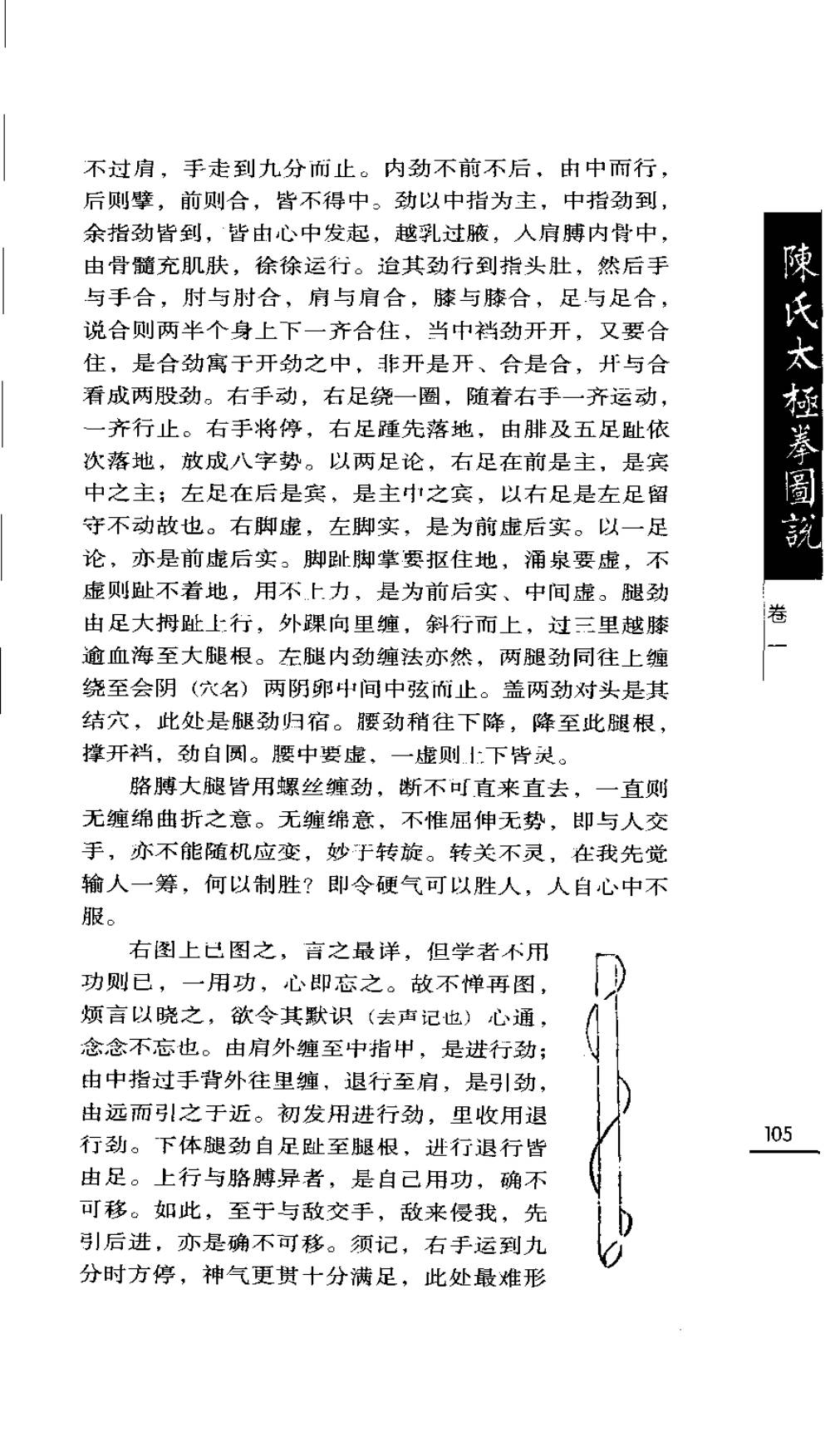
Chen Family Taijiquan Illustrated (page 106, Volume One, no diagram)
...capacity (容). From start to finish the movement must run slowly; slow as you can, keep it slow — slow to the fullness of ten-tenths gongfu, and you will be nimble to ten-tenths. Only when the nimbleness reaches the full ten-tenths of ripeness can the opponent fail to keep up with me, and will instead find my art strange — such is ordinary human feeling. Little do they know this is the effect of the work of "first the difficult" (先難之功). Again: the whole body is first slanted, then upright — slanted outside, upright within. The slant is its shape; the upright is its essence. With the central qi (中氣, zhōngqì) of the heart moving through the four limbs — this is a place others do not see and I alone know; one must constantly apprehend it spiritually, and with time it becomes clear of itself. When the hands and feet move, they must be gathered, not scattered: gathered, the spirit collects and congeals; scattered, the spirit disperses and grows sluggish. In short, the sense-organs and frame all take orders from the heart; once the heart is reverent and careful, the hands and feet naturally move according to the method.
The shoulders must press down, the elbows must sink down; the right hand leads the left hand, forked at the waist, the arms bent — this is this move's most essential configuration. The gaze of the eyes follows the right hand's movement: in this move the right hand gives the commands, so the eyes follow only the right hand; when the right hand arrives at its place, the gaze fixes at once on the right hand's fingernail; this middle finger is the standard the eyes look at. The bone seam of the shoulder must open. At first it will not open; do not force it open. If the gongfu has not arrived, when it seems to open and you think it has opened, in truth it has not; only after bitter, long-attacked practice will it open naturally — only then does it count as open. Once this place opens, all the arm's coming and going, bending and stretching, like wind blowing willows, with heaven's mechanism stirring, alive and brimming without any stagnating gear — all depends on this. This is the pivot of the arm's nimbleness; one must not fail to know it.
The right hand is level with the shoulder: not too low, not too high. If low, the central qi has difficulty moving through, perhaps failing to arrive; if high, the raised arm is without strength. In all cases, hitting the mean is prized. The top jin leads up (頂精 — the leading is the central qi of the heart lifting like something drawn up). Where does the top jin reside? At the Baihui point (百會穴, bǎihuì xué). Its intention need only lead slightly — "leading" means leading the spirit of the whole body so that it is neither biased nor leaning — and that suffices; it must not go too far, for then one is stretched and suspended above and stands unsteadily. This is the key point of the whole body, that through which the central qi passes; one must not fail to know it. The central qi connects above to the Baihui and below to the twenty-first vertebra. Once this place connects, above and below all connect; the body's whole qi-channels and bones connect, and there is naturally no defect of toppling or leaning. The two sinews behind the head are the aides of the central qi; the sinew-less space between those two sinews is the road along which the central qi circulates up and down. It descends through the middle of the spine, stopping at the twenty-first vertebra. Even the front-and-back Ren and Du mai (任督二脈, Rèn/Dū èrmài) are all aids to my central qi. The central qi is hardest to name, and even the road along which it travels is hardest to name. It is formless and soundless; without long gongfu one cannot know it. Thus "neither biased nor leaning" does not refer to bodily traces; it means the spirit naturally attaining the center. Even the central qi moved within the four limbs is merely a side-flow of this same central qi — there is not another central qi besides. When this place does not lean, the central qi in the four limbs all does not lean either. Though the shapes of the four limbs may take many leaning postures, the central qi flowing within the limbs is naturally unbiased. This meaning can only be apprehended spiritually and then understood. The neck must stand upright and correct, like a pillar in midstream (中流砥柱), neither forward nor back, neither left nor right, so as not to topple — then this posture is achieved. In the right hand's movement, the right is primary, because it responds to the opponent rightward. The right hand belongs to yin; what moves in it is yang within yin; and that by which it moves is that which governs it. The left hand makes a fist and bends; the left foot does not move; the turn...
*Translator's note: Page 106, Volume One, no diagram. Discusses slowness producing nimbleness, slanted-outside/upright-inside body method, opening the shoulder seam, the top jin at the Baihui point, the central qi's route from Baihui down the spine, the Ren/Du mai as aides to the central qi, and the upright neck. The text breaks off mid-sentence at the page's end.*
Chen Shi Taiji Quan Tushuo (陳氏太極拳圖說), Juan 1 (Volume 1)
Continued from previous page: ...to the right hand, which is the guest (賓), yet in truth it is the master within the guest, serving as the foundation that guards the whole body. The left hand belongs to Yang; its manner of movement resembles the yin within yang, and the reason it can be yin-within-yang is that there is something that governs it. In terms of principle, Yin and Yang take each other as their root and cannot be split into two severed halves. Consider the right arm: the right half of the body is all yin, and its internal jin (勁, intrinsic force) coils outward from the shoulder to the fingernails, then coils from the fingernails back inward. Yin and Yang appear to be two forces, but in fact they rise and fall simultaneously — this shows the marvel of Yin and Yang interbeing as mutual roots. How is this seen? When facing an opponent, if the opponent's hand comes in, I use my hand to draw it in; drawing and striking happen at once, not drawing first and striking afterward — this proves the reality of Yin and Yang as each other's root.
The way of quan (拳, the fist/boxing) is endless advance and retreat, with shen-qi (神氣, spirit and energy) threading through without the slightest interruption. I have seen people practicing quan: before the previous posture is finished they want to stop. Once they stop, the qi is broken and the spirit scattered. Or if not that, before this posture is finished they want to strike the next one; and by the time they strike it it is still unfinished, and they already want the one after that. With such an impatient mind, how can one carefully ponder and understand the rising and falling of the internal jin and the fullness of spirit? Those in a hurry always suffer this fault, and so they never succeed. In practicing quan, one must not only deeply ponder the principles within each posture: even the end of the previous posture and the beginning of the next — the place where bones join and mortise fits (接骨斗筍) — is the "transitional vein" (過脈). At the transitional vein one must consider how to keep the blood-vessels continuous so no gap arises. At the end of the previous posture, one must wait until shen-qi is completely full before it can be concluded. When concluding the previous posture, its form is complete and the surplus spirit flows beyond the boundary — this means the trigger of the next posture has already stirred at the end of the previous one, and then the next posture arises joined to the previous one: this is the "joint" (構). The joint means the mortise of the next posture connects and fuses with the mortise of the previous one. Not only must they be joined in form (勢); one should first join them in spirit. When the shen-qi has no gap with the previous posture, that is skillful beginning. As the saying goes, "in gaining the stance, contend for the incoming vein" (得勢爭來脈); once the incoming vein gains the stance, what follows is like splitting bamboo — no part fails to gain the stance. This is the most crucial point. The reason the above has been repeated three or four times, and rambled without stopping, is fear that the reader has not grasped its meaning.
Specially Marked: The Left Hand's Reverse Rotation (特標左手倒轉)
In the left hand's rotating circles — as in Lansao Yi (攬擦衣, Lǎn Zā Yī / Llam Tσα Yı, "Lazy Tying the Coat"), Lou Xi Ao Bu (摟膝拗步, Brush Knee and Twist Step), Chu Shou (初收, First Withdrawal), Zai Shou (再收, Second Withdrawal), Pishen Chui (披身捶, Wrap-body Fist), Zhou Di Kan Quan (肘底看拳, Watch the Fist Beneath the Elbow), Zhi Dang Chui (指襠捶, Fist to the Crotch), and Xia Bu Kua Hu (下步跨虎, Step Down and Straddle the Tiger) — all are methods of the reverse-rotating circle (倒轉圈). However, in Chu Shou, Zai Shou, and Zhou Di Kan Quan the left hand is near the top, so rotating the circle is somewhat easier; in Lansao Yi the left hand sits at the middle, level with Jiuwei (鳩尾, the sternum point) at the middle of the left ribs, so its rotation is rather difficult; in Zhi Dang Chui the rotation is very slight; in Xia Bu Kua Hu, the left hand's rotation is the same as in Lansao Yi. All the above are executed with the essence of chansijin (纏絲精, coiling-silk force), and being reverse circles they are difficult — though it is the same hand. The right hand's reverse rotation is very easy, which is why the left hand's reverse rotation is specially marked. As for the left hand turning rightward, one naturally finds it easy and there is no need to repeat it; study closely the earlier scattered diagrams and it will be self-evident.
Taking the Image (取象)
Take Lansao Yi as a posture: Yang on the left, yin on the right; Yang bends, yin extends; there is inner yang and outer...
Chen Shi Taiji Quan Tushuo (陳氏太極拳圖說)
Continued from previous page: ...yin; inner strength with outer compliance (內健而外順) — therefore it takes the image from Tai (泰, the hexagram "Peace"): this is the image of the right hand. As for the left hand: first draw a small circle; then the left hand goes from above downward, to the left, upward and to the right, and down to the waist, bending like a circle — square outside and round inside — the hand propping at the waist, with the image of "the hidden dragon does not act" (潛龍勿用, from hexagram Qian 乾). Judging by the image formed from the left hand's own position, it is a still image. When stillness reaches its extreme it must move: this is the natural principle. Thus the left hand already conceals the trigger of "return after seven days" (七日來復, from hexagram Fu 復). The right foot moves with the right hand; the left foot does not move, in order to secure the root.
Four-Character Folk Verse (四言俚語)
One yin, one yang; the images of the law shine clear.
That which bends is yin; that which extends is yang.
Yin and yang in fivefold function — the Way of Heaven is stored therein.
When motion and stillness are without bias, that is your strength.
Seven-Character Folk Verse (七言俚語)
People of the world do not understand Lansao Yi (攬擦衣, "Lazy Tying the Coat"):
left bends, right extends, shaking the tiger's majesty.
Who knows the bending stored within the extending?
Rare are those who perceive the extending hidden within the bending.
The crotch divides and stands like the Sword Pavilion (劍閣 — taking its roundness);
the central peak above the head is like the Xuanji (璇璣 — a metaphor for zhongqi (中氣), central energy).
A thousand changes and ten thousand transformations move at my command;
the two feet of the lower body fix the foundation.
Chen Shi Taiji Quan Tushuo (陳氏太極拳圖說), Volume 1
Third Posture: Dan Bian (第三勢 單鞭, "Single Whip")
Diagram: A single male figure in traditional woodcut line style, facing the reader, wearing a short buttoned jacket and loose trousers. The left arm extends up and outward, open palm facing outward at roughly head height; the right arm extends sideways with the fingers pinched together into the hook hand, wrist bent. Wide stance: left leg bent forward with knee over the foot; right leg straighter and extended, foot pointing north and hooked slightly northwest. The only label written on the body itself is 胸 ("chest"); all other annotations attach by leader lines to the eyes, neck, shoulders, elbows, hands, hips, knees, and feet.
Diagram annotations (translated):
1. The finger-pads exert strength.
2. The left hand's joints must not be limp.
3. The inner elbow is like a new moon, like a drawn bow — slightly bent.
4. The eyes fix on the left hand's middle finger. Ding jin (頂勁, crown energy) is led upward.
5. The neck stands erect.
6. Front and rear shoulders sink down; they must not be hunched up.
7. The right hand's joints must not be limp.
8. All the right fingers pinch together, gathered to one point; the front half spreads, the rear fingers bundle — this is the rear hand.
9. The left hand, in exhalation, must pair with the right hand.
10. The palm's outer front edge exerts force.
11. The rear of the palm and the thumb exert force.
12. The crosswise qi of chest and diaphragm should be discharged down to the soles of the feet; if that is not possible, it should at least be discharged to the dantian (丹田).
13. The right hand must respond and pair with the left hand.
14. Chest (label on torso).
15. The space between the arms forms a crescent shape.
16. The buttock bones tuck up slightly; the lower belly closes over the crotch, and then the Huantiao (環跳, hip) points rise naturally.
17. The front knee braces across; the front knee shows five or six tenths.
18. The left foot's five toes must grip the ground with force, the big toe especially.
19. The left foot is slightly more empty than the right foot.
20. The rear heel touches down first, gradually moving forward onto the left toes.
21. The crotch-step opens round, all closing inward — naturally mutual in attendance.
22. The right knee shows two or three tenths; it must not be limp, and must also brace.
23. The right foot points north, hooked slightly northwest.
24. Sink into the Yongquan (湧泉, "Bubbling Spring," sole point).
25. The great heel presses firmly on the ground, stable and secure.
26. The right foot must be solid — this is called "front empty, rear solid" (前虛後實).
27. The two great thighs wrap and close from the outside inward.
Bottom commentary:
Ding jin and zhongqi (中氣, central qi) are a stream of upright qi. The mind's intention leads it up, and it immediately travels to the crown of the head — the central qi is naturally led upward thereby. Nothing physical lifts it: it is purely the intention that does so.
In practicing quan (拳), the heart is the master. The spine is the pivot of the body's left and right; the waist is the pivot of the body's upper and lower. Above the waist the qi travels upward; below the waist it travels downward — like two opposing pulls, yet in truth one qi threads through, moving in parallel without conflict. Let the left hand lead the left foot and the right hand lead the right foot; however the hands move above, so the feet move below. Rising, they rise together; landing, they land together. Upper and lower follow each other, naturally in rhythm.
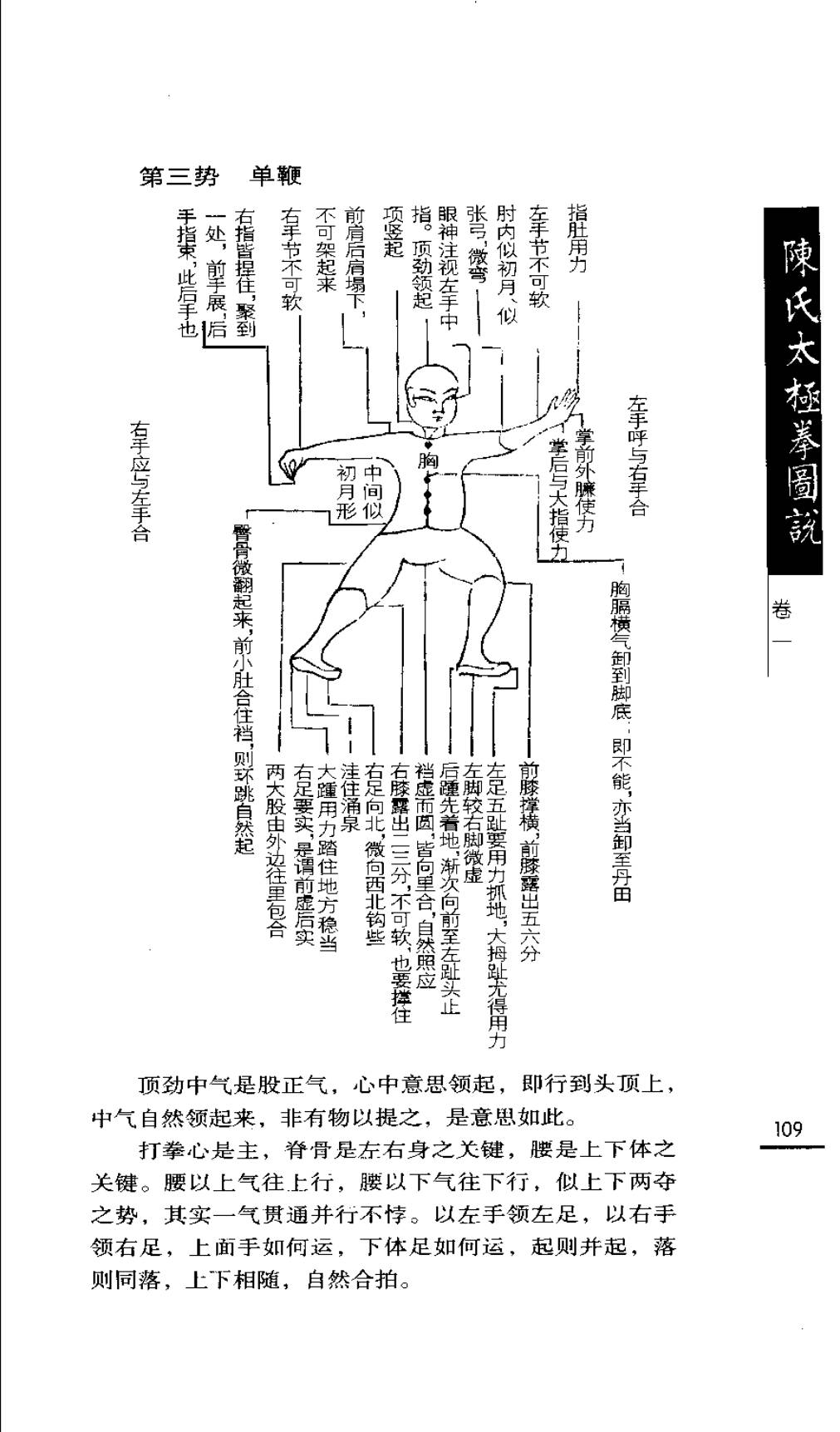
Chen Shi Taiji Quan Tushuo (陳氏太極拳圖說)
The skillful use of the hand lies wholly in the palm; the fingers lead the movement of the whole body, and the feet following the hands is especially crucial. The zhongqi (中氣, central energy) must travel slowly through the middle of the arm; do not rush or neglect it, but follow what is natural of itself. Then move according to what is natural, letting nothing lean to one side, and let the heart's qi travel through the middle of the two arms — this is the central qi. The back of the left hand faces north by one or two parts (fen 分), the back of the right hand faces north by four or five parts; when the central qi travels to the fingers, ten-tenths complete, all close together at once.
In ordinary practice of quan (拳) one need not rigidly fix the facing, but a fixed standard is drawn for the diagrams: the Northern Dipper is in the north, governing heaven's transformations, so north is taken as the primary orientation. Thus all the diagrams take facing north as the standard — right is east, left is west, facing north, back to south — thereby fixing the directions.
Diagram 1 (hand-movement diagram): a drawing of circles and lines tracing the hands' paths, labeled: the hand rises (手起); the arm relaxes and extends (舒肱); going down toward the west (下西行); left circle (左圈); turning with (以轉); left hand (左手); stopping together (並住); opening out (展開); the left hand's fingers (左手指); the left hand leaves the waist and travels upward (左手離腰上行); closing together (合住); small circle (小圈); first turns one (先轉一); this is not yet moving (此是未運行); the right hand moves (右手運); movement only like (行只如); the right hand stops (右手止); this is the arm's jin (此是胳膊勁); circle, turning fully one (圈,轉夠一); the back slightly forward (背微向前).
Text between diagrams: This diagram follows the one above in facing north; it is drawn with the right hand as primary. This is the left and right pairing together — the transitional vein (過脈) between the end of the previous posture and the beginning of the next.
Diagram 2 (upper-body movement diagram): labels: left shoulder (左肩); left hand spreads (左手展); left hand stops (左手止); this is the left hand's movement diagram (此左手運行圖); the left arm bends at the elbow and pairs with the right arm (左肱以肱彎與右肱合); in the middle the chest and belly join (中間有胸腹合); from the Tiantu point (天突穴, at the throat hollow) to the navel (臍); below, at Yinjiao (陰交), the qi...; ...Hai (海), Shimen (石門), Guan (關) [acupoint names along the midline of the abdomen]; like the form of bowing (如鞠躬形); this is called gou (鞲), holding-contained (含住); the chest is called contained (胸,謂含住); contained, the jin must be empty (勁要虛); the right arm reversed (右肱反); its back posture pairs with the left hand (背勢與左手相合); the line inside the circle is the right hand's point of departure (圈內線即右手發端); the right hand's departure first turns a small circle, the right hand gathers (右手發端先轉一小圈,右手束).
Text below diagram 2: This diagram is still drawn facing north, so left and right are as above.
Diagram of the Legs' Coiling Jin (足纏絲勁圖)
The great thigh coils from the foot up to the thigh root; its jin coils from the outside inward, coiling to the root of the leg; the two legs' jin brace against each other head-on, held fast like a gourd (瓠住), without using hard qi; the two knees close inward, and the five toes of the foot all point...
Diagram 3: Diagram of the Left and Right Thighs' Method of Joining (左右股合法圖) — a line drawing of the legs and knees in stance, labeled left knee (左膝) and right knee (右膝).
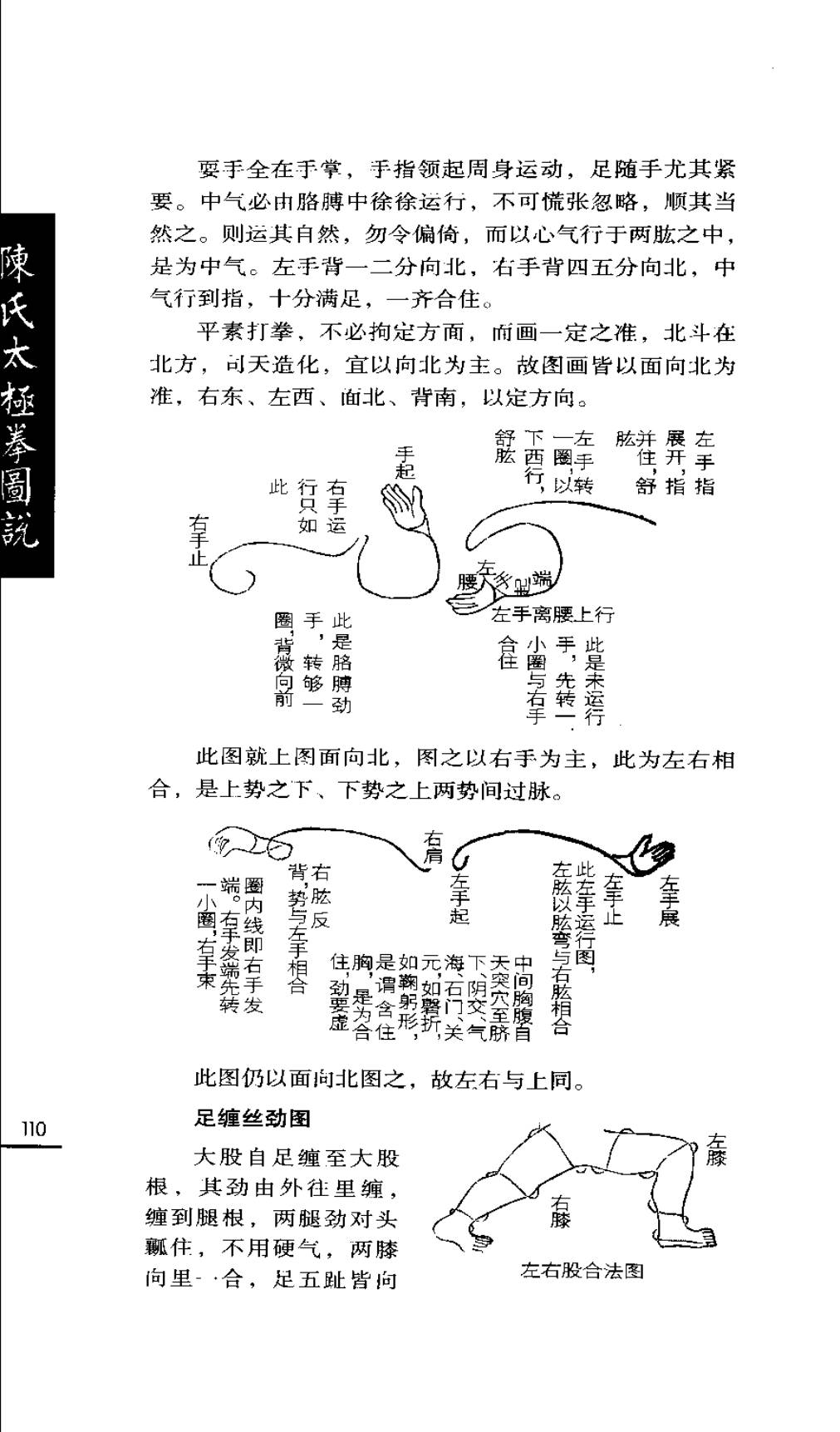
Chen Family Taijiquan Illustrated — Volume One (page 111, no diagram)
...joins inward; the legs above and below naturally join closed, and the kua opening (裆口) is of itself round.
The method of the feet's movement: the left foot first comes to the right foot's side, the toes touching down, then steps out toward the west; the two feet are about one and a half chi apart.
The method of twisting the heel: as in Single Whip (單鞭), the left foot first withdraws to the right foot's side, the toes touching the ground, then travels out toward the west — this need not be repeated. As for the right foot: in Grasp the Robe (揽擦衣) its five toes originally press the ground pointing northeast; when the left foot opens a step to the west, at the landing the toes point northwest. At the moment just before landing, the right foot does not leave the ground: the heel, pointing northeast, twists on the ground slightly toward north, northwest, and west — because it inclines toward the western side of north, hence the phrase. The right toes and the left toes come down together, pressing onto the ground. The left foot likewise lands heel first, gradually reaching the toes, joining its jin with the right foot, so that nothing scatters.
Question: What is Single Whip (單鞭, Dān biān)? Answer: The two hands are not in front of or behind the chest, but on the left and right of the ribs. The two arms spread open — the posture seems singly weak, yet its force is like the venom of a whip; and with the two arms spread it is again like a single whip, hence the name. In this posture the left hand is primary: the left hand rises level with the navel and turns a small circle from outside to inside; the right hand, from back to front, also turns a small circle; left and right join closed together, the spirit and qi answering each other like two people talking face to face. Then the left hand leads up from where they joined; the left half of the body turns from below to above toward the west, gradually traveling west until eight or nine tenths, and then stops. While the hand has not yet spread and not yet stopped, the gaze of the eyes follows the left hand; when the left hand stops, the gaze fixes on the middle finger of the left hand, without glancing sideways. As for the central qi's chansijin (缠法, coiling method) and Grasp the Robe: when the right arm joins with the kua, the left foot on the left first draws in to the right foot's side, the toes touching the ground, setting the position in advance for the lower foot's movement. When the movement begins, the left foot travels west together with the left hand; as the left hand above is about to stop, the left heel lands first, advancing step by step until the movement reaches the left great toe, stopping together with the left hand (the shape seems stopped, but the spirit is not stopped). Thus the left half of the body, above and below, follows along; the left foot extends according to the size of each person, in general within no more than two chi. As for the right hand when it joins: the right hand first turns one circle; as the left hand rises and issues, traveling west, the right wrist is behind, and the right hand turns again one circle (轉, pronounced shàng tone) from back to front, the arm slowly taking the reversed-back posture (反背勢). It is not like the left hand's spreading open with the flow: the moving hand not only reverses the arm's jin backward, but travels slightly eastward, and the back of the hand must again close forward. The right hand travels east while the left hand travels west — seemingly a posture of two divide, but in truth it lodges the spirit of two joining. The reason the hand takes the reversed-back form is that it plants a hidden thread (伏脈) for the next move. As for the right hand's five fingers being gathered and not spread: this is for fear that someone behind might suddenly seize the fingers and bend the joints backward; the eyes look to the front and cannot attend to the rear, so gathering them guards against this harm. The arm's coiling jin (缠劲) coils from back to front, ending at the right fingertips. Though the right foot does not move, it watches the right hand's movement and twists in front accordingly, the toes pointing northeast. Now...
*Translator's note: Page 111, no diagram. Covers the footwork and heel-twisting method connecting Grasp the Robe (揽擦衣) to Single Whip (單鞭, Dān biān), the question-and-answer on the name "Single Whip," the left hand as primary, the gaze following the middle finger, and the reversed-back right hand with gathered fingers guarding against a rear grab. The text breaks off mid-sentence at the page's end.*
*Chen Shi Taijiquan Tu Shuo* (陳氏太極拳圖說, Illustrated Explanation of Chen Family Taijiquan)
Then as soon as the right hand moves, the right heel touches the ground, and the toes twist and settle pointing northwest (it says "northwest" because there is more north in it and less west); in this way the upper and lower of the right half of the body follow one another. In explaining the method for others, one cannot avoid analyzing it point by point, but one must not view the body as split into five fragments; when it comes to joining, the whole body must lock together as one — that is best. As for the joints of the whole body, such as the left and right elbows, left and right shoulders, and all places above and below, those with the same names each lock in place in the same way; no need to repeat this. If anything is unclear, look at the diagram and it will be self-evident; afterwards, imitate this body method, always keeping it upright, never leaning to one side. The joints are relaxed and open, the arms as if hanging from the shoulders; the movement seems soft but is actually hard, the spirit is stored within and not revealed — this is the highest level.
A boxer takes personal practice (躬行, gongxing) as primary; but it is difficult at first, and one must not expect quick gain. If idle thoughts fill the chest, the art of quan (拳) cannot advance. When skill is achieved, however the enemy comes, so you respond — without waiting for thought, there is naturally a method. At the moment of crossing hands, who knows from where the enemy comes! Who knows where the enemy will strike me! But wherever he relies on, use that very place (this is the "local scenery" [of the moment] — the hardest thing of all) — draw him in and strike; the timing always fits, and it is marvelously beyond comprehension — truly attained without thinking, hitting the mark without trying. But one who has not yet achieved this cannot do it. Ask: when may one be considered accomplished? Answer: the levels within this are more than a lifetime can exhaust; speaking only roughly of the present stage, great accomplishment takes nine years, small accomplishment seven. As for refinement and subtlety, it is learning that a lifetime cannot exhaust. Students who study one or two years, or three or four, stop after a shallow taste; they remain outsiders, never having tasted the flavor! Those who harbor a mind set on quick gain, I know, will never find the ford — for they cannot advance steadily step by step, just as one cannot make squares and circles without compass and square. In learning, perseverance is precious; personal practice is the hard part.
Seven-character verse on Dan Bian (單鞭, Single Whip)
Dan bian — this posture is the most powerful; a long snake in a single line, moving between west and east. Strike the head and the tail moves, spirit threading through; strike the tail and the head moves, the channels open. Strike the middle and both head and tail move; above, below, and the four sides lock like a drawn bow. If you ask the true secret within (that is, the guiding thread), you must seek it in the joints of the spine and back.
Verse of mixed long and short lines
An unmatched whip under heaven — strike in, unhurried. The enemy, seeing my left hand at my waist and my elbow bent, takes advantage of my unpreparedness, invades the western frontier, and insolently flaunts his strength. How could he know that when my bowstring is released, what is bent must extend — I strike him so that he has nowhere to hide, and instead meets disaster. It is no other extraordinary method, but relying on the whole body's empty nimbleness (空灵, kongling), a single thread of central qi (中气) rising with the momentum. No matter how he comes (this is what my long cultivation has prepared), seeking victory he meets defeat, not knowing his own measure (this speaks of the enemy coming to strike) — openly displaying his strengths and weaknesses before me. This is what is called "yin concealing yang" (bent is yin; the extended arm is yang).
The image taken by Dan Bian (單鞭取象)
In practicing quan, if the mind attaches to nothing at all, it is clearest; the chest contains everything…
*Chen Shi Taijiquan Tu Shuo* (陳氏太極拳圖說), Volume 1
Outside it is empty and open; within, refined and yielding outwardly — this has the image of the trigram Li (離) with its emptiness in the middle. The qi (气) returns to the dantian (丹田); the principle is solid, the qi empty; empty above, solid below — the image of Kan (坎), fullness in the middle. The four limbs are extended and open; the central qi (中气) circulates to full satisfaction, the momentum abundant — the image of Taiji. When the qi is full it is hard to shift, change is not easy — the image of Pi (否, stagnation). Yet the accomplished hand deals with it without anxiety: this is the great man dwelling in stagnation yet prospering. The second line changes and becomes Kan — the central qi is stored within; the fifth line changes and becomes Li — the empty nimbleness is contained within. Nourishing the firm central qi with the empty, nimble mind, what harm even in stagnation! This is what is called "in times of hardship, walk through hardship." Not greedy to strike people; respond as things come — hence the image of stagnation at rest. Possessing these four virtues, the art of quan (拳) is complete!
Lan ca yi (攬擦衣, Lazily Pulling the Robe) and Dan bian (單鞭, Single Whip) are the Two Polarities (兩儀). When the two polarities interact, the Four Images arise. From Taiji arises these two polarities; from then on generation is inexhaustible, the myriad images in their profusion cannot all be given shape — everything depends on the practitioner embodying it, pondering it carefully; with time one knows it oneself. That the quan is named Taiji — how could this be empty talk! It is truly the natural movement of heaven's mechanism, the natural opening and closing of yin and yang, not a thread forced or contrived. Whatever is forced violates the natural principle of Taiji and may not be called Taijiquan (太极拳).
Fourth Posture: Jin Gang Dao Dui (金剛搗碓, Buddha's Warrior Attendant Pounding the Mortar)
Here in the form this is the second Jin Gang Dao Dui; in the sequence of the form it is the fourth posture.
Correct Body Method (正身法)
In this quan, only this posture together with Dan bian, Lou Xi Ao Bu (摟膝拗步, Brush Knee and Twist Step), Ye Ma Fen Zong (野馬分鬃, Parting the Wild Horse's Mane), Dao Juan Hong (倒捲肱, Reverse Reeling Forearm), and Shang Bu Qi Xing Chui (上步七星捶, Step Up Seven Stars Fist) are Correct Body Methods facing east, west, south, and north.
Seven-character vernacular verse
The second Jin Gang faces west; the whole body turns (a "turn" is half a rotation), hands and feet in unison. Clearly distinguish empty and solid — you must remember this; do not let the horse's hooves fall into confusion.
Left empty, right solid — this sets the posture for Bai E Liang Chi (白鵝亮翅, White Goose Spreads Its Wings).
The subtlety within: do not sever the spirit-qi (神气); if the spirit-qi is unbroken, the blood channels naturally circulate.
The first Jin Gang Dao Dui faces north; this Jin Gang Dao Dui faces west. How does one facing north turn to face west? As in the previous posture Dan bian: the left hand is in the west, the right hand in the east. When the central qi has circulated to the full, seemingly stopping yet not stopping, the left hand leads, the intent seems to go upward; the right hand also leads, the intent seems to go downward; meanwhile both shoulders relax downward. As the shoulders relax, the left toes point north. In the previous posture the toes pointed due north; in this posture they point due west — because the drawing is not easy to make, I state it expressly; readers should know this and forgive it. As for the left and right feet…
[Diagram]: A line drawing of a man standing upright, feet shoulder-width apart, knees slightly bent, hands together in front of the lower abdomen (dantian), facing the viewer — the Correct Body Method (正身法) stance. No labels on the diagram.
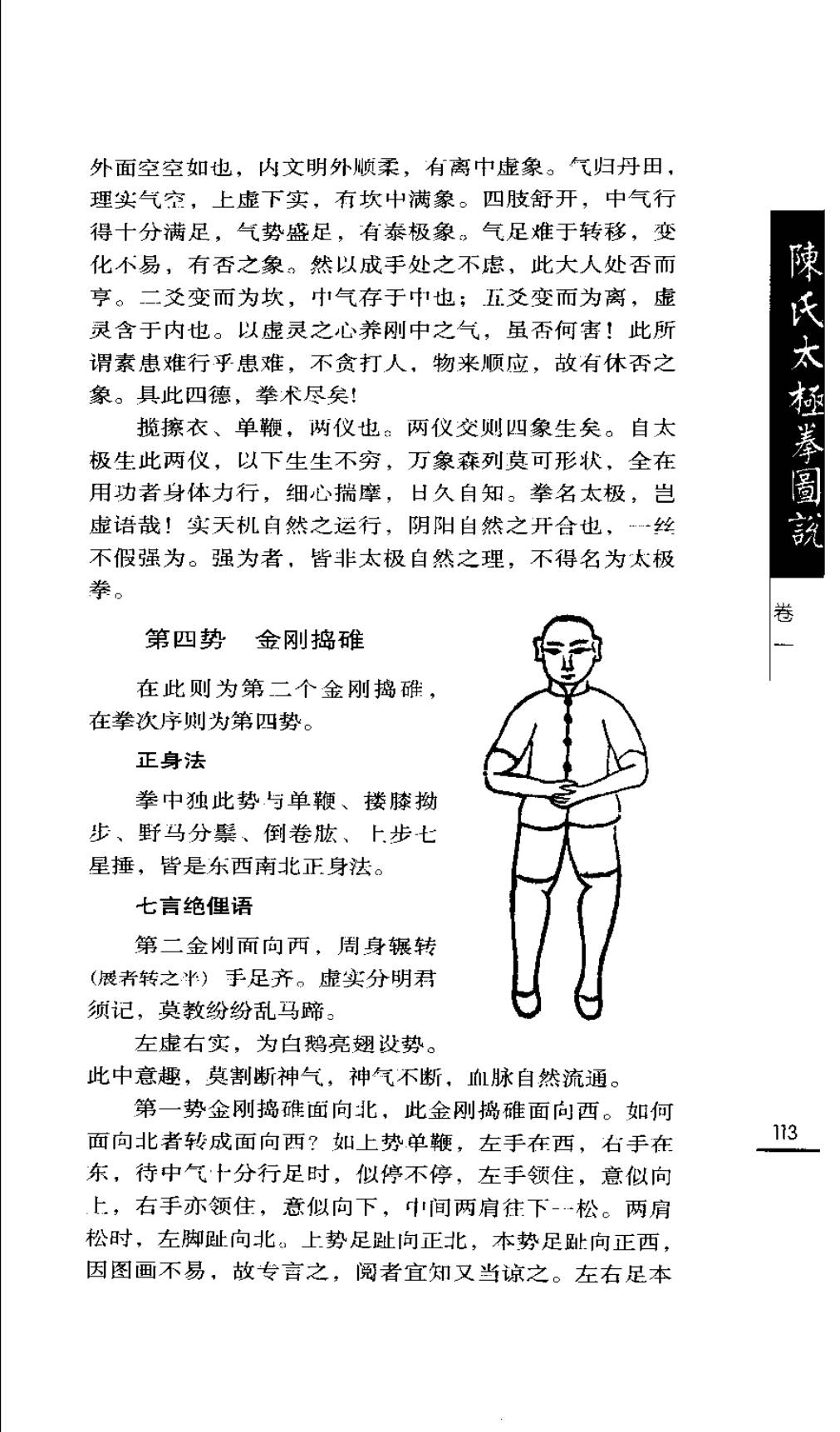
*Chen Shi Taijiquan Tu Shuo* (陳氏太極拳圖說)
This is not an "eight-character" foot shape. Now the toes rise slightly, the heel stays on the ground without leaving its place; give the big heel a twist (ning, 拧) toward the west so that the left toes turn around to point west. When the left foot has been drawn in from outside to the inside, at once the left hand circles downward from outside to inside in one arc, arriving at the chest; the hand cups itself like a mortar (碓臼), the wrist facing up, awaiting the right hand. At the moment the left heel twists (ning means to twist, to turn — like a boat turning its rudder), as the left hand first rises inward the right hand simultaneously launches, passing downward and across the right side of the body, stroking up from below (lü, 捋) to grip, then the fist drops down, landing on the Laogong point (劳宫) in the middle of the left wrist. When the left toes twist to the west, the face and body have turned to face west — thus the one facing north has turned to face west. Why strike another Jin Gang Dao Dui (金剛搗碓)? "When a person reaches the limit, he returns to the root" — like the first posture Jin Gang Dao Dui, this is the original image of Taiji. Since the momentum was exhausted at Dan bian (單鞭, Single Whip), it therefore returns to the original posture, so that the movement and transformation of the body in the following postures can arise; hence Jin Gang Dao Dui is used again to continue.
Seven-character vernacular verse
Already the Jin Gang posture has been set before; now it is repeated — could it be the same?
There, the face pointed straight to the north; here, the spine turns to the east.
It links above to Single Whip not without reason (exhaustion returns to the root; this is also the connecting vein between the preceding and following postures),
and opens below to the White Goose (白鵝亮翅), uncommonly mighty.
Whoever can grasp this method of turning the body will find within it the spirit and mechanism of transformation.
(No diagrams on this page.)
Volume 1 · Fifth posture: Bái é liàng chì 白鵝亮翅 (White Goose Spreads Its Wings)
Diagram annotations
- Dǐng jìn lǐng qǐ 頂勁領起 — the crown jin (leading energy at the crown of the head, dǐng jìn) is raised.
- Yǎn shén kàn zhù 眼神看住 — the gaze is fixed forward; bù kě páng shì 不可旁視, one must not look sideways.
- This posture takes the right hand as the anchor. First the right hand leads upward; the right foot draws a large circle toward the right side — that is, toward the north — and the right foot steps out to the right, no more than four or five cùn 寸 (about 13–17 cm).
- The right elbow sinks down; the right knee bends three or four cùn.
- The left elbow sinks down; the left knee likewise bends three or four cùn.
- The waist jin settles firmly (yāo jìn 塌住); the jin in the chest also seems to follow the right hand and left hand: first from the right, downward, then to the left, then upward, and around to the right in one large circle.
- The left hand follows, led up by the right hand; the left leg also draws a large circle. The left foot follows the right foot — one may say the right foot is three or four cùn away, its toes touching the ground; the two hands are about one chi 一尺 and one or two cùn apart. This is the hidden link (fú mài 伏脉, "concealed thread") between the movements.
Vertical text below the figure
The right foot arrives at the right side and plants on the ground; before the foot touches down, the foot circles once following the hand.
Carrying the movement through, the fresh form advances until it is beside the right foot, some two-three or three-four cùn from it. The five toes of the right foot press the ground — this completes the posture (chéng shì 成勢). Bái é liàng chì is the upper half of the posture; lóu xī 摟膝 (brush the knee) is the lower half; only when the two are joined does one whole posture form.
Horizontal text
This is the drawing jin (yǐn jìn 引勁).
The left hand rises and stops following the right hand. When the right hand rises, the left hand rises too; when the right hand circles, the left hand circles too; when the right hand stops, the left hand stops too — like a wife following her husband (fū chàng fù suí 夫唱婦隨).
The right hand, from in front of the right breast...
Small hand-circle diagrams
- Left-hand diagram: the right hand sets out · not yet stopping · seeming to stop.
- Right-hand diagram: the left hand sets out · not pausing · pausing and...
(Page 115)
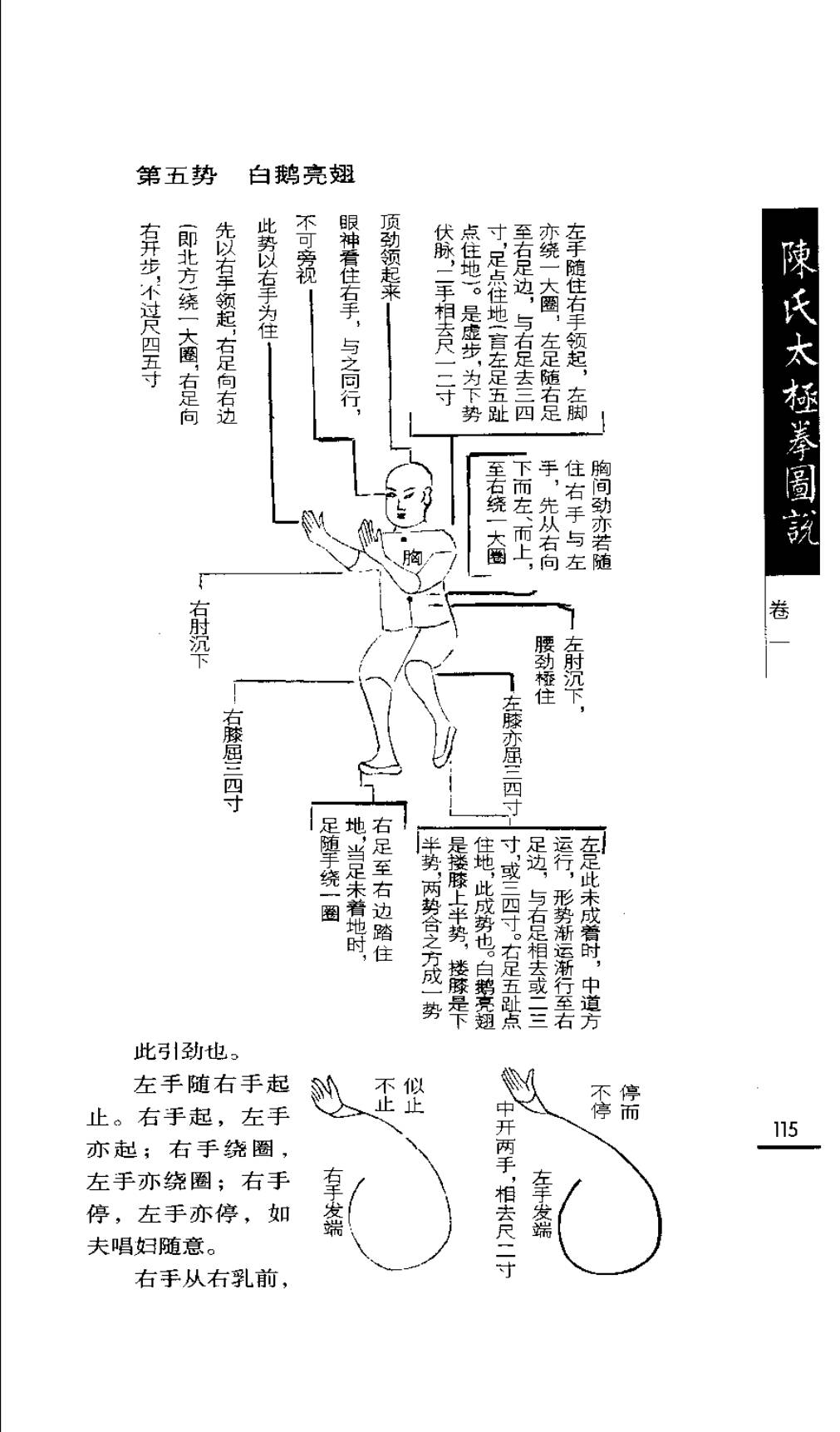
*Chen shi Taiji quan tushuo 陳氏太極拳圖說 (Illustrated Explanation of Chen-Style Taijiquan)* — continuation of Bái é liàng chì 白鵝亮翅 (White Goose Spreads Its Wings).
Main text
...seven or eight cùn 寸 from the breast, going down and then up toward the left, from left to right — the start and finish are set by the size of the step taken by the right foot. Upper and lower run together as one, and so each part watches over the other. The single line in the middle, where yin and yang, the two qì 氣, merge into one — that is the central qi (zhōng qì 中氣). It too sets out on its own, going down, then left, then up, then right, stopping only when its jin meets the right side head-on. Its jin takes the rising and stopping of the right hand as its own rising and stopping. This is exactly the Great Harmony primordial energy (tài hé yuán qì 太和元氣) circulating without a break. Look at this diagram and quietly absorb the meaning of how the internal jin runs.
Foot-movement diagram (足運行圖)
Around the circle: 循環 circulation · 陰陽 yin-yang · 五行 five phases · 心氣由右行 the heart-qi travels from the right · 心 heart. In each of the two lower foot circles is the character 發 fā "issue"; a line joins each circle to a drawn foot, showing the direction the force issues from the foot.
Foot movement
In Bái é liàng chì the right hand is host (zhǔ 主) and the left hand guest (bīn 賓); so too with the feet. The left foot moves rightward with the left hand; the right foot stands to the right and fixes the stance, then the left foot circles toward the right. In moving, the hands can move in unison but the feet cannot move in parallel — to try would be to fall. The toes of the foot touch the ground in an empty stance. The step opens to the right, moving rightward together with the jin of the right hand, and the toes of the right foot rest flat pointing to the northwest.
If we speak of striking (如以打人論)
If an opponent controls my right elbow, I lead it leftward with the elbow, then return and strike; if he controls my left hand, the left hand being on the left, I lead it rightward with the left hand and strike; if he controls both my hands, I lead both rightward in this posture. Here only the drawing jin (yǐn jìn 引勁) is shown — the striking has not yet been discussed.
This marks the boundary with the next posture: this posture ends where the drawing (引) ends. Learners are mostly impatient — before putting in the work they already love to strike. The principle is: wherever the opponent presses in, from there you draw and strike; no fixed frame confines it. I cite one or two examples merely as illustration. I do not speak of it lightly, fearing to stir impatience in learners so that they skip the groundwork — that is why it is not spoken of casually. The preceding diagram should be absorbed with quiet attention; do not dismiss it.
Meaning of the name
What is "White Goose Spreads Its Wings"? It is like the white goose spreading its feathers — a picture-shape (xiàng xíng 象形). The right hand leads the left hand, first descending to in front of the left ribs, seven or eight cùn from them, first completing one circle; then the left hand leads the right hand in a diagonal line, moving upward against the flow toward the right side, circling only a little more than half a circle — the shape of a goose spreading its wings, seeming to stop yet not stopped; the right foot travels rightward, also circling a little more than half a circle, the step being a bit more than one chǐ 尺. The toes of the right foot point north...
(Page 116)
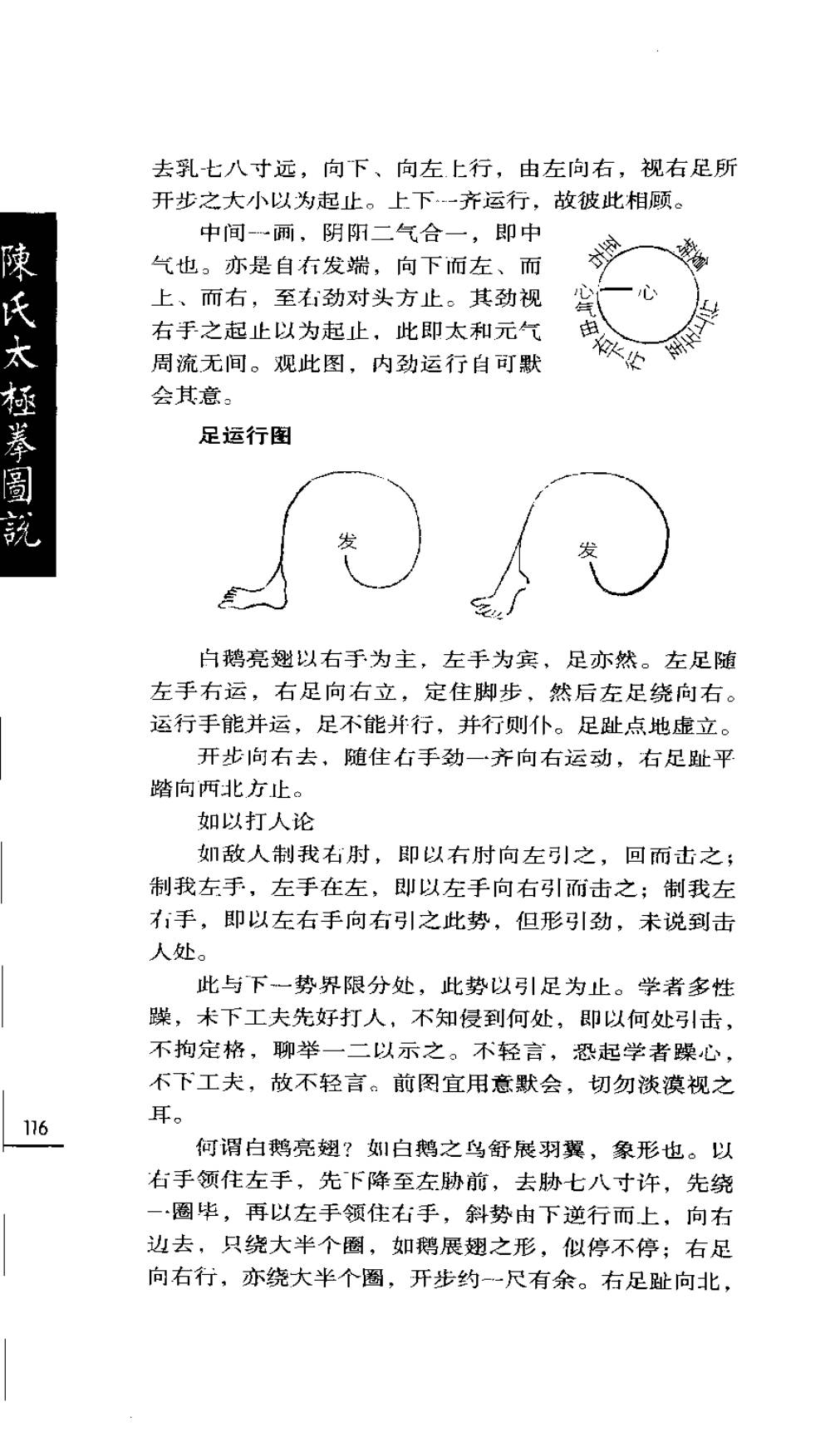
Chen Family Taijiquan Illustrated — Volume One (page 117, no diagram; conclusion of the posture White Goose Shows Its Wings 白鵝亮翅)
...flatly and solidly on the ground; the left foot follows the right foot, arriving at its side, the toes touching and standing on the ground — also making the next open-step easy. The left foot is empty, the right foot solid; the chest in the middle faces north-west (explanation given earlier). The inner jin within the chest revolves like the primal qi of the Great Harmony (太和元气): first from the right downward, moving leftward in reverse and upward, turning from left to right a full circle, stopping together with the hands and feet. The right hand passes the head on the right, about a chi from the right ear; the left hand moves along with the right hand to in front of the nose, the left hand slanting upward, seven or eight cun from the face. The left and right hands are a bit more than a chi apart. The eyes fix on the two middle fingers. The crown leads, the neck is straight, the elbows sink, the shoulders press, the chest is held in, the knees bend, the kua opens; the left foot stands empty and inverted, the right foot flat on the ground. Though this posture is named one posture, it is in fact half a posture, for its quality is blunt (钝); it is the intent of "leading in to land on emptiness" (引进落空, yǐnjìn luòkōng), and it is entirely opening-intent with no joining-intent; it must combine with the next posture to make one whole, and only then does the overall position come to a halt.
Taking the image (取象): this posture carries the meaning of the hexagram Bi (比, Holding Together). The left hand moves along with the right hand, and the chest also turns its closing with the right hand — "holding together from within, soft, compliant, and centered" (比之自内,柔顺中正). The left foot moves along with the right foot; viewed together, there is the image of "holding together outward," and the good fortune of "bright holding-together" (显比之吉). This posture takes left following right, above and below alike; but it only leads and does not strike, gaining the softness of the lower trigram Kun and the centered hardness of the upper trigram Kan — hence it takes from Bi. Above and below follow each other; hardness comes and dwells beneath softness; movement and joyousness in following — hence it further takes from the hexagram Sui (隨, Following). "The noble man, as dusk falls, enters and rests" — to only lead and not strike is fitting.
Seven-character vernacular verses (七言俚语)
The first: In leisure, with nothing to do, I watch the white goose; its right wing spreads out in yet another wave. The two hands lead in and shift the peak posture — how unlike autumn waters issuing from the Tai'e sword (太阿)!
The second: Whence does the primal qi know the Great Harmony? The right hand wheels half a turn (辗 — 辗 is half of turning) and the two hands play the autumn snail. In the north the leading-in and the spirit-mechanism are complete — that the wing shines has ever been the white goose's way (a man's nourishing of the primal qi is like the goose crouching motionless, nourishing its spirit).
Former title, five-character quatrain: It is not the crescent moth-brow moon, yet rubbing it makes a perfect likeness (the two elbows bend, the chest like a bowing man); why should the bent bow not shoot? Once shot, it is doubly spirited.
*Translator's note: Page 117, no diagram; the conclusion of the posture White Goose Shows Its Wings (白鵝亮翅, Bái é liàng chì). Contains the final body-method description, the Yijing "Taking the Image" discussion (hexagrams Bi 比 and Sui 隨), and two seven-character vernacular verses plus a five-character quatrain on the posture's imagery.*
Chen Family Taijiquan Illustrated (page 118) — Sixth Posture: Brush Knee and Twist Step (搂膝拗步, Lǒu xī ào bù), with a body-method diagram (a standing human figure, each part connected by lines to marginal notes)
Diagram notes (pointing to the parts of the figure):
- Crown (頂): the top jin (頂勁) leads the whole body up by the central qi (中氣)
- Left shoulder (左肩): the left shoulder sinks down; do not hoist it up
- Right shoulder (右肩): the right shoulder sinks down; the eyes look toward the middle finger of the right hand
- Right hand (右手): the right hand spreads open, square outside and round within (外方內圓), the side-waist holds the hand, landing in front of the chest. The middle finger takes the nose-tip (鼻準) as its target; use chansijin (纏絲勢 — the coiling-silk jin, 缠丝劲) coiling from the shoulder to the hand; only when the central qi arrives at the middle fingertip is the movement complete. The right hand is four or five cun from the chest; hold the jin softly — do not retain the slightest hard qi
- Left hand (左手): the rear hand gathers the wrist upward, square outside and round within, using chansijin. The hand lands on the rear spine
- Waist (腰): the waist jin reaches down; the kua bone (尻骨, coccyx) lifts slightly, containing it from all four sides
- Left knee (左膝): the left knee spreads open, rising by chansijin; the lower abdomen naturally joins its jin closed
- Right knee (右膝): the right knee props outward and joins inward; the coiling method of chansijin is the same as for the left leg
- Feet (足): the left foot steps solid; the right foot steps solid
- Legs/kua (腿/襠): the kua bone's Huantiao (環跳) lifts up; the thigh roots inside spread open and the kua opens of itself; the two knees join closed and the kua is naturally round
- Chest and abdomen (胸腹): the chest and abdomen are broad and grand, joining closed forward, the central qi threading through, full spirit above and below — truly bearing the air of "a countenance at ease and a back full of abundance" (睟面盎背)
Main text: This posture faces due west, bearing the image of the Great Harmony primal qi (太和元气), and conforms with the upright positions of the four directions — Kan, Li, Dui, Xun, Qian, Kun, Kan, Li. The left elbow twists slightly into the reversed-back form; the rear hand gathers the wrist upward, square outside and round within, using chansijin. The hand lands on the rear spine. The left shoulder sinks down; do not hoist it up. The top jin leads the whole body up by the central qi. The right shoulder sinks down; the eyes look toward the middle finger of the right hand. The right hand spreads open, square outside and round within; the side-waist holds the hand, landing in front of the chest. The middle finger takes the nose-tip as its target; use chansijin coiling from the shoulder to the hand; only when the central qi arrives at the middle fingertip is the movement complete. The right hand is four or five cun from the chest; hold the jin softly — do not retain the slightest hard qi. The waist jin reaches down, the kua bone lifts slightly, containing it from all four sides. The left knee spreads open, rising by chansijin; the lower abdomen naturally joins its jin closed. Coiling — coil to the thigh root and join the jin closed. The left foot steps solid. The kua bone's Huantiao lifts up; the thigh roots inside spread open and the kua opens of itself; the two knees join closed and the kua is naturally round.
The chest is like a man bowing, bending slightly forward, bearing the image of containment from all four sides. With long practice, when the gongfu reaches this state, one naturally knows its spirit and expression. Even having arrived at that state, it can only be grasped by the mind and cannot be transmitted in words.
The chest and abdomen are broad and grand, joining closed forward, the central qi threading through, full spirit above and below — truly bearing the air of "a countenance at ease and a back full of abundance." With long practice, when the gongfu reaches this state, one naturally knows its spirit and expression. Even having arrived at that state, it can only be grasped by the mind and cannot be transmitted in words.
Explanation beside the diagram: for the left hand, for fear the reader might not see the shape it moves along its path and the circle it turns in reverse, it is also drawn in front. This makes people see that in truth the left hand is behind, at the waist — it must not be mistaken as being in front.
Citing the Lingshu, chapter "The Circulation of Defensive Qi" (《靈樞·衛氣行篇》): "The course of the defensive qi (衛氣, wèiqì): in one day and one night it makes fifty circuits of the body. By day it travels in the yang for twenty-five circuits;"
*Translator's note: Page 118, with a body-method diagram for the sixth posture Brush Knee and Twist Step (搂膝拗步, Lǒu xī ào bù). The page consists of detailed annotated labels for every body part (crown, shoulders, hands, waist, knees, feet, kua, chest), the main text repeating the same instructions, a note explaining why the left hand is drawn in front, and the beginning of a quotation from the Lingshu on the defensive qi's daily circulation. The text breaks off mid-quotation at the page's end.*
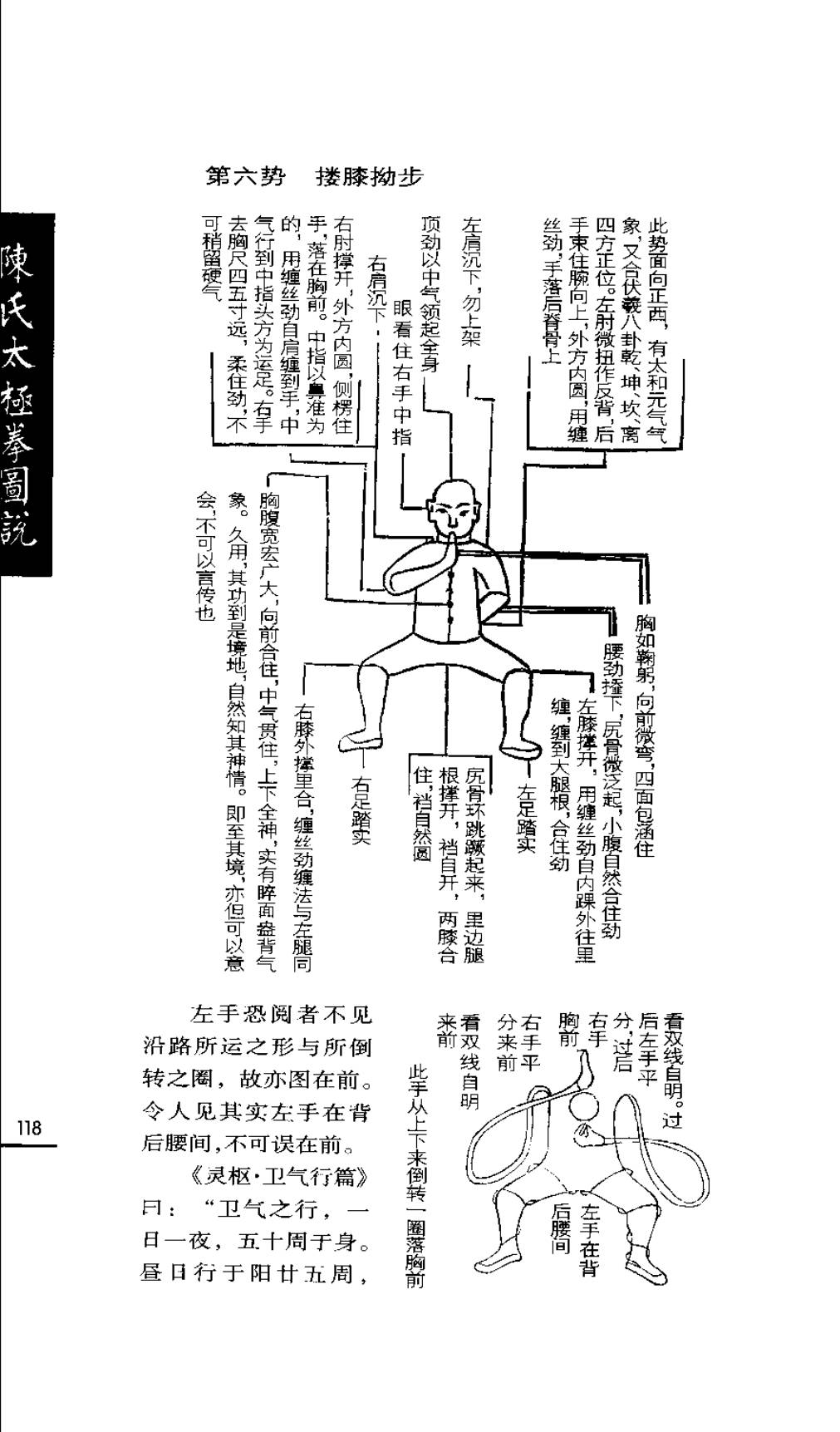
Chen Family Taijiquan Illustrated — Volume One (page 119, no diagram; continuing the Lingshu quotation from the previous page)
...by night it travels in the yin for twenty-five circuits. "At daybreak (平旦), when the yin is exhausted, the yang qi issues from the eyes; when the eyes open, the qi travels upward through the head (following Jingming 精明), then down the Foot Taiyang Bladder meridian (足太陽膀胱經), the Hand Taiyang Small Intestine meridian, the Foot Shaoyang Gallbladder meridian, the Hand Shaoyang Triple Burner meridian, the Foot Yangming Stomach meridian, and the Hand Yangming Large Intestine meridian — this is what is meant by governing the exterior for one day. By night it travels the Foot Shaoyin Kidney meridian, pours into the Hand Shaoyin Heart meridian, the Hand Taiyin Lung meridian, the Foot Jueyin Liver meridian, and the Foot Taiyin Spleen meridian, likewise making twenty-five circuits like the yang course, and then returns to join at the eyes. That which is called 'human qi arising at daybreak' is precisely this: traveling upward through the head and returning to join at the eyes." In each posture of the form, when the yang qi stirs once, it makes one circuit of the body; when reaching stillness, one stillness is one circuit of the body. That is, when one thought of the heart stirs, the yang qi immediately makes a circuit of the body; when one thought stills, the yin qi immediately makes a circuit of the body, without a moment's interruption. Considering the whole body: the back is yang, the chest is yin; the arms and backs of the hands are yang, the inner hand and elbow bends are yin; the face is yang, the back of the head is yin; the upper half of the body is yang, the lower half is yin; the knees are yang, the calves are yin; the left hand and left foot are yang, the right hand and right foot are yin; the top of the foot is yang, the sole is yin; qi is yang, blood is yin; the six bowels are yang, the five organs are yin. This is the discrimination of yin and yang among the sense-organs and frame.
Speaking of the central qi moving within: drawing-in jin (引勁) is yin, issuing jin (出勁) is yang; bending is yin, stretching is yang; opening a step is yang, withdrawing a step is yin; the toes touching down is yang within yin; the foot flat on the ground is yin within yang. Again: the back of the arm originally belongs to yang; in Grasp the Robe (揽擦衣) the jin is drawn from the right fingers up to the shoulder — the shape is yang, yet the jin is on the contrary yin; the belly of the arm originally belongs to yin, yet its jin is moved from the heart to the fingertips — the shape is yin, yet the jin is on the contrary yang; and they move together at once. This is what is called "yang hidden within yin, yin hidden within yang; one and yet two, two and yet one." That is, the arm's drawing-in jin is yin; with one turn it becomes yang jin — this is what is called "yang is rooted in yin" (陽根於陰). The jin of the arm's belly moving outward suddenly contracts — yin rooted in yang; yang hidden in yin, yin hidden in yang: this is what is called "they are roots of one another" (互為其根). Again, half-drawing and half-advancing, drawing while advancing, drawing that is advancing, taking drawing as advancing — yin and yang applied together at once: this is what is called "the Way goes forward in parallel without conflict" (道並行而不悖); without yin and yang united in virtue it could not be done. The heart's mechanism stirs and the hand arrives at once — nothing is faster than this.
As for the saying that the central qi returns to the dantian (丹田, dāntián): do not cling rigidly to it; it merely means making the qi descend to the lower abdomen below the navel. If one investigates finely: if the dantian is not the source of qi, why is returning to it alone spoken of? This is only a rough statement of the general idea. If one traces the source: the body's whole primal qi issues from the kidneys (腎); when kidney-water is sufficient, the qi is naturally strong. It is nourished in the stomach (胃); when the stomach receives nourishment, the qi is also strong; it is stored in the liver (肝) — when liver-qi stirs, rebellious qi springs up crosswise and the qi loses its balance; it is steeped in the heart (心) — when the heart has no idle thoughts the heart is calm, and where the heart is calm the qi is naturally harmonious with the lung (肺). The lung governs the voice; in truth it is sounded by the heart — where the heart's mechanism goes, even before the voice issues from the mouth the heart has already signified it. It is strengthened in the gallbladder (膽); the gallbladder knows no hesitation, and the qi follows its movement into the spleen (脾). This meridian has much qi and little blood; hearing a sound it stirs, and stirring, its transport-transformation does not cease — the moment the heart stirs, the spleen stirs too. It is aided by the large intestine (大腸), which has much qi and little blood and is the official of transmission...
*Translator's note: Page 119, no diagram, continuing the Lingshu "Circulation of Defensive Qi" quotation from the previous page. Content: the twelve meridians' day/night circulation, the yin–yang division of every body part, the yin–yang character of drawing versus issuing jin (with examples from Grasp the Robe 揽擦衣), yin and yang as mutual roots, and the beginning of the discussion that the body's primal qi issues from the kidneys and is nourished through stomach, liver, heart, lung, gallbladder, spleen, and large intestine. The text breaks off mid-sentence at the page's end.*
Chen Family Taijiquan Illustrated (page 120, no diagram; continuing the discussion of the organs from the previous page, then the sixth posture Brush Knee and Twist Step 搂膝拗步)
...official [of transmission]; and further aided by the small intestine (小腸), which in front lies above the navel and behind assists the spine; the dregs and filth are not retained — the turbid qi departs and the clear qi arrives. All the meridians above are of benefit to the fist art, hence they are mentioned. If one speaks solely of the kidneys: the kidney is the official of strength and skill (作強之官), from which craft and ingenuity issue. This meridian has little blood and much qi; it stores essence in the will (藏精於志) — the abode of essence and spirit, the root of nature and life (性命之根). Man has two kidneys, each with two attachments: one attaches to the heart, one travels upward to connect with the brain. Where qi is generated truly begins here, and its final homecoming must return to this. As for the mingmen (命門, Gate of Life): it is in truth the gate through which the qi between the two kidneys goes out and in, hence it is called the Gate of Life. When the fist art speaks of the kidneys, it speaks of the source of going-out and coming-in, so there is no need to speak again of the mingmen.
The previous posture, White Goose Shows Its Wings (白鵝亮翅), has both hands raised and above. When the inner jin has moved to complete fullness, the two hands immediately part level and descend; the right foot twists to point due west, and the left foot opens a great step leftward, more than two chi, the toes likewise pointing due west and pressing solid. While parting level and descending, the right hand brushes past the right knee, traveling from below upward to the right, turning left, turning one great circle slantwise upward to face the nose; the left hand brushes past the left knee, traveling downward, then upward from the left, and again turns down and back, completing one circle — this is reversed-back jin (反背勁) — the hand landing at the middle of the rear spine, level with the waist, and halting; the right hand likewise turns one circle in reverse, the right and left hands moving together and stopping together. Though the right hand lands in front of the chest and the left hand lands behind the body, with abdomen and back between them like a mountain range apart, when the right hand calls (一呼) the left hand answers (一應), and the spirit of front and back naturally threads and joins. The right hand is in the west — west is Kan's (坎) upright position; a man's qi and blood circulate like Kan-water flowing around without gap. The right hand in front guards the front so that no one above or below dares intrude; the left hand is in the east, guarding the back, so no one dares intrude suddenly from behind. The reason is this: the east belongs to Li (離), and Li is empty within (離中虛). For the practitioner of the form, the left hand behind is supremely empty and supremely nimble; if anything touches it, it knows at once and can respond according to the occasion. Not only the hand — the back and the whole body are all empty and nimble; thus the left hand behind is not without anchor. The left hand behind gathers its fingers, for fear someone might seize the fingers and snap the joints backward; it gathers them to guard against harm. The left elbow is in the south. South is Qian's (乾) upright position. Qian is vigor (健); like Qian, centered and hard, awesome, none dare offend. The left elbow resides in the south, the right hand in the north. North is Kun's (坤) upright position. Kun is compliance (順); according with principle and following the situation, it responds to the ten thousand things. The Book of Changes says: "Beauty dwells within, and flows freely through the four limbs, issuing into affairs — this is beauty at its utmost" (美在其中,而暢於四肢,發於事業,美之至也). The right elbow has deeply attained this meaning. Though a strong enemy be in the north, what is there to fear? As for the head and ears: the ears can hear the sound of the enemy's approach, the eyes can see the enemy's expression as he issues, the head can make contact front, back, left, and right, and moreover the two hands can rise to assist it — this is not unworthy of Qian's image as head and as roundness. As for the feet: if he comes from the left, sway left; from the right, sway right; kick to defend the front, stamp to defend the rear. The foot belongs to Zhen (震); Zhen is thunder — one lifting of the foot is like sudden thunder that cannot be covered by the ear. Of all enemies invading my lower body, the foot's contribution is the greatest — great indeed is the foot's use! The proverb calls this posture "Six Sealing and Four Closing" (六封四閉) — truly so! The six sealings: above, below, and the four sides are all sealed, leaving no door to enter; the four closings: left, right, front, and back are strictly closed, leaving no...
*Translator's note: Page 120, no diagram; continuing the organ discussion from the previous page (kidneys, mingmen/Gate of Life), then the sixth posture Brush Knee and Twist Step (搂膝拗步): the hands' great circles, the front/back呼应 correspondence, the Yijing trigram correspondences (Li 離, Qian 乾, Kun 坤, Zhen 震), and the "Six Sealing and Four Closing" saying. The text breaks off mid-sentence at the page's end.*
*(Pure text page, no diagrams — continuation of the discussion of Brush Knee and Twist Step (搂膝拗步, lōu xī ào bù) following White Goose Shows Its Wings (白鹅亮翅, bái é liàng chì).)*
…(the hands) joined can strike; no matter whether the opponent comes empty, comes full, comes from an oblique angle (meaning the enemy advances with a slanted form), or comes straight on (meaning the enemy advances with an upright form) — in every case there is nothing to fear.
The previous posture, White Goose Shows Its Wings, is purely opening energy (开劲, kāi jìn); the present posture, Brush Knee and Twist Step, is purely closing energy (合劲, hé jìn). The previous posture is the first half of the following posture, and the following posture is the second half of the previous posture: one opening and one closing, together forming a single posture.
The former, White Goose Shows Its Wings, is movement; where it halts is stillness — that is stillness within movement. The latter, Brush Knee and Twist Step, is movement; where it halts is stillness. Viewed together they are one movement and one stillness. The former stillness is the end of the first half-posture, and is the "guest"; the latter stillness closes the whole posture, and so is the "host." The upper move stores power for the lower move — it is purely opening, hence the guest. The lower move immediately receives the upper move: after circling once left and right, the whole body closes together in one piece; upper and lower moves are connected in a single breath of energy, with no interruption of spirit and qi. In the upper move — the movement and stillness within opening — one is temporarily the guest, and the qi still rests in the four limbs; one must wait until the following posture closes, and only then does the qi return to the dantian (丹田, dān tián). This is what is meant by "movement generates yang, stillness generates yin; one movement and one stillness are the root of each other."
This posture takes the four trigrams Qian, Kun, Kan, and Li (乾坤坎离).
Their positions have already been discussed above. This posture obtains the upright qi of Qian and Kun to circulate through the whole body: soft outside, firm within, truly in accord with the strength of Qian and the compliance of Kun. The heart belongs to Li, the kidneys to Kan. The heart's empty clarity is like the emptiness in the center of Li; the fullness of qi is like the fullness in the center of Kan. Qian and Kun, through their central lines interacting, transform into Kan and Li; heart and kidneys exchange their qi, not harming but aiding one another — thus returning to the root (Qian gives its middle line to Kun, obtaining Kun's middle line and becoming Li; Kun gives its middle line to Qian, obtaining Qian's middle line and becoming Kan; returning to the root they again become Qian and Kun, their original unexchanged forms). Now, since "Heaven-one generates water, earth-two generates fire," one might say water comes before fire; yet although the will (志, zhì) is stored in the kidneys, it is actually issued from the heart. When the heart's mechanism stirs, the intent first exists in the heart; then the will, as commander, leads the true yang of the gate of life (命门, mìng mén), with the true yin following. Thus the will is the dwelling, the qi, and the commander of the heart. In this move, when yang qi should be aroused, once the heart's intent is issued, the will immediately leads the true yang of the gate of life, passing from the kidneys through the sea of qi (气海, qì hǎi) to the heart and circulating to the four limbs. When movement reaches its extreme and stillness arises, once the heart's intent grows still, the will leads the true yin of the gate of life back from the kidneys to the sea of qi — this is speaking from the standpoint of function. Therefore Li comes before Kan: Li is the master, Kan the function. Moreover, before Qian and Kun were split apart, yin and yang lay mingled together, substance and function both complete: its use should move when it ought to move and be still when it ought to be still — one must not cling or stagnate. If this move is discussed together with the previous one, it is a closing; closing means gathering the spirit of the four limbs, not merely the completed form. As to the completed form, the right hand is in front, the left hand behind, and the left and right feet are several feet apart — so it seems one cannot call it simply a closing. Yet what closes is its form and spirit; what does not close is the placement of the four limbs. Without this, the closing of the next posture would have no "incoming dragon" (source of momentum)! And if it is named a closing, without opening how could there be a closing? This is called "opening within closing" — the closing being the closing within opening — and so the following connecting posture continues from this one. If the posture were set up for the sake of the next move, yet truly is not for the sake of…
*Chen Shi Taiji Quan Tu Shuo* (陳氏太極拳圖說, Chen Style Taiji Quan Illustrated Explanation)
The next posture is set up in advance. After White Goose Spreads Wings (白鵝亮翅, Bai'e Liang Chi), the two hands divide evenly, whether inclining forward or backward; where the feet should open, they open; where the stance should be wide, it is wide. This change of form and the positions of hands and feet seem as if they ought to be so, but in fact they are the operation of the natural mechanism of Heaven (tianji ziran, 天機自然), not something human force can make. A person merely follows the natural mechanism and moves accordingly. At the moment of closing (he, 合), the qi (氣) must return to the dantian (丹田); when movement reaches its extreme, stillness is naturally due. The principle of the taiji cycle cannot be forced or altered — just as when a person's strength is spent, rest is due; where the momentum leads, it cannot be otherwise. This is what is meant by "one opening, one closing — nothing but what is natural." All the forms that follow likewise follow the natural mechanism, opening and closing, only the forms of opening and closing differ in each case.
Although in practicing the form one must not first ask how each posture strikes an opponent — for unknown to most, every posture in the form can strike in all four directions and eight angles; it is only that one cannot yet do so before the moment arrives. What I have always meant by quan (拳, fist/boxing) is "to weigh" (quan, 權): thereby one weighs things and knows their lightness or heaviness. When the moment of application comes, my whole body is the fist. I weigh the lightness or heaviness of what comes at me and respond with measure, not confined to any direction, not concerned whether the incoming force is great or small. There is nothing in what the opponent brings that is "wrong"; the only question is whether my own foundation is prepared or not, whether my gongfu (功夫) is accomplished or not.
Practicing the form is fundamentally preparing the body methods (shenfa, 身法). The body methods include upright and slanted, straight and bent, compliant and reversed, inclining forward or backward, left or right, upward or downward; sometimes sitting on the ground, sometimes flying in the air, sometimes gathered in, sometimes dispersed — body methods beyond enumeration. But all must be moved by the central qi (zhongqi, 中氣). Even the most inverted, most crooked body method is threaded through by the central qi. If at this point you apprehend it with the mind (yi, 意), you will know yourself that Brush Knee and Twisting Step (摟膝拗步, Lou Xi Ao Bu) is an upright body method, while the previous posture was a right-inclining body method. One need only seek the principle within the present body method, and it is obtained.
As for the movements of hands and feet, they are nothing outside a circle (quan, 圈); there is absolutely no coming straight or going straight. Circles may be upright or slanted, compliant or inverted; the various methods of turning also differ. One should turn according to what is natural to each posture. For example, the previous posture White Goose Spreads Wings is a forward (shun) turn; Brush Knee and Twisting Step is an inverted (dao) turn. Raise one to infer three — this is shown as the ford and bridge (jinliang, 津梁).
Chang Duan Ju Li Yu (長短句俚語, Colloquial Verses of Long and Short Lines)
The quan shi (拳势) fundamentally has no fixed direction; no need for great opening and great closing — like the next posture, the slanting twisting step (xie xing ao bu, 斜行拗步), in the same stance. The right hand is in the northwest, the left hand in the southeast, the left foot in the southwest, the right foot in the northeast; in the middle, the kua (裆, crotch) opens wide, the arms extend, one twisting step and only then is it settled. I too have weighed it carefully: the two hands divide evenly, brushing the knee together; the right hand, like a side lattice, descends to the chest; the left hand hides behind the back; both feet aligned neatly facing west — the banner orderly, the ranks dignified. Even from this posture one may see in self and other a shining of auspicious light. Why insist on clinging to the ancient forms or only following the modern forms to be strong? I once heard that of the marvelous arts of sword-dancing, none surpasses Sister Sun (referring to Gongsun Da Niang, 公孫大娘). How could the mysterious and subtle have a constant form? Only follow what is good — nothing is hindered thereby. This is what is called "variation without fixed direction, finding the central path" — this is the ford and bridge.
You (又, Again)
"Out of the kidneys, into the kidneys" (chu shen ru shen, 出腎入腎) is the true secret (zhen jue, 真訣); the reeling-silk force (chansijin, 纏絲勁) requires that the body's stance be set upright and not swaying —
*Chen Shi Taiji Quan Tu Shuo*, Juan Yi (陳氏太極拳圖說卷一, Book One)
The feet stand firm, the kua (裆, crotch) opens round, the hard qi (硬氣) softens below. Not one element lacking, the original qi (yuanqi, 元氣) not escaping — like the two halves of a tally meeting (ruo he fu jie, 若合符節).
Qi Yan Li Yu (七言俚語, Colloquial Verses in Seven-Character Lines)
Qi Yi (其一, The First)
两手平分两足开,右前左后护胸怀。
中间只要身法正,何怕周围一齐摧!
The two hands divide evenly, the two feet open; right in front, left behind, guarding the chest. In the middle, only the body method (shenfa, 身法) need be upright — then why fear the surroundings crushing in all at once?
"Dividing evenly" (ping fen, 平分) means the two hands divide evenly downward from the renzhong (人中, the philtrum); "the two feet open" means the left foot opens into a step, and with one twist of the right heel the body method becomes upright. "Upright" (zheng, 正) means the body's stance is square and correct, leaning toward nothing, containing the insubstantial spirit (xuling, 虛靈) within — hence one does not fear being pushed over by another. This speaks of "preparedness averts peril" (you bei wu huan, 有備無患).
Qi Er (其二, The Second)
太和元气运周身,普护两膝前后心。
眼神看住中指甲,四面八方任人侵。
The qi of Grand Harmony (taihe yuanqi, 太和元氣) circulates through the whole body, universally guarding the two knees and the centers before and behind; the eyes' spirit (yanshen, 眼神) fixes on the middle fingernail — the four sides and eight directions may be invaded at will [by the opponent, who can do nothing].
Qi San (其三, The Third)
自从白鹅展翅开,扣合周身护官骸。
只有一点真命脉,无妨出入任君裁。
Ever since White Goose Spreads Wings (白鵝展翅, Bai'e Zhan Chi) opened, closing and uniting the whole body guards the organs and frame. There is only one point of the true life-artery (zhen mingmai, 真命脈) — its going out and coming in may be judged freely, without hindrance.
The "life-artery" (mingmai, 命脈) is the kidneys (shen, 腎), from which the central qi (zhongqi, 中氣) originates. In movement it goes out, in stillness it enters; it has fixity yet no fixity — meaning that because the posture is constantly changing, the changes of the two qi, yin and yang (陰陽二氣), are likewise without fixity.
Qi Si (其四, The Fourth)
一气旋转自无停,乾坤正气运鸿濛。
学到有形归无迹,方知玄妙在天工。
One qi revolves, never stopping of itself; the upright qi of qian and kun (乾坤, Heaven and Earth) moves through the primordial vastness (hongmeng, 鴻濛). When your study reaches the point where the formed returns to the traceless, only then do you know the mystery lies in the work of Nature (tiangong, 天工).
Seventh Posture: First Close (第七势 初收, dì qī shì — chū shōu)
Central figure: a practitioner in a half-seated (squatting) posture, left hand wrapped behind the back, right hand raised beside the right ear; leader lines connect the annotations to each body part.
Figure labels (by body part):
- (Eyes) The eyes watch the finger pads (眼看住指肚).
- The top energy (顶劲, dǐng jìn) must be raised all the more, the body held in: make the spirit of the whole body collect in one place, allowing no scattering; if it scatters, the body method grows too small to resist the enemy; if gathered, front, back, left and right can all be protected. Moreover, since it is named "close/collection" (收, shōu), it is the momentum of drawing the opponent to advance.
- The left elbow sinks down; the left hand whips up beside the left cheek; the left armpit is braced open, not pressed against the left ribs; the back of the hand faces outward, the wrist turned inward.
- The more the right elbow sinks down the better — it must not be clamped; it moves toward the center of the right chest. The right hand lands before the center of the right chest, seven or eight inches from the chest, back of the hand facing out; the two hands are about a foot apart.
- The right knee is bent, toes pointing west; the crotch must be opened round; the 【?】 closes forward; the waist energy sinks down and must not go limp.
- The left knee is bent: brace the energy open and close it inward; do not use stiff qi, but do not be too soft either — just hit the middle.
- The left foot draws in beside the right foot, the two feet four or five inches apart, the toes touching the ground — this is the empty foot, a hidden seed (伏脉, fú mài) for the following posture.
Movement instructions at the bottom:
The left hand, behind the back, unfolds the hand that was wrapped in; press the fingers tight, likewise turn left and forward through a full circle, and land in front of the left chest, back of the hand facing out, facing the right hand as if opposite it, only slightly offset in height — left hand high, right hand low.
The right hand leads upward from in front of the chest, turns left and across to the right side, the elbow sinking; the fingers are beside the right ear and whip upward, slightly slanted toward the face, the palm about a foot from mouth and cheek.
Small diagram labels (lower right): right hand / left hand / right hand starting point / issue (发) / turn from left / toward right.
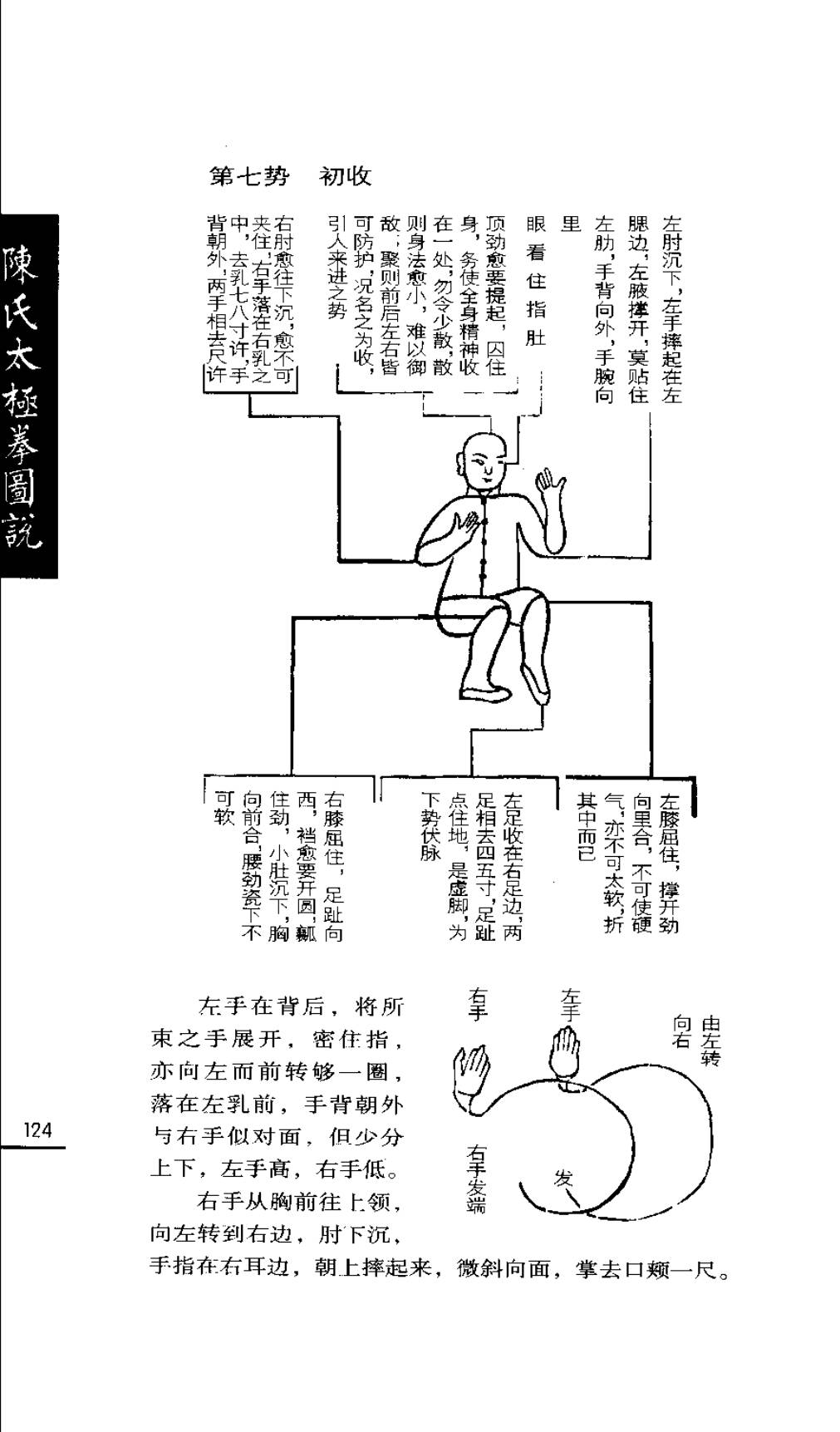
*(Continuation of the Seventh Posture, First Close (初收, chū shōu). Upper right: two schematic foot drawings — the left foot with toes touching the ground, the empty stance; the right foot flat on the ground, the solid foot.)*
The left foot's toes touch the ground: this is the empty stance (虚步, xū bù), a hidden seed for the start of the following posture. The right foot rests flat on the ground: this is the solid foot (实脚, shí jiǎo).
"First Close" (初收) is so named to distinguish it from the "Second Close." In the previous posture the right hand is in front and the left hand behind — scattered and unordered. Here the two hands are gathered in front of the chest: the bodily frame is collected into one place and the spirit gathers together without scattering, hence it is named "close/collection" (收); it is also the connecting link that receives what is above and opens what is below. The right hand goes from below upward along the left, turns a circle from left to right, and when it lands the hand is slanted inward and turned upward. If this man attacks me with his forearm, I meet it with my right hand; when the two hands and two forearms make contact, I use my right hand to lead in his right hand, drawing it close to my body. If I do not do this, he will not advance and I cannot strike him. The right foot lifts, turns a small circle to the right, shifts three or four inches toward the center, and comes down flat and solid on the ground. As soon as the right hand begins to move, the left hand follows it and moves too: the left hand goes from behind upward along the left, turns a circle from left to right, and lands outside the left chest, seven or eight inches from the left nipple and about a foot from the right hand, and stops. The left fingers slant toward the right shoulder, the back of the hand also facing outward — thus the left hand follows the right hand. This is leading in his right forearm, letting him advance close to my body to strike me; only when he believes he has the advantage will he step in to attack. I use both hands to lead him in and make him fall into emptiness — this is the winning calculation of "to take, first give" (欲取先与). As for the left foot, it is collected on the right side with the toes touching the ground, an excellent ambush: not only can an upward kick strike the opponent, it also sets up the connection to the next posture most advantageously. Though the form of First Close is small, its breadth of spirit is vast, like the open sky and wide earth, beyond measure. Moreover, the top energy leads upward, the turbid qi descends, and the central qi (中气, zhōng qì) is stored and enters the dantian: though the shape is small, the bearing of qi is grand and unimpeded — a posture hard for others to fathom. Speaking of the present, it is stillness within movement; speaking of what is to come, it is also movement within stillness. Do not despise it because the form shrinks like a hedgehog.
Four-character folk verse (四言俚语)
The image of First Close: great qi spiraling. Like a cat pouncing on a rat, it folds its fur and feathers; like a tiger biting a man, it first binds its body; like a lion wrestling an elephant, the whole body's spirit (全休【?】— likely 全副). Do not, because the form is small, think it shriveled like a hedgehog. One spirit, numinous and subtle: heart, eyes and hands follow one another; release the moment release is called for — hard to withstand its keen edge. From of old the hunched caterpillar has never failed to stretch; I know its intent but can hardly depict its spirit. Wait for a master hand to trace its truth in full; this drawing is lifeless and cannot transmit it to others.
Seven-character folk verse on the above (前题七言俚语)
The whole body shrinks like pure yin; within the yin, yang hides, letting others invade. Slowly, slowly leading in — none perceive it; little by little lingering, the intent deepens of itself. Right solid, left empty, concealing the 【?】 strike; lifting above and striking below, embodying release and capture (纵擒, zòng qín). If one can truly grasp the principle within, with an empty, masterful hand one crowns the present age.
Five-character folk verse (五言俚语)
Writing prizes stored momentum; practicing the fist is just the same. If one truly wishes to win over others in the end, first, from within defeat… (continues on the next page)
(continuing from the previous page) ………reached/consummate.
Seven-character vernacular verse
To close from openness (the previous posture is opening) and gather (this posture is gathering) well, the only way is to keep the circles drawn by the two hands small. One gathering instantly shows the spirit collected; with one sudden turn, no one understands. Without gathering one never sees the ingenuity within releasing; once gathered… released, how soaring it is. People say this posture still seems green; I say the gathered form is the most seasoned technique. The right palm turns inward, fingers pointing to heaven; the left hand also gathers near the breast. The fierce tiger descends the mountain with an empty belly; outwardly appearing empty, yet its cunning is lofty. Half empty, half solid — who can predict? If you would catch mice, watch the clever cat. The clever cat stalking a mouse first gathers its body; with one gathering the whole spirit collects. When spirit gathers, the whole body is strong; to turn heaven and earth is held within the hands. Solemn and august, learn this one thing: great bravery appears as timidity — its mechanism is hard to fathom.
Taking the Image (from the Yijing)
The two hands are above, like the second line of Xun (巽, Wind). With yang above, Kun (坤, Earth) is the belly; with yin below, this is the image of Kun. Kun below, Xun above: the hexagram Guan (觀, Contemplation). Guan — "sincerity, reverent gaze": the central qi of the boxing dwells in sincerity within. The Image says: "The great contemplation is above; compliant and gentle, correct in the center to contemplate all under heaven." The two hands gather and restrain to store up the momentum, observing how the enemy comes to strike me, calmly examining the moment to respond. The lower trigram is Kun — compliant; compliance follows where the eyes look (Xun is "many white eyes," good at observing opportunity and momentum). Xun inverted is Zhen (震, Thunder); Zhen is the eldest son; the eldest son leads the army — the firmness of the heart leads the four limbs; lines two and four combine as Kun: likewise the lower body compliantly follows the upper body, moving as opportunity dictates. Kun takes the form of Qian (乾, Heaven); though seemingly yielding, strength truly dwells within. Gathering the body, the method stores momentum — this also carries the meaning of the hexagram Da Xu (大畜, Great Accumulation). The principles of the Changes are the most fluid, and the images taken are the broadest and most fitting. In taking the Changes for taijiquan, one may take the meaning of the hexagram's name, or the Image commentary, or the line statements, or the Great Image, or the Small Image, or a single phrase within a hexagram, or sentences from Confucius's Xici ("Great Commentary"), Shuogua ("Explaining Trigrams"), Xugua ("Sequence of Hexagrams"), or the ideas of Bo (剝, Splitting), Fu (復, Return), Pi (否, Standstill), Tai (泰, Peace), the waxing and waning of yin and yang — the meanings taken cannot be enumerated; the ten thousand principles are all complete, the myriad images all present. Whatever I take, each fits its intent exactly. That taijiquan accords with the Way of the Changes is not forced, far-fetched interpretation; it truly originates from the Supreme Ultimate itself. Observe the one opening and one closing of the whole body: it is truly the natural closing and opening of yin and yang, not forced — one acts without knowing why it is so, and yet it is so. Profound indeed is boxing as an art!
Seven-character vernacular verse
In the hands, day by day, draw the Supreme Ultimate — yet no one recognizes this Way. Yin and yang wax and wane with their own truth; all depends on a attentive mind searching within the hands. The circles drawn may be upright or slanted, yet each is nothing but one circle, one Supreme Ultimate. Straight and oblique, joining and parting, full of feeling — it all depends on whether one can understand. The mechanism of heaven is active, subtle and deep; the pivot turns and turns within one mind. If indeed you can taste the delight within the boxing, then the thirty-six palaces are all spring.
(Printed page number: 126. Spine: Chen Shi Taiji Quan Tu Shuo.)
*Chen Shi Taijiquan Tushuo*, Volume 1
Eighth Posture: Xie Xing Ao Bu (Oblique Walk, Twisted Steps)
The right hand is at the northwest — Fuxi's *gen* (艮) direction.
The left hand is at the southeast — Fuxi's *dui* (兌) direction, King Wen's *xun* (巽) direction. This posture takes the *dui*, *zhen*, and *xun* directions of Fuxi's Eight Trigrams: it requires a strong twist of the body, so that above and below, hands and feet face different directions — this accords with the meaning of *ao bu* (twisted steps), and accords with the corner directions of Fuxi's Eight Trigrams. This is another type of body method in the fist, like the "Airs of the States" (*bian feng*) variations in the *Book of Songs* — not the ordinary pattern of facing east or west.
Figure: A person in a low horse-stance: the left hand raised to the mouth/chin, palm facing inward; the right hand held behind the body at the waist. Directional labels: northwest (top), southeast (left), northeast (bottom left), southwest (bottom right).
Notes beneath the figure:
- The right foot is at the northeast — Fuxi's *zhen* (震) direction, King Wen's *gen* (艮) direction.
- The left foot is at the southwest — Fuxi's *xun* (巽) direction, King Wen's *kun* (坤) direction.
- Once the waist twists, the upper body twists naturally and does not align with the lower body: the waist is the pivot between upper and lower body.
At the start of the set one faces due north; by the second Jingang Dao Dui (Buddha's Warrior Attendant Pounds the Mortar) one has already turned to face the west. By the first Closing (shou) the body has already turned to the southwest. Now in this Xie Xing Ao Bu, the chest faces southwest while the eyes watch the right hand at the northwest — this is the "twisted body" method of this posture. Although the body method changes, the joints above, below and on all four sides still respond to one another, and the opening and closing of the whole body is threaded through by the *zhong qi* (central energy, 中氣), so the whole body naturally flows as one breath. The physical form changes but the principle does not — this is what is meant by "different yet the same."
Xie Xing Ao Bu (verse)
"Oblique walk" means from northeast toward southwest: the left foot first takes one large step, and the right heel...
(Page: 127)
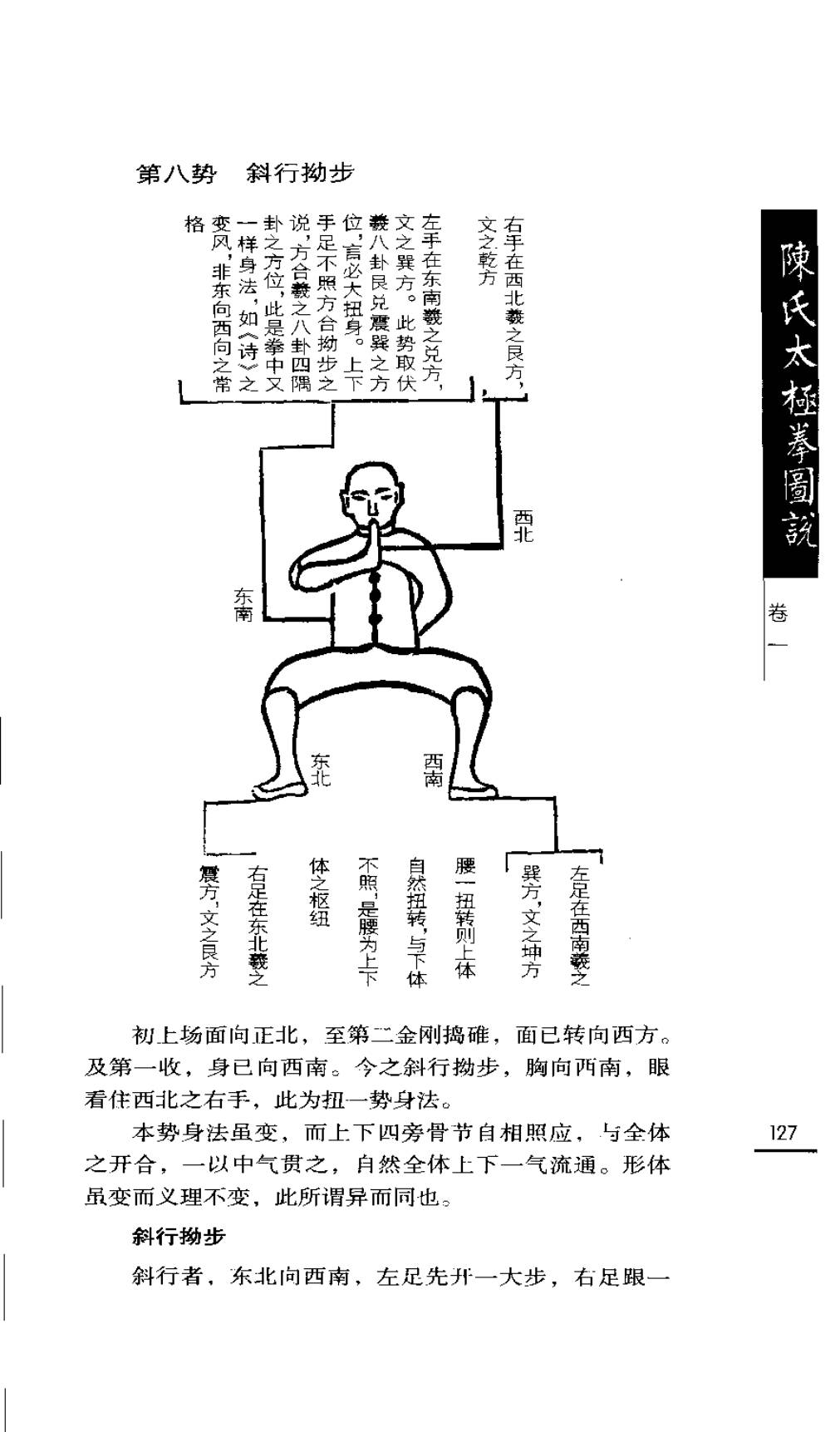
*Chen Shi Taijiquan Tushuo* (page: 128)
Figure: A martial artist in a low, twisted stance: the left foot forward (southwest), the right foot back (northeast); the body faces southwest, waist twisted. The left arm (right side of the figure) reaches forward and slightly up; the right arm (left side of the figure) is bent with the hand near the chest/shoulder.
The body method of this posture is the hardest to depict in a drawing. On paper it is not easy to draw its twisting form — how much harder to depict its *nei jin* (internal energy, 內勁)!
The internal energy winds the left arm first: the upper arm turns in reverse, and although this is against the direction of the force, the energy still coils from the elbow to the fingertips and joins in front. When the right hand turns through a reverse circle and hooks inward, the internal energy coils from inside outward to the fingers and also joins in front. The chest and the two hands join together as one.
Notes at the right of the figure:
When this hand is formed, it folds behind the back.
The left hand is behind, fingers gathered. The left hand faces southeast. The left hand initiates: it brushes past the knee and turns one circle, following the momentum moving toward the southeast, the back of the hand toward the southwest; once past, the back of the hand also turns that way. The upper arm bends like a new moon — slightly curved, not straight; the circle is reversed.
The left foot at the southwest is "front."
The right foot at the northeast is "rear."
Notes at the left of the figure:
The body faces southwest. Twisted waist. Movement issues through the middle.
The right hand is at the northwest; the right hand in front spreads open, fingers held together and not allowed to scatter. When this hand is formed, it folds to the front of the chest.
Text at the left:
The right hand turns in reverse; when the hand hooks inward, the hand moves with conforming energy toward the northwest while the body travels toward the southwest. The circle is reversed. The right hand also initiates by brushing past the knee and turning one circle; following the momentum it hooks once inward, then moves toward the northwest with the right middle finger. The left hand brushes the knee first, the right hand brushes the knee after. The back of the right hand also faces southwest; the gaze fixes on the right hand. The right hand is in front and the left hand behind; at initiation the left goes first and the right after, but once the posture is formed the right is in front and the left behind.
Final paragraph:
...step, placed in front of the foot. Before it settles, the left foot again opens one large step toward the southwest, about two *chi* (roughly two feet) or more, and only then the foot stops, without stepping further forward. Two shorter steps on the left and one on the right — three steps in succession, walking obliquely. "Twisted steps" (*ao bu*) means: left foot at the southwest, right foot at the northeast, right hand at the northwest, left hand at the southeast — hands and feet twist in one posture, left and right hands and feet in different directions. After the initial Closing (shou), the right hand leads, the left hand and left foot lead back slightly by half an inch; then with the left hand above and the left foot below, one large oblique step opens toward the southwest, about two *chi*...
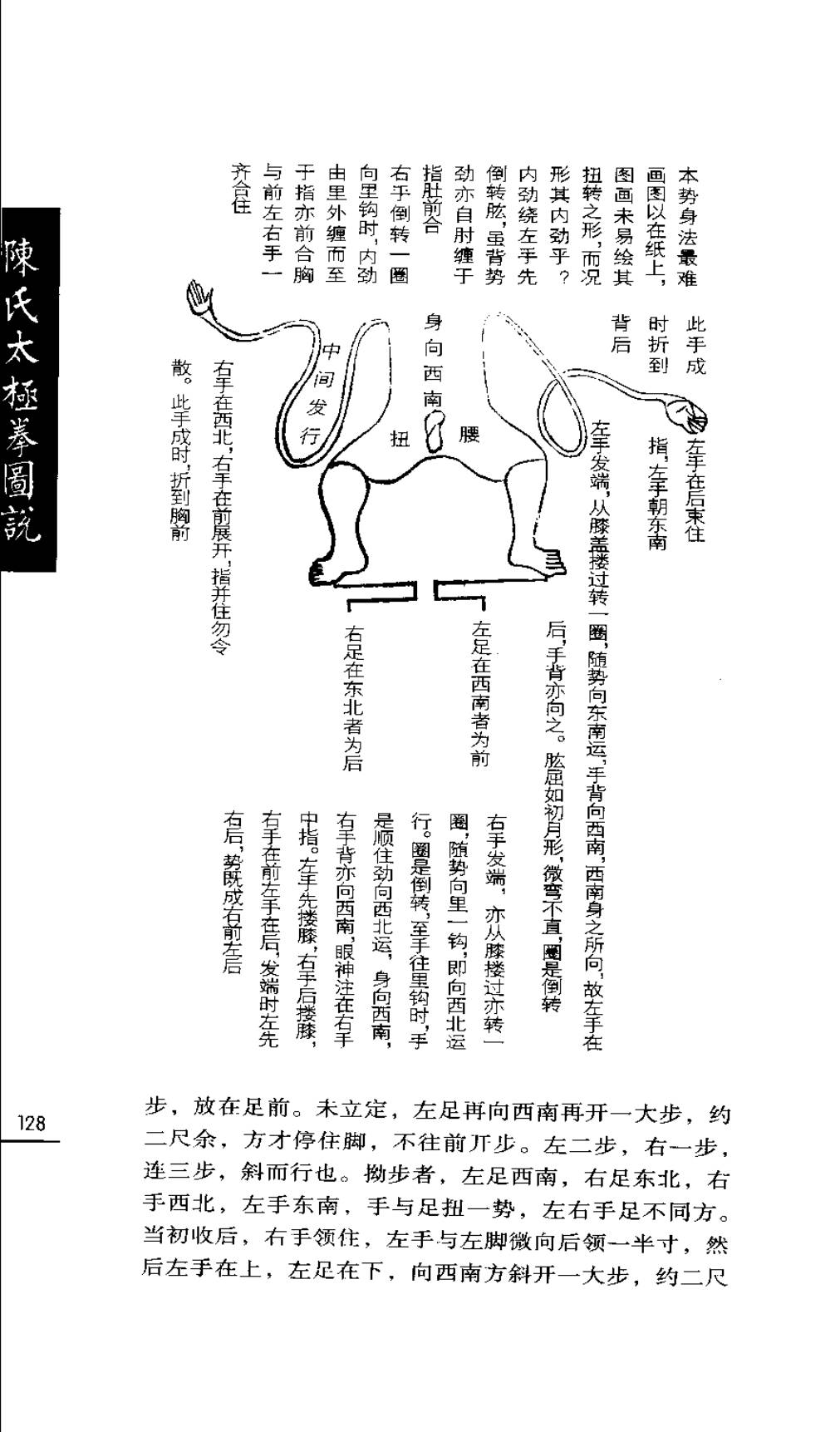
*Chen Shi Taijiquan Tushuo*, Volume 1
...permit. The left hand turns in reverse toward the back; it has turned barely half a circle when — swift as rainwater streaming off the eaves of a house. When the left hand has turned in reverse, brushing the knee toward the rear, the right hand immediately follows the momentum, turning in reverse from above downward, and also brushes the knee going up toward the rear, then to the rear and then to the front. When the right hand goes to the rear, the left hand has already arrived in front. The right hand completes a full circle, using conforming energy (*shun jin*, 順勁) to coil the arm from inside outward and extend it to the northwest. The back of the right hand faces up, slightly toward the southwest, joining in front with the left hand. When the full circle is completed, the energy issues from the armpit, coiling from outside back inward on top. The hand leads the arm; the bend at the back relaxes and opens; the hand joins forward, the fingers are gathered, the fingers hook down a little, and the eyes fix on the right middle finger. The right hand spreads open, the four fingers leaning on one another — do not let them scatter.
The thumb cannot quite rest against the second joint of the thumb, but it should lean slightly against the index finger; then above and below join together as one. For the two hands each do their own work — it is not that the left hand finishes its movement before the right hand begins. When the left hand arrives behind, the right hand starts from the front; when the left hand turns to the front, the right hand also turns from behind to the front — the interval between one and the other is very small. As for extending the arm, the right hand turns one more conforming circle, and only then the arm spreads open; the left hand spreads toward the rear, likewise along its path slowly turning a small circle with the back of the hand and arm; the back-bend relaxes and opens; the crown energy (*ding jin*, 頂勁) and crotch energy (*dang jin*, 襠勁) are full and refined — all as before.
The internal-energy diagram is given below.
Both right and left hands turn two circles; the previous diagram did not show this fully, so it is diagrammed again to make it easy to understand.
Diagram: Xie Chan Fa (Oblique Coiling Method, 斜纏法) — two hand positions with movement trajectories: the upper hand an open palm with fingers pointing down; the lower hand a hook (*gou*) with fingers curled inward; curved lines mark the paths.
- Vertical title at top of diagram: Oblique Coiling Method
- Horizontal annotations above the diagram (fragmentary lines): "...circle, just enough for one..." "...from below to the inside..." "...outward and downward..." "...up, toward..." "...from inside toward..." "Conforming energy is energy..." "...toward, from inside..." "...turning over..."
- Horizontal notes below the diagram: "The right hand reaches up and hooks inward"; "The right hand is first led up from behind."
- Vertical title at right edge of diagram: Diagram of the Right Hand's Internal Energy (右手內勁圖)
- Vertical note beside the upper hand: "This hand issues from the right side, descending like water flowing downhill, very fast."
- Vertical note at the left of the diagram: "Coils again a small circle, hooking inward."
- Inside the upper loop: "hook inward."
(Page: 129)
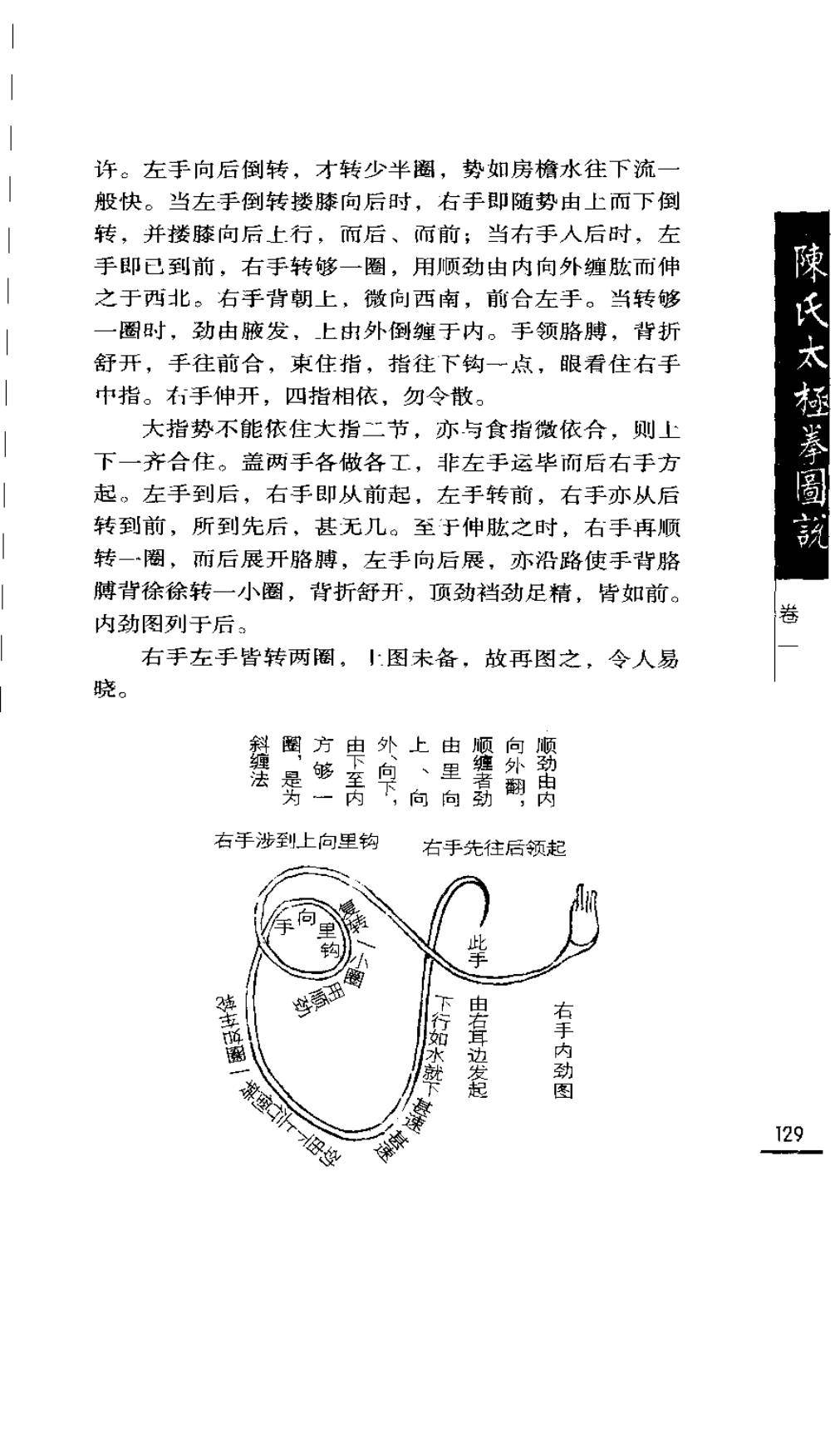
Chen Family Taijiquan Illustrated Explanation (陳氏太極拳圖說)
Xie Xing Ao Bu (斜行拗步, Diagonal Circling Steps) — taking Gen, Dui, Zhen, Xun as images
*Figure of the left hand's internal force (左手内劲图) labels:* 此随 ("this follows"); 左手发端 ("left hand initiates"); 右手向右领寸许 ("right hand leads an inch or so to the right"); 左手没到上够一圈 ("the left hand, not yet arrived above, completes one circle"); 由下行 ("moves downward"); 下流倒转 ("the downward flow reverses and turns").
The force this left hand employs: elbow forward, back of hand forward, the posture like walking along a roof ridge, carrying winding (缠, chan) and extending along the way; the chest is the reverse-winding force. Reverse winding means the force goes from the armpit outward, then from outside to inside, downward and again along the arm to complete one circle — this is also the chest-winding method, winding inward at the belly, downward and again along the arm to complete one circle, also the chest-winding method. The diagonal-winding method.
This is the left hand, which also reverses through a small circle of force; the five fingers bind together.
*Figure of the left foot's force (左足劲图) labels:* 起 ("rise") — 落 ("land").
Gen (艮) is the hands. The right hand is in the northwest; the changed hexagram (文卦, King Wen's line-image) is Qian (乾). Qian means vigor; Gen means stopping. Using the hand to stop things so the enemy cannot invade me is actually accomplished by the qi of centered strength. The left hand is in the southeast: Dui (兑) is the youngest daughter and means breaking and destroying — like the impetuous temperament of a young girl, able to smash things, so the enemy dare not offend, fearing injury. The King Wen image is Xun (巽): as wind, the hand moves as swiftly as wind; as work (工), the hand is skilled in answering the enemy; as "many white eyes," the hand is behind while the mind watches over it, just as the hand can perceive things — knowing the moment they come, seeing even without looking — not merely using the white eyes to be arrogant, but truly having surplus in responding to the enemy. As "gains near the market, threefold profit": when people come near my body they gain much advantage; in the end it is impetuousness (躁). The left hand is behind; once it moves it cannot but be impetuous, and once this spot is impetuous the whole body's hundred bones come to aid it — how much more can one impetuous hand repel the enemy? The left foot is in the southwest: Xun means advance and retreat; the left foot is in front and knows advancing and retreating. The King Wen image is Kun (坤), meaning "devoted to service" — the left foot can follow the upper body as its servant, and gathering much it has great force: one foot like the strength of many, because the few serve the many. The right foot is in the northeast: Zhen (震). Zhen is thunder — striking a person like sudden thunder too fast to cover the ears; it is the dragon — the right foot changes unpredictably like a dragon; it is decided impetuosity — the foot is not content with stillness; it is "treading feet" — this foot constantly wants to move; it is vigor — the right foot's strength is extremely strong. Its King Wen image is Gen: Gen is the mountain — the right foot dwelling in the northeast is stable as a mountain; moreover it is hands and fingers, able to stop a strong enemy's pursuit from behind; it is the "black-beaked one" — the foot trampling a person like a bird's beak pecking, because it has bony strength. In this posture the hands and feet occupy the four corners, each holding one angle, while my mind uses the central qi (中气, zhongqi) to move through the four limbs, each attaining its proper role. It is like commanding troops: when the general has strategy and courage, the three armies naturally win victory. Xie Xing Ao Bu is the surprise force (奇兵): surprising yet never departing from the straight, and therefore it wins.
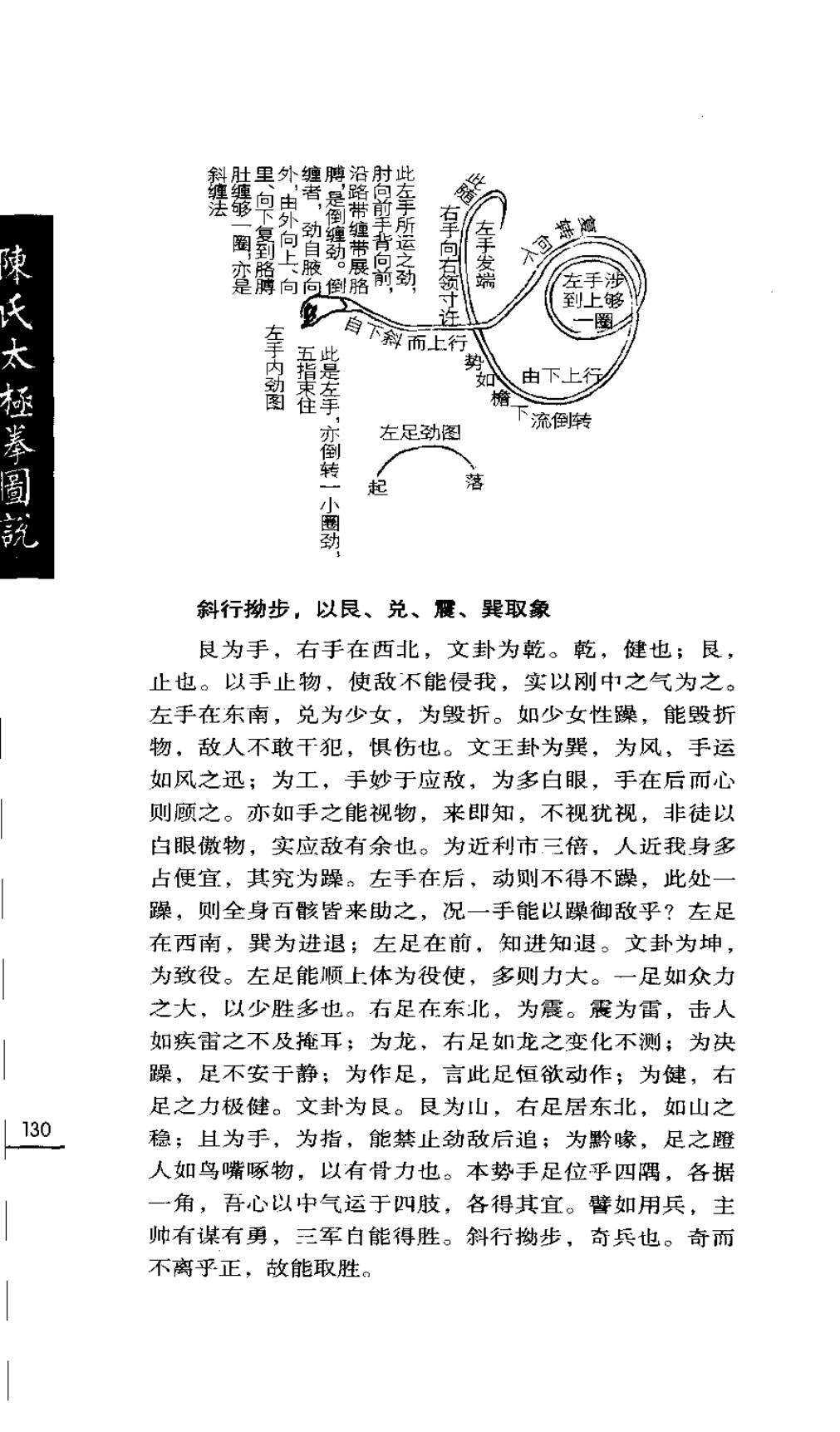
Chen Family Taijiquan Illustrated Explanation, Volume 1 (陳氏太極拳圖說卷一)
Figure labels:
- 左手手背朝上束 ("left hand, back of hand facing up, bound together")
- 伏脉余同 ("hidden pulse; the rest as before")
- 住指,此为下势 ("fingers come to rest; this foreshadows the Lower Posture")
- 右手手背朝外 ("right hand, back of hand facing outward")
- 下腰劲尻微翻起,裆劲自然合住 ("the waist's lower force: the coccyx tips up slightly, and the crotch force (裆劲, dang jin) naturally closes and holds")
- 左足趾点地是虚步,为下势伏脉 ("left toes touching the ground make the empty step — the hidden pulse for the coming Lower Posture")
- 右足正脚平实踏地,是实脚,是主 ("right foot placed squarely, flat and solid on the ground — the solid foot, the principal one")
*The figure shows a man in a low bow-like stance: right leg straight and planted flat (solid foot), left leg bent with only the toe touching the ground (empty step), both hands raised near chest level.*
The Ninth Posture: Zai Shou (再收, "Gathering Again")
The internal force (内劲, neijin) runs; we want it to be fully, ten-tenths sufficient. When the force is not yet sufficient, it still runs like moving one foot — and thus the mechanism of the coming Lower Posture (下势) is set in motion. This is the natural tendency and natural principle of yin at its extreme giving birth to yang. The gaze fixes on the right hand; the crown force (顶劲, ding jin) leads the chest so they unite — this is a key point of the boxing arts; the bone joints above and below each correspond to one another.
In the previous posture, Initial Gathering (初收), the face was toward the southwest, the feet also toward the southwest, left first and right after, stepping three steps diagonally, the chest settled toward the southwest as this posture halts. After Xie Xing Ao Bu (斜行拗步), in this Gathering Again, the face is toward the northwest, yet the spirit attends to the west. The fist strikes along one line; the intention is that the coming Lower Posture must correspond in position with the earlier Brush Knee and Twist Step (搂膝拗步), and only then is it correct. The right hand revolves smoothly; the left hand revolves smoothly along with it in one circle; the right fingers spread then draw together, coming to rest in front of the right ear, seven or eight inches from the body, and stop. The left fingers bind together and come down above the left knee, five or six inches from the knee, seven or eight inches from the body, stopping together with the right hand — appearing to stop yet not solidly stopped.
Verse in Seven-Character Common Speech (七言俚语)
斜腕吊踝真难看,此中自然有高见。
妙手空空从何来,太极图中贵善变。
善变神机无滞形,功夫归根在百炼。
百炼真金金有光,金光闪闪如震电。
此是功成最后境,当初谁是真先难。
日日先难难无尽,难尽易来小神仙。
(Steep wrists and hanging ankles truly look awkward, yet within this there is naturally lofty insight. Whence comes the marvel-hand, empty and free? In the Taiji diagram the excellence lies in skillful change. Skillful change: the spirit's mechanism has no sluggish form; the root of gongfu lies in being tempered a hundred times. A hundred-tempered true gold has its glow; the golden light flashes like startling lightning. This is the final realm of accomplished skill — at the start, who truly met the hard first? Daily the hard comes first and hardness is endless; when hardness ends and ease arrives, one becomes a minor immortal.)
Verse in Seven-Character Common Speech (continued)
初收转圈自然好,未若此圈十分巧。
(In Initial Gathering the circling is naturally good, yet not equal to the subtlety of this circle — the circle is the whole body turning, not merely hands and feet; but hands and feet, being on the outside, are easily seen, hence the turning is described in terms of the hands.)
前所转圈犹嫌大,
(The circle turned before still seemed too large,)
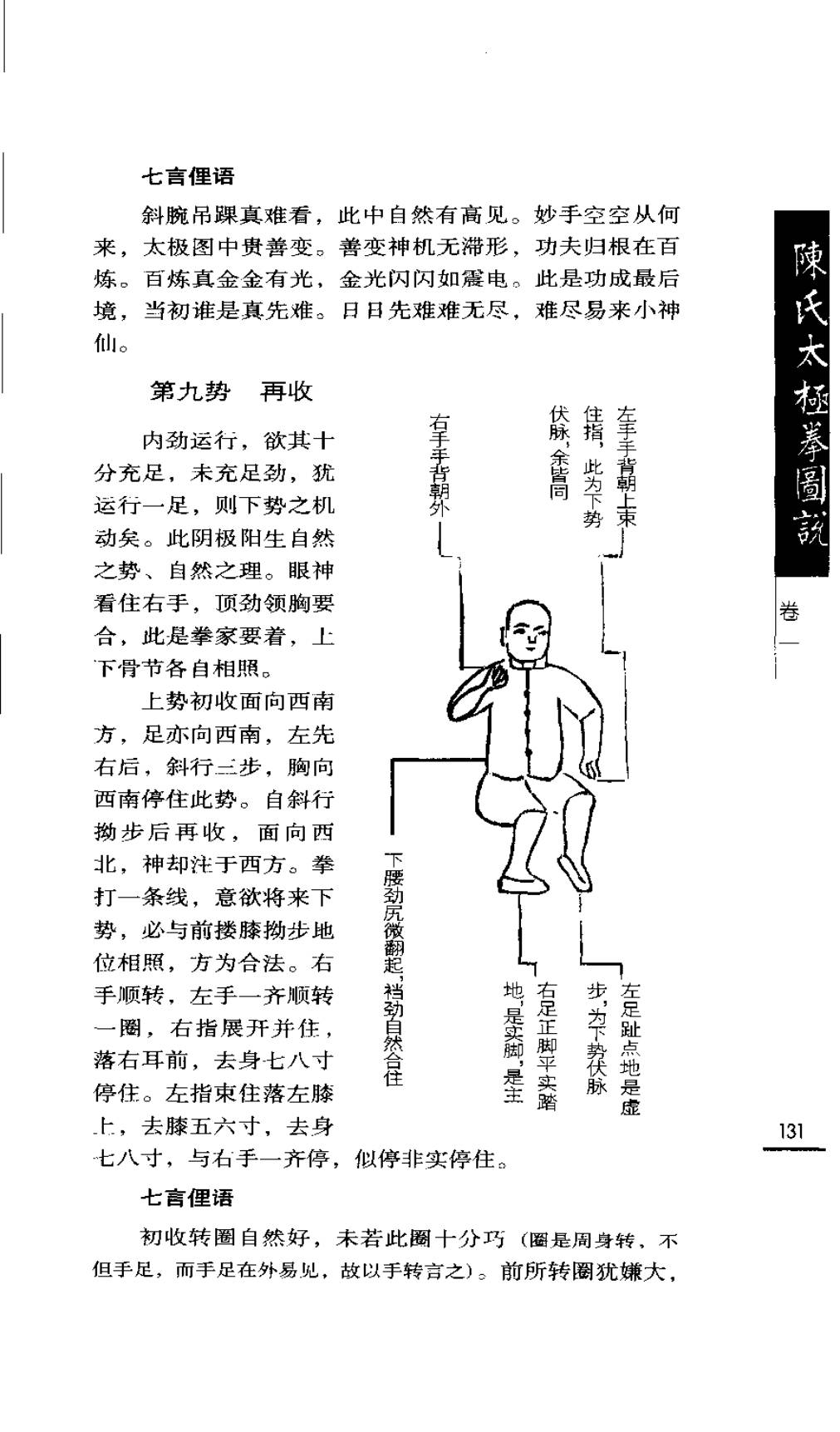
Verse on "Second Gathering" (Yan Shou) — linking what comes before and after
As this circle turns, it grows ever smaller. When it diminishes until there is no circle at all, it returns to the true divine marvel of Taiji.
People say this art depends on secret formulas, and often will not reveal them to others. I say this art is nothing strange:
From youth one must practice until old age. Practicing into old age, one naturally awakens — suddenly unified, the spirit and principle are marvelous.
Looking back on times of laziness, it was not that the wise teachers had not spoken. It was spoken, but it never entered my heart,
and my heart instead felt only much vexation. Day after day it was said, day after day forgotten — if one does not apply the mind, when will one ever understand?
If one day you can exert effort in seeking, the waxing and waning of yin and yang will show their truth. Each day study the Taiji diagram carefully:
one opening, one closing, is within my own body. Advance step by step, and the work grows long; in time you will naturally smell true fragrance.
As long as your effort is long and uninterrupted, Taiji everywhere reveals its circular radiance. This is the true formula within the fist —
try measuring it carefully with a calm mind.
Second Gathering (Yan Shou zai shou 再收) — instruction
The First Gathering (chu shou 初收) originally follows Brush Knee; the Second Gathering tightens, connecting with the Diagonal Posture (xie xing 斜行). Once the body turns to face forward, the fist is raised and the right hand performs its role.
Taking the Image (qu xiang 取象)
In this posture the whole body is bent/contracted; only the right hand is up, the fingers still at a slant, the elbow also bent. Thus the many yin harm the yang, and only one breath remains — many petty men harming one noble man, the situation nearly perilous. This is like the Bo 剝 hexagram of the Yi Jing: from foot to belly only one great fruit survives, yet the living potential is not extinguished; therefore the image is taken from Bo 剝 (Splitting). In the Bo hexagram, the inner lines: the second and fourth (lines) form the pattern of Kun 坤 opposed to Qian 乾; the third and fifth likewise form Kun opposed to Qian — all retain the virtue of central firmness within. Since the lower body is all strength, why fear a dangerous situation? The Xiang says: "The mountain rests upon the earth — Bo (Splitting). Those above thereby thicken the base and secure their dwelling." This means the noble man does not prey upon his people, and thereby secures his own position.
Chen Family Taijiquan Illustrated Explanation, Volume 1 (陳氏太極拳圖說卷一)
The Tenth Posture: Qian Tang Ao Bu (前堂拗步, "Front Hall Twist Step") — first half
"Front Hall" (前堂) means the foot moves toward the front face of the hall. The previous posture was diagonal, its step-position not square; now it turns to face squarely forward.
Figure labels:
- 左手由里而上、而外转过来,五指向地,如水就下势 ("the left hand comes from inside upward, then turns over to the outside, five fingers pointing to the ground, like water taking its downward course")
- 右手亦是由内向下、向外上行,由上下向里转一圈,手往下刺,如瀑布下锐流势猛不可当 ("the right hand likewise goes from inside downward and upward along the outside, turning one circle from above to below and inward; the hand thrusts downward like a waterfall's sharp descending current, fierce and unstoppable")
- 腰贵大弯,随左足开步,上随左手运转,侧棍肩带,上体往下刺,亦如瀑布往下流,又如猛虎下山势 ("the waist prizes the great bend; as the left foot opens the step the upper body follows the left hand's turning; the torso thrusts downward like a waterfall flowing down, and again like a fierce tiger descending the mountain")
- 前开第二步 ("second step opened forward")
- 点住地,必待左足趾地,而后向 ("touching and holding on the ground; one must wait until the left toes reach the ground before turning")
- 右足先是平实踏地 ("the right foot first presses flat and solid on the ground")
- 点住地,待右足至至而后平踏,如前有深渊,说回即收回,至虚至灵 ("touching the ground; wait until the right foot arrives, then tread flat — as if before it were a deep abyss; when told to return it withdraws at once, utterly empty and utterly spirit-like")
- 左足抬起顺转半圈,开步先使足趾 ("the left foot lifts and turns smoothly through half a circle; in opening the step first employ the toes")
*The figure shows a man in a low semi-squatting stance, left hand low with fingers pointing downward, right hand raised near the chest as if thrusting downward.*
The left foot follows the left hand around one circle inward and outward; the foot opens one step toward the northwest; the right hand follows the left hand around one circle as well; the left foot lightly touches and holds on the ground; both hands are like a fierce tiger descending the mountain.
The previous posture took Bo (剥, "Splitting Apart") as its image; this posture takes Fu (复, "Return") — yin at its extreme gives birth to yang. If the great fruit does not remain, yang cannot be born of the great fruit: when it perishes above, yang is born below. Moreover, within Bo all the lines are Kun (坤); Kun reversed is Qian (乾) — yang has not yet ceased. Thus in the previous posture the hand was above like the great fruit; Kun reversed into Qian is like the central qi (中气, zhongqi) held within. When the left hand and the right hand turn over together, yang is born — this is exactly the image of "return after seven days." This diagram is yang's first stirring, having the images of "return not far" and "resting return"; the second step carries the image of "repeated return."
The left foot opens the step, and the left side of the body revolves with the left hand through one great circle, like a wheel; the right hand revolves like the left hand.
Here the left hand is in front, revolving smoothly like waterfall water. The left foot opens the step as the hand circles —
Figure of the internal force (内劲图)
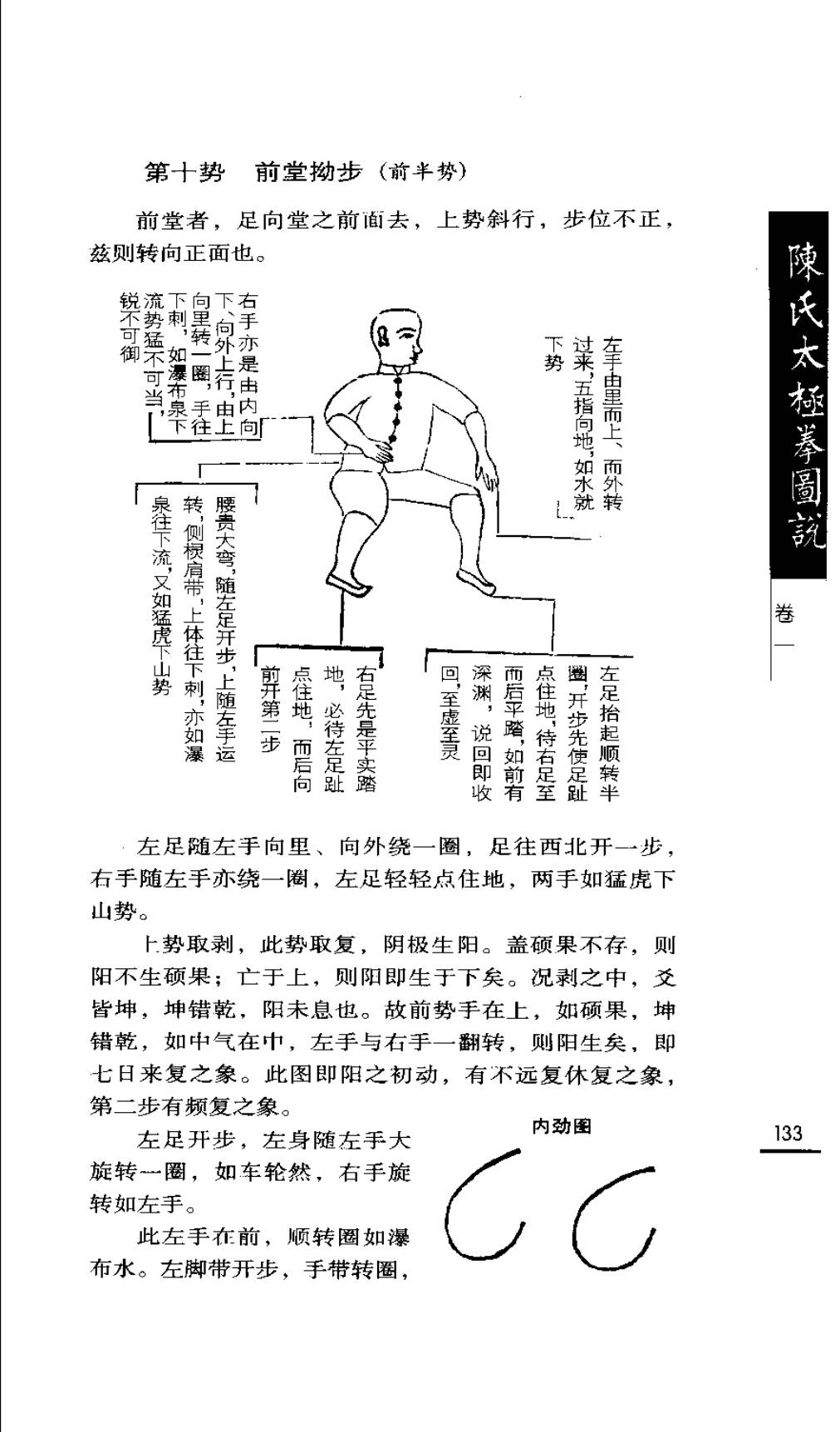
Chen Family Taijiquan Illustrated Explanation, Volume 1 (陳氏太極拳圖說卷一)
Moreover, the left foot likewise follows the left hand in circling — it is not a step straight forward. Here the right hand and left hand move together: this one below, that one above, mutually rising and sinking without pause, alternating in their movement. The left foot opens one step, the left hand brushes the knee, the hand circling; the right foot follows one step, the right hand brushes the knee, the hand turning smoothly in a circle.
Qian Tang Ao Bu (前堂拗步, Front Hall Twist Step) — second half
The third step: from the second step, the right hand has only just come down brushing the knee, when the left hand turns at once from behind to the front, using the back of the forearm (背扦) with reversed-turning force to spread open behind, reversing through a small circle. The left foot, with the left hand, opens one great step toward the west; the right hand stays behind, gripping with the head hanging (搦住垂头).
At this point the rear hand has not yet been lifted — this is depicting the world of Front Hall Twist Step. The moment it is lifted, one enters the Lower Posture (下势); the momentum within this movement has reached the point where it cannot but lift.
Figure labels:
- 右足在后如蹬 ("right foot behind, like a pushing kick")
- 左足在前如撑 ("left foot in front, like a brace")
*The figure shows a man in a low wide stance: left foot extended forward bracing, right foot back pressing; left arm raised high with open palm, right arm extended at shoulder level with open palm.*
This is the second step of Front Hall Twist Step. With the Lower Posture's Finished-Hand Fist (演手捶, yan shou chui) it runs as one qi, never halting — carrying the images of "the solitary return of the middle way" (中行独复) and "sincere return" (敦复). In the fist there is purely the vast flood-like qi (浩气, haoqi), flowing through the whole body, its momentum unarrestable. The Image says: "Thunder is within the earth" (雷在地中). The left hand is in front — whether spreading open or hooking the fingers together, either is acceptable. The right hand behind grips the fist (捶); before the hand is finished, it already has the posture of wanting to finish the hand and strike a person — its form like thunder lying hidden within the earth.
Song says (歌曰)
前堂须与金刚照,亦是拳中最紧要。缠法一切皆如前,观图自然会其妙。
(Front Hall must correspond with the Buddha's Guardian (金刚, jingang); this too is among the most essential in the fist. The coiling method (缠法, chanfa) — all is as before; observing the diagram, one naturally grasps its subtlety.)
Second verse (其二)
二次收来不须长,提回两足在一方。上从下行开三
(Gathering a second time needs no length; lift back so both feet are on one side. Above, from the downward movement, open three…)
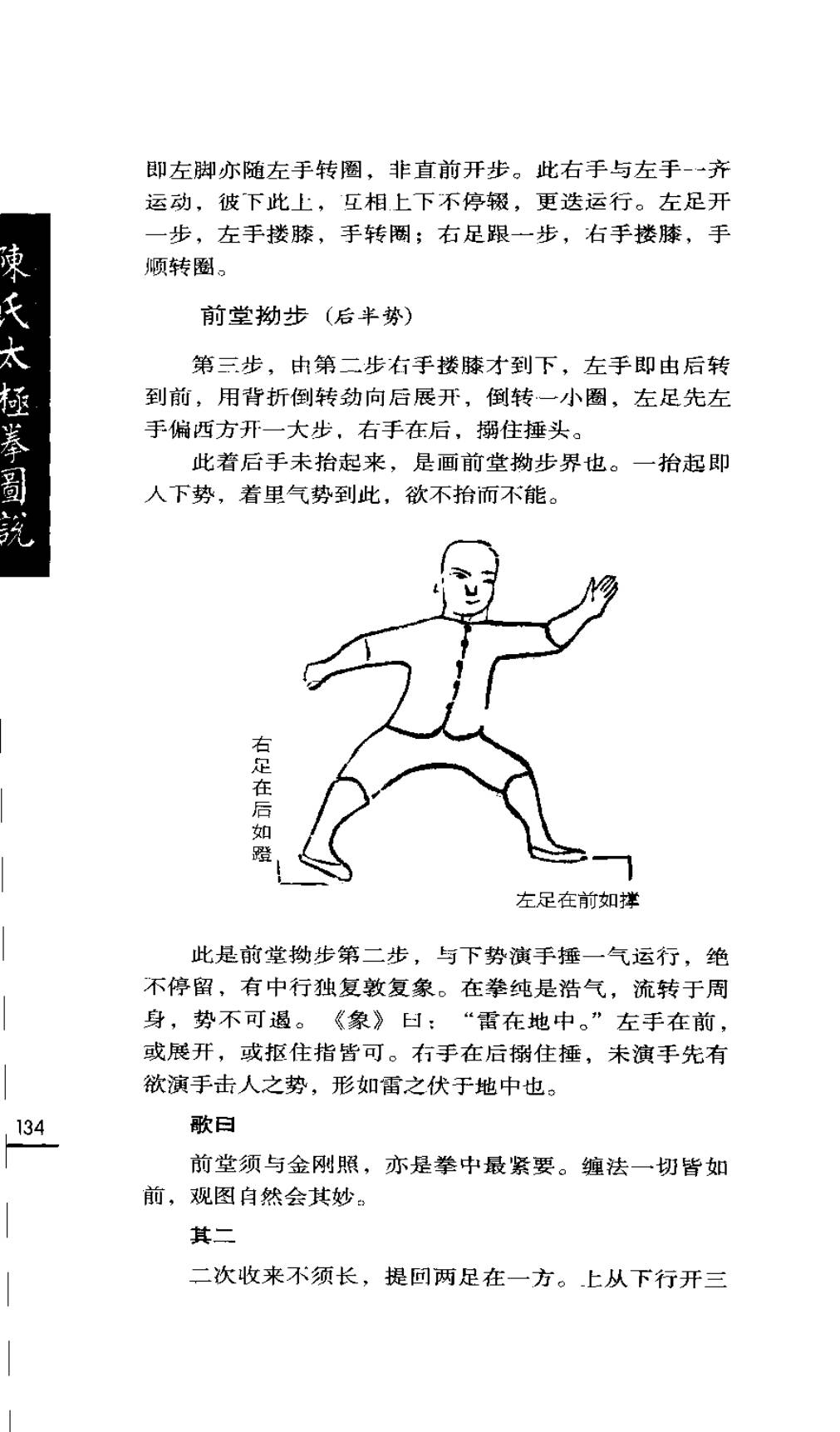
Chen Family Taijiquan Illustrated Explanation, Volume 1 (陳氏太極拳圖說卷一)
…step, and connect below to the Finished Hand at the Front Hall (前堂). The Front Hall pressed step resembles the Diagonal (斜行), turning to stand at the northwest center. The right below joins with what is above; the spirit is concentrated; the foot presses flat on the ground like a wall of bronze.
The left hand brushes the left knee, having just turned smoothly backward half a circle; the right hand leads while the right foot follows one more step, passing beyond the left front — the right hand makes a reversed-turning circle; the right hand brushes the right knee. This is the second step.
Diagram of the Second Step, Left and Right Brush Knee (第二步左右搂膝图)
Figure labels:
- 右手起 ("right hand rises")
- 右手搂膝 ("right hand brushes the knee")
- 左手起 ("left hand rises")
- 左手搂膝 ("left hand brushes the knee")
*The figure shows two semicircular arcs: the left, wider arc (opening upward) traces the right hand's path — rising, then brushing the right knee; the right, flatter arc traces the left hand's path — rising, then brushing the left knee.*
Eleventh Posture: Punch with the Forearm (第十一势 演手肱捶, yǎnshǒu gōngchuí)
Figure labels (the drawing shows a low bow stance — front left leg deeply bent, rear right leg straight with foot planted; left arm extended forward with open palm, right arm bent with fist at the ribs):
- 前手是左手展开,即抠住亦可 ("The front hand is the left hand spread open; hooking-gripping with it is also acceptable.")
- 顶劲领住 ("The crown force (dingjin) is led and held.")
- 背用中气贯住劲,微扭一势 ("The back is threaded and held by the central qi (zhongqi), with a slight twist of the posture.")
- 前胸合住 ("The chest is closed and held.")
- 在后是右手,手背朝上合住劲,用缠丝法 ("Behind is the right hand, back of the hand upward, holding the force closed, using the silk-reeling method (chansifa).")
- 左膝屈住不可软 ("The left knee is bent and held; it must not go soft.")
- 左足趾向西北,足后踵不掀起,要塌实地 ("The left toes point northwest; the heel must not lift — press solidly into the ground.")
- 裆尤要虚,虚则回转皆灵 ("The crotch (kua) must above all be empty (xu); when empty, all turning is agile.")
- 右膝微屈,愈不可发软 ("The right knee is slightly bent, and even more must not go soft.")
- 右足蹬住地,如用力蹬重物 ("The right foot presses against the ground as if forcefully kicking a heavy object.")
- 腰劲要下去,下去腰劲,两膝撑开,裆合住要圆、要虚,自然下体又虚又灵又稳当,摇撼不动 ("The waist force must sink down. With the waist force down and both knees braced apart, the kua held closed — round and empty — the lower body is naturally empty, agile and stable, unmoved by shaking.")
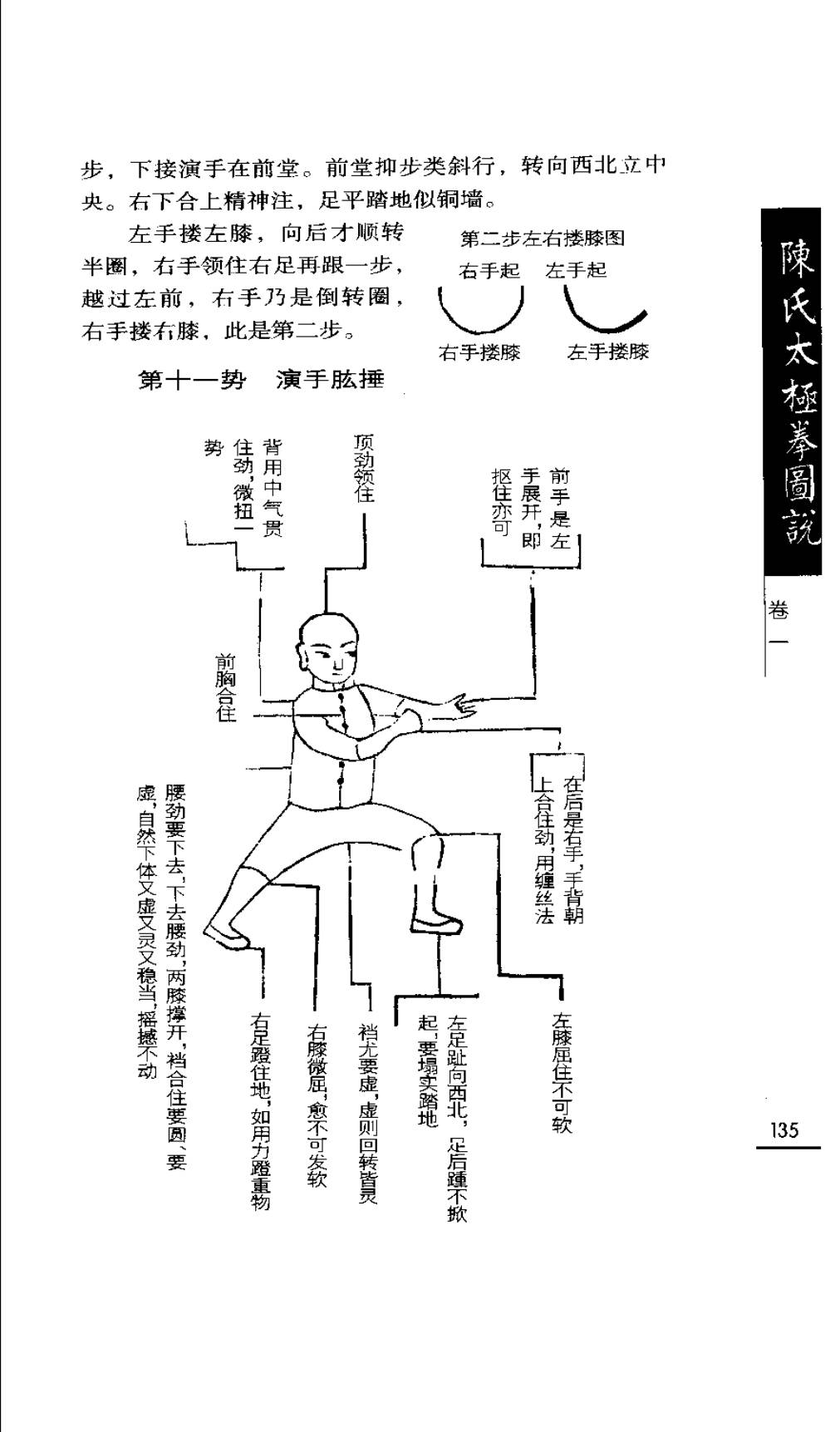
Chen Family Taijiquan Illustrated Explanation, Volume 1 (陳氏太極拳圖說卷一)
Diagram of the Step Positions of Xie Xing Ao Bu (Diagonal Twist Step) and Qian Tang Ao Bu (Front Hall Twist Step) (斜行拗步与前堂拗步步位之图)
Figure labels:
- 西 (west), 东 (east), 南 (south), 北 (north)
- 地位 ("ground position")
- 初收 ("First Gathering" — the First Closing)
- 再收 ("Second Gathering" — the Second Closing)
- 左足开步至此止 ("The left foot opens a step, stopping here.")
- 右足次开步至此 ("The right foot next opens a step to here.")
- 再次仍是左足开步,开一大步约一尺余 ("Again still the left foot opens a step — one great step of about a chi and more.")
- 左足向西北开步至此 ("The left foot steps open toward the northwest to here.")
- 西南方第三步左足至此止,初收步位在此,再收地位亦在此 ("Third step southwest, left foot stops here; the First Gathering step-position is here, and the Second Gathering ground-position is also here.")
- 再次又是左足开一大步,二尺有余 ("Again the left foot opens one great step of over two chi.")
- 次右足开,开到左足边 ("Next the right foot opens, opening to the side of the left foot.")
- 初收地位第一步开步一尺有余,向西南方左足先开 ("At the First Gathering ground-position, the first step is a chi and more, opening southwest with the left foot first.")
Hand-posture diagram (two hands in a pressing position with curved movement lines):
- 左手不丢 ("The left hand is not lost/abandoned.")
- 右手领劲 ("The right hand leads the force.")
- 左臂屈收 ("The left arm bends and gathers in.")
- 右臂屈收 ("The right arm bends and gathers in.")
- 左手 ("left hand"), 右手 ("right hand")
The left hand is in front, slightly hooking-gripping, the wrist facing west to serve as the counterpart posture for the right hand. The right hand rises from below, going upward, then backward, then forward again, striking into the middle of the left wrist. The back of the right hand faces upward, closing downward to strike, with force. Yet if the right hand greedily strikes forward, it is not as good as having both hands outside the left flank, some seven or eight cun from the ribs: then the right hand holds the force closed, uses the whole body's total force, and strikes with seizing force (najin), revealing no roughness — only then does it accord with the rules. Asked: whence does this force issue? Answer: the right foot is planted well; the force goes from the heel, over the calf, up along the spine, threading to the right shoulder and arm as it turns, moving from the back of the arm across to the back of the hand — hence closing the force in makes the strike powerful. Yet although the force rises from the heel, its use fundamentally lies in the heart-mind: the moment the mind stirs, the central qi (zhongqi) at once goes from the dan… [continues]
136
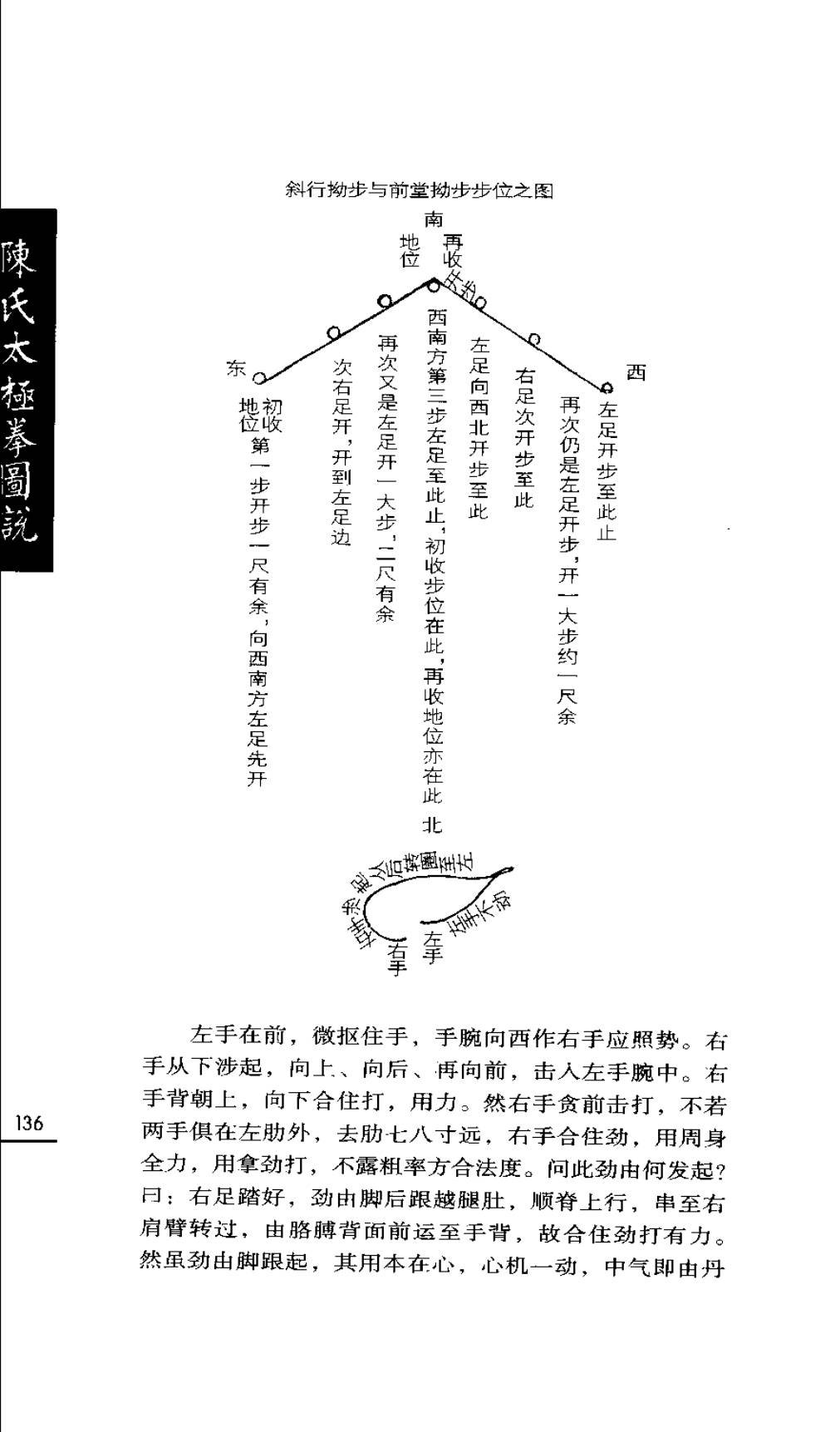
*Chen shi taiji quan tu shuo* (陳氏太極拳圖說, Illustrated Explanation of Chen-Style Taijiquan), Juan 1 (卷一, Volume One).
From the moment the force issues until it reaches the hand, the whole body's strength gathers there. As for striking an opponent, it depends on his distance. At a distance you can extend the arm to reach him; up close the arm cannot extend, so use the bent elbow with a combined chui (捶, fist/thrust) — this is extremely restrained (hanxu, 含蓄), showing no outward trace at all, and the one struck simply falls down. This is the highest grade. Striking from afar is easy, striking up close is hard, so one must put in much extra work to accomplish this.
Qu xiang (取象, Taking the Image)
The previous posture took Fu (復, Return) — yang at its first arising. This posture takes Zhen (震, Thunder/Arousing): "thunder within the earth" must in the end burst forth outward; thunder above, thunder below — the whole body becomes like thunder that cannot be approached, and the hand is its most conspicuous expression. If it does not strike, nothing happens; once it strikes, "thunder startles a hundred li." Further: the right hand in advancing can strike, in retreating can defend, and externally can serve as the body's chief force. It is said: "Startling a hundred li — the far are startled and the near are afraid." Going forth, one can guard the ancestral temple and the altars of state, acting as the master of sacrifice — is this not precisely the image of Yanshou hong chui (演手肱捶, Wrapping Hand Forearm Fist)? It is on this basis that the image is taken.
Qi yan liyu (七言俚语, Seven-Character Folk Verse)
炼就金刚太极尊,浑身合下力千斤。
劝君智勇休使尽,剩下余力扫千军。
Forged into the Diamond (Jingang, 金刚), the honored one of Taiji — the whole body, when combined below, has the strength of a thousand catties. I urge you: do not exhaust your wisdom and courage; keep the remaining strength to sweep away a thousand armies.
Posture 12: Jingang Dao Dui, third time (金刚捣碓第三, Diamond Pounds the Mortar)
First withdraw the right foot level with the left foot, facing west, then turning north; the two hands circle and wheel as if flying — left empty, right full (音足也 [as given in the text]). You must remember this: only when the Diamond pounds three times can it be called marvelous. Lift up Kunlun (昆仑, the sacred mountain), part open the abyss's depths; standing dignified and alone, the countenance of the spirit solemn and serene, the bearing august and grand; chaos and void-spirit possessed in one heart, the myriad images stored in the five skandhas (五蕴), still and unmoving like a simpleton. Who knows that yin and yang are united in this body? Let people from the four sides and eight directions approach — it is hard for them to get near. Even if the brave and fierce, superior in strength, suddenly come to invade, some topple, some fall — none can fathom this spirit. And further: to go is hard to go, to advance is hard to advance, like standing on a round stone where one cannot stand steady — truly perilous. Regret inevitably follows a fall; is there another method? Only that the gongfu (功夫) be pure — everything depends on one opening and one closing, one stroke sweeping away a thousand armies.
*[Diagram: a standing martial artist in traditional Chinese attire, hands clasped in front of the body, feet together. No text labels on the diagram.]*
(Printed page number: 137)
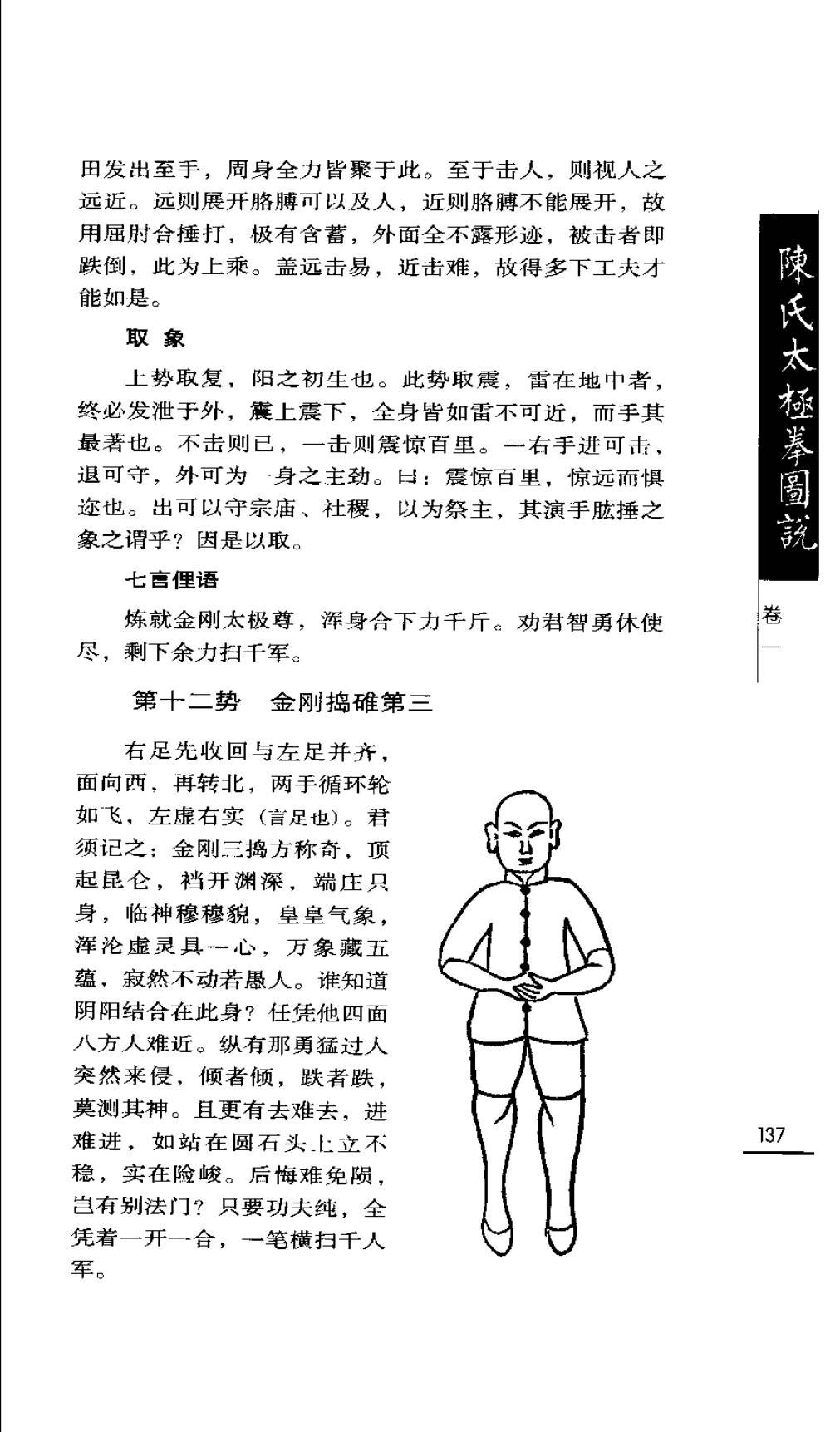
*Chen shi taiji quan tu shuo* (陳氏太極拳圖說).
Upper caption: "The left hand, in front of the chest, circles one loop from outside to inside; the hand is slightly bent, the wrist facing upward." — "Diagram of the paths followed by the left and right hands in Posture 12, Jingang Dao Dui (金刚捣碓, Diamond Pounds the Mortar)."
Vertical annotations beside the upper diagram (right to left): "The right chui (捶, fist) also comes from the east… circles left, returns to the chest, from the outside coils one large loop… in the left wrist the right fist lands."
Upper diagram: an arched label reads "Supplementary diagram of the movement path of the second Jingang Dao Dui" (补第二金刚捣碓运行图). Labels on the figure: zuo shou (左手, left hand) and you chui (右捶, right fist) on the upper coil; you shou (右手, right hand) on the middle coil; zuo zhang (左掌, left palm), you chui (右捶), and zuo zhang (左掌) on the lower coil.
Caption between the two diagrams: "Diagram of the right foot's movement for this third Jingang Dao Dui."
Annotations around the lower diagram: "The toes of the left foot twist once toward the northwest; as the heel turns the toes return to facing due… south; the foot withdraws beneath, behind the right foot… coils from below upward, level with the left… loop… east… the right hand coils from outside the left hand, circling together with the left hand… you chui (右捶, right fist)."
Lower diagram: an arched label along the upper coil reads "Diagram of the hand's movement, returning through four loops" (四圈些回运行手图). Labels: xiong (胸, chest), zuo shou (左手, left hand), wai (外, outside), the directions nan (南, south), bei (北, north), dong (东, east), you chui (右捶, right fist), and zuo shou (左手, left hand).
Explanatory text at the bottom:
Jingang Dao Dui has already appeared twice — why repeat it again? Because the second Jingang follows Dan Bian (单鞭, Single Whip), with the forearms spread wide open; to close what has been opened, nothing is easier than closing with Jingang Dao Dui. Therefore using Jingang Dao Dui to combine the combination also takes the meaning that "things reverse when they reach their extreme" (wu ji bi fan, 物极必反). This Jingang Dao Dui follows Yanshou chui (演手捶, Wrapping-Hand Fist), in which the spirit-energy (shenqi, 神气) has all scattered outward. Yet although the stance is spread wide, fortunately the two hands are gathered in one place. As soon as the heel of the left foot shifts slightly to face due north, the two hands go from above downward and from inside outward, then rise again, circling together; the right chui lands in the hollow of the left wrist, four or five cun (寸) from the body, and the right foot also turns along with what is above. The foot and the hand come down together…
(Printed page number: 138)
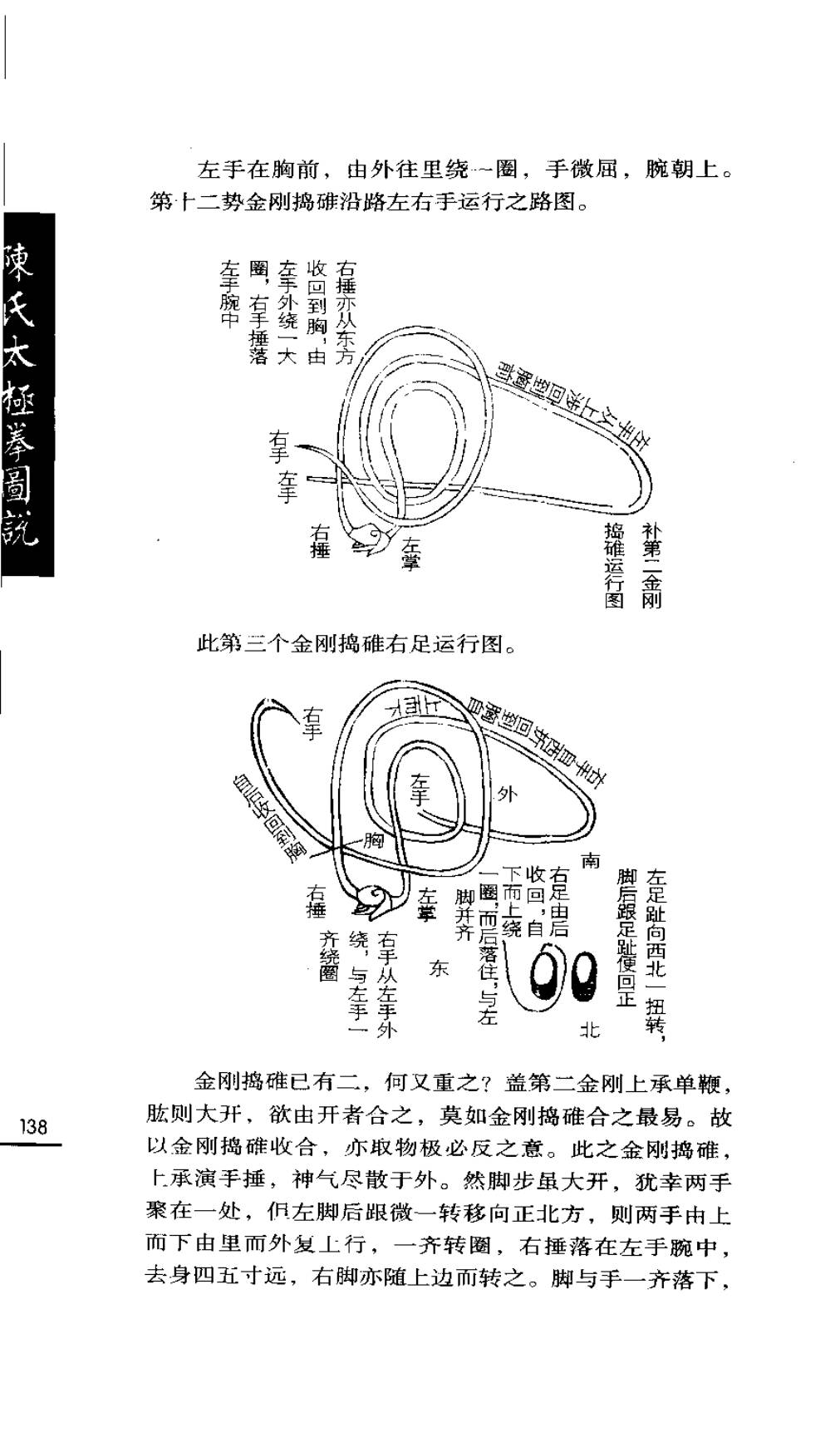
Chen Family Taijiquan Illustrated Explanation, Volume 1 (陳氏太極拳圖說卷一)
…held closed with essence (jing); compared with before this is somewhat easier. What has long been scattered must gather; what has long opened must close — this is truly the natural closing and opening (hepi) of yin and yang. Therefore it is followed by the Buddha's Guardian Pounding the Mortar (金刚捣碓, Jingang Dao Dui): on the one hand, the complete spirit is gathered so that when one wishes to change the posture one naturally feels it agile; on the other, it returns to the original image of taiji, to show that the myriad differences all issue from one root. As for internal force and outward method, all has been said before — no repetition.
On the Image (取象)
The preceding posture — "thunder startles for a hundred li, nothing can withstand it" — what exhilaration! Hence Jingang Dao Dui takes the image of Yu (豫, Delight/Enthusiasm). If a person can preserve and unite Supreme Harmony (太和), he is at ease wherever he goes — this is the great attainment of "following Yu." How much more so "as firm as a rock, not waiting the whole day." In all affairs, follow the moment and move with it, harboring no impulsiveness or recklessness, and one can always abide in one's joy. If the time has not yet arrived, quietly nourish one's natural innocence. That this fist still returns to the original image of taiji — vast and unfathomable — what joy can match it?
The first Jingang faces north; the second Jingang turns to face west; the third Jingang again faces north. The body method is upright and settled, never leaning. Gather in the spirit; there is no other secret — a calm mind and harmonious qi and it is attained.
139
Chen Family Taijiquan Illustrated Explanation (陳氏太極拳圖說卷一)
*(Blank page; only the spine strip 陳氏太極拳圖說 and the printed page number 140.)*
Quyển II — Các Thế / Volume II
Chen Family Taijiquan Illustrated Explanation (陳氏太極拳圖說)
Volume Two (卷二)
*(Volume-two title page: large characters 陳氏太極拳圖說 卷二; printed page number 141.)*
Chen Family Taijiquan Illustrated Explanation (陳氏太極拳圖說)
*(Blank page; only the spine strip 陳氏太極拳圖說 and the printed page number 142.)*
Posture 13: Bishen Chui, first half of the posture (庇身捶前半勢圖 — Bìshēn chuí qiánbàn shì tú)
Volume 2, *Chen Shi Taijiquan Tu Shuo* (陳氏太極拳圖說, Illustrated Explanation of Chen-style Taijiquan).
This figure continues from Jingang Dao Dui (金剛搗碓, "Buddha's Warrior Attendant Pounding the Mortar"). After stepping, first open the right foot in a large step of about four to four-and-a-half cun (四四五寸); then sink the right shoulder forcefully downward, passing the right shoulder beneath the right knee — only then is the form correct. This is what is called the "seven-inch lean" (七寸靠, qī cùn kào), extremely difficult, extremely difficult. Nowadays there is no one who can do it — even this figure is only approximate: the right shoulder has already passed beneath the knee and is rising again, not the moment when the shoulder passes directly under the knee. As for the hands: some first brush the knee with the right hand, circling a great circle from the east, gripping the fist (搦捶) to land beside the forehead; then the left hand brushes the left knee, reversing through a great circle, the hand landing at the waist, propping the waist — this is one variant. In another, the right and left hands separate downward together, the right hand forward, the left hand back, the hands landing as described above — this is another variant; this figure follows the latter.
This figure shows the body method (身法, shēn fǎ) in the first half of Bishen Chui; the movement must not pause the qi mechanism (气机). Because the seven-inch lean technique is included, a figure is given to show it.
With the upper body down low, the spirit at the crown (頂勁, dǐng jìn) and the central qi (中气, zhōng qì) must all the more not be lost; the crotch (襠, dāng) and waist sink down, the foot presses the ground with force to fix the root. The lower the body method goes, the better — the right shoulder almost touches the ground, only seven inches high. If an enemy in front presses down on my head, put the right foot inside the enemy's crotch, place the right shoulder against the enemy's lower abdomen, and use shoulder force to lift upward once (挑, qiao, departing tone); the enemy will fly up and fall down.
Section explanation (節解, jié jiě)
- The left elbow and right elbow join their jin (合住勁).
- The elbow tip points yet further forward.
- The gaze watches the toes of the left foot.
- The chest faces north; the back faces south.
- The crown jin is well led; the central qi must sink down through to the tailbone (尻骨).
- The right fist and the left hand join their jin between the left knee.
- The chest must be contained; use joining jin (合勁) to join it.
Note: the page has two figures. The upper shows the low body position of the first half of Bishen Chui — upper body sunk, right shoulder near the ground at about seven inches (the "seven-inch lean"). The lower figure (jie jie) carries the labels transcribed above. One or two characters were unclear in the scan and are noted as such in the Chinese file.
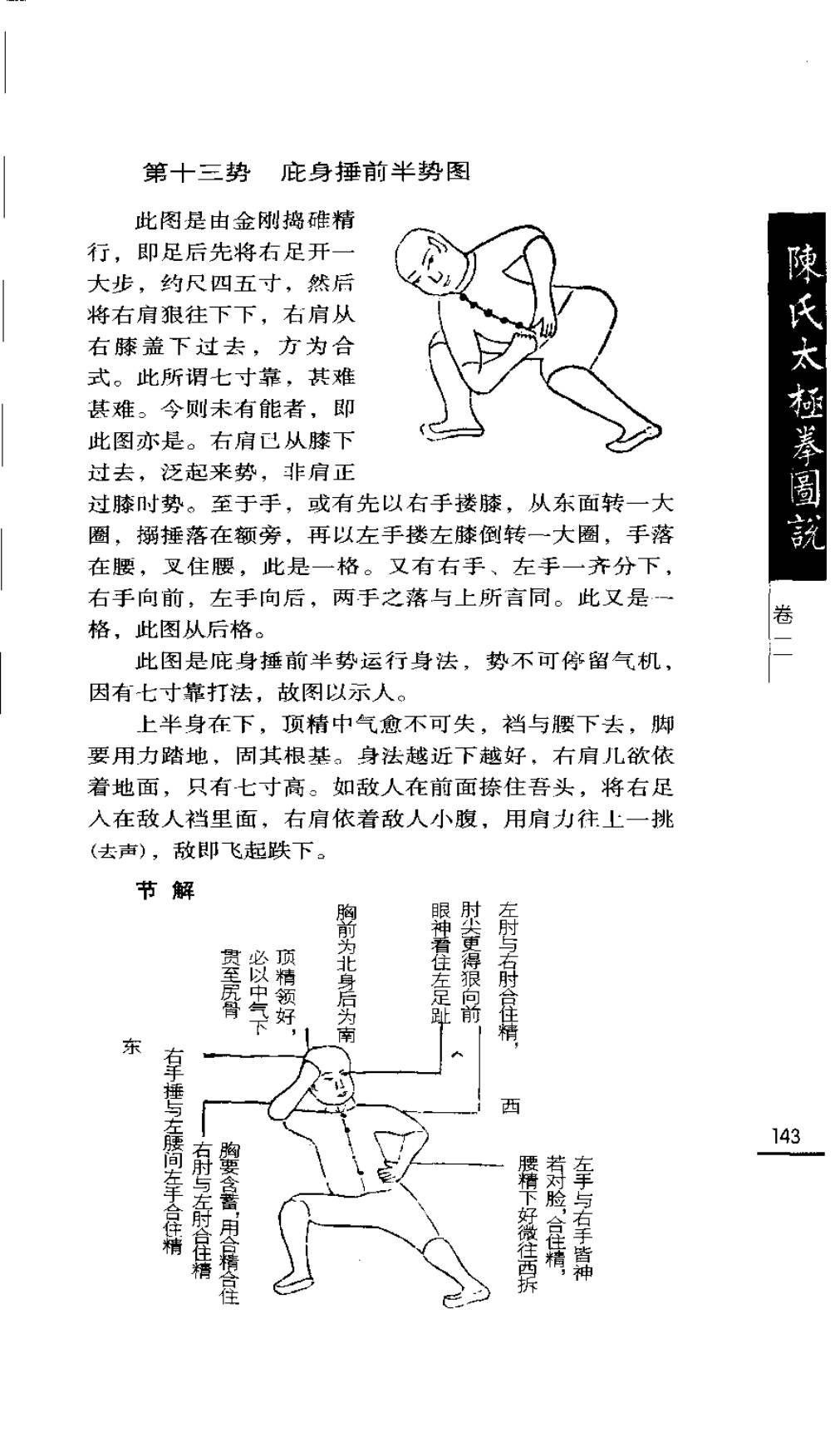
Internal jin figure of Bishen Chui (庇身捶内勁圖) — this is the completed form of the standard Bishen Chui (庇身捶成式圖)
Bishen Chui (庇身捶, Bìshēn chuí, "Body-Protecting Fist") is a method of looking back: the body is in the west, the eyes in the east, the head up, the eyes below. This was already discussed in the first half of Yinmeng (引蒙); there is no need to repeat it. This is the body method: the body inclines to the east, the waist folds to the west. The front is easy to watch over, so the shoulders and arms need no discussion. Below the shoulders and arms, everything depends on the mind's numinous awareness to watch over them. The left foot joins with the right foot, toes also pressing firmly toward the northeast. The crotch (襠, dāng) must be all the more round and empty-alert (虚灵, xūlíng), in readiness for nimble turning at the transitions (转关, zhuǎn guān). Below the knees everything is rigidly fixed (死煞); therefore turning depends entirely on the waist and crotch. The right foot joins with the left, toes toward the northeast, flat and solid on the ground. The right knee joins with the left and props well. In practicing the fist, north is taken as "up," so north governs throughout; this figure faces north.
Figure labels (second figure: internal jin of Bishen Chui)
- The central qi (中气) passes from the crown through to the spine.
- The right elbow bends forward, joining jin level with the left elbow.
- The tip points forward.
- The left hand circles westward; the left hand props the waist (叉腰); the place where the left hand rises.
- The right hand circles eastward and lands at the forehead; large circle of the right hand; small circle of the left; circling back east; circling back west.
- The right shoulder lands squarely on the enemy's chest; this is the right shoulder folding back; this is the right shoulder going outward; the rise of the shoulder.
Bottom text
This figure is named Bei Zhe Kao (背折靠, Bèi zhé kào, "Back-Folding Lean"); it is the latter part of Bishen Chui, carrying on the remaining intent of Bishen Chui — it is not a separate posture.
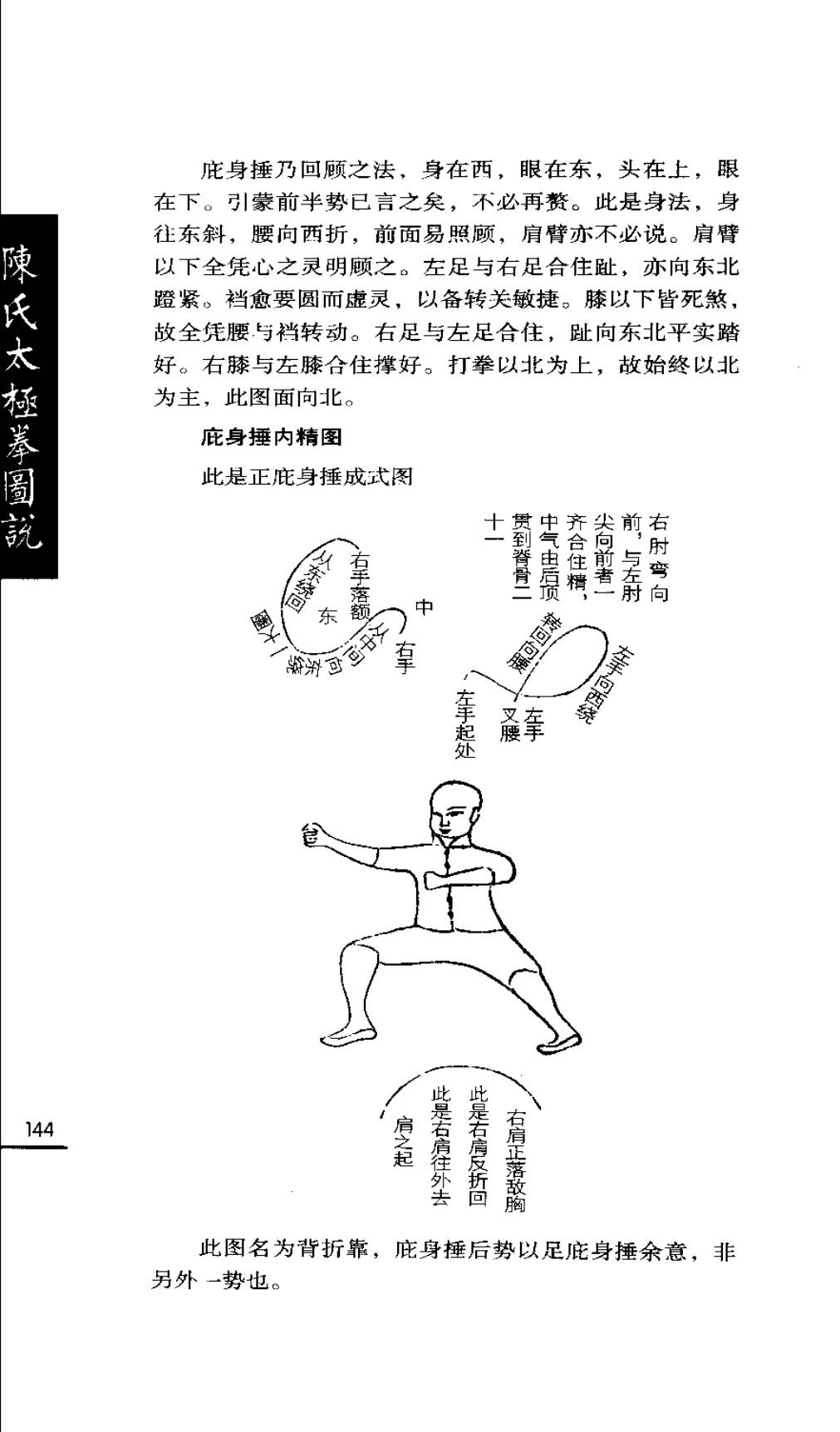
(Continued) Application of Bei Zhe Kao (背折靠)
One must use the strength of the whole body to fold back and strike with the shoulder — not merely shoulder strength, for the shoulder is where the jin gathers (肩其聚勁地也). Application: if the enemy uses both hands to brush my arm and draws it toward his body, his posture nearly leaning forward, my shoulder happens to be close to his chest; I fold my shoulder outward and counter-strike. Because there is this method, it is not feared. A figure is further given to reveal its inner meaning.
Posture 13: Bishen Chui (庇身捶, also called Pishen Chui 披身捶)
What is Bishen Chui? Using the fist to protect the body. What is Pishen Chui (披身捶, Pīshēn chuí, "Draping-Body Fist")? Both hands split evenly down from the center; it is also called Pieshen Chui (撇身锤; 撇 piě, rising tone, means "to fold"). Why is it so called? It is named from the folding-back of the body. This posture continues from Jinang Daodui (金剛搗碓, Jīngāng dàoduì): the right hand leads the right foot, the hand moves downward, the right foot opens a large step to the east, the body follows the step sinking down and then rising up, the body is held in the draped position (i.e., folding the waist), the head turns back to look — left toes, right breast, half forward and half back. The body is slightly bent; though the body inclines, the central qi (中气) must be straight. The right toes point northeast, the right knee closes inward, the left foot hooks its toes toward the northeast, and the gaze rests there. Body method: as the right foot opens the step, the right shoulder sinks down; bend the waist where it can bend — bend as much as you can bend. Even if the shoulder cannot reach below the knee, level with the knee is acceptable; failing to come within seven inches of the ground need not be rigidly forced. Hand method: when the right foot opens the step, the right hand goes from above downward, turns to the east, slightly back two or three fen, reverses and winds around to the front, landing the fist on the forehead to guard the head, back of the hand facing up. The left hand likewise goes from above downward, reversing backward through a great circle, comes forward and props the waist where there are no ribs: the second, third, fourth, fifth fingers at the front of the waist, the thumb behind the waist resting against it, to assist the waist's strength. Bend the elbow, the elbow tip forward, joining jin with the bend of the right elbow; right hand joins with left hand, right elbow joins with left elbow; twist the neck backward, lift the head up, contain the chest, the thigh roots must not collapse, the crotch opens round. Knee joins knee, foot joins foot, the whole body joins into one piece; when the spirit-energy does not scatter, only then can the one qi flow through and protect the whole body.
Bishen Chui is for when the enemy controls me from behind: I use shoulder, arm, and forearm to face the enemy with my back, and wherever he touches me, I fold back from there and strike. Also, if someone comes from the east, approaching my body, I withdraw slightly backward, the right shoulder turns its jin around, the right arm bends, and the right hand thrusts the fist suddenly toward the enemy's lower abdomen, striking with the fist. This Bishen Chui — using the fist to guard the body and the fist to strike the person — is yet another variant.
Seven-character vernacular verse on the Yanshou Chui following Bishen Chui (庇身捶后演手捶七言俚语)
The right shoulder draws back a few fen, / turning the jin around comes another fist. / This fist strikes especially at the lower abdomen, / one blow to the mark and the man is hurt.
Seven-character vernacular song of Bishen Chui (庇身捶七言俚语歌)
The Bishen Chui posture is hardest to transmit, / both feet spread open three chi wide, / both hands split apart, both reversed… (continues on next page)
English
(Continuation of Bishen chui 庇身捶, the "Guarding-the-body fist")
...turning; both legs' combined jin (精) coil entirely diagonally. The right fist lands above the Shenting (神庭, above the Shangxing point 王星穴, below the fontanel Ximen 囟门), while the left fist forks (去声, a departing tone) at the left waist. The body is like lying on its side with a slight twist; the gaze fixes on the tip of the left foot. The crown jin (顶精) lifts up, diagonal yet holding straight; the crotch (裆) is braced open (knees spread) and closed (jin held together) like a half moon (the shape of a half-crescent moon). The right shoulder strikes downward (下 = downward) with a seven-inch lean (七寸靠); the back-fold lean (背折靠) is still perfectly centered. The right hand withdraws and delivers another punch — this is the "variable middle fist" of Taiji (太極變中拳).
The back of the body is yang; chest and abdomen are yin. The left and right hands use reverse-coiling jin (倒转精); this is yang closing into yin. As for using the folded-arm jin (臂折精) to strike an opponent, that is right-turning jin — from yin turning to yang and striking with yang jin. Once the Bishen-chui posture is complete and the jin is held closed, that is stillness; using the arm to fold back is movement — from stillness into movement. In sum, from the shoulder downward, the right hand reverses its circle and the body follows it in reverse turning — this is the back-fold lean (背折靠). When the right hand turns its circle in the normal direction, the body also follows it in normal turning — this is a single qi (一氣) above and below. In the back-fold lean, the right hand turns forward circles while the left hand goes from behind, from below, up and around to the front — reverse-coiling jin. Without this, it cannot run in one smooth sequence with the right hand. This is the inevitable configuration, also the natural order of principle; otherwise the two hands would oppose each other and be unable to help one another, and the qi would likewise be unsmooth. As for the shoulders and arms withdrawing so as to strike with the fist — using the back of the hand to send the fist-wrist, striking the opponent downward in a closing blow — that is yang closing into yin-yang jin. Before the shoulders withdraw, there is stillness; when the fist strikes the lower abdomen downward toward the east, there is movement. This too is movement arising from stillness, and after movement arises, stillness is born again. Movement and stillness cycle round — how could there be a gap between them! What I call one movement, one stillness, one opening, one closing, fully exhausts the subtlety within the quan (拳). Unless the mind has its measure and balance, it will not easily stand on ground where defeat is impossible; responding according to how the enemy comes, one wins in every case.
Taking the Image (取象)
In this posture the right hand is above, the left hand at the waist; the tip of the right elbow points east, the tip of the left elbow north; the right foot is in the east, the left foot in the west; the Qihai point (氣海) faces north; the Huagai (華蓋) twists toward the northwest; the eyes are above yet look below; the Tianting (天庭) faces west; the toes all point northeast — above and below all have a tendency of separation. Therefore it takes the Li hexagram (離卦). Outside the body is strong, within empty; hands and feet are all strong, yet the heart's substance is empty and clear, able to illuminate the whole body — the image of Li. Second Nine: "Yellow radiance, greatly auspicious." The Image says: "Yellow radiance, greatly auspicious — it attains the middle way." If the quan can illuminate the principle of centrality and correctness, where would it go that is not fitting? Top Nine: "The king sends out on a campaign: he breaks the heads and captures those who are not his own kind — no blame." (The back-fold lean is the image of going out on campaign.)
English
(Posture 14 — end of Pishen chui 披身捶, striking downward: the Zhi-dang chui 指裆捶, "fist to the crotch," illustrated)
The explanation (讲义) has already been made clear, but its form had not yet been drawn; therefore diagrams are provided so that one may understand at a glance.
Circular diagram (showing the sequence of movements): Da lü 大捋 (large roll-back) → Zhi-dang chui 指裆捶 → you jian 右肩 (right shoulder) → chan jiao 缠脚 (coiling foot) → chan tou 缠头 (coiling head) → xiao lü 小捋 (small roll-back) → yan shou gong quan 掩手肱拳 (covering hand and forearm fist).
Note beneath the diagram: Lü the fist, back of the hand facing up, hold the jin closed and strike (捋住拳,手背朝上,合住精打).
Figure drawing: a left bow stance (左弓步) — left leg bent forward, right leg extended behind; the left arm reaches forward and downward, the right arm bent with the fist near the right shoulder/chest; head turned to the left. No labels on the figure.
Margin: Chen Shi Taiji Quan Tu Shuo 陳氏太極拳圖說, Book Two 卷二.
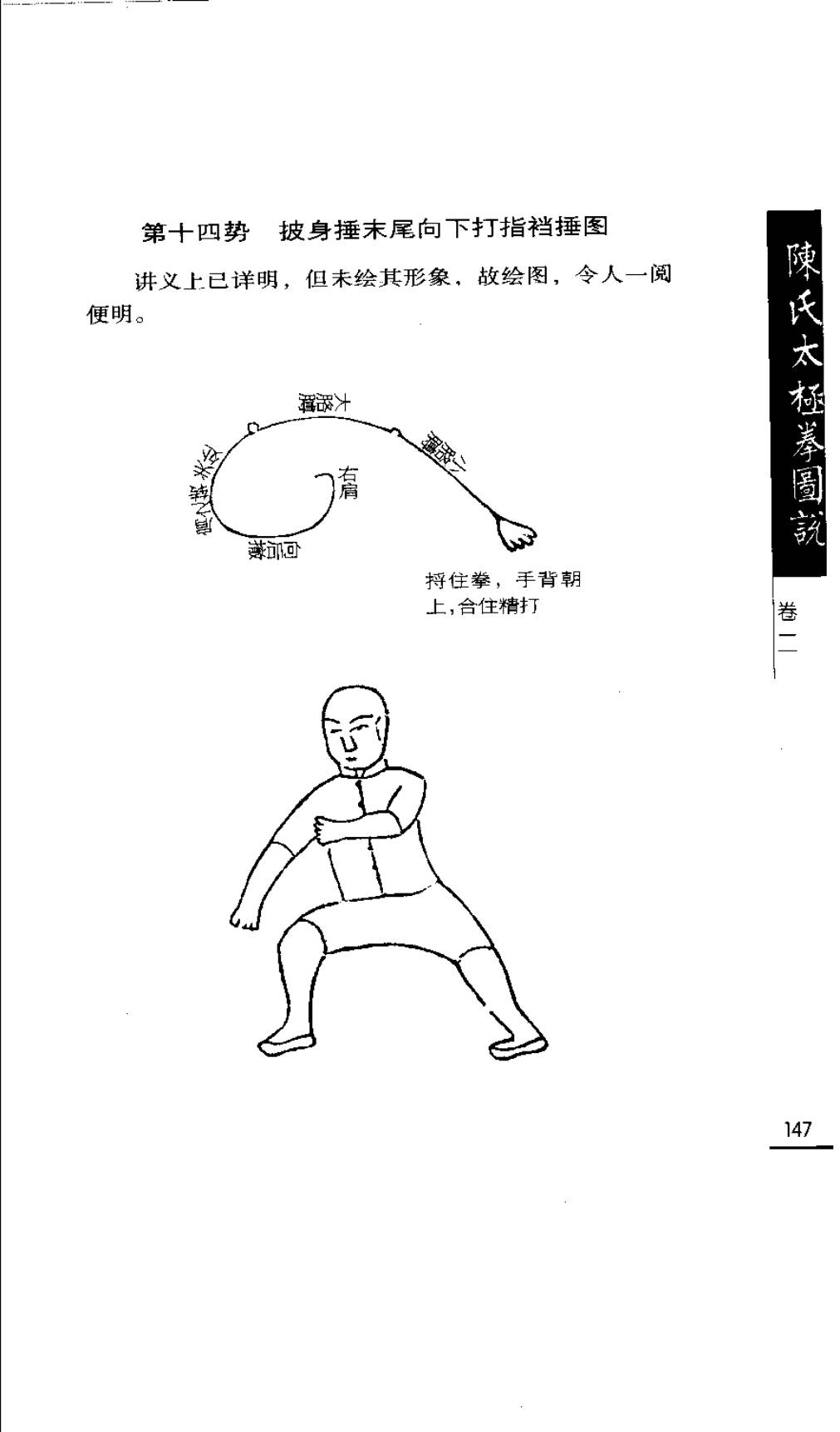
English
(Posture 15 — Zhou-di kan quan 肘底看拳, "Fist under the elbow, guarding")
The chest must hold the jin (精) in, and must also be empty. The right elbow is bent; the five fingers spread open and support each other; the eyes watch the right-hand fist below the left elbow. When the crown jin (顶精) leads once, the jin and spirit of the whole body are all roused.
When an enemy comes, there is first wind. If he is fast, his wind is great; if slow, his wind is slight — even with no wind there must be an omen beforehand. If the enemy is in front, the eyes can see him; but if he is to the right, to the left, or behind, that too is the omen. Consider: he is not in front but at the sides and behind, his mind unfathomable — one can only rely on the ears to listen and the mind to guard.
Diagram labels (attached to the figure): Crown jin leads once and the whole body's jin and spirit are roused / The chest must hold the jin in and be empty / The right elbow is bent, five fingers spread and supporting, eyes watching the right fist below the left elbow / The left knee is bent, braced open, jin held closed / The toes touch the ground — this is the empty foot, lying in wait for the incoming pulse of the next posture / The crotch opens round / The right foot treads flat and solid on the ground / The right knee is bent, braced open, closing with the left knee / The waist jin sinks down / The elbow braces open, square outside and round within / The right shoulder sinks; the lower hand lü's the fist (下手捋捶).
Caption below the diagram: Zhou-di kan quan, the old form (肘底看拳老式).
This is the shape traced by the hand as it withdraws from the east along its path.
Small diagrams: Left: the elbow; the place where the left hand forks at the waist (左手叉腰处). Right: the right-hand fist beneath the elbow; the grasp (拿); this is the completed configuration of the arm.
Final paragraph: What my late father transmitted to me: he always required left and right to rise together and move together, the right turning forward and the left turning reverse, turning circles together, closing together, and together stopping — the hands snapping up and held in place.
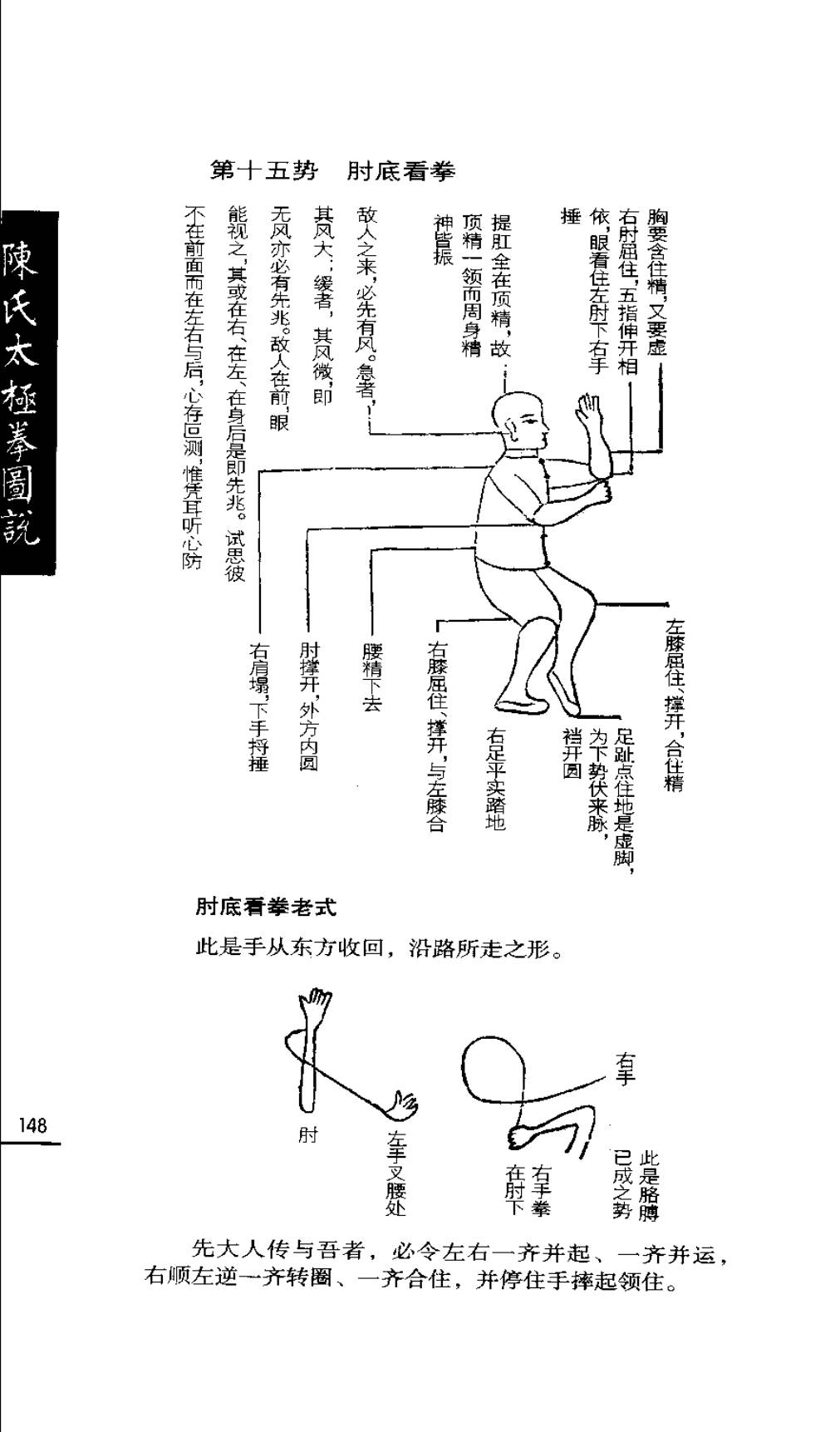
English
(Printed page 149; spine: Chen Shi Taiji Quan Tu Shuo 陳氏太極拳圖說, Book Two 卷二)
Left diagram labels (an upright arm with a looping trajectory, open hand with spread fingers on top):
- "This right hand reverses through one circle and reaches upward" (此右手倒转一圈涉到上)
- "The right hand is at the eastern starting point" (右手在东起端处)
- "The left elbow is below; the elbow sinks down; the shoulder presses down" (左肘在下,肘沉下,肩压住)
Right diagram labels (a large loop with the fist at its lower end):
- "The right hand is at east" (右手在东)
- "The right hand goes from east downward, then travels upward, rotating forward one circle, landing below the elbow" (右手由东向下再上行,顺转一圈,落在肘下)
New-style internal-jin diagram (新式内精图)
What is "Zhou-di kan quan" (肘底看拳, fist guarding beneath the elbow)? Because the right hand lets its fist land beneath the left elbow, hence the name. First, with the right toes pointing northeast, use the heel — without leaving the ground — and with one twist turn the toes to the west, deviating one or two fen to the north, treading flat and solid. The left hand comes obliquely down from above, first from north to south, then turns back from south to north, reversing through one circle. The arm is bent; the hand spreads its fingers, supporting each other and facing up, the elbow below. The left foot withdraws from the west, drawing in beside the right foot, five or six cun from it; the left knee is bent, the kneecap and the elbow tip facing each other above and below; the knee opens outward while the jin closes inward; the toes touch the ground — first lying in wait with the incoming pulse for the following Dao-juan gong (倒卷肱, reverse reeling forearms). The right hand turns one forward circle from south to north and returns again to the south. Lü-ing the fist, it lands below the left elbow, the eyes fixed on the fist. The right knee is bent, opening outward, jin closing inward; the secret lies in rounding at the hip joint, the inner thigh closing inward from above. In this way not only is the jin held closed but the crotch (裆) is also round; the crown jin (顶精) holds up, the head inclines slightly to the northwest, the fontanel (囟门) tipping down one or two fen; the chest is held closed. The trace seems to halt the qi yet does not halt it: one must wait until the internal jin (内精) slowly arrives, fully complete. When the mechanism of the next posture is eager to stir, only then can the preceding and following postures be joined through, without barrier, the qi flowing in one stream. Not only this one posture: from beginning to end of the quan, the end of every posture is like this.
Zhou-di kan quan: the left hand is yang, the right hand yin; the back of the hand is yang, the right wrist yin — everyone knows this; why belabor it! But the left hand reverses from below upward, winding from outward to inward: this is movement turning to stillness (由动之静), not merely circling. The right hand withdraws from the east up high, turns one forward circle sweeping down, and the fist lands beneath the elbow — this too is movement turning to stillness, not an empty circle. For the left hand's reverse turn, its jin arises from the finger pads, coiling obliquely downward and outward and turning back, regardless of the number of circles. Coil obliquely to the armpit, then from outside the armpit coil obliquely inward, again regardless of the number of circles, winding to the left fingers... (continues on the next page)
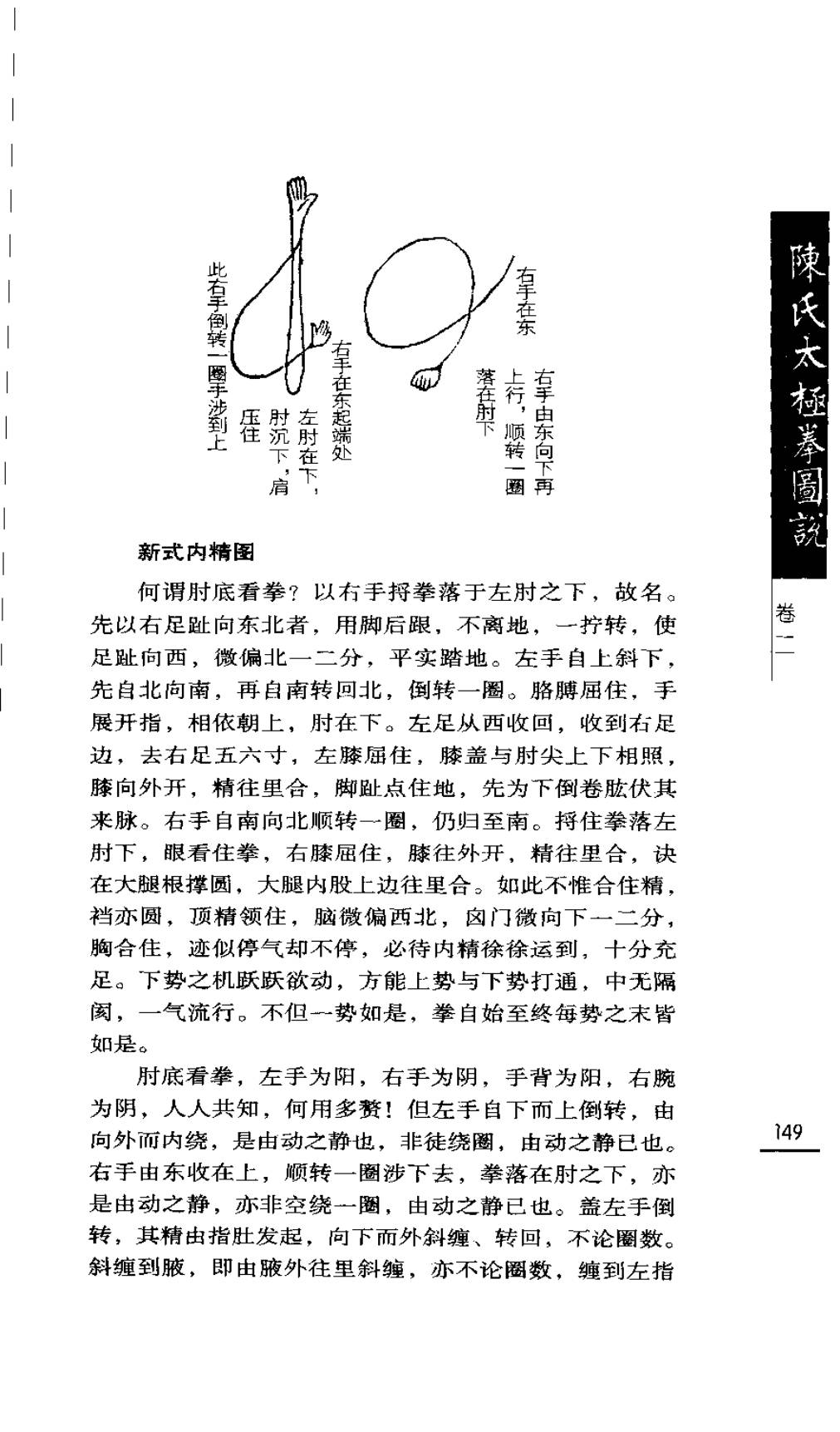
Chen Shi Taijiquan Tushuo (marginal title)
...stopping at the belly (du zhi 肚止); only thus can it join (he 合) with the right hand's jing (精, essential energy). The right hand turns in the forward direction (shun zhuan 順轉): its jing goes from the fingernail downward to the inner side, from the inner side outward in a slanting coil (xie chan 斜纏) to the right armpit, then turns back from the armpit, from inside going up, outward and down, coiling slantwise until it stops at the fingernail, joining the jing with the left hand. To join the jing, one must use the coiling method (chan fa 纏法); without the coiling method the outward form appears joined, but in truth the inner jing has never been joined.
Therefore I say it is not merely the hand turning circles: it is truly the xin-qi (心氣, heart-energy) moving and coiling in the left and right hands without a single moment of stopping. As for what is called stillness (jing 靜), in the boxing it only means the breath is somewhat quieter than in movement — it does not mean stopping. When have yin and yang of heaven and earth ever stopped? At the summer solstice, one yin is born — yin is stillness. Yet after that yin is born, when has there been a moment of not growing! Likewise when a person sits, lies, or sleeps — the body's time of stillness — yet how could one breath ever be interrupted? When the gong reaches this point, the rules are roughly worth looking at; they are just not yet lively. If one can advance without ceasing until it becomes lively and active, one enters a further level. How could the mysteries of the chamber be hard to glimpse! Mencius said: "A great master craftsman teaches others only with compass and square (guiju 規矩)." The compass and square are the perfection of square and round. Teaching with them is what a great craftsman can do. As for skill (qiao 巧), the great craftsman cannot confer it; it rests with the learner. If one reaches skill, then one follows the rules without being stuck in the rules, leaves the rules yet naturally hits the rules — but one's resolve must never be full, for fullness invites loss. The proverb says: "Beyond the sky there is still sky; once full, one invites loss." Able to follow the rules and not lose correctness, one counts success, failure, gain and loss as nothing.
Taking the Image (Qu xiang 取象)
This posture's body seems unconnected: the hands have some extended, some fisted (lü quan 捋拳); the feet, though several inches apart, have some flatly planted, some standing on tiptoe. Moreover the five sense-organs and hundred bones all have a constricted form — truly bearing the image of repeated Kan (xi kan 习坎, "double abyss," Hexagram 29) and entering the abyss, so the image is taken from Kan. Yet it says: "Hardness and softness in mutual aid — in the end there is strategy; at the time of leaving danger, Kan is full within." A person's psycho-physical constitution is complete; the central qi (zhong qi 中氣) returns to the dantian (丹田), bearing the image of upper Kan and lower Kan. The Classic text: "Xi Kan: if one possesses truthfulness (you fu 有孚), the heart-mind penetrates (wei xin heng 維心亨); action has distinction." The Image says: "Xi Kan means doubled danger." It is like my body entering heavy danger: the water flows yet does not overfill (like my humility being able to receive benefit); moving in danger yet not losing trust; the heart-mind penetrates because of the firmness at the center (meaning there is true principle in my heart, and the central qi commands it). "The danger of earth — mountains, rivers, hills" (meaning what others despise, from any terrain one can defend). "The kings and dukes set up barriers to guard their states" (meaning that in the boxing, preparedness averts calamity — what danger is there?). "The use of danger in its season is great indeed!" (meaning in the boxing, every deployment is fitting — nothing is impossible!) The middle lines and Lü (履) speak of the yang qi lying hidden below; Zhen (震, Thunder) is the dragon — the transformations of the hand are like a dragon; Zhen is inverted by Xun (巽). Xun means compliant: "dwell amid trouble and walk within trouble," moving with the times. The second change: Kun (坤) inverted by Qian (乾) — outwardly soft and inwardly firm. Though the boxing's form appears cramped and constrained, the upright qi of Qian and Kun is ever naturally at ease — how fear that Kan cannot be exited? Box the fist so that on the narrow road you can keep yourself firm without loss; on the wide road, move about freely without obstruction. This hexagram is Kan above and Kan below, saying the central qi is real and again real; its inversion is Li (离, Fire), speaking of the heart...
(printed page number: 150)
Chen Shi Taijiquan Tushuo, juan 1-2 (Volume 1, Chapter 2)
...clear and clear again (fragment continuing from previous page).
Elbow-Bottom Guarding the Fist (Zhou di kan quan 肘底看拳) — four-character verse
Left elbow above, right fist below; the chest holds reserve, the head turned aside, looking down. Left foot touches the ground, right foot flatly planted, both knees bent and held, the crotch broad and open. Spirit complete, qi full — the true and nothing false; it links what is above and opens what is below, the image archaic and elegant.
On the preceding topic — five-character verse
It also resembles an image of a macaque monkey; the immortal peach hangs beneath the elbow (the peach is a metaphor for the fist). Dare to look, dare not to eat (meaning: the fist must not be touched, lest one be struck); quietly nourishing the heaven within one's nature (bending the body, keeping to oneself, awaiting what comes).
The Sixteenth Posture: Dao Juan Hong (倒捲紅, "Rolling Back the Red / Reverse Reeling Silk")
(Diagram labels)
- Right hand arrives on top; the elbow slightly bent, the fingers slightly curved.
- The spine is held up and led (ling 領); the body spreads down yet must also be led upward — a great bending of the waist while stepping backward.
- Right foot flatly planted.
- This is the great spreading body method; the crown jing (ding jing 頂精) must be all the better led.
- The eyes' spirit fixes on the left foot; otherwise one may fear stepping where one should not step, and thus standing would be unstable — hence the eyes' spirit stays here.
- Left hand behind; the arm bent one or two degrees, the fingers slightly hooked as if digging.
- Method of retreating: the feet step backward in retreat, opening into large strides.
- Left forefoot presses the ground with force.
(Diagram: a figure in a low, backward-retreating posture — left foot forward on the forefoot, right foot flat, waist deeply bent back, spine led upright, right hand raised with the elbow slightly bent, left hand behind with slightly hooked fingers.)
(printed page number: 151)
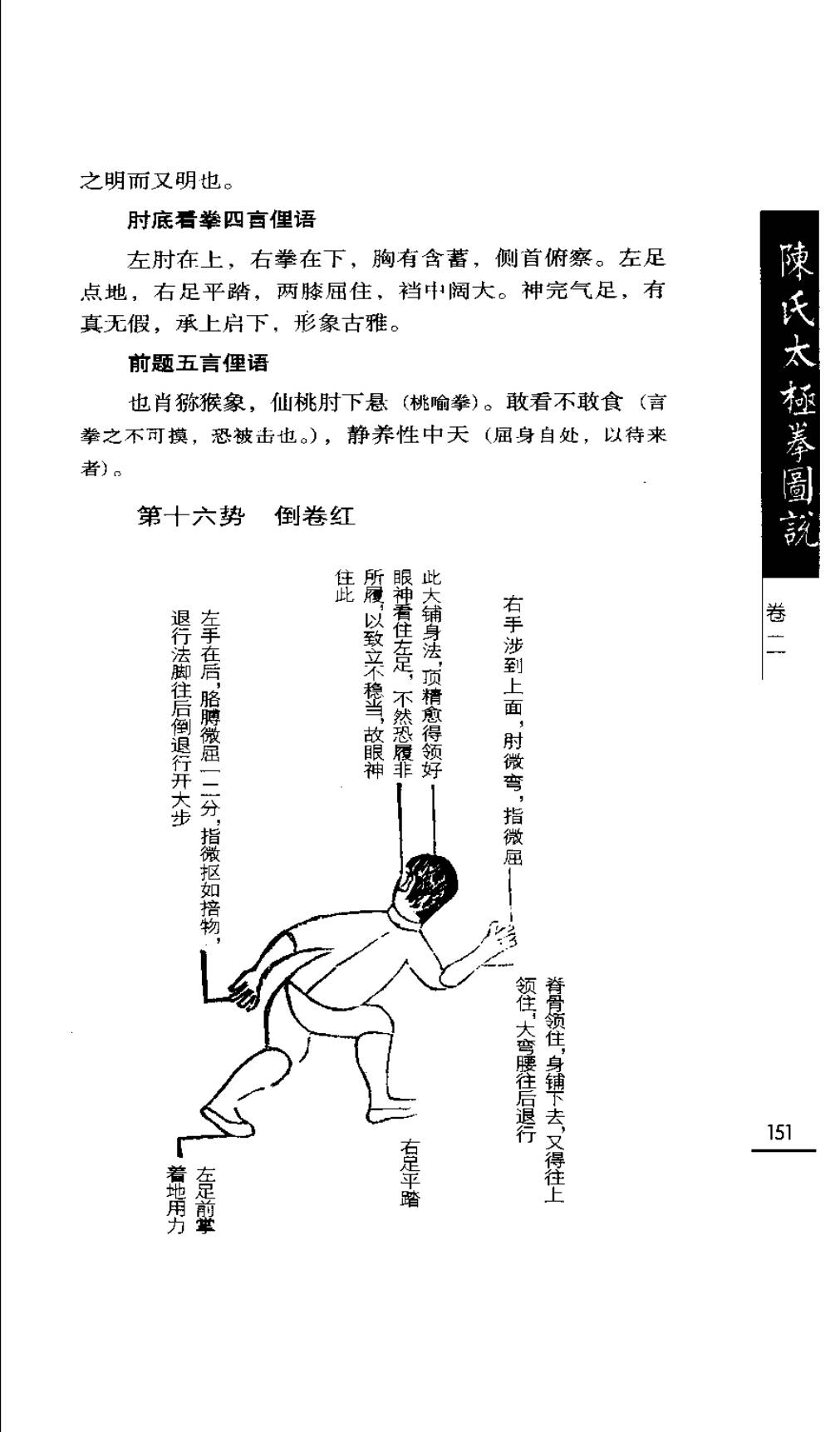
(Marginal title) Chen Shi Taijiquan Tushuo
This is the old style. The chest is two chi from the ground — people today can all do this no longer, so the posture is slightly altered, avoiding the difficult and taking the easy. Yet in liveliness of movement it surpasses the old style, so it is specially drawn here to show the old style's original form, lest it be lost to posterity.
Diagram 1: Cang shen zuo zhuan tu (藏身左轉圖, "Diagram of hiding the body, turning left")
- Left hand (左手)
- Right foot (右足)
- The left toes and sole touch the ground first (左足趾與足掌先着地)
Dao Juan Hong (倒捲紅) retreats from the position of Zhou Di Kan Quan (肘底看拳, Elbow-Bottom Guarding the Fist); from front to back it goes until Bai E Liang Chi (白鵝亮翅, White Goose Spreads Wings), and must stop only when the left foot is behind. This is the dividing line between Dao Juan and the next posture (xia shi 下勢).
Diagram 2: Shou jin, zuo jiao you zhuan tu (手進左腳右轉圖, "Hand advances, left foot, turning right — diagram")
- Upper left (上左)
- Moon-like bend (月如彎) — new posture
- The fist goes downward (拳往下倒)
- Turning, moving backward and down (轉往後下運)
- The left hand stops here (左手至此止)
- Right foot (右足)
- Left foot (左足)
Dao Juan Hong (倒捲紅, "Reverse Reeling the Red")
What is Dao Juan Hong? The feet retreat; the hand turns over from above downward, falls back and reels. "Red" (hong 紅) means striking with full force without sparing face — hence the name Dao Juan Hong. The jing (精) of the fingertip pad goes from inside to below, from below to outside, then coils from outside upward and returns inside — this is reverse-coiling jing (dao chan jing 倒纏精), a slanting coil method (xie chan fa 斜纏法). From the armpit it coils slantwise to the hand, then from the hand coils to the inner side of the shoulder, then from the inner shoulder from inside going down, out, and up to inside, coiling slantwise to the fingertip pad — this is half...
(printed page number: 152)
陳氏太極拳圖說 卷一二 (Chen's Illustrated Explanation of Taiji Boxing, Vol. 1, Part 2)
Quan shen fa (圈身法, Body-Coiling Method)
The quan shen fa (圈身法): the foot method (足法, zu fa) all follows the hand method (手法, shou fa) in reverse coiling — this is the appearance of retreating (倒卷, dao juan). When the left hand is behind and moves from rear to front, the right hand moves to the rear; when the right hand, from the rear, coils in reverse to the front (front means in front of the face, its position is above), the left hand immediately coils in reverse to the rear (rear means behind the body, its position is below). When the left hand arrives above, the right hand arrives below; when the right hand coils back to above, the left hand immediately coils to below. The hands follow the feet's backward stepping as their standard: the left foot retreats one step, roughly three chi (尺, ~1 meter), and the left hand likewise completes one reverse circle. With the left foot behind, the left hand is also behind. When the right foot retreats to the rear, then the left hand and left foot are both in front. When the right foot retreats to the rear, the right hand also, following the right foot, completes one reverse circle to the rear. With right foot and right hand behind, the left hand and left foot arrive in front; with left hand and left foot in front, the right hand and right foot go behind. The two hands alternate one after another, exchanging front and back, running in succession, the circles round like the turning of a wheel — only, the wheel turns all together forward, whereas here the two hands alternately travel backward.
Qu xiang (取象, Taking the Image)
This posture retreats, chest and belly in front. Kun (坤, the Receptive) is the belly hexagram, so the image is taken from Kun. Kun says "first loses the way" (先迷) — the foot retreats backward, not knowing where it will land: this is "first losing the way." It says "afterwards gains the lord" (后得主) — the foot, retreating backward, finds its footing on the ground: the foot has a master. The Classic (《易经》) says "benefit," says "behind, compliant, attains constancy" (后顺得常): the foot has found the ground, the hand follows it — there is a constant measure. The First Line: "treading on frost; solid ice is coming" (履霜,坚冰至) — speaking of retreating: like treading on frost before solid ice, one should guard against future trouble. The Second says "straight, square, great" (直方大): in reverse-coiling retreat, the qi (气, khi) in the heart-mind is straight and square. "Without practice, nothing is not beneficial; the way of Earth is luminous" — though retreating, there is no harm. The Third Line: "holding inner beauty, one can remain correct" (含章可贞) — having the plan already formed in the chest, upright and firm. "Perhaps serving the king's affairs" — meaning, compelled by circumstance one retreats to hold one's position: "without accomplishments yet with completion" (无成有终). The Fifth Line: "yellow lower garment, greatly auspicious" (黄裳,元吉); the Image says "the pattern is within" (文在中也) — the ordering principles within the belly are clearly distinguished; beauty lies within. Though retreating in reverse coil, there is no injury. The Top Sixth: "dragons fight in the wild" (龙战于野) — speaking of retreating while the hands reverse-coil: this is combat. "Their blood dark and yellow" (其血玄黄) — if a strong enemy is in front, even with weapons, and one retreats and reverse-coils to fight — can one be certain of no injury? The Image of the Sixth says: "ending with the great" (以大终也). Yang is great, yin is small; Kun's opposite is Qian (乾) — by the way of firmness at the center, one brings the affair to completion. It says "benefit in lasting correctness" (利永贞): Kun is utmostly soft yet in movement firm, utmostly still yet in virtue square — hence retreat is without misgiving. The Sixth Five: "The noble person, yellow at the center, penetrates the pattern; occupying the correct position, dwelling in the body; beauty within, and flowing through the four limbs, issuing forth in achievement — beauty's utmost" — reverse coiling and retreating is beautiful in just this way. The left hand follows the left foot, the right hand follows the right foot — above and below follow one another: this carries the meaning of the Sui (随, Following) hexagram. Its Image-text says "movement and joy: following" (动而说随), hence it is taken again.
Yong dao juan hong chang duan ju li yu (咏倒卷红长短句俚语, Rustic Verse on Rolling-Back Red, in Long and Short Lines)
Watching through the curtain pearls roll back in reverse; upright qi (正气, chinh khi) threads through the center. Yin and yang change and alternate back and forth, following (continues on next page)
陳氏太極拳圖說 卷一二 (Chen's Illustrated Explanation of Taiji Boxing, Vol. 1, Part 2)
The 17th Posture: The Second Bai E Liang Chi (第二个白鹅亮翅, White Goose Spreads Its Wings, second occurrence)
The pivotal awareness (机, ji) looks left and glances right (左顾右盼). The retreat is straight, without deviation, one qi (气) threading through continuously, like two wheels turning. Do not raise the head to gaze afar; do not tilt the leg hanging high. Look carefully at both sides, the left and right hands — truly believe that the primordial qi of great harmony (太和元气) turns in reverse, entirely round.
Five-character rustic verse (五言俚语)
Raising the feet, all step forward; this posture alone retreats.
The two hands like sun and moon, turning in alternation without a sound.
The 17th Posture: The Second Bai E Liang Chi
Again spreading open the white goose's right wing; vainly raising the two hands to guard the chest. Sink the elbows, press down the shoulders, shaped like a moth's eyebrow; one spark of the living pivot lies in the heart's own design. (The left and right hands go north and must not be blunt and direct: the intent is like the curve of a moth's eyebrow, like the moon on the third or fourth day of the month. The right foot circles half a ring and steps out to the right; the left foot follows to meet the enemy. One can fix the principle in advance but cannot fix the situation in advance; hence one adapts to circumstances in the moment — where to lead (引) lies in one's own judgment.)
Five-character rustic verse
Above it receives Dao Juan Hong (倒卷红); below it links to the Brush-Knee posture (搂膝势). The living pivot is but one turn; leading from the right is by itself unimpeded.
The silk-reeling essence (缠丝精, chan si jing) above and below, and all the rules of method, are the same as in the previous White Goose Spreads Its Wings. The left foot, three to five cun (寸) from the right foot, touches the ground with its toes reversed — this is the empty stance (虚步), set up for the following Brush Knee Twist Step (搂膝拗步). The right foot steps out to the right, toes pointing northwest, planted flat and solid.
The left foot arrives behind; the right foot, beside the left foot with its toes touching the ground, immediately sends the right foot circling half a ring outward and steps out; the left foot follows the right foot to the right side, several cun from the right foot, toes touching the ground, settling the posture's incoming line (势脉). In the previous posture the left foot stood in the east unmoving and the right foot pointed at its side; hence in this posture it is very easy for the right foot to step out to the right. This empty standing of the right foot is precisely this posture's incoming line. In this posture the left foot is at the left①, toes touching the ground, making it easy for the following posture to step out to the left. Each posture receives from above and opens below — all like this. For the rest see the first White Goose Spreads Its Wings.
① The original edition reads "in this posture the left foot is at the right"; following the form of the posture and its principle, the character "right" has been corrected to "left."
(The right-hand page carries one drawing of the posture: standing with one foot forward, hands in the specific gesture, no caption.)
Chen Shi Taiji Quan Tu Shuo, Volume 2 — Qu xiang (Taking the Image)
In this posture the left hand follows the right hand in movement, the left elbow follows the right elbow, the left foot follows the right foot — just like the meaning in the *Dui* (兑, duì, Lake) hexagram of line two leaning on three, three leaning on four, four leaning on five; therefore the image is taken from Dui. Heart (xin 心) and kidneys (shen 肾) are within, like the central firmness of lines two and five; hands and feet are without, like Dui's third and top lines — softness outside. Meeting things with the sincerity of the heart through outer softness: though soft, within the delight there is real firm integrity — this is called "delight favorable through perseverance." The *Tuan* says: "Following Heaven and responding to humankind." Moving the hand with the heart, turning the circle with the flow of momentum — therein is the Way of Heaven: the upper Dui. The kidneys store will (zhi 志); the foot following the will also turns half a circle with the flow — therein is the Way of Man: the lower Dui. The first line is "harmonious delight," the second "sincere delight," the fourth "deliberated delight," the top six "leading delight": within, deliberating with a sincere heart; without, leading the advance forward with the qi of soft compliance — thus the firm qi lies concealed within softness. This posture is purely the essence of leading-in (yin jin 引进), so the image is taken from Dui, and above all from the "leading delight" line. Again, in a person the heart is the master and the four limbs follow it, like line nine-five of the *Bi* (比, bǐ, Holding Together) hexagram occupying the honored place, possessing firm virtue while all the other lines cling to and assist it. The *Image* says: "Bi means holding together; those below comply and follow... because of the firm center. The restless now come, above and below respond." In this posture the four limbs move from the heart and all the sense-organs and frame comply gladly; therefore the image is also taken from Bi — and in the end all is carried out with the upright qi of Qian and Kun (乾坤, qián kūn).
The Eighteenth Posture: Lou Xi Ao Bu (搂膝拗步, lǒu xī ào bù — Brush Knee and Twist Step)
Diagram
The drawing shows a person in stance: left leg forward with bent knee, right leg extended behind; the left hand circles to the side of the left knee, the right hand raised in front of the chest. Labels beside the figure:
- 左足手精皆倒转,外往里缠 — "The jing of the left foot and hand are all reversed, spiraling from outside inward."
- 左右足足精、腿精用包合法,皆是外往里缠 — "The foot-jing and leg-jing of both left and right use the enveloping method (bao he fa 包合法); all spiral from outside inward."
Text
In lou xi ao bu, the right hand winds around to the front, loosely enveloping (xu xu long zhu 虚虚笼住); the left hand winds around to the rear and gathers in the hand, also loosely enveloping; the right hand is a chi (尺) and more from the chest, the left hand six or seven cun from the back. The waist between is slightly bent, the chest joined and closed — there is the capacity to envelop the myriad phenomena, the air of possessing the upright qi of Heaven and Earth. The heart is calm and the qi harmonious; fix the gaze quietly on the tip of the middle finger of the right hand. The crotch jing (dang jing 裆精) is stretched round, yet must also be empty.
(Printed page number: 155)
Chen Shi Taiji Quan Tu Shuo, Volume 2 (continued from previous page)
Text (continued)
The knees join their jing; the big toes of both feet wrap inward; the sole of the foot, front and back, must exert force, treading the ground level and firm; all the remaining rules are as in the First Lou Xi Ao Bu (搂膝拗步, lǒu xī ào bù — Brush Knee and Twist Step).
The jing of the left foot and hand are all reversed, spiraling from outside inward. The foot-jing and leg-jing of both left and right use the enveloping method (bao he fa 包合法); all spiral from outside inward.
Qu xiang (取象 — Taking the Image)
The preceding lou xi ao bu took the directions of Qian (乾, qián), Kun (坤, kūn), Kan (坎, kǎn) and Li (离, lí), yet the meaning was not exhausted. When the boxing skill has matured, upright and respectful, reverent toward what one does, not daring to be self-satisfied — there is the meaning of humility (qian 谦); therefore the image is also taken from the *Qian* (Modesty) hexagram. Qian means to possess yet not dwell on it. The mountain is of the utmost height yet bends to dwell beneath the earth — the image of modesty. Stopping within, gathering in and not boasting; complying without, and humbling oneself below others — the meaning of modesty. The *Image* says: "The Way of Heaven descends to aid and is bright; the Way of Earth is lowly and moves upward. Heaven diminishes the full and augments the humble; Earth changes the full and flows to the humble; ghosts and spirits harm the full and bless the humble; the Way of Man hates the full and loves the humble." Humility brings benefit. If a person can shepherd himself with lowliness, he will naturally have a serene, tolerant bearing; this outwardly formed state matches line two, "sounding modesty, persevering brings good fortune." The right hand is in front, the left hand behind; the left foot slightly forward, the right foot slightly back, the two feet more than two chi (尺) apart. The heart runs the movement wholly with respectfulness; though the body has a divided form, the heart has its master — this matches line three, "toiling modesty," and line four (扐 — per Lai's note, "to divide") of modesty: not boastful, not expansive, composed and easy in manner. Though called practicing martial arts, the civil is within it. Line five, "it furthers one to invade and conquer," and top six, "sounding modesty, it furthers one to lead armies" — these are the meanings contained within the boxing. If one can truly be humble, where in dwelling of heart would it not be fitting — how could it apply only to lou xi ao bu! Yet lou xi ao bu all the more must not be let go, hence again the image of Qian.
The Second Lou Xi Ao Bu — Six-Character Folk Rhyme (六言俚语)
Before there was lou xi ao bu; now again lou xi ao bu. Not that one loves to make extra trouble — without it one cannot open the step. The White Goose hands (bai e shou 白鹅手) are both on the right; here the right is in front and the left behind. The crotch opens across a full chi, letting people assail from all four sides. This body relies wholly on the empty-spirit (xu ling 虚灵); every organ and limb is attended to. Moreover, humility unceasing — what worry, what fear has the gentleman? Let cunning and craft spring up as they may, firmness and softness are stocked from the start. The Qian hexagram: Gen (艮, gèn) below, Kun (坤, kūn) above. Gen is the hand — it can stop things with the hand. Gen inverted is Zhen (震, zhèn), the yang in the two feet. Kun is compliance; opposed to Qian, which is vigor — hence it is said firmness and softness are both complete. Zhen is the foot, hence the mention of feet.
(Printed page number: 156)
Chen Shi Taiji Quan Tu Shuo, Volume 2
The Nineteenth Posture: Shan Tong Bei, First Half (闪通背前半势, shǎn tōng bèi qián bàn shì — Flash Through the Back, first half of the posture)
Diagram: path of the right hand (右手运行图)
A curved-loop diagram with directional markers: North/above (北/上), South/below (南/下).
Text
The right foot steps open toward the west; the right hand immediately turns one circle from south to north, then the right hand, turned sideways, sweeps down toward the crotch; the crown and neck must be good and the central qi (zhong qi 中气) connected, running through the twenty-one... eleven segments of the spine below. The left hand follows the right hand and also winds one circle; the left foot retreats and steps open to the rear (left side); the left hand sweeps down from above and again sweeps up from below to behind the back. This is a half-posture diagram, not a resting posture.
Figure
A drawing of a person in a low, forward-leaning stance: right hand in front; labels — 眼看着右手 "the eyes look at the right hand"; 腰弯下 "the waist bends down"; 膝屈住 "the knees stay bent"; 左手到东 "the left hand arrives at the East."
Diagram: path of the left hand, initial rise (左手运行图·初起)
A loop diagram with West (西) and down (下) markers.
Text (footwork)
The right foot first withdraws without touching the ground, steps open westward six or seven cun (寸), and only then plants on the ground. The left foot steps open toward the East about one chi (尺) and plants level on the ground. The right foot is gathered back to the west — see the preceding diagram for how it is gathered. The left foot goes from west to east, the left foot lands in the east position.
Figure notes
This is due west; the right foot lands here, pointing to the northwest. Below the crotch is the interior. This is the foot of Bai E Liang Chi (白鹅亮翅, bái é liàng chì — White Goose Spreads Its Wings).
(Printed page number: 157)
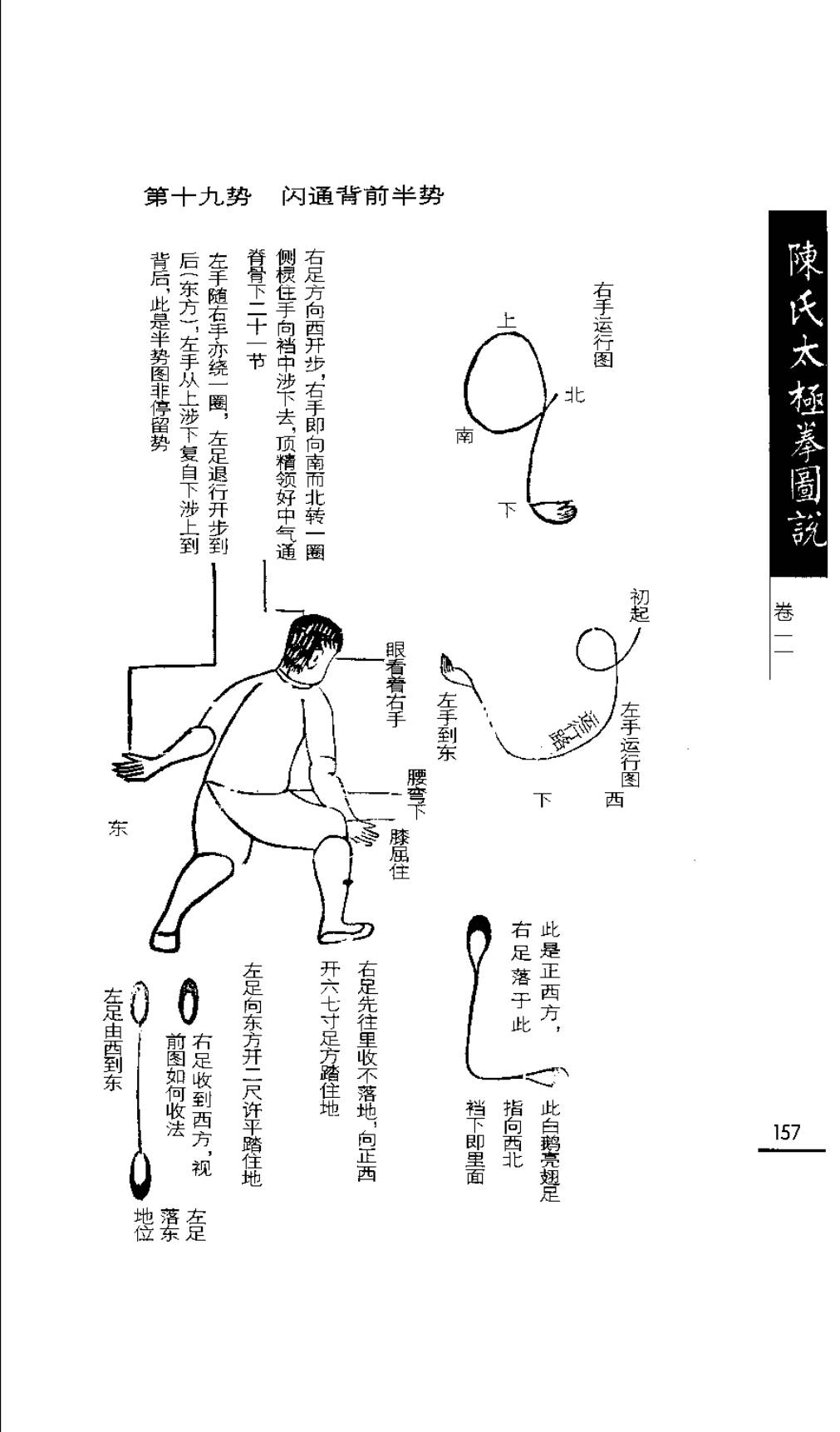
Chen Shi Taiji Quan Tu Shuo, Volume 2
Shan Tong Bei (middle section) — diagram (闪通背·中截, shǎn tōng bèi zhōng jié — Flash Through the Back, middle interception)
Figure and labels
A drawing of a person in a left bow stance: the left hand raised overhead, the right hand extended forward, the eyes watching the right hand. Labels:
- 頂精不可失 — "The jing of the crown must not be lost."
- 左手在东 — "The left hand is at the east."
- 眼看住右手 — "The eyes fix on the right hand."
- 右手在东 — "The right hand is at the east."
- 右足拧转不动 — "The right foot twists in place and does not move."
- 左足至西 — "The left foot arrives at the west" (the left foot is at the west).
Text
The previous right foot was at the west; here the left foot turns a reversed step past the front of the right foot, passing the right foot by more than two chi (尺), and lands at the west without pausing. One posture is not yet complete — how could one halt even briefly? Readers, do not mistake the inner jing. In the preceding posture, when the waist bent down, the central qi (zhong qi 中气) rose in reverse from the twenty-first segment at the base of the spine, traveled up, passed in front of the crown and swept down to the dantian (丹田, dān tián); in this posture the central qi issues from the dantian, travels in reverse across the chest to the crown of the head, crosses the brain and descends, returns below, is caught at the twenty-first segment, still in reverse; going up it passes the crown and descends, returning again to the dantian. Here the Du vessel (督脉, dū mài — Governing Vessel) moves in reverse and catches the Ren vessel (任脉, rèn mài — Conception Vessel), goes down and turns back; the Ren vessel moves in reverse, catches the Du vessel, moves in reverse to the crown and descends, returning again to the dantian. In the previous posture the Du moved in reverse and the Ren forward, making only one circle; in this posture the Ren moves in reverse, catches the Du over the crown, descends forward to the twenty-first segment and turns back. The Du again moves in reverse, passes over the crown and sweeps down, catches the Ren, which descends forward and returns to the dantian — Ren first and Du after makes one circle, then Du first and Ren after makes another circle. This is the middle-intercepted posture, and the vessels, Du and Ren, turn two full circles back and forth.
(Printed page number: 158)
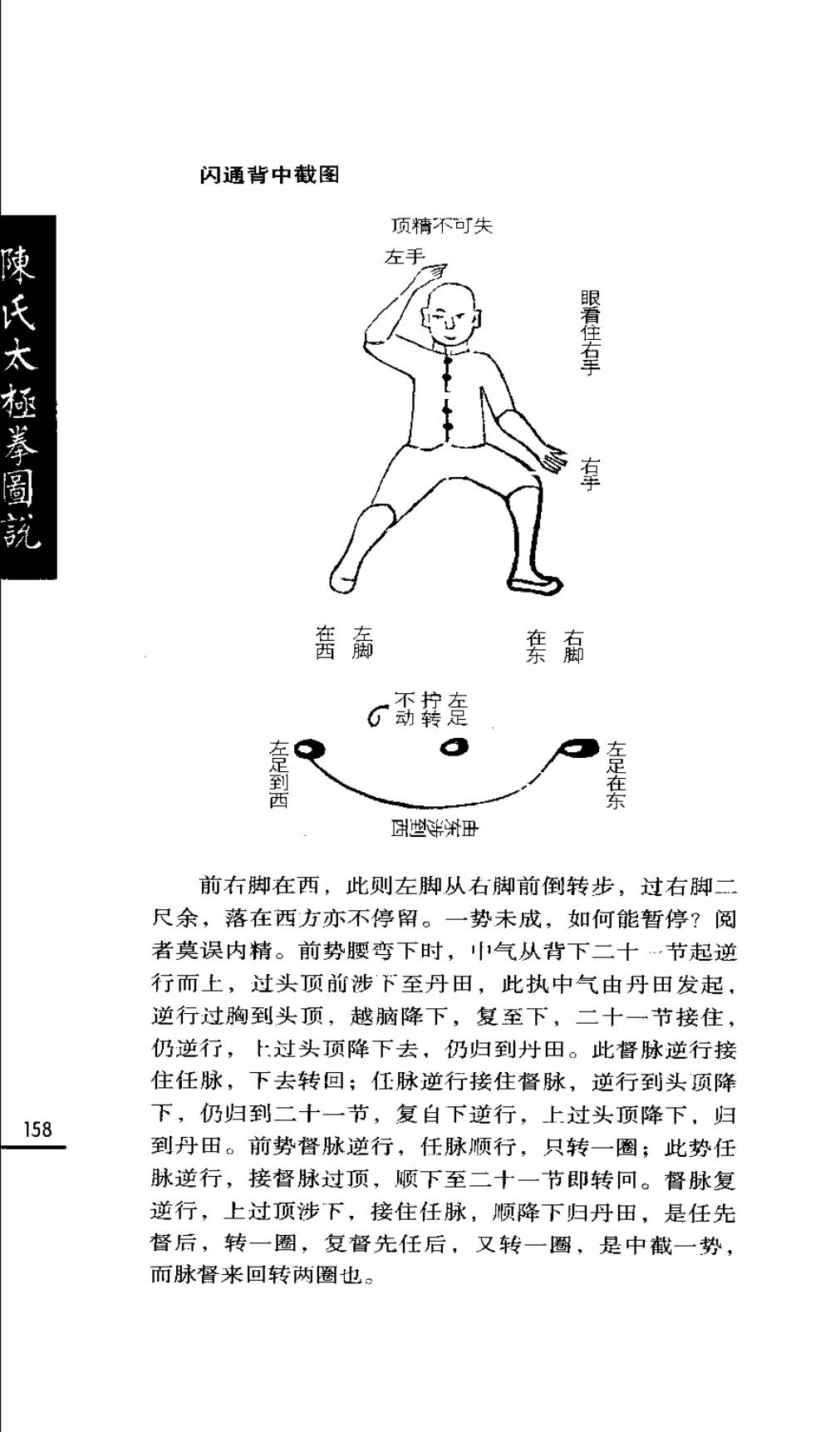
*Chen Shi Taijiquan Tushuo* (陳氏太極拳圖說, Chen Family Taijiquan Illustrated Explanation), Book 2 (卷二).
Diagram (final section of Shan Tong Bei 閃通背)
Line drawing of a practitioner in the Shan Tong Bei (Flash Through the Back) posture: left forward bow stance, left hand extended forward, right fist held at the chest, head turned to gaze at the left hand, torso slightly twisted. Labels:
- ding jing ling hao 頂精領好 — the crown's essence well suspended
- yan kan zuo shou 眼看左手 — eyes watch the left hand
- xin zai you chui 心在右捶 — attention in the right fist
- dang kai yuan 裆开圆 — crotch open and rounded
- you shou zhan zai hou 右手展在后 — right hand extended behind
- shan tong bei jie xian 闪通背界限 — boundary of Shan Tong Bei
- bu dong zuo zu 不动左足 — left foot unmoving
- you jiao dao zhuan 右脚倒转 — right foot rotates back around
- you zu dao xi 右足到西 — right foot arrives at the west
- right foot / left foot / dantian 丹田
Caption below the diagram: This is the final-section diagram of Shan Tong Bei; its boundary reaches only to here — what follows is Yan Shou Chui (演手捶, Deliver the Fist). The internal essence after passing the front crotch along the Ren meridian is received by the Du meridian, reverses direction with the central qi (中氣), slowly rises, crosses the brain to Baihui (百會) at the crown. The internal essence travels reverse — the boundary stops here. This diagram combined with the previous two makes three diagrams for one posture.
Commentary
The left hand, ready to answer the right hand behind, holds the potential of stepping forward and striking with the fist; the chest must be closed. This is still a non-stopped (transitional) posture: one must wait until Yan Shou Chui is finished, pause briefly, then begin the next posture. The left foot does not move; only the heel twists — the toes pointing west turn east, which is why the left foot ends at the east: the right foot steps behind the left.
This diagram shows the rear hand, already setting up the following Yan Shou Chui, so the stored fist has entered the launching frame.
Shan Tong Bei is a reversed circle. The left foot merely rises, first opens one step to the west and, staying at the west, only manages the twisting of the heel. The right foot rotates from west to east, then from east to west — completing one reversed circle; the right hand follows the right foot's path, rising alone. At first the right hand reaches down with forward-rotating essence (順纏); thereafter it all follows the right foot's reversal, using reversed essence (倒轉精). When bending at the waist in Shan Tong Bei, the left hand is behind (east): its internal essence coils in reverse from hand to armpit; when the left foot arrives west, the left hand's essence goes from armpit up the inside and outward in forward coiling (順纏) to the hand; when the left foot reverses to the east, the left hand is also east, still forward-coiled to the hand, lightly suspended (虛虛領住) awaiting the right fist's eastward strike to answer it. At the start, the right foot and right hand are west; the right hand sweeps down from above, the body rises, reversing half a circle; the right foot east, the right hand uses reversed coiling (倒纏) and is also east. When the right foot reverses to the west, the right hand follows the body to the west. Extending the arm to gather (捋) the fist, fist level with the waist, left hand in front at shoulder level — this is Shan Tong Bei, the standard pattern (正格) of the two hands, the fixed, unchanging boundary of the two hands in Shan Tong Bei.
What is meant by Shan Tong Bei? The central qi descends from the heart past the navel to the dantian, then from the dan— (continues on the next page)
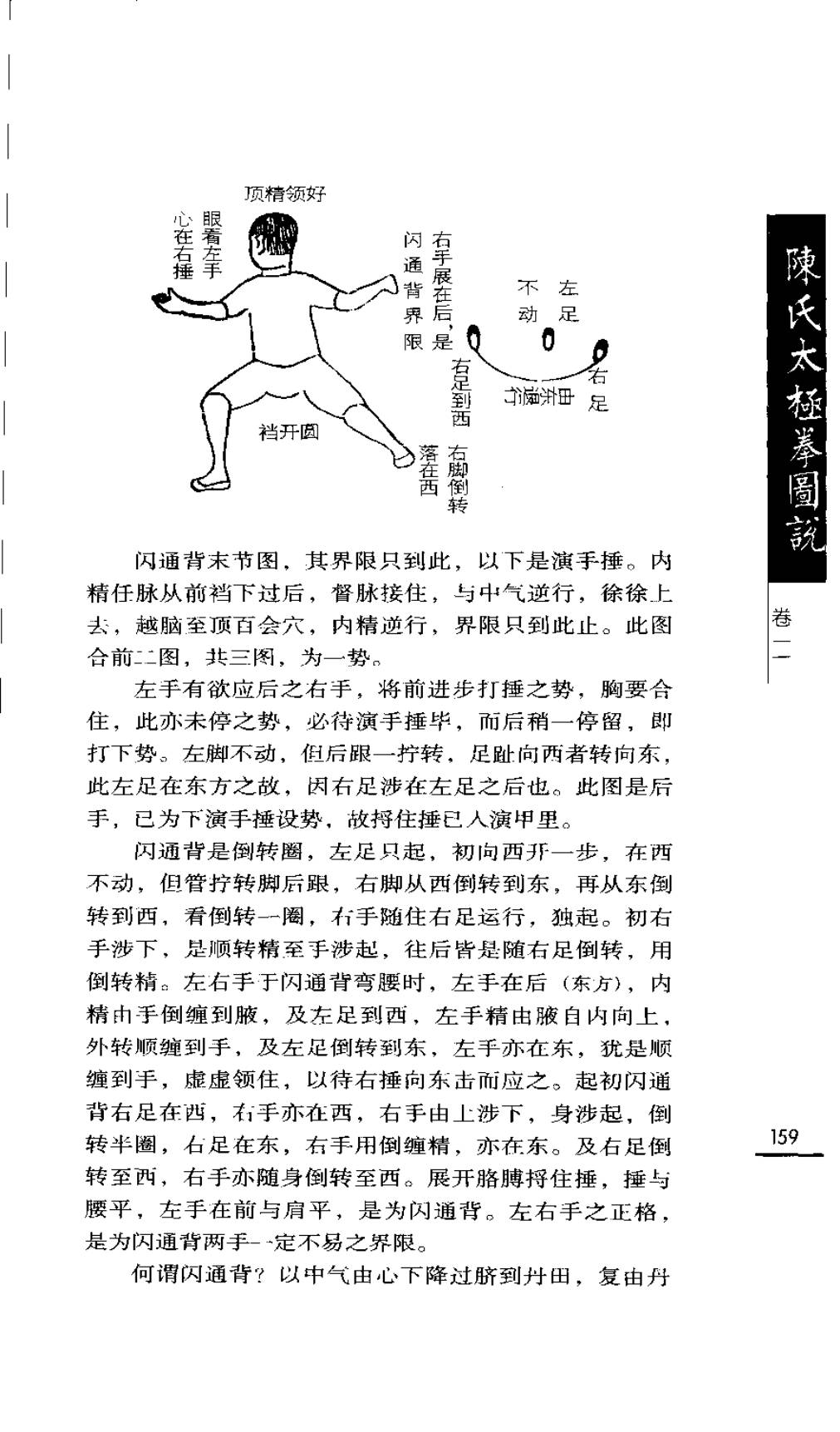
*Chen Shi Taijiquan Tushuo* (陳氏太極拳圖說), Book 2.
Commentary (continuing from the previous page)
…(dan)tian and the Ren meridian (任脈) reverse-travel upward, past the navel, Shangwan (上脘), Huagai (華蓋), Tiantu (天突), Lianquan (廉泉) to Chengjiang (承漿, below the lower lip). The Du meridian (督脈) receives it, reverse-travels through Shuigou (水溝), Renzhong (人中), Suliao (素髎, nose tip), past Shenting (神庭), Shangxing (上星), Xinhui (顖會), Qianding (前頂) to Baihui (百會); descending past Houding (後頂), Qiangmen (強門), Naohu (腦戶), Fengfu (風府), Yamen (啞門), Dazhui (大椎), Taodao (陶道), Shenzhu (身柱), Shendao (神道), Lingtai (靈台), Zhiyang (至陽), Jinsuo (筋縮), Jizhong (脊中), Xuanshu (懸樞), Mingmen (命門), Yangguan (陽關), Yaoshu (腰俞) to Changqiang (長強) — all the back-shu points of the spine — and again to Huiyin (會陰), the extreme (the starting point below where the front Ren and rear Du meridians both begin). The central qi (中氣) from Baihui descends and connects through Changqiang and Huiyin: this is called "passing through the back" (通背). "Flash" (閃) means: as if someone grabs you from behind at the waist, the front waist bends forward sharply, head and shoulders dip down, while at the rear Changqiang and Huantiao (環跳, the outer hip bone) forcefully lift the lower abdomen upward and flip it over; the opponent's hands come apart, is turned upside down, flashes over your head to the front, and falls backward before you. This is called Shan Tong Bei (閃通背, Flash Through the Back).
The body is a reversed circle; the right hand reaches the top and reverses with it, the right hand being the leader. The hand turns with the body — in truth it turns with the foot: wherever the right foot lands, the right hand follows. The left hand likewise turns with the body in a reversed circle.
Diagrams
Right Hand Movement Diagram (右手运行圖)
Compass: north top, south bottom, west left, east right. Path labels:
- the right hand begins facing west
- the right hand arrives east, then reverses southward
- the right hand arrives west
Left Hand Movement Diagram (左手运行圖)
Compass: north top, south bottom, west left, east right. Path labels:
- the left hand begins, arrives east
- the left hand arrives west, then reverses southward
- the left hand begins, arrives west
Symbolism (取象)
Originally the head is above yet moves downward; facing west it reverses, going north then east, then reverses from east, facing south completing one great circle. This turning — passing from this to that — is the great body-turning method (大轉身法) of the fist. Reversal belongs to yin: Da Guo (大過, hexagram 28, Greater Exceeding), Xun below and Dui above — eldest daughter and youngest daughter, both yin images — hence the symbol is taken from Da Guo. The first and top lines are both yin lines, like the hands and feet at the two ends, yielding and obedient. The middle lines two, three, four, five are all Qian (乾) way, like my heart moving the four limbs with firm, vigorous power. Moreover Qian inverted gives Kun (坤), firmness and softness completing each other: though the body makes a great turn, the four limbs obey without obstruction. Hence line four of the hexagram: "The ridgepole rises — good fortune" (棟隆,吉), speaking of the flood-like qi (浩然之氣)… (continues)
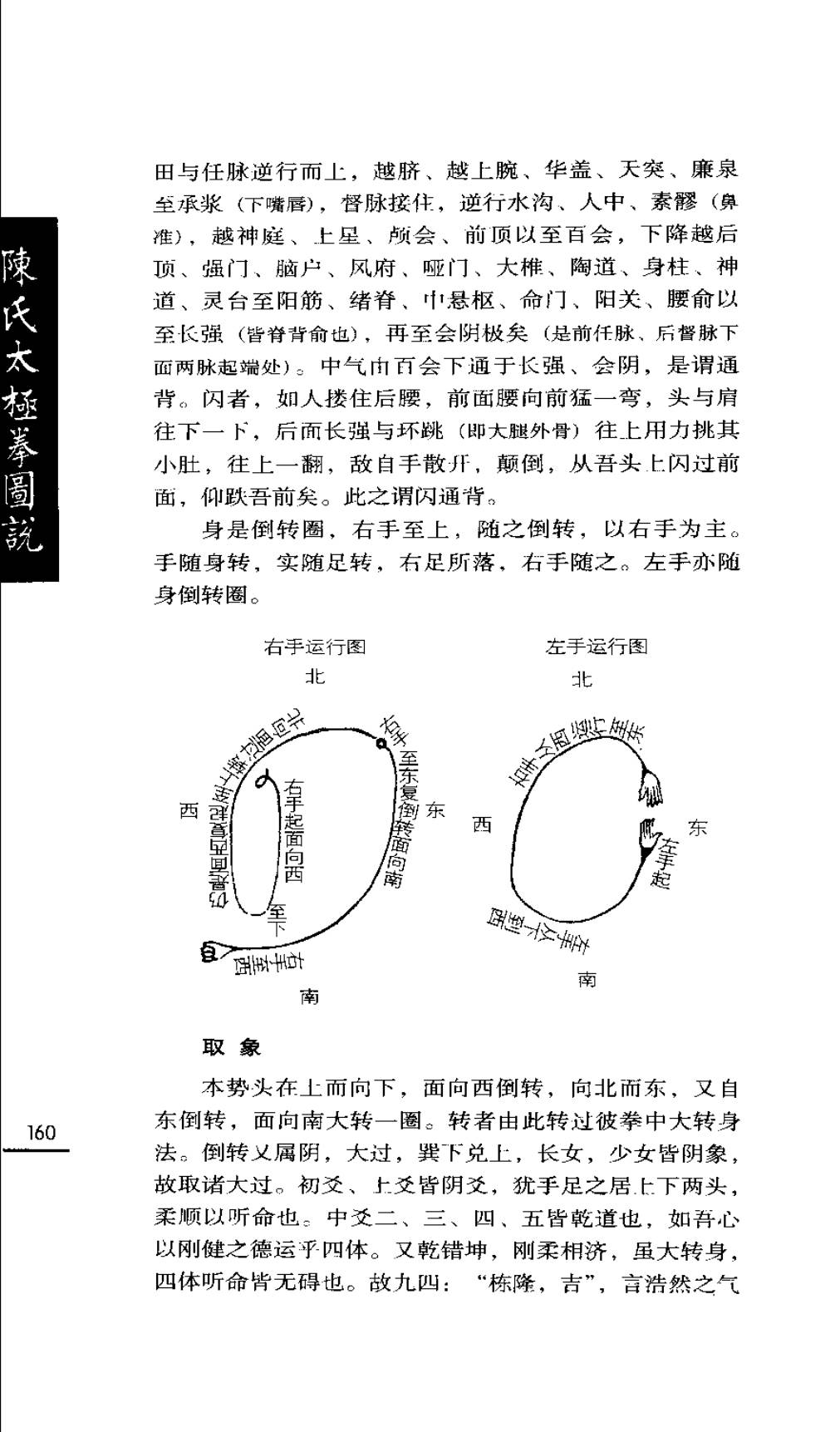
*Chen Shi Taijiquan Tushuo* (陳氏太極拳圖說), Book 2 (卷二).
Commentary (continuing from the previous page)
…sufficing to fill one heart; hence the Great Image says the junzi (君子, noble person) "stands alone without fear," and meets no harm. The Xiang commentary says: "Da Guo (大過, Greater Exceeding): the great one exceeds" (in the fist we take only its general sense — the guo 過 of passing, as when a boat canopy passes an angle) — meaning the great turn of the body passes over. It says "the ridgepole sags: root and branch are weak" — a metaphor for hands and feet. It says "firmness exceeding yet central" (a metaphor for the upright qi of the heart: though the body makes a great turn it can still attain the middle way). It says "yielding and joyfully moving" (metaphor for hands and feet yielding in obedience). It says "beneficial to have somewhere to go, hence success" (metaphor for the fist: no turn is without advantage; it always succeeds). It says "Great indeed is the timeliness of Da Guo!" The principles of the Book of Changes are supremely supple, supremely great, all-embracing — what affair under heaven could fall outside them? That I take Da Guo is only because the meaning of the words fits the general idea; how dare I use Change theory to illuminate the fist!
Shan Tong Bei, Five-Character Vernacular Verse (閃通背五言俚語)
A bronze slab presses down the back;
the whole body stores up its qi.
The hip bone flips over sharply;
the skull plunges downward.
However heavy — a thousand catties —
it can be made to fall to the ground.
Shan Tong Bei, Seven-Character Vernacular Verse, First Set (第一閃通背七言俚語)
I.
The ancients left us Shan Tong Bei;
the right palm chops down in a great turn.
The right foot draws back to the geng-xin position (庚辛, the west);
the whole body gains the posture, outdoing mighty Qin.
II.
Why are shoulder and arm named "flash through the back"?
From the Du meridian to Changqiang is the exact center.
Rising from below is called reversed essence (倒精);
the enemy flashes to my front — I shoot within it.
III.
At first, Deliver the Fist (演手捶) went west;
why does this move alone turn east?
A word to you: if strong, do not use all your force —
guard against a cunning enemy attacking from behind.
IV.
Since ancient times worldly affairs have all differed;
how could the fist be done one single way?
Each move has its own posture;
don't let outsiders laugh that it doesn't make sense.
Up close, bend the elbow and use full effort;
at a distance, how can the arm not extend?
Moreover the enemy's attacks come without fixed pattern;
transforming lies entirely within one heart.
Since the great turn of Shan Tong Bei —
one wave, three folds, marvelous beyond telling.
The waters of Yu Gate rise in three-tiered waves (one change of Shan Tong Bei, one strike);
would any fisherman fail to ask the ford? (the enemy again comes from the east)
East comes, east strikes — originally no fixed form;
this single strike settles heaven and earth.
People say there are many marvels here:
the one flood-like qi (浩然一氣) moves with natural truth.
*Chen Shi Taijiquan Tushuo* (陳氏太極拳圖說).
20th Posture: Yan Shou Chui 演手捶 (Deliver the Fist / Strike with the Hand)
Hand-Movement Diagram
Line drawing of the hands' trajectory with directional arrows and hand icons.
Labels:
- you shou qi chu 右手起處 — where the right hand rises
- xiang dong pian yi ying 向东偏以应 — angled east to respond
- zuo shou zai zhong wei 左手在中微 — left hand in the middle, slightly…
- right hand passes over the left wrist (cong zuo shou wan guo 从左手腕过)
- qu 去 — goes away
- you shou luo chu 右手落處 — where the right hand lands
- dong 东 — east
Main Figure (rear view)
Line drawing of a practitioner in a low stance facing east, wearing a long-sleeved jacket. Labels:
- zuo er ting zhu hou mian 左耳听住后面 — left ear listening to the rear
- ding jin ling zhu 顶劲领住 — crown jin (energy) suspended
- ci yan shou chui bei mian 此演手捶背面 — this is the rear view of Yan Shou Chui
- yan kan zhe you shou 眼看着右手 — eyes watching the right hand
- zuo zhou chen xia 左肘沉下 — left elbow sinks down
- dang yuan 裆圆 — crotch rounded
- xi cheng zhu 膝撑住 — knee propping up
- yao jing xia hao 腰精下好 — waist essence well settled down
- shen xiang dong si tan bu tan 身向东似贪不贪 — body toward east, as if reaching yet not reaching
- you shou you xi xiang dong ji 右手由西向东击 — right hand strikes from west to east
Footwork Diagram
Three foot positions in line drawing. Labels:
- you zu qi 右足起 — right foot rises
- you zu ru deng 右足如蹬 — right foot like a tread/push
- zuo zu ping ta; zuo zu you xi jin bu dao dong 左足平踏,左足由西进步到东 — left foot treads flat; the left foot advances from west to east
- zuo zu zai zhong bu dong 左足在中不动 — the left foot in the middle does not move
- you zu luo 右足落 — right foot lands
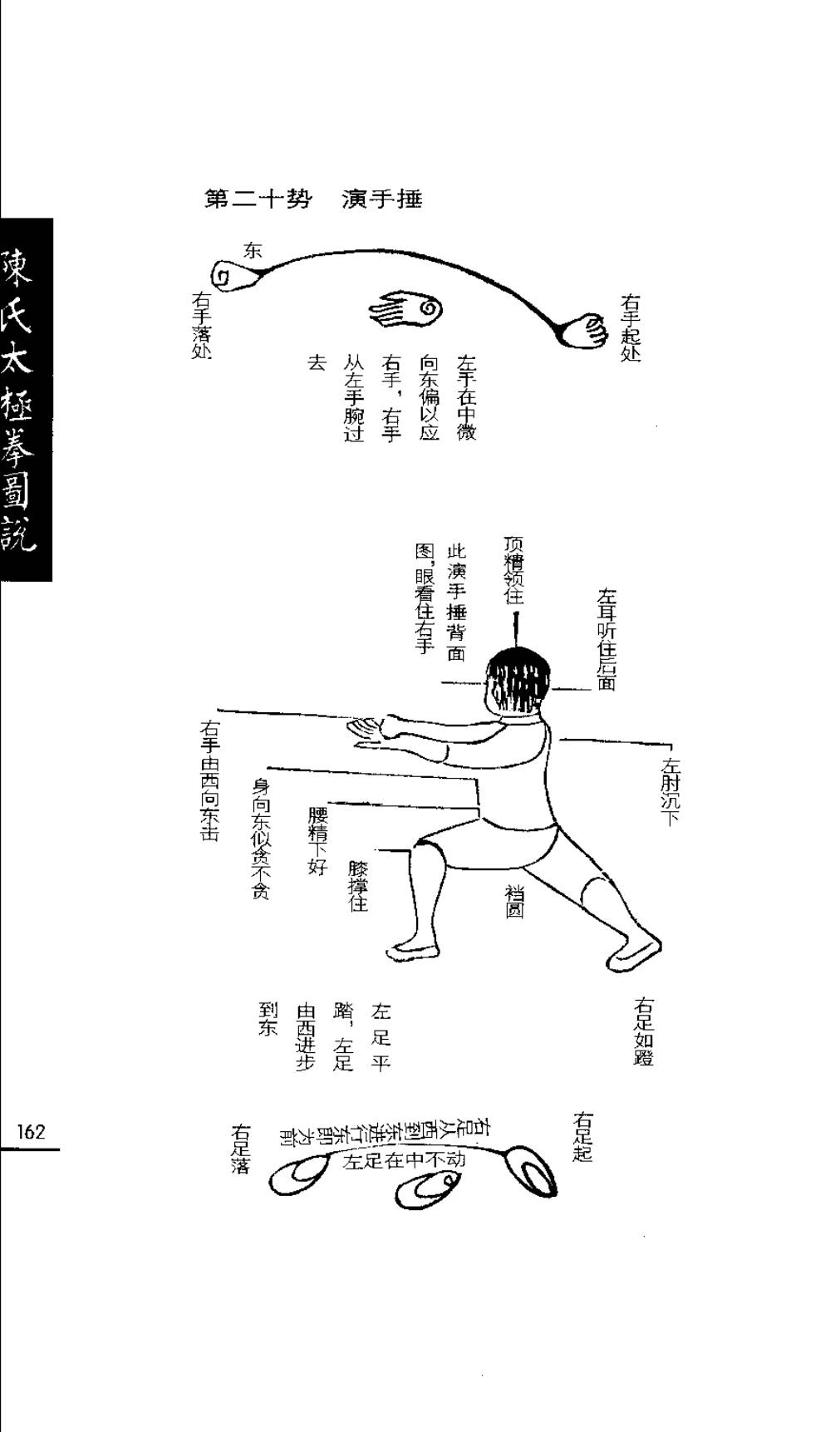
*Chen Shi Taijiquan Tushuo* (陳氏太極拳圖說), Book 2 (卷二).
Opening Instruction (引蒙)
In Shan Tong Bei (閃通背) the right foot rests east and does not move; the left foot starts from the west, steps past the right foot and advances①, the step landing east of the right foot. In Shan Tong Bei the right hand is at the west; raised from below and closed, the fist strikes east. The left hand spreads open; the right fist sweeps past it and strikes east; the left elbow slightly wards west. The internal essence descends from the dantian (丹田), passes the crotch and rear, then reverse-travels from Changqiang (長強) up to Baihui (百會), descending to the shoulder, advancing and moving into the right fist. Only when the spirit of the whole body gathers into the fist is there power. Left and right feet press the ground, steady as a mountain, immovable on the earth — that is true power.
Symbolism (取象)
In this posture the spirit gathers in the right fist, like the Cui hexagram (萃卦) line one: "as if calling, one grasp" (the Lai note: speaking of a heart of sincerity 有孚). Facing forward and gripping the fist with the right hand — this is sincerity at its utmost. And the Classic says: "Cui brings success; beneficial to have somewhere to go" — hence this symbol is taken from Cui. In this posture the right foot advances one step from behind — one small exceeding (小過) — so the Small Exceeding hexagram is also taken. The right fist strikes from rear to front like thunder on a mountain, too swift to guard against; its advance is swifter than a bird's flight — this is the right fist's taking of Xiao Guo. The right fist is not soft or weak, so the image of Da Zhuang (大壯, Great Strength) "beneficial, correct" is also taken. The Tuan says: "Firmness in motion: hence strength (the right fist is pure central firmness filling the fist — hence strength)." The Xiang says: "Thunder above heaven: Da Zhuang (the right fist is like a thunderbolt in the sky — one strike, a clap of thunder, too quick to cover the ears)." Line one: "Strength in the toes — advancing brings misfortune (the right foot lands east and moves no more: this is the strength of the toes; to move again is unlucky, not to move is lucky)." Da Zhuang is Qian below, Zhen above: the qi of central firmness is moved into the fist, correct and solid, hence line two: "Correct — good fortune"; the Xiang says: "Nine in the second place: correct and lucky, because of central firmness."
Deliver the Fist, Second Set — Seven-Character Vernacular Verse (第二演手捶七言俚語)
I.
Suddenly an enemy comes from the east;
the right fist opens toward the east.
The right foot steps forward — do not slacken;
the attacker, in high spirits, returns face upturned.
II.
Lifting the foot, advancing to crush eastward,
fist-power like wind, the meaning like thunder (that is, its swiftness).
Ask why one more step is taken?
Because the next posture lies latent in embryo.
Note
① According to the requirement that the opening posture faces north, the original edition's "left" and "right" were reversed; "left" is corrected to "right" and "right" to "left."
*Chen Shi Taijiquan Tushuo* (陳氏太極拳圖說).
21st Posture: Lan Ca Yi 攬擦衣 (Grasp and Wipe the Robe)
Diagram
Line drawing of a practitioner facing north in a bow stance (front leg bent). The right hand (viewer's left) extends forward toward the east in a grasping (拿, na) pose; the left hand (viewer's right) rests near the hip on the west side, also labeled na (拿). Direction labels: east (东) upper left, west (西) upper right. Diagram title: "Facing North Diagram" (面向北圖).
Five-Character Vernacular Verse (五言俚語)
The right arm extends, never bends;
the enemy dares not enter.
The left hand guards against a touch from the west;
one release — nothing so venomous.
So swift — who can withstand it?
The method belongs to me alone.
East is jia-yi wood (東方甲乙木);
seemingly straight, seemingly not,
the right hand spreads east,
the central qi moves from the heart —
how much more when advancing like wind.
The body is the same as other men's;
there is no special secret:
the clear spirit lies in one heart.
Only be able to move from the center —
among chickens, a crane stands out.
For those who study the fist
I have pointed out the whole way.
Commentary
The body methods up, down, left and right are all as in the first Lan Ca Yi; no need to repeat. As for the linking method: the right hand withdraws, then spreads again; the right foot draws in beside the left foot, toes touching the ground; then from the west it circles half a circle outward and spreads east. The left foot only twists on its heel, pointing north, staying in place. The right foot draws from east to west, then from west circles half a circle and lands east.
Method of the Right Hand (右手法)
The right hand withdraws from the east to the side of the body, circles toward the ribs, then spreads east; withdrawal and turning together make one full circle.
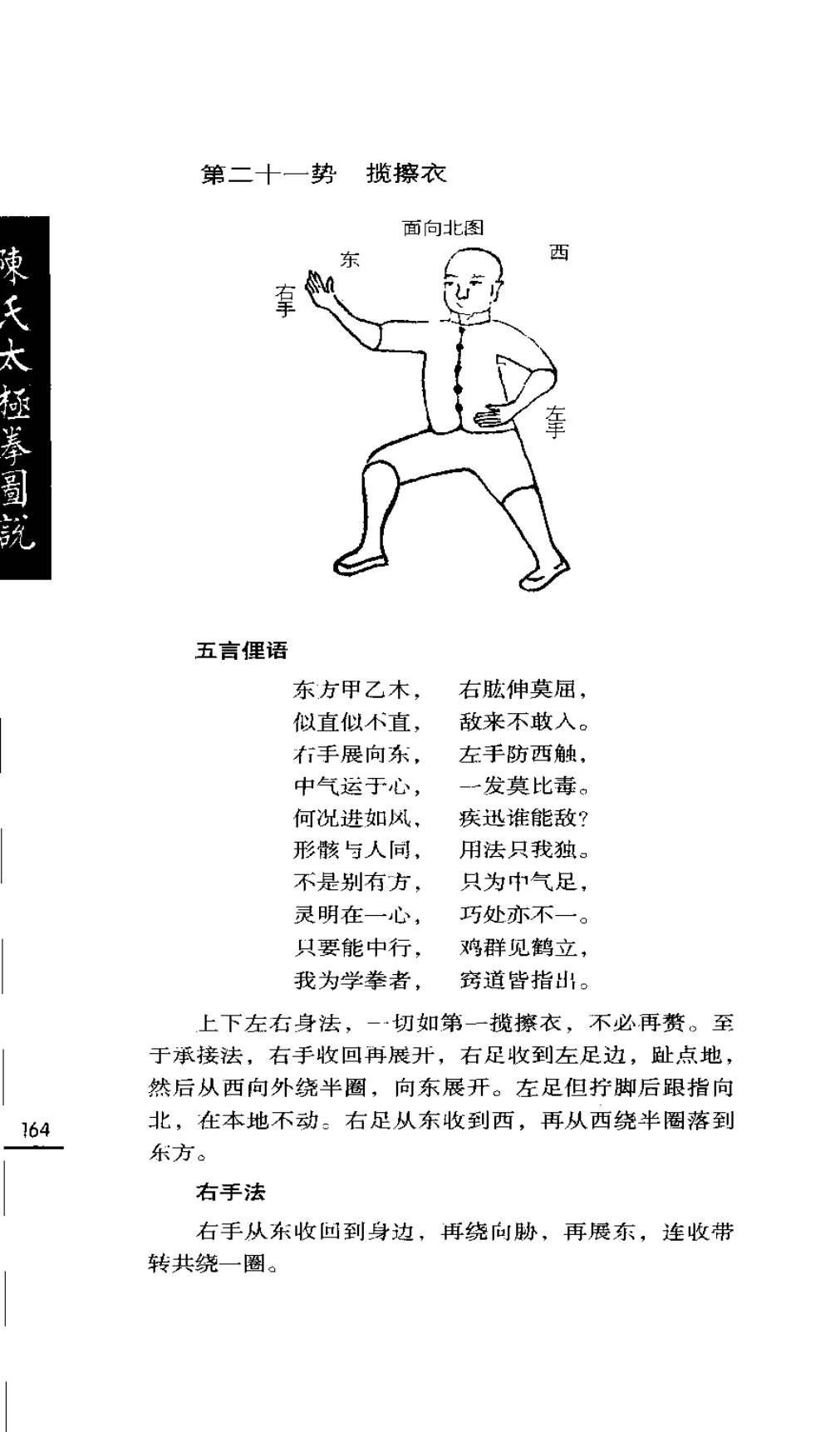
*Chen Shi Taijiquan Tushuo*, Volume 2
Taking the Images (取象 qǔ xiàng)
This image takes the general meaning of the two hexagrams Xiao Xu (小畜, "Small Accumulation") and Da Xu (大畜, "Great Accumulation"). The Xiao Xu hexagram says: "Bringing it about from my western suburbs" (this means the right hand moves from west toward east). The Image says: "In Xiao Xu, the yielding obtains its place and is responded to from above." The right hand belongs to yin; the fourth line, yin (六四), is a yin line. Qian below, Xun above — Qian within, Xun without; the yang strength is in the center, moved up and down to respond to the right hand, responding to the yin of the fourth line: this is Xiao Xu. The Image says: "Robust yet yielding; strong in the center and the will acts" (this means the right hand can extend only with the aid of yang; the right hand, being moved by the strength-centered second line, therefore extends). The Image says: "Wind traveling over heaven" (this means the right hand is like wind traveling over heaven — swift). The first line says: "Returning by one's own path" (this means the right hand, from below, turns and rises to settle in the east, also returning by its own path). The top line: "Rain has fallen, and resting, virtue is carried" (Xun is wind and rain, and is yin; the right hand is yin. Moving the central qi (中气 zhōngqì) with the right hand, its swiftness is like wind, and the yin disperses. When the top line changes, Kan becomes the cart below; the third line being yang, virtue is carried by the cart. This means the right hand moves the central qi within the hand). It says: "The moon is nearly full" (this means the central qi of the right hand is sufficient, like the moonlight of the sixteenth day — round and complete, visible). The second line: "Led back." The fifth line: "Possessing sincerity, linked together" (this means although the right hand belongs to yin, the yang qi is all linked and threaded through within the arm).
Da Xu: Qian within, Gen without. Gen is the hand; using the right hand to move and stop things, strong qi must act through its center. Qian's opposite (错 cuò) is Kun: hard and soft temper each other. Gen's reversed hexagram (综 zōng) is Zhen, and Zhen is the east. The right hand extends from the west toward the east. Zhen is the foot; the left and right feet tread the ground steadily. The Image says "Strong, robust, sincere, substantial" (this means the central qi of the fist is abundant); it says "The strong is above and honors the worthy" (this means the right hand's use is more convenient than the left's — slightly superior to the left hand); it says "It can stop the strong: great centrality" (this means the right hand can, with one hand, stop the enemy's strength — attaining the middle way); it says "Beneficial to cross the great river" (if one can cross a great river, then nothing is without benefit — the right hand is like this). The top line: "Where is the sky-road? Prosperous" (何 hé here read in the departing tone). The Image says: "The sky-road — the way greatly advances" (having accumulated for long, its way greatly advances). Moving the central qi within the right hand, attaining its way and greatly advancing, without the slightest obstruction.
Posture 22: The Second Single Whip (第二个单鞭 dì èr gè dān biān)
Four-Character Rhymes (四言俚语)
Where does numinous qi arise? It arises from the one heart/mind. Where does the central qi (中气 zhōngqì) return? It returns to the two kidneys. The heart-mind stirs and the will follows (the will is stored in the kidneys), moving my four limbs. The qi travels within the bones and fills the flesh. With long practice comes numinosity, a numinosity beyond compare. Touch and you instantly know; there is naturally a response. Neither separating nor clinging — sticking, connecting, adhering, following. Like a fly landed on glue: though it has wings it cannot fly away. The subtlety within this is subtle beyond subtlety.
Diagram: Facing North (面向北图)
Annotations around the figure (right to left):
- The left hand meets the right hand at the navel; once the joining is complete, it then unfolds from east to west, with the sense of a coiling line along the path — use the smooth coil (顺缠 shùnchán) energy
- West
- The foot momentarily taps and holds its place, joining with the right foot to unfold toward the west
- The toes of the left foot are drawn in beside the right foot
- The crown energy holds the head up
- The eyes look at the middle finger
- The crotch is open and rounded
- The right hand, not moving in the east, turns back in a circle from behind
- East
- The rear foot is in the east; the right rear heel twists and turns toward the west
- North
The Second Single Whip (第二单鞭)
The right hand turns from below and backward, circling a small circle toward the north; the left hand turns from within toward the north and then to the south, also circling a circle; then both hands join facing the face. The right hand unfolds toward the west with smooth-rotating energy; the left hand unfolds toward the east with reverse-rotating energy; gather and bind the five fingers together.
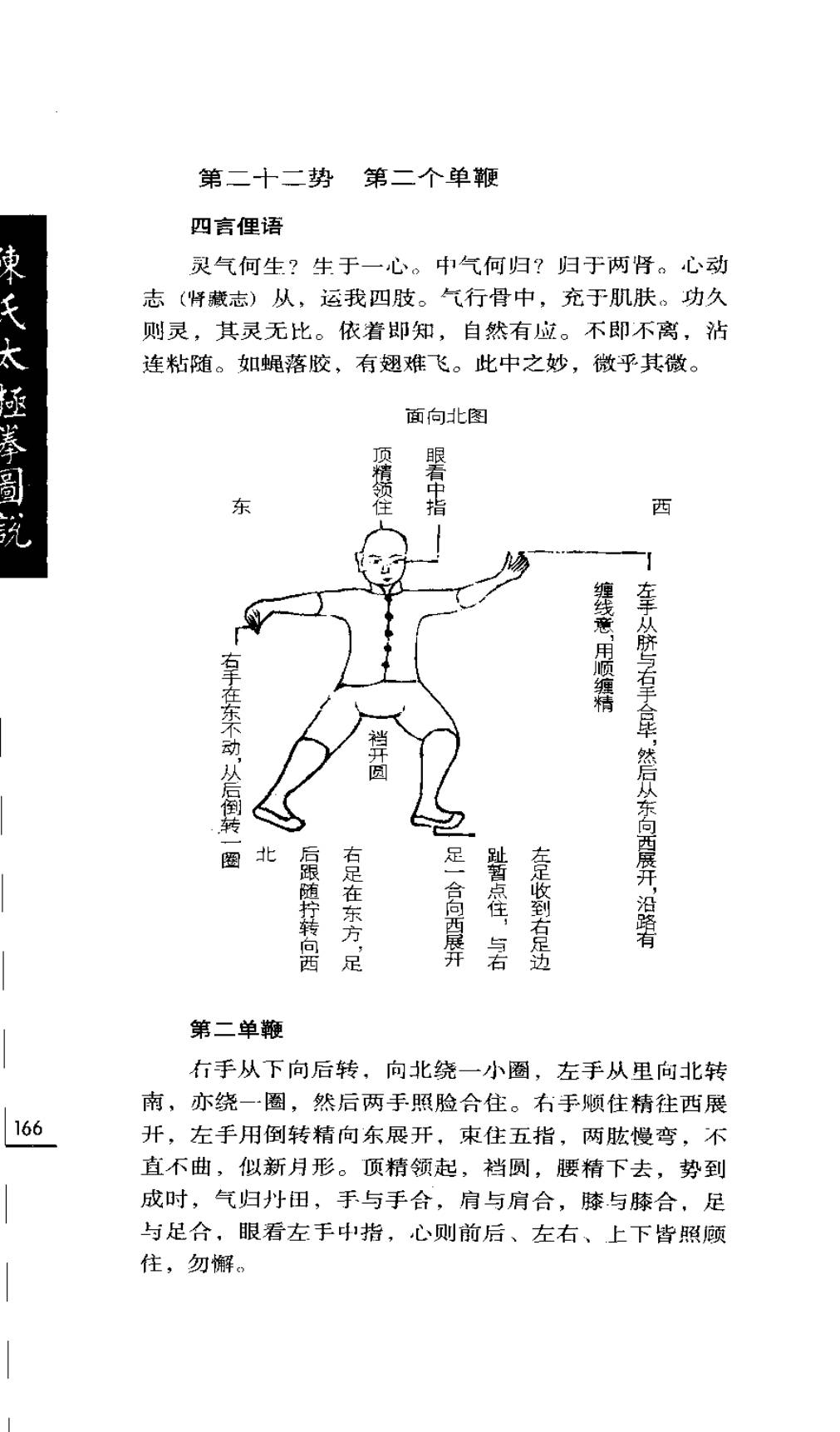
Taking the Images (取象 qǔ xiàng)
The first Single Whip took the four hexagrams Kan, Li, Pi, and Tai; the image taken for this posture is likewise so — one will understand by reading the earlier discussion of the taken images.
Seven-Character Rhymes (七言俚语)
The first Single Whip faces north; the second Single Whip still faces north. The former Single Whip follows Jingang (Buddha's Warrior Attendant); this one follows Yanshou (Cannon Fist) and the separation. Each posture's incoming channel differs of itself — not merely the hands and feet positioned toward the east. A point of numinous qi arises from the heart, ascending to the blue heavens above, entering the earth below. This qi travels within hands and feet, neither hard nor soft, naturally composed and at ease. What follows below is Cloud Hands — that is the outgoing path, and it is precisely the incoming channel (来龙 láilóng) of Cloud Hands. The eight bodily gates (顶 crown, 裆 crotch, 心 heart, 眼 eyes, 耳 ears, 手 hands, 足 feet, 腰 waist) and their crucial closings — you must remember them: human effort, perfected, rivals heaven's work.
Posture 23: Left and Right Cloud Hands (左右云手 yún shǒu)①
Annotations on the figure:
- Right hand (右手)
- Middle finger of the hand (手中指)
- The eyes attend to the right (眼着右)
- Crown lifted (顶起)
- Essence/energy (精)
- Both shoulders relax down together (两肩一齐松下)
Below the figure: In Single Whip, the left hand is in the west; it then leads the right hand up. The right hand moves to the east, while the left hand is drawn back from above down to in front of the left breast, five or six inches from the breast. When the left hand first leads, the shoulder immediately relaxes down. The right hand begins from the east (because in Single Whip the right hand is in the east, it starts here), withdraws to the right breast, turns upward in a smooth rotation, turns back toward the east, comes around again to the side of the right breast — one complete circle.
Left Cloud Hands (左云手)
The left foot is in the west; the left hand withdraws; the left foot, following the left hand, turns one circle and withdraws, together with… [text continues on the next page]
【Note】① The original edition names posture 23 "Right Moving Hands" (右运手); following the table of contents, it has been corrected here to "Left and Right Cloud Hands."
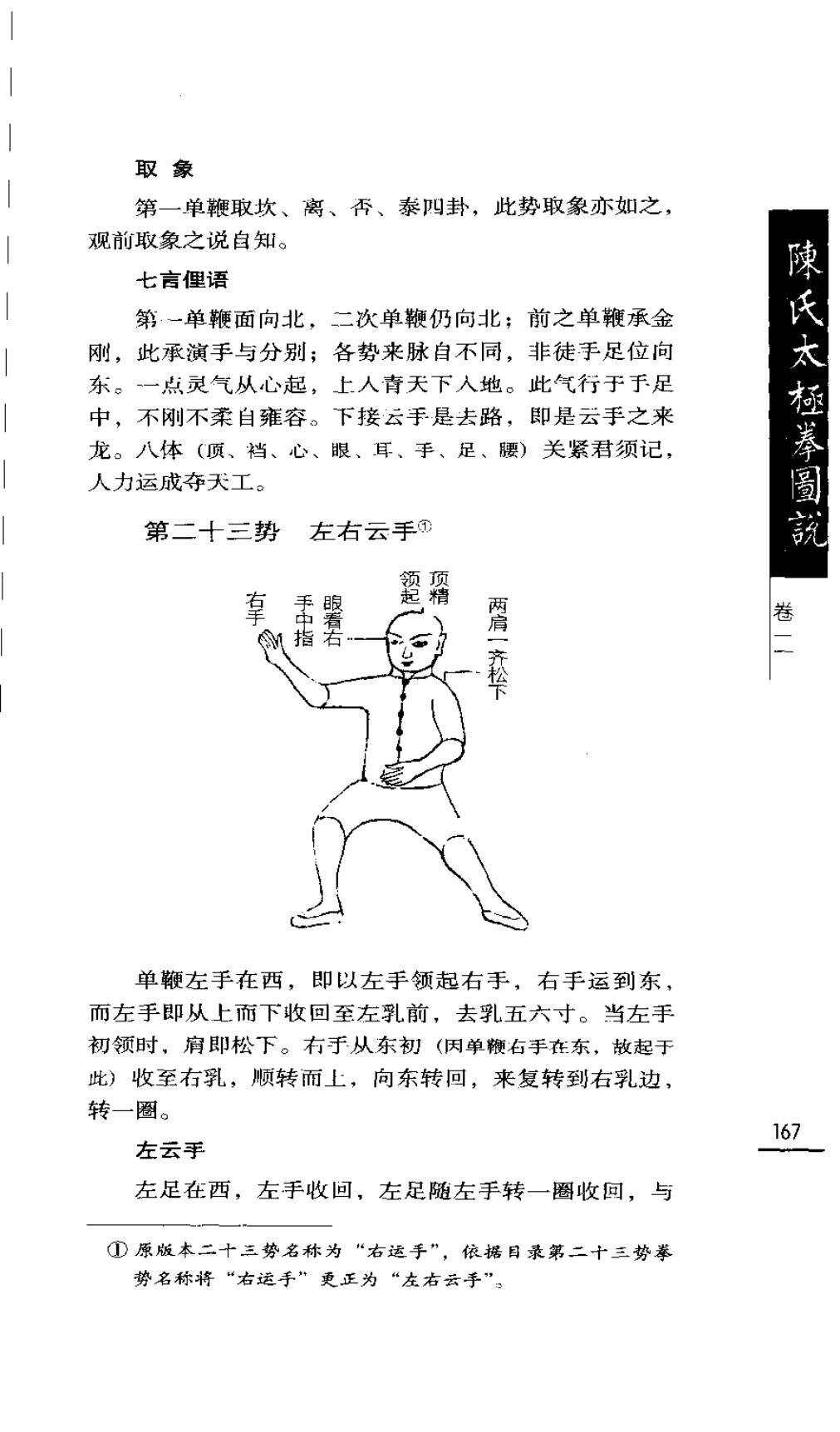
*(Continuation of Left and Right Cloud Hands — Left Cloud Hands, from the previous page)*
Annotations on the figure:
- The eyes look at the left hand (眼看左手)
- Relax (松) / right shoulder (右肩) / down (下)
- The elbow sinks down (肘沉下)
- The knee presses two or three inches (膝压二三寸)
- The crotch is open and rounded (裆开圆)
- Left foot (左足)
- Right foot (右足)
Vertical annotations (right to left):
- The left hand is in the west, leading the foot in the west. The left hand withdraws from below inward to the left breast, rises and turns westward to the western side — this is a smooth-rotating (顺转 shùnzhuǎn) circle. At this moment the right foot has just been withdrawn to beside the right breast.
- The left foot is in the west, waiting for the right foot to unfold; when the right foot withdraws and the left foot settles, it is drawn from the west to beside the right foot, turning half a circle, still…
Main text:
The left breast and it face each other above and below, pointing due north. The right foot is withdrawn to beside the left foot, then moves eastward one circle, alighting on the east and treading flat, pointing due north.
The left foot unfolds in the west; the right foot turns half a circle and withdraws to the west, facing the right breast above and below. The left hand moves half a circle to the west; then the right hand, from below, turning half a circle, withdraws inward to beside the right breast, five or six inches — or seven or eight inches — from the breast.
The right hand and right foot withdraw from the east to the right breast, then move again to the east — one full circle. The left hand rises from the west, turns downward half a circle and withdraws to beside the left breast; without pausing, the left hand from above the left breast smoothly rotates half a circle to the west — this is the left foot taking another step to the west. The right hand is immediately withdrawn from the east to beside the right breast; below, the right foot follows the right hand, turning half a circle from below and withdrawing to beside the left foot, six or seven inches from the left foot. When the right hand arrives in the east, the left hand has just arrived beside the left breast; when the left hand moves to the west, the right hand has just withdrawn to beside the right breast. The left foot bends slowly westward, stepping to the west; the right foot immediately turns from below and withdraws to beside the left foot; the right foot moves across above the left foot, advancing to the east, while the left foot moves down from the west and withdraws to beside the right foot. One replaces the other, back and forth, taking turns in circles, not bound to a fixed number — generally two or three circles (three circles: the left foot takes three steps westward, the right foot follows with three steps), stopping about a step and a half short of the position of the third Jingang Dao Dui (金刚捣碓 jīngāng dàoduì, "Buddha's Warrior Attendant Pounding the Mortar"), leaving room for the next posture, Gao Tan Ma (高探马 gāo tàn mǎ, "High Pat on Horse").
The two feet alternate, the turning mechanism never pausing. The left foot takes a step westward and the right foot follows it. Though it too takes a step, when the right foot is about to reach the left foot, it turns back five or six inches on the ground before finally alighting — only so does the movement show no straight steps. Every time the left foot steps out, the right foot follows it in the same manner. The two feet move westward, the face toward due north; the feet travel crosswise toward the west, not stepping toward due north. For instance, when the right hand smoothly rotates one circle: in the first half circle the central qi spirals obliquely from within the armpit outward to the fingers; in the second half circle, returning from the east, the energy spirals obliquely from outside back to the armpit… [text continues on the next page]
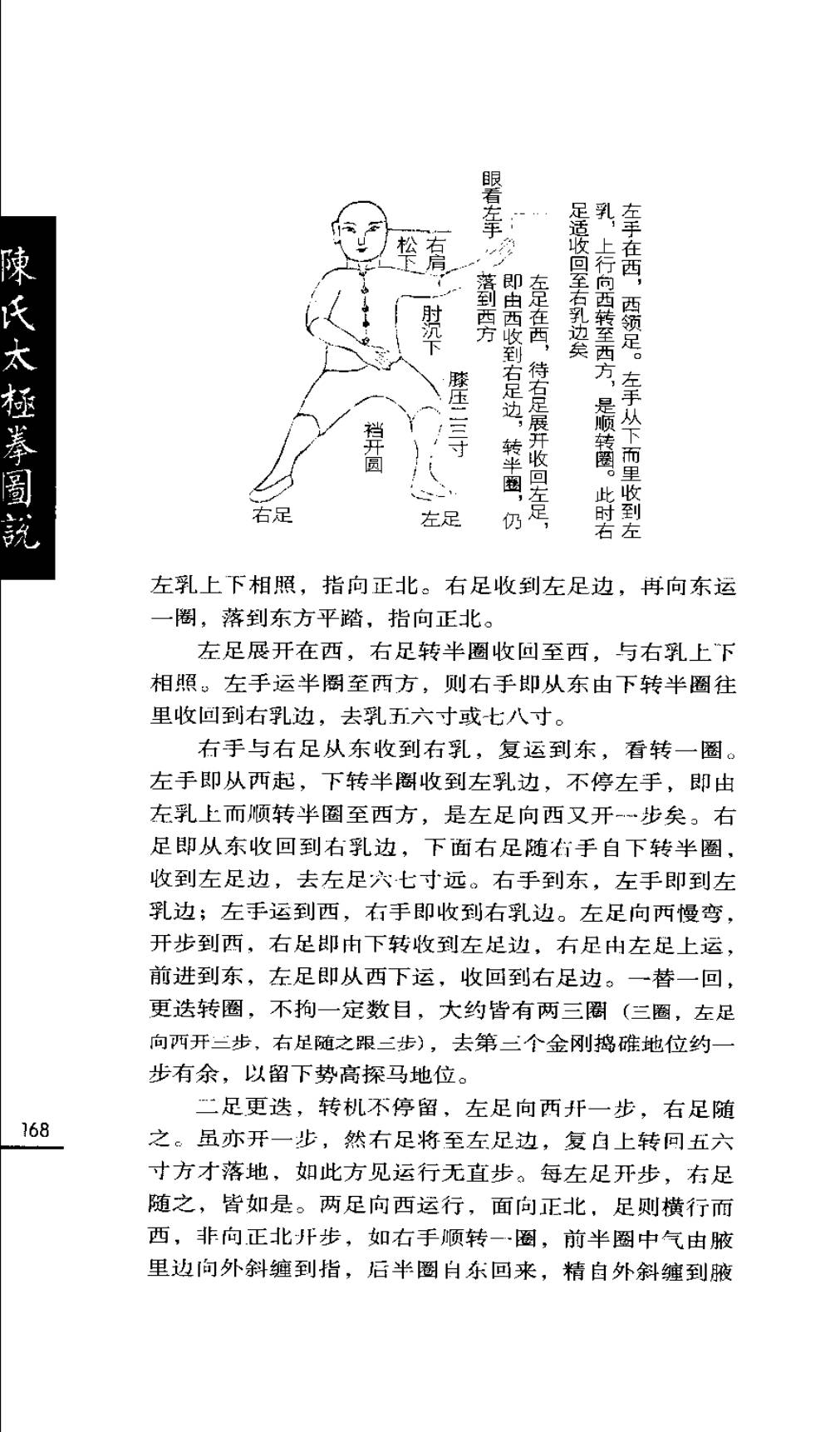
Chen Family Taijiquan Illustrated, Volume Two
(Continuing the preceding text) ...down; the left hand is likewise. As for the feet: the right foot's front half-circle coils from the leg root inside outward to the toes and returns, then coils from outside to inside back to the leg root; the left foot is likewise.
【Diagram】Diagram facing due north
Right-hand circle diagram:
- Above (north), East (right), Below (south)
- Inside the circle: the right hand is yin, like the shape of the moon
- Text around the circle: the right hand's half-circle turns the neck, the coiling silk applied descending, going east, returning from below, again five times by return; rising from outside, from the right hand
Left-hand circle diagram:
- Above (north), West (right), Below (south)
- Inside the circle: the left hand is yang, like the shape of the sun
- Text around the circle: the left hand rises from outside, moves upward, applies coiling; the center of the ground strikes, the left from the right descends, going west, returning from below, again five times by return
Together forming the upper circle.
Right-foot diagram:
- Above (north), West (right), Below (south), East (left)
- Inside the diagram: the right foot is east of the left foot
- Text around the diagram: the right foot advances east, returns from below, again five times by return
Left-foot diagram:
- Above (north), West (right), Below (south), East (left)
- Inside the diagram: the left foot is west of the right foot
- Text around the diagram: the left foot advances west, returns from below, again five times by return
Taking the Image (取象)
The left hand is yang; the right hand is yin, like the moon. Qian is heaven and is the head. The hands pass before the head, like sun and moon suspended in the sky. The Great Image says: "Sun and moon attain heaven and double their brightness, suspended in the sky" (日月得天重明,以麗乎天). The Great Image says: "The great man continues his brightness to illumine the four quarters (just as the fist's left and right hands illuminate the whole body)." First Nine: "Thrown into confusion, yet reverent — no blame (錯 means interlacing, east and west crossing as oblique movement; the opening step of the crossed fist is like this; one must take reverence as the master)." Join at the bosom; the chest must join empty — Li is empty within (離中虛); Li interchanges with Kan (離錯坎). The waist essence descends and the qi returns to the dantian (丹田, dāntián), matching Kan's fullness in the middle (坎中滿) — hence it takes from Li. The two hands being like sun and moon, they are also like thunder and wind (the hexagram Heng 恒, Xun below and Zhen above: Xun is wind, Zhen is thunder; the two hands move in alternation without cease, without interruption, having the meaning of duration. The hexagram Heng. The Great Image says: Heng means lasting. Sun and moon attain heaven and can shine long — this speaks of the Way of heaven and earth enduring without halt. Benefit in having somewhere to go: the end again has a beginning — hence it further takes from Heng (Nine in the second: regret vanishes, for one can long remain in the middle. Six in the fifth: constant in one's virtue. The merit is all like this).
—— 169 ——
*Translator's note: Page 169 (book page), Volume Two, continuing the Yunshou (运手, Cloud Hands) movement descriptions. Contains four circular diagrams (right hand/yin/moon, left hand/yang/sun, right foot, left foot) with their surrounding circuit text, and the Yijing "Taking the Image" discussion of the hexagrams Li 離 and Heng 恒. The diagram-circle texts are jumbled transcription strings from the original woodblock layout and are rendered literally.*
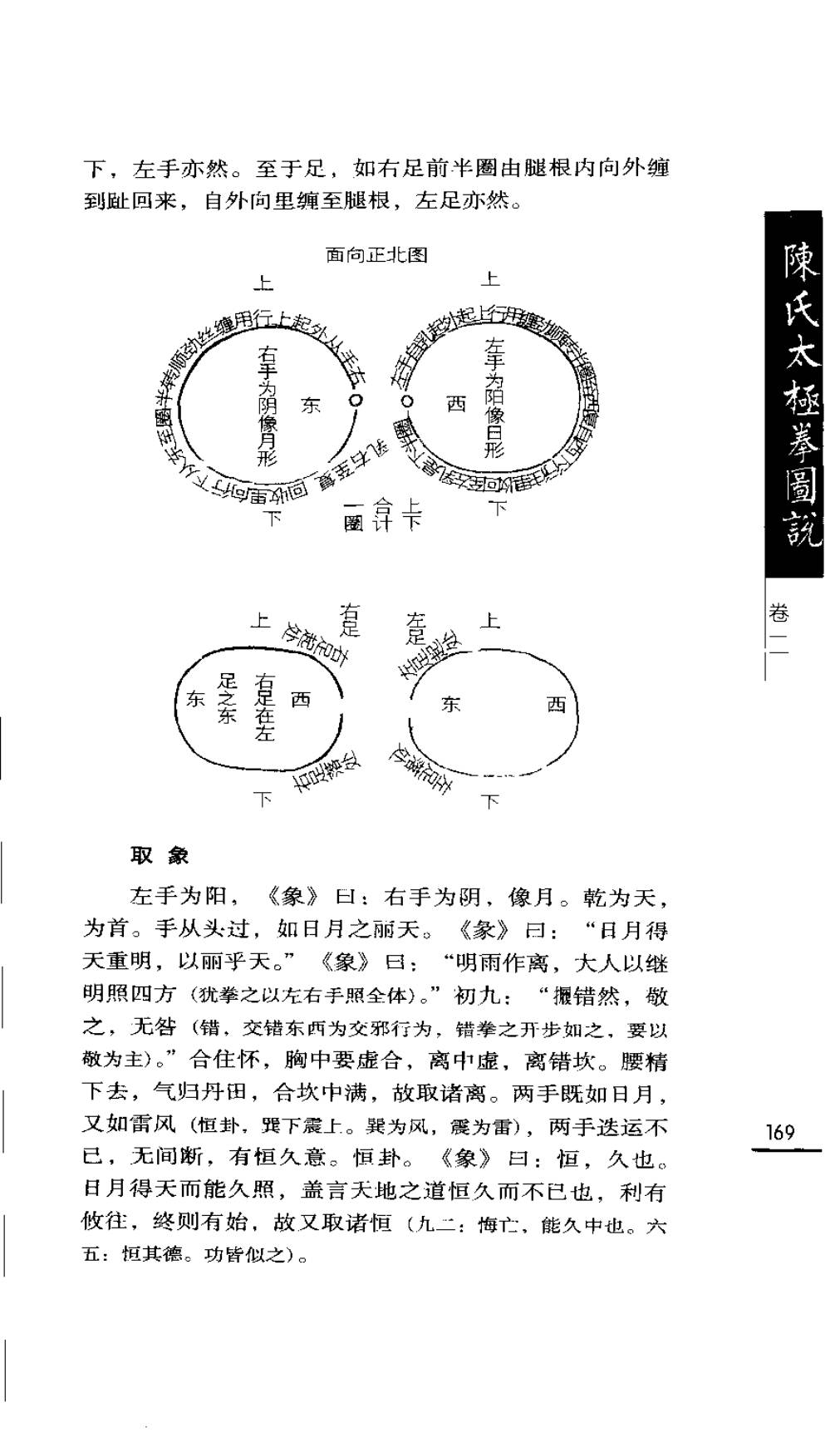
Chen Family Taijiquan Illustrated
- The eyes look fixedly at the middle fingernail of the right hand
- The top jin (頂精) holds the central qi (中氣) leading
Five-character vernacular verses on Yunshou (运手五言俚语, Cloud Hands)
Two hands lead two feet, dancing left-right, east and west. First the left hand leads, the right hand follows going west. The right foot also gathers west; the two hands are level with the eyebrows. The hands a bit more than a chi apart, turning slowly inside and out (both coils go from inside outward). The central qi threads the middle of the spine — nowhere may it tilt. When the right foot withdraws (this is the final non-dancing moment), the left hand halts in the west.
Seven-character vernacular verses (七言俚语)
Two hands turn like a ring, east and back to west; two feet travel sideways — a strange stepping method. Coming and going the qi moves, unceasing and lasting; two suns suspended in pairs shine on heaven and earth (it has an intimate connection with Li 離 and Heng 恒).
The Twenty-Fourth Posture: Gao Tan Ma (高探马, High Pat the Horse)
【Diagram】Single-practice posture diagram: a man in a long robe, the left leg bowed in front and the right leg stretched behind, the body leaning slightly forward; the right hand extends straight forward, the palm slanting downward; the left hand is bent beside the left hip; the head turns toward the right hand, the eyes on the middle fingernail of the right hand.
Yunshou (运手, Cloud Hands) faces north; this diagram, facing north, turns to face south — this is the old style. The left hand leads and holds; the right hand circles one turn from the east and again leads and holds; the left foot draws back one step and lands to the east, and the face is then turned south. The right hand follows the left hand circling one turn eastward, turning back to the west; the body twists around, in front. The right hand is in front, the back of the hand spread open facing upward. As the left foot follows the right hand circling eastward, the right foot first opens one step back, its heel then shifting to point southwest; the left foot then retreats one great step, landing east of the right foot.
The right foot follows the right hand to the east. The right foot first retreats backward, the foot landing; with one twist of the right heel, the toes point southwest.
—— 170 ——
*Translator's note: Page 170 (book page). Contains the closing verses of the Yunshou (运手, Cloud Hands) posture — a five-character vernacular verse and a seven-character vernacular verse — and the opening of the twenty-fourth posture Gao Tan Ma (高探马, Gāo tàn mǎ, "High Pat the Horse"), with a diagram description of the single-practice pose and the initial footwork (the right heel twisting so the toes point southwest).*
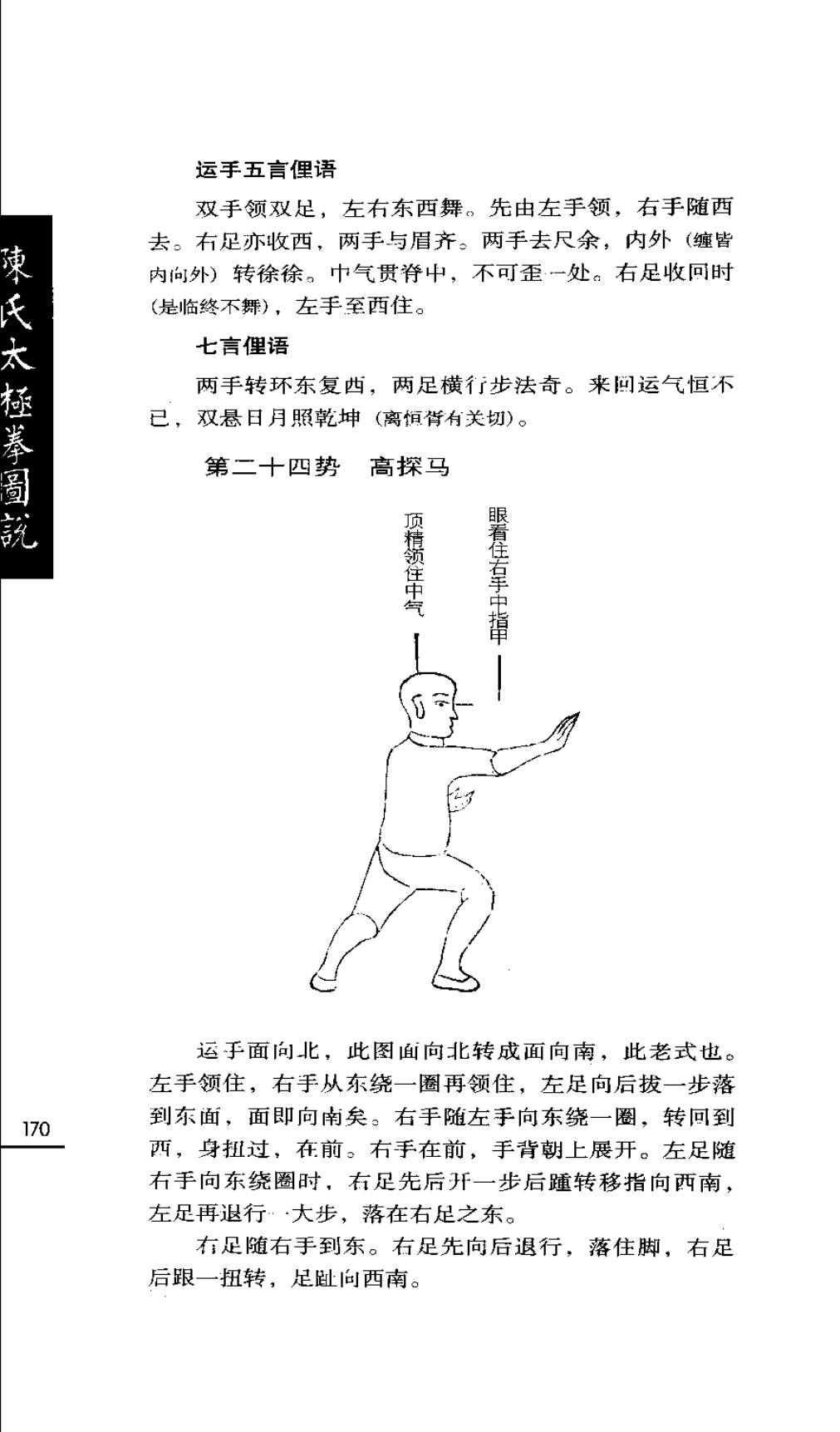
Chen Family Taijiquan Illustrated, Volume Two
What is Gao Tan Ma (高探馬, High Pat the Horse)? It is like a horse grown tall and large: mounting it, one first reaches the hand out to explore its saddle-bow (鞍橋) — hence the name. In Yunshou (运手, Cloud Hands), both hands are in the west; the enemy sends his hand to invade my left arm; I immediately lead and hold with the right hand and draw him with the left hand, making him advance. To make the enemy advance, one must first step the right foot back one step to the east; after the drawn foot [comes], one then immediately folds the left hand back to the west and strikes — this is why the hand turns one circle. At the time of drawing him in, the right hand is in the east; the right foot follows the right hand, retreating one step and landing in the east, twisting with the rear heel so it points southwest. The left foot then retreats one great step, landing east of the right foot. The right foot① is the solid foot; the left foot② is the empty foot. Above, the left elbow strikes back, and the body twists around to face south; the left hand immediately withdraws, landing below the left nipple, the wrist facing upward, two or three cun from the chest, guarding the chest and body. Then, twisting from the west around to the south, the right hand and arm immediately spread open westward, the wrist facing down, joining with the left wrist — like the complete saddle-exploring horse posture. The right hand is forward-turning essence (顺转精); the left hand is reverse-turning essence (倒转精).
【Diagram】Diagram of the inner essence turning in the left and right hands (the face already turned south): the right hand goes west, arriving at the exploring face; the right hand in the south; the right hand in the west; west is front.
【Diagram】Left-hand diagram: the left hand comes out downward from the left shoulder, withdrawing to below the left nipple; the right hand extends forward from the right arm.
【Diagram】Footwork diagram (east/west): the left foot retreats one step east; the right foot retreats one step east; this follows the body method.
Taking the Image (取象)
In this posture the right hand is in front and also above; the left hand is behind and also below. The chest has...
① The original version reads "是实脚" (is the solid foot); according to the requirements of the boxing posture and principle, it is supplied as "the right foot is the solid foot."
② The original version reads "右脚是虚脚" (the right foot is the empty foot); according to the boxing posture and principle, the character "右" (right) is corrected to "左" (left).
—— 171 ——
*Translator's note: Page 171 (book page), Volume Two: the name-explanation for Gao Tan Ma (高探馬, Gāo tàn mǎ, High Pat the Horse), the drawing-in and counter-striking sequence, three diagrams (hand-turning, left hand, footwork), the textual-critical footnotes correcting solid/empty foot attributions, and the opening of the "Taking the Image" section. The text breaks off mid-sentence at the page's end.*
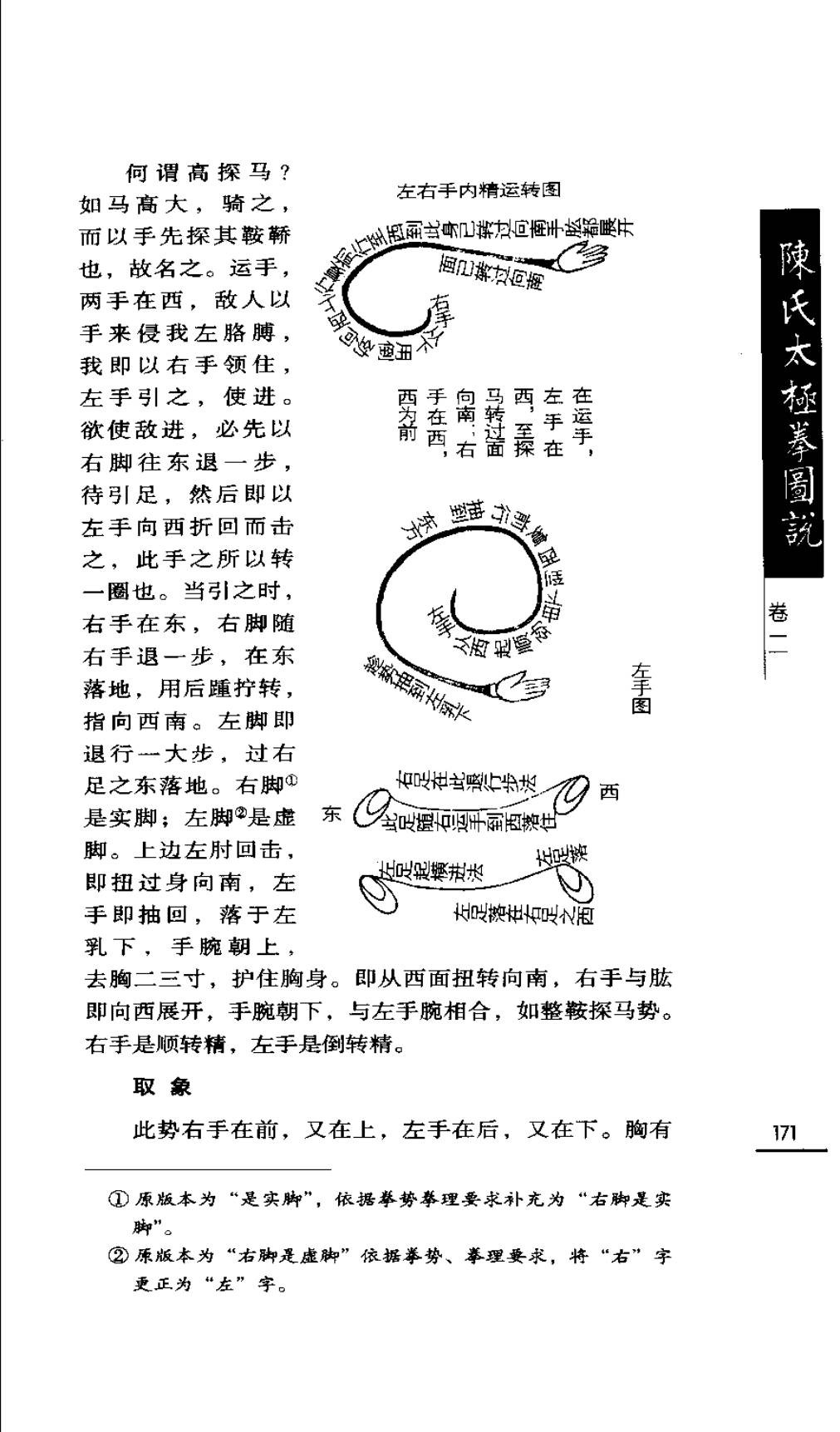
陳氏太極拳圖說 (Chen Family Taijiquan Illustrated)
Reserved and contained, utterly empty (xu 虛). The hand outside is substantial (shi 實), the mind within is empty — this has the image of Li 離 (Fire). The two feet are empty in front and solid behind; the crotch (dang 裆) is rounded, the knees open yet joined. Zhen 震 (Thunder) is the foot: its upper two lines resemble the thigh and the lower leg, its lower line resembles the foot joined. Zhen below and Li above — this is the hexagram Shi He 噬嗑 ("Biting Through"), therefore it is taken from Shi He. In practicing the form one cannot fail to strike people; without striking people one cannot defend the body — of what use would it be? "There is something in the jaws: that is called Shi He" (the hand is above; before one strikes a person, there is first the posture of striking — like the image of the jaws in which there is not yet anything. When one comes to strike a person, there will be something in the jaws). The Great Image says: "Firm and yielding are divided" (this means the foot below belongs to Zhen — firmness is below; the hand above is mostly Li. Yet in Li the upper and lower lines are both yang, like the hand of the fist being below and above; the middle yin line is like the mind at the center, utterly empty and utterly alert), "moving and bright" (when the hands and feet wish to move, the mind first perceives clearly and commands it), "thunder and lightning join and become manifest" (the foot is like Zhen, thunder; the mind is like the brightness of Li — inner and outer, above and below, each becomes a coherent pattern in itself), "the yielding obtains the center and moves upward" (the two hands extend left and right, like Li obtaining the middle way and moving upward). The Great Image says: "Thunder and lightning: Shi He" (this means that a person's having a mind is like the brightness of lightning, and having feet and hands is like the firmness of thunder). The first line says: "destroying the toes" (meaning I destroy the enemy's toes); the second line: "biting the flesh, destroying the nose" (meaning I strike the person's flesh and also strike his nose flat); the fourth line: "biting dried gristle"; the fifth line: "biting dried meat" (meaning even if I meet a strong enemy, I need not worry). The image taken is Shi He: it means that I possess the equipment of biting-through; although I have not yet bitten through, within there is the mind of biting-through and without there is the form of biting-through — in time there will surely be an affair of biting-through; it is only that the biting-through has not yet happened. Affairs have what must come; principles have what is inherently so — all these are words of anticipatory resolution. That the boxing takes Shi He likewise carries the meaning of anticipating in advance. Moreover, the two legs are at the sides with emptiness in the middle, like the hollow center of Li; the right hand is above with the two ribs at the sides, like Gen 艮 (Mountain) as an overturned bowl. The hollow center of Li moves upward and penetrates to the heart — the image of the heart-fire (xin huo 心火). When this heart-fire stirs and is transported to the right hand, that is "fire beneath the mountain," so it is further taken from Bi 贲 ("Adornment"). The Great Image says: "Yielding comes to adorn the firm" (this means the yielding of the lower body comes to adorn — for what humans rely on is culture, ren wen 人文: resplendent with propriety in mutual greeting, which is where adornment comes to rest, and sharply distinct in mutual keeping of bounds — this is an analogy for the right hand above, able to stop and able to guard). "Observe the patterns of Heaven to discern the changes of the seasons; observe the patterns of humanity to transform and complete the world" (this means the boxing has the mind transporting to the hand, and can thereby win people's hearts). The first line: "adorns his toes" (Gen is the inverse of Zhen 震; Zhen is the foot, having the image of toes; Gen is the hand — meaning the boxing has the sense of hand and foot guarding one another). The second line: "adorns his beard" (on the chin it is called beard xu 鬚, on the upper lip mustache zi 髭, on the cheeks whiskers ran 髯; "adorning the beard" means even in small places one is compliant). The third line's image says: "The good fortune of lasting perseverance — in the end nothing encroaches upon it" (with the High Pat on Horse 高探馬 raised high, no one dares come near). The fifth line: "adorned at the hill garden" (the pat raised high is like the horse at the hill garden). The Great Image says: "The good fortune of the sixth line five lies in having joy" (no one dares encroach — what joy could match it?). The top line nine: "white adornment, no blame." The Great Image says: "White adornment, no blame — the highest attains its will." Between Heaven and Earth, form is emptiness and emptiness is form; form, form, emptiness, emptiness; emptiness, emptiness, form, form —
陳氏太極拳圖說卷二 (Chen Family Taijiquan Illustrated, Volume II)
Non-being gives birth to being, and being returns to non-being — with what thing is it not so? How could it be so with the boxing alone? How could it be so with the High Pat on Horse 高探馬 in the boxing alone? When an art reaches this point, the heart is satisfied and everything is judged fitting!
High Pat on Horse — Seven-Character Folk Verses
The First
An eight-chi horse and above is called a dragon: standing alone on Wu Mountain, the highest peak. Only because one wishes to ride a thousand li at speed does he raise his hand high to pat — Zhao She enfeoffed as Lord of Mafu (Zhao She, descendant of Boyi, was enfeoffed as Lord of Mafu 馬服君).
The Second
North of Ji, picking the finest from the herd is hardest of all; a horse of eight chi in height is not easy to pat. If one can truly stand in a posture transcending the vulgar crowd, in a single day a thousand li can be freed from the saddle.
The Twenty-Fifth Form: Right Heel Kick (You Ca Jiao 右擦脚)
【Diagram】Single-person practice-posture diagram (Right Heel Kick), with labels beside the figure:
- jing 領 at the crown of the head (ding ding jing 頂頂精)
- the eyes watch the right hand
- jing joined together (合住精)
- just now with the left hand
- joined in jing with the right hand
- outside — going from outside to inside is the coiling direction (fang 外往內纏方)
- the left elbow sinks down
- the waist bends forward one or two fen
- the buttocks point downward
—— 173 ——
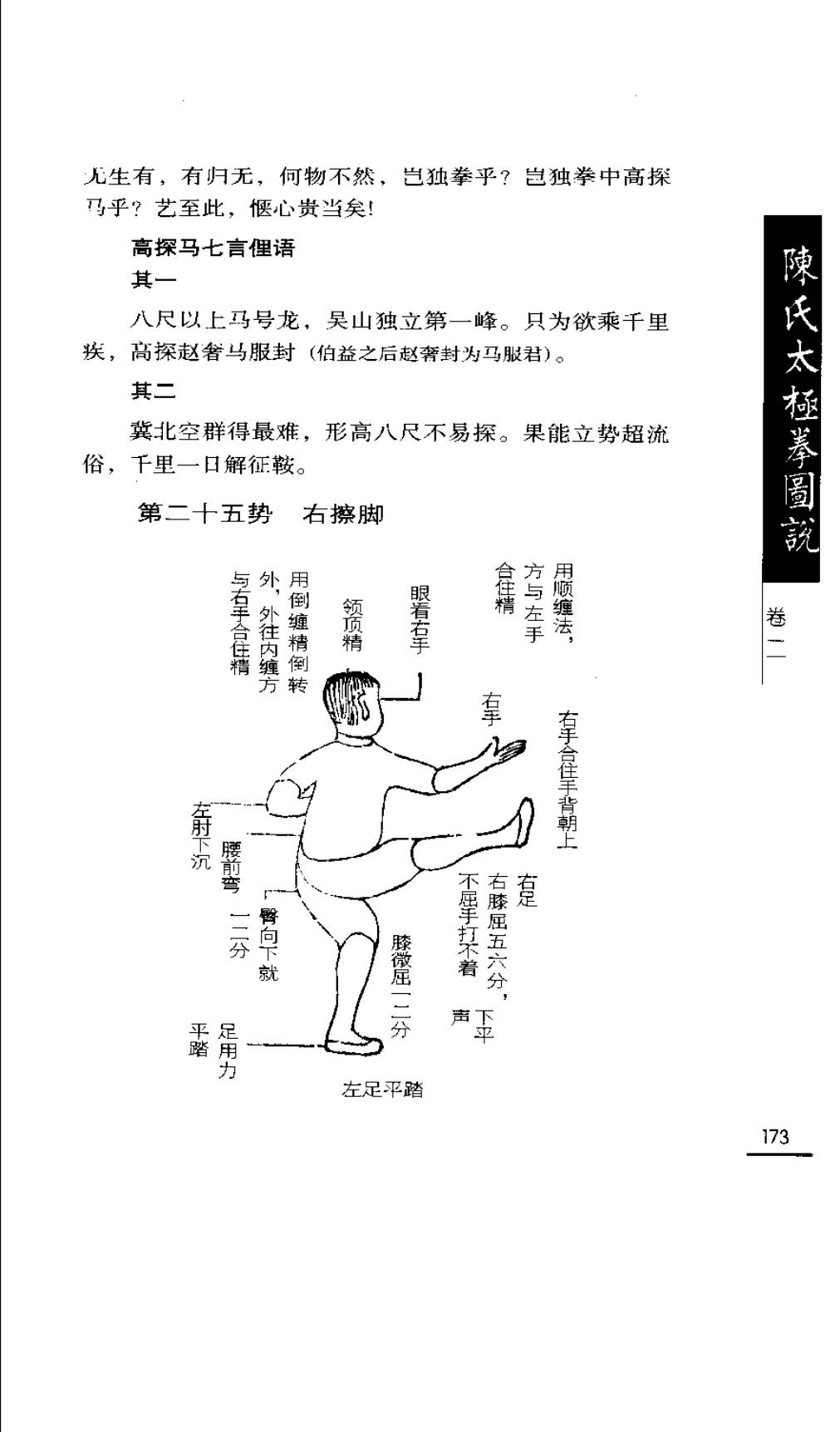
Posture 26: Left Foot Rub (左擦脚 zuǒ cā jiǎo)
Annotations on the figure:
- 頂精領住 dǐng jīng lǐng zhù — the crown force threads upward and holds
- 眼看左手 yǎn kàn zuǒ shǒu — the eyes watch the left hand
- 左手腕打左足面 — the left wrist strikes the instep of the left foot
- 左足左屈膝一二分 — the left leg bends the knee one or two parts
- 右膝微屈 — the right knee is slightly bent
- 外纏往精用外順 — wrapping outward: use outer coiling (顺缠 shùn chán)
- 左手倒纏方与外往里纏 — the left hand coils in reverse, from outside inward
- 左手合住 — the left hand closes and holds
- 右肘沉下 — the right elbow sinks down
- 腰前就勢,臀往下稍就方能撑住左半身 — the waist leans forward with the momentum and the buttocks drop slightly, only then can the left half of the body be braced
- 右足平踏用力 — the right foot presses flat with force
Text:
The right hand strikes the right foot. First bring the right hand down and fold it back to the left ribs, then travel upward and westward, using the coiling method (顺缠 shùn chán) to strike the instep of the right foot. The chest bends forward, the buttocks press back and down; only following this momentum can the front and rear brace each other so the body does not topple. The left knee bends slightly, only then can the left foot stand stable. After striking the right foot, move the right foot a little forward, one foot's length (that is, move it after the right foot has landed), toes pointing north; move the left foot in front of the right foot, pointing northwest, set the foot down, then lift it again. Before striking the foot, the left hand likewise goes up from the left ribs and strikes forward at the instep of the left foot, also using coiling force; the waist bends westward, the buttocks drop, and following the momentum press toward the east — then left and right can both brace. The crown force must be well lifted; the crotch sinks with bent knees, and the foot on the ground must press solidly.
Annotations under the figures:
- 面向南方图 — figure facing south
- 右手图 — figure of the right hand
- 东 East — 西 West
- 左手在后亦往下暗助力 — the left hand behind also secretly assists downward
- 手在前打右足面 — the front hand strikes the right instep
- 左肘在后亦展开 — the left elbow behind also opens out
- 右肋 right ribs — 左肋 left ribs
- 右手从西屈肘回到右肋 — the right hand comes from the west, bending the elbow back to the right ribs
- 右肘展开 — the right elbow opens out
- 右前臂 right forearm — 左前臂 left forearm
- 左肘 left elbow — 右肘 right elbow
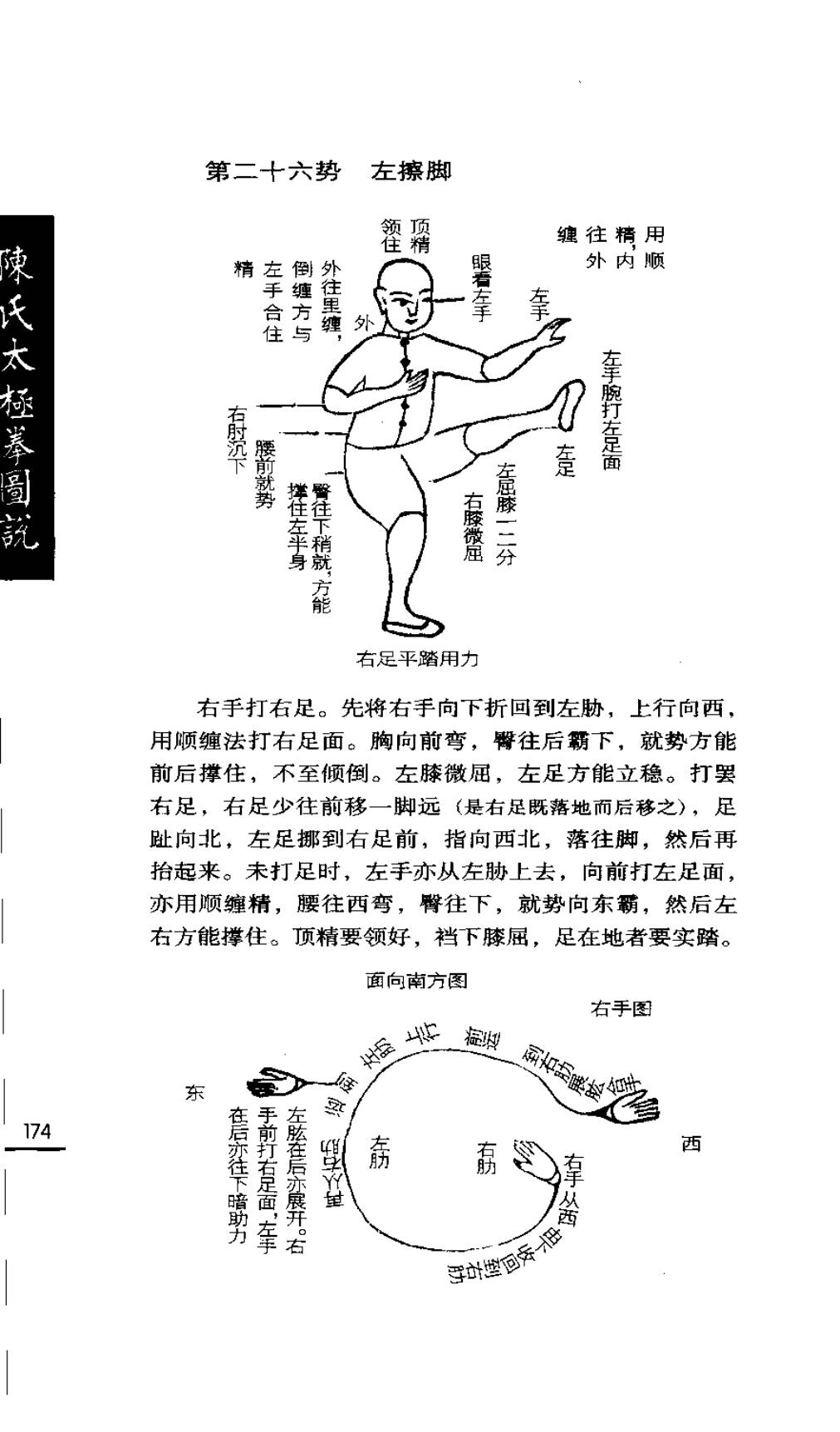
Posture 26 (continued) Left Foot Rub: Facing-North Figure, Image and Verse
Annotations on the figure:
- 面向北方图 — figure facing north
- 左手图 — figure of the left hand
- 西 West — 东 East
- 肱展开合手 — the forearm opens, the hands close
- 右肋在後亦展開 — the right ribs behind also open out
- 左手从左肋由外往 — the left hand goes out from the left ribs, from outside
- 左肋 left ribs — 右肋 right ribs
- 左足所落之西停住,再抬左足 — the left foot lands in the west and stops, then lifts again
- 左足在东右足在西,右手打罢右足落原位 — the left foot is in the east and the right in the west; after the right hand strikes, the right foot returns to its original place
- 扭转足踵使趾向北,然后左足自东越右 — twist the heel so the toes point north, then the left foot crosses from the east past the right
- 左足从此起 — the left foot rises from here
- 右足从此起 — the right foot rises from here
- 打罢仍落 — after striking it still lands
- 左足越之 — the left foot crosses over it
- 足时之前踵扭转,右足指亦向北 — when lifting the foot the fore-heel twists, and the right toes also point north
Right Foot Rub — Image (取象 qǔ xiàng):
This posture uses the right hand to slap the instep of the right foot. Zhen (震) is the foot: the right foot kicks the opponent; Gen (艮) is the hand: the right hand assists and wards off the enemy — this is the true intent. Practicing the quan is not truly meeting an enemy; slapping the right foot prefigures the authority of self-defense. The foot kicks upward, the hand strikes downward — the meaning of Increase (益 Yì); therefore the hexagram Yi is taken. The Image says: "Decrease above, increase below" (the hand assists the foot); it says: "From above coming down to below — its way is greatly bright" (the right hand descends from above down to the right foot — a compliant path, hence "its way is greatly bright"); it says: "It furthers one to have somewhere to go; correctness in the center brings blessings" (inside, move it with the central qi; the waist bends forward, the buttocks press back — gaining central correctness, hence blessings. The right foot kicks up — nothing is not favorable). First line: "It furthers one to undertake something great; supreme good fortune" (the right foot is honored by having accomplishment; kicking upward with it is a great deed — good fortune, the utmost good). There is the hexagram Guai (夬), the image of strength in the fore-toe; and the fourth line, the image of "no skin on the buttocks" (when the right foot kicks forward, the buttocks must follow; here one orders them to whip behind and drop slightly — "no skin" means not exposing the skin).
Right Foot Rub — Mixed Verse (长短句俚语):
The right hand draws out from the left ribs and circles once, the hand level with the heart; open the forearm, stand firm on the left foot, kick up the right foot — it lands below the jaw or in the crotch. It can rob a man of his life in an instant; if it can be spared, then spare it — one must not rashly raise and move at random.
Left Foot Rub — Image:
The right hand has just finished the foot-rub strike; turn straight back around, facing north, then kick up with the left foot, left palm facing down, and strike with the left hand. In the previous posture the left foot had just finished standing alone; now again
*(page 175)*
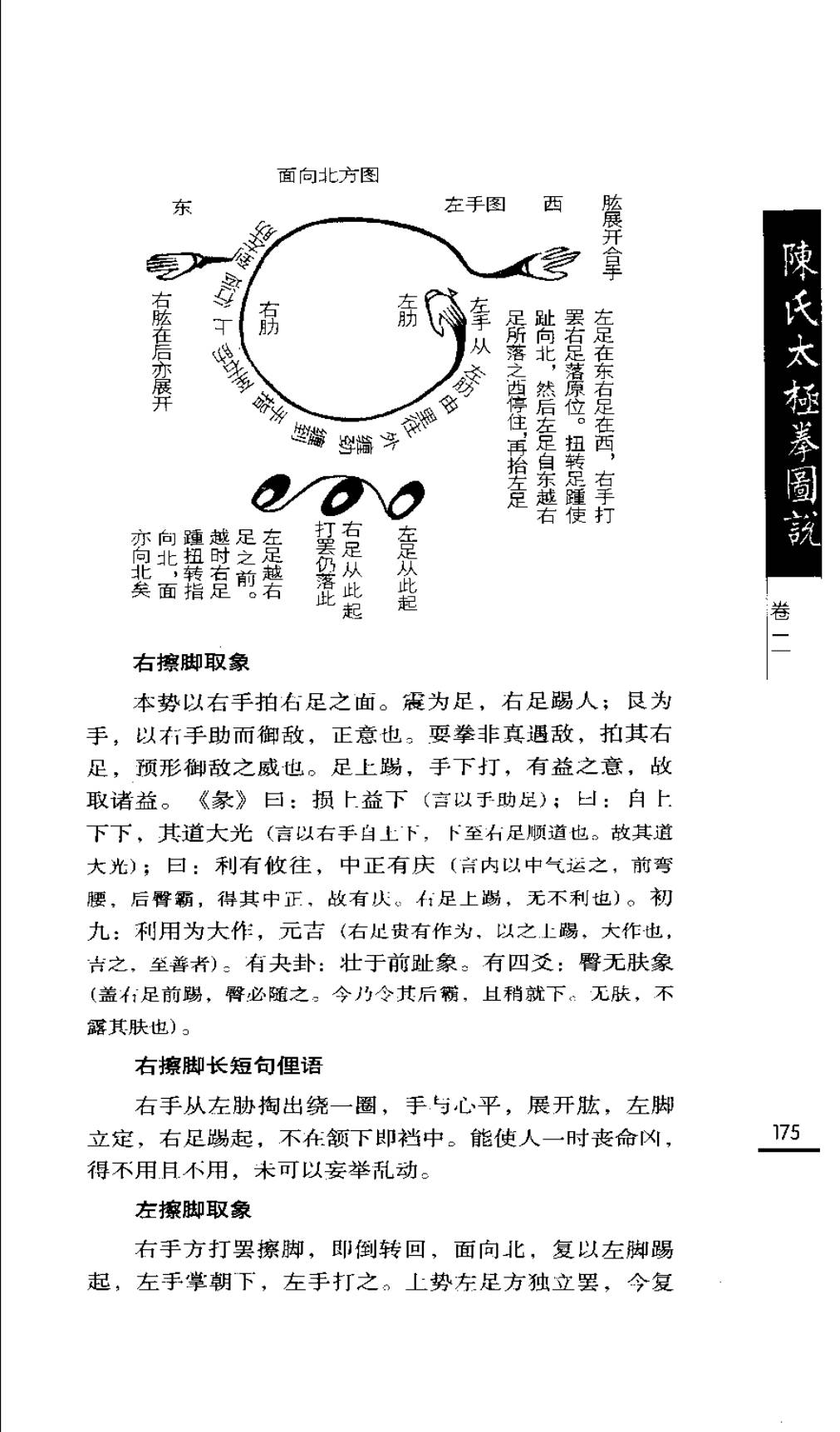
Left Foot Rub — Image (continued), Verse for Right and Left Foot Rub
Left Foot Rub — Image (continued):
Stand on the right foot alone. The right foot below is yin, Xun (巽) below being broken and thus yin; with Xun below and Gen above this is the hexagram Gu (蛊, Decay/Remedying), therefore Gu is taken. The right thigh stands alone, trembling and unsteady — yet in unsteadiness achieving steadiness, like a tree beset by insects, hardly able to sustain itself and yet forcing its support. The Image says: "Gu: firm above and yielding below" (firm refers to the left hand, yielding to the right foot); it says: "It furthers one to have somewhere to go" (this refers to the advantage of striking the foot-rub); it says: "The end has a new beginning" (this posture once finished, the next begins — this is the movement of heaven; the quan too is the natural movement of heavenly principle). First line: "He remedied the decay of the father" (the Gen hand above — there is a father occupying the honored place, devoted to non-action yet acting), "and the son is capable" (the right foot governs standing, the left governs kicking — serving and obeying like the compliance of Xun), "the father is without blame" (the foot can kick, the hand can strike — like a father without blame); fifth line: "He remedied the decay of the father and gains praise" (the left foot kicks up with achievement — that is gaining praise). In sum: though a matter may contain decay, one who remediates it dissolves the decay and even gains merit.
Left Foot Rub — Mixed Verse (长短句俚语):
The right foot stands firm facing north; the left hand likewise turns back from the right ribs, the hand level with the heart; open the forearm; the left hand closes its palms and strikes downward, the left foot kicks up swift as the wind. Neither leaning nor crooked, it kicks again into the enemy's crotch (the enemy is not one man) — face to face, the hero appears.
Right Foot Rub — Four-Character Verse (四言俚语):
Mark the positions clearly, the facing sharply defined; the left foot first crosses sideways, the right foot follows and plants; the right hand scoops from the left, striking level toward the foot.
Seven-Character Verse (七言俚语), the first:
First lay the left foot crosswise toward the south (the Horse-Exploring posture faces north; the left foot first twists toward the south, the right foot twists to face south — hence facing south); raise the right foot with the instep stretched flat. The right hand first circles over from the left; striking above and kicking below, the two meet.
Seven-Character Verse, the second:
Facing south, the left foot fixes the foundation; the right hand receives from below without troubling thought. The whole body closes like a drawn bow; glancing east, striking west, they follow each other.
Left Foot Rub — Four-Character Verse:
The face, from the south, turns to the north. The right foot stands firm, the left foot flies aloft. The left hand circles to the right, striking down without hindrance. The central qi threads through fully — such is your strength.
Seven-Character Verse:
Then twist the right foot toward the north; lock and close the whole body and strength arises of itself. The left hand circles rightward and strikes downward — thread by thread into the groove, only then is the form correct.
*(page 176)*
Left and Right Foot Rub — Combined Chant; Posture 27: Middle Single Whip
左右擦脚合咏长短句俚语 (zuǒyòu cā jiǎo hé yǒng chángduǎn jù lǐyǔ):
First commit the positions to mind; from north turn south with both feet crosswise. The left foot first stands firm; the right hand circles one full turn from the left; then the right foot kicks up and the right hand strikes level and true at the instep of the right foot. After the right foot has kicked, it lays crosswise toward the north, and the left foot follows forward and plants. The right foot first steps true; the left hand circles one full turn along from the right ribs, opening the hand, stretching out the forearm, and strikes once more at the instep of the left foot. The crown force lifts up, the crotch force sinks down; each posture, each foot stands distinct. Assailed from four sides yet unafraid — the tiger roars, the wind rises, hands and feet receive it; the primal breath of Great Harmony refined to perfection, alert as a rolling eye. Motion and stillness weighed together; keep the heart reverent, cultivate by real effort, advance step by step, and in ten years it is achieved. By then the breath no longer contends, the mind holds no excess — only then does one know the quan practitioner holds the scale of judgment.
Posture 27: Middle Single Whip (中单鞭 zhōng dān biān)
Upper-posture figure (上半势图) labels:
- 顶精领 — the crown force leads
- 右肘相合 — the right elbows join
- 眼神意注前 — the eye spirit and intention concentrate forward
- 听思聪 — hearing with clarity
- 右膝屈与左膝合 — the right knee bends and joins the left knee
- 右肘屈住与左肘合,腰精下去 — the right elbow holds bent and joins the left elbow; the waist force sinks down
- 左肘屈住与右膝合住 — the left elbow holds bent and joins the right knee
- 右足平踏 — the right foot presses flat
- 左足点住地 — the left foot touches the ground
Lower-posture figure (下半势图) labels:
- 顶精领 — the crown force leads
- 右手 — right hand
- 右肘节展开 — the right elbow joint opens out
- 腰精下去 — the waist force sinks down
- 右膝微屈 — the right knee slightly bent
- 右足平踏 — the right foot presses flat
- 身往后霸 — the body presses back
- 西 — West
- 能得正气右足亦立得住 — once upright qi is attained, the right foot too can stand firm
- 左脚东之蹬精惟如此,身 — the left foot's kicking force goes eastward in just this way; the body...
- 左手 — left hand
- 左肘节展开 — the left elbow joint opens out
- 眼看左手中指 — the eyes watch the middle finger of the left hand
- 身向南 — the body faces south
- 东横蹬一脚 — one horizontal push-kick toward the east
*(page 177)*
*Chen Family Taiji Boxing Illustrated Explained* (陳氏太極拳圖說, Chén shì tàijíquán túshuō)
After the left hand finishes striking and the left foot kicks, the body turns around from north toward the west, the face turning toward the south. The left foot stands facing east, the toes pressing into the ground; both elbows are bent. Suddenly the left hand extends east and the right hand extends west, opening out together. This is called "Middle Single Whip" (中单鞭, zhōng dān biān), also called "Double Wind Pierces the Ears" (双风贯耳, shuāng fēng guàn ěr). It is so named because when the two arms open out, the hands quickly pass by the ears, as though wind were rushing into them. When the two arms open out, the left foot simultaneously kicks out eastward; the foot pushes east while the body presses west, so that the forces east and west balance each other and the body stays centered and upright, without falling; the right foot below keeps the stance stable. The crown energy (頂精, dǐng jīng) must be held up, the right knee slightly bent; only then can the hips sink slightly so the body can press westward. Neither leaning east nor leaning west, it stands firm in the center. Everything is like this: whoever can weigh things to hit the mean will naturally be fitting. Yet this weighing has no fixed rule — the body may be somewhat off-center, but if the applied forces balance, one can still be centered: this is called attaining the mean. The weighing is unfixed, yet there is in it something fixed and immovable; each person must grasp this for himself.
Taking the Image (取象, qǔ xiàng)
Qián (乾) is the head. The head is on top, the crown energy held up; the gaze fixes on the left hand and also on the spot where the left foot kicks. The two arms open out with the hardness of Qián. Zhen (震) is the foot. The right foot stands firm while the left foot kicks east, swift as thunder. Zhen below, Qián above — this is the hexagram Wu Wang (无妄, "Innocence / No Falsity"), so the image is taken from Wu Wang. Wu Wang means utmost sincerity without falsehood. In all things do your utmost in what is yours to do, and entrust good and ill fortune alike to fate — then naturally there is nothing to reckon. The Image says: "Hardness comes from outside," referring to the upper trigram of Da Xu (大畜); Gen (艮) comes and becomes Wu Wang. Zhen means movement (the left foot kicks east — the movement of Zhen); it says: "Movement and strength" (the kick is utterly vigorous); "the center is hard and has response" (the strong hands of Qián respond to the left foot); "great success" (both left hand and left foot are effective); "beneficial to be upright" (kick when kicking is fitting, not kick recklessly; the eastward kick strikes a vital point, and thus is correct); "this is the command of Heaven" (the eastward kick too follows principle — the situation arises naturally, nothing but Heaven's command); "there is somewhere to go" (the kick is not a mere kick; something comes after it — the classic's "going without falsity"); "whither?" (directly opposite is where to strike); "Heaven does not aid" — no: opposite there is a target, kick what should be kicked, strike what should be struck, and Heaven aids it; "go, then." Keep reverence in the heart, circulate the central qi (中气, zhōng qì) — where can one not go? First line: "Going without falsity — auspicious." The Image says: "Going without falsity attains one's aims" (sincerity can move things; nothing fails to follow one's wish — this is the meaning of striking with the hand and kicking with the foot). The Image of the fourth line says: "Steadfast, no blame — it is inherent" (Single Whip can kick or strike, and can also refrain, because it has been cultivated as a habit).
Internal Essence (内精, nèi jīng)
In Grasp the Robe (揽擦衣, lǎn cā yī) the right arm is extended and must first join with the left arm; only then does the left hand open out into Single Whip. In Middle Single Whip both elbows are bent, like a firecracker wrapped up (wrapping the opponent's arm with mine, opening outward to strike him). Suddenly use compliant energy (順精, shùn jīng) to open out all together — this differs only slightly from the former.
Chen Family Taijiquan Illustrated Explanation (Chén shì tàijíquán túshuō), Volume 1–2
When kicking with the left foot, one likewise uses shùn-chán (unwinding coiling) and *jing* (essence) to close it together. When kicking with the right foot, one likewise uses shùn-chán and jing to close it together — only then can one stand stably.
Seven-character verses on Middle Single Whip (Zhōng dān biān)
I:
The posture of the body stands dignified and correct, without the least deviation; the left and right (hands and forearms) spread evenly (extended, that is), arrayed on both sides. The left foot kicks out one kick toward the east, relying entirely on a single tree (zhen trigram = wood, = foot; the right foot stands independently below) thrusting up to pierce the heavens.
II:
The two hands suddenly gather and suddenly disperse; the vast, mighty *yuanqi* (original qi) threads through the center. The right foot sinks below like a foundation, supporting the left foot as it hangs in mid-air.
Posture 28: Strike-the-Ground Fist (Jī dì chuí)
Notes around the figure (right to left):
- "Striking the ground" is not literally so; it means that the enemy has been kicked to the ground, and one then advances two steps to strike him with the fist.
- Shang jiu (top line): "Dun gen, auspicious" — "dun" meaning the whole body is present within it; the left and right forearms, shoulders, and hands naturally need no mention.
- The rear vertex (hou ding), the back of the skull, must further rise upward and lead, so that although the face points downward, the heart/mind is at the back. The eyes look toward the right fist.
- Six in the fifth: "Gen its jaws." "Fu" is the outside of the jaw/cheek; from the stillness of the jaw one may know the closing of the mouth.
Right-side notes on the figure:
- The body inclines and halts; the right shoulder is below, the left shoulder above.
- The left hand is behind, above, guarding the back.
- Six in the fourth: "Gen its trunk." The trunk is the chest and back.
- Nine in the third: "Gen its waist (xian)." Xian is the waist.
- Second line: "Gen its calf (fei)." The fei is the belly of the leg; this is the right foot.
Left-side notes on the figure:
- The right hand must strike the ground with the fist.
- Bent and lodged beneath the left lower leg.
- Initial line: "Gen its toes." The left knee.
[Figure] Posture of Strike-the-Ground Fist (Posture 28): the body bends forward nearly to the ground, the right hand fisted and striking down close to the ground, tucked beneath the left lower leg; the left hand is behind and above, guarding the back; the right shoulder below, the left above; though the face points downward the rear crown lifts, eyes on the right fist. The six lines of the Gen hexagram (52) of the Yijing are matched to the body's parts: dun gen (top nine), gen its jaw (six-five), gen its trunk/chest-back (six-four), gen its waist (nine-three), gen its calf/belly of the leg — right foot (second line), gen its toes — left knee (initial line).
Chen Family Taijiquan Illustrated Explanation
In Middle Single Whip (zhong dan bian), when the left foot finishes kicking (deng), the left foot comes down and immediately opens one step toward the east. The right foot crosses over the left foot and opens another step east. The left foot again crosses over the right foot and opens another step east, until the right knee is only two or three cun from the left nipple. If not done this way, the waist has not bent down and the right hand cannot strike a fist toward the ground. The right hand strikes the ground with the back of the hand facing east: this is the closing together (he zhu) of the fist striking the yang jing (yang essence).
Hand method: when the left foot finishes kicking and opens its step and lands, the left hand immediately follows it, unwinding (dao zhuan) through one circle. When the right foot crosses the left foot and opens a step east, the right hand likewise unwinds a circle following the right foot. When the left foot opens another step east and the left hand unwinds a circle, as the left hand comes down to rest at the left ribs, the right fist immediately strikes a blow toward the ground — this is called the Low Performance-Hand Fist (xia yan shou chui). At the final opening step of the left foot, the knee bends greatly, the knee very near the chest; the waist bends far down, and the rear vertex (hou ding) must further be lifted and held up. Do not let the spirit court (shen ting) or cheng jiang (the groove below the lower lip) sink downward. Even with the rear crown lifted and leading, so the face does not point down, one is already seven-tenths downward — how much more if the rear crown is not lifted enough! This is of the utmost importance and must be understood. Below, the crotch (dang) must be rounded open, and the steps must be firmly planted. This is a greatly spread-out posture (da pu shen fa): the back is only a few cun higher than the buttocks (meaning that when the body bends down, the back being level, the difference front-to-back in height is no more than five or six cun). Otherwise, if someone presses on the back one topples over. If they lift the ear from the east, one likewise falls face-down. So the crotch must be spread open and the feet planted on the ground. As for the mind, it is used entirely on the head and back and the bend of the right leg.
When I was young, my late father once lowered his body in this posture and had us two brothers press on his spine, exerting force up and down with all our strength. We only felt him twist his body once, and we two brothers fell down together. At that moment I understood that the mechanism lies entirely in the waist: the crown essence above leads once, the crotch essence below opens round, the two feet truly plant on the ground, and the waist essence in the middle gives one twist — no matter how many people, they cannot hold you down, let alone us two brothers. This is what is called the zhongqi (central qi) threading fully: things come and one accords with them; nothing can oppose it.
Internal jin (nei jin)
Left-hand diagram: when the left foot kicks and opens the first step east, the left hand uses dao jin (inverted/reversing jin) to unwind one circle.
Right-hand diagram: when the right foot opens the second step east, the right hand likewise unwinds one circle following the step, using the reversing jin. When the left hand has completed one full circle, the right hand strikes the fist downward from the upper half of the circle, turning only one circle.
The left foot then opens another large step east and settles. The waist bends down, the left hand following the left foot turns one circle with the reversing jin; when the left foot lands, the right hand, taking advantage of the bent waist, strikes one fist toward the ground.
Footnote: the original edition reads "the right HAND" crossing over the left foot to open a step east; per the posture and principles, "right hand" has been corrected to "right FOOT."
Chen Family Taijiquan Illustrated Explanation
Three circular direction diagrams
- Upper half circle: left falls, hand rises (E, W, S, N)
- Right rises, hand falls (E, W, S, N)
- Left falls, right rises (E, W, S, N)
- Lower half circle
Left-hand diagram
Left foot lands third step; first step, second step, third step (E, W, S, N) — three steps in all.
Text
The left foot first kicks once and opens one step; when the right foot has finished opening the next step, the left foot then opens one large step further east — thus three steps in a row. When the left foot opens the third step, the right hand has just turned the lower half circle; once the left hand has arrived, the right hand fisted, level with the crown of the head toward the east, strikes downward past the head by seven or eight cun; it may also strike down from west to east. This is the right hand's upper half circle.
Taking the Image (qu xiang)
In this posture the whole body is directed downward; only the left hand is above, and still behind. The rest — the right hand and both feet — are all on the ground, stopped and unmoving; hence the image is taken from Gen (Keeping Still, hexagram 52), the passage from movement to stillness. When stillness reaches its extreme, movement arises again! Movement and stillness cycling round is the principle of nature. The fist art is just these two qi, one moving and one still, the wondrous operation of ceaseless cycling.
Gen below, Gen above — this is the Gen hexagram. (Gen means stopping. One yang halts atop two yin lines; the yang rises to its utmost and stops there — this is the meaning of stopping. Its image is earth below the mountain, the substance of the mountain. One yang overspreads two yin, the turbid below — also an image of stopping.)
"Gen its back, and one does not grasp its body; walking in one's courtyard, one does not see its people — no blame." (Lai's note: this hexagram is the inverse of Zhen, whose fourth line is the human body; therefore the Duke of Zhou's line-statements take the fourth line as the body. In the trigram, the second place is the human position. The courtyard is the front courtyard, the fifth line. Gen is gate and tower, so the space within the gate is the courtyard. Zhen means walking. Walking upward, the face is above and the back below, so the yang lines initial and fourth are taken as the back. Gen means stopping. Standing downward-facing, the face below and the back above, the yang lines third and top are taken as the back. The first two phrases speak by the lower trigram, the last two by the upper trigram: halting the back, the body is behind and one does not see the fourth line's body; walking in the courtyard, the back is before others and one does not see the second line's person — all from the one stopping. Neither seeing oneself nor seeing others. The wording is by nature profound and hard to grasp…)
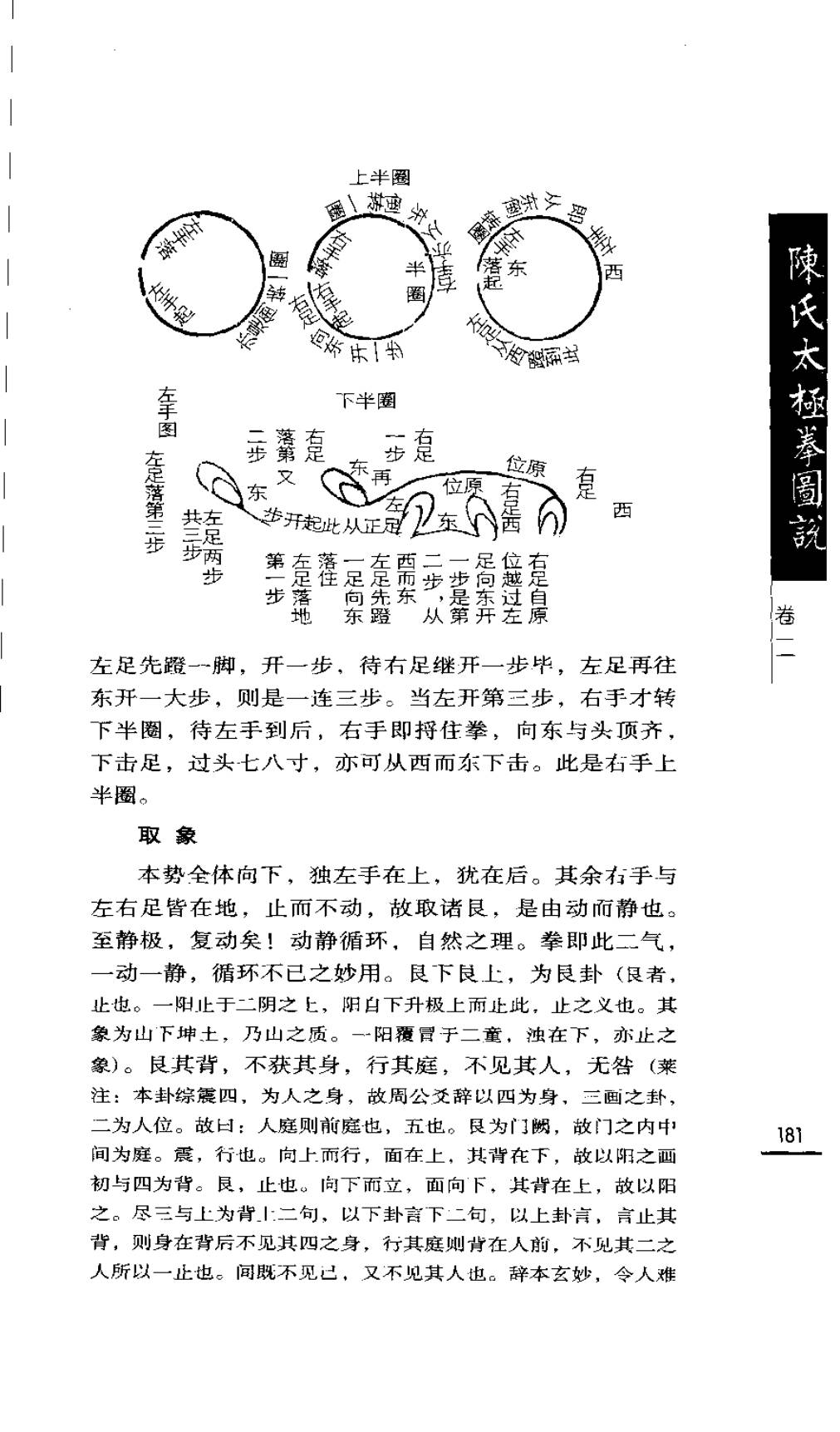
*(Commentary on the Gen 艮 hexagram — hexagram statement, Image, first and second lines; part of the Yijing commentary linking to boxing principle. No figure on this page.)*
Confucius knew that King Wen formed the hexagram statement by means of the hexagram's paired counterpart (zong 綜) — one "walking" character, one "stopping" character, both joined to "timing" (shi 時).
The Tuan 彖 says: Gen means stopping (zhi 止). When it is time to stop, stop; when it is time to go, go. If movement and stillness each do not miss their proper time, one's Way will be bright and clear. "He stops at his stopping" — he stops in his proper place. The upper and lower lines "match as opponents" (di ying 敵應) yet have nothing to do with one another; therefore "he does not gain his body; he walks in his courtyard and does not see his people — no blame." *(This explains the hexagram name by the hexagram body, its zong-pair, and its virtue. The hexagram statement says: what is called Gen lies in its stopping. Yet the principles under heaven are inexhaustible and human affairs change in myriad ways — if one merely "stopped" and nothing more, how could that suffice to exhaust the principles of affairs! One must also look at its zong-pair to see how it is. Now what accords with the fitting is called "timing": when the time fits Gen's stopping, then stop; when the time fits Zhen's 震 going, then go. When the movement and stillness of going and stopping never miss their time, then nowhere is one off the impartiality of heavenly principle, and one's Way shines like sun and moon — far more than merely "no blame"! Yet Gen is named "stopping" not because of stubborn fixation without change, but because it stops where it should stop. Because it stops at what is inherently fitting, "when it is time to stop, it stops." The statement again says "he does not gain his body, does not see his people": if others engage with me, then I can obtain the other; if I engage with others, then the other can seize me. Here, the first line with the fourth, the second with the fifth, the third with the top: yin stays yin by itself, yang stays yang by itself, with no mutual engagement. Hence others cannot gain my body, and I do not see the other — one merely obtains "no blame." How could there be the "stop when it is time to stop, go when it is time to go," which is far more than no blame? Of the eight pure doubled hexagrams none respond to one another, yet this is said only of Gen — because Gen's nature is to stop, and stopping means stubborn fixation without change, hence not bright and clear, hence only "no blame." King Wen spoke wholly in images; Confucius spoke wholly in principle.)*
The Image 象 says: Doubled mountains — Gen. The junzi thinks without leaving his position. *(Doubled mountains: one mountain within, one mountain without — a two-layer mountain. The principles of the world exist in their positions: the father has the father's position, the son the son's; ruler and subject each their own; husband and wife likewise. The wealthy-honored have their position, as do the poor, lowly, the barbarians, hardship. So too in boxing: ears, eyes, hands, feet, head, and body each have their position. Where there is the inherent position, there is the principle of what ought to be. "Thinking without leaving one's position" is precisely how one stops at that principle; to leave one's position is to overstep the principle.)*
First Six (初六): Stopping at his toes — no blame, beneficial to be forever correct. *(Gen's zong-pair is Zhen, the image of foot and toe; the first line at the bottom is likewise a toe image. The Xian 咸 hexagram likewise moves up through the body gradually. First Six is yin and soft, without talent to act — one who can stop; it further dwells at the very bottom, lowly, one who must stop. Hence the image of stopping at the toes. If one divines thus, one must not act rashly or push forward blindly, and may be without blame and correct. Yet there is fear the correct one cannot remain so forever — hence this instruction to the diviner.)*
The Image says: He stops at his toes — he has not lost correctness. *(What principle requires one to stop is called "correct" — that is the zhen 貞 of the line statement. The line says "beneficial to be forever correct"; the Image says "has not lost correctness." This shows the first line's stopping is where principle requires it.)*
Second Six (六二): Stopping at his calves; he cannot rescue those who follow him; his heart is not glad. *(Fei 腓 means the calf. It is also the foot image of the lower Zhen. "Rescue" (zheng 拯) means to save; "follow" (sui 隨) means to comply. The second line adheres to the third and follows it; "he cannot rescue his follower" means he does not seek rescue from the third he follows. Whenever the yin-soft depends on the yang-firm it is called "rescue" — as in Huan 渙, first line, "rescue with a strong horse." The second line is central and correct; in the bagua the correct position is Gen. When it is a time of Gen's stopping, the second, stopping, does not ask of the third; the third, stopping, does not yield and defer to the second — hence the second's heart is not glad. The inner trigram Kan 坎 means added sorrow and heart-ailment: the image of "not glad." ○ Second Six dwells central and correct, adjacent to the third, stopping at the calves. With a yin-soft nature seeking the yang-firm third's aid would be possible; but Gen's nature is to stop, and not seeking rescue from its follower, its central-correct virtue has nowhere to be applied — hence the heart must be unhappy. Thus the image of the divination is as...)*
*(The sentence continues onto the next page.)*
*(Printed page 183, Book/Volume 2 — commentary on the Gen 艮 hexagram lines 9-3, 6-4, 6-5, upper-9, and the taiji posture 擊地捶 Ji Di Chui / Strike-the-Ground Fist)*
Nine in the third line: "Gen its limit — danger; it smokes the heart" (艮其限,厲薰心). (The "limit" is the boundary: the dividing line between upper and lower body is the waist. "Tendons" [夤] means connection — the waist's unbroken linking. The waist, in the body, stands at the very point of bending and stretching: it ought to move, not stop. If one stops at the limit, then upper is upper and lower is lower, no longer connected; separation cuts the body into two distinct halves. 薰 is the same as 熏, smoke rising. "Smoking the heart" means the heart is unsettled. The inner trigram is Kan 坎, water, which stands for heart-ailment — hence the second line's unease and the third line's smoking heart; Kan's opposite is Li 離, fire, the image of smoke. ○ The way of stopping lies only in stopping where principle resides. The third line sits above the calf, at the waist — the very place of change and movement, where one ought not stop. Stopping where stopping is wrong, one can neither bend nor stretch, and upper and lower are split apart and cut off from each other. Hence danger and an unsettled heart — such is the image for one who divines this.) *The Image says:* "Gen its limit — danger smokes the heart." (To stop where stopping is wrong is to cling to one thing and lose adaptability. Outwardly severed, the heart must be uneasy; hence danger and a smoking heart.)
Six in the fourth line: "Gen its body — no blame" (艮其身,無咎). (To stop one's body is to be quiet and withdrawn: when neighbors quarrel, shut one's door — the "tied sack, no blame" category. The fourth line is yin dwelling in yin, purely yin, hence the image of stopping the body. Having stopped one's body, there is nothing to undertake; one who divines thus is without blame.) *The Image says:* "Gen its body — stopping in one's own person." (躬 [gōng] is the body: unable to govern others or complete things, one merely stops in one's own person.)
Six in the fifth line: "Gen its jaws — speech in order; regret vanishes" (艮其輔,言有序,悔亡). (序 [xù] is sequence; "jaws" [辅] is explained in the Xian 咸 hexagram. Gen's opposite is Dui 兌, lake — mouth and tongue, the image of jaws and of speech. "Gen its jaws" is not speaking rashly; "speech in order" is speaking always in accord with principle. Regret arises when speech becomes glib and verbose, rambling, or perverse. The Xian hexagram mostly images the human face, while Gen mostly images the human back — because King Wen's judgment reads "Gen its back." ○ The fifth line is at the jaws, the place where speech issues out; yin dwelling in yang, it cannot avoid the regret of mis-speaking. Yet because it attains the center, there is also the image of stopping the jaws with ordered speech, and so the divination reads: regret vanishes.) *The Image says:* "Gen its jaws — because of central correctness." (正 [zhèng, "correct"] should be read as 止 [zhǐ, "stop"], the same "stop" as in "stopping in one's own person": stopping from central stillness, hence regret vanishes.)
Nine at the top: "Sincere Gen — good fortune" (敦艮,吉). (敦 [dūn] is the same "sincere/thick" as in "sincere in practice." The meaning: stop when it is time to stop, firm and unchanging. There is an image of inner solidity — hence "sincere approach" and "sincere return" both take earth as their image. The top nine, with yang firmness at Gen's utmost, stops from beginning to end without changing: solid in stopping. One who divines thus — what good fortune could match such lightness/clarity?) *The Image says:* "The good fortune of sincere Gen lies in ending with thickness." (To end with thickness is to be sincere and steadfast to the end without change. In the hexagrams Bi 賁, Xiao Xu 小蓄, Gu 蠱, Yi 頤, Sun 損, and Meng 蒙, the top nine is auspicious in all six because they carry this sense of a thick ending.)
Ji Di Chui (擊地捶, Strike-the-Ground Fist): The right hand draws back a fist resting near the ground, the arm spread open — this is the single yang line of Gen's lower trigram; the toes of the right foot press the ground and the five toes of the left foot press the ground, imaging Gen's two yin lines — this is the image of Gen's lower trigram. For the upper trigram Gen: above, the occipital bone continuing down through the great vertebra (Dazhui 大椎) and the twenty-one vertebrae below it images Gen's one yang line; the two halves of the buttocks image one yin line, and the ribs on left and right, in two branches, image the second yin line — this is the image of Gen's upper trigram. My taking of images does not stop at this Gen-stopping: the jing 精 at the crown is held up, the jing of the crotch (dang 裆) sinks down, the jing of the waist is well employed, and all the rest each stop in their proper place. For when stamping, the feet open… (sentence continues on the next page).
Figure: Posture 29 — Er Qi Jiao (二起脚, Double Kick): the practitioner is shown mid-leap, body leaning forward, right arm extended forward and slightly up with open hand, left arm extended back; left leg extended forward-downward, right leg bent and lifted behind — a kicking/jumping motion, head turned looking at the right hand.
Labels on the figure:
- 顶精更得领起来! "The crown must be led upward!"
- 眼看向右手 "The eyes look toward the right hand"
- 他势肩要松下 "In other postures the shoulders must sink and relax"
- 身并提起 "The body lifts up together"
- 独此势肩要与 "Only in this posture the shoulders must…"
Main text (middle column):
…step, the hands reverse and turn. When movement reaches its extreme it must become still — this is the moment to stop. When it is time to stop, then stop: this is stopping where one ought to stop. When stillness reaches its extreme it must arise; this passage first sets up the rise for the next posture.
Seven-character verse on Ji Di Chui (击地捶, "Punch to the Ground") (the left foot kicks with a stamp, knocking the enemy flat on his back to the east; because he is now far from me, and I fear he may rise again, I must take three quick steps in a row and, before he gets up, strike his body another punch so he cannot rise again):
The first:
Turn the face around to face the south,
Stamp the left foot eastward and watch the remarkable man (these two lines continue the previous verse).
Three chasing steps in a row, waist and legs strong,
Deep into the tiger's den, probing with the hand (to seize).
The second:
Open the stride and greedily press forward,
Having finished, the eastern stamp leaves the left foot suspended ("having finished" means the foot has already landed),
Strike down one punch to control his fate,
Then turn the body as if about to fly to heaven.
Posture 29: Er Qi Jiao (二起脚, Double Kick)
When the right-hand lower "performing the hand" (演手) is finished, leap up from the ground, and with the right hand turn one circle following the movement, then slap the instep of the right foot with the wrist; or one may first lead the left foot up with the left hand, the left hand and left…
*Margin: 陳氏太極拳圖説 (Chen Shi Taijiquan Tu Shuo)*
*Printed page: 184 (scan p217)*
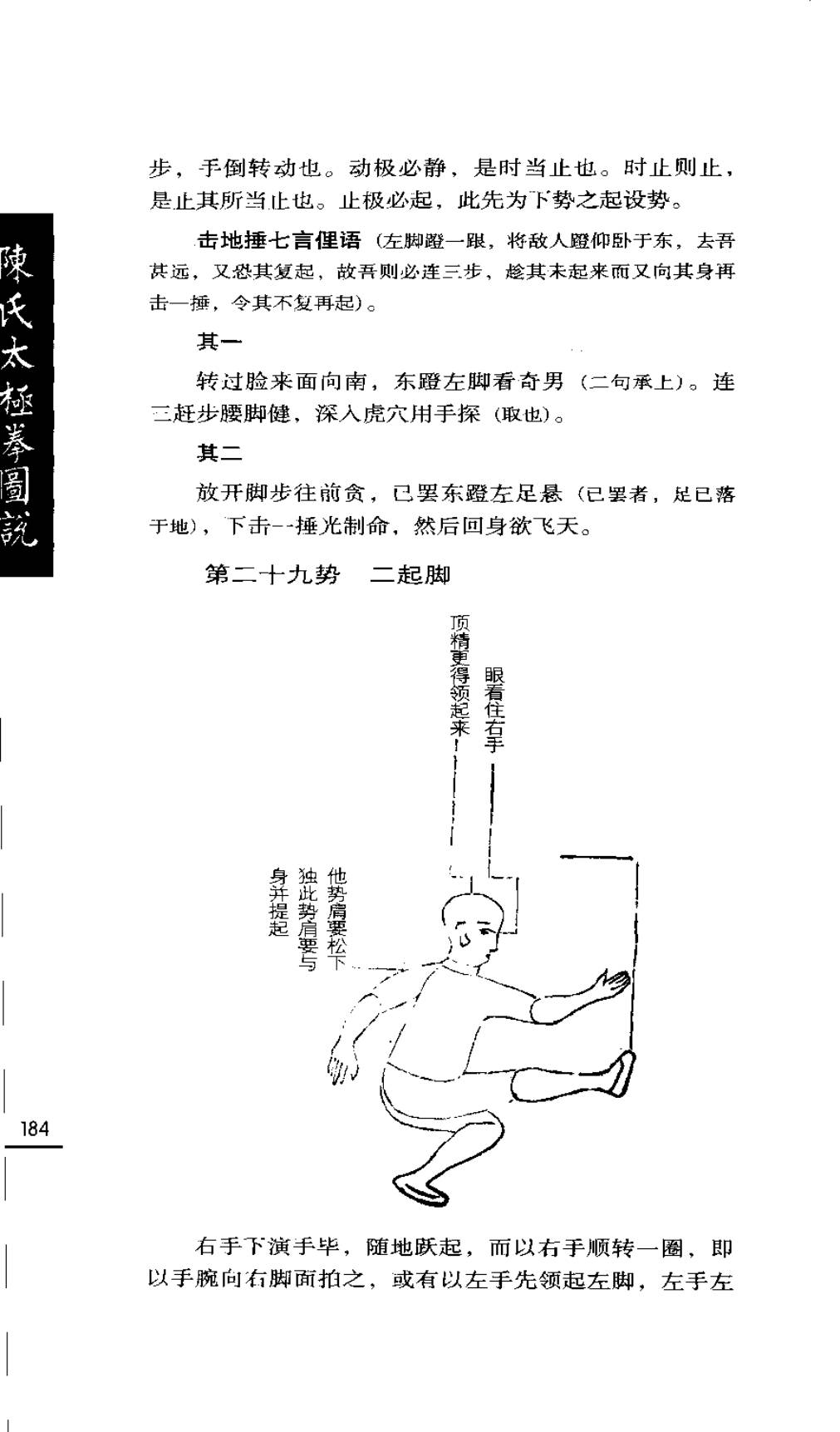
*(Text-only page, no figure)*
Margin (right side, vertical): 陳氏太極拳圖説 卷二 (Chen Shi Taijiquan Tu Shuo, Volume 2)
Main text:
…foot about to descend, the right foot instantly flies up, while the right hand reverses through a small circle and slaps the instep of that right foot. In the preceding method the route is close to the right foot: as soon as the lower "performing the hand" (演手 yan shou) is finished, turn the head abruptly and, following the momentum, leap up with the whole body, instep level with the palm — the right foot is the host; the left foot, when the lower yan shou is finished, sets up the position for the right foot, leaping up first — this foot is the guest. In body method, the heart-jin lifts upward; the whole body's spirit rouses and soars into the air. The right foot must rise as high as the crown of the head to be correct; if it cannot match the forehead, it can still rise no less than level with the shoulders. When the lower yan shou of the left hand is finished, at the moment of turning the head sharply, the right hand turns one circle following (shun), slapping the right foot, and the left hand reverses through one circle to aid the right hand's jin — like a general deploying decoy troops to bolster the army's morale. When speaking of the hands, shoulders and feet are all included.
What is "double rise" (二起 er qi)? The left and right feet, one after the other, leave the ground together, leaping up four or five chi — hence the name. Kicking the er qi: the right hand's yan shou punch has just been cut down to strike an opponent, and on both sides enemies come attacking from behind; at once turn the head sharply, the right hand going from below upward, from south to north and down, the left hand likewise rising from below to above, moving from above downward. The left foot kicks up first to lead the right foot's rise. Just as the left foot is about to come down, the right foot rises following it, and the rising jin also lifts upward with all its strength (sheng, "rise," means going up; ti, "lift," means lifting the spirit). The kicking instep must be level. At this moment the right hand below does not stop: following the reversing jin it speeds from below upward, closing the palm, and slaps the instep of the right foot with the right hand. When left and right feet land one after the other, the form has not yet halted when the mechanism of the next posture already stirs. The boundary of er qi reaches here — this is the largest version. Because the circle turned by the right hand and body method is large, the posture is large; this is the lowest grade of kick. Yet learners must begin by this route as the entrance; ascending by grades, the right hand need not reach to the right side. When the lower yan shou is finished, the left hand rises up once, and the right hand goes from east to west, then down from the west, up toward the east, completing a westward circle, and the right hand slaps the left foot; the two feet leap up, again left first, right after — this is the middle grade of kick. Ascending further is the highest grade, quite difficult. When the right hand's lü-punch plants downward, at once use the right hand following the momentum with shun jin to turn one circle and slap the instep of the right foot; the right hand turns one circle shun, while the left hand uses side jin reversing one circle to aid the right hand's jin. As for the feet, again left first, right after; but the left foot must first kick upward fiercely with force, and only then can the right foot kick high. Er qi purely uses the whole-body lifting method. When er qi is finished, both feet stand facing south, the right hand in the west, the left hand in the east, as in the single whip (單鞭 dan bian) posture.
Printed page: 185 (scan p218)
Margin: 陳氏太極拳圖説 (Chen Shi Taijiquan Tu Shuo)
Figure 1 (top): 内精二起右手下等运行图 Nei jin er qi — right hand, lower-grade movement diagram
- Text beside the figure: 右手复向西运行,到西方打足 "The right hand again moves westward, reaching the west and striking the foot"
- Labels: 手外圈右足也 ("outside the circle the hand and right foot"); 越過身 ("passing over the body"); 在手 ("at the hand"); 在地 ("on the ground"); 右手又到东 ("the right hand again reaches east"); 右边下行 ("descending on the right side"); 目转由自然 ("the eye turns naturally"); 右手自然圈 ("the right hand turns a natural circle")
- The figure shows a stable standing stance, left foot on the ground, with a figure-eight movement path around the body.
Figure 2 (middle): 中等图 Middle-grade diagram
- Text: 原初面向下,涉上打罢,面向南立,不停。 "Originally facing downward; having struck and finished stepping up, stand facing south without stopping."
- Beside: 左脚打前向右足打后,从左膝里起往右转,右足随手到东,右手又到东 "The left foot strikes in front, the right foot strikes behind; rising from within the left knee, turn rightward; the right foot follows the hand to the east, the right hand again reaches east"
- Labels: 胸前 (front of chest); 此是用顺 ("this uses shun/following"); 胸右 (right of chest); 胸左 (left of chest); 地 (ground)
Figure 3 (bottom): 上等手法运行图 Upper-grade hand-method movement diagram
- Text: 踢二起上等打法,就外观之,较中图、下图似易而实难,非久有功夫不能踢起来。且非亲阅其境,不知盖以本地风光不预设势,故也。 "Kicking er qi in the highest-grade method: viewed from outside, it seems easier than the middle and lower diagrams but is in fact harder; without long practice one cannot kick it up. And unless one has personally entered that state, one cannot know it — because the natural scene of the place does not pre-set a posture."
- Labels: 圈一口吹 ("one circle, one breath"); 右手 (right hand); 右足 (right foot)
- Below: 此三圈是上等左右运行图 "These three circles are the upper-grade left-right movement diagram"
Qu Xiang 取象 (Taking the Image):
In this posture the left foot rises first. Zhen (震, Thunder) is the foot: the lower Zhen — the right foot rises from behind; the upper Zhen — combining them gives the hexagram Zhen, therefore the image is taken from Zhen. Zhen means movement. Nothing long remains still without moving: when the two feet move, the whole body rouses itself in response. This is the first and fourth lines of Zhen, yang — one movement…
*(text continues on the next page)*
Printed page: 186 (scan p219)
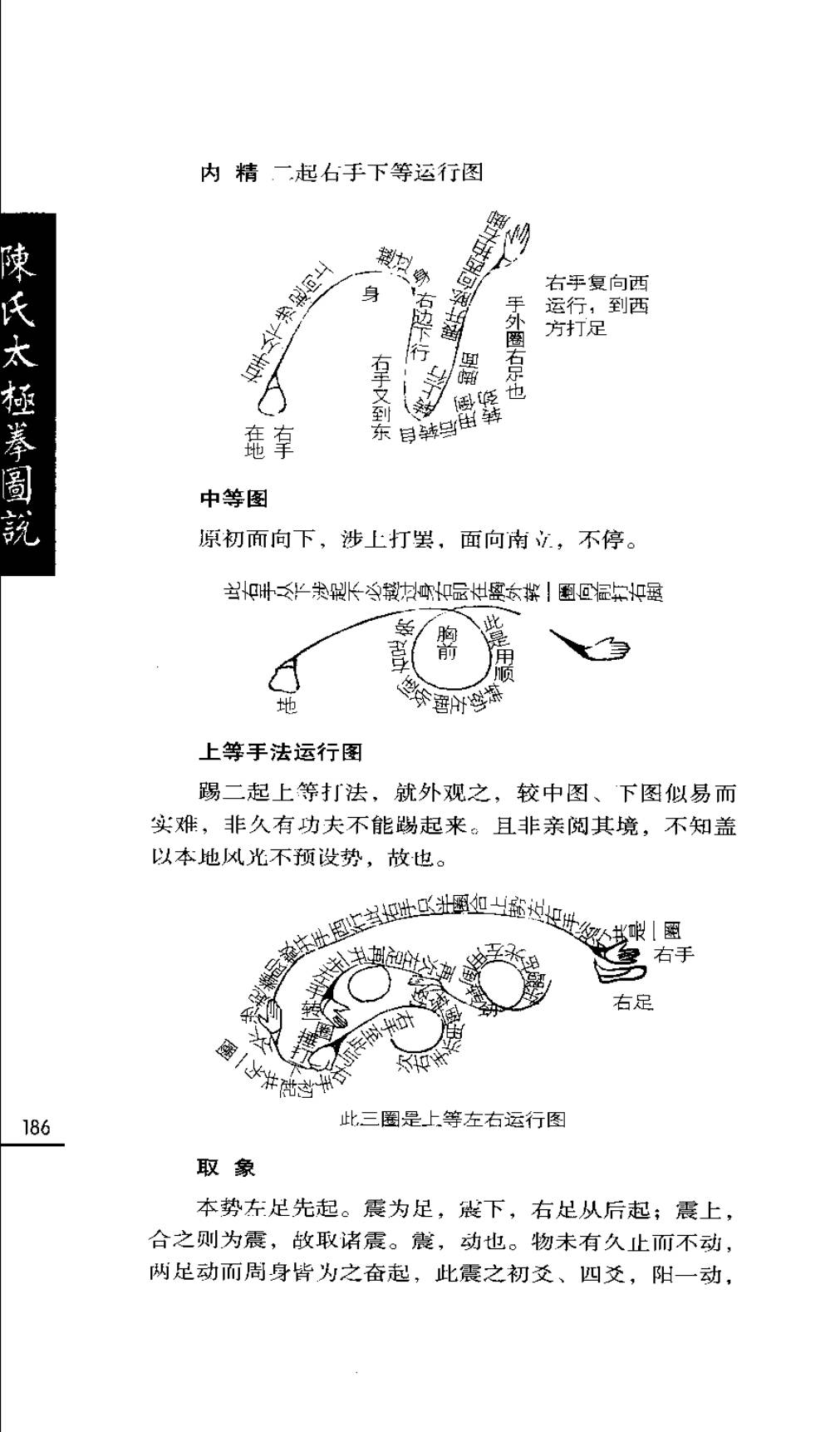
Margin (right, vertical): 陳氏太極拳圖説 卷二 (Chen Shi Taijiquan Tu Shuo, Volume 2)
Main text (continuing the Qu Xiang from the previous page):
…then the second, third, fifth and sixth lines also shake and move in response. The previous posture is stillness at its extreme; this posture bears the image of "thunder coming, perilous" (震来厉). The feet rise extremely high, so there is also the image of the Qian hexagram, "the flying dragon in the heavens." Once the heart-jin leads up, the five sense organs and the hundred bones all rise together with it, so there is also the Sui (随, Following) hexagram — Sui carries the image of gain. Moreover, rising up vigorously from the lower yan shou punch, like thunder amid the marsh — how could one not shake with alarm for a hundred li?
First: Er Qi, five-character verse
One foot rises in linked succession, the whole body leaps to mid-air.
If you do not kick from below the mouth, whence does the blood flow red?
Second: seven-character verse
Raise the central qi and the sinew strength of the back grows hard; linked, the er qi soars upward.
If it had not first lain hidden eastward in ambush, how could the western strike pass the bridge of the nose?
Third
The flying dragon in the heavens is nothing rare (the dragon's ordinary affair); thunder amid the marsh is hard to place with skill (rising high from the ground is hardest).
Rely only on this body long smelted in the forge; first learn Wei Ju's single bound.
Posture 30: Shou Tou Shi (兽头势, Beast-Head Posture)
Labels on the figure:
- 顶精领住 "The crown-jin is held in place"
- 肩压下 "The shoulders press down"
- 左肘沉下撑开 "The left elbow sinks and braces open"
- 拳落在胸前敌人 "The fist lands at the chest toward the enemy"
- 眼视右前敌人 "The eyes watch the enemy at the right front"
- 右肘外方内圆 "The right elbow square without, round within"
- 膝精往开右里缠,与左膝屈撑外相包合 "The knee-jin opens rightward spiraling inward, wrapping with the bent left knee bracing outside so they enclose each other"
- 左右平踏足 "Left and right feet placed flat"
- 左膝屈住 "The left knee is bent and held"
- 左足点住地,以蓄下势,裆撑开又要圆又要合住 "The left foot is planted on the ground to store the next posture; the crotch braces open, and must be both round and closed"
Printed page: 187 (scan p220)
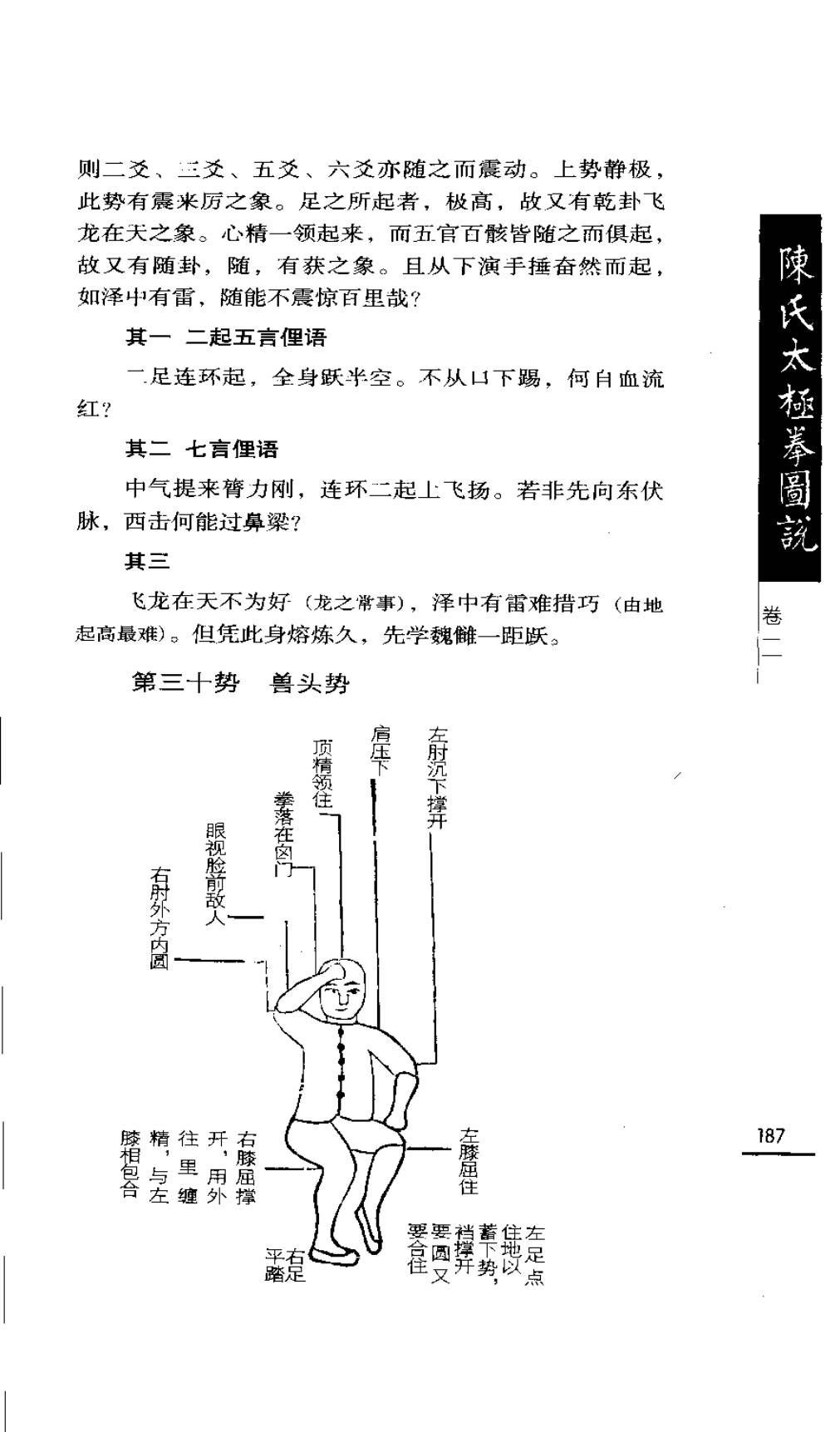
Margin: 陳氏太極拳圖説 (Chen Shi Taijiquan Tu Shuo)
Main text:
What is the Beast-Head Posture (兽头势 shou tou shi)? The right fist is at the forehead, the left fist above the left knee, and between them the eyes glare with a fierce look (chēn: to look hatefully). The form is fierce like the beast-head ornament on a roof — hence the name. When the rise is finished, the left foot first comes down; the right foot steps forward six or seven cun; the left foot then steps forward about one chi. Then the left and right hands divide downward on either side of the left knee, using reversed-winding silk-reeling jin (倒转缠丝精) to wind onto the fists. The right fist settles at the forehead, five cun from it, outside the direct line of the forehead. The left fist settles above the left knee, seven or eight cun from the abdomen and two or three cun from the knee. The left foot — of the two — is drawn in beside the right foot, five or six cun from the stepping foot, the toe touching the ground: this plants the hidden thread for the next posture.
Nei Jin (内精, Inner Jin)
Hand-movement circle labels:
- 右拳落额上 去额五寸 在正额外 "Right fist settles at the forehead, five cun away, outside the direct line"
- 左拳左膝上 去膝二三寸许 "Left fist above the left knee, two-three cun from the knee"
- 左右手从左膝两旁分下 用倒转缠丝精缠到拳上 "Left and right hands divide down beside the left knee, winding onto the fists with reversed silk-reeling jin"
- 左足在两者收到右足边 去行足五六寸 点住脚 "Left foot drawn in beside the right foot, five-six cun from the stepping foot, toe touching"
- 右手运行图 "Right hand movement diagram"; 左手运行图 "Left hand movement diagram"
Footwork diagram labels:
- 左足前进收回图 "Left foot advance-and-recover diagram"; 右足前进开步图 "Right foot advance-and-step diagram"
- 右足向西开一少步 落住不动 "Right foot takes a small step west and lands without moving"
- 左足再向西开一步 至此 "Left foot again steps west, reaching here"
- 点住脚 "toe touches"; 复收回 "then withdraw"; 边足右回 "beside the right foot returning"
Qu Xiang (取象, Taking the Image):
In this posture the spirit gathers entirely in the eyes, watching the enemy's expression come and go: observing his outside one knows his inside, therefore the image is taken from Guan (观, Observation). Guan means: he observes my fist as I observe him — watching the path by which the enemy comes and seizing the opportunity to respond. The Image says: "Great observation is above; compliant and yielding (xun), central and correct, observing all under heaven" (that is, the two eyes on the face — great observation above. "Compliant and xun": the Xun trigram has much white in the eye. Watch his general momentum and strike following it. "Central and correct": with a calm mind and even qi observe the enemy — this is observing all under heaven). It also says: "Observe the divine way of heaven: the four seasons do not err" (heaven is heavenly principle, heaven's mechanism; the divine way is the path. Observe the path by which another's foreknowledge reveals his coming, and respond with the four limbs according to the moment). Third line: "Guan wo sheng" ("observe my life" — sheng means life) — advance and retreat. The Image says: "He observes his own life in advancing and retreating, not losing correctness" (two people in combat: life is at stake; outwardly observing the other…)
*(text continues on the next page)*
Printed page: 188 (scan p221)
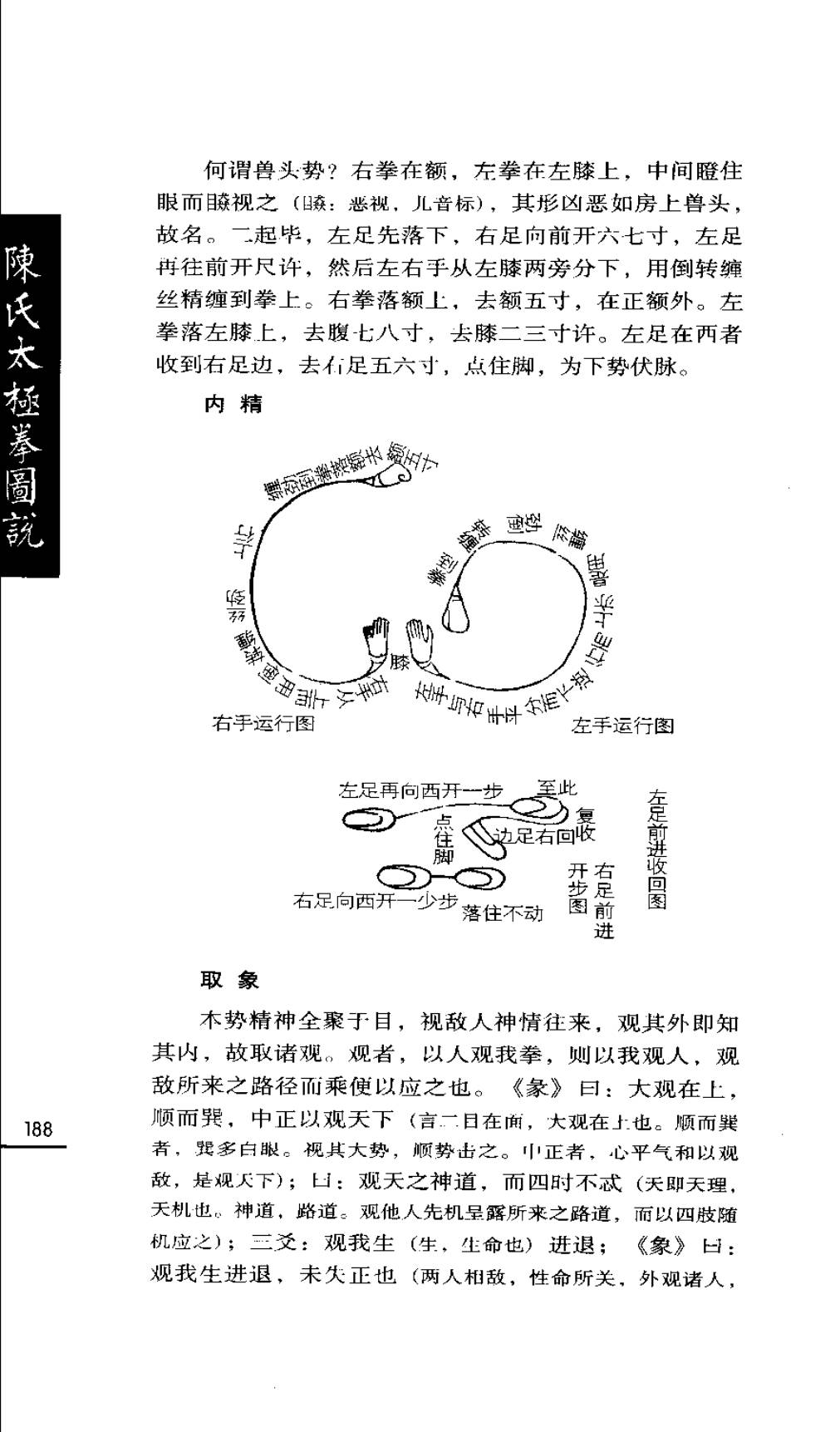
*Chen Shi Taijiquan Tushuo* (陈氏太极拳图说, Illustrated Explanation of Chen-Style Taijiquan), Volume 2 (卷二). No diagrams on this page; commentary on the Shou Tou Shi (兽头势, Beast-Head Posture), continuing the Guan hexagram (观, hexagram 20, "Contemplation") correspondence.
Interiorly observing oneself; knowing oneself and knowing the other, one wins a hundred battles out of a hundred, and all is governed by the zhong qi (中气, central qi), never departing from the way of great centrality and correctness (大中至正). Fourth line: "Contemplating the light of the kingdom." One skilled at reading appearances can repel small foes as well as great bandits — hence "contemplating the light of the kingdom." Fifth line, Image: "Contemplating my life means contemplating the people" (here "people" stands for the opponent). Top nine: "Contemplating his life, the noble one is without blame" (the noble one stands for the completed hand/strike); Image: "Contemplating his life, the will is not yet at rest" (meaning the quanjia (拳家, boxer) whose hand is complete can steady his will, so that he has no crosswise qi and nothing he cannot undertake). The upper two strokes of Xun (巽, hexagram 57, Wind) are yin — the left and right fists. Xun's "white eyes" signify observation. Xun's opposite is Zhen (震, hexagram 51, Thunder), carrying an air of roused spirit. The lower trigram is Kun (坤, hexagram 2, Earth), which is the belly. The upper body is yang, the lower body yin; Kun's opposite is Qian (乾, hexagram 1, Heaven) — softness meeting hardness. Kun below and Xun above matches the sense of the Beast-Head posture, so it is taken up. There is the Kuai/Kui hexagram (睽, hexagram 38, Opposition) — the image of meeting an evil man; the Yi hexagram (颐, hexagram 27, Nourishment) — "the tiger gazes intently, its desires pursuing one after another"; Da Zhuang (大壮, hexagram 34, Great Power, beneficial to be correct) — "power in the toes"; and Kuai (夬, hexagram 43, Breakthrough), fifth line: "The great man changes like a tiger, and his pattern is brilliantly visible." After all, though the images present many a warrior's form, the interior is truly soft, compliant, central and correct; there is also Ming Yi (明夷, hexagram 36, Darkening of the Light) — inner brightness and文明 with outer softness and compliance — so beyond taking images from the various hexagrams, Ming Yi is taken as well.
Seven-character verses on the Beast-Head Posture (兽头势七言俚语)
One
Glaring eyes and grabbing fists, the image most fierce; the mechanism nimble, hidden within the chest. The left foot points emptily, first storing up power — who could recognize this great hero?
Two
The two fists, above and below, are like a beast's head; the left foot goes west, then draws back east. Within the heart-protecting fist (护心拳) lies boundless meaning: to use hardness, first show softness.
Four-character verses (四言俚语)
The right thigh must bend; the left thigh must be gathered in; the left foot touches the ground, straight yet not straight. The right fist is at the forehead, the left fist at the knee; above and below watch each other, together with my heart and belly. The application is in the mind, the keenness in what is unique (独 — what others do not know and only I know). To be hard, first be soft; to rise, first press down. The primal qi of Great Harmony (太和元气) lies hidden in the whole; before the numinous trigger moves, one already knows there is no enemy.
*Chen Shi Taiji Quan Tu Shuo* (陳氏太極拳圖說)
The Thirty-first Posture: Ti Yi Jiao 踢一脚 (Kicking One Foot)
Shou tou shi (獸頭勢, Beast-head posture): the left foot touches the ground, and immediately following the posture the face turns to face north. With the left foot planted, [the body turns] toward the west, and one kicks upward with one foot into the enemy's crotch (襠中, dang zhong).
In the beast-head posture, the left hand is above the knee because, as the left foot kicks up, the left hand also spreads open together with the posture and the arm, to assist the power of the left foot.
The eyes watch the spot where the left foot kicks, so that it never misses its mark.
Ding jing ling zhu (頂精領住): the energy at the crown is held up.
The right hand is at the forehead because, as the left foot kicks up, the right hand also spreads open together with the arm, to assist the power of the right leg.
Annotations on the Figure
- Ding jing ling zhu (頂精領住) — the crown energy leads and holds.
- Yao jing wei wang hou xia qu er san fen (腰精微往後下去二三分) — the waist energy sinks slightly back and down two or three fen.
- You zu ping tou ta zhu di (右足平頭踏住地) — the right foot, flat on its sole, presses firmly on the ground.
- Xi yao wei qu, bu qu li bu wen (膝要微屈,不屈立不穩) — the knee must bend slightly; without bending, the stance is not stable.
The figure shows a one-legged stance: the weight is on the right leg, straight with a slight knee bend; the left leg lifts with a bent knee, kicking upward toward the opponent's groin; the left hand extends near the left knee, the right hand rises to the forehead.
Taking the Image (Qu Xiang 取象)
The previous posture contained the two meanings of "the tripod overturned" (鼎顛) and "the toes of the traveler" (趾旅即次). This posture kicks up the left foot, having the image of strength in the fore-toes (壯於前趾), and the image of Increase (益) in which the top is diminished to benefit the bottom (損上益下). All the power of the upper body is poured into the left foot; kicking a person with the left foot, one only knows to "advance one's horns" (晉其角) and "to attack the city" (維用伐邑) — "harsh but auspicious, no blame" (厲吉无咎) — without considering that there may be regret (吝). For Da Zhuang (大壯, Great Strength) says: "Strength in the toes; going forward brings misfortune" (壯于趾,征凶). It is also like the top six line: "The ram butts the hedge; it cannot retreat, it cannot advance; nothing is favorable" (羝羊觸藩,不能退,不能遂,无攸利). Though the affair is difficult, in the end it is auspicious.
(Printed page: 190)
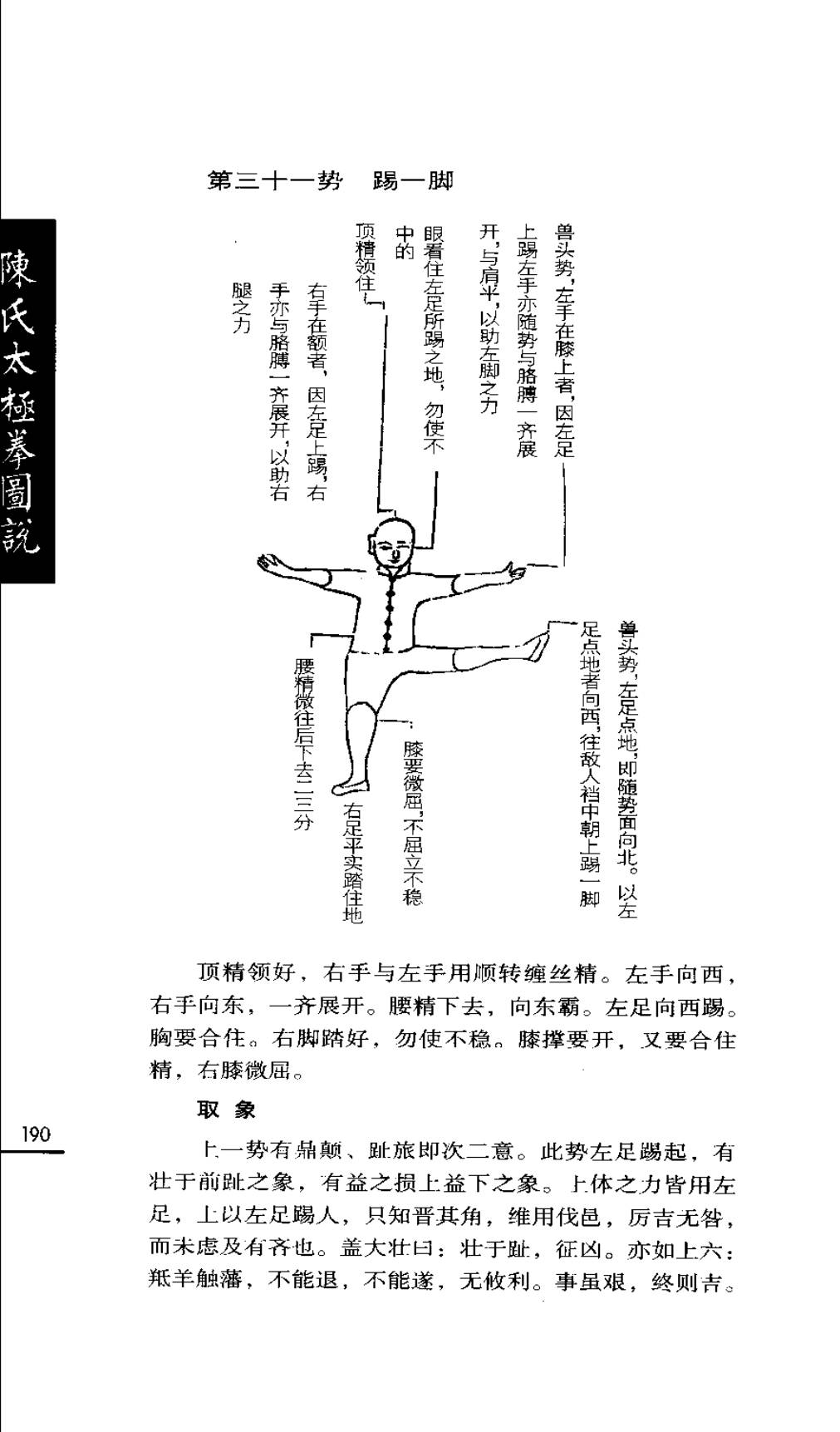
*Chen Shi Taiji Quan Tu Shuo* (陳氏太極拳圖說), Volume 2 (卷二)
When I kick a person with my foot, he naturally lifts my foot with his hand — how could I retreat or advance (退與遂)! Nothing is more difficult; yet in the end there is a way to resolve it, hence auspicious. At this moment there is the image of Ming Yi (明夷, Darkening of the Light): "darkening of the left thigh" (夷于左股); the only recourse is "to be saved by a strong horse — auspicious" (用拯馬壯吉). The "strong horse" means the following posture: Deng Yi Gen (蹬一跟, Kicking One Heel).
Ti Yi Jiao 踢一脚 — Five-Character Folk Verse (五言俚語)
Left foot kicks upward,
those outside cannot fathom it.
One strike to the crotch (兜襠),
and in an instant his life is gone.
Seven-Character Folk Verse (七言俚語)
Before the eyes a sheer wall rises to the mighty heavenly pass,
the Sword Pavilion hollow amid the mountain valley's mouth.
Should a hero first arrive at this place,
one kick topples ten thousand layers of mountain.
The Thirty-second Posture: Deng Yi Gen 蹬一跟 (Kicking One Heel)
Annotations on the Figure
- Hou ding di zhu (後頂提住) — the rear crown is lifted.
- Yao ji bu ke ruan (腰脊不可軟) — the waist and spine must not be soft.
- You xi bi wu qu deng (右膝必无屈蹬) — the right knee must not bend while kicking.
- You zu ping ta (右足平踏) — the right foot treads flat.
- You quan shou jie zhi (右拳手節執) — the right fist and hand joints are held firm.
- Ying quan suo jin (硬拳搠緊) — the hard fist grips tight.
- Jiang yi xia zhi yan hou (將以下至咽喉) — from below up to the throat.
- Deng wu jiu wei yu cheng (蹬吾鳩尾與承) — kicking my Jiuwei (鳩尾) and Cheng [jiang] points.
- Tui yi bu, yi fang (退一步,以防) — step back one step, to guard.
- Ji yi zuo jiao wang hou (即以左腳往後) — then with the left foot backward.
- Ren lai deng wu, wu (人來蹬吾,吾) — when the opponent comes kicking me, I...
- You shou na di (右手捺地) — the right hand presses the ground.
- Zuo shou na di (左手捺地) — the left hand presses the ground.
- Zhou jie yong li (肘節用力) — the elbow joint applies force.
Text Below the Figure
This figure shows the opponent's [attack] posture: he wants to lift my whole body with one hand and strike me with the left hand. Or, because his right hand has caught my foot, he uses his left hand as well to pull my foot, twisting it hard to injure my left thigh and vent his momentary fierceness. The plans of these two postures are not without cunning — but how could he know that when the body enters the place of death (死地), nature provides another way of life (生法).
In this figure, I kick the opponent with my left foot; he grips my foot with his right hand, wanting to twist it and make me fall to the ground in pain, or he lifts my foot upward, wanting my whole body off the ground so he can throw me down and strike me. I then follow the momentum and tumble over: both hands press against the ground, and with my right foot I slide upward along my own left leg against his right hand that grips my left foot — the difficulty is at once resolved.
(Printed page: 191)
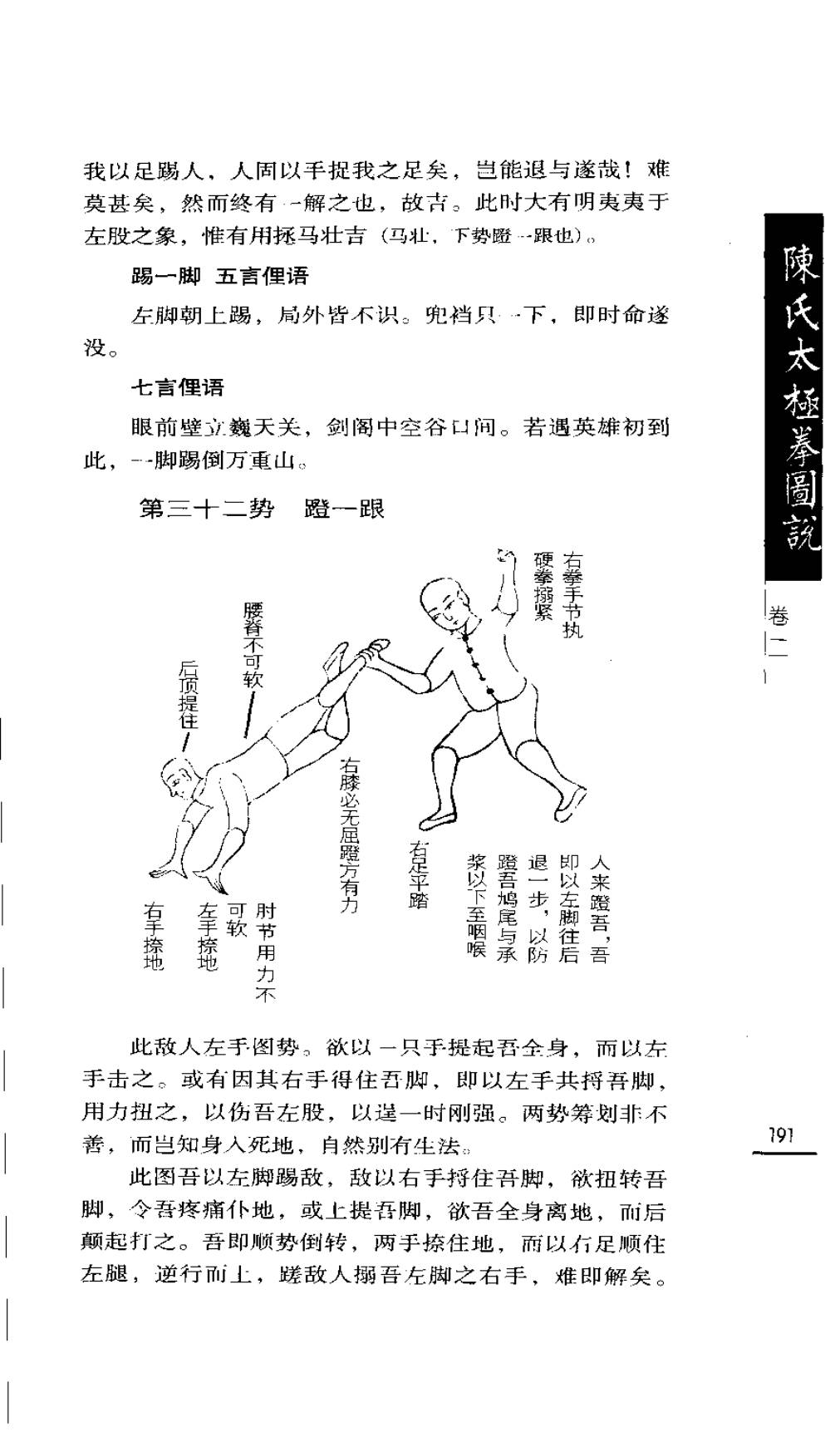
*Chen Shi Taijiquan Tushuo (陳氏太極拳圖說, Illustrated Explanation of Chen-Style Taijiquan) by Chen Xin, printed page 192.*
Paragraph (top column)
Or again, if the opponent blocks (擱 ge) my left foot, I immediately use my right foot to kick (蹬 deng) the tip of his right elbow, or kick his wrist joint — either can resolve the situation. Such is the general principle of "Kicking with the Heel" (蹬一跟 Deng Yi Gen). As for the differing circumstances of the moment, it is permissible — according to the advantage of my own position — to kick his vital spot (要害 yaohai) in order to break free. Applying it in the moment depends on one who examines the opening (審機 shen ji) and responds to the enemy according to what is convenient.
Heading
Nei Jing 內精 (Internal Essence)
Main text
When I kick a person with my left foot, he may seize my foot with his right hand. I then quickly sink the body down, both hands pressing (捺 na) the ground. Although the head faces downward, the back of the crown (後頂 hou ding) is lifted up by intention. The body and waist use the essence of "two opposing pulls" (兩奪之精). The strength of the shoulders is entirely employed in the hands: from the shoulders to the finger joints there must be no softening. Once it softens, not only can the lower body no longer kick the opponent, the upper body too will collapse to the ground — how then could one break free? From the navel (臍 qi) downward, spirit and strength are entirely devoted to the backward kick of the right foot. Whether the difficulty is resolved or not, whether danger emerges or not, depends entirely on landing this one kick. Kick to a vital spot: not only can the difficulty be resolved, the opponent can be injured. Fail to kick where it hurts: not only is the difficulty unresolved, the harm that follows — who knows where it would end! Can one afford not to be careful? But to be careful only at the moment of kicking is already too late; the care lies in the preceding posture. Just before kicking, look: if it can be kicked, kick; if not, do not kick. Do not use the kick recklessly. Even when there is an opening to exploit with a kick, value speed like lightning and not slowness; value kicking the crucial joints, openings and acupoints (關緊穴俞 guan jin xue shu), not kicking broad thighs or thick flesh where no pain or itch is felt. This is the essential secret (要訣 yaojue); the one who kicks must know it.
Diagram
Deng Yi Gen Xin Shi Tu 蹬一跟新式圖 (New-style Diagram of Kicking with the Heel)
Labels in the diagram:
- 頂精領住 — "The crown essence leads and holds" (spirit lifting the head)
- 西 — West (direction faced)
- 右手 — "Right hand" (the hand pressing the ground)
- 力不可吃 — "Strength must not be swallowed" (must not slack)
- 懈怠 — "Slackness" (to be avoided)
- 手不捺地,須要穩 — "The hand presses the ground and must be steady"
- 左足踏地 — "The left foot treads the ground"
Description: the figure leans forward with both hands pressed to the ground, right foot kicking up and back, head facing down while the back of the crown stays lifted; the toes point west.
Paragraph (bottom column)
This posture is harder than the preceding one. Wishing to avoid the hard and take the easy, another method has been established for the learner: have him first learn this, and afterwards practice that — also bending down into it, easier to perform — lest the fear of difficulty overcome him and he abandon the work halfway. Kick one foot, the face turning west in the inverted turn.
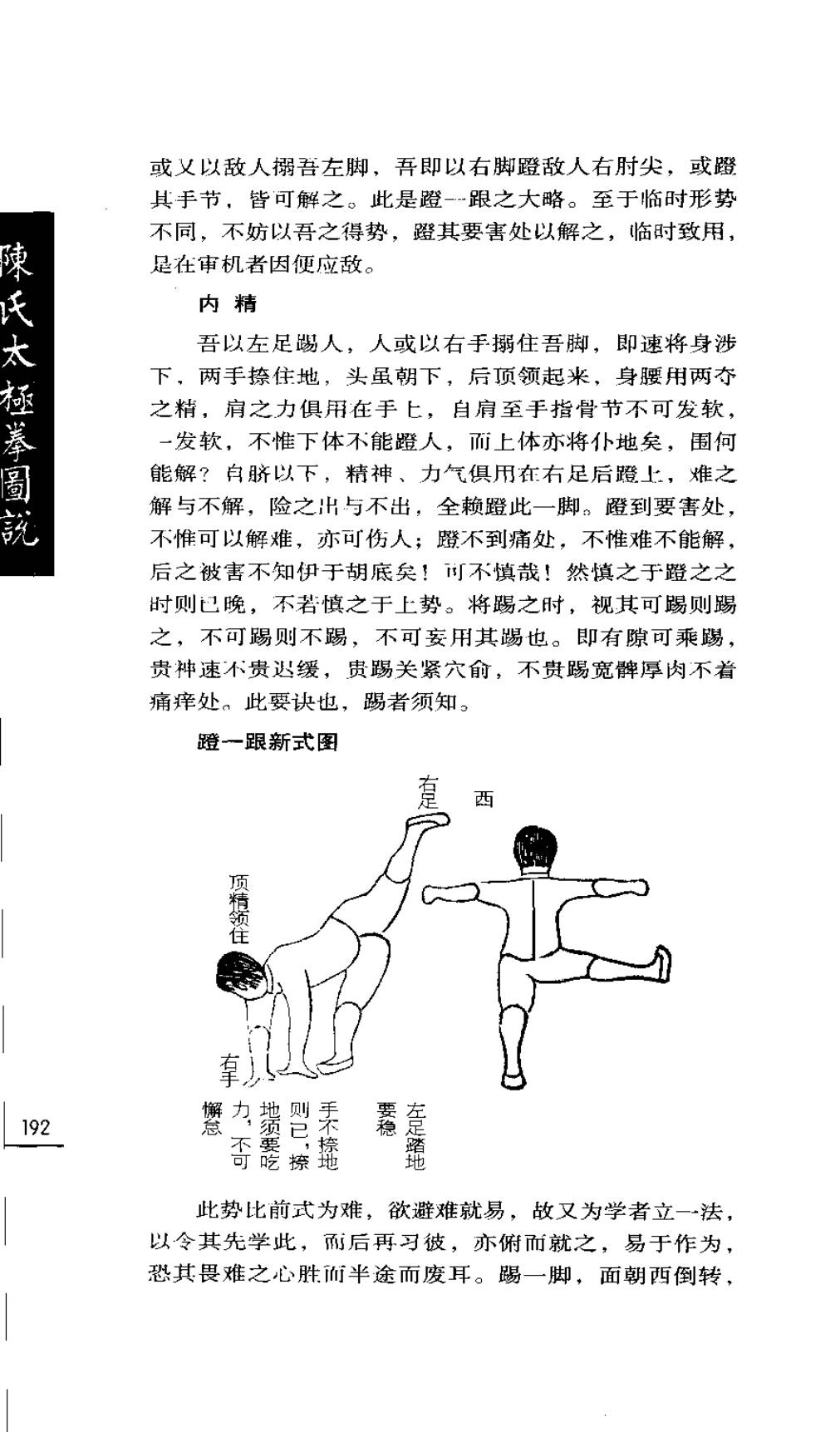
*Chen Shi Taijiquan Tushuo 陳氏太極拳圖說, Volume 2 (卷二), printed page 193.*
Main text
From West to North and to East, the head faces East and downward. Having finished the kick with the left foot, it travels from West through North and lands to the East of the right foot; immediately kick back one heel (蹬一跟 deng yi gen) with the right foot, kicking the opponent's chest, and the body swiftly inverts — the faster the better. The crown essence (頂精 ding jing) is led upward; both hands use the inverted-reeling silk essence (倒轉纏絲精 dao zhuan chan si jing) and the uniting essence. Both hands may press the ground, or may not press the ground; the foot need not kick upward in inversion — exert force only in kicking backward. Behind are both sides; the eyes watch the left and right hands, the mind settles on the right foot.
Qu Xiang 取象 (Taking the Image)
Taking the image: I kick a person with my left foot and he seizes my left foot — this body has entered the mansion of Kan 坎 (Water); therefore the image is taken from Kan. Yet there is "stripping the bed to the flesh, a calamity close at hand" (剝床以膚 Bo — hexagram Bo 剝, Splitting Apart); therefore the image is also taken from Bo, and Tai 泰 (Peace).
The first line says: "Pulling cogon grass, the roots intertwined" (拔茅茹) — [hexagram Pi 否, Standstill; the first line of Tai reads the same]. The enemy wishes to lift my whole body with one hand — like the image of pulling cogon grass with its tangled roots; therefore the images are taken also from Pi and Tai.
[Kun 困, Oppression.] The first line says: "Entering the dark valley, for three years unseen" (入于幽谷,三年不覩) — [meaning my head faces downward and sees nothing]. The third line says: "Trapped by stone, grasped by thorns" (困于石,據于蒺藜) — [Gen 艮 is the hand and is stone: it figures the tightness of the enemy's grip, like being seized amid brambles].
The top line: "Trapped by tangled vines, in perilous unease; it says: movement brings regret, there is regret — yet marching brings good fortune" (困于葛藟,于臲卼,曰動悔有悔,征吉) — [the foot is entangled like deep peril among vines; to move brings regret, but once the heart resolves, marching is auspicious, and not marching is inauspicious]. Therefore the image is also taken from Kun.
Were it not the great fruit (碩果) — [meaning the right foot] — that is not eaten, how could one reach the islet (祗)? Once leveled, the cup of wine and the pair of vessels; counsel admitted through the window — escaping danger, and gaining the divination of "the wheel-strap comes off" (脫輻).
By the time one heel has kicked back, the overturned Standstill (傾否) has passed and the great difficulty is Resolved (解); the bent mulberry puts forth shoots — is this not a great rejoicing? People say "Heaven aids him"; I say in truth it comes from man: if one attains the Way, one divines good fortune of oneself [hexagram Fu 復, Return].
Deng Yi Gen Qi Yan Li Yu 蹬一跟七言俚語 (Seven-character Rhymes on Kicking with the Heel)
One: The left foot kicks west and upward; both hands press the ground with tiger strength. The inverted body kicks at the hand [the enemy's hand]; turning over, the hand plays out striking toward the chest.
Two: Then send the right foot kicking up to heaven; follow along the left leg, sweeping without deviation. When matters reach their hardest there is still a method — who would know the body can undo the inverted hang.
*Chen Shi Taijiquan Tushuo 陳氏太極拳圖說, printed page 194.*
Heading
Posture 33: The Fourth Yan Shou Chui 演手捶 (Play-the-Hand Punch)
Diagram
The figure stands in a bow stance facing West, right fist striking forward, left hand near the body. Vertical labels beside the figure:
- 眼看右拳 — "The eyes watch the right fist"
- 頂精領住 — "The crown essence leads and holds"
- 周身力氣俱聚于右拳,尤須用其膀力 — "The strength and qi of the whole body gather in the right fist; in particular the shoulder power must be used"
- 腰精下去 — "The waist essence sinks down"
Caption beneath the figure: "The right foot follows the body's inversion turning West, opening one more step without moving; the left foot lands and opens one step."
Main text (right column)
The face is toward West, the body toward due North. The right hand comes from behind and travels upward, advancing past in front of the face; grasp into the fist (捋 lu), using the reeling-silk essence (纏絲精 chan si jing) to reel from outside inward, reeling to the fist, uniting the essence to strike forward. The left foot first lands, opening one step; the right foot inverts, from behind opening one more step toward West, and stays without moving; the left foot then opens one large step toward West, and stays without moving. The right foot presses firmly on the ground behind; the heel force travels in reverse up the leg to the twenty-first vertebra of the spine, then in reverse from the twenty-first vertebra up to the shoulder, and from the front of the shoulder to the right fist, to aid the force of the fist.
Main text (left column)
When the heel kick (蹬一跟 deng yi gen) is finished, the left foot first lands and inverts, coming from East through South to West. The right foot opens one more step toward West, the chest toward North. The left foot then performs Yan Shou Chui toward West. The left hand is in the West, using the uniting essence (合精 he jing) to answer the right hand. The left hand uses the inverted-reeling essence toward West, back of the hand facing up; united, the punch strikes the enemy — no enemy can withstand it. Facing the enemy's fist, it falls into the left wrist in playing the hand (演手). The left and right arms need not spread wide; judge by the enemy's distance. If the enemy stands far from me, spreading the arms is permissible; if the enemy is very far, advancing in consecutive steps is permissible — one step, two steps, or three steps — the right hand grasping into the fist, the arm extended to strike. In this way...
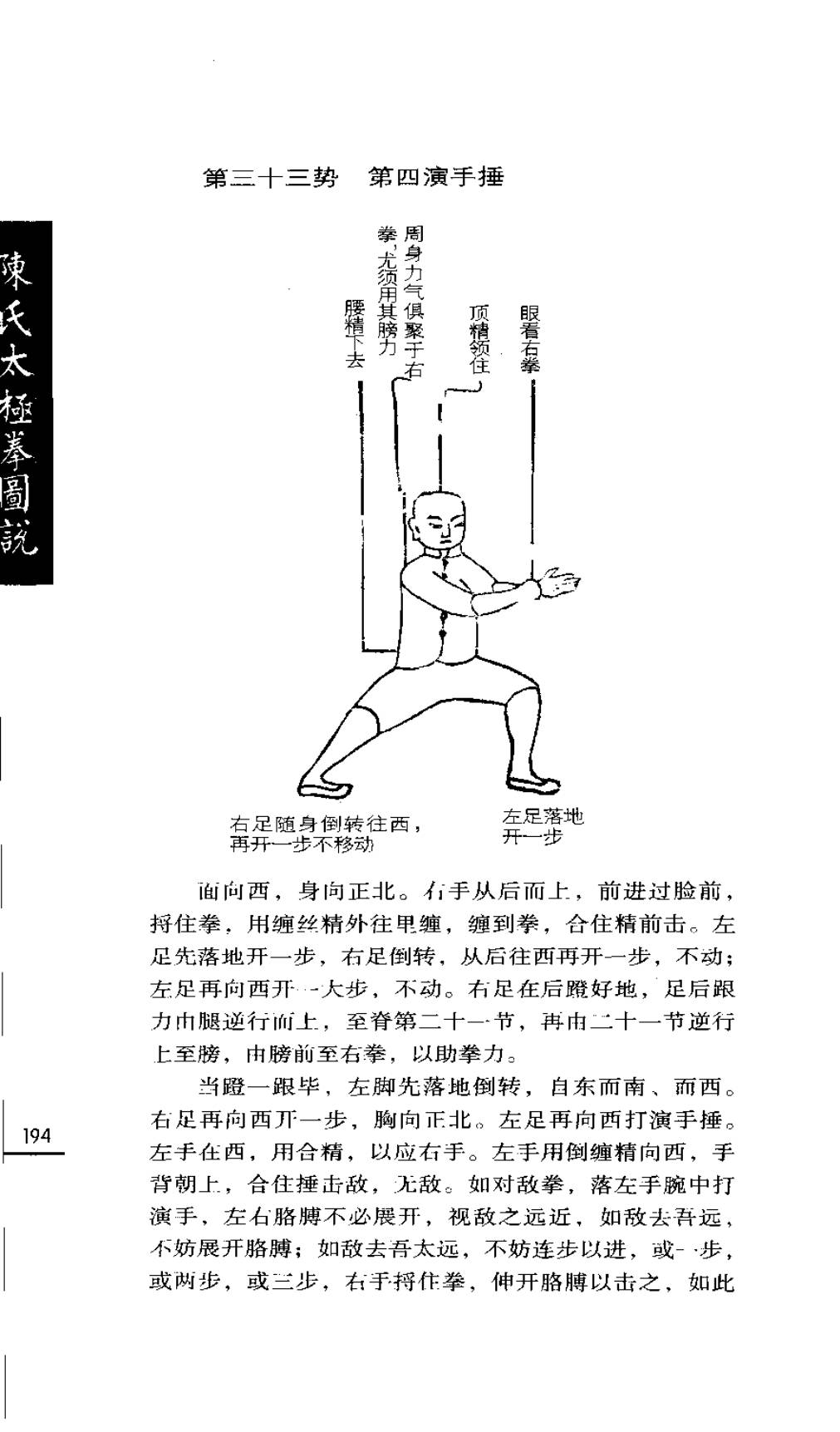
陳氏太極拳圖說 · Volume II
"Linked through three steps" — that is the meaning. If the enemy clings (li 麗 means to attach) too close to my body, there is no harm in bending the arm, the hand grasping into a fist, and using the strength of the whole body to strike with a努 (努, explosive force). This, however, still depends on the state of one's gongfu, one's strength, and one's issuing jing (chu jing 出精). If the gongfu, strength, and issuing jing are all abundant and flowing freely, then using this explosive force is far better than extending the arm. For the moment this place moves, the other person falls several bu 武① away. If not, then striking with a bent elbow is still not as effective as striking with an extended elbow — for although extending the elbow may not fell a person, it beforehand has none of the hindrance of a constrained arm. The jing at the crown (ding jing 頂精), the jing at the waist (yao jing 腰精), the gaze, and the jing at the crotch (dang jing 襠精) — where they should rise and where they should join — all follow the previous method.
As for the footwork: after the backward-leaning kick is finished, the face is toward the East; from East one turns leaning toward South, then West. The left foot lands first, twisting on its heel, going from East to South. The right foot turns around and takes a step from South toward West; at this point the chest already faces North. The left foot then takes another step toward West — this makes three consecutive steps of the left and right feet. Before the left foot has landed firmly, the right fist strikes toward the West. If there is no enemy in the West, the right fist may simply land outside the left shoulder and left ribs, some six or seven cun from shoulder and ribs. The empty space — in the end the boxing postures have no fixed frame; it would even be acceptable for the right fist to land just in front of the left ribs, only five or six cun from the left nipple. In ordinary practice of the form one must neither neglect to keep the established rules nor rigidly adhere to them — it rests on the learner's ability to make good use of the inner jing (nei jing 內精). As for the outward traces of movement, if the terrain imposes limits, adapt and apply them according to the lay of the ground; that is acceptable.
When performing the High Pat on Horse 高探馬, one stands and strikes a person. Upon meeting a strong enemy — if on the South side the hand cannot reach (xia, here read in the level tone), insert the right foot; or on the North side insert the left foot; or turn the head toward the East and perform the hand strike (yan shou 演手); or lean back, turn the head toward the West into the Double Punch (er qi 二起); or kick with the left foot toward the West; or turn around and use the Great Turning Body Kick (da zhuan shen 蹬) with the right foot. Above there are the images of Shi He 噬嗑 (Biting Through), the wooden cangue (he 校, to wear) on the neck, and the misfortune of "destroying the toes"; below there are the images of Da Guo 大過 (Great Excess), "wading through" (guo she 過涉), "destroying the crown of the head" (mie ding 滅頂), Shi He 噬嗑, "destroying the ears" (mie er 滅耳), Yi 頤 (Mouth Corners), and "toppling Yi" (dian yi 顛頤) — the Way turns back and forth; who knows when one can come out of layered peril and "cross the great river" to attain the "solitary return of the middle way"? Now, however, it is "return after seven days" (qi ri lai fu 七日來復); "treading the way, smooth and even" — who would not use the warrior's campaign, performing it with the hand to repay enmity! Confucius said: "To repay enmity with uprightness is not excessive."
Diagram Descriptions (Tu Shuo 圖說)
Diagram of the right fist (right fist posture): annotations — shoulder 肩 (vai), back of the elbow joint 肘節背面.
Diagram of the left hand (left hand posture): annotations — elbow crease facing inward 肘彎朝裡.
Footwork diagram (feet with curved arrows):
- the left foot in front (在前左足)
- the right foot behind (在後右足)
- unmoving (不動)
- the right foot 右足
- opening a step (開步)
- jing. The right foot also uses the reverse-turning jing (dao zhuan jing 倒轉精), then again toward the West — chân phải cũng dụng tinh đảo chuyển, rồi lại hướng Tây.
- The left foot lands first, then steps toward the West with the left foot; the left heel twists, using the reverse-turning jing — chân trái đáp trước, ngay lấy chân trái mở bước hướng Tây, gót chân trái xoay, dụng đảo chuyển tinh.
- The left foot in the West still uses a large step — chân trái ở phía Tây vẫn dụng đại bộ.
- The left foot, having landed in the West, also does not move — chân trái đáp tận phía Tây cũng bất động.
Inner Jing (Nei Jing 內精)
The central qi (zhong qi 中氣) rises from the dantian 丹田 up to the shoulder — (Trung khí từ đan điền đi lên tới vai,)
① shu wu 數武: several half-steps; the ancients held that "a half-step is one wu 武." (số vũ: vài nửa bước, người xưa có thuyết "nửa bước là một vũ")
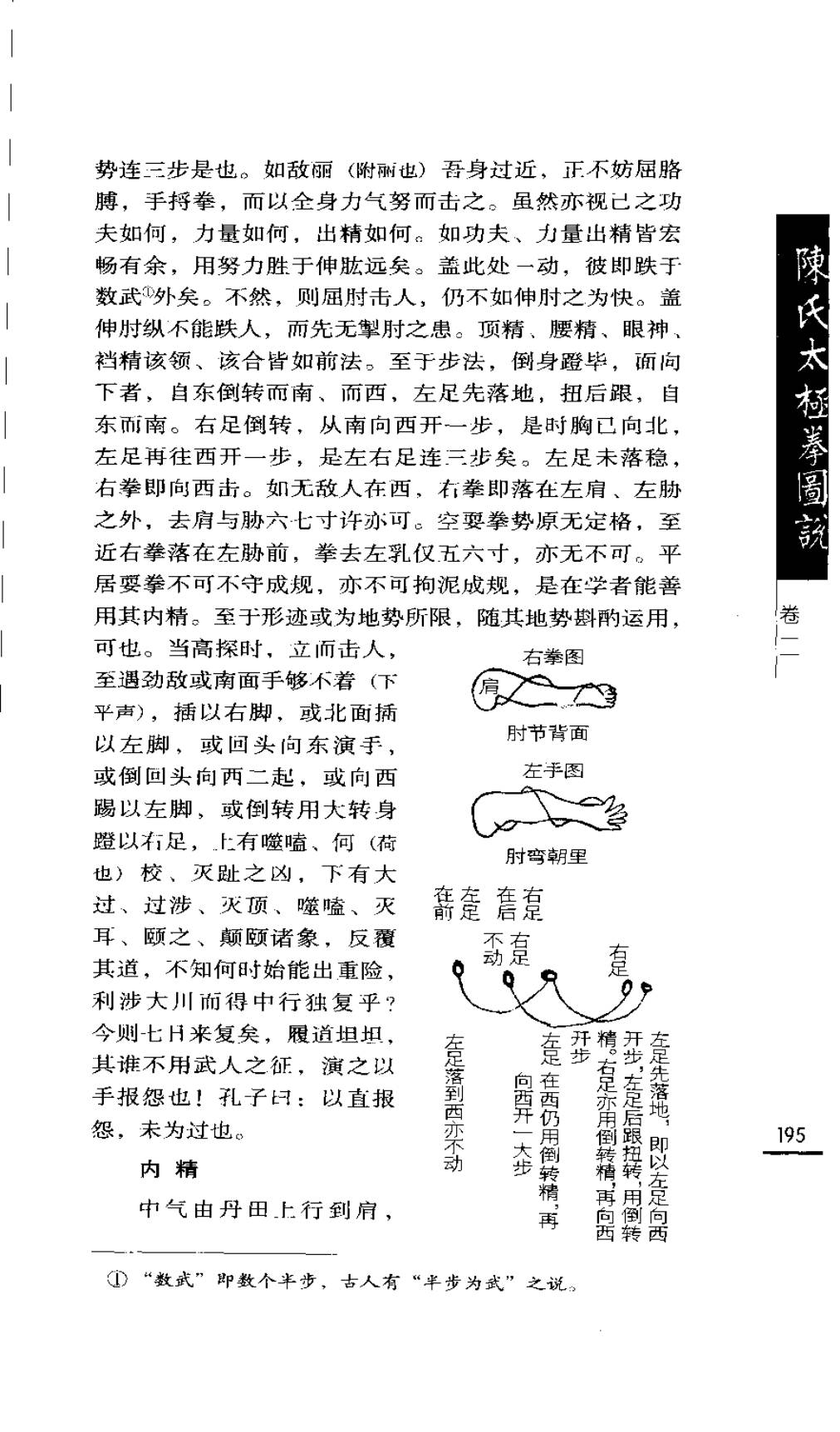
陳氏太極拳圖說 (continued)
From the shoulder it goes down and outward, coiling obliquely from the outside until it reaches the lower edge of the third segment of the back of the fist. The force rises from the rear heel, travels counter-current up along the spine to the right fist; one must use the shoulder-arm force joined in jing (he zhu jing 合住精) — this is striking with the left hand. It is reverse coiling (dao chan 倒纏) arriving at the hand; the hand slightly hooks and holds the wrist toward the East. The jing at the crown (ding jing 頂精) and at the crotch (dang jing 襠精) are as before; the left knee bends and holds, joining with the right knee; the foot treads the ground level and stable; the right foot is behind as if kicking against something, to assist the force of the right fist. The right knee must not go soft — it joins its jing with the left knee.
Taking the Image (Qu Xiang 取象)
The previous five forms truly carry the image of Xi Kan 習坎 (Repeated Peril — layered danger). The third line says: "Coming and going, pit after pit; perilous, and leaning back one falls into the pit's hollow. Even if one wishes it, it cannot be used" — therefore it is taken from Kan 坎 (Water). Yet even though in the affairs of the world it is said "there is no level ground without slopes," there is also "no going without returning" ("no level without slopes" refers to the previous five forms: what is rooted in Heaven draws near to the top yet instead draws near to the bottom — this refers to the head; what is rooted in Earth draws near to the bottom yet instead draws near to the top — this refers to the feet. "No going without returning" means that those drawing near the top and those drawing near the bottom each return to their original positions). When Pi 否 (Standstill) reaches its extreme, Tai 泰 (Peace) comes; therefore Pi and Tai are taken again — now the time has become Tai. Thus, "advancing as if checked" and "walking alone in the correct way," one takes from Jin 晉 (Progress). The Tuan Commentary says: "Jin means advancing; the yielding advances and moves upward" (this means the force of the right foot's great heel also moves upward, assisting the right fist's force). Top line nine: "advancing to the horns, used only for punishing one's own city; danger, yet good fortune" (taking danger as good fortune). Who says "dense clouds but no rain, from our own western outskirts"? If one returns by one's own way, then "it has rained, it has settled" — what blame could there be? Therefore Xiao Chu 小畜 (Small Accumulation) is taken as well.
Fourth Performing-Hand Fist (Di Si Yan Shou Quan 第四演手捶) — Seven-Character Folk Verses
The First
The fourth performing-hand fist faces the West: entering peril and leaving peril, repaying others' bullying.
The right fist must use the strength of the shoulder (bang 膀); with one strike everyone's horse hooves are thrown into confusion.
The Second
The left foot landing comes first of all; the right foot turns and lands in front of the left foot (this refers to the reverse turn, taking a step toward the West).
Then take another step with the left foot — behold the spirit-force brimming in the empty fist.
Printed page: 196
陳氏太極拳圖說 · Volume II
The Thirty-Fourth Form: Small Grappling Qinna (Xiao Qinna 小擒拿)
Diagram: a figure stands in a bow stance, left foot in front and right foot behind, both arms extended forward in a pushing/grasping posture; the left hand open, palm facing forward; the right hand in a palm-push posture. Arrows and dotted lines indicate the direction of force and the axis of the body.
Labels on the diagram:
- 眼看着住敵人之胸 — the eyes look, holding to the enemy's chest.
- 而以右手推之 — then use the right hand to push.
- 打拳全手推之 — strike/push with the whole hand in boxing.
- 精領好全身精神,為之一振 — the jing leads well, the spirit of the whole body rouses with it.
- 耳須聽住背後 — the ears must listen to what is behind.
- 在膀力須用上 — the shoulder (bang 膀) strength must be brought into play.
- 左手 左掌 — left hand; right palm.
- 膝撐住,與右膝合住精 — the knee props and holds, joining its jing with the right knee.
- 腰精要下好,腰無力則周身無力 — the waist jing must settle down well; if the waist has no strength, the whole body has no strength.
Footwork instructions (below the diagram):
The left foot — because in front the enemy is rather far from me and striking would not reach (ji 及), one therefore advances a step forward to strike him. But to advance the left foot, the footwork must first advance the right foot, with the left foot following it. The step is already large and cannot advance further, so first advance the right foot with the left foot following; then take one more step forward and one is at the West. If the jing props and rounds, then the whole body has strength; if left and right do not turn roundly, one is not nimble. Therefore the right foot takes up the position of the previous posture and opens forward four or five cun, then stops.
Main text:
From the rear crown of the head down to the thigh bone (bi gu 髀骨), all must be nimble and alive. Although the mind is in front facing the enemy, one must also keep attention on what is behind, fearing that another enemy may attack from the rear where one does not expect it.
When the enemy strikes at me with his hand, I use my left hand with compliant coiling jing (shun zhuan jing 順轉精) to lead away his hand, then use my right hand to push at the enemy's Jiuwei point (jiuwei xue 鳩尾穴, CV15, below the sternum). Palm force must be used — only when there is strength in the palm can one push a person down.
In the previous performing-hand fist, perhaps I did not strike the enemy where it hurts and he fights with me again; or he has been knocked down but rises again and comes back to fight; or this person has fallen and yet another enemy comes forward to oppose me — in every case he is rather far from my body and we cannot close and cross hands. Then the feet below must advance, left and right, bringing my body near the enemy; afterward the left hand deflects the enemy's hand aside, and the right palm pushes forcefully against the enemy's chest — all this is arrayed battle in the open field (lie zhen da zhan 列陣大戰). Here the enemy, slightly defeated, comes again; therefore cover above and strike below, seize and take him — there is no need for large body method. It is called "small" (xiao 小), meaning the body method is small.
Printed page: 197
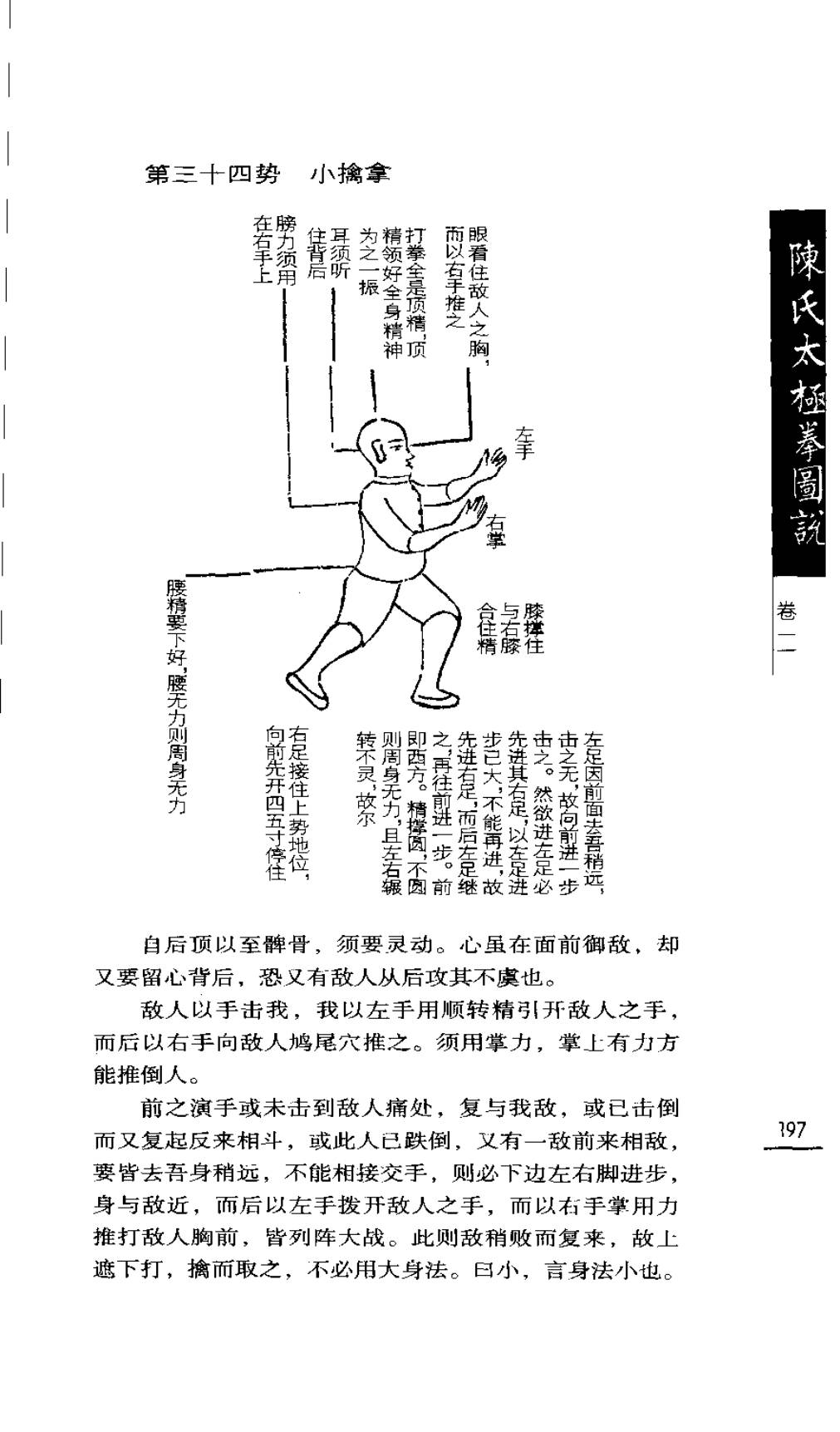
Chen Family Taijiquan Illustrated · Book 2
Posture 34: Xiao Qin Na 小擒拿 (Small Seizing) — continued
Internal energy (nei jing 內精):
I use the left hand to deflect the opponent's hand; one must use forward-turning energy (shun zhuan jing 順轉精), either drawing it up and leading it, or deflecting it away from north to south. Both hands go out together, left hand above, right hand below, using reverse-turning energy (dao zhuan jing 倒轉精) from south to north, and afterward striking forward. This is the method of stealthy seizing beneath the elbow.
Taking the image (qu xiang 取象):
This posture is like Ma Wu capturing the bandits, nearly defeated by Zhou Jian and Su Mao (referring to the previous postures). Then Wang Ba came to the rescue; Wu fought with doubled strength and turned defeat into merit (referring to the preceding Yan Shou Quan 演手捶 — the "Performing-Hand Fist"). Having won, one must still pursue to the utter end, as Cangtou Zimi killed Peng Chong until his submission. Small seizing and striking is like Xiang Yu striking Zhang Han — nine battles, nine victories. Or again, after the Hong Canal marked the boundary, the King of Han was determined to drive Xiang Yu to his death at the Wu River before stopping. Or again, like the Jin hexagram's "advancing as if crushed" (crushing means pushing the enemy down with the hand) — the image of "advancing alone is upright," hence the Jin hexagram is taken. Again the second line: "advancing as if sorrowful" (sorrow is caution shown outwardly), "perseverance brings good fortune" (moving it with central qi, upright and firm). "He receives great blessings" (referring to returning in triumph with victory) "from his queen mother" (the Queen Mother dwells in the Yao Pool in the west; a series of postures all strike westward, and this one goes yet further west). Also the top ninth line: "advancing to the horns" (a metaphor for the right palm), "it is fitting to attack the city; danger" (li 厲 means severity, courage) "but good fortune, no blame." Again, like the Ming Yi hexagram's "hunting, one must obtain the great head before stopping." Again, like what Pan Geng said: "if there are those who are not auspicious, not obedient, who rebel and transgress, disrespectful, who in the moment commit treachery, I will cut them off and exterminate them, not allowing them to leave descendants in this new city" (referring to the principle of eradicating evil at its root) — the image of Family, top ninth: "having sincerity, majestic, in the end good fortune"; though one goes among evil men, though coming is obstructed, one returns to greatness. Hence the images of Family top ninth, Gui first line, the ninth line of Jian, and Jian top sixth are also taken.
Six-character folk verse on Xiao Qin Na:
The preceding posture's Yan Shou is most brilliant; moreover it wins by the unexpected (qi 奇 — stratagem: above covering, below striking, striking the man by stealth, hence called "unexpected"). Heart, hand, eye, and foot as one breath; the enemy is surely seized.
Diagrams:
1. Circular diagram — titled 右手掌前推图 ("Diagram of the right palm pushing forward"). Circular text: 此即 / 右手掌前推 / 自南而北 / 倒转精 / 左手拨开 / 自北而南 / 顺转精 / 左手拨开.
2. Standing figure diagram:
- Right side: 左手用引精引开敌人之手,须用缠丝精 ("the left hand uses leading energy to deflect the enemy's hand; it must use coiling silk energy 缠丝精"); 引之,令其脚立不稳 ("lead him so that his feet cannot stand steady"); 下体步法与前法相同 ("the lower-body footwork is the same as the previous method"); 东 ("east").
- Left side: 前即西方 ("in front is the west"); 步即速向前开步 ("step quickly forward").
- Feet: 左足随住右足开步 ("the left foot opens a step following the right foot"); 左足原位 ("left foot in original position"); 右足原位 ("right foot in original position"); 右足先向前开步 ("the right foot first opens a step forward").
3. Footwork diagram: 步即速向前开步 ("step quickly forward").
Printed page: 198
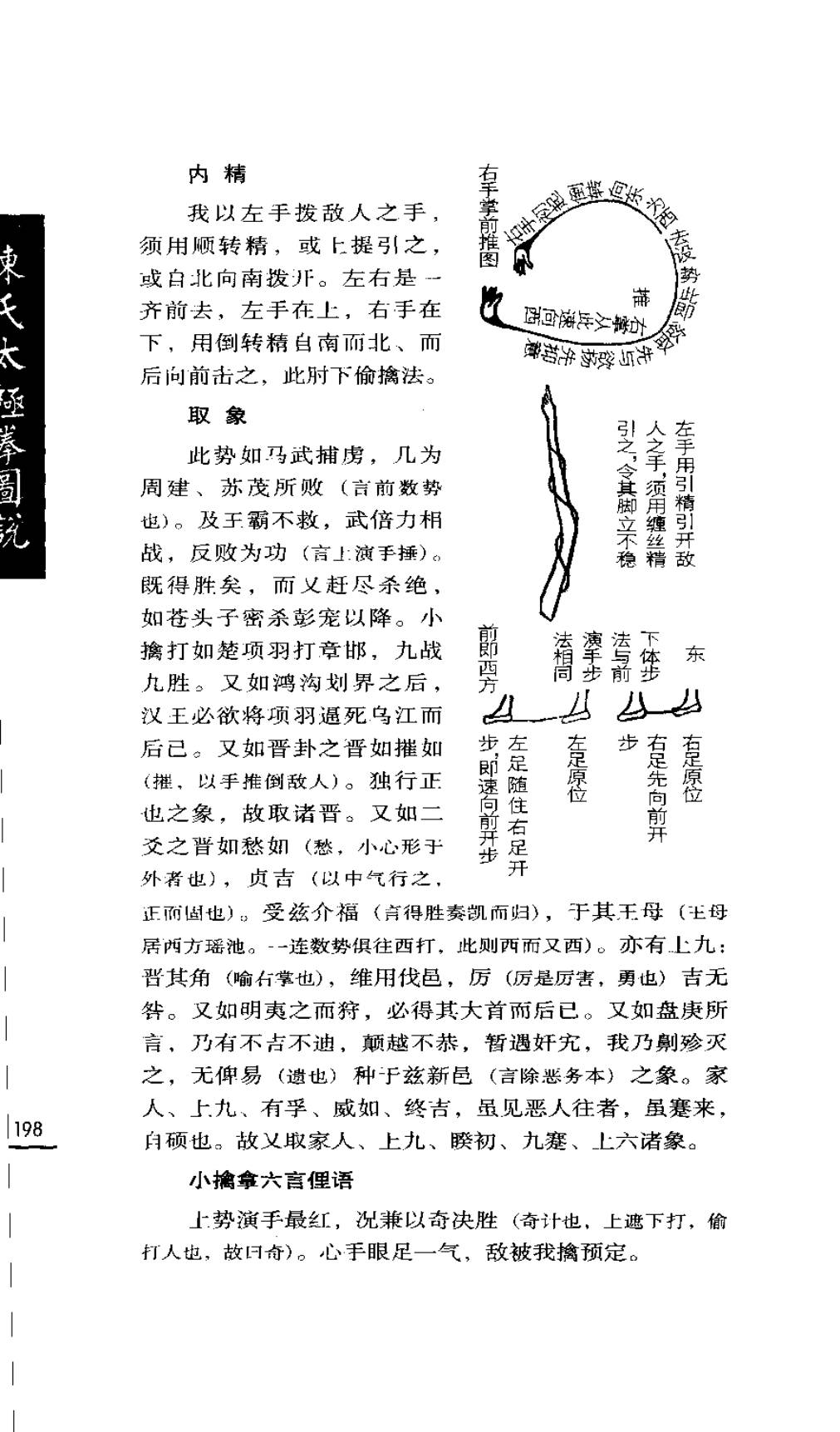
Chen Family Taijiquan Illustrated · Book 2
Posture 34: Xiao Qin Na 小擒拿 (Small Seizing) — folk verses
Seven-character folk verse
First:
The rear heel follows, the left foot forward ("forward" means advancing forward); the left foot lifts and steps again ahead. The left hand lifts up as if to block and parry; the right hand with one palm strikes straight at the strong point.
Second:
One palm to the belly — pain reaching to heaven; stealthily it passes through beneath the left elbow (piercing through). Even an immortal certainly cannot defend against it — how much less a mountain peak, entirely hao ran 浩然 (hao ran is the central qi 中气).
Five-character folk verse
The west is Geng-Xin Metal 庚辛金, the season when the ten thousand things bear fruit (when the myriad things reach autumn they all bear fruit); why speak of Xiao Qin Na — arriving here it is nothing remarkable (referring to the bearing of fruit).
Seven-character folk verse
One bout attacking east (all the postures lie west of this posture), one bout west (the Yan Shou Quan 演手捶 lies in the west); west and yet further west (this posture, Xiao Qin Na) — the unexpected lodged in the upright. Only here does one begin to know the Taiji Quan (the preceding postures are all small seizing-and-striking; when the postures arrive at Xiao Qin Da, that is a small moment of fruition for Taijiquan. Within the substantial there is the insubstantial, within the insubstantial the substantial — the natural wonder of Taiji. Only when the use reaches its fruition does one awaken to the refinement of this principle).
Printed page: 199
Chen Family Taijiquan Illustrated · Book 2
Posture 35: Bao Tou Tui Shan 抱头推山 (Embrace the Head and Push the Mountain)
Diagram: a figure in a bow stance, left leg bent forward, right leg extended behind, both arms extended forward in a pushing motion.
Labels on the diagram:
- 上既有咸其辅颊舌,则咸其耳,咸其目,咸其头一头能触,咸其肩,咸其肘,皆在其中 — since above there is already "sensing the jaws, cheeks, and tongue," then "sensing the ears," "sensing the eyes," "sensing the head — the head can touch," "sensing the shoulders," "sensing the elbows," all are contained within it.
- 左手掌与五指俱用精前推,两肘要摘精,亦犹左足之咸其拇也,两肩用力 — the left palm and five fingers all use energy pushing forward; the two elbows must gather energy, just like the left foot's "sensing the great toe"; both shoulders apply force.
- 顶精颈好,眼看向右手 — the crown energy and neck are good; the eyes look toward the right hand.
- 咸其辅颊舌(辅口辅腮内肉颊颊颊舌口内舌也)— "sensing the jaws, cheeks, tongue" (fu is the inside of the mouth and cheeks; jia is the inner flesh of the cheek; she is the tongue inside the mouth).
- 右手掌用精亦犹右足之咸其腓也 — the right palm uses energy just as the right foot "senses the calf."
- 心为一身之主,后既咸其腹,前之咸其心者可知 — the heart is the master of the body; since behind it "senses the belly," that in front it "senses the heart" may be known.
- 咸其股膝可知矣 — "sensing the thigh and knee" may be known.
- 咸其腓(足肚也)— "sensing the calf" (the belly of the leg).
- 裆撑圆 — the crotch supports round.
- 后足蹬好 — the rear foot presses well.
- 大趾也(足咸其拇)— the great toe (the foot "senses the thumb").
- 腿弯直硬,一丝不可软 — the leg is straight and hard, not one thread may soften.
- 咸其腹(腹背内在心上而相背不能感物而无私系)— "sensing the belly" (belly and back are within, above the heart, facing away from each other; unable to respond to things, having no selfish attachment).
Main text:
My face is turned toward the man I have seized and his surrounding partisans who oppose me. Suddenly someone strikes at me from behind; fearing a blow to my skull, I instantly twist my face around, and with my left and right hands I part the enemy's left and right hands, then with both hands push against the enemy's chest, so that his two hands cannot come inside to strike me. The posture is like hands pushing a mountain, seeking to topple it. The right thigh, which was extended, suddenly bends; the left thigh, which was bent, suddenly extends; the left foot presses hard against the ground; the crown and neck are well led; the waist energy sinks well; the crotch energy supports round; the soles press hard into the earth; the strength of the shoulders is delivered into the palms; the strength of the whole body pours into both palms. In pushing, power values divine speed: even if one cannot push him over, one can make him retreat several paces.
Internal energy (nei jing 內精):
Both arms and both thighs all use coiling silk energy (chan si jing 纏絲精), coiling from outside inward, taking their combined forces joined for the attack. The nearer the enemy, the faster the push: from afar pushing is easy, from close it is hard. Advance like a fierce wind driving a man, like a lightning flash — the faster the better. The left and right hands first travel from above downward, rising from the two thighs, parting, then closing from outside inward, entering between the enemy's two... (text continues on the next page).
Printed page: 200
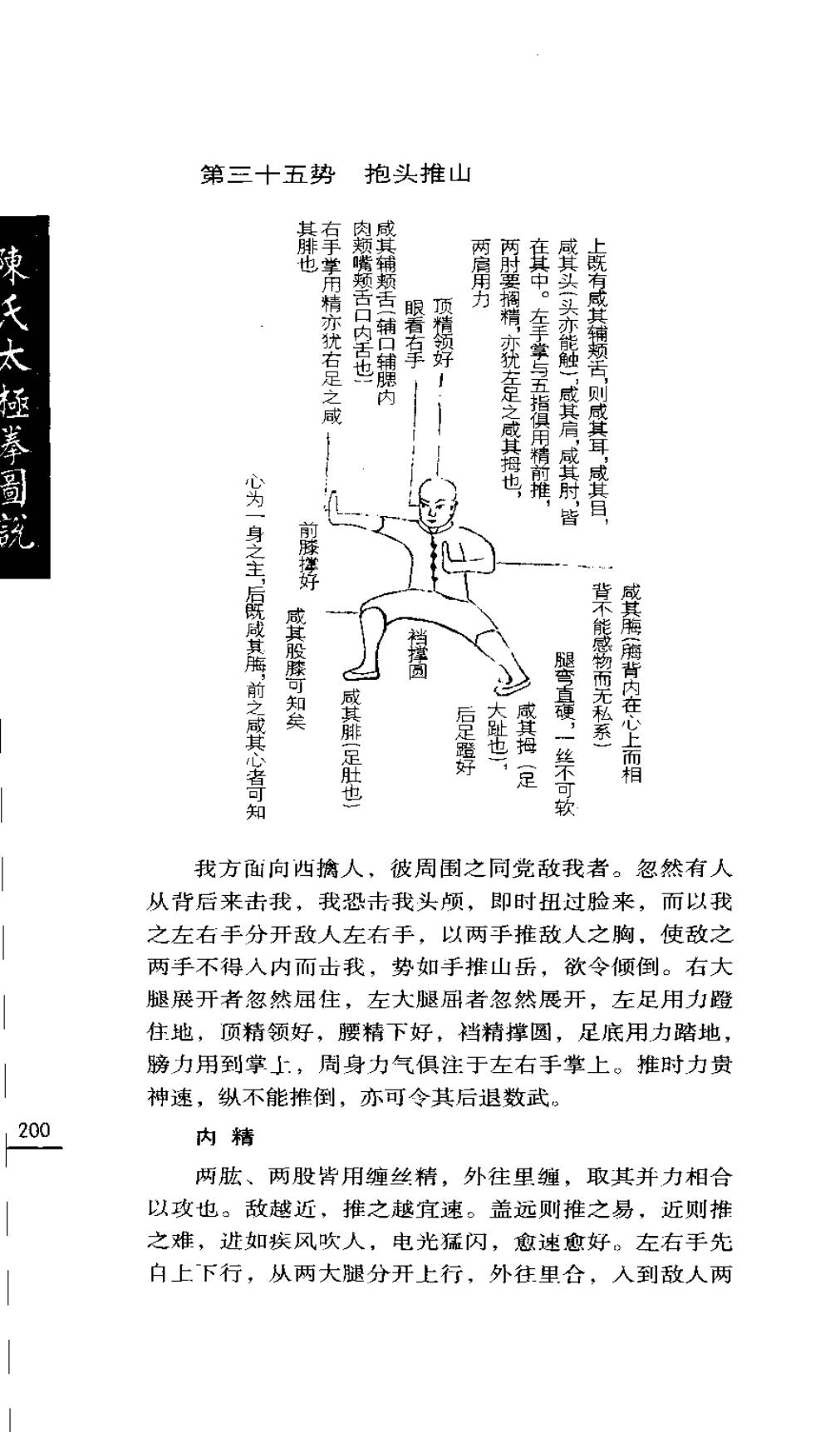
*(From Chen Shi Taiji Quan Tu Shuo, juan 1, part 2.)*
...within the forearm, press down against the opponent's chest and push with force. If you are only a few inches from the opponent's body, pushing slowly will not topple him, and it will even give the opponent time to devise a clever trick — therefore swiftness is prized.
In the previous posture the left foot faced west and was in front; in this posture the body has already turned toward the east, so the left foot, formerly in front, now becomes the rear foot. The left foot need not leave its place; merely twist on the heel. Once turned, the right foot, formerly behind, now becomes the front foot: from its original position toward the east, step out once more toward the east. Step according to each person's foot length; the stepping must place the foot in a position of advantage, with strength applied above — the step goes no farther than one chi.
Qu Xiang (取象) — Taking the Image
In the previous posture I was facing west, seizing an opponent, when suddenly someone comes from the east intending to attack me unawares — this is being "stimulated" from behind. I instantly turn around to face due east and push with both hands — this is my stimulating him. The two stimulate each other, just like the young man and young woman of the Yijing mutually stirring one another; hence the image is taken from Xian (咸, hexagram 31). Xian means "to stimulate/move." If someone comes to provoke me, I will not lightly let him go; and in my provoking him, would I lightly let him go? Since neither will lightly let go, it must come to using the strength of the whole body, pushing as if to topple a mountain. Hence "stirring the big toe," "stirring the calf," "stirring the thigh," "stirring the cheeks" of the Xian text are all appropriate. Moreover, the five sense organs and hundred bones all join in and are stirred together. Fearing that the strength of the two hands alone is small and cannot topple a man, it is better that the strength of the whole body is great and can overthrow the enemy. The Image says: "Two vapors respond and stimulate, and thereby unite" (speaking of man and woman); "thus benefit favors steadfastness." In the boxing, it is I who stimulate others with the upright qi (zheng qi) of heaven and earth — nothing fails to penetrate, nothing fails to profit, correct and firm. Thus in movement one does not lose constancy: even in sudden alarm one remains composed. If pushing is appropriate, push — not deliberately intending to push, yet naturally without losing...
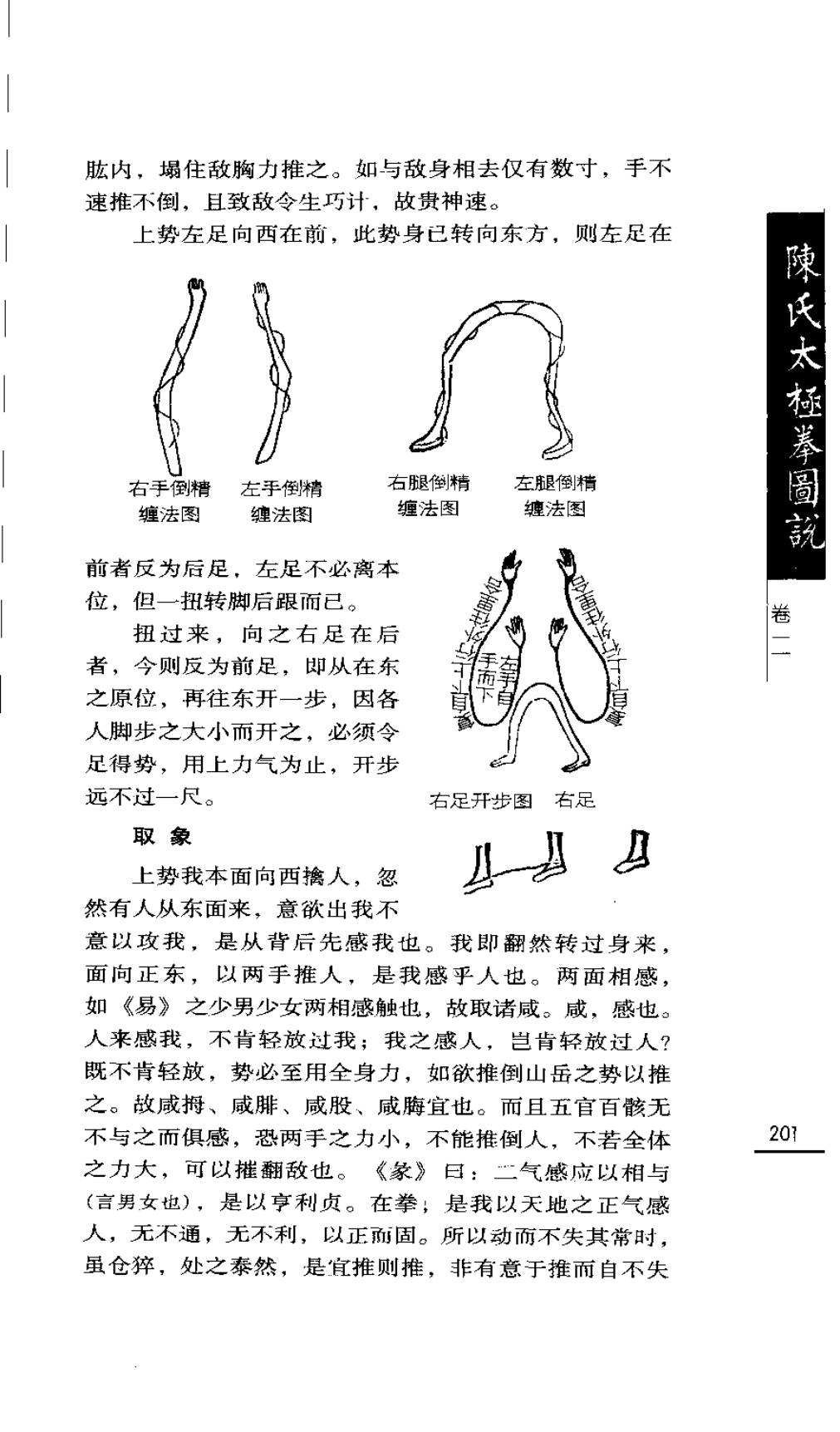
...the peril of not pushing. Yet the head is not excessively heavy, so wrap around with the hands from left and right and push.
Bao Tou Tui Shan (抱头推山, "Embrace the Head and Push the Mountain") — seven-character vernacular verses
Verse 1
Fangzhang, Penglai, Yingzhou — mountains of the immortals; assuredly wondrous immortals dwell therein (a metaphor for the opponent). I now imitate a gallant man: with both hands push him into the great billows.
Verse 2
To push the mountain, why raise the arms to embrace the head? For fear of a chopping blow to the crown, take the upper position. Turn the body, embrace the head, and advance forward — push down Penglai and Yingzhou and cover the nine regions.
Verse 3
Both hands support the chest as if pushing a mountain, regretting not to topple him in one stroke. This body's strength must be united; pay careful attention further to the region of the spine (this calls up the intent of the following posture, Dan Bian / Single Whip).
(No diagrams on this page.)
Title and Section Explanation
Posture 36 — the fourth Single Whip (單鞭, Dān biān)
Jie jie (節解) — section explanation.
Labels on the figure (right to left)
- "The eyes watch the tip of the left middle finger."
- "The crown jin (頂精, dǐng jìn) leads and holds up."
- "Both shoulders relax downward — never raise them up."
- "The right arm uses reverse silk-reeling jin (倒纏絲精, dào chán sī jīn) from below the shoulder/armpit, coiling from outside to inward."
Yinmeng (引蒙) — Instruction
Having just thrown down the enemy attacking from the east with "Embrace the Head and Push the Mountain" (抱頭推山), suddenly another person strikes from the west. I immediately take both hands on the east side, coiling with outer-to-inner jin in one closing (合, hé); then, coiling with inner-to-outer jin, I chop out toward the west, while the left arm spreads open.
The positions of the body points have already been described under the previous method. The heart/mind must be empty (虛, xū); when the mind is empty, the four limbs are all empty. The dantian (丹田), the waist jin, and the soles of the feet must be solid (實, shí). When these three places are solid, what was empty in the four limbs all becomes solid — this is called "empty yet solid." When the crown jin is well led, the spirit of the whole body is roused. The right arm, in closing, uses reverse silk-reeling jin; in extending, it uses forward (順, shùn) silk-reeling jin. The left arm, in both closing and extending, uses reverse silk-reeling jin. Both legs, in closing, use reverse silk-reeling jin: coiling from the foot up to the back of the knee as the stance opens. The right foot does not move; the left foot steps out toward the west, using forward silk-reeling jin, coiling from the foot inside-outward, likewise coiling up to the back of the knee.
*(Chen Family Taiji Boxing Illustrated Explanation, Volume 2. Page 203.)*
*[Figure: a man in an open stance — right leg bent, left leg extended with the foot turned; right arm reaching forward with the palm down, left arm spread to the side; joints marked with dots and captioned by the labels above.]*
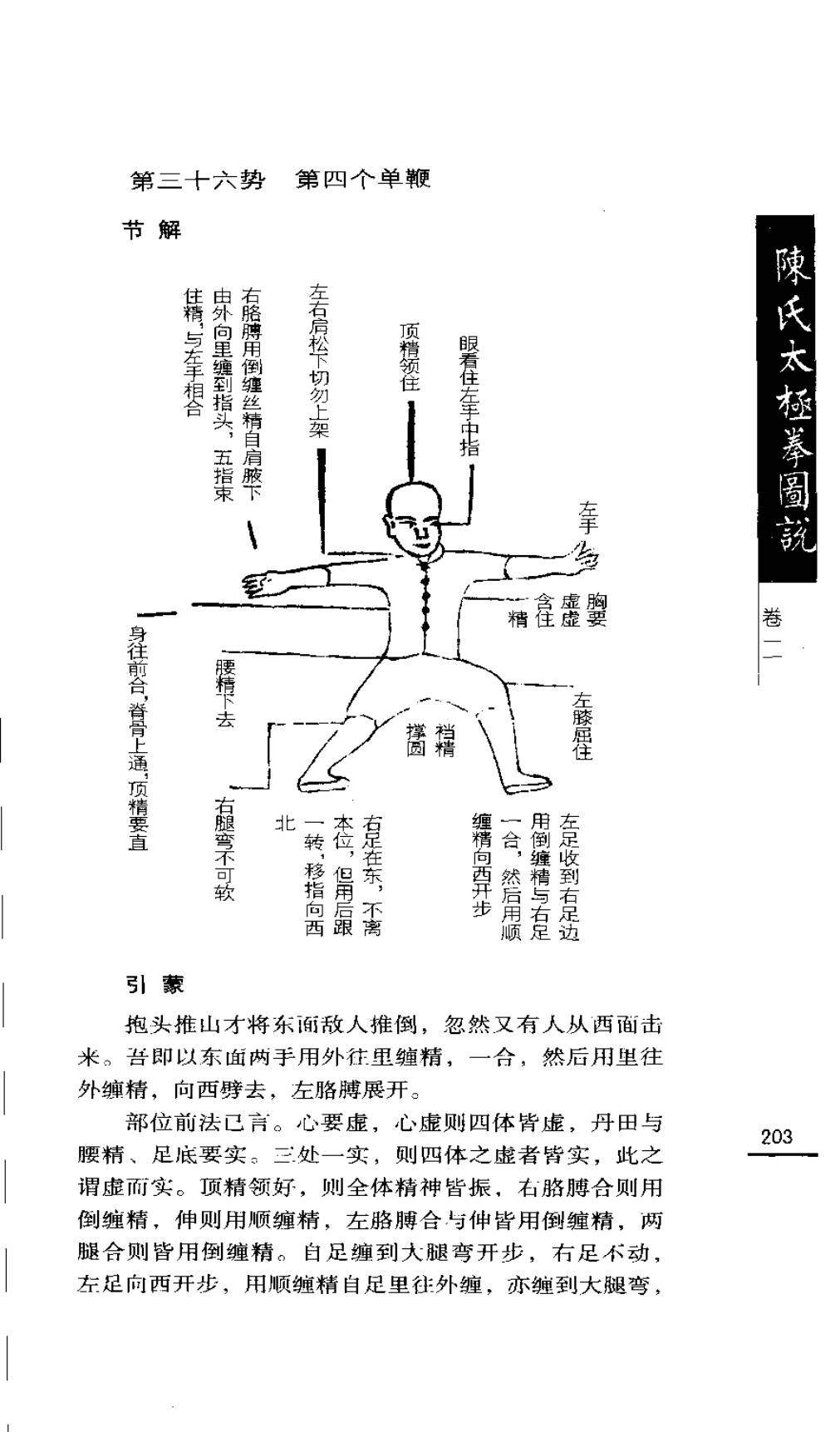
*(Continuation of "the fourth Single Whip" — diagrams of silk-reeling jin and footwork.)*
Main text
The toes and the heel both exert force.
Labels on the diagrams (right to left)
- "This is the diagram of reverse silk-reeling jin (倒纏精) — it must be clearly distinguished."
- "This line enters the waist from behind."
- "This is the diagram of forward silk-reeling jin (順纏精)."
- "This is the diagram of the reverse-coiling method (倒纏法)."
- "Inner-to-outer coiling — use this for opening (開法)."
- "Outer-to-inner coiling — use this for closing (合法)."
- *(Small captions on the foot-coiling diagrams, partly hard to read:)* "From the big toe's pad coil obliquely up to the thigh… to the waist… reaching the big toe, rising over the instep…" *[several small characters illegible]*
- "Bend the knees and walk" (曲膝行步) — written inside a circle diagram.
- "The right hand is at the east and must fold back behind, reversing the jin — the intent of the turn."
- "The left hand uses forward-turning jin (順轉精) to spread open."
- "The left foot first gathers in to the side of the right foot and touches down; after the closing (合) is finished, then step out toward the west — with the intent of a new-moon curve; it must not be straight and stiffly extended."
- "The right foot does not leave its position."
- "West" (西) — direction label.
Quxiang (取象) — Taking the Image
This posture faces east — it is said to face east, but the chest points due north and the face is only half-turned toward the east; this need not be argued again. But because this art is named Taiji (太極), from beginning to end images are taken from the *Book of Changes* (《易》, the Yijing); therefore for this posture as well one takes the images of the *Changes* that accord with the boxing…
*(Continued on the next page. Where small characters were unreadable this is marked; connections follow the sense of the text.)*
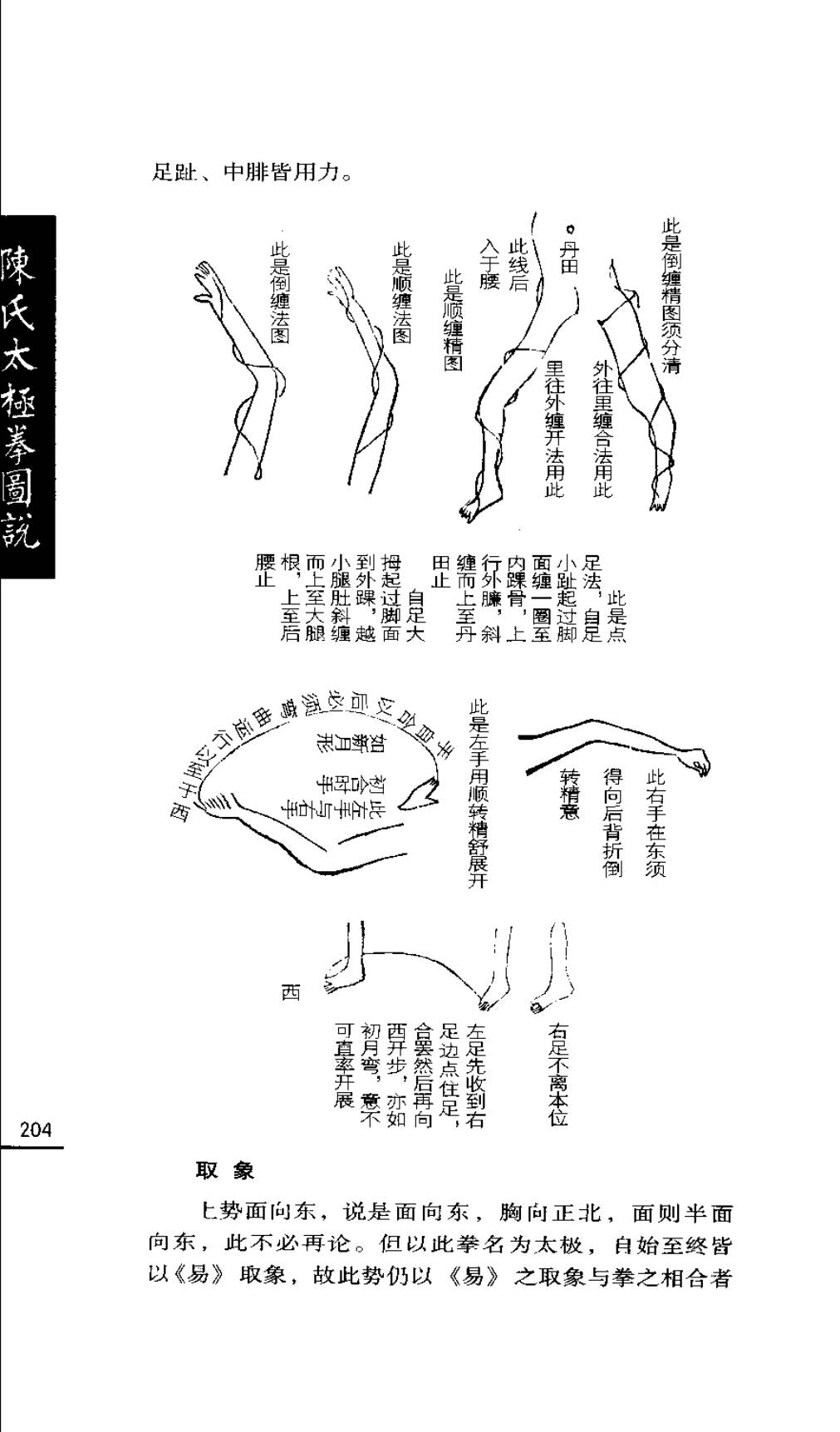
*Chen Shi Taijiquan Tushuo (Chen's Taijiquan Illustrated Explanation), Volume 2*
...and take it from them. The *Yi Jing* (*Book of Changes*) begins the first part (upper canon) with Qian and Kun and ends it with Kan and Li, because Qian and Kun, by the intercourse of the central qi (i.e. the qi of the central line), beget in the second generation Kan and Li; hence the upper canon ends with Kan and Li. In taijiquan, by the fourth Single Whip (dan bian 單鞭) thirty-four postures have been completed, so it too can take Kan and Li as a conclusion. Yet the movement of qi has never stopped — this is only borrowing Kan and Li to close this passage for the moment. Speaking first of the Li trigram: Li is empty in the middle with one yang line above, like the yang line below the left and right upper arms; [the yin lines] are like the yin within the left and right legs; it resembles the heart's Li brightness, upper Li and lower Li shining upon each other in succession. The heart's empty clarity is like sun and moon, shining in succession without a moment's interruption. Moreover, once the heart is empty, the whole body is empty. Only emptiness is spirited (ling 靈), and spiritedness suffices to answer the opponent — hence this is taken from Li.
Speaking of the Kan trigram: the left and right upper arms at the two sides resemble the yin line at the top of Kan; the left and right feet standing apart resemble the yin line at the bottom of Kan; the central qi threading through the middle of heart and kidneys, reaching upward to the crown of the head and downward to the huiyin (perineum), is like the single yang line in the middle of Kan. For only when a person's solid principle and solid qi (solid principle is utmost sincerity; solid qi is the flowing mechanism of transformation) are full within can opening-closing, seizing-releasing proceed without obstruction — hence this is taken from Kan. To combine them: at first pulling Single Whip one attends to the circulation, which is all the central qi — that is Kan; at the moment of pulling Single Whip, the empty-spirited heart illuminates everything — this is Kan producing its image in Li. When the Single Whip posture is complete, the heart is calm and the qi harmonious, the central qi returns to the dantian (丹田) — this is Li in turn producing its image in Kan. Kan and Li join, returning again to the Qian and Kun trigrams, returning to the primordial qi of taiji's yin-yang. The heart belongs to fire, the kidneys to water — these are just the Kan and Li of the *Yi*. Thus once heart and kidneys interact, it returns to Qian and Kun, and the primordial qi of taiji in my body (primordial qi is the qi of yin-yang and the five phases) is restored. Qian and Kun, the firm and the soft, use yin and yang together, neither leaning to one side, neither exceeding nor falling short; when Kan and Li attain the center, this art is complete. Kan and Li certainly have their proper positions as Kan and Li, but to regard Kan and Li merely as Kan and Li is not to know whence Kan and Li come; it is moreover not to know that Kan is the middle son and Li the middle daughter, and that the middle son and daughter are themselves a small Qian-Kun within Qian-Kun. My body contains within it the principle and qi of yin-yang — in the midst of heaven and earth, does it not itself possess the upright qi of Qian and Kun! Since it possesses the upright qi of Qian and Kun, my body too has of itself the primordial qi of taiji. To move this primordial qi inherent in my body through my body — its bending and stretching, going and coming, gathering and releasing, seizing and letting go — is nothing but one opening and one closing, one empty and one full! So this posture may be called Kan-Li, or it may be called Qian-Kun (tracing it to its source), or even taiji — none of these is not permissible. And if from being it returns to not-being, calling it wuji (無極, the limitless) is also not impermissible. Provided the principle can be extended flexibly, any of these may be borrowed as a name. But the image of Single Whip is close to Kan and Li, so Kan and Li are used to clarify Single Whip — this is why Single Whip takes the trigrams Kan and Li.
Fourth Single Whip, Seven-character Folk Verse (第四單鞭七言俚語)
No. 1 (其一)
第四单鞭象坎离,闲拉无事不为奇。
抱头方向东边击,转向西方向更宜。
The fourth Single Whip images Kan and Li; pulling it idly when at leisure is nothing remarkable. Facing east to strike with baotou ("embrace the head"), yet turning to strike toward the west is even more fitting.
(Page number: 205; no diagrams on this page.)
*Chen Shi Taijiquan Tushuo — continuation of "Fourth Single Whip, Seven-character Folk Verse"*
No. 2 (其二)
双手抱头向东推,又有敌人自西追。
回头诸势来不及,惟用单鞭最相宜。
Both hands embrace the head and push to the east, while another enemy pursues from the west. For all the other postures there is no time to turn the head back — only using Single Whip is most fitting.
No. 3 (其三)
左足从容向西方,抱头东推力倍强。
庚辛(西方也)从后来相击,转(即回头也)用单(用,我用也)鞭一命亡。
The left foot unhurriedly points to the west; embracing the head and pushing east, the force is doubled. When Geng-Xin (i.e. the West) strikes from behind, turning (i.e. turning the head back) and using Single (yong 用, "use," means "I use") Whip — a life is lost.
No. 4 (其四)
忽然左耳听西方,若有人兮称刚强。
岂知太极元气转,为用全鞭孰敢当?
Suddenly the left ear listens to the west, as if someone there boasts of his strength. How would he know the primordial qi of taiji turns — when the whole whip is set to use, who dares withstand it?
No. 5 (其五)
声东击西计最良,此是平居善用方。
谁知实向东推毕,转脸四击一字长(一字,言我单鞭如一字长蛇阵)。
"Make noise in the east, strike in the west" is the finest stratagem — this is the method to use well in ordinary practice. Who would know that, having actually finished pushing to the east, I turn my face and strike in four directions with a "one-line" length (yizi 一字, "one line": my Single Whip is like the one-line long-snake battle formation)?
(Page number: 206; no diagrams on this page.)
*(Volume 3 title page)*
Chen Shi Taijiquan Tushuo Volume Three (卷三)
Taijiquan Tushuo (太極拳圖說)
Volume Three (卷三)
(Page number: 207; this is the Volume 3 title page — no body text, no diagrams.)
*Chen Shi Taijiquan Tushuo* (spine title strip)
(This page is blank in the body — no text, no diagrams; page number: 208.)
Section 37: Qian Zhao 前昭 (Forward Gaze) (Volume 3, printed page: 209)
Diagram Labels
- Left elbow sinks down
- The five fingertips and the middle and lower segments apply force
- The arm bends slightly, three or four parts
- The gaze fixes on the middle finger of the left hand
- The jing 頂精 at the crown leads and holds up (dingjing)
- The ears listen to the back of the body, guarding against the enemy's stealthy attack
- The shoulders are compliant; the Jianjing 肩井 and Futu 扶突 points all relax and sink
- The elbow tip points upward
- The chest closes forward
- The left knee bends slightly, one or two parts
- The left foot touches the ground but must be empty
- The crotch jing 裆精 opens round
- The right foot steps flat and solid on the ground
- The right knee bends and holds forward
- Waist, body, and crotch all sink down together
- The five fingers of the right hand close together; the wrist draws back, but do not let it hang down excessively
(Figure: a standing figure with the left arm extended forward and leading upward, the right hand gathered behind at the waist, feet clearly divided into empty and solid.)
Explanatory Lecture (Yinmeng Jiangyi 引蒙講義)
What is "qian zhao" (forward gaze)? The eyes look forward, gazing at the left hand. Why gaze at the left hand? Suppose the enemy is to the west and comes to seize the hand or twist the forearm: I lead my left hand upward and toward the north, then turn a small circle from north to south (falling tone), striking with the back of the hand and the back of the forearm. This demands quick hands and sharp eyes; any delay and one risks being controlled. At the moment the left hand leads upward, the waist and crotch sink down together; the upper body revolves and feels lively, while the lower body does not stiffen and die — the right knee bends and holds, the left leg gathers in, and it becomes naturally easy. As for the right hand behind: when the left hand leads upward, turning a small circle from south to north, the back of the right hand, together with the arm, also turns a small circle from north to south. The left hand turns with the flow, the right hand turns in reverse; the back of the left hand faces south, the back of the right hand faces north. In sum, the whole body must be made to move upper and lower in mutual accord, with one qi 貫通 running through as one.
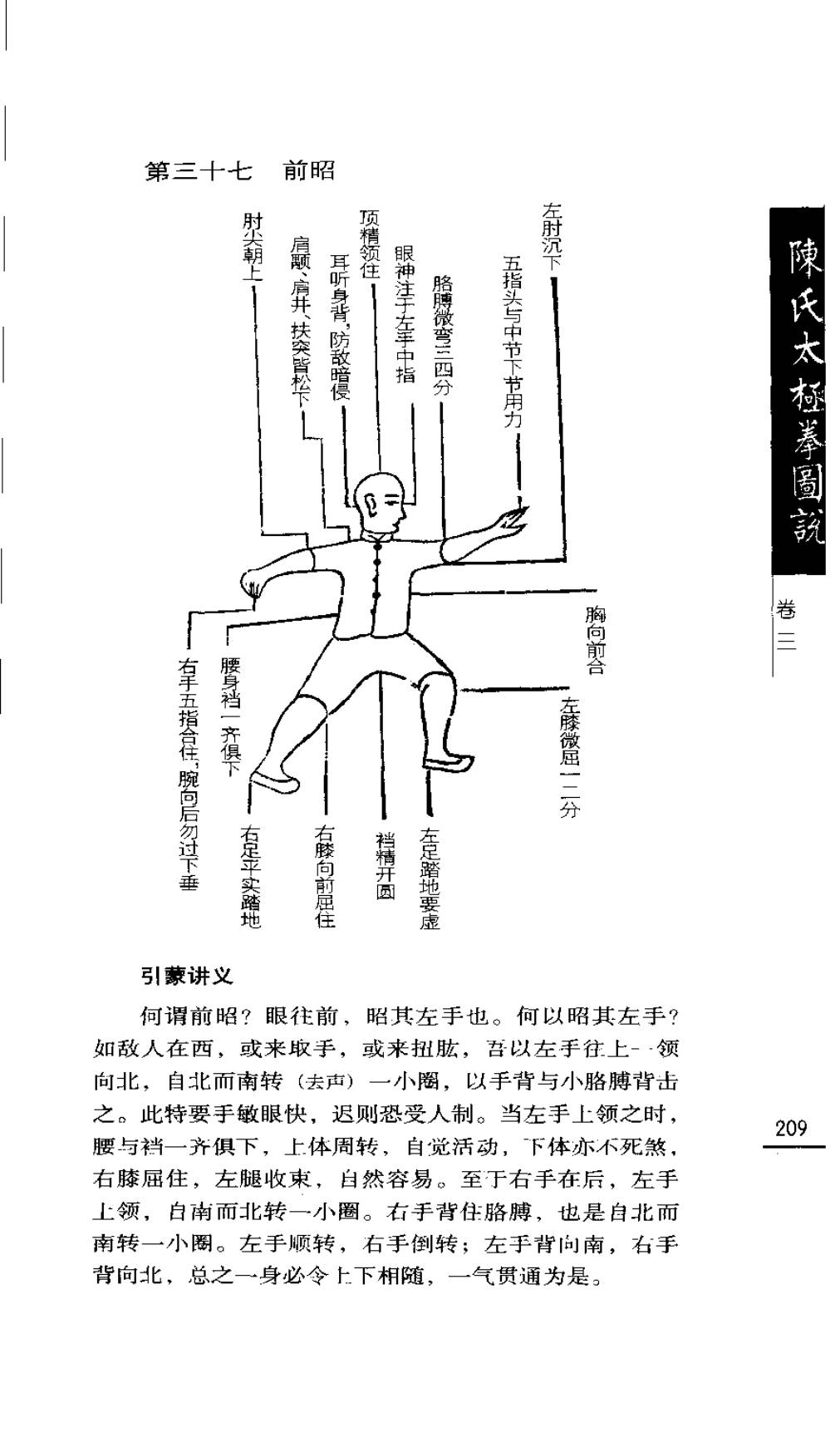
(Printed page: 210)
Inner Jing 內精
(The preceding diagram shows the completed form of Qian Zhao 前昭, but does not yet explain the stages of movement along the arm or the coiling of the true qi 真氣. Therefore further diagrams show how it rises in the arm, how it falls, and how the central qi 中氣 turns and revolves — thereby displaying the natural opening and closing of taiji 太極, achieved without forcing by human effort, and only thus according with principle and method.)
Diagram 1: Left Hand in the West, Turning with the Flow (順轉圖)
(Circle diagram. Center, vertical: "the left hand turns over from inside to outside." Outer ring, directions matched with the eight trigrams 八卦: North, Li 離, Kun 坤, Dui 兌, South, Kan 坎, Xun 巽, Zhen 震.)
Diagram 2: Right Hand in the East, Turning in Reverse (逆轉圖)
(Circle diagram. Center, vertical: "the right hand turns over from outside to inside." Outer ring: North, Qian 乾, Dui 兌, Kun 坤, South, Kan 坎, Gen 艮, Zhen 震.)
Text between the two diagrams: "Reverse hand, with-flow circle… the right hand must follow the left hand's turning" 〔the phrase appears garbled in the print〕.
Main Text
Diagram twelve shows the manner in which the left and right hand methods revolve. Practicing the quan 拳 depends entirely on using the heart-mind 心: the moment the heart's intent stirs and wishes the hand to lead upward and turn a circle, the hand transmits it just as the mind intends. Here the one issuing the command is the heart, the one transmitting the command is the hand, and the one observing the countenance is the eye. This is the teaching of the "three arrivals" — heart, hand, eye — none of the three may be lacking. When crossing hands with an enemy, observing the enemy's countenance, noting where on my own body he fixes attention, and how his hands and feet set up their position, advance or retreat — all of this lies in the eye. Once the eye has seen it, the heart knows it; how to prepare and respond, the hand arrives following the heart. The mechanism is supremely nimble, the movement supremely swift (movement here means the motion of hands and feet). Hence observe his hand and you know his heart.
Left Hand Clockwise Coiling Diagram (左手順纏圖)
The left hand leads upward and turns a circle; the circle drawn by the fingers and the coiling jing 纏精 of the arm are one and the same jing 精 — they must not be seen as two separate segments. Only for ease of seeing is it described by way of the hand.
(Figure: an arm extends diagonally upward; a spiral line runs along it, showing the coiling-silk motion.)
Right Hand Reverse Turning Diagram (右手倒轉圖)
In Qian Zhao the left hand is primary, so the gaze fixes on the left hand — indeed the spirit of the whole body attends to the left hand. The right hand in the east, with the forearm turned back, is not useless: should an enemy attack from behind, one reversal of its jing naturally leaves ample leisure to respond.
(Figure: an arm extends horizontally to the right; a spiral line runs along it.)
(Continues onto the next page)
This posture continues upward from Dan Bian 單鞭 (Single Whip). The arm has already extended to meet the enemy. Yet once the arm has already [continues on p244]
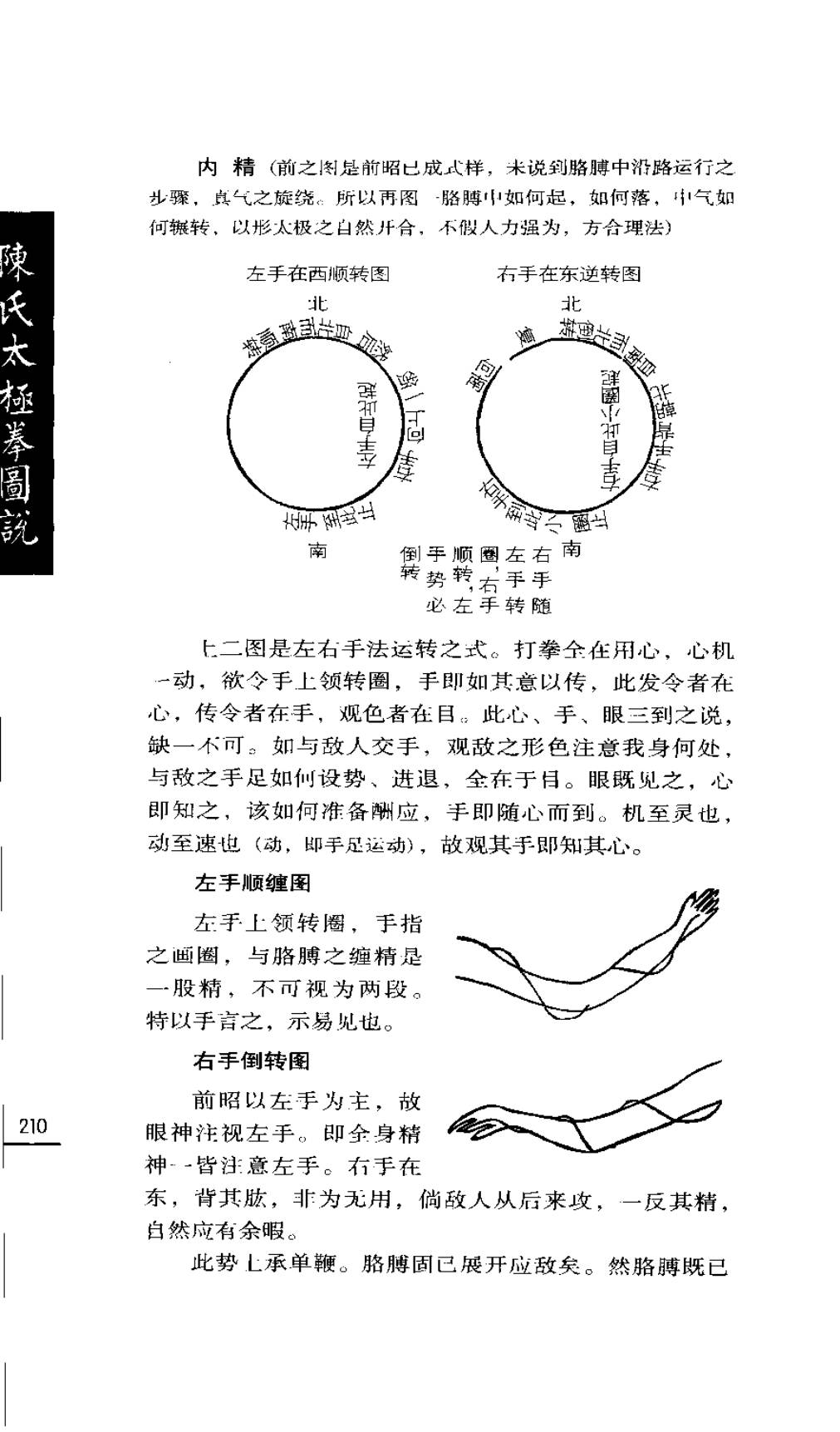
(Printed page: 211; Volume 3)
Main Text (continued from the previous page)
…extended. But should another enemy come, the situation will no longer permit extending again; therefore bending must be taken as the superior course. Yet if the forearm is bent, how does one meet the enemy? Thus the hand must be led upward, with the coiling method 纏法 used inside to meet the enemy coming from the left side. This too is the natural mechanism and moment inherent in the quan 拳 — no forcing is required. The left hand, in a person, is by nature not in an advantageous position, and moreover extended but not yet bent: should an enemy come, one has no choice but to lead the left hand upward. When the left hand is up, the jing-force of the entire body must be gathered and poured into the left hand before it will serve the purpose. This is "diminishing the lower to benefit the upper, its way moving upward" (損下益上,其道上行) — hence it is drawn from the Sun 損 (Decrease) hexagram.
Seven-Character Homely Rhyme on Qian Zhao (前昭七言俚語)
The eye watches the left hand — this is Qian Zhao 前昭;
Lead above, strike below, and invite the guest in.
Let him come from the four quarters to bully and encroach:
In a hundred battles, with success achieved, the empty hand is portrayed.
Posture 38: Hou Zhao 后昭 (Backward Gaze)
Diagram Labels
- The right fingers point upward, casting
- The eyes watch the right-hand fingers
- The chest is slightly concave like a qing 罄 (chime stone)
- The crown jing 頂精 leads well
- The ear listens behind the body
- The left shoulder relaxes down
- The five fingers of the left hand are bound together, as if with an intention to raise
- This is the state of being about to gather but not yet formed
- The right foot should withdraw back
- The crotch props open round and holds the jing 精
- The left foot has an intention of advancing
- The bend of the left knee is slightly flexed
- The body closes forward
- The waist jing 腰精 sinks down and unites
(Figure: a bow-stance figure — left leg bent in front, right leg straight behind — left arm extended forward, right arm bent at the elbow with the hand raised near the shoulder, the gaze on the right hand.)
Caption Beneath the Figure
This diagram is the completed form of Hou Zhao 后昭. All the human figures drawn before and after are alike. As for [continues on p245]
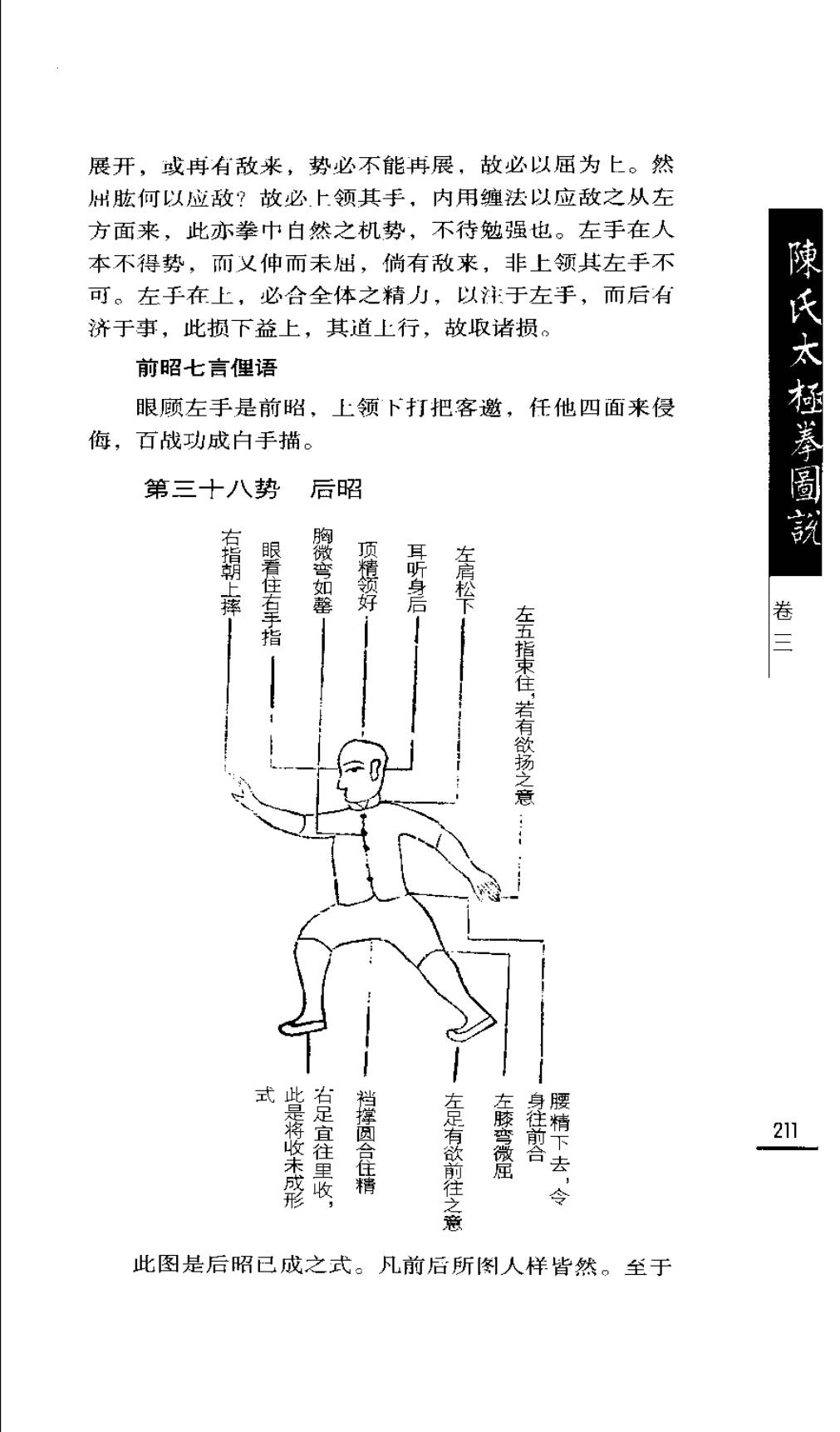
Chen Shi Taiji Quan Tu Shuo (陳氏太極拳圖說, Illustrated Explanation of Chen Family Taijiquan)
Hou Zhao (後昭, hòu zhào — "Backward Shine" / defending the rear)
Diagram labels:
- 右手内精顺转图 (yòu shǒu nèi jīng shùn zhuǎn tú) — Diagram of the right hand's internal essence turning forward; 手背向北 (back of the hand faces north)
- 右足收法 (yòu zú shōu fǎ) — Method of withdrawing the right foot
- 右足用缠丝精图 (yòu zú yòng chánsī jīng tú) — Diagram of the right foot using silk-reeling essence
- 右手顺转缠丝精图 — Diagram of the right hand's forward-turning silk-reeling essence
- 左手倒转缠丝精图 — Diagram of the left hand's reverse-turning silk-reeling essence; 左手下垂,手背向北 (left hand hangs down, back of the hand faces north)
Yimeng Lecture Notes (引蒙讲义)
What is hou zhao? The eyes look to the right hand in order to defend against the enemy. This is a matter of ordinary solo practice — the empty frame one drills — not that an enemy truly exists; it supposes an enemy coming from behind and asks how to resist him. For example: just as qian zhao ends, suddenly countless enemies arrive from the east; the body abruptly turns around, the head faces east, the left and right feet also face east, and the right hand and forearm catch the enemy's hand, circling one round from south to north, then issuing out again from north to south. Before issuing, one must first bend the elbow, keeping the right hand about a chi (尺) from the chest. For if the elbow is not bent it cannot extend; if it cannot extend, how can one resist the enemy? Therefore bending the elbow and circling round are one and the same moment. During qian zhao, the left hand turned forward (顺转, shùnzhuǎn) and the right hand reversed (倒转, dàozhuǎn), the left hand being host (主) and the right hand guest (宾). But when an enemy appears behind and one abruptly turns the body around, the right hand becomes host and the left hand guest. Whereas before the back of the right hand faced north, the moment it engages the enemy the right hand turns around with the momentum, from south to north and back again to south, turning (forward-turning) one full circle to serve as inviting-in (引进, yǐnjìn) and striking momentum. The right hand settles down in the east, hand level with the waist, back of the hand facing north so as to sink into the lower posture, guarding against the enemy encroaching from the left front as one advances. The right knee is bent and held; the right foot also carries the sense of forward turning, planted flat and solid on the ground — yet within the utmost solidity utmost emptiness resides. The left foot is in the west, toes pointing forward, simply still and awaiting movement.
The line diagram drawn after the figure shows the internal essence (内精, nèi jīng) running along its path through the hands and feet from beginning to end of this posture.
Taking the Image (取象, qǔ xiàng)
This posture need not use the large body method (大身法) to turn the corner; it suffices to pass the corner with the small body method (小身法).
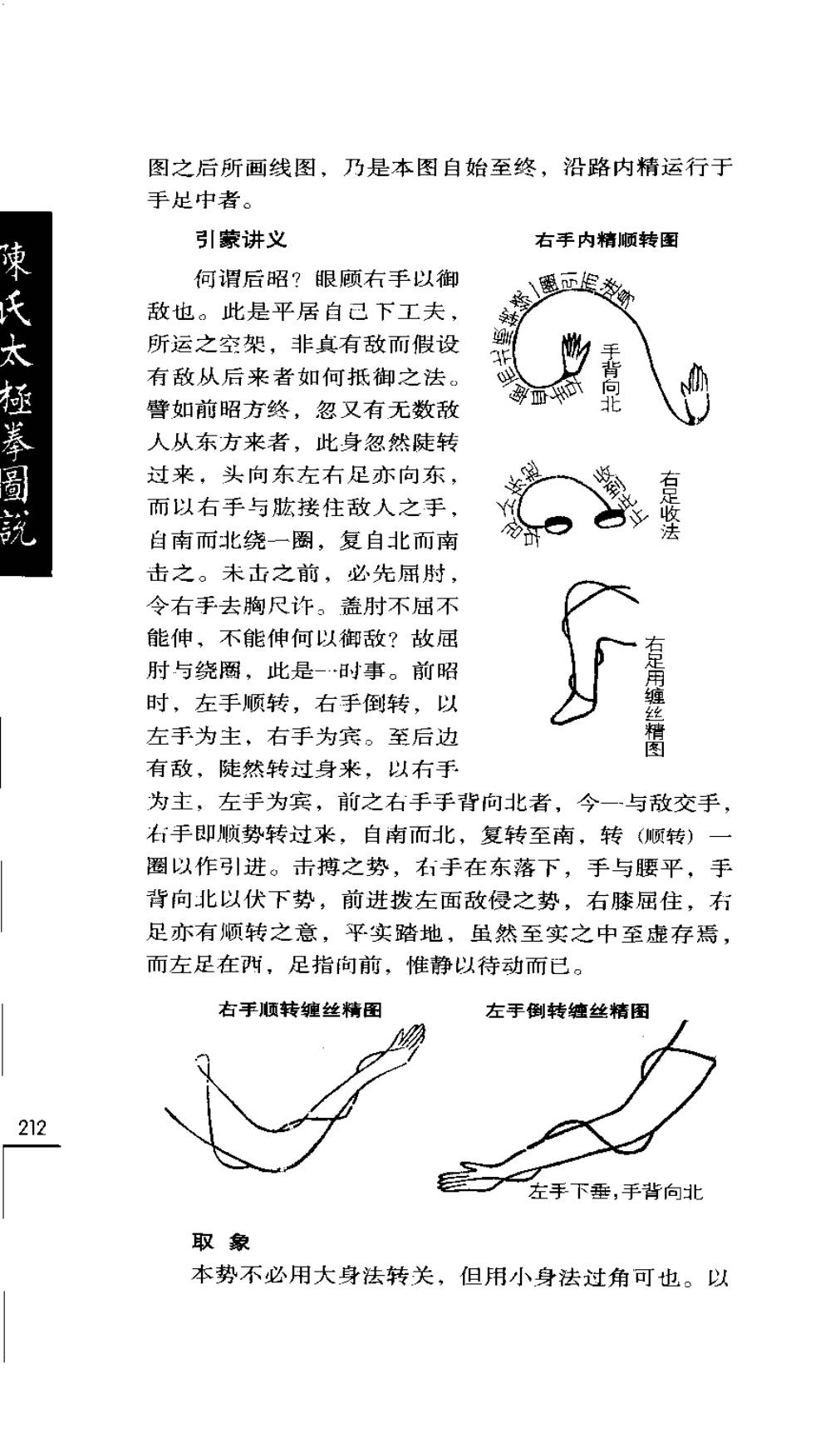
Chen Shi Taiji Quan Tu Shuo (陳氏太極拳圖說), Volume 3 (卷三)
Hou Zhao (後昭) — continued
Agility and quickness are what is prized. The eyes were just turned to the west when suddenly an enemy comes from the east; the body at once wheels around to face east and answers him with the right hand. This is the small corner-turning body method (小过角之身法) between the end of qian zhao and the beginning of Ye Ma Fen Zong (野马分鬃, Wild Horse Parting Its Mane) — hence the image is taken from the hexagram Xiao Guo (小过, Small Excess). Xiao Guo crosses over Zhong Fu (中孚, Central Sincerity) and images Li (离, Fire); Li is the pheasant — a flying bird. Judging by the hexagram body, the two yang lines of Zhen (震, Thunder) and Gen (艮, Mountain) image the bird's body, the four yin lines above and below image its wings, and the middle-line Dui (兑, Lake) is mouth and tongue — the image of the lingering cry (遗音). The enemy comes from the east, first moving with sound — there is the image of the flying bird leaving its cry behind; one who relies on deceiving others must fail. Hence the first line (初六) says, "The flying bird brings misfortune." The middle-line is Dui; Dui is west and Xun (巽, Wind) is east — I turn from west to east. Therefore the fifth line (六五) says: "I make the offerings in the western suburbs" (自我西郊). And again: "The lord shoots with a corded arrow and takes him in the den" (公弋取彼在穴). I use the right hand to draw him in and strike — like shooting a bird with a corded arrow, no different from taking an object out of a bag. This is the image of "taking him in the den." But unless one's sensitivity has reached the utmost, this cannot even be spoken of. This too is a turn of extraordinary difficulty. This posture cannot be let past — much less when attackers swarm in from left and right; how then shall one resist them? Therefore the boxing art overcomes hardness with softness (以柔克刚) and thereby attains the center. When softness can attain the center, the arrival at good fortune is only fitting.
Hou Zhao: Seven-Character Folk Verse (後昭七言俚语)
Suddenly one turn facing east — countless enemies come, countless attack. Were this body not agile to the utmost, nearly would the back of the head be done for.
Five-Character Folk Verse (五言俚语)
Turn the eyes to face east in zhao — none of them are small heroes. Only guard the head well; why fear that crowd of fellows?
The Thirty-Ninth Posture: Ye Ma Fen Zong (野馬分鬃 / 野马分鬃, yě mǎ fēn zōng — Wild Horse Parting Its Mane)
Shan Tong Bei (閃通背, Flash Through the Back), Er Qi (二起, Double Kick) and Dao Juan Gong (倒卷肱, Reverse Reeling Forearm) are body methods of major function in the boxing art. This posture is likewise a body method of major function.
Diagram labels (right side):
- 腰精愈要下去 — the waist essence (精, jīng) must sink down ever further
- 左手在下,五指、手背、肘亦要用精 — left hand is below; the five fingers, back of the hand and elbow must all apply essence
- 耳要听其身后 — the ears must listen behind the body
- 顶精领好则全身精神皆振 — when crown essence (顶精) leads well, the spirit of the whole body is roused
- 眼睛顾视左右要快 — the eyes must glance left and right quickly
- 右手直符 — the right hand holds the straight alignment; the right hand's five fingers and back of hand must all apply essence, and the left hand's straight alignment likewise
Diagram labels (left side):
- 胸合住精 — the chest closes and holds the essence
- 右肘尖沉下用精 — the right elbow tip sinks down applying essence
Diagram labels (bottom):
- 右足踏得十分稳当 — the right foot plants most steadily
- 十指头上握 — the ten fingers grasp upward
- 左手腕朝下 — the left wrist faces downward
- 裆精愈下愈好 — the crotch essence (裆精) sinks, the lower the better
- 胯不可软 — the hips must not be soft
- 左膝微屈腿 — the left knee slightly bends the leg
- 前左脚有欲往前之势 — the front left foot has the intent of moving forward
Yimeng Lecture Notes (引蒙讲义)
What is Ye Ma Fen Zong? The left and right hand methods are like a horse in the wilds whose mane falls in parted locks on both sides — it is an image taken from form. This posture is a great body-spreading, forward-bursting, escaping body method. Above, the crown essence leads and holds the whole body; below, both knees are bent and held; the crotch essence must be empty and round. As for the hands: if there is a crowd of enemies on the left, the left hand rises from below upward, facing outward toward...
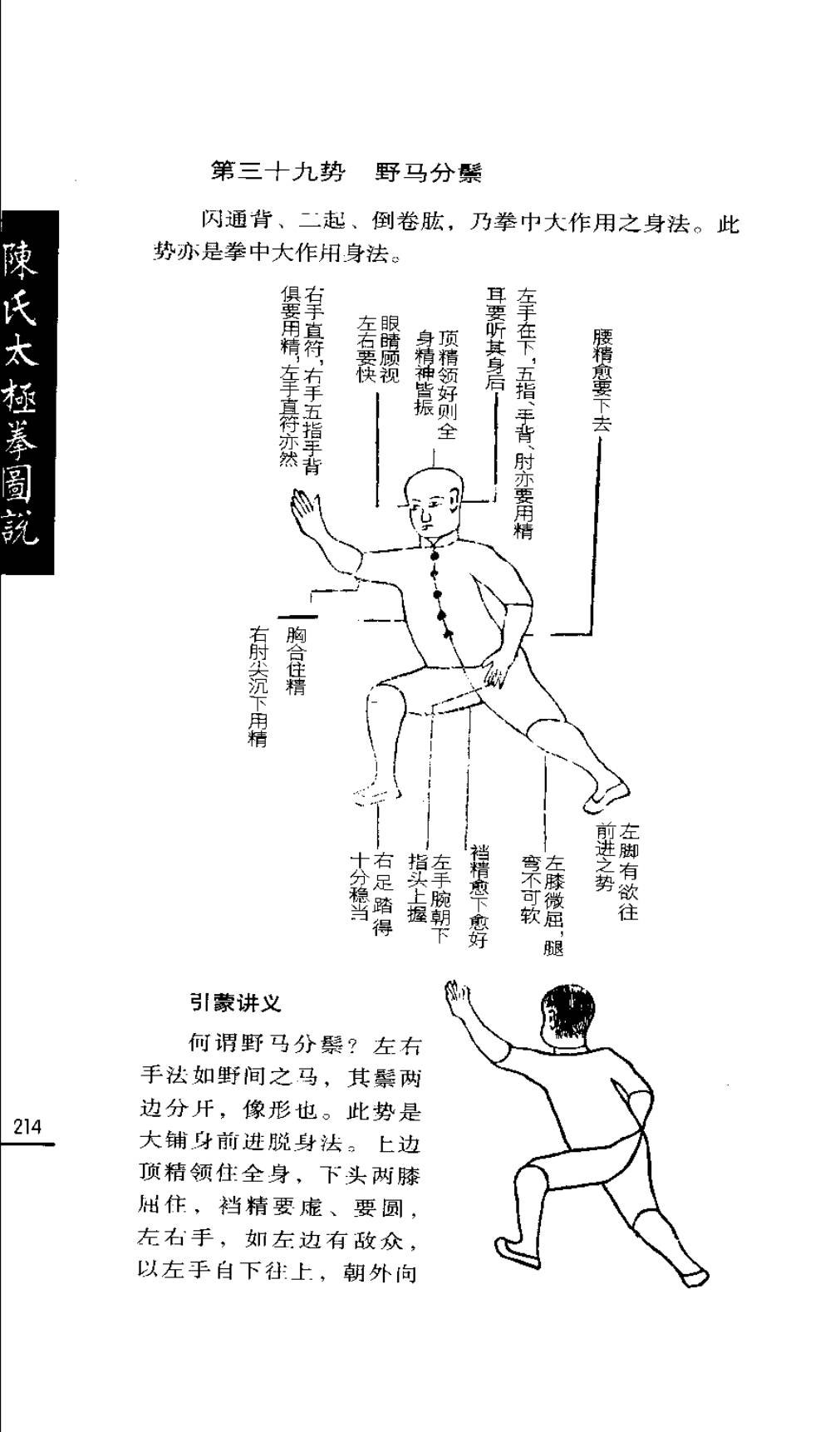
Right margin (vertical title):
陳氏太極拳圖說卷三 (Chen Shi Taijiquan Tushuo, Scroll/Juan 3)
Top text block (continuation):
"...below to ward it off; if an enemy comes from the right, the right hand likewise goes from below upward, turning a large circle smoothly (shun, 顺转) to ward it off. Generally, whenever the two hands alternate reaching the top, they all fan outward and disperse; yet it is not mere deflecting (bo, 拨), for each carries both drawing-in (yin, 引) and striking (ji, 击). One must have this method of body and hands before one may go out amid a crowd of enemies and come to no harm. This is the art of withstanding ten thousand men, and it is by no means easy."
Diagrams section (right to left):
- Right diagram: 左手运行图 (Diagram of the left hand's movement)
- Curved text above: 左手自上而下 (left hand from above downward)
- Vertical text right: 下行转一大圈以挡之 (descends, turning one large circle to ward off)
- Vertical text right below: 左右肱缠 (left and right forearms coiling, chan 缠)
- Vertical text below: 丝内精图 (diagram of the jing/silk thread within)
- Title below: 左手顺缠图 (Diagram of the left hand's smooth coiling, shunchan 顺缠)
- Central vertical label: 左右手内精 (the jing-silk within left and right hands)
- Left diagram: 右手运行图 (Diagram of the right hand's movement)
- Curved text above: 右手自下而上 (right hand from below upward)
- Curved text below: 膝下止 (stops below the knee)
- Text below: 右手止处 (where the right hand stops) / 右手起处 (where the right hand rises)
- Title below: 右手顺缠图 (Diagram of the right hand's smooth coiling)
Middle text block:
If the left hand issues from below to the top, then the right hand arrives below; one replaces the other in a circle, alternating in rotation. Advancing footwork (bufa, 步法) and hand technique advance together; when the right hand reaches the top, the left hand is below.
Section heading:
野马分鬃象乾卦 六爻俱備图 (Ye Ma Fen Zong 野马分鬃 — Parting the Wild Horse's Mane — imaged as the Qian 乾 hexagram; diagram of all six lines complete)
Bottom text block:
The lines drawn in the jing-silk diagrams, front and back, are the formless momentum (shi, 势) left by the fingers' movement. When it moves, its speed has a sound that can be heard; its dance has a form that can be seen. When the posture finishes its rotation, form and sound both vanish, nothing to see or hear. Hence I deliberately preserve the sense of each posture's rotation to show it: this is called the form of the formless (wuxing zhi xing, 无形之形). The two diagrams above depict the left-right cyclic hand technique; this line diagram depicts the qi (气) circulating within the hand technique like Heaven (the qi of supreme strength cycling without cease).
Bottom circular diagram (following the Qian hexagram lines):
- Top: 群龙无首 用九见 (a host of dragons without a head — "use nine," line 9)
- Right: 飞龙在天 此以下是 (flying dragon in the sky; below this...)
- Bottom right: 用九见 群龙无首
- Bottom: 见龙在田 (the dragon appears in the field)
- Left: 潜龙勿用 (the hidden dragon, do not act)
Printed page number: 215
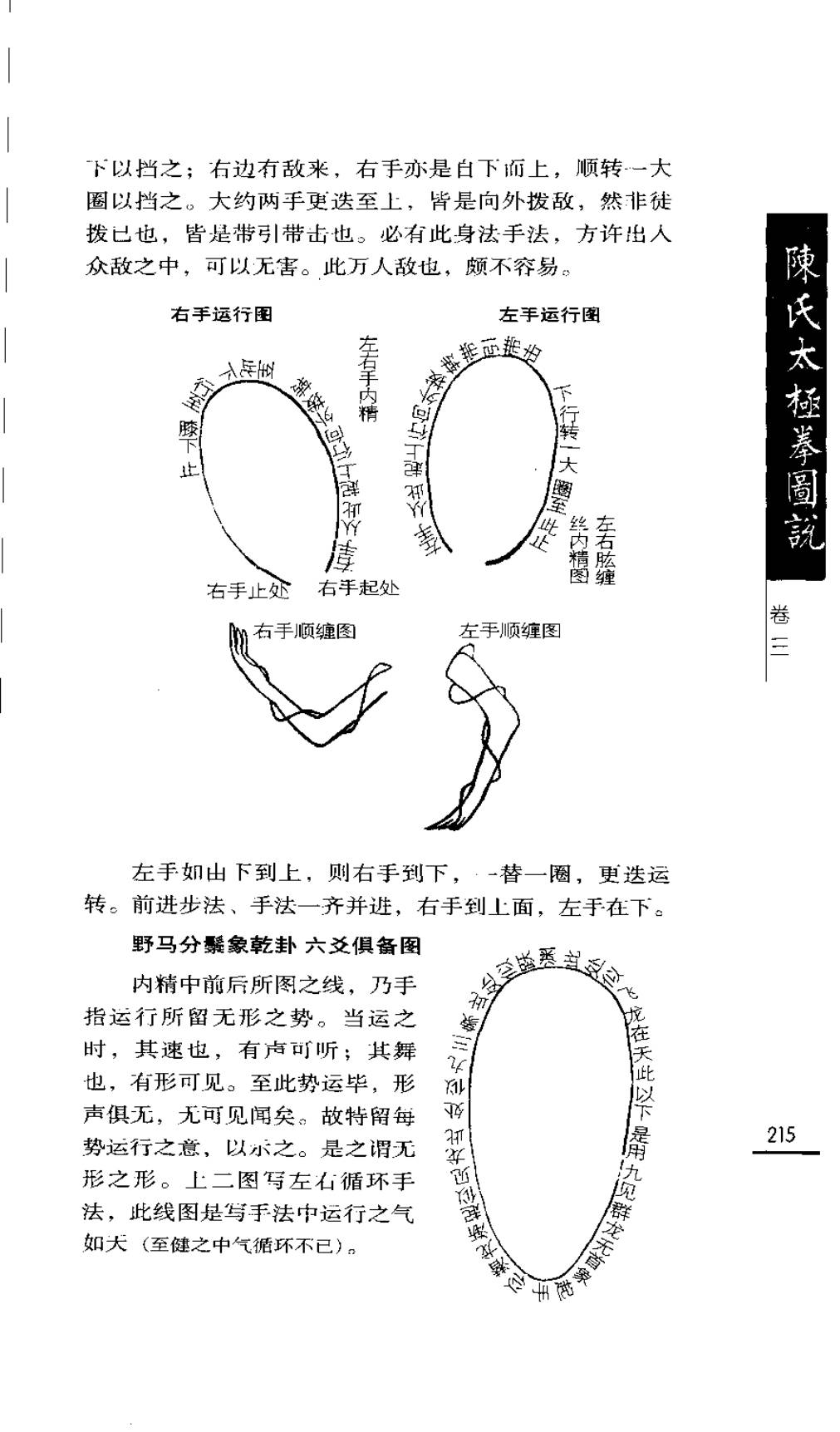
Vertical side title: 陈氏太极拳图说 (Chen Shi Taijiquan Tushuo)
Section heading: 取象 (Qu Xiang — "Drawing the Image/Symbolism")
Main text (columns right to left):
This posture moves the whole body purely with the intent of the strength of Qian 乾 (Heaven). The left and right hands and feet closely resemble the image of qian qian (乾乾) — ceaselessly active — hence it is taken from Qian. "Qian is strength": Heaven receives from the Taiji its pure yang, supremely great and supremely firm. Since Heaven opened at Zi (子, the hour of midnight), each day has been so, and through all antiquity it is so; its rotation never ceases, stopping not for a single moment. The ceaseless advance and retreat of Ye Ma Fen Zong 野马分鬃 (Parting the Wild Horse's Mane) is likewise like Heaven's image of qian qian. Moreover the two hands spread forward on both flanks, like the sun and moon in the sky alternating their light by day and by night without resting, so that nothing among the ten thousand things is not bathed in their radiance. It is again like sudden thunder and fierce wind: ahead no one blocks the road, behind no pursuing troops, left and right no obstruction — the wind bends the grass, and wherever it turns all is swept aside. This is what Ye Ma Fen Zong takes from Qian. Yet it is not done merely by great force; it truly works by the pivot of the original qi (yuan qi, 元气) at the center driving and pressing, so that the opponent cannot help but fall back. And because the art of drawing in (yin, 引) and striking runs within the hands and feet, the opponent also cannot come close to my body. Such is the natural subtle function of Ye Ma Fen Zong — and truly the natural subtle function of the strength of Qian. The Tuan Xiang says: "Great indeed is the origin of Qian!" (大哉乾元) — how true it is.
Section heading: 七言俚语 (Seven-character vernacular verses)
Sub-heading: 其一 (The first)
Verse:
两手握地转如飞,中间一线贯无倚。
任他千军围无罅,左右连环破敌欺。
Commentary:
"Two hands grasp the ground and turn like flying" means both hands sweep the ground upward, so that the whole body top and bottom is looked after. The left hand turns first, the right hand after, so that it can connect with the preceding posture Hou Zhao 后昭. "One line through the middle" means the central qi (zhong qi, 中气) runs up from the Baihui 百会 point down through the Changqiang 长强 point, as if strung on one thread. "Linked rings left and right" means the left hand goes from below upward, the right hand turns from above downward, the left hand again goes from below upward, the left [right] hand again turns from above downward; the two hands are like two circles, dancing in alternation, one above the other. Its hardness cannot be broken, its sharpness beyond compare, its rotation without gap — hence it can withstand enemies.
Sub-heading: 其二 (The second)
Verse:
一身独入万人中,将用何法御英雄,
惟有飞风披左右,庶几可以建奇功。
Printed page number: 216
Right sidebar (vertical): 陳氏太極拳圖說卷三 (Chen Shi Taijiquan Tushuo, Juan 3)
Title: 第四十势 单鞭第五 (Posture 40: Dan Bian 单鞭 — Single Whip, the fifth)
Diagram labels (vertical columns, right to left):
- 指肚用力伴住指肚 (the finger pads press; the finger pads accompany/hold)
- 两手把一去声无软 (the two hands hold as one, without slack)
- 肘弯微屈似新月形 (the elbows slightly bent like a crescent moon)
- 眼看住中指 (the eyes fix on the middle finger)
- 顶精颈起来 (the crown jing/silk — the neck lifts)
- 耳听住后面 (the ears listen behind)
- 两肩松下 (both shoulders sink and relax)
- 两肘弯向前弯住 (both elbows bend, held forward)
- 右手五指密依撮住无伸开 (the five fingers of the right hand close tightly together, not spread)
Lower/left area labels:
- 腰精下好 (the waist jing-sink set well)
- 裆圆 (the crotch rounded)
- 右膝微屈 (right knee slightly bent)
- 右足向前钩住 (right foot hooked forward)
- 力抓住地 (strength grips the ground)
- 腓、足踵用 (calf and heel engaged)
- 形,足趾、足 (form; toes and foot...)
- 左足八字撇 (left foot angled in the ba character/splayed)
- 左膝屈住 (left knee bent and held)
- 胸向前合 (the chest closes forward)
Main text — Yin Meng (引蒙, "Guiding the Uninitiated"):
This posture echoes and answers the first Dan Bian (Single Whip). As in writing where rules and measure are observed, it must not scatter. The body method (shenfa 身法), hand method, footwork, and the inner-outer silk-reeling (chan si 缠丝) jing method are all the same as in the first Dan Bian; only its opening differs. The first opening came from the first Lan Ca Yi 揽擦衣 (Gathering and Rubbing the Clothes), with that body method. This Dan Bian comes from Ye Ma Fen Zong 野马分鬃. One must wait until Ye Ma Fen Zong's left hand and left foot are in front, just landed and not yet settled; then with the right foot leap eastward (in common speech, "stepping forward") one large step. First plant the right foot down, then step the left foot westward to draw out the Single Whip. When the right foot leaps eastward, the right hand immediately slants up from below, sweeping a large circle toward the east. Its inner jing uses the smooth coiling method (shun chan 顺缠): from below, inward, upward, outward, down and slanting coiled to the armpit — this is where it differs from the first Dan Bian in continuing from what precedes; the rest of the movements of the body's parts are broadly the same with minor differences.
The inner jing: the right foot advances forward, pushing to the utmost — as far as it can reach. This is flat/level...
Printed page number: 217
Headings / lead-in
纵法也。("…this is the method of releasing/extension" — tail of the previous section)
Diagrams
右足前进图 (you zu qian jin tu — Diagram of the right foot stepping forward)
- 右足止处 (where the right foot comes to rest)
- 右足从右足后面落于此处 (the right foot lands behind the right foot at this spot)
- 右手起处 (where the right hand begins)
右手图 (you shou tu — Diagram of the right hand)
- 缠丝劲由东向西起 (the silk-reeling force, 缠丝劲 chansijin, starts from east and goes toward west)
- 按下膝 (press down toward the knee)
- 左手从右足后至此 (the left hand comes from behind the right foot to here)
Notes on the diagrams
- 手往前进须用缠丝精方不直率 (for the hand to advance it must use silk-reeling essence, otherwise it is crude and straight-lined)
- 五指往来勿令散开 (the five fingers move to and fro — do not let them spread apart)
Qu xiang 取象 (Taking the Image)
膻中、鸠尾、气海、丹田,其象与第一单鞭同,皆取乎坎离。右足向东开步,有取乎晋。晋,进也,从后往前也。又取乎震之六五,震,往来厉之象。且震为足,震,东方卦也。右足向东,方锐不可当,故厉。
Translation: The danzhong (膻中, center of the chest), jiuwei (鸠尾), qihai (气海, sea of qi) and dantian (丹田) take the same image as in the first Single Whip (单鞭 danbian), all drawing on the trigrams Kan (坎, Water) and Li (离, Fire). The right foot steps out toward the east, drawing on hexagram Jin (晋, Advance): Jin means advancing, going from rear to front. It also draws on the fifth line of Zhen (震, Thunder): Zhen is the image of danger in coming and going. Moreover Zhen is the foot, and Zhen is the trigram of the east. The right foot goes east with an edge nothing can withstand — hence "danger."
Qiyan liyu 七言俚语 (Seven-character folk verses)
Verse one:
右足急蹦向东方,右手一齐往东趟①,只要顶精提得
(The right foot springs swiftly toward the east, the right hand in unison sweeps eastward①; provided only that the essence at the crown is lifted…)
① The original edition reads "右手一齐往东汤", clearly a copying/compilation error; the character "汤" is corrected to "趟".
(The verse continues onto the next page.)
Verse continuation (from previous page)
…好,连身带肘似鹰扬。
(…good — body and elbow together like a hawk soaring.)
Qiyan liyu 七言俚语 (Seven-character folk verses)
Verse two:
左手在左左皆顾,右手随现月光圆,从下往上须斜势,平地飞腾第一山。
(The left hand guards on the left and all is watched on the left; the right hand appears in turn, round as the moon. Rising from below to above must be on the slant — leaping from level ground, the foremost mountain.)
Posture heading
第四十一势 玉女穿梭(第一图) — Posture 41: The Fair Lady Works the Shuttles (Yunü Chuansuo), first diagram
Instructional text
顺转平纵法,青龙出水是直进平纵法,二起是上跃法,此势是大转身法。上承野马分鬃,下来右手趁其在下之势,不容少停,即以右手用缠丝精,从下握上,沿路斜形飞风向东去,指如钢锥。亦全赖右足在前,随住右手,亦用顺缠精。就住上势,大铺身法,尽力向东连进三大步,方够一大圈,约八九尺许。此是右足先蹿一大步之势,尤在顶精提好,裆精不得满足。身随右手,如鸷鸟疾飞而进,莫能遏抑。步落粘地即起,以启左足进步之势。此其三步之第一。下两步得势不得势,设势机关全在于此。此处圈转过一下,破竹不难矣。此玉女穿梭第二步(左足)进步姿势。面已转过向南,身已转过一半矣。此不算成势,是中间运行之形,亦是方转不停,莫误看。左足进步,足趾向东者,亦随右足趾向西,切莫停留。手法、步法、转法,愈快愈好。身方倒转,右足随住身
Translation: The "level leap with conforming turn" (顺转平纵法): Green Dragon Emerges from the Water is a straight-ahead level leap; Double Jump (二起) is a jumping-upward method; this posture is the great-turning method. It follows upon Parting the Wild Horse's Mane (野马分鬃 yema fenzong). From below, the right hand seizes the moment while it is underneath, without the slightest pause: with the right hand using silk-reeling essence (缠丝精 chansijing), it coils up from below and, along its path, slants like flying wind toward the east, the fingers like steel awls. This relies entirely on the right foot in front following the right hand, also using conforming reeling essence. Holding the preceding posture, spread the body wide, and drive forward three large steps toward the east with all your might — only then is one great circle completed, about eight or nine feet. This is the momentum of the right foot first springing one large stride; it depends above all on lifting the crown essence well, with the crotch essence never slackening. The body follows the right hand, advancing like a bird of prey darting swiftly, nothing able to check it. The instant the foot lands it springs off, to launch the left foot's advance. This is the first of the three steps; whether the next two steps gain the momentum or not — the pivot of the whole maneuver lies here. Once the circle turns through here, splitting bamboo is not hard. This is the Fair Lady Works the Shuttles, second step (left foot) advancing posture. The face has already turned toward the south, the body already half turned. This does not count as a settled posture: it is the form in mid-transit, still turning without pause — do not misread it. The left foot advances, toes toward the east, following as the right foot's toes point west; do not linger. Handwork, footwork and turning: the faster the better. As the body turns around, the right foot follows the body…
Diagram labels
First diagram (玉女穿梭第一图)
- 顶精领住 (crown essence held aloft)
- 松右肩 (relax the right shoulder)
- 右手仄 (right hand on its side)
- 楞手 (braced hand)
- 前身 (front of the body)
- 贪往
- 右手自转大圈为式 (the right hand turns a large circle as its form)
- 功久自然小方好 (with long practice it naturally becomes small, and that is best)
- 左肘与左手平,去胸六七寸 (left elbow level with the left hand, six or seven inches from the chest)
- 左足此一脚仍是野马分鬃末一步 (this left-foot step is still the final step of Parting the Wild Horse's Mane)
- 右步足,前进 (right foot, advance)
- 左足有争往前进意 (the left foot has the intent of racing forward)
- 大前进步开足初 (at the start of the big forward step, open the foot)
Second diagram
- 玉女穿梭左足进图 (Diagram of the Fair Lady Works the Shuttles, left foot advancing)
Instructional text (continuation from previous page)
倒转过来,面仍向北,右足再向东开一大步,似停不停,唤起下势起势之脉。本势似与揽擦衣大同小异,然其实大不相同。彼则身不动专用心运其右手、右足,其气恬,其神静。兹则连转身带运手、右足,其气猛,其神忙,非平素实有功夫,临事以中气贯其上下全体者,不能获万全。何也?盖出入广众之中,以寡敌众,旁若无人,惟天生神勇,其胆正、其气刚,其练习纯熟,故披靡一切裕如也。
Translation: Turning back around, the face again faces north; the right foot once more opens one large stride toward the east — seeming to pause yet not pausing, awakening the pulse that launches the next posture. This posture seems similar in the large and small to Lanche Yi (揽擦衣, "Brushing the Robe"), but in truth it is greatly different. There, the body does not move and the mind alone works the right hand and right foot — the qi is tranquil, the spirit calm. Here, turning the body is joined with moving the hand and right foot — the qi is fierce, the spirit urgent. Unless one has genuine skill in daily practice and, at the moment of action, threads zhongqi (中气, central qi) through the whole body above and below, one cannot achieve complete safety. Why? Because going in and out among crowds, meeting the many with the few as though no one were beside you, only inborn divine courage — upright in gall, firm in qi, thoroughly practiced — sweeps everything aside with ease.
身法内精 (Body Method and Internal Essence)
玉女穿梭,非再三图之,不足见转身全像。然三图,以第三图为主,自起势以至终势。右手足虽是顺缠法,而身法皆是倒转精。连三赶进皆是进步,绝无退步之说。至于内精,自顶精以至足五趾,法皆与前同。始终以右手右足为主,而以左手左足佐之。右手顺转,左手必是倒转。此是天然呈象,非人力所能为也。缠丝精即道也者,不可须臾离也。不必再赘。
Translation: In the Fair Lady Works the Shuttles, unless it is diagrammed several times the full image of the turning body cannot be seen. Of the three diagrams the third is the primary one, from the start of the posture to its finish. Although the right hand and foot use conforming reeling (顺缠 shunchan), the body method is entirely inverted-reeling essence. Three advances in a row are all forward steps — there is no such thing as stepping back here. As for internal essence, from the crown essence down to the five toes, the method is all the same as before. Throughout, the right hand and right foot are primary and the left hand and left foot assist them. When the right hand turns conformingly, the left hand must turn inversely. This is a natural image, not something human effort can produce. The silk-reeling essence is precisely the Dao, "which cannot be departed from for an instant" — no need to say more.
取象 (Taking the Image)
乘乾健之后,宜取诸离,离中虚象也。心中虚,万理毕具,应敌不难。离本中女,宜属坤,何以舍坤而言乾?盖阳极生阴,又得中气,故取诸乾。且离错坎,坎中满,有理实气空之象。不但此也,玉女穿梭,其进如风,巽为风,故又取诸巽。巽错震,震为足,此势上虽凭手,下尤凭足,足快尤显手快之能。然中女、长女皆带父生之性。故吾谓此势虽以女名,实乾道贯注其中也。故莫或御之。
Translation: Following on the vigor of Qian (乾, Heaven), it is right to take from Li (离, Fire): Li is the image of emptiness within. When the heart is empty, the ten thousand principles are complete within it, and facing an enemy is not hard. Li is originally the middle daughter and should belong to Kun (坤, Earth) — why set Kun aside and speak of Qian? Because when yang reaches its extreme it generates yin, and the central qi is obtained — hence it takes from Qian. Moreover Li inverts to Kan (坎, Water): Kan is full within, the image of principle solid while qi is empty. Not only this: the Fair Lady Works the Shuttles advances like wind; Xun (巽) is wind, so it also takes from Xun. Xun inverts to Zhen (震, Thunder); Zhen is the foot. In this posture the upper body relies on the hands, but below it depends even more on the feet — the swiftness of the feet sets off the power of the swift hands. Yet the middle daughter and eldest daughter both carry the nature of their father. So I say: though this posture bears a woman's name, the way of Qian truly courses through it. Therefore nothing can resist it.
七言俚语 (Seven-character folk verses)
Verse one:
转引转击出重围,宛同织女弄织机;此身直进谁比
(Turning to draw in, turning to strike, breaking out of the encirclement — just like the Weaving Maid plying her loom; this body charges straight forward — who can compare…)
(The verse continues onto the next page.)
Diagram
- 此图玉女穿梭势已成之式 (this diagram shows the Fair Lady Works the Shuttles in its completed form) — a figure in a left bow stance, left arm extended up and forward, right hand near the chest; no labels inside the figure.
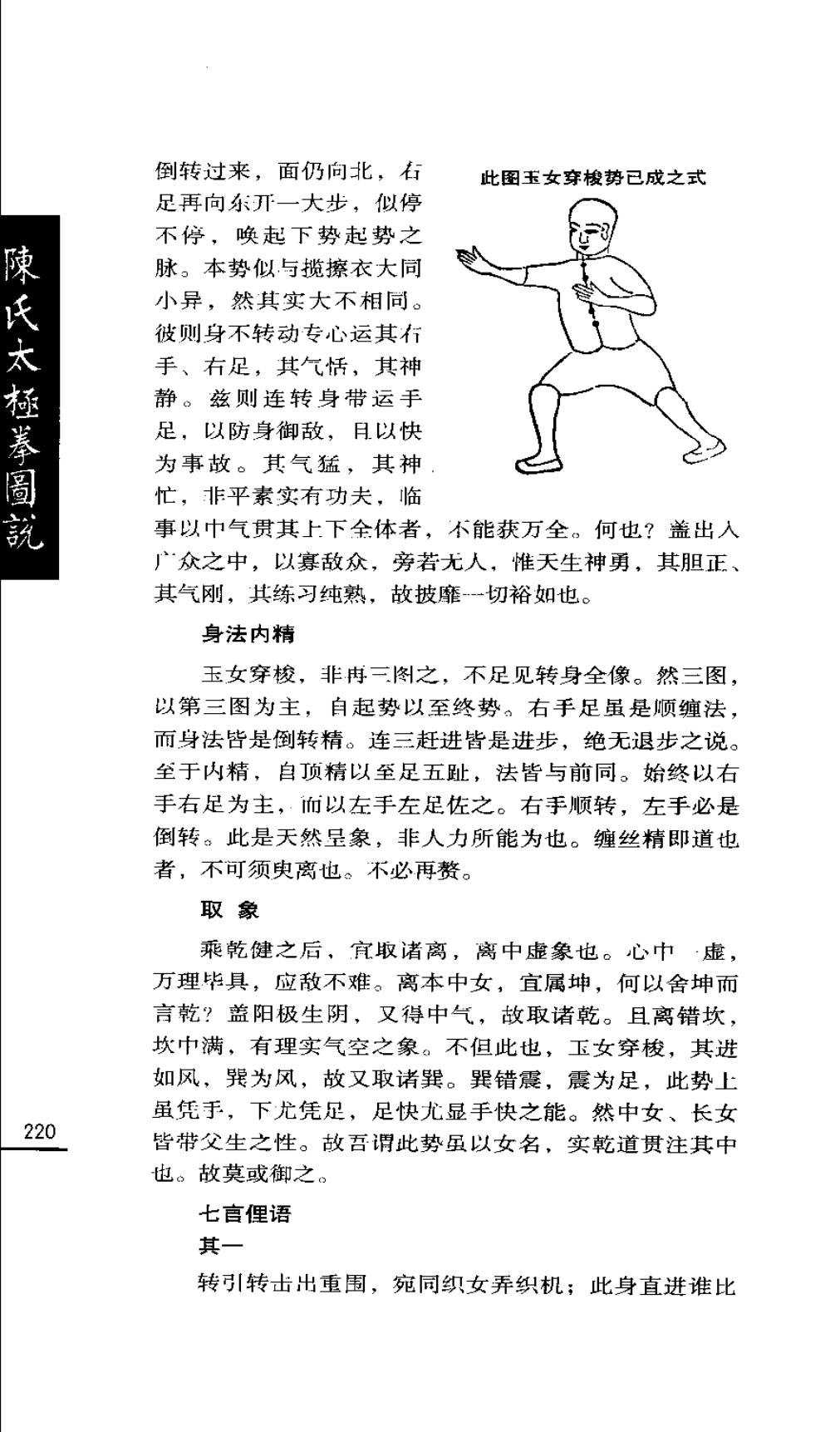
Verse continuation (from previous page)
…迅,一片神行自古稀。
(…swiftness — a whole body of spirit in motion, rare since antiquity.)
七言俚语 (Seven-character folk verses)
Verse two:
天上玉女弄金梭,一来一往织绫罗,谁知太极拳中象,兔走鸟飞(如日月运行之快)拟如何。
(In heaven the Jade Maiden plies her golden shuttle, coming and going, weaving silk gauze; who knows the image within taijiquan — the rabbit runs, the bird flies (as swift as sun and moon in their courses) — how to liken it?)
Posture heading
第四十二势 揽擦衣 — Posture 42: Brushing the Robe (Lancayi 揽擦衣)
此第三个揽擦衣,与第一个揽擦衣相呼应。(This is the third Brushing the Robe, echoing the first.)
Diagram labels
(The figure stands in a left bow stance, left hand extended forward, right hand at the hip; labels in vertical columns:)
Right side
- 此红线即后图之左手叉腰 (this red line is the left hand on the hip shown in the later diagram)
- 之黑线先图于肘沉下去 (the black line is first drawn at the elbow, sinking down)
- 上,以明右手运行肩松下去 (above, to show the right hand's path of movement, shoulder relaxed and sinking)
- 路自何起,至何落耳听身后 (where the path starts, where it ends; the ears listen behind the body)
Upper middle (on the crown)
- 顶精者,是中气上冲于头顶者也,不领则气塌,领过不惟全身气皆在上,足底不稳,病失上悬,即顶亦失于硬,扭转不灵,亦露笨象。是在似有似无,折其中而已
(The crown essence is the central qi surging up to the crown of the head. If not held aloft the qi collapses; but if held too hard, not only does all the body's qi stay up top and the soles become unsteady — losing the suspended-from-above quality — the crown itself becomes stiff, twisting turns clumsy, and clumsiness shows. It lies in seeming to exist yet not exist — strike the mean and stop there.)
Left side
- 眼视中指勿斜 (the eyes look at the middle finger, not aslant)
- 肚住五指束住,指 (the belly settled, the five fingers bound together)
- 胸要虚含如罄 (the chest must be hollow like an inverted bell)
- 右膝露出膝盖 (the right knee — kneecap exposed)
- 力着地 (force reaches the ground)
- 腓、足趾、足 (calf, toes, foot)
- 趾肚俱用 (the balls of the toes all engaged)
- 裆撑圆虚实合住 (the crotch propped round, full and empty joined)
- 左膝微屈 (left knee slightly bent)
- 左足用精蹬 (left foot pushes with essence)
- 腰胯下去 (waist and hip sink down)
- 腿弯莫软 (the bend of the leg must not be soft)
- 手把无软 (the hand-grip not soft)
- 肘沉下 (the elbow sinks down)
引蒙 (Yinmeng — Guiding the Uninitiated)
揽擦衣上下身法、步法,一切皆与第一揽擦衣同。但彼自金刚捣碓来,手足运动似觉稍易;此从玉女穿梭来,较彼似难。盖玉女穿梭,我虽出乎重围,而边贼未
Translation: In Brushing the Robe, the body method above and below and the footwork are all the same as in the first Brushing the Robe. But that one comes from Buddha's Warrior Attendant Pounds the Mortar (金刚捣碓 Jingang Daodui), so the movement of hands and feet feels somewhat easier; this one comes from the Fair Lady Works the Shuttles, and by comparison seems harder. For in the Fair Lady Works the Shuttles, though I have broken out of the heavy encirclement, the bandits at the edges have not… (continues on next page)
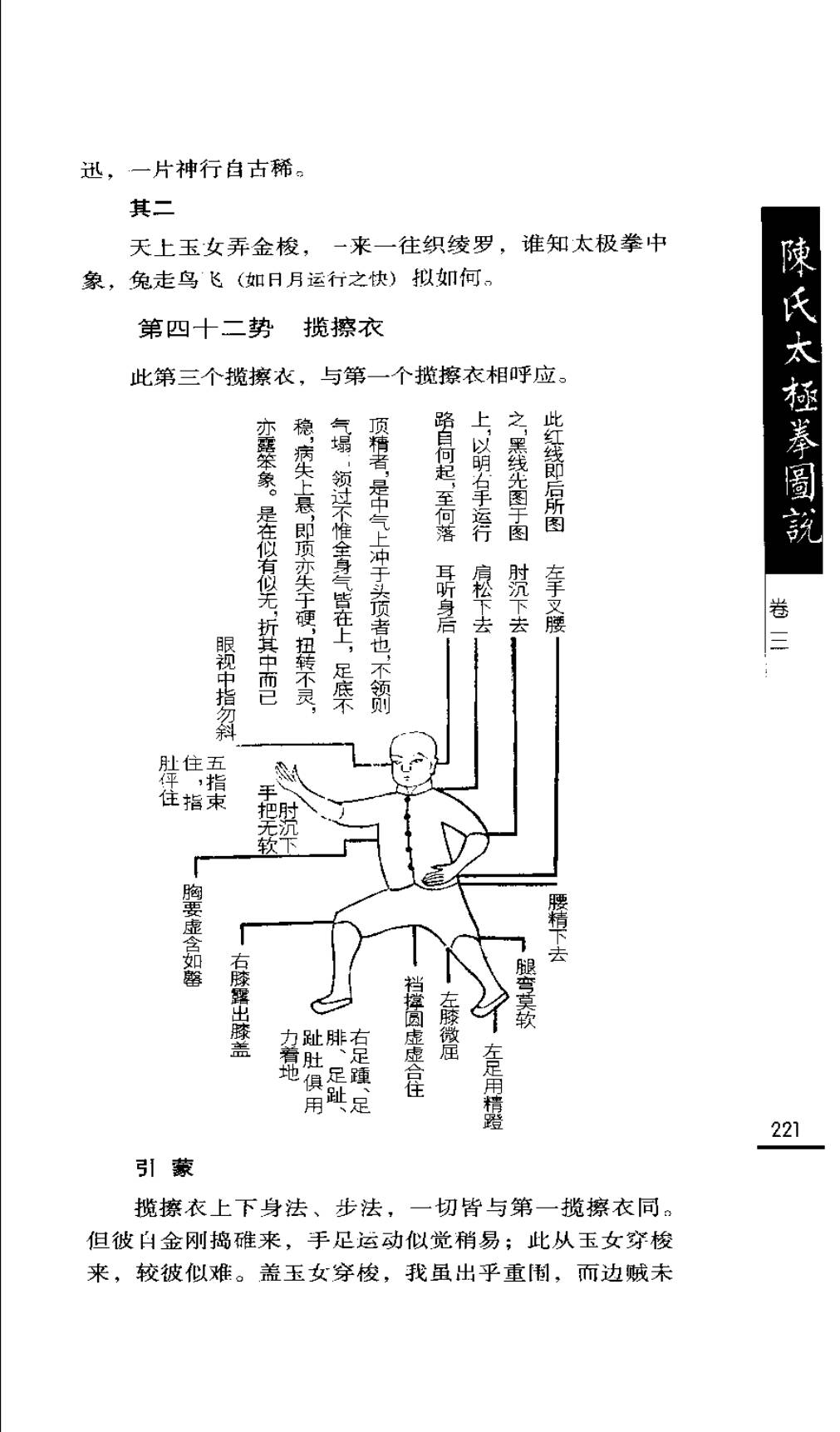
...still, therefore, having turned the body around, one immediately uses the right hand to defend toward the east. Look sideways at the third diagram of Yünü Chuansuo (玉女穿梭, "Fair Lady Works the Shuttles") and you will know that in the earlier Lan Cai Yi (揽擦衣, "Brush the Clothes"), the right hand first circles from beside the body before issuing out to form the Lan Cai Yi posture. In this Lan Cai Yi, the right hand is still outside defending against the enemy; you must wait until this enemy has been struck down and another enemy comes, then bring the right hand diagonally downward, from outside to inside, drawing it in beside the right ribs; then from below upward, together with the right hand collected in from outside, altogether making one large circle — only then does the hand begin to move toward the east, forming the Lan Cai Yi posture. The right foot likewise must be drawn from the east in beside the left foot, standing on the ball of the foot; then the right foot follows the right hand, also circling half a circle, gradually bending slowly, stepping out toward the east: the heel lands first, gradually becoming solid forward, placed in a splayed "eight-character" shape, all five toes gripping the ground; the right heel and left heel face each other east–west, not permitted one in front of the other. As for the method of chanshi jing (缠丝精, silk-reeling energy): the right hand uses smooth reeling (顺缠, shun chan), the left hand reverse reeling (逆缠, ni chan), both reeling upward from the finger pads to the armpit and stopping there. The right foot likewise, from inside to outside, coils diagonally upward to the root of the right leg and to the huiyin (会阴, perineum) as far as the left foot. In all the world only the practitioner of pushing (推手, tuishou) can use silk-reeling energy; in stillness it is very hard to use. Yet its intent has never ceased to reside within the thigh. Therefore once a posture is formed, above and below are joined in accord. And the left foot likewise coils from inside to outside diagonally upward to the huiyin — not only joining together with the right thigh, but joining with the whole upper body as one, not slightly lagging behind. Hence I say: even in stillness, silk-reeling energy is never absent from within the thighs — this can be tested at the moment of closing (合, he). If the closing does not reach the huiyin, there is no crotch energy (裆精) and the frame cannot be propped round. This is why silk-reeling energy must never be set aside.
Nei jing (内精, internal energy)
This diagram is divided into two sections: the front half is the completed Yünü Chuansuo (玉女穿梭) posture; the rear section is the path of movement of Lan Cai Yi (揽擦衣).
Labels beside the diagram (vertical):
- Along the upper arc: gradual advancing must use silk-reeling energy in its turning movement
- The right hand stops only here
- The hand and forearm are (from) Yünü Chuansuo
- Along the middle arc: the red line is the right hand's drawing-in
- Along the lower arc: smooth turning first follows this path — the left hand
Caption below the diagram: the arm and the "red line" are the front section; the "red line" is (the path) for drawing the enemy in.
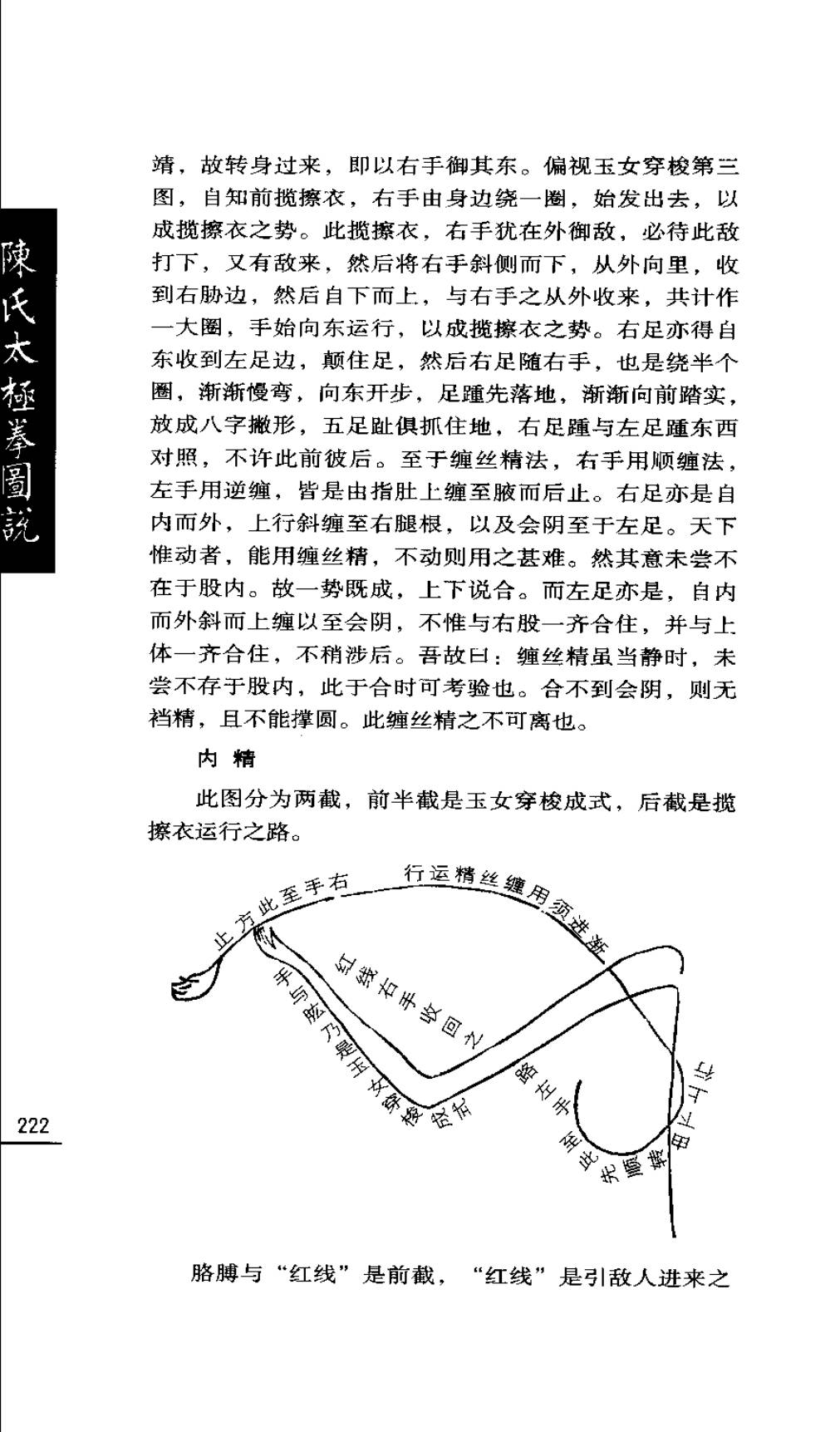
*Chen Shi Taijiquan Tu Shuo* (Illustrated Chen Family Taijiquan), Volume 3.
Diagram annotations:
- "The red line is the path of the right foot withdrawing" (紅線是右足收回之路)
- "It is nevertheless also the completed posture of Yünü Chuansuo" (然亦是玉女穿梭成式) — *Yünü chuansuo* 玉女穿梭, "Fair Lady Works the Shuttles"
- "The hand wishes to go right" (手欲向右)
- "The foot wishes to go forward" (足欲向前)
- "The silk-reeling path of the hand" (纏絲的手路) — *chansi* 缠丝, silk-reeling
- "The silk-reeling path of the foot" (纏絲的足路)
…path, which is what is meant by "in order to extend, first bend"; the "black line" is the method of striking — bending yet necessarily extending, a fixed method. The reason one first turns a full circle is that otherwise the arm and hand would both be without power.
That *chansijing* 缠丝精 (silk-reeling force) must be used within the boxing: the method of sticking and connecting (*zhanlian* 粘連) lies entirely here. The method of drawing the opponent in and leading them forward (*yinjin* 引進) also lies here — it must not be neglected. With long practice, one can make others not dare to advance. If they advance, strike them; if they retreat, strike them too.
Taking the Image (取象)
This posture follows Fair Lady Works the Shuttles; again an enemy comes to attack — there is the image of difficulty. Using the right hand to ward him off carries the image of restraining. Combining danger and correctness, these two meanings, there is the image of Kan (☵) below and Gen (☶) above, hence the image taken is Meng (蒙, "Youthful Folly," Hexagram 4). Why take Meng? It means: the man has already failed to understand how to break my Yema Fen-zong (野馬分鬃, "Parting the Wild Horse's Mane"), and cannot defend against my Fair Lady Works the Shuttles, yet still wishes to exploit my danger and block me in front. How could he know that I, with the virtue of strength at the center (*gangzhong* 剛中), move within it. Like the second line of Kan, the central strength embraces all the lines above and below without exception. "Embracing" is precisely the meaning of drawing the opponent in. Making a man know my intent so he dares not advance recklessly — this is the way of "nurturing the immature through correctness." If he does not know to desist, it becomes the posture of the top line's "striking the foolish" (击蒙) — this too is what warding off bandits makes unavoidable. Moreover, Kan is the middle son — his strength is truly strong. Gen is the hand — it has the power to restrain. Employing this centrally, operating with the essence of strength-at-center, how could it be merely a matter of stopping things with the hand? "Stripping the bed to the flesh" (剥床以肤, from Hexagram 23) — injury to the enemy cannot always be avoided. Thus obtaining "the son who can manage the family" (克家之子, Meng's second-line omen) is fitting. As for what lies beyond strength-at-center — all unknown — that is the image of the youthful and ignorant; the youthful mind is single-focused.
Seven-Character Vernacular Verses (七言俚語)
First:
玉女穿梭步向东,轻身直出众人中,
虽有小贼来相犯,中气一击判雌雄。
*Yünü chuansuo bu xiang dong, qingshen zhi chu zhong ren zhong,
sui you xiao zei lai xiang fan, zhongqi yi ji pan ci xiong.*
Fair Lady Works the Shuttles, stepping toward the east; the light body darts straight out among the crowd. Though petty thieves come to offend, one strike of the central qi (*zhongqi* 中气) decides who is master.
Second:
破围全赖揽擦衣,屡次分疏识者稀,
即擒即纵缠丝精,须于此内会天机。
*Po wei quan lai lan ca yi, lüci fenshu shi zhe xi,
ji qin ji zong chansijing, xu yu ci nei hui tianji.*
Breaking the encirclement depends wholly on Lan Cao Yi (揽擦衣, "Grasp and Rub the Robe," i.e. Lazily Tying the Coat); time and again it disentangles, though few recognize it. Seizing and at once releasing — that is the essence of silk-reeling; one must grasp within this the workings of Heaven.
223
① Note: the "red line" and "black line" — in the original manuscript, red and black lines respectively marked the paths of hand and foot movement; these cannot be shown in ordinary black-and-white printed images.
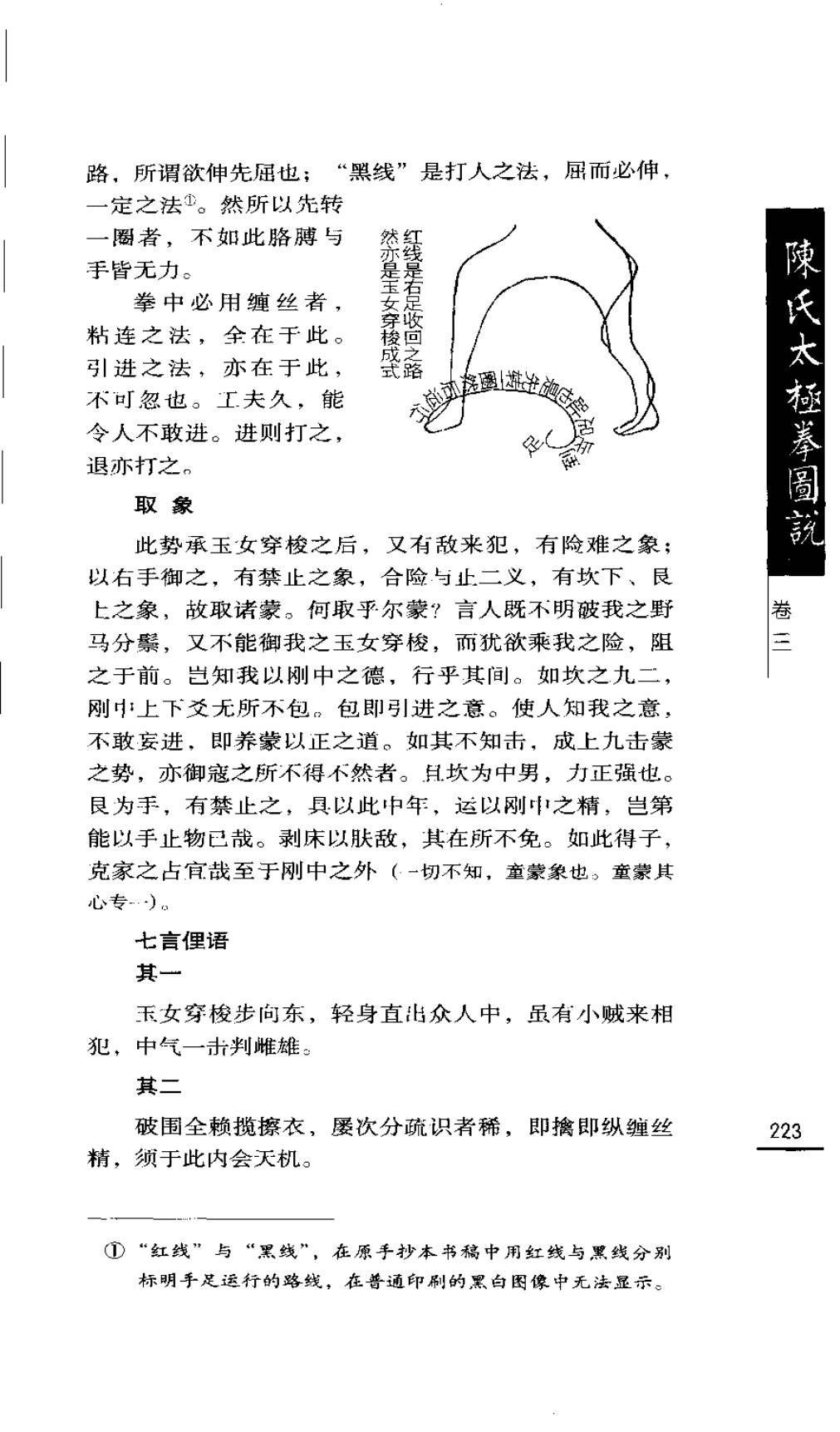
*Chen Shi Taijiquan Tu Shuo*, Volume 3.
Posture 43: The Sixth Dan Bian (第六單鞭, "Single Whip")
This corresponds to the Single Whip below Shan Tongbei (闪通背, "Flash Through the Back") earlier. That one was a reversal, leaping out from difficulty, then forming Single Whip to protect the body. This one is likewise a reversal, bounding out (蹦 — pronounced with a rising tone, meaning to leap forward) from difficulty, then forming Single Whip to preserve one's life — slightly harder than the former. Because the enemy's numbers differ, the posture, though the same, comes at a somewhat different time and place.
Diagram Annotations
- Fingers press down; the finger pads exert force.
- The bend of the arm faces forward (that is, due north).
- The eyes look at the middle finger.
- The head and neck are held up as if suspended (顶颈领起来).
- The ears listen behind — must be alert.
- Both shoulders sink and relax.
- Though the elbow cannot bend forward, the intent is as if bending forward in a reversed back-forearm posture.
- The back of the hand easily faces forward, so it is slanted forward with the fingers pointing back.
- Make a "containing" (包含, bāohán) posture.
- The chest is slightly closed.
- The left foot presses and braces.
- The left knee shows.
- The toes of the left foot grip the ground.
- The crotch (裆, dāng) is rounded and braced, yet must remain empty/alive.
- The right foot presses the ground.
- The right heel shows one or two tenths.
- The bend of the arm curves forward; above and below, every part echoes the closed points, mutually encompassing and closing.
- The waist's essence sinks down; the intent closes forward.
Yinmeng (引蒙, "Guiding the Beginner")
The body method, footwork, and all the methods of moving above and below are no different from the earlier Single Whip. That earlier Single Whip has already appeared repeatedly in layers. Now another Single Whip follows — is that not too many? Of the whole body, the two hands are the most convenient to use. Shoulder, back, and elbow are used when the enemy presses against the body; foot and leg are used for what the hands cannot reach. The hands alone can block left and ward right, screen in front and guard behind — every command executed as one wishes. Precisely because they are the most convenient, they are used most often. Moreover, of enemies coming from the front — whether from the left, the right, straight at the center, or from above and below…
224
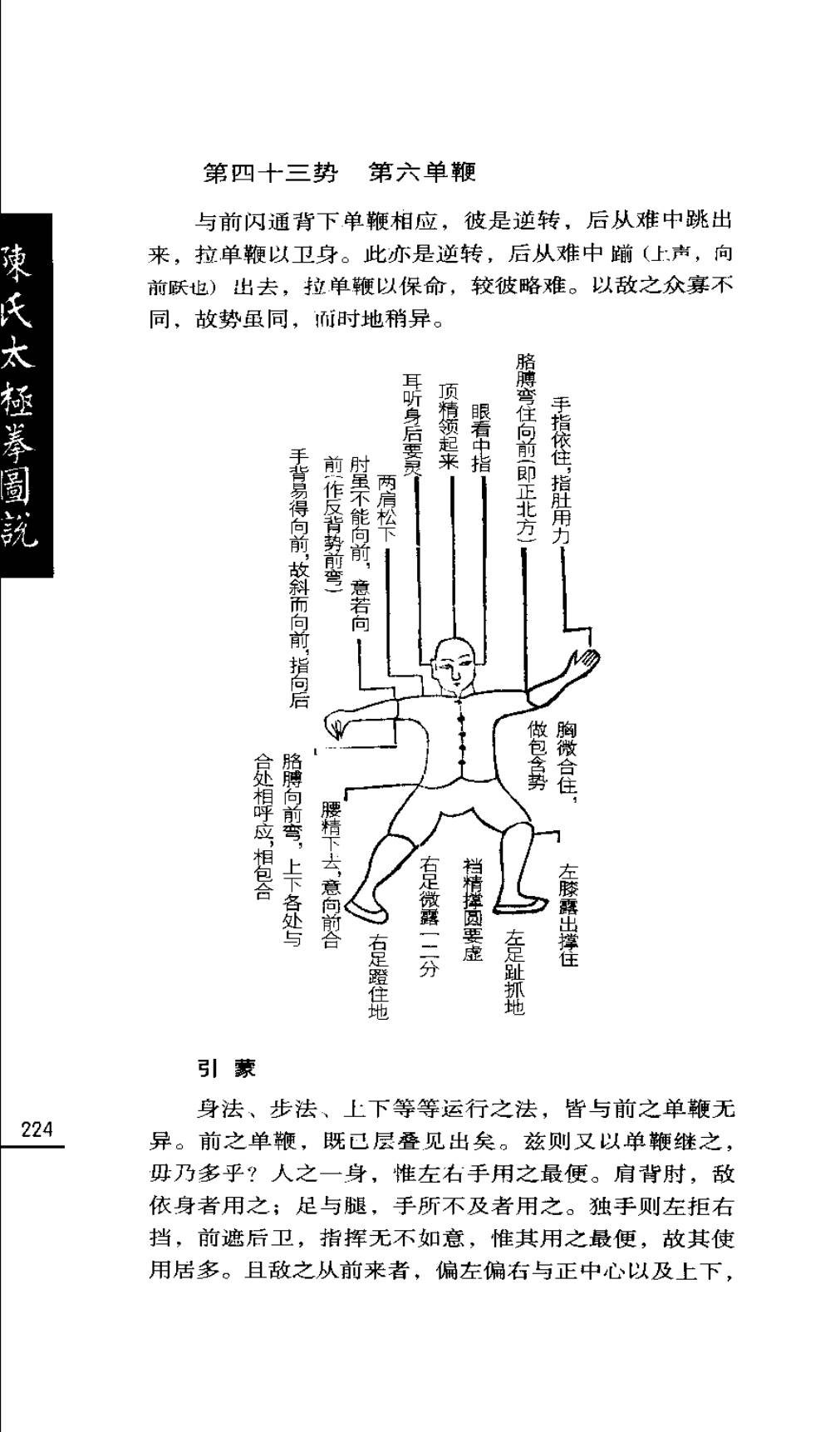
*Chen Shi Taijiquan Tu Shuo*, Volume 3.
(Continuation of Yinmeng, "Guiding the Beginner")
…all of these can be met with the two hands — either together at once, or alternately as they come — and this seems somewhat easier. But when the enemy is at left or right, or comes from both sides at once, then use the central Single Whip (单鞭, dānbiān) to break him; if he comes from the right, use Lan Cao Yi (揽擦衣, lǎn cā yī, "Grasp and Rub the Robe") to ward him off; if from the left, use Single Whip to strike him. Within the boxing there is no method better than this, hence it is used again and again, never tiring of its repetition. Why is it good? Generally, when an enemy comes to bully me, his mind seeks victory, and fierceness predominates. He knows advancing but not retreating — and once he does not know retreat, his mind has already entered my snare (彀中, gòu zhōng). How does he enter the snare? He only knows to advance, so I first respond with retreat. Retreat is precisely drawing-in (引, yǐn). He does not understand my method of drawing-in — I deliberately let him advance, as a plan of ambush. When his wits are exhausted and strength spent, when he realizes the difficulty of striking me and urgently thinks to retreat, it is already too late. At that moment his hands are powerless and his feet without root. So if I do not wish to strike him, fine; but if I do, one turning-around converts defeat into success. This is exactly the method of "to raise, first press down; to extend, first bend" (欲扬先抑,欲伸先屈) — what extraordinary art is there in it! This is still only a principle ordinary people all know; they merely forget it the moment affairs arise. Therefore the gongfu must become thoroughly ripe. And yet within this there is purely and simply the method of chansijing (缠丝精, silk-reeling force), which must not go unknown.
Neijing (内精, "Inner Essence") — Diagrams
- Diagram of the movement path of the left hand in Single Whip
- Diagram of the movement path of the right hand
- This elbow bends forward, not downward. The elbow tip points back; the hand is level with the shoulder — do not mistake this.
Text along the arcs (same in both diagrams)
- The rear right hand moves forward to meet the front left hand.
- The chest and back fold to close with the rear hand.
- The left hand meets the front right hand.
- The front right hand slants to the left side.
- The front left hand slants to the right rear.
Annotations on the lower diagram
- The elbow tip points south, floating up one or two tenths.
- The fingers bind together and point back.
- The back of the hand faces forward.
225
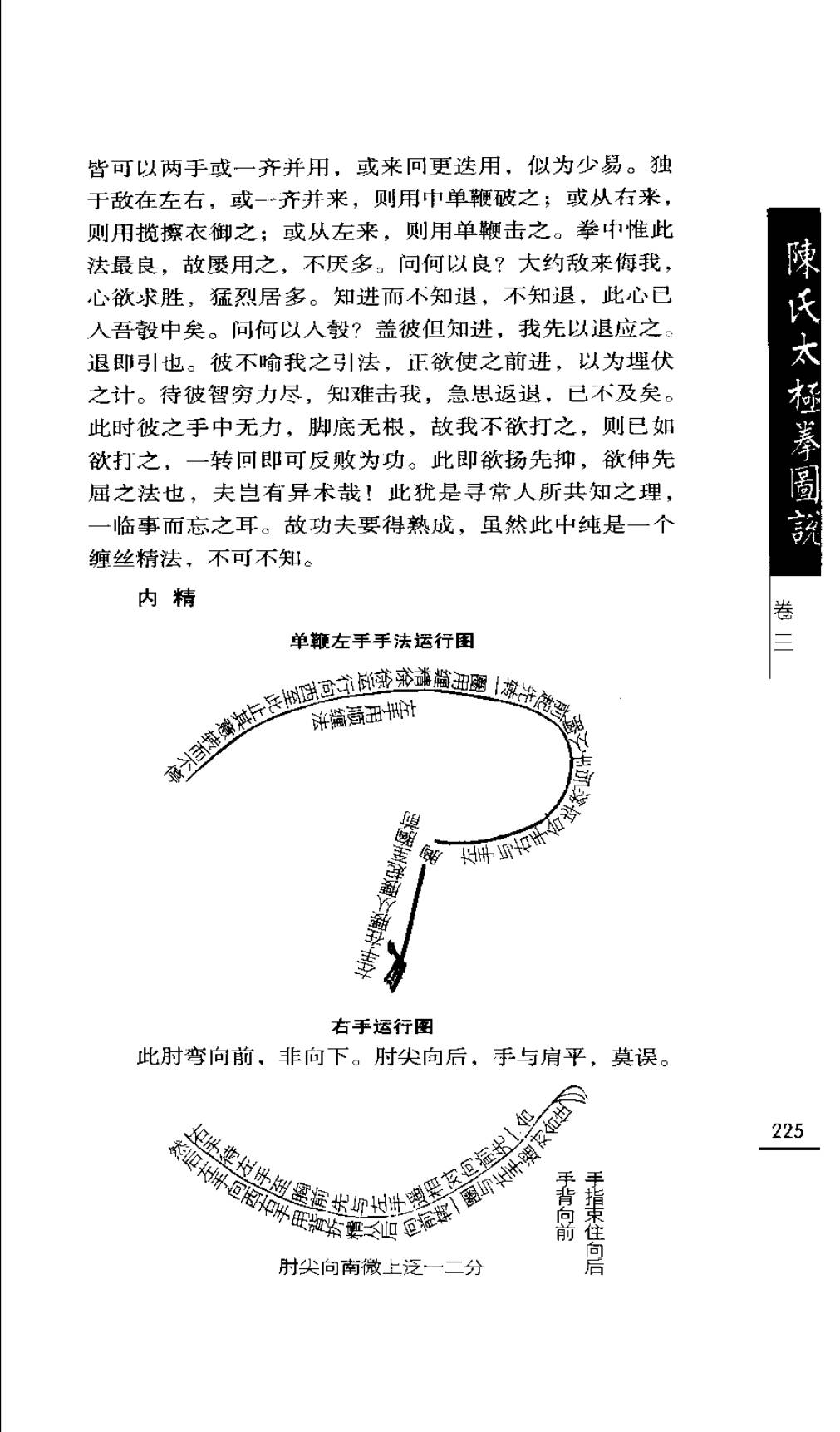
*Chen Shi Taijiquan Tushuo (Illustrated Explanation of Chen Family Taijiquan)*
Main text
The right foot stays unmoving in the east; only twist the heel so the toes point slightly northwest. When the left foot is drawn in to join it, the feet still do not move.
The left foot plants here, toes pointing northwest. The toes do not first settle fully; above, together with the left hand they rise together and set down together — the intent is again "stopping without stopping, stopping without ceasing," and only this is correct form.
Diagram labels (upper diagram):
- 左足从此收 — the left foot draws in from here
- 左足收至此 — the left foot is drawn to here
- 左足和右足与十字 — the left and right feet form a cross
- 右足从此收(从右足到左足)— the right foot draws from here (from the right foot to the left foot)
Diagram: 左足收回图 (Diagram of drawing in the left foot) — a curved arrow shows the left foot's path, labelled 初发 (initial launch) and 终止 (end point), 由发至止约一尺 (about one chi from launch to stop).
Diagram: 左足开步图 (Diagram of opening a step with the left foot) — a curved arrow with a circle at center, labelled 终止 (end point) at the left end.
取象 (Taking the Image)
This posture embraces the myriad phenomena within the chest and carries the image of Li (離, Fire) hollow at its center: the void is sufficient to hold all principles, so the image is taken from Li. The second line, "Yellow Li, greatly auspicious — it attains the middle way." The top ninth: "The king employs: marching out on campaign is honored; beheading the leaders; capturing the bandits' crowd; no blame." Li, first line changing, becomes Gen (艮, Mountain), paired with Dui (兌, Lake). Dui is joy; Gen is the hand and is stopping. To stop others through joy, nothing serves but the hand. The second line changing becomes Qian (乾, Heaven), paired with Kun (坤, Earth): firm within, yielding without. The third change is Zhen (震, Thunder) as the foot, paired with Xun (巽, Wind), "bringing gain to the market, threefold." In opening a step the foot does not advance recklessly unless it benefits oneself. In this posture the central qi (氣) threads through the foot: the principle solid, the qi hollow — again like the image of Kan (坎, Water) filled at its center; so the image is also taken from Kan. Kan gains Qian's firmness at its center, hence "moving meets with esteem, going achieves merit; entering doubled peril without fear, leaving Kan's hollow with accomplishment." The middle lines: Kan's second and fourth joined form Zhen, paired with Xun, opposed by Gen; Li's second and fourth joined form Xun, paired with Zhen, opposed by Dui. Zhen, the eldest son, presides over sacrifice; Xun, the eldest daughter, carries out the command. The left hand belongs to yang as Zhen, positioned below — yin within yang, of the same kind as the right hand's Xun. This is "the eldest son commanding the army, the younger son accompanying": firm within, yielding without, and therewith one meets the enemy. Gen is stopping, yet nothing fails to follow the way; joy and compliance. Kan's third and fourth joined form Gen, paired with Dui, opposed by Zhen; Li's third and fifth joined form Dui, paired with Gen, opposed by Xun — meaning that when firmness and softness aid each other at the right moment, the disposition is everywhere fitting, naturally according with the natures of the four trigrams Gen, Dui, Zhen, and Xun. As for the subtlety of the movement, it also secretly connects with the hexagrams Jian (漸, Gradual Progress) and Jin (晉, Advance).
七言俚语 (Seven-character folk verses)
First verse
六子用事各有长,皆于乾坤耀精光(乾坤是个阴阳,震巽坎离艮兑六子皆是一阴一阳),果能悟得真主宰(太极之理以御气),人生何处不阴阳。
The six children, each in office, have their strengths; all shine their essential light through Qian and Kun. (Qian and Kun are one yin and one yang; the six children Zhen, Xun, Kan, Li, Gen, Dui are each one yin and one yang.) If one truly awakens to the true Master (the principle of Taiji governing the qi), then in human life where is there not yin-yang?
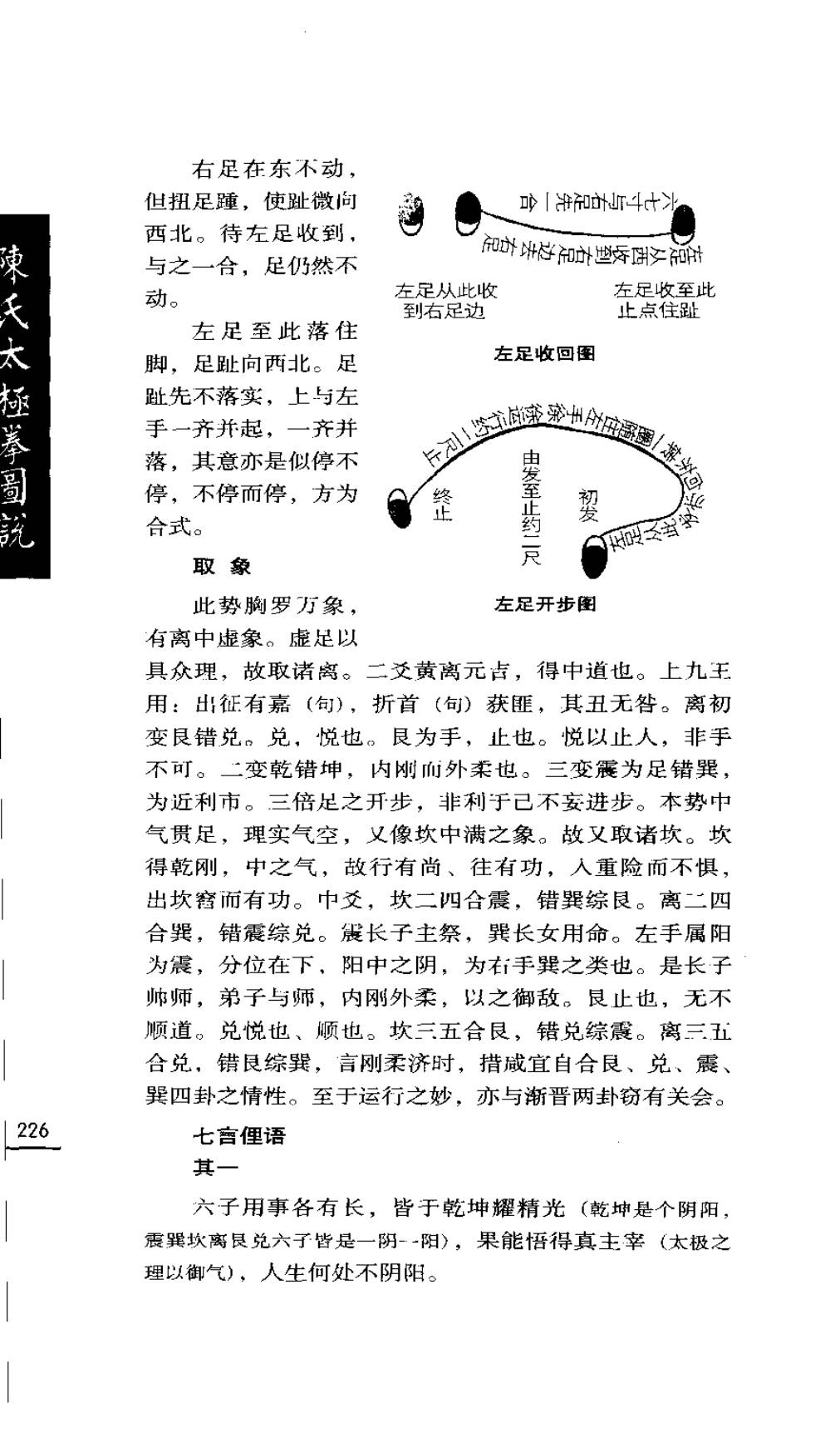
*Chen Shi Taijiquan Tushuo — Volume 3*
Second verse
遥承玉女弄金梭,中间揽擦①漾轻波,忽然一字长蛇亘,宛似清秋舞太阿。
Distantly receiving the Jade Maiden playing with her golden shuttle; amid it, the Lan Ca (攬擦, Grasp-and-Brush)① ripples light waves; suddenly a long snake in a single line stretches across, like dancing the Tai'e sword in clear autumn.
Notes:
- ① In the original edition "攬擦" (lan ca) was misprinted as "懶插" (lan cha); corrected here.
- ② The original read "攪插衣"; evidently an error, corrected to "攬擦衣" (Lan Ca Yi).
Diagram title: 揽擦衣②下单鞭上夹缝中左右手足图 — Diagram of hands and feet, left and right, in the central seam of Lan Ca Yi (Grasp and Brush the Robe)② above, with Dan Bian (單鞭, Single Whip) below.
Labels of the three figures:
- The right hand inserts obliquely like flowing water, silk-reeling (纏絲, chan si) joined from outside to inside.
- Joined in mutual response with the left foot; the right foot treads flat, the big toe turned inward.
- The left foot's toes touch the ground, in mutual response with the right foot's toes.
内精 (Internal Essence)
This is the posture of Lan Ca Yi above with Dan Bian below, at the central seam. From where does the internal essence (內精, nei jing) issue, and where does it travel? It issues from the one heart-mind and travels through the marrow of the four limbs, filling the skin and flesh of the four limbs. As the incoming line of Dan Bian enters the preceding posture: Lan Ca Yi has already used opening essence; here, when the heart delights and the intent unites, the whole body, upper and lower, hands and feet, joins together at once. The right hand uses joining essence from outside to inside, inserting obliquely downward, force in the finger pads, while the elbow and the rear of the palm use no force. The left hand, from the left ribs to below the right breast, likewise uses outward-to-inward reeling essence, force in the finger pads corresponding with the right fingers. The right foot, in a figure-eight shape, treads the ground unmoving. Drawn back from the left side, some seven or eight cun from the right foot; the five toes touch and hold the ground. The right foot follows the right hand, the left foot follows the left hand; when the heart's intent wishes to join, then upper and lower, hands and feet all join from outside to inward at once. What joins are the hands and feet — but that by which they join is the heart's essence. Once the heart's essence issues, the sinews, vessels, and joints of the whole body all follow it. What manifests without all issues from what is released within. Thus it is said: after the internal essence has joined, the left hand circles a small coil, extending from right to left; the arm extends seven or eight tenths, stopping without stopping. The left arm uses inward-to-outward reeling essence; the right hand, from below to outside, up, and inward, also circles a small coil, corresponding with the left hand, stopping without stopping. The right arm, however, uses reverse reeling essence, moving through the arm. Between right and left arms the essence is one smooth, one reverse, responding to each other front and back. Below, the left foot and right foot are likewise. After the two feet have joined, the left foot, its toes touching the ground, opens a step to the left of no more than a chi and four or five cun, then stops. When about to open the step, the left foot too first circles a small coil before opening. Otherwise there is not only no posture; the foot...
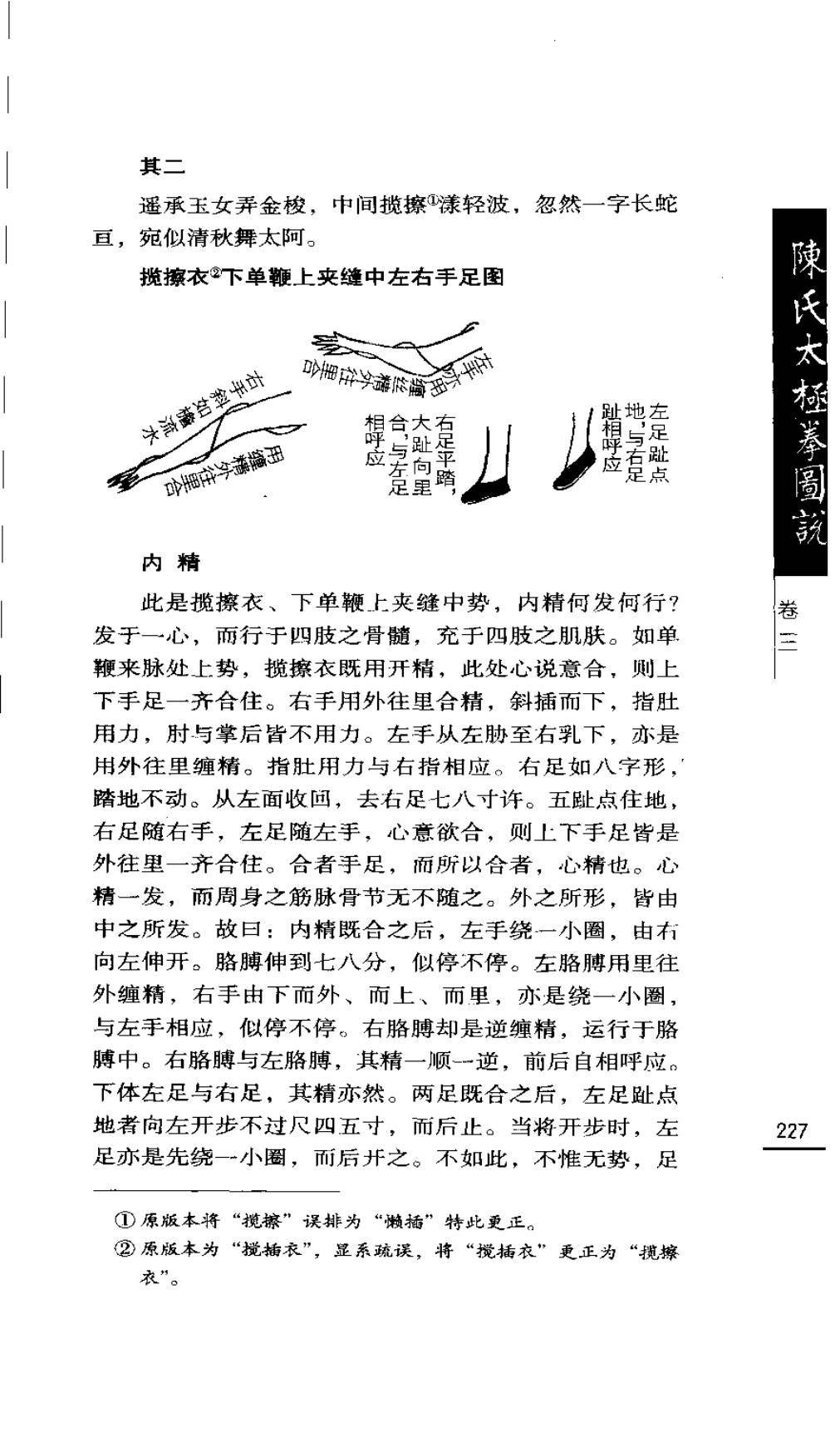
*Chen Shi Taijiquan Tushuo*
*(No diagrams on this page.)*
Main text
...it also has no force. Therefore one must first circle a small coil, as the cause that sets the posture for opening the step.
Heaven and earth move entirely by the two qi of yin and yang. We, born with heaven-and-earth's qi, likewise rely wholly on their numinous qi for the body's ceaseless revolving of opening and closing. Thus the movement of our body is the same as the movement of heaven and earth. Yet what moves is the body's frame, while that by which it moves is the principle (理, li) of Taiji. Only because principle governs the qi does our movement — high or low, reversed or upright, now slow, now swift, now hidden, now manifest, greatly opening and greatly closing, now moving, now stopping — all present one piece of numinous qi displayed in visible form, truly like kites soaring and fish leaping: the mechanism of transformation alive. One who observes the art well will never bestow deep admiration merely on ears, eyes, hands, and feet dancing among appearances. Therefore the learner must first study the principle; when the principle is clear, the qi naturally grows lively and nimble. It is not that the qi can by itself become lively — it is the principle that makes it so.
Only after knowing this may one speak of it. Internal essence (nei jing) as merely "issuing within to manifest without" — such an account is still shallow. Someone says: this boxing cannot strike people. Not being able to strike people is only a matter of practice not yet arrived; if the practice is pure and ripe, from the coil whose greatness has nothing outside, reaching the realm whose smallness has nothing inside — meeting no enemy is one thing, but if one meets a strong enemy, the internal essence erupts suddenly, like sudden thunder and fierce wind snapping rotten timber — who could withstand it? Speaking of the prior joining in this very posture: the ignorant say it merely sets the posture for Dan Bian (Single Whip), not knowing it is not so. The preceding Lan Ca Yi has already repelled the aggressor; if someone then presses and seizes my elbow, my shoulder goes from below backward, turning a small coil upward, then inserts obliquely forward and down, and the "guest" is escorted out beyond the main gate. If at this moment he seizes the elbow, strike with the elbow; seizing the shoulder is the same. If he seizes my hand, the hand flips from front to rear, again turning a small coil, striking with the back of the hand. After striking, if another comes to invade my left half-body, then after the left hand has joined, I follow the momentum to defend leftward. Such is Dan Bian: both left and right hands contain methods of striking. The one who first joined strikes by joining; the one who later opens strikes by opening. Nowhere are the hands and feet not turning a coil; nowhere are they not a place for striking. For I move my qi by my principle; when the principle has no obstruction, the qi naturally has no blockage. Do I intend to strike anyone? I simply practice my boxing, acting as though nothing were happening. When the art reaches this point, the skill is more than half attained.
取象 (Taking the Image)
The preceding posture, Lan Ca Yi, used opening essence at completion; this posture, at its opening, first uses joining essence — the sense of turning opening into joining. Moreover, things at their extreme reverse: the principle of nature. Opening at its extreme must join; joining at its extreme must open — likewise principle following naturally. Hence at the opening the image is taken from Ge (革, Revolution). After joining, the wrist faces downward, gradually turning over the hand so the palm faces outward; the left hand rises from below the right breast, gradually traveling past the jaw, past the front of the nose, beyond the front of the left ear, gradually spreading toward the left hand. The hand leads the arm to extend seven or eight tenths; the form seems to stop, but the intent does not stop, gradually filling the internal essence, so that the essence must fill from within the bones to the skin and flesh, and onward...
*Chen Shi Taijiquan Tushuo — Volume 3*
*(No diagrams on this page.)*
Main text
...finger tips. When the internal essence is fully satisfied, the mechanism beneath the posture stirs of itself. After the right hand has joined, the wrist, facing downward and to the right, is likewise gradually gathered in. The fingers face downward and backward, rise, go forward, and return backward. Here is the hardest thing to describe. The arm bends forward; the right hand moves together with the left. Yet the arm's essence must turn a full coil before "stopping without stopping," in mutual response with the left hand. Joining the essence and advancing by degrees, the movement between is imaged by Jian (漸, Gradual Progress). As this posture nears completion, the essence prizes fullness. The Yi says: "Fit to be like the sun at mid-heaven; when the sun is at mid-heaven its light shines over all under heaven." So at the posture's end the image of Feng (豐, Abundance) is again taken — speaking of the sufficiency and fullness of the inner essence, imaged by the light of the sun at noon.
Sixth Dan Bian (Single Whip), seven-character folk verses
First verse
一开一合妙入微,上下四旁泄化机。纵使六子俱巧舌,也难描尽雪花飞。
One opening, one joining — subtle into the infinitesimal; above, below, and on four sides, the mechanism of transformation leaks forth. Even if the six trigram children were all clever of tongue, they could hardly describe the snowflakes' flight completely.
Second verse
一片灵机写太和,全凭方寸变来多。有心运到无心处,秋水澄清出太阿。
One piece of numinous mechanism portrays the Great Harmony, relying wholly on the square inch (the heart) for its many changes. When intentional movement reaches the place of no-intention, autumn water, clear and still, yields the Tai'e sword.
*Chen Shi Taijiquan Tushuo*
Posture 44: Second Yun Shou (雲手, Cloud Hands), Left and Right ①
Note ①: The original edition read "中運手" (Zhong Yun Shou); according to the table of contents' title it is corrected here to "Second Yun Shou, Left and Right."
Figure: A practitioner in the Yun Shou (Cloud Hands) posture, in long robe with standing collar, left foot forward, left hand extended forward at shoulder height, right hand near the lower abdomen; vertical lines from head and hands indicate alignment. Labels:
- When the left hand moves to the bottom, the right hand moves to the top.
- The left elbow sinks down.
- The left shoulder relaxes down.
- The crowning essence (頂精, ding jing) leads everything up.
- The right shoulder relaxes down.
- The eyes look at the middle finger.
- The right hand's finger pads apply force.
- The five fingers gather together.
- When the right hand moves to the top, the left hand moves to the bottom.
- The elbow sinks; the chest slightly joins forward.
- The right knee is held bent; if not bent the crotch (襠, dang) will not open — hence the knee must...
- ...reach the right side, also turning one coil.
- The right foot follows the right hand, moving behind to the left side, moving...
- If the hips (髖股) do not lift up, then the front crotch cannot hold the essence.
- The left knee is also held slightly bent.
- When the left hand moves to the bottom, the left foot settles fully.
- The coccyx bone (尻骨) is slightly lifted upward.
- The waist essence (腰精) sinks; the waist is the crossroad of above and below (if it does not sink, the upper body's qi floats and the feet are unstable).
Closing text
Though this posture repeats an earlier one, there were meanings not yet fully set forth before, so it is specially supplemented (it is not another, separate posture). At the start, first move the right hand, then the left hand. There is no fixed count to the hand-circling; the left hand first leads upward. If the left hand does not lead, the right hand cannot rise; even if it rises, there is no posture, and it is not one continuous breath. With this one leading, the blood vessels of the whole body are all summoned into motion.
Previously the right hand moved to the top; now the left hand moves to the top — this is one full cycle of left and right. When one cycle is complete, still move with the right hand; when the right hand finishes, still move with the left. It must continue until the hands reach the position of Gao Tan Ma (高探馬, High Pat on Horse) ahead before stopping. When the right hand moves, the right hand is the master; when the right hand finishes, immediately move with the left hand. When the left hand moves, the left hand...
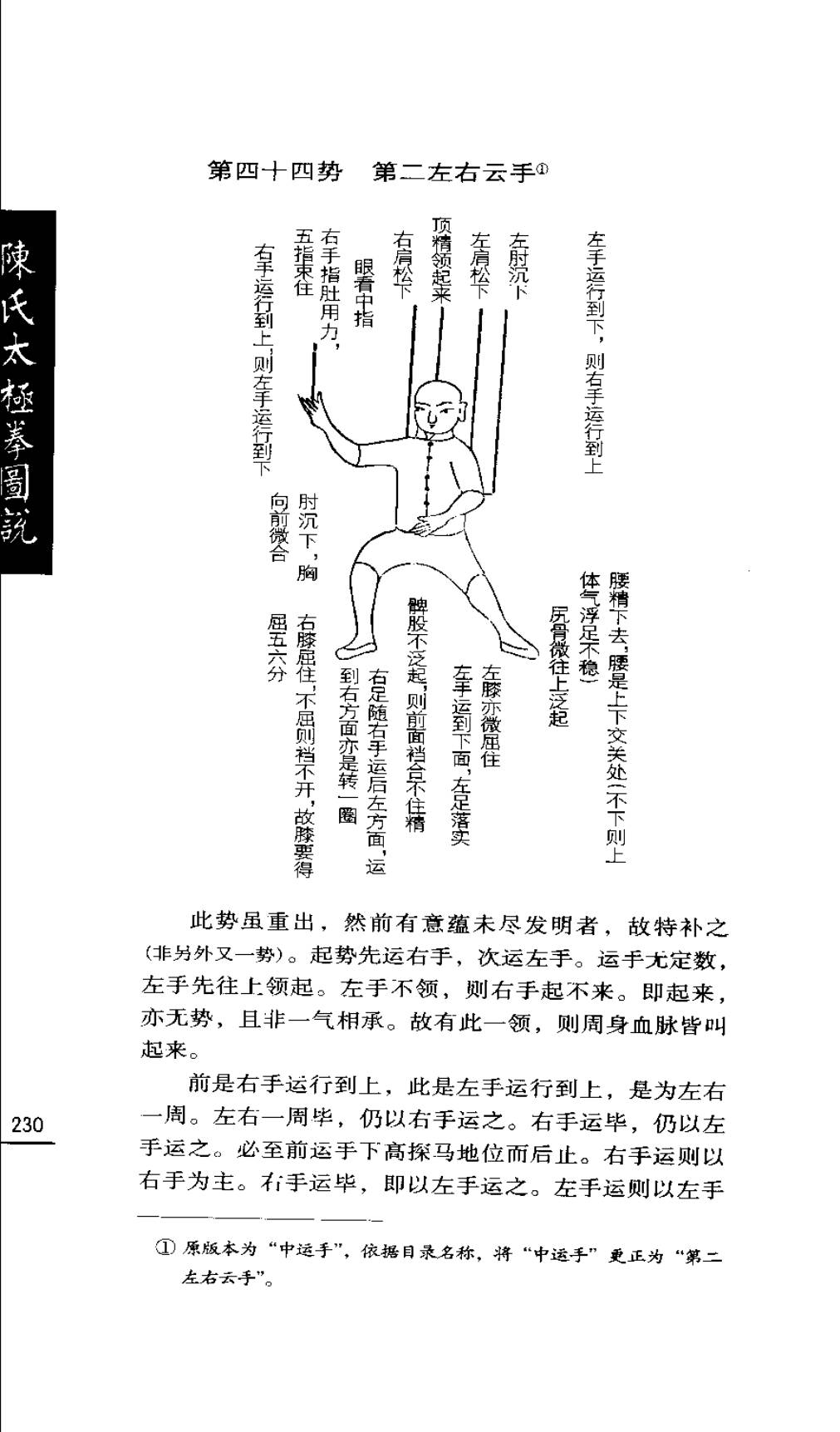
*Chen Shi Taijiquan Tushuo — Volume 3*
Figure: A woodblock-style line drawing of a practitioner, standing collar, weight low with the left leg bent forward and right leg extended back; the left arm extends forward and slightly up, the right arm down and back. No labels on the figure.
Main text
...is the master. When the left hand is the master, the spirit of the whole body pours into the left hand, and the eye's spirit is especially critical — it must fix on the left hand. Next, moving with the right hand, the eye's spirit at once follows the right hand's movement; do not look sideways. Sideways looking scatters the spirit, and the will too loses focus.
Movement is rooted in the one heart-mind, while spirit lodges in the eyes. The eyes are the official that transmits the heart; that the eyes do not glance sideways is proof the heart is not applied to two things at once.
引蒙 (Guiding the Uninitiated)
Q: With what does the hand-circling begin? A: It is led up by the tips of the left-hand fingers. Q: What moves first? A: The pads of the right hand's fingers and the little finger's palm. Q: Where is the pivot of the movement, where does the motion begin? A: Once the left hand has led the right hand into motion, the right hand, level with the right arm, goes from above down, turning smoothly (順轉, shun zhuan, forward reeling) to outside the right knee, rises past the heart's gate (chest), moves to the nose, crosses the right temple corner, passes above the right shoulder, and returns to the original starting position — only then is one coil complete. The right elbow sinks, the right shoulder presses down, the right foot also turns smoothly following the right hand. When the right hand reaches outside the knee, the right foot, following the right hand, is withdrawn to the left foot's side. Now, as the right hand rises and moves outward, the right foot likewise rises and moves rightward — but the right foot lands five or six cun nearer the inside than its original position: this is called "opening a step unintentionally." When the right hand reaches outside the right knee and is about to rise, the left hand descends from above — this is the smooth-turning method. As the right hand rises and moves rightward back to its position, the left hand descends to the knee, and the left foot is likewise withdrawn to the right foot's side. When the right hand descends to outside the knee, the left hand and right hand move together. The left hand also rises, past the chest and up to the nose tip, crosses the left temple corner, passes above the shoulder, and moves to the left hand's original starting position. The left foot, from outside the right foot, opens a step leftward — also the smooth-turning method. But only because the right foot moved five or six cun less to the right can the left foot open five or six cun more to the left. When the left hand reaches its position, left and right have each completed one cycle. After one left-right cycle, the mechanism does not stop: the right hand rises again from below, the left hand continues from above, ending and beginning again, moving in alternation, cycling without cease, like sun and moon alternating in brightness.
Q: What governs the movement? A: The master is in the heart. When the heart intends left and right to move in alternation, the left and right hands and feet immediately move in alternation; when the heart intends the silk-reeling essence (纏絲精, chan si jing) to turn coils smoothly, the left and right hands immediately turn smooth coils with the reeling essence; when the heart intends the elbow to sink and the shoulder to press, the elbow sinks and the shoulder presses; when the heart intends the chest and abdomen to join forward, the waist essence sinks and the crotch opens round. And as the chest joins in front, the waist...
*(Text breaks off at the page's bottom after 腰 "waist.")*
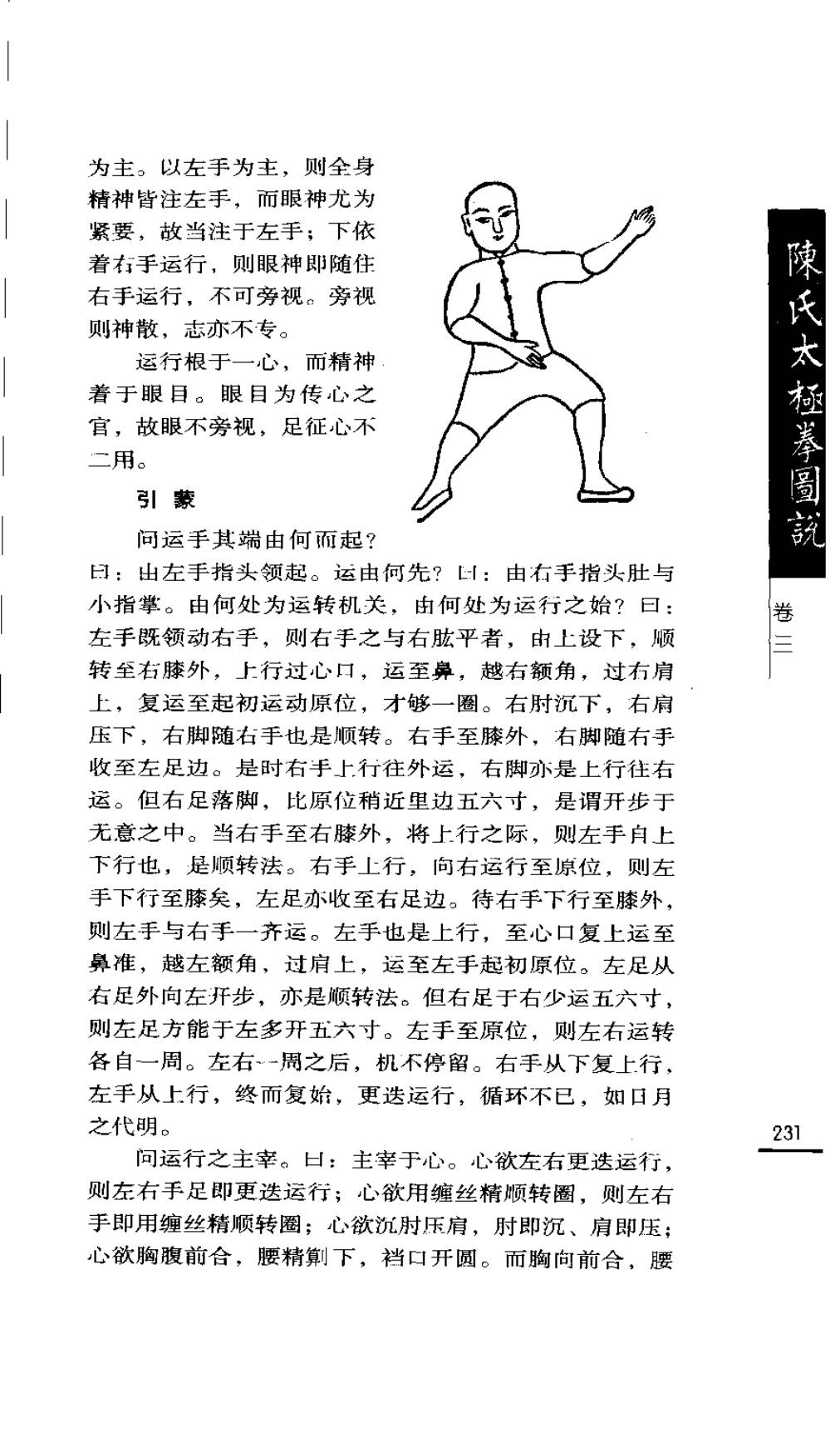
*Chen Shi Taijiquan Tushuo* (陳氏太極拳圖說, Chen Style Taijiquan Illustrated Explanation)
...below the *jing* (精, essence), the crotch (dang, 裆) immediately opens round and everything follows one's wish; if the xin (心, heart-mind) wishes to bend the two knees, the two knees bend at once. The right foot moves with the right hand, the left foot with the left hand; and the knees follow the respective feet — otherwise many defects arise. This is why the organs and skeleton (guanhai, 官骸) cannot but obey the heart-mind. Hence I say: the xin is the master (zhuzai, 主宰) governing the movement of the whole body.
Q: Where does the key (guanjian, 关键) of practicing the quan (拳, boxing form) lie? A: Below the Baihui point (百会穴), running from the Dazhui (大椎) at the back of the head down to the Changqiang (长强); its movement lies in the Ren and Du meridians (任督二脉). Where does its spirit (jingshen, 精神) reside? A: In the pupils of the eyes (mouzi, 眸子). The moment the xin stirs, the eyes convey it, and never err. Someone said: the general outline of the quan I have now heard; yet why can one not express its spirit (shenqing, 神情)? A: This lies in ordinarily removing the heart that desires haste — as Mencius said: "One must be attending to it, but not forcing it; let the heart not forget it, yet not help it grow" (必有事焉,而勿正,心勿忘,勿助长焉). Before practice, first rid yourself of any air of frivolity and panic; purify the heart and lessen desires, calm the heart and settle the qi (气). Move through each posture (zhezhe, 着着) in accordance with the rules; over long accumulation the gong (功) ripens. Then, layer upon layer of twists and turns, having passed through every difficulty, bitterness gives way to sweetness and interest springs up irresistibly. When the heart holds real scenes and feelings, the spirit will naturally be expressed in the form. In short, all this is within human effort. As for achieving transformation without deliberate intention (wuxin chenghua, 无心成化), that depends on cultivation (hanyang, 涵养): over long days remain at ease and await its self-arrival, and you will attain it. Mencius said, "I am good at nourishing my flood-like qi" (我善养吾浩然之气) — these words are truly no falsehood. The questioner bowed assent and withdrew, and I thereupon took up the brush to record this.
The middle transporting hand (zhong yun shou, 中运手) and the front and back transporting hands echo each other from afar, yet clearly divide into the three realms of upper, middle, and lower — and those three realms are nonetheless penetrated by one single principle (li, 理).
Neijing (内精/内勁, internal essence)
Diagram of the paths traveled by the left and right hands (左右手沿路所走之图)
Two circles; texts arranged around and within each circle:
- Right-hand diagram: "right hand rises and stops" (右手起止), "right hand descends" (右手下行), "left hand ascends" (左手上行), "method of leading in" (引进来行之), "ascending stops here" (上行至此即止), "descending just moves" (下行即行), "together with the right hand rises together and stops together" (与右手齐起齐止), "left hand / right hand", "rise together" (一齐起), "stop together" (一齐止).
- Left-hand diagram: "left hand starts from here, at the end stops here" (左手从此起,临终至此止); the rest as above.
- Between the circles: "spirit leads — one inhale, turn and return" (神领一吸翻至乃回).
Although left and right hands rise and move together, the left hand starts from the left side, hand level with the shoulder, beginning downward; while the right starts from beneath the left nipple, arm bent, beginning upward. Therefore when the left hand reaches the bottom the right hand is at the top; the left hand, coming beneath the right nipple, should bend, and the right arm should extend to the right side.
(Page number: 232)
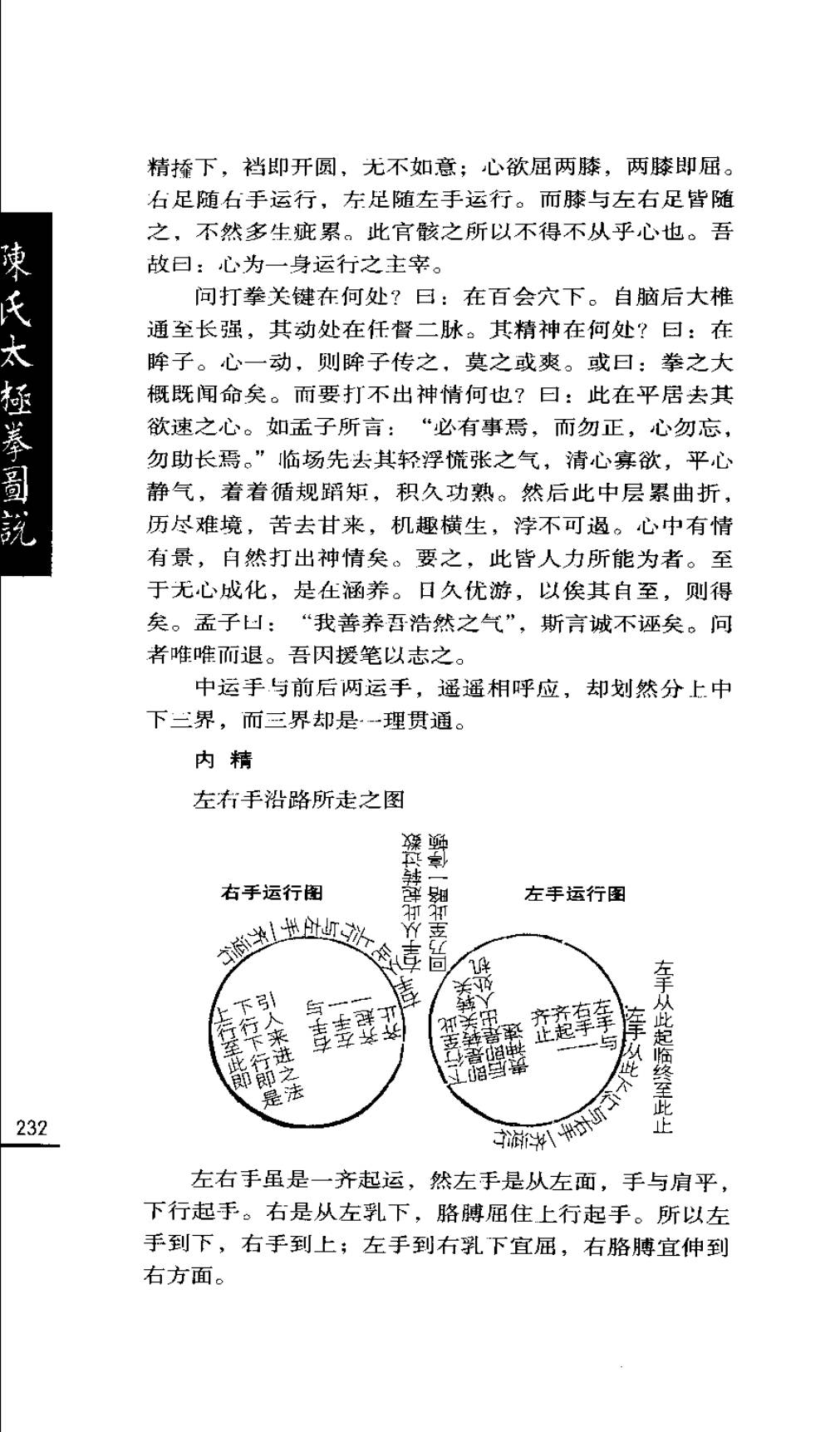
*Chen Shi Taijiquan Tushuo* (陳氏太極拳圖說), juan 3 (卷三)
In practicing the quan (拳), movement is entirely led by the hands, and turning (zhuanguan, 转关) depends entirely on relaxing the shoulders (song jian, 松肩). This figure specifically depicts the method of relaxing the shoulders in the hand movement of Single Whip (Dan Bian, 单鞭). With long practice the bone seams (gufeng, 骨缝) of the shoulders open by themselves and cannot be forced. If the left and right shoulders will not relax downward, the turning is not agile. Moreover, relaxing the shoulders is not hunching the shoulders. When the joints (gujie, 骨节) open, the shoulders relax down of themselves.
Supplementary Diagram: Song Jian in Dan Bian (补单鞭松肩图)
[Figure: line drawing of the Single Whip posture — left bow stance, left arm extended forward at shoulder height, right arm extended to the side; no labels inside the figure.]
Qu Xiang (取象, Taking the Image)
The human heart (xin, 心) belongs to fire. Fire has no constant form; it attaches to the movement of hands and feet, and only then does the brightness of the heart-fire appear — like the Li hexagram (离卦) of the Yijing. Li means "to cling/be bright" (丽) and "brightness" (明). The two hands turn left and right like sun and moon clinging to heaven, alternating in brightness, moved by the qi (气, i.e. shenqi, 神气, spirit-energy). The two feet move below like the grains and plants clinging to the earth, alternating in succession, form clinging to form; doubled brightness clinging to the correct (重明以丽乎正). Upper and lower, hands and feet move by the middle way (zhongdao, 中道), turning without cease. When selfish desires in the human heart are utterly stilled and the barrier of principle (lizhang, 理障) is emptied, the substance of the heart is constantly bright. Bright, it shines on everything: if something comes from the left it shines on the left; from the right, on the right. When a person cannot deceive this brightness, it is numinous (ling, 灵), and numinous enough to respond to the ten thousand affairs. So if an enemy comes on the left, strike the left; if on the right, strike the right — prepared, there is no peril (有备无患). The image resembles Li; therefore it is taken from Li.
Middle Transporting Hand — Five-Character Folk Verse (中运手五言俚语)
The two hands move through the middle (of the three transporting hands — upper, middle, lower — this one is the center), left and right like a circling ring. Borrowing this tangible thing, I paint the sky within the water (utterly empty, utterly numinous: every single movement is the round image of Taiji, 太极圆象).
Seven-Character Folk Verse (七言俚语)
One forth, one back, completing one round; the qi mechanism (qiji, 气机) above and below never pauses. From antiquity Taiji (referring to the principle of yin-yang, the qi of hard and soft) has been thus — what need to vainly seek outside the body? (The Zhongyong says the Way is not far from man; Mencius says all things are complete within me. One need only seek within oneself — 返求诸己.)
(Page number: 233)
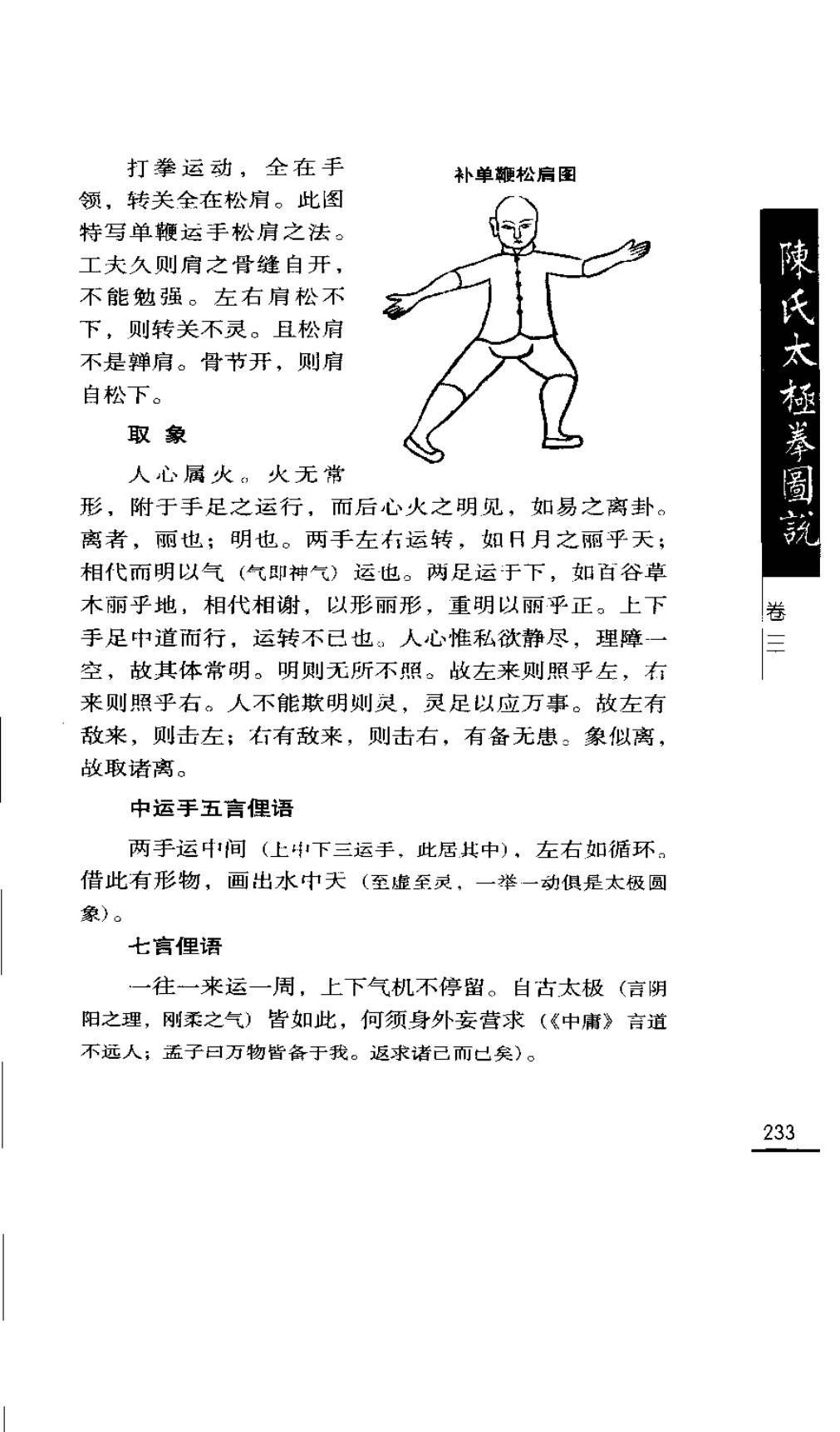
*Chen Shi Taijiquan Tushuo* (陳氏太極拳圖說)
Posture 45: Bai Jiao (摆脚, Swinging Foot)
Figure labels
Right side (top to bottom): "left elbow bends and holds" (左肘屈住); "eyes watch the right foot" (眼看右脚); "jing at the crown leads and holds" (顶精领住, i.e. dingjin 顶劲); "ears listen behind" (耳听身后); "shoulders relax down" (肩松下); "right arm extends open" (右肱伸开).
Left side: "palms face down" (掌朝下); "waist sinks down" (腰下去); "left leg bends but must not go soft" (左腿弯不可软).
Bottom: "right foot level with the leg, knee bent seven or eight parts; left knee bent two or three parts" (右脚与腿平,膝屈七八分,左膝屈二三分); "the left foot stands solid on the ground — the whole body depends on this foot, exert full strength" (左足实地踏地,周身全凭此脚,当十分用力); "hands slightly upward, circling from left toward the right, placing the swinging foot into this posture; what follows is the front view of Bai Jiao" (手微向上,从左绕而向右……).
[Figure: line drawing of Bai Jiao — standing on the left leg bearing the full weight, right leg raised and extended sideways with knee slightly bent; left arm reaching forward-downward palm down, right arm folded across the chest.]
Main text
What is Bai Jiao? The right foot lifts, level with the right hip, sweeping horizontally toward the north (the right side), using the foot to strike the opponent (摶, tuan, means "to strike", 击). It requires the right arm to extend open to the right, the left arm bent and held, hands toward the right, both palms facing down; the left and right hands sweep horizontally toward the south to meet the right foot. The right foot sweeps horizontally toward the north, meeting the two hands at the center, like two men facing each other in combat. The hands and the right foot brush past each other (modang, 摩荡, grind and surge). Hands and foot face off; when they have passed, the right hand is crossed by. The left hand levels off toward the left, the left arm extends open; the right hand also levels toward the left arm and bends and holds. The right foot levels with the arm; the right knee bends slightly — stopping yet not stopping, on the point of a downward-falling impulse (ji, 机), though in fact not yet fallen. The boundary of Bai Jiao ends here.
Yinmeng (引蒙, Leading the Beginner)
The completion of the preceding posture is already clear from the figure-by-figure explanation, and need not be repeated. But between the hand movement ending below and the swinging foot above — at this seam, what do the hands and feet do? It is said: as the hand movement is about to finish, the left foot shifts slightly toward the right by two or three parts, to clear the path for the narrow base of the following posture. The upper body's left hand leads and holds...
(Page number: 234)
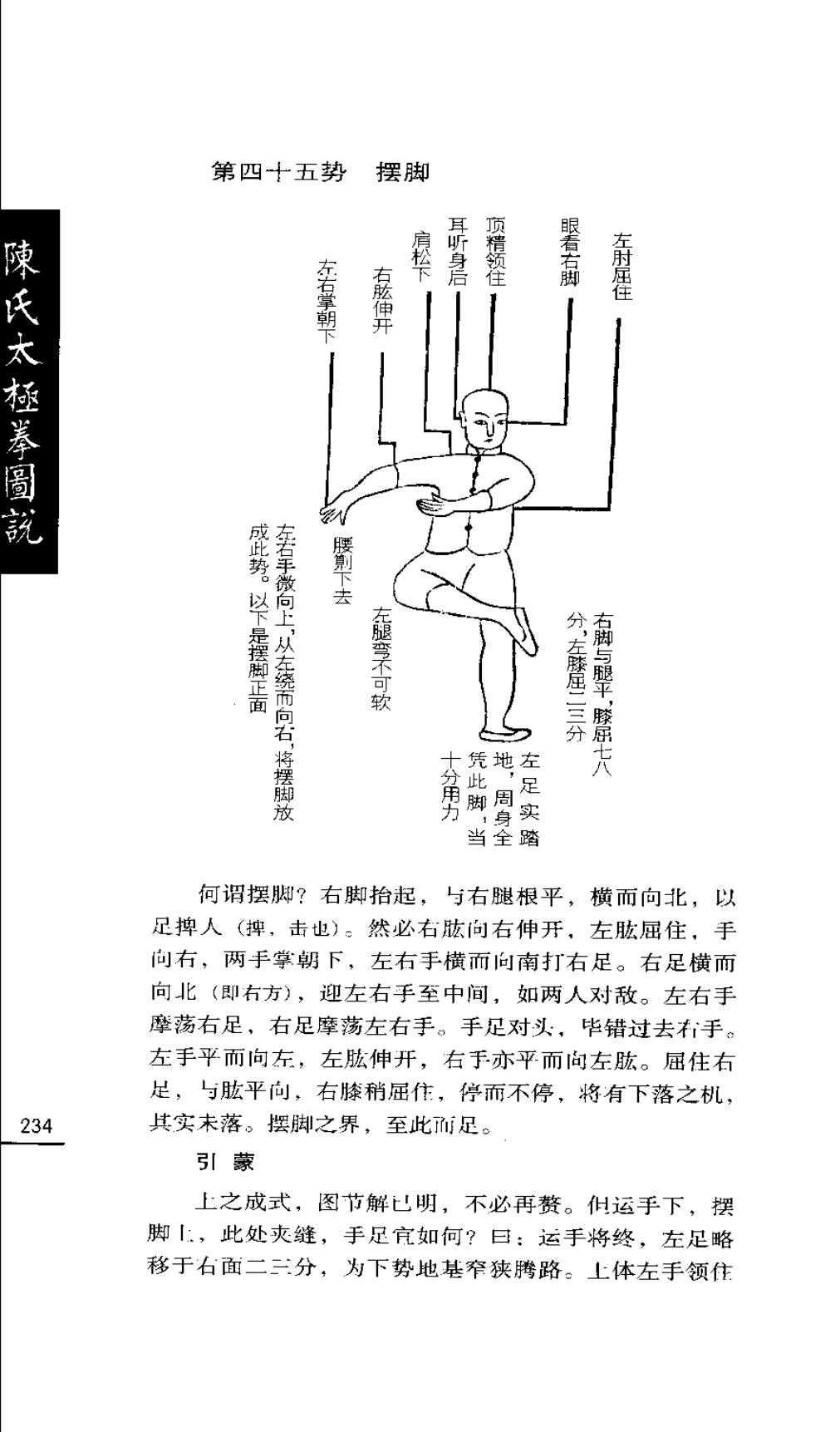
*Chen Shi Taijiquan Tushuo* (陳氏太極拳圖說), juan 3 (卷三)
The right hand first goes left, rising from below and turning a small circle, then bends the arm to the right; the left hand drops to rest in front of the right shoulder. The right hand follows the left hand, likewise rising from below, turning a large circle, extending the arm open and stopping at the right. The two hands going left are leading (yin, 引) the opponent; turning to the right, the right hand strikes the opponent; turning again to the left, the left hand strikes. The right foot is originally at the right yet moves left: without first going left, a strike to the right has no power. Therefore one must first go left and only then strike right. With the two hands striking horizontally left and right, the right foot also lifts above, swinging right to strike — then of the four limbs only the single left leg remains below. Yet this one foot is what the Yijing (《易》) calls "the eldest son carries the vessel" (长子主器). It must be made as stable as a rock (盘石之安), as firm as moats of metal and walls of boiling water (金汤之固); only then, though attacked from all around (环而攻之), can it not be shaken — otherwise defeat! Q: How to make it stable, how to firm the thigh bone (bigu, 髀骨)? Sit down slightly, one or two parts; bend the left knee one or two parts; the upper body's crown-jing (dingjing, 顶精) well led; in the middle close and hold the chest; the left foot grips the ground, the sole's center clawing (kou, 抠) into the earth; the upper body propped and held front, back, left, and right, letting no side be over-weighted — then the sole of the foot is naturally steady, stable and firm.
Neijing (内精, internal essence)
Bai Jiao — Starting Position of the Left and Right Hands (摆脚左右手起端式)
[Figure 1: line drawing of the starting position; the curved movement paths carry the following annotations:]
- The right arm rises from below turning a small circle and bends to the right (右臂由下而上转一小圈向右屈住)
- The left hand drops to stop in front of the right shoulder (左手落在右膀前停住)
- The right hand follows the left hand, rising from below in a large circle, extending open and stopping at the right (右手随住左手自下而上转一大圈展开向右停住)
- The two hands going left lead the opponent (两手向左者引敌人也)
- Turning to the right, the right hand strikes the opponent (转而向右者以右手击敌人也)
- Turning again to the left, the left hand strikes (复转而向左者以左手击人也)
- The right foot is originally at the right yet moves left: not going left, a rightward strike is powerless (右足本在右而向左者……)
- Therefore first go left, then strike right (故必先向左而后击右)
- Both hands strike horizontally left and right; the right foot also lifts above, swinging right to strike (两手左右横击右脚亦抬起在上向右摆而击人)
Bai Jiao — Completed Position of the Left and Right Hands (摆脚左右手已成图)
[Figure 2: line drawing of the completed position; annotations:]
- The right foot swings from right to left — this foot movement is named Bai Jiao (右足从右向左摆右脚名摆脚)
- The left hand strikes from left to right — named the left strike (左手从左向右击左手名左击)
- The right hand strikes from right to left — named the right strike (右手从右向左击右手名右击)
This posture is a variant pattern (biange, 变格) within the quan (拳). Foot techniques with the foot below — kicking forward (前踢), pushing back (后蹬), stamping down (下蹴) — are the standard pattern (zhengge, 正格). Here the right leg lifts and the foot sweeps horizontally across to strike, hence it is called a variant. With the hands, forward strikes and back strikes, or a single hand splitting left and leading right, occur often. Here the two hands strike horizontally left and right in answer to the right foot — also within the quan a left... [text continues on next page]
(Page number: 235)
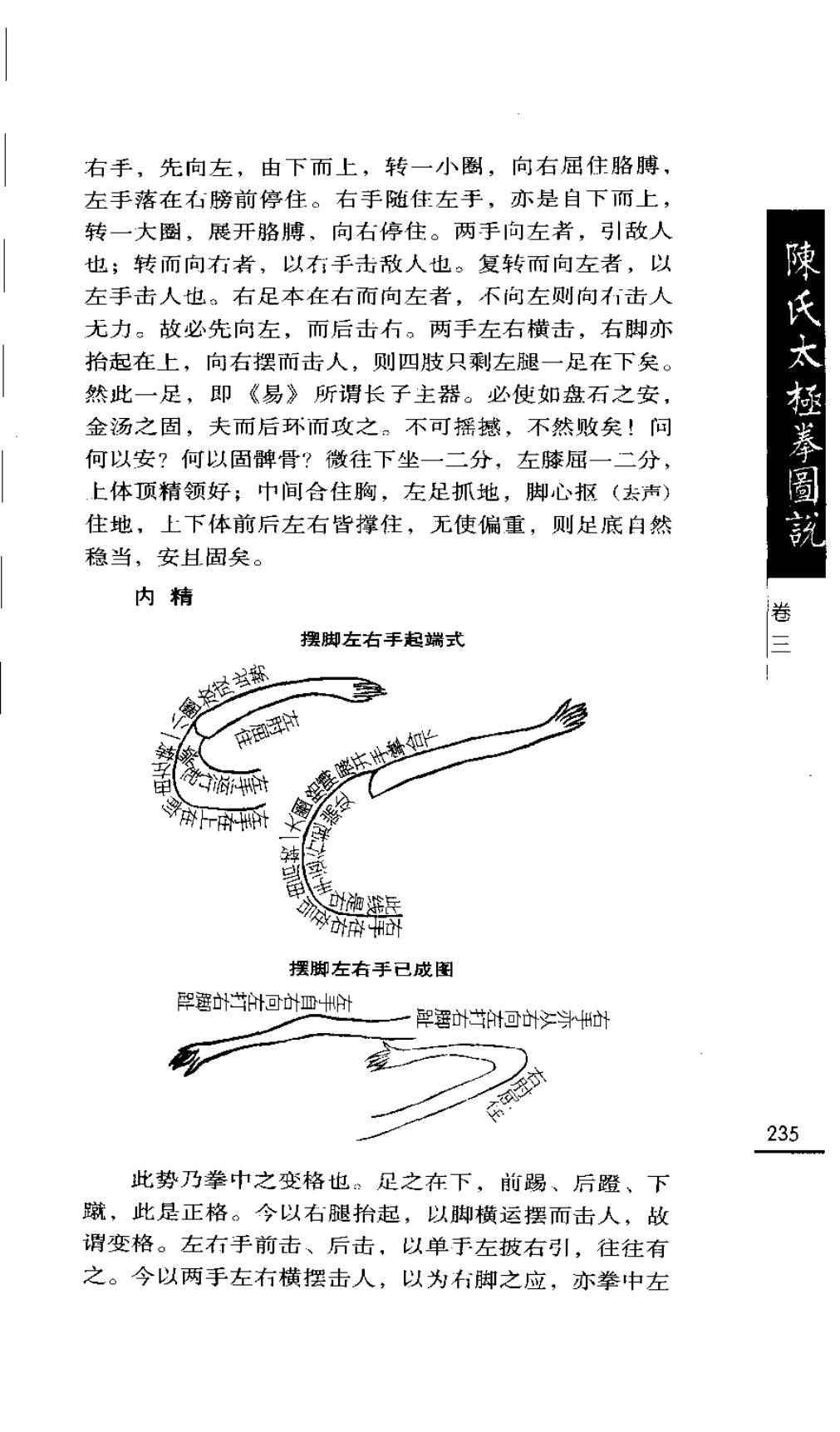
*Chen Shi Taijiquan Tushuo* (陳氏太極拳圖說)
...a variant pattern (biange, 变格) of the right hand [aspect of Bai Jiao]. Practice it with the flood-like qi (haoran zhi qi, 浩然之气) and nowhere will it be unfitting. In the lower body the left leg stands alone like a pillar in midstream (zhongliu dizhu, 中流砥柱).
Qu Xiang (取象, Taking the Image)
Bai Jiao resembles the hexagram Gen (艮, Mountain). Gen is the hand (艮为手): with the left hand and the right hand one stops things on either side. Gen means "stopping" (止). The first line: "Gen in its toes" (艮其趾) — not yet losing correctness. The third line: "Gen in its body, stopping in one's own person" (艮其身,止诸躬). When the foot is stable the body cannot be shaken. The top line: "Sincere Gen, good fortune" (敦艮吉). The Xiang says: "The good fortune of sincere Gen lies in ending with substance" (敦艮之吉,以厚终也) — meaning the strength of the sole of the foot is great and the upper body hard to break down; therefore the image is taken from Gen. It also resembles the hexagram Lü (旅, the Traveler). Heaven and earth are the inn of the ten thousand things; time is the passing traveler of a hundred generations. The left and right hands go from left to right and again from right to left, like a traveler coming and going on the road — one passing, that is all. The right leg's horizontal sweep is likewise one passing. The left foot stands without moving: when it should stop it stops, when it should move it moves (referring to the right leg). All are passing travelers coming and going, leaving no lingering trace; therefore the image is also taken from Lü.
Bai Jiao — Seven-Character Folk Verses (摆脚七言俚语)
One: A single beam can prop up a great mansion's collapse (the single beam figures the left leg, the mansion figures the whole body); raising the right leg is a sword held level. Left and right hands strike left and right; first set yourself in the death-ground, then seek life (先置死地后求生).
Two: Of all postures Bai Jiao is hardest; standing alone, trembling (kui kui, 夔夔), like a chill in the gall. Who would know Taiji has wondrous use — the hands like a balance scale, the ten thousand affairs at peace.
Mixed-Length Folk Verse (长短句俚语)
One thread of heart's blood moves my flood-like qi (浩然之气). Front and back in proportion, all follows one's wish. Let him attack from the four sides — how can he withstand my hands and feet striking horizontally. Left, right, front, back — every affair is carried through.
(Page number: 236)
*Chen Shi Taijiquan Tushuo* (陳氏太極拳圖說), juan 3 (卷三)
Posture 46: Yi Tang She (一堂蛇), also named Die Cha (跌岔, Falling Split)
Figure labels
Upper section (right to left):
- The left hand passes beneath the right leg, extending open together with the left leg, gradually advancing forward (左手从右腿下去,与左腿一齐展开,以渐前进)
- Eyes watch the left hand and left foot (眼看左手左足)
- The crown-jing (dingjing, 顶精) must not be lost (顶精不可失)
- The right ear listens to the right side (右耳听住右面)
- The right arm extends open (右胳膊展开)
- The right hand seems to have an intention of going forward (右手似有欲前之意)
Lower section (right to left):
- The left leg extends open, resting level on the ground (左腿展开,平落地面)
- The left foot stamps hard against the opponent's shin bone (左足用力蹬敌之廉骨)
- The left knee must not bend (左膝不可屈)
- The body must be led and held, the qi gathered forward (身要领住,气往前合住)
- The right knee bends and holds, must not press heavily down (右膝屈住,不可踏实)
- The thigh bone (bigu, 髀骨) sits yet does not sit — solid yet empty (髀骨似坐非坐,实而虚)
- The right instep faces down, the shoe sole faces up (右足面朝下,鞋底朝上)
[Figure: line drawing of the single falling split — left leg extended left, level on the ground; right knee bent down to the right, right instep down; left arm reaching left-forward, right arm extended right, ear listening right.]
Main text
What is Die Cha? The body falls from the air with the two legs spread apart — that is Die Cha. In this figure the left leg extends open and the right leg bends and holds: this is the single falling split (dan Die Cha, 单跌岔). With the double falling split (shuang Die Cha), one cannot rise without the leaping method (zongfa, 纵法). Not so the single falling split: with only the left heel closing forward once, the right knee opening outward once, and the right heel flipping over with force, one rises as soon as one falls. Compared with the other it is somewhat easier, so it is used, and it can also secure victory. Moreover today's quan masters all do it this way; for now I follow them.
Yinmeng (引蒙, Leading the Beginner)
Die Cha answers back to Er Qi (二起, the double kick). Er Qi goes from below upward, flying into mid-air; this one comes down from mid-air, both legs reaching the ground. A natural correspondence, not a forced one — such is the strictness of the laws by which the ancients created the quan. When Bai Jiao finishes, bend the right arm and extend the left arm, both hands at the left. The two hands then from the left side, rising from below, turn toward the right. The right arm extends open, the left arm bends and holds, both hands extended. At this moment the right foot falls down to the ground; the left foot, following from the right foot, with its heel resting on the ground gradually kicks away toward the southwest. The intent bends upward like a new-moon crescent; the left hand moves just like the left leg. It is from the right waist slowly bending down, and with... [continues on next page]
(Page number: 237)
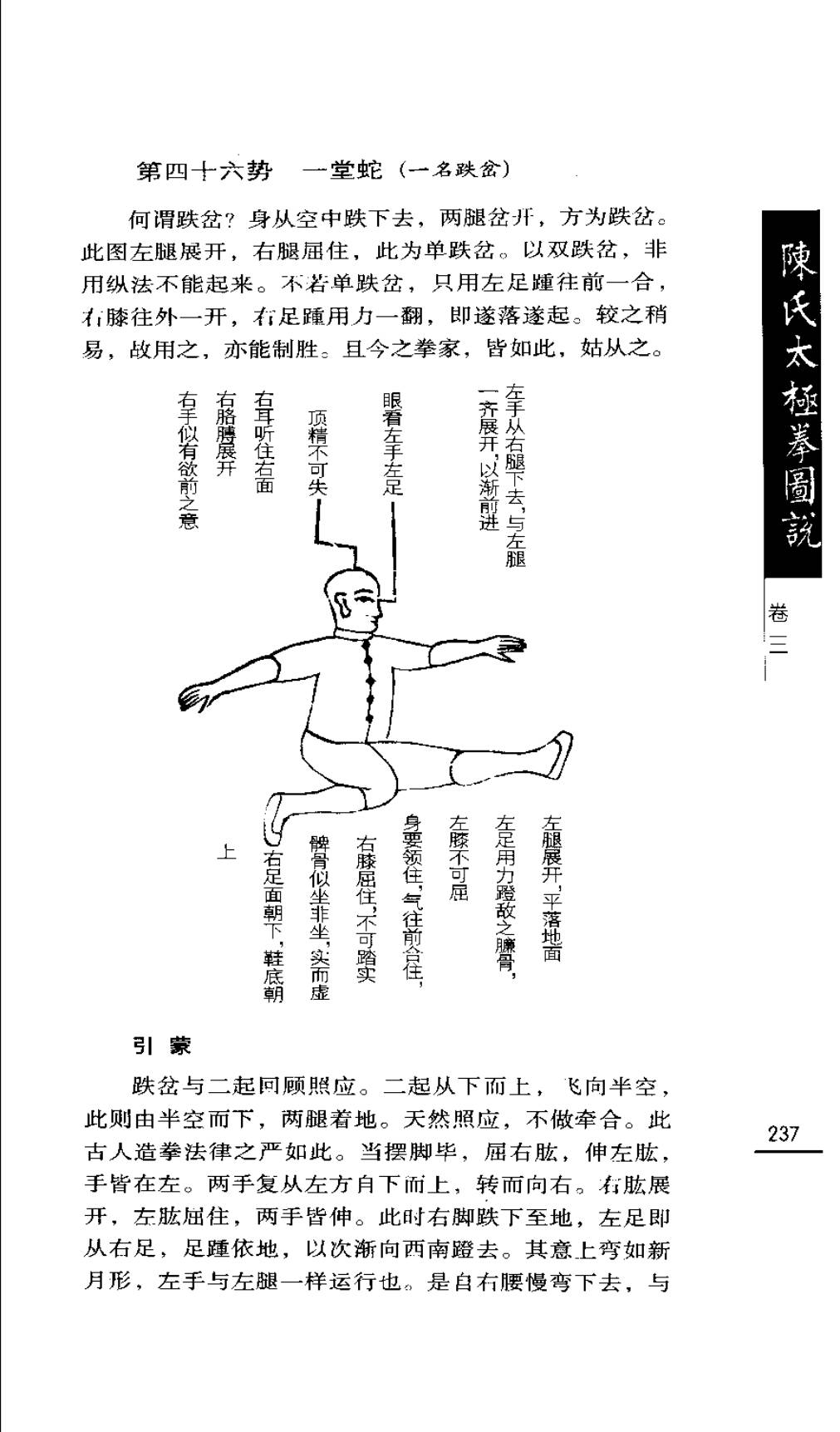
Chen Taijiquan Tushuo (Illustrated Explanations of Chen Style Taijiquan)
The left foot moves along together, pushing out toward the southwest. First use finger strength, then palm strength. The right hand is behind; although the arm is extended, the hand is still held inward (han). From top to bottom there is the intent of pressing forward — only the posture has not yet manifested (the Diěchà / 跌岔 falling-split section ends here).
Nei jing (内精 — internal essence)
Right leg diagram (右腿图 you tui tu)
In this posture the left foot kicking forward is primary. The kick is not an empty kick — it kicks the opponent. Therefore the heel at the back of the foot cannot fail to use strength, and the left hand pushing forward assists the left foot. The right hand being at the right likewise has great significance: it assists the intent of the left foot.
Qu xiang (取象 — taking the image)
In the falling-split posture (diecha), although one prevails by kicking with the left foot, the hip bone sits on the ground — it is no different from practicing Kan and entering the abyss of Kan, danger of the greatest degree. Without fu (孚, sincerity/faith), "only the heart penetrates" (wei xin heng), one cannot advance with attainment. If one can, with the principle of taiji, be honest and true within, not reckoning gain and loss, fortune and misfortune, and can, with the vast flowing qi (haoran zhi qi), act according to what the heart rests content in, then in due course Kan will not overfill but merely reach the islet (zhi 祗 is to be read as chi 坻 — chi is a small islet in the water; the Odes say: "as if standing on an islet in the water" — that is chi). Having entered danger and become level, one who entered danger can emerge from danger, hence "no blame." The posture of diecha in its movement resembles practicing Kan, therefore the image is taken from Kan. A person standing with both feet on the ground, with left and right hands stirring above, can still defend against the enemy with ease. As for diecha, the body enters layered danger — difficulty of the utmost. The hexagram Gen above and Kan below is Jian (蹇, Obstruction). The obstruction lies in the northeast (the Gen direction). In King Wen's circular diagram they are all in the northeast; the southwest has no obstruction, hence "favorable to the southwest." This is why the left foot of diecha kicks toward the southwest: because the southwest is the auspicious direction, kicking there has merit. Line Six-Two: "The king's servants obstructed and obstructed again" (jianjian). The king is the fifth line, the head; the second line is the servant, the thighs and arms (gugong). The outer trigram Kan is the head's obstruction; the middle-line Kan is the thighs-and-arms obstruction. The Yi takes the second and fifth as within the two Kans, saying "jianjian." Man's head and thighs-and-arms both sit in the lowest places — so it is likewise. The Yi speaks of "the cause of not sparing oneself"... (text continues on the next page).
Diagrams
Right leg diagram: a leg and foot drawn in a seated/low posture, labeled: 跌岔顶精 (essence at the crown of diecha), 提好,心精 (lifted well, essence of the heart), 提足,胸合 (lifted foot, chest closed), 髀骨 (hip bone), 无实坐下 (sitting down without solidity), 足底朝上 (sole facing up).
Curved line (middle of page): the trajectory of the left leg reaching forward to kick. Above: "this is the idea of the left leg advancing forward to kick"; below: "this is the form of the left leg extending to kick"; along the curve: "the danger of Kan is hard to travel — as at a deep pool, treading on thin ice" (approximate).
Foot diagram (bottom right): "the big toe curls, all the toes grip the ground; the knee gathers toward the heel."
*(Printed page number: 238. Some in-diagram annotations are partly illegible in the print.)*
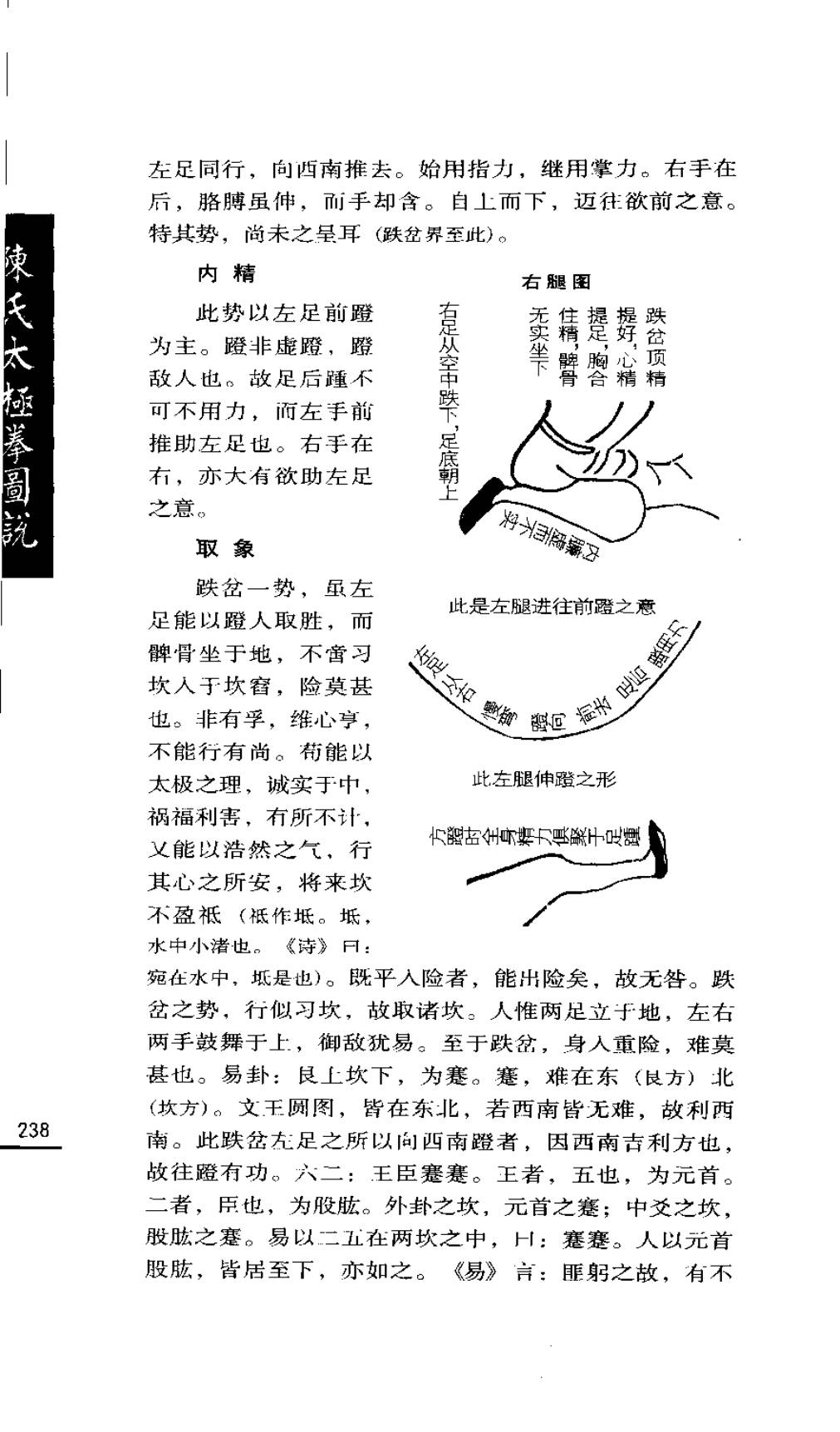
Chen Shi Taijiquan Tushuo, Juan 3 (Chen Family Taijiquan Illustrated Explanations, Volume 3)
...the image of seizing his body (this speaks of the calamity of destruction — none is greater than this). There is also the idea of what is not brought on by oneself. When the enemy's aggression is not exhausted, that is why one is brought into it; diecha (跌岔, falling-split) is the same. There is also the idea of not possessing one's own body. The head is placed low, the left foot dare not spare itself, kicking urgently forward — hence "jianjian" (蹇蹇). Therefore line Nine-Three: "going is obstruction; returning brings reversal" — this speaks of a person turning inward to examine himself, having the means to dissolve the obstruction. Though obstructed, he may still go. Line Six-Four: "going is obstruction; returning brings union" (lian). "Returning brings union" means the left foot joins with the right leg and the left and right hands, using the strength of the whole body to rush to the difficulty — those in multitude are strong. King Wu said: "I have three thousand ministers, all with one heart." Though there is obstruction, treading on danger is as if on level ground — the obstruction can be gone through. Line Nine-Five: "great obstruction; friends come." Though the head sits low, so long as the spirit of the whole body is intact, all can assist. Line Top-Six: "going is obstruction; returning brings greatness (shuo)." "Going is obstruction" speaks of my having the real capacity to bear hardship and great tasks. When it arrives suddenly, with reason upright and qi strong, no obstruction can block it. In the great battle of Kunyang, Xiu (Liu Xiu) finally won — this is the proof of "coming brings greatness." In sum: with this one kick one is not reduced to being trapped; when the gongfu is thoroughly ripe, its effect can be reaped — therefore it is also taken from the hexagram Jian (蹇). Further, Li below and Kun above — brightness entering the midst of the earth — is called Ming Yi (明夷, Darkening of the Light); it too is encountering hardship of the utmost degree. Line Initial-Nine: "the darkened light in flight, drooping its wings" — this speaks of diecha: left and right below, like a bird's wings drooping. Line Six-Two: "the darkened light wounds (yi means to level) the left thigh" — this speaks of the left foot kicking forward: the leg should extend level and relax. "It saves with a strong horse: auspicious" — this speaks of: if the foot is not strong as a horse, it cannot rescue from difficulty. Line Nine-Three: "the darkened light in the southern hunt." The inner trigram Li is due south; the outer trigram Kun is the southwest. "Southern hunt" means kicking the enemy toward the southwest and capturing his great head — that is, defeating the enemy. Line Six-Four: "entering into the left belly" — the left foot strikes the enemy's left belly. "Capturing the heart of Ming Yi" — this speaks of the enemy's pain. "Going out of the gate and courtyard" — one can now emerge from the difficulty. Though the place and time are hard, "know yourself, know the other, and in a hundred battles you will win a hundred" — this is because within there is cultured brightness (nei wen ming); therefore it is taken from Ming Yi. The hexagrams Kan, Jian, and Ming Yi — all three are borrowed forms for situations of the greatest difficulty, and without abundant virtue one is not equal to them. This matter has no great or small — its principle is one. Diecha in the boxing is likewise a situation of the greatest difficulty: without great gongfu one cannot prevail over a man with a single foot. It is not a fondness for difficulty; it is also being pressed by circumstance from which one cannot escape.
Diecha five-character vernacular verse (跌岔五言俚语)
The right foot swings down from above, the left foot brushes the ground below. One kick of the foot to the southwest — this again is attacking the unprepared.
Using a bow with the back facing down, the essence like a crescent new moon's upward curve. The left hand and left foot go from top to bottom, and at the bottom kick forward. Then again from bottom to top. Going from top to bottom is the beginning affair of diecha; going from bottom to top is the ending affair of diecha. Without this there is no way to rouse the rising momentum of the low posture (xiashi).
Seven-character vernacular verse (七言俚语)
One:
"Frighten above, take below — you must remember this; the left foot brushes the ground, and the kick brings its own advantage. The right thigh bends and the knee touches the ground; within the coiled roots lies hidden the intent of sinking."
*(Printed page number: 239. No diagrams on this page.)*
Verse, second stanza
右脚一摆已难猜,又为两翼落尘埃。
不是肩肘能破敌,一足蹬倒凤凰台。
"The right foot sweeps once — already hard to fathom; again the two wings fall to the dust. It is not the shoulder or elbow that can break the enemy — one foot kicks over the Phoenix Terrace."
Verse, third stanza
阴阳变化真无穷,只说英雄遇匪躬。
谁料妙机难预定,解围即在一蹬中。
"The transformations of yin and yang are truly inexhaustible; one says the hero meets hardship. Who could foresee that the subtle opportunity is hard to predetermine — the breaking of the siege lies within a single kick."
Verse, fourth stanza
果能太极(言太极拳)仔细研,绝处逢生自不难。
天下凡事皆如此,非徒拳艺令人观。
"If one can truly study taiji (meaning taijiquan) carefully, then finding life in a deadly situation is not difficult. All things in the world are like this; it is not merely the boxing art that is for show."
Verse, fifth stanza
一缕浩然然下行,坐中能令四座惊。
此身若非成铁汉,掷地何来金石声。
"A thread of vast moral force (haoran zhi qi 浩然之气) flows downward; within the stance it can startle all present. If this body were not an iron man, how could it strike the ground with the sound of metal and stone?"
Posture 47: Golden Rooster Stands on One Leg (Jinji Duli 金鸡独立)
What is called Golden Rooster Stands on One Leg? One leg stands alone, like a rooster standing on one leg with the other leg raised — it is an image (xiangxing 象形). This posture answers to the earlier Right Foot Sweeping (you ca jiao 右擦脚).
Jie jie (sectional explanation)
Jie jie (jie jie 节解 means: the joints of the whole body, unraveled joint by joint).
Yin meng (guidance for beginners)
From the fallen split (die cha 跌岔), the xin jing (heart essence) is lifted upward; the big toe and heel of the left foot press together with force forward; the right knee is lifted up; the toes and heel of the right foot close forward; both legs are firm; both hands gather forward; the jing of the crown and the jing of the crotch lead upward together; hands and feet exert force all at once, and one naturally rises. Just as one is about to rise, the body springs forward, the right heel kicks back. Once the body has left the ground, the left hand slowly bends and travels up to...
Figure label
- Figure: the Jinji Duli posture (standing on one leg, the other raised).
- Right column label: 右膝猛 (the right knee thrusts fiercely).
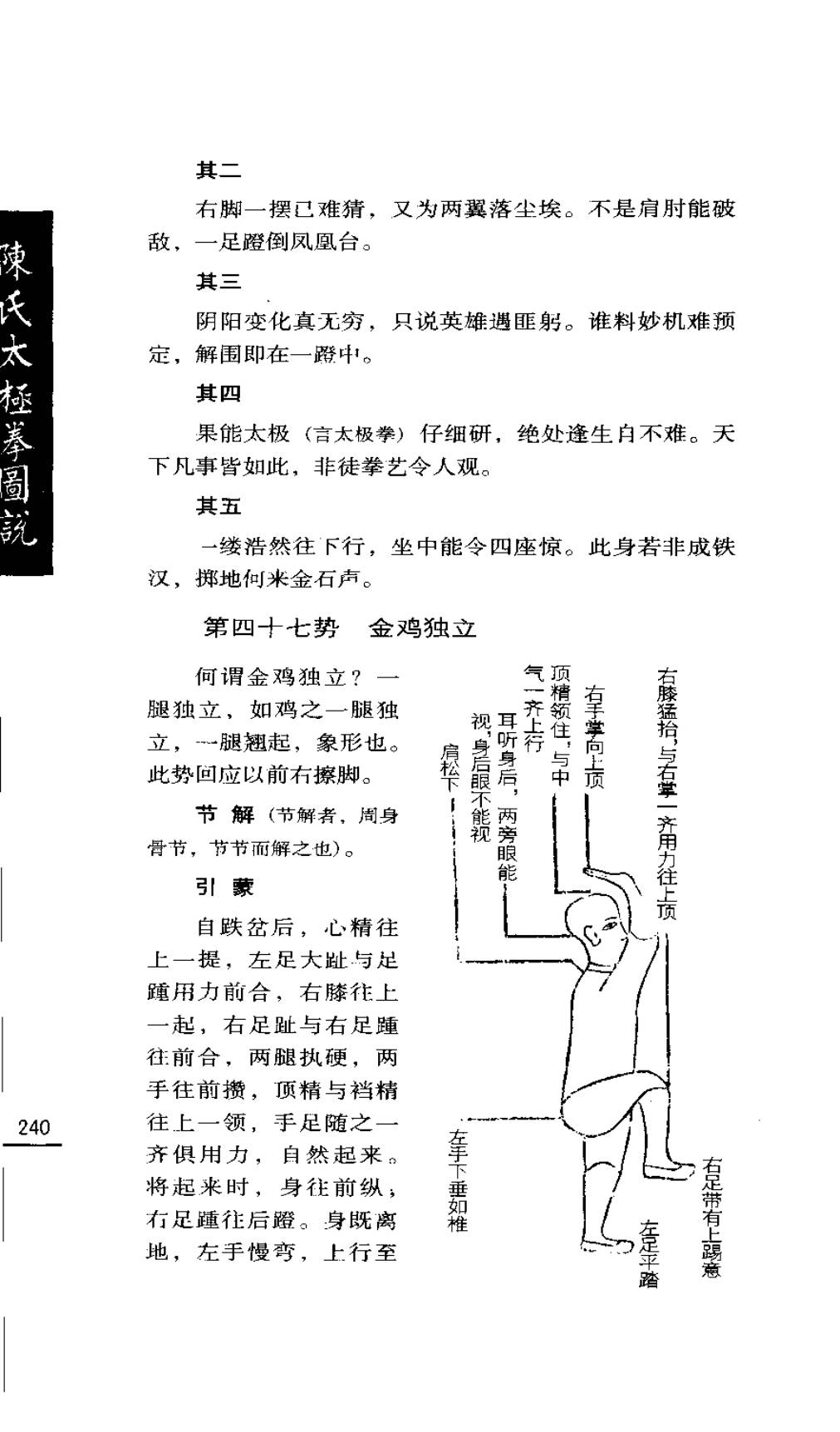
...ear. The jing (essence) is in the hand; it travels from the left shoulder and arm down to the heel of the left foot. The left hand descends in front of the shoulder, down to the left ribs, level with the breast. Then the right hand and right knee rise together; the right palm rises from below, past the outside of the right ribs, level with the left hand. Without stopping it goes straight up, the arm fully extended, the palm facing the sky; the right knee rises level with the lower abdomen, while the left hand has already hung down below. The right palm thrusts up against the enemy's bone below the Chengjiang point (承浆, the hollow below the lower lip); the right knee rises to strike the enemy's testicles (shenzi 肾子). Both are painful spots of the human body — they must not be used lightly. The left foot stands on the ground like a mountain; the right hand holds up the sky, as if it would break the heavens.
Nei jing (internal essence) — figure labels
- Right palm diagram (you zhang tu 右掌图)
- Left hand diagram (zuo shou tu 左手图)
- Large figure, label along edge: "and passes over shoulder, over ribs, over belly, then rises up again to here"
- Right foot diagram: "the right foot falls from the air to here"
- Left leg diagram: "the left leg stands straight and should be rigid; the bend of the leg is slightly bent, must not be soft"
- Right knee diagram: "the knee pushes upward"
- "The sole steps flat"
- Left hand diagram: "rises up to above the left ear"
Qu xiang (taking the image)
In terms of yin and yang: the right hand is yang, the image of the sun; the left hand is yin, the image of the moon. Kun (坤) is the belly. The right hand not only passes the belly but rises above the head, with the palm pushing up under the enemy's jaw — this is "advancing while attacking" (jin ru cui ru 晋如摧如, hexagram Jin 晋). The right hand above the head is "advancing to its horns" (jin qi jiao 晋其角). Li (离) is fire; fire's qi flames upward. The right hand and right knee both rise, like fire's qi ascending, not stopping until the utmost. Li above and Kun below — "brightness emerges from the earth" — is called Jin. Jin means to advance. The right hand rises past the crown with the sense of ascending, hence the image is taken from Jin. Below the mountain there is fire: Bi (贲). Gen (艮) is the hand and is the mountain. The hand raised is like a mountain peak towering. The second line: "adorns the beard." If the right hand can protect the beard, the head is safe. The first line: "adorns the toes" — the left foot must naturally exert force. Li dwells in the lower trigram, its brightness shines on everything, hence the image is taken from Bi. In Golden Rooster Stands on One Leg one has already escaped danger and subdued the foe — it carries the sense of "when Pi (否, standstill) reaches its extreme, Tai (泰, peace) comes; in seven days comes the return." The Yi says: "Thunder is in the midst of the earth: Fu (复, Return)." Kun is earth...
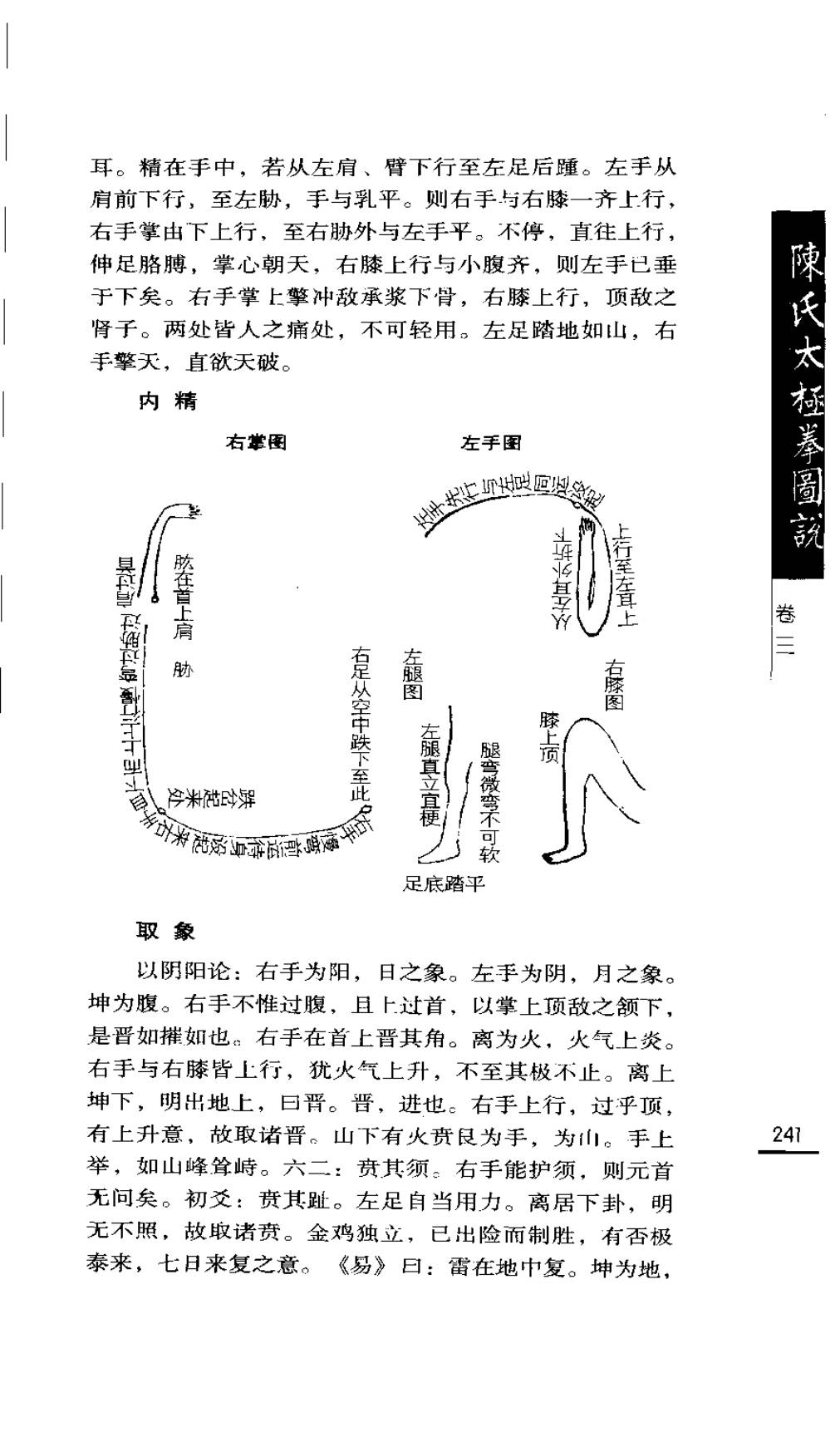
(Qu xiang, continued) ...is the belly. Zhen (震) is thunder, is the foot — it is movement. The right foot moves like thunder, the knee rising to the belly swift as thunder — hence "in the center one alone returns" (zhong xing du fu 中行独复, hexagram Fu 复). "In the center" means the zhong qi (central qi 中气) moves through the middle; "alone returns" means alone able to come out of danger and return to the ground of peace. In the earlier foot sweep, the left leg stood alone until the fallen split (die cha 跌岔), where the right leg could not stand①. But at Golden Rooster Stands on One Leg, the left leg still stands alone. Earlier the right foot swept the man and in the split the leg coiled bent on the ground. At Golden Rooster Stands on One Leg, the right knee again knees the man, again able to strike his painful spot and make him cry out. This is precisely "from Pi (否) comes Tai (泰); in seven days it naturally returns" (qi ri lai fu 七日来复). As the kernel of the great fruit has not ceased, so the heavenly mechanism of the fist has not ceased — there is in the end a principle of return; hence the image is again taken from Fu (复, Return).
Seven-character folk verses (qi yan li yu 七言俚语)
First
耸身上手擎天,左手下垂似碧莲。金鸡宛然同独立,不防右膝暗中欺。
"The body rises, the hand holds up the sky; the left hand hangs down like a jade lotus. The golden rooster stands just like on one leg — beware the right knee deceiving from the dark."
Second
一条金蛇拖玉堂,忽然飞起似鹰扬。只说右手冲上去,谁知膝(上膝盖之膝,下膝字是上顶之意)也难防。
"A golden snake drags along the jade hall, suddenly flying up like a soaring hawk. One only says the right hand charges upward — who would know the knee (the character 'knee' above means kneecap; the 'knee' below means pushing up) is also hard to guard against."
Jinji Duli (Golden Rooster Stands on One Leg)
This is the one-sided moving body method (pian yun shen fa 偏运身法). The right side of the body governs motion, the left governs stillness. In Golden Rooster Stands on One Leg, the standing is in the left jing (精); the movement is in the right, hence the right is taken as the primary. This posture rises from the fallen split. The right hand's jing travels up the right thigh, past the right ribs to the armpit, past the bend of the elbow to the right palm, turns from the five fingers to the back of the hand, passes the elbow to shoulder and arm, and descends to the right heel. The right leg's jing rises from the right toes to the knee-wrist (kneecap, xi gu 膝骨); the zhong qi rises from the dantian (丹田) past the crown of the head, turns to the back of the head, and descends to above the Changqiang point (长强). The zhong qi of hand and foot moves all at once together — it must not be done one after another. The left hand's jing travels from the left thigh up to the left ear, down past shoulder and arm, from the left hip to the Weizhong point (委中), ending at the left heel; the left foot stands without moving②. Front, back, left, right — the jing used is even and balanced, and one naturally stands stable. As for the later "facing-left heavenly kick" (chao zuo tian deng 朝左天镫), the left hand and knee move as the right did.
[Editorial notes]
① The original edition read "the right leg stands alone until the fallen split, then the left leg cannot stand"; according to the form's execution and principles, "right" was corrected to "left" and "left" to "right."
② The original edition read "the right foot stands without moving"; according to the form, "right" was corrected to "left."
Posture 48: Chaotian Deng (朝天镫 — Lamp Facing Heaven)
What is Chaotian Deng? The left palm faces upward, like today's "heaven-facing lamp" — it is an image (xiangxing 象形). This posture answers the earlier Right Brush-Foot (you ca jiao 右擦脚).
Jie jie (sectional explanation) — figure labels
- The left kneecap pushes upward (zuo xi gai wang shang ding 左膝盖往上顶)
- The chest must be held in reserve (xiong yao hanxu 胸要含蓄)
- The left palm faces up (zuo shou zhang chao shang 左手掌朝上)
- The crown jing is suspended upward (ding jing ling qi 顶精领起)
- The ear listens behind (er ting shen hou 耳听身后)
- The right shoulder sinks down (you jian song xia 右肩松下)
- The right hand hangs down (you shou chui xia 右手垂下)
- The right knee is bent only one or two tenths (you xi wei qu yi er fen 右膝微屈一二分)
- The right foot presses flat with force (you zu yong li ping ta 右足用力平踏)
- The whole body relies entirely on this one right leg to carry it — therefore it must not be soft
Figure: a man standing on the right leg alone, head tilted back gazing upward, the left knee raised high, the left arm arched over the head with palm facing the sky like a lamp held to heaven, the right arm hanging naturally.
In the human body the waist is the middle boundary: the qi of the left hand and left knee travels upward; the qi of the right hand and right thigh travels downward①. The waist is the dividing line in the middle.
Yin meng (guidance for beginners)
When the palm has finished pushing upward, the jing (精) is conducted from the fingers to the back of the hand, descends past the shoulder and arm, straight... (the sentence continues on the next page)
[Editorial note] ① According to the posture diagram, the original edition here had text and figure disagreeing, with "left" and "right" both reversed; this has been corrected.
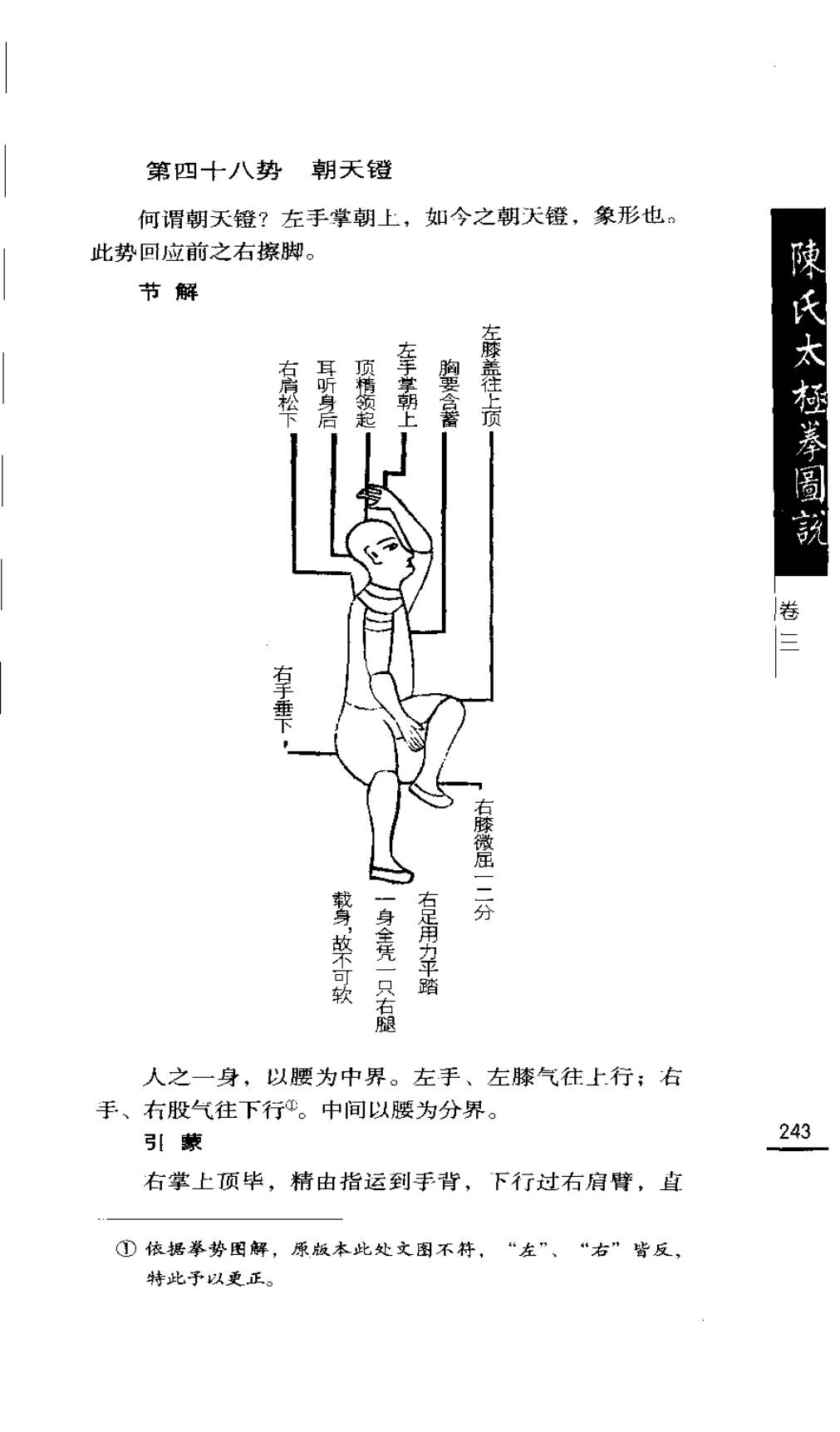
*Chen Shi Taijiquan Tushuo (Illustrated Explanation of Chen-style Taijiquan)*
...down to the right heel, passing the Yongquan (湧泉, KI-1) point, reaching Dadun (大敦, LR-1) and Yinbai (隐白, SP-1); only then has the qi (氣, qì) completed one full circuit. This is precisely how it should be circulated — it is the intention of the movement being run in the mind. As for the trace of the right hand: the thumb points downward from the right shoulder at the Jianyu (肩髃) point, passes the right ribs, and reaches the right thigh, the fingertips hanging down like an awl. The right foot moves downward; before it touches the ground, it shifts toward the northwest. The toes of the right foot point northwest, the heel lands first, a bit more than a chi (尺) away from the left foot. The left hand slowly bends; the momentum rises along the front of the left thigh, passes the left abdomen, the left ribs, the front of the left shoulder, the side of the left ear, rises over the left temple, the arm extends and thrusts straight upward, the palm facing the sky. The left knee bends and holds as it rises; the knee stops in front of the lower left abdomen.
Question: the left-side circulation is the same method — why not run both together, and instead run them separately, alternating? Answer: it cannot be done. The two hands can be raised together, but if the two feet rise together, that is the "leaping" (纵) method. If this leaping method were applied to this posture, the heart-qi (心氣) would lead upward, and the qi of the whole body would gather in the chest; although the foot of the lower body rises, the palm of the upper body would be without strength. Not entirely without strength — but the strength could not gather in the palm, and likewise the strength of the lower body could not all gather in the two knees. Once the heart-qi is lifted, the qi all gathers in the chest and has no time to distribute to the four limbs; it disperses and leaves each part to proceed step by step, slowly performing its own rotation. This is why the left and right are divided into two stages. When the left foot is grounded, the vital energy of the right half of the body can be carefully circulated one full round; when the right foot is grounded, the vital energy of the left half of the body can be carefully circulated one full round — without running into danger or unforeseen mishap. Moreover, this method of circulation also avoids the defect of neglecting one side. This is why the alternating method (迭運法) and sequential method (遞運法) are used, and not the method of running both together. That is the reason. So I say: it cannot be done. The student should examine this in detail.
Neijing (內精, Inner Essence)
What previously faced southwest now turns to face northwest. The preceding posture, Golden Rooster Stands on One Leg (金雞獨立), took the right hand and right knee as primary; this one is its reverse.
Diagram notes:
- Diagram of the left hand's circulation (左手運行圖): head, shoulder, ribs; straight up, straight down; left passing, right moving; palm facing the sky, with the left hand as primary and the palm exerting force.
- Diagram of the right hand's circulation (右手運行圖): head, ribs; down the thigh; the right hand descends from above, passes the head, passes in front of the left ribs, and reaches the thigh, the hand hanging down.
- Use the strength of the knee; here the left knee is primary.
- The left leg stands straight as in the previous left-leg method.
( Printed page: 244 )
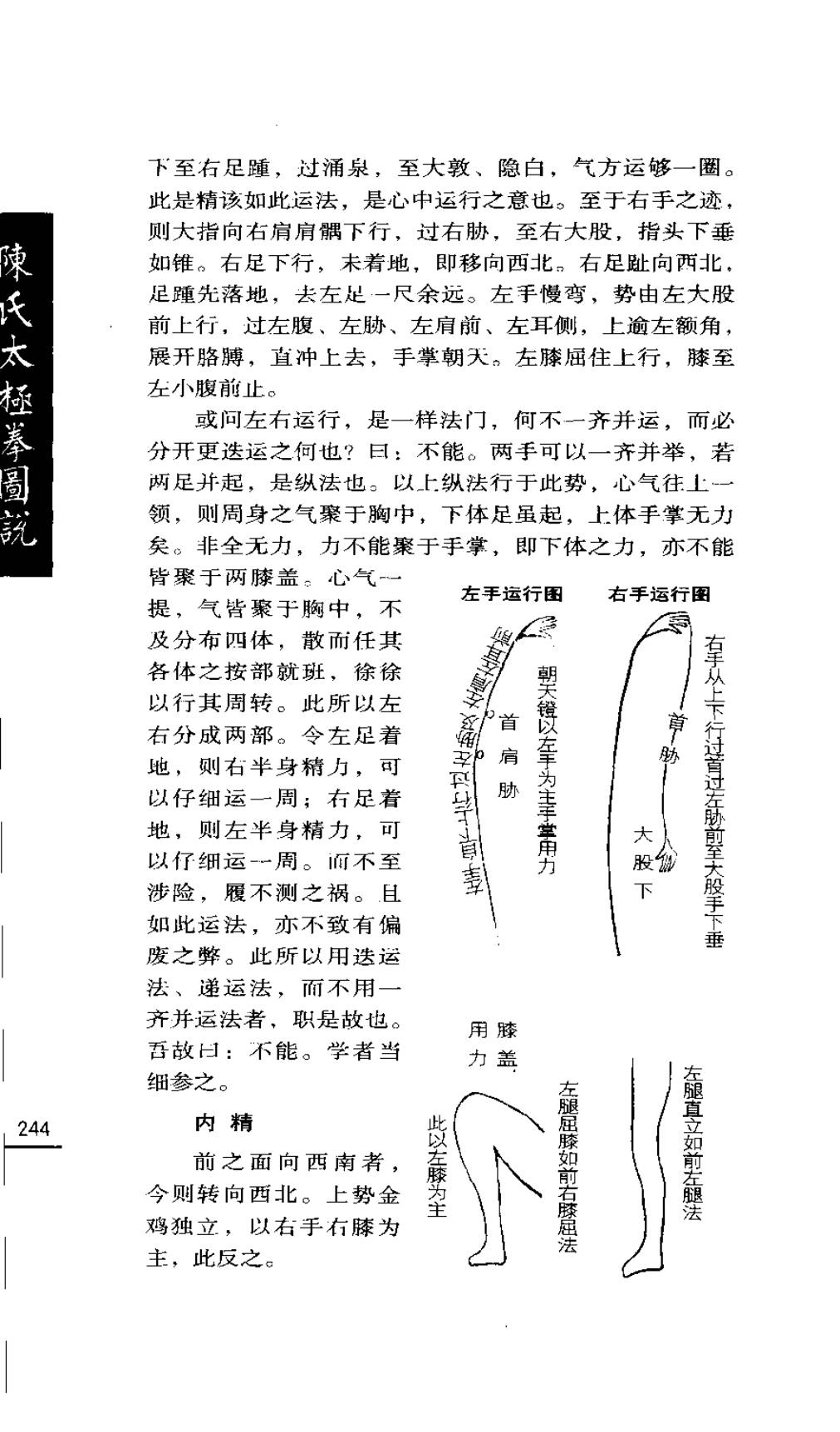
*Chen Shi Taijiquan Tushuo, Volume 3* (陳氏太極拳圖說 卷三)
Quxiang (取象, Taking the Image)
The preceding posture rises out of the Falling Split (跌岔, Diecha), lifting up while striking, and would seem harder than this one. Yet in the human body the right hand and right foot are used most, while the left hand and left foot are used less, for the left limbs are not as handy as the right. Viewed this way, the Chaotian Deng (朝天镫, "Lamp Facing Heaven" / kick toward heaven) is harder still than the Golden Rooster Stands on One Leg (金雞獨立), because the left hand and left knee cannot find their proper position. Yet the Golden Rooster first wins victory with the right hand and right knee; the Chaotian Deng then follows, winning with the left hand and left knee — the fullest flowering. When the quan (拳) reaches the Falling Split, obstruction (否, pǐ) has reached its extreme. When obstruction is at its extreme, peace (泰, tài) must come. The Golden Rooster and the Chaotian Deng, winning victory alternately left and right, may be called the extreme of peace — hence the image is taken from the Tai hexagram. The principle of heaven and earth is cyclical: nothing goes without returning. When obstruction peaks there must be peace; when peace peaks there must be obstruction — even heaven and earth cannot escape this reckoning, how much less the small art of boxing. Even so, it depends on one who handles it well. In obstruction, if one can maintain a single, steadfast heart, even obstruction will surely pass; meeting peace, if one can keep a heart that preserves fullness and guards peace, then peace will not suddenly turn to obstruction. Students of the quan should understand this.
Chaotian Deng — Seven-Character Vernacular Verses (朝天镫七言俚語)
I.
Again the palm faces heaven on high, the knee between follows the method as before; still one bend divides left and right, and once more the hero spares his whip (the crotch cannot straddle a horse — what use a whip?).
II.
The right foot comes down, the left foot hangs; the left palm stretches upward, the lamp facing heaven. If a man of talent grasps the meaning within, he laughs in turn at how one lineage runs through the Golden Rooster.
III.
The right knee at the crotch — people are not convinced; who expected the left thigh to come forth again. Do not use it until real necessity; this move can make one weep (on it hangs the fate of life and death — be careful).
IV.
The teeth and the jaw below have nothing to do with it; what is feared most is the palm held up level (borrowed word). The reckless man does not know the hardship within — it can cost him three meals a day.
( Printed page: 245 )
*Chen Shi Taijiquan Tushuo* (陈氏太极拳图说)
The 49th Posture: Dao Juan Hong (倒卷紅, Reeling Silk in Reverse / Reverse Reeling Red)
This is a retreating method, the same as the "Pearl① Reverses the Curtain" (珍珠倒卷帘); hence the name. This posture echoes the earlier Reverse Reeling Red, and also faces the Parting the Wild Horse's Mane (野馬分鬃): that one advances forward, this one retreats. When you have finished watching the left hand, turn the face to watch the right hand; the right hand's circulation is likewise watched from front to rear.
Diagram notes (a retreating stance: the left hand raised high, the right hand near the waist as if holding a pole, the head turned right watching the right hand, the left leg stepping back):
- The crown essence lifts upward (頂精上提).
- The eyes watch the hand; the left hand goes from front to rear, the eyes likewise from front to rear.
- The waist essence sinks down (腰精下去).
- The right knee exerts strength, slightly bent.
- The right foot exerts strength, planted flat.
- The belly must be full; the hand as if sweeping in.
- The perineum (會陰) must be empty, the ...
- The toes of the left foot touch the ground first.
- The left leg, if it can extend, extends fully.
Yinmeng (引蒙, Guiding the Uninitiated)
This posture is a fully spread-out body method, the hardest of all retreating movements to perform. By what channel the left hand of the Chaotian Deng went up, by that same channel it comes down. The fingers slightly hook, sweeping backward as if gathering in (in the level tone). By what channel the left foot went up, by that same channel it comes down. Before the foot touches the ground, retreat backward and open a large step. Once the step is complete, if an enemy on the right comes wielding a weapon, the right hand sweeps to the right to parry the weapon (a weapon such as a spear or staff), sweeping it back as it goes. The right foot likewise spreads out, the leg retreating, opening one large step. When the right foot's retreat is complete, it again joins with the left hand in the reverse... (text continues on the next page).
① The original edition reads 真珠; per the table of contents this has been corrected to 珍珠.
( Printed page: 246 )
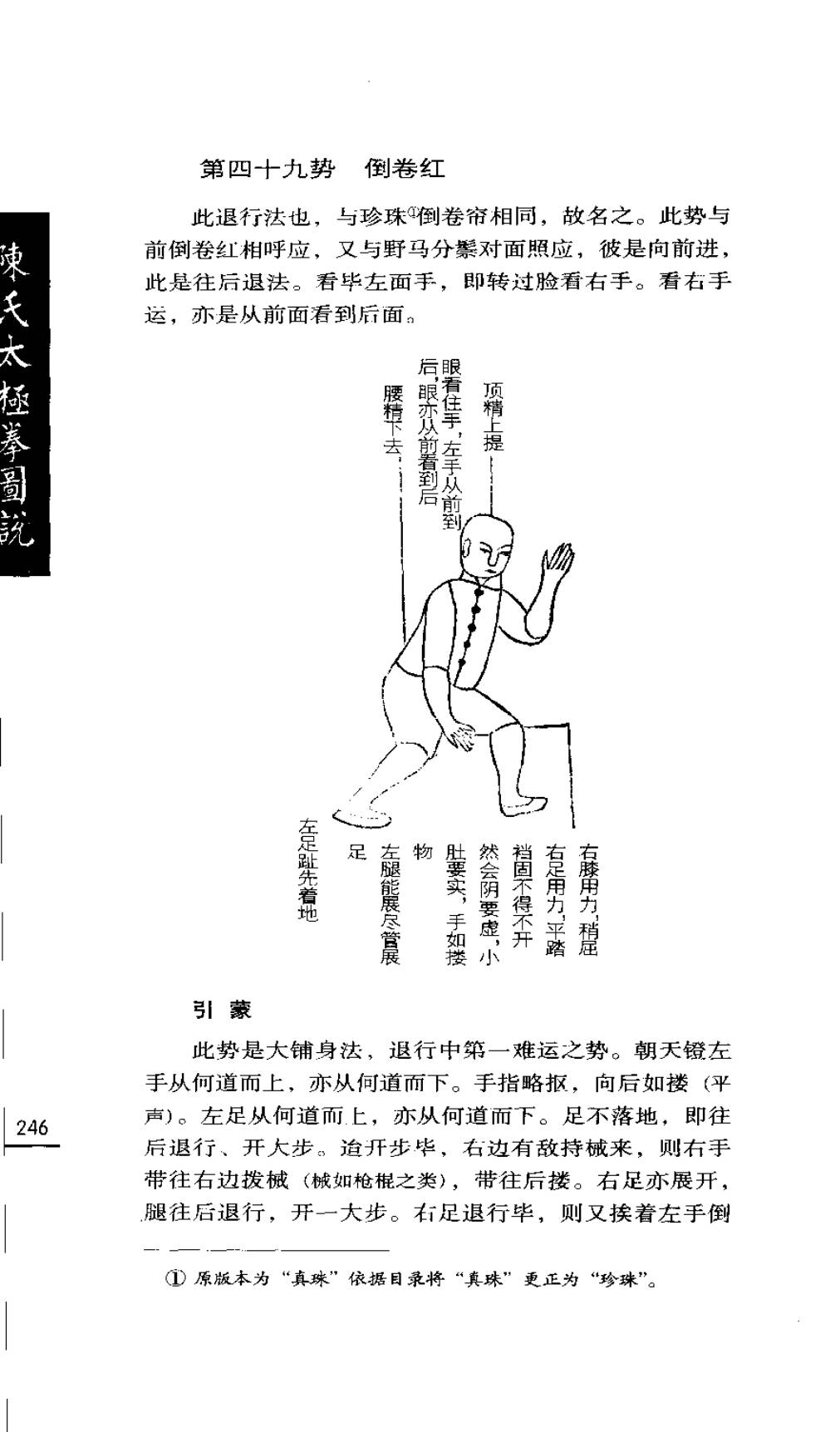
*Chen Shi Taijiquan Tushuo, Volume 3* (陳氏太極拳圖說 卷三)
...reeling (倒卷, "reverse reeling" means reversing the circle); the left foot retreats. First left, then right, two or three times on each side, until the left hand and left foot have both arrived at the rear.
Neijing (內精, Inner Essence)
Diagram notes (four figures: right-hand, left-hand, right-leg, left-leg diagrams):
- Right Hand Diagram: the right hand arrives at the rear; the right hand arrives below.
- Left Hand Diagram: arrives above; the left hand; the left hand arrives at the front; the right hand arrives at the front; left and right are both reverse-winding essence (倒纏精); if the left hand arrives at the rear, then...
- Right Leg Diagram: if the right leg is at the rear, then...; the right leg is below.
- Left Leg Diagram: if the left leg arrives at the front, then...; the right leg to the rear; the left leg is at the front; the right leg has turned to the front; if the left leg arrives at the rear, then...; if the right leg is at the front, then...; if the left leg turns to the rear, then...; the right leg is at the front.
Both legs use silk-reeling essence (纏絲精, chansijing); both wind from outside inward — this is called the reverse-winding method (倒纏法), that is, reversing the circle.
Quxiang (取象, Taking the Image)
The earlier Reverse Reeling Red (倒卷紅) took its image from Kun (坤, the Receptive); why take it again now? Let me put into words what was not fully said before. The left hand and foot should each reverse-reel and retreat — this is the meaning of the six broken lines of Kun. One might ask: why not advance, but retreat backward — is this not cowardice? Answer: no. It is like conducting a campaign: if you can attack, you attack; if you cannot attack, you withdraw and defend. Attacking is hard, but defense is not easy either; to be able to withdraw and defend in order to prepare ground for attack is harder still. In this posture it is not that one does not wish to advance; but with thousands of men and ten thousand horses, spears and blades all at one's front with no gap through which to enter, one cannot but retreat — and with the two hands, left and right, reverse-reeling to avoid their sharp edges, watching for... (continues on the next page).
( Printed page: 247 )
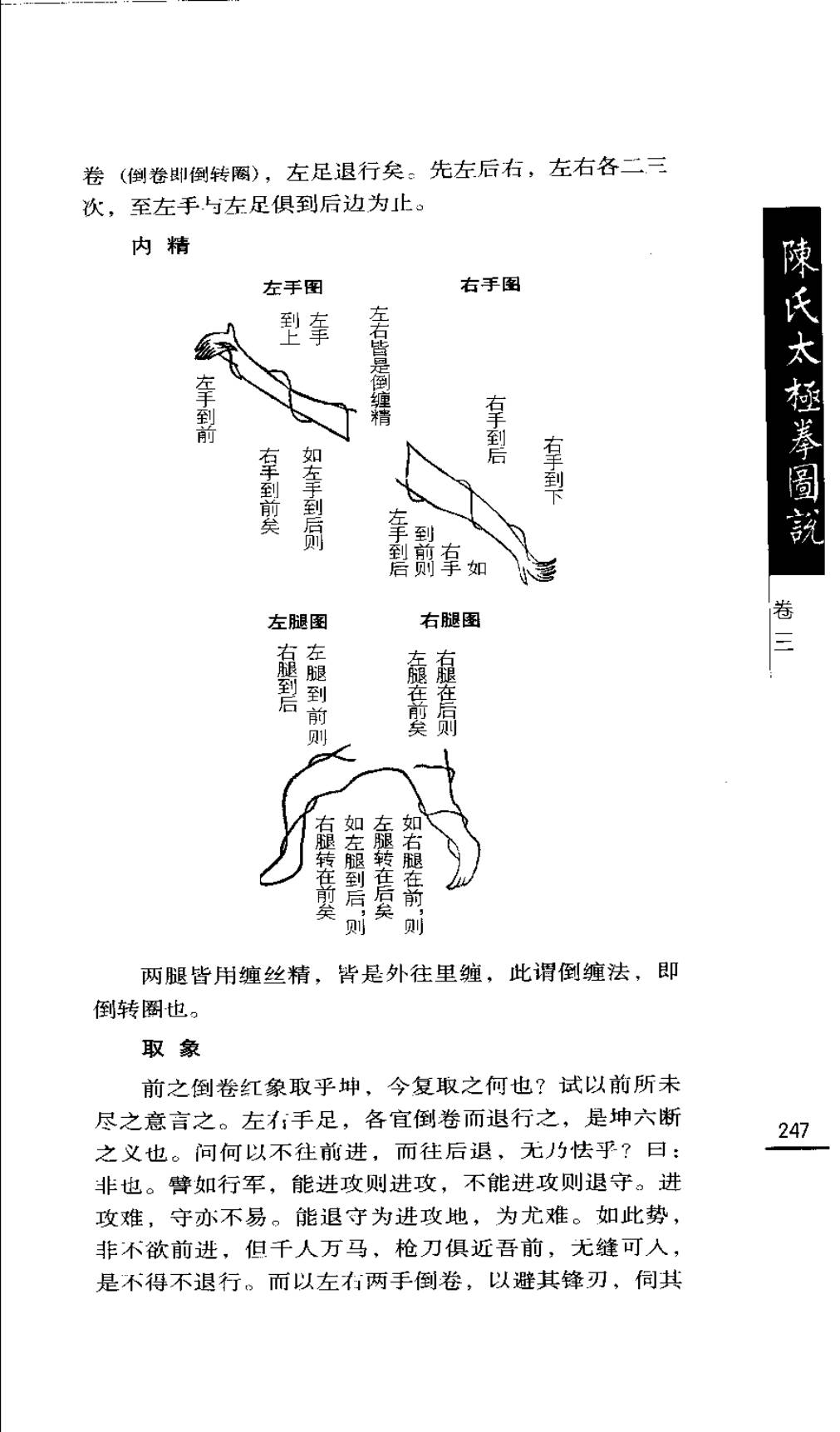
陳氏太極拳圖說 (Chen Family Taijiquan Illustrated)
To advance only after there is a gap is not too late. Moreover, if there is an opening to exploit, then one arrow hits the mark (striking the chief culprit, or hitting a vital point) — better by ten thousand times than killing nameless rank-and-file soldiers. This is the reason for retreating. The intent lies here — what is there to fear? Moreover, Kun 坤 (Earth) is compliant: comply with the time — when the time calls for retreat, retreat; comply with the ground — where the ground allows retreat, retreat; comply with the opening — when there is no opening to exploit, one naturally ought to coil back (dao juan 倒卷); comply with the momentum — when the momentum does not allow advancing, one should again retreat.
This is the yielding (Kun is the way of yielding, rou dao 柔道) overcoming the hard — taking retreat as advance is the way of Kun. Kun is the inverse (cuo 錯) of Qian 乾 (Heaven); Qian is hard. Kun is utterly yielding, yet in movement it is hard. This boxing outwardly seems yielding, but in reality is utterly hard. When the first line changes, it becomes Zhen 震 (Thunder); Zhen is the foot, movement. The foot moves — the image of retreating. It is the inverse of Xun 巽 (Wind); Xun means advancing and retreating. The boxing's advance and retreat have no fixed rule: advance when one can advance, retreat when one can retreat — judge what is fitting. [Xun] is "many white eyes": the eyes govern seeing; look left and right so that there is no failure. It is the reverse (zong 綜) of Gen 艮 (Mountain); Gen is the hand, the hand can stop things — use the hand to ward off the enemy so that he cannot injure oneself. It completes Fu 復 (Return): the two hands send and transport to and fro, ending and beginning again. When the second line changes it becomes Kan 坎 (Water), "full in the middle": the middle line is like a person's body — from Baihui 百會 to Changqiang 長強 the central qi (zhong qi 中氣) penetrates through; the four lines above and below are like the four limbs, left and right. It is the inverse of Li 離 (Fire); Li is the eye, the eyes can cast their light in all directions. Li means brightness. The hands and feet left and right move like sun and moon alternating in brightness. Li is empty in the middle: for one who retreats, his mind always thinks one step backward, not daring to be complacent, in hope of certain victory. The two lines above and below are like the left and right halves of the body, moved with real substance. It completes Shi 師 (The Army): shi means the multitude. With the mind as master, the five sense organs and the hundred bones all obey its command. When the third line changes it becomes Gen 艮: Gen is the gatekeeper (hun si 閽寺), the finger, the gate-tower. The hands, left and right, look after front, back, left and right — like a gatekeeper using his fingers to stop things, firmly guarding the gate-tower. It is the inverse of Dui 兌 (Lake); Dui is metal — smelt this body a hundred times into an iron man. As Dui occupies the West, it belongs to the metals Geng 庚 and Xin 辛. It is the reverse of Zhen 震; Zhen is the dragon — the boxing's transformations are like the dragon's, unfathomable. It completes Qian 謙 (Modesty): when I meet the enemy, I can guard myself with modest yielding; good fortune predominates and blame is rare. As for the changes of the fourth, fifth, and sixth lines, their meaning is the same. Since Kun's changing lines are thus, it is taken again. And that this posture is empty in front and solid behind naturally goes without saying.
Second Dao Juan Hong 倒卷紅 (Reverse Coiling Red) — Seven-Character Folk Verses
The First
Beneath the sky-facing stirrup (chao tian deng 朝天鐙) comes the Reverse Coiling Red; the left hand first returns, swift as the wind. When the left hand finishes turning, the right hand turns — retreating, truly a great hero.
The Second
The two hands turn like a screw-thread, one up and one down, perfectly even. It all depends on Taiji's true quickening (zhen xiao xi 真消息): four ounces can deflect eight thousand catties (this means that four ounces of strength can turn aside eight thousand jin 八千斤).
(Printed page: 248)
陳氏太極拳圖說 卷三 (Chen Family Taijiquan Illustrated, Volume III)
The Fiftieth Form: White Goose Shows Its Wings (Bai E Liang Chi 白鵝亮翅)
It echoes and corresponds to the two previous White Goose Shows Its Wings. This posture responds to the two earlier White Goose Shows Its Wings as a conclusion.
Section Explanation (Jie Jie 節解)
(Diagram: a figure in a seated, low stance, both palms extended forward with the palm centers facing forward, showing the White Goose Shows Its Wings posture; thin bracket lines connect to the crown of the head, eyes, shoulders, elbows, hands, waist, crotch 襠, knees, and feet.)
Diagram annotations (right side, top to bottom):
- the left elbow sinks down
- the jing at the crown is held up (ding jing 頂精領住)
- the eyes watch the right hand
- the shoulder loosens down
- the left hand follows the right hand
- the right hand leads the right foot
- the waist jing settles down
Diagram annotations (bottom, right to left):
- the left foot follows the right foot to the right
- the left knee is also slightly bent and held
- the crotch jing (dang jing 襠精) opens round
- the right foot treads level on the ground
- the right knee is bent and held
Diagram annotation (left side):
- the left elbow sinks down
Guiding the Beginner (Yin Meng 引蒙)
This posture is purely the jing of leading in (yin jin 引進). In the Reverse Coiling Red 倒卷紅, the left hand arrives below; the right hand goes from right to left, the two hands about one chi apart. The right hand leads the left hand, first turning a small circle from the left, then following the momentum obliquely upward from the left to the right. The right foot likewise first turns a small circle, then steps out from left to right; the left foot follows the right foot to the right, the two feet five or six cun apart, the toes of the left foot touching the ground. The right hand and right foot turn together — only then does it become one qi (yi qi 一氣).
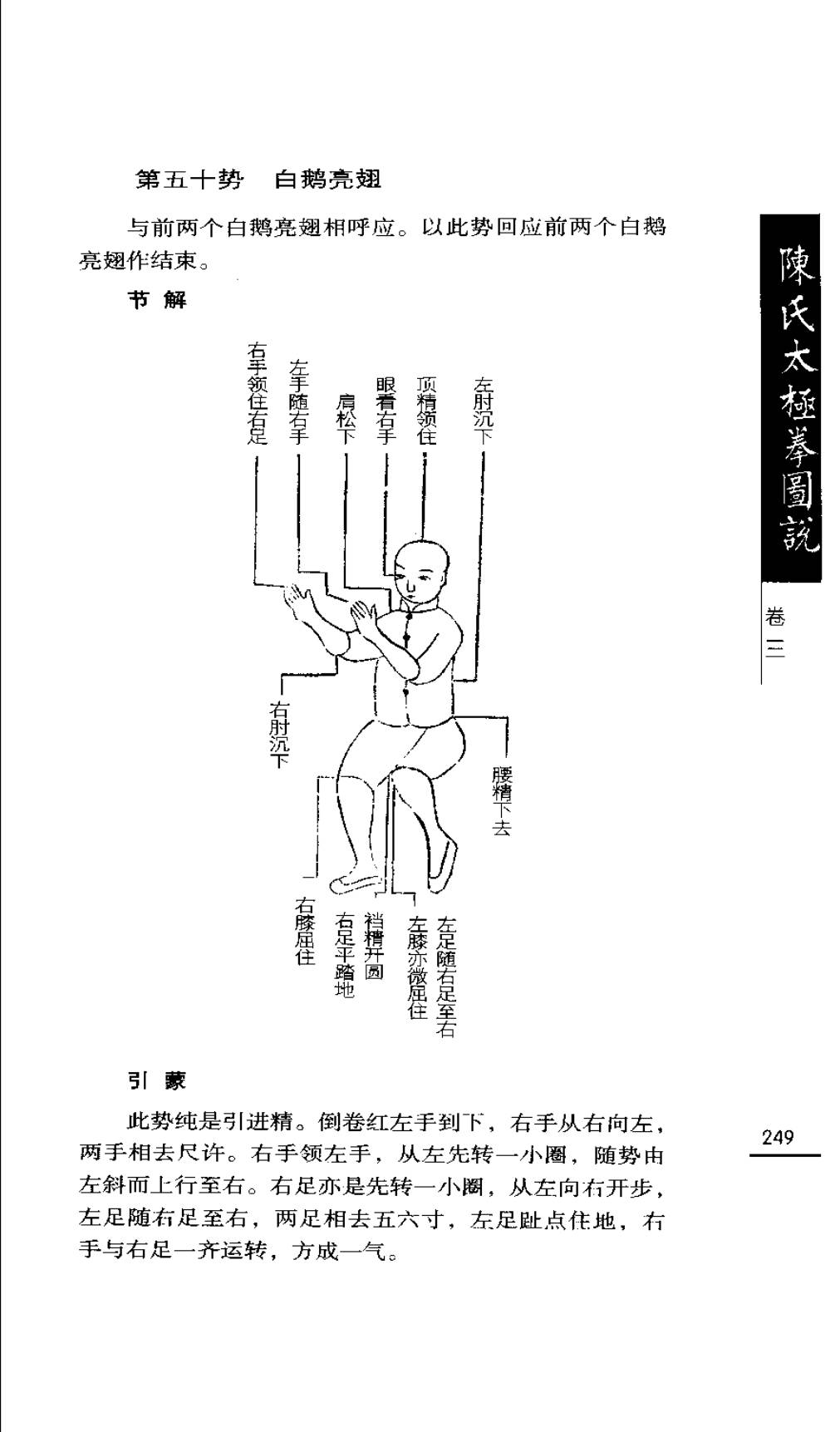
陳氏太極拳圖說 (Chen Family Taijiquan Illustrated)
Inner Jing (Nei Jing 內精)
The method of movement along the route has already been diagrammed before. The right hand uses the compliant-turning method (shun zhuan 順轉); the right foot does likewise. The left hand uses the reverse-turning method (dao zhuan 倒轉) — all of these are coiling-silk jing (chansijin 缠丝精). The right hand and right foot move together with the left hand; only the left foot must wait until the right foot has landed, then the left foot follows it also toward the right, its toes touching the ground.
Taking the Image (Qu Xiang 取象)
In the previous posture, Reverse Coiling Red 倒卷紅, the body was amid peril. This posture resolves difficulties and untangles disputes, coming out beyond the peril. Therefore it is taken from Jie 解 (Deliverance/Difficulty). But to deliver from difficulty, leading in (yin jin 引進) cannot be dispensed with.
Seven-Character Folk Verses
The First
The third White Goose, its feathers full and rich; turning left toward the right, this technique is most refined. Within this lies boundless meaning reserved and contained — again it leads a person in and drops him into emptiness.
The Second
Each posture is harder than the last; this posture whirls like a rolling pellet. The marvelous mechanism originally issues from the heart — how could the enemy discern where the dragon coils (long pan 龍蟠)?
The Third
The secret of leading in can never be fully told: one yin, one yang — look within the hands. To suppress, first raise — this is the true principle; striking a person does not depend on whipping the horse first (i.e., on moving first).
陳氏太極拳圖說 卷三 (Chen Family Taijiquan Illustrated, Volume III)
The Fifty-First Form: The Third Brush Knee and Twist Step (Lou Xi Ao Bu 搂膝拗步 — lou in the level tone)
This posture responds to the two previous Brush Knee and Twist Step postures.
(Diagram: a figure standing in a stance showing the Brush Knee and Twist Step posture; thin bracket lines connect to the crown of the head, eyes, shoulders, elbows, hands, waist, crotch 襠, knees, and feet.)
Diagram annotations:
- the left hand is behind
- the eyes watch the middle finger
- the jing at the crown is held up (ding jing 頂精領住)
- the shoulder loosens down
- the right elbow sinks down
- the right knee is slightly bent
- the right foot treads rather level
- the crotch jing (dang jing 襠精) props round
- the left foot is a little ahead of the right foot, treading level on the ground
- the left knee, the kneecap showing
- the waist jing settles down
Further annotation: calm the heart and settle the qi (ping xin jing qi 平心靜氣); do not let crosswise qi (heng qi 橫氣) fill and block the chest.
Guiding the Beginner (Yin Meng 引蒙)
The left and right hands divide downward, level, from in front of the chest, both using reverse coiling-silk jing (dao chansijin 倒缠丝精). The right hand circles around the right knee, turns behind and back to in front of the chest, about a chi or more from the chest. The middle finger faces the tip of the nose (bi zhun 鼻准) in mutual regard; the eyes watch the middle finger. The left hand brushes the left knee from the left side: the hand sweeps from behind to the front around one full circle, then turns back behind, the hand regarding and settling with the spine, the five fingers gathered together. The left foot takes a large step out from right to left; after it lands, the rear foot is like a hook — above and below join together.
Inner Jing (Nei Jing 內精)
For the explanation, see the Sixth Form.
The head is upright, the eyes gaze level; shoulder joins with shoulder, elbow with elbow, hand with hand, thigh-root with thigh-root, knee with knee, foot with foot. Calm the heart and settle the qi,
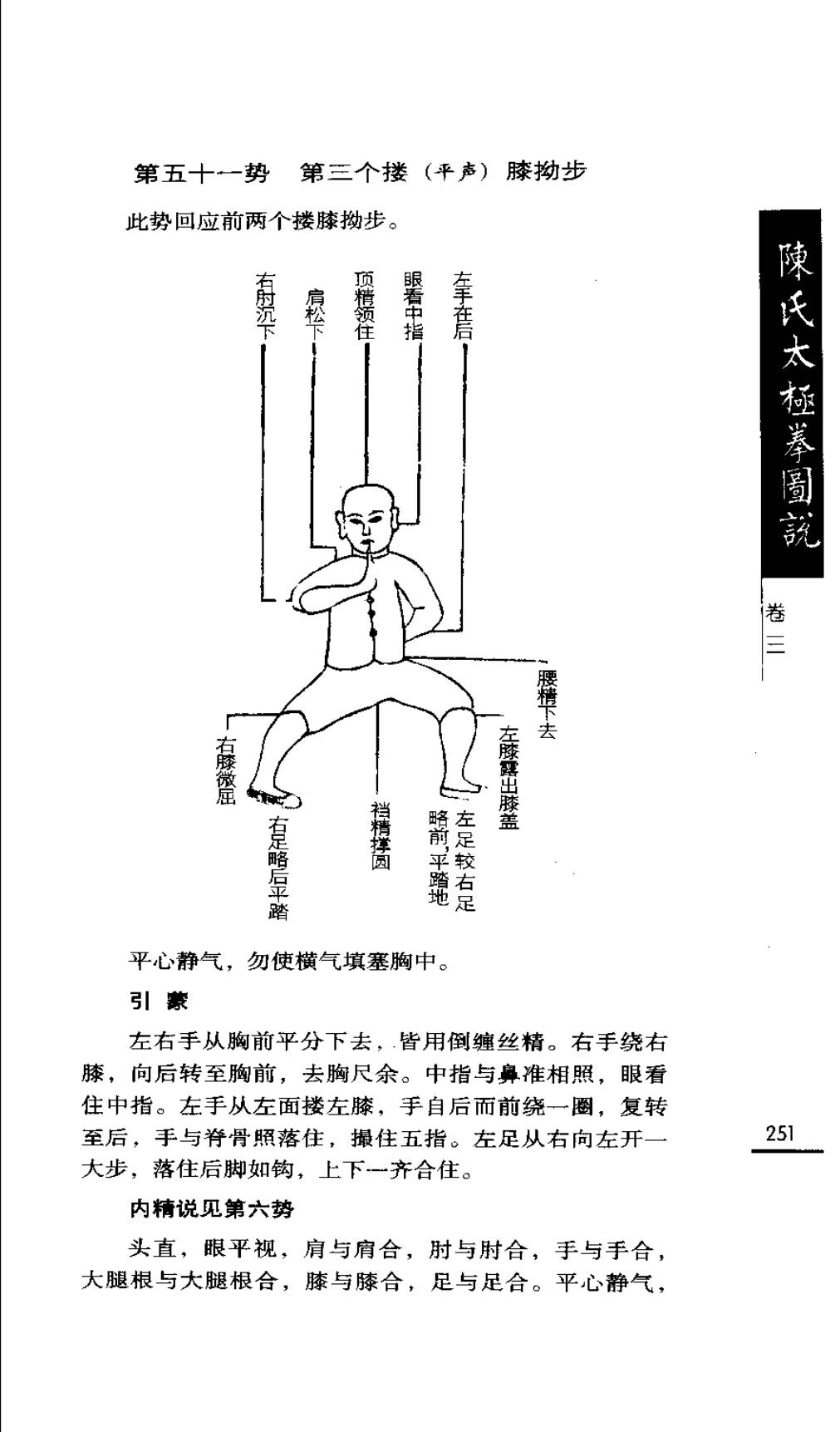
陳氏太極拳圖說 卷三 (Chen Family Taijiquan Illustrated, Volume III)
The Fifty-First Form: The Third Brush Knee and Twist Step (Lou Xi Ao Bu 搂膝拗步) (continued)
It is said "join" (he 合): above and below join together as one, and the qi returns to the dantian 丹田. All the joining methods use the reverse-coiling method; only the left foot's opening step uses the compliant-turning method. This posture is purely joining jing (he jing 合精).
Taking the Image (Qu Xiang 取象)
This posture takes Qian 乾, Kun 坤, Kan 坎, and Li 離. In terms of directions, the explanation is given in the Sixth Form. Speaking of Qian, Kun, Kan, and Li, the four corner trigrams — Dui 兌, Zhen 震, Xun 巽, and Gen 艮 — are contained within them. Here the trigrams are taken for their virtue (de 德), not merely for their positions or their line-structures.
Seven-Character Folk Verses
The First
Brush Knee and Twist Step reaches the third; it responds to those lying hidden before (referring to the two previous Brush Knee and Twist Steps), the zest at its height. Prepared on all four sides and eight directions — only when the work is complete does one realize it was no empty talk.
The Second
When the primal vital energy of Great Harmony (tai he yuan qi 太和元氣) reaches stillness, without stillness one does not see the marvel of movement. Six trigrams, four yin (on all four sides above and below) — who could explain it? Only the one who has attained it knows it himself.
The Fifty-Second Form: Dodge and Thread Through the Back (Shan Tong Bei 閃通背)
It responds to the previous Shan Tong Bei.
Section Explanation (Jie Jie 節解)
Guiding the Beginner (Yin Meng 引蒙)
When the previous posture, Brush Knee and Twist Step, is finished, the right foot takes a large step forward; the right hand goes from right to left, first circling a small circle, turning back to the front crown, stopping with the hand on the upper slanting edge. Bend the waist greatly, splitting down through the crotch 裆 until reaching the inner ankles, left and right; then from below sweep upward, the hand arriving at Xinhui 囟會 (GV22, fontanelle point). The left foot takes a large step forward, the left hand following the left foot from behind to the front, the hand level with the shoulder, the arm spread open. Then the body turns around reversed; the right foot follows the body in the reverse turn, landing behind the left foot. The right hand likewise follows the body's reverse turn, from above downward, landing behind the right foot, the hand level with the waist, the arm spread open — this is the great turning-body method (da zhuan shen fa 大轉身法). It depends entirely on
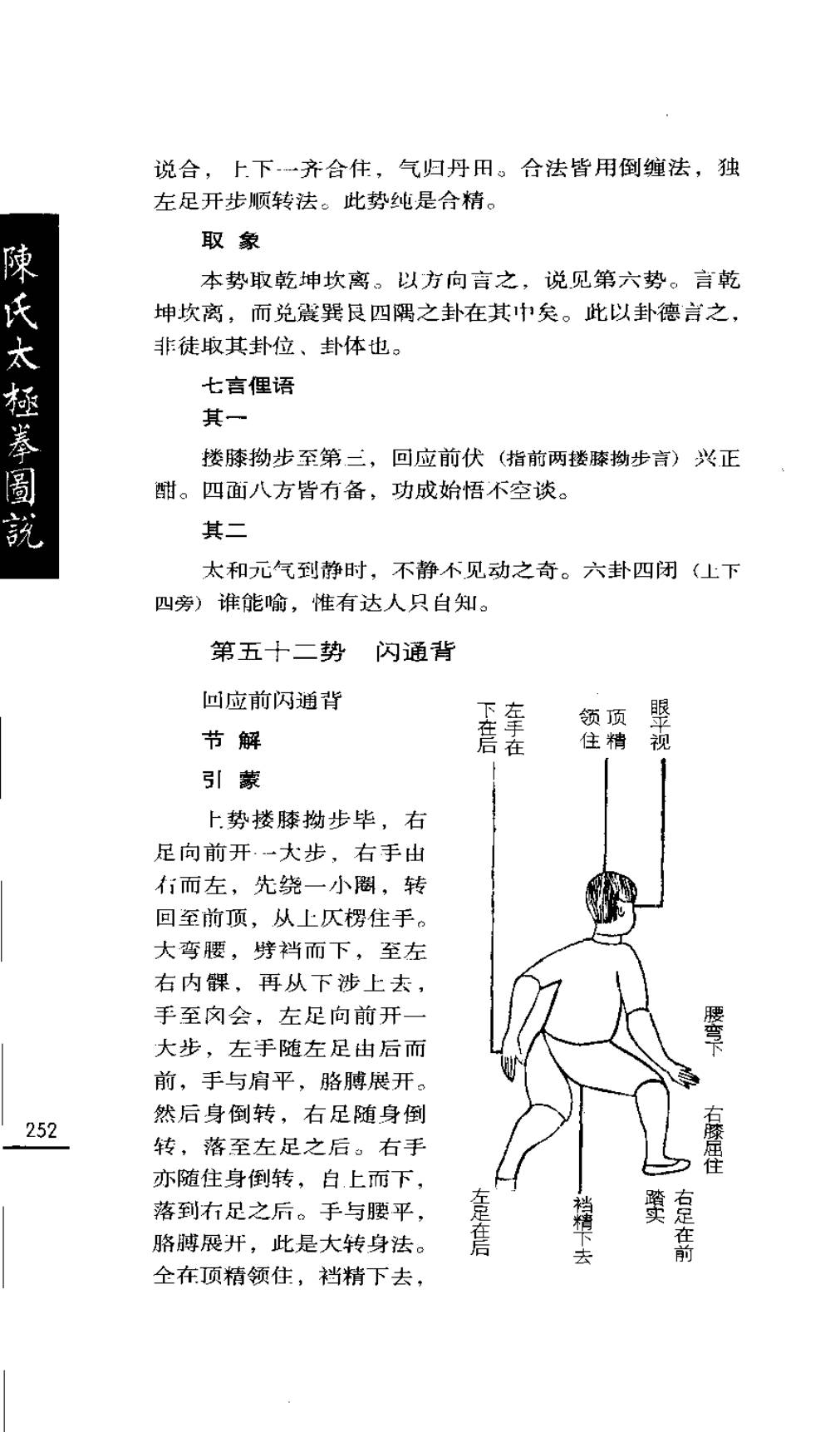
陳氏太極拳圖說 卷三 (Chen Family Taijiquan Illustrated, Volume III)
the liveliness of the footwork, with both shoulders loosened open and hands and feet following one another above and below — only then is it attained.
Inner Jing (Nei Jing 內精)
The diagrams and explanations are all given in detail before.
Seven-Character Folk Verses
Then use the right hand again to face the enemy in front, while an enemy behind again grabs my waist. Who would know my waist suddenly bends down, the tailbone (tun gu 臀骨) thrusting upward (in the rising tone) — the enemy can hardly escape. This is speed jing (su jing 速精); if slow, it will be too late. It looks like a crude posture, but in fact its subtlety is beyond compare.
The Fifty-Third Form: The Sixth Performing-Hand Fist (Di Liu Yan Shou Quan 第六演手捶)
It is the direct counterpart of the Third Performing-Hand Fist. It also ties together the five previous performing-hand fists, and it initiates the Fist at the Crotch (zhi dang chui 指襠捶) that follows. This single fist, in the manner of literary composition, connects what precedes with what follows.
Section Explanation (Jie Jie 節解)
(Diagram: a figure standing in a stance showing the Sixth Performing-Hand Fist posture, left bow stance, the left hand extended forward with fingers spread, the right hand holding a fist in front of the chest with the elbow tip pointing up, the head turned to look back behind the body.)
Diagram annotations:
- the left fingers spread open, to correspond with the right fist
- the right hand grips the fist; the eyes watch the fist
- the jing at the crown is held up (ding jing 頂精領住)
- the waist jing settles down
- the crotch jing (dang jing 襠精) settles down well
- the left knee is bent and held
- the ground — the left foot treads level, using force
- the right hand joins in; the elbow tip points upward
- the ears listen behind, guarding against the enemy's secret scheme
- the right heel treads the ground — it must be with force
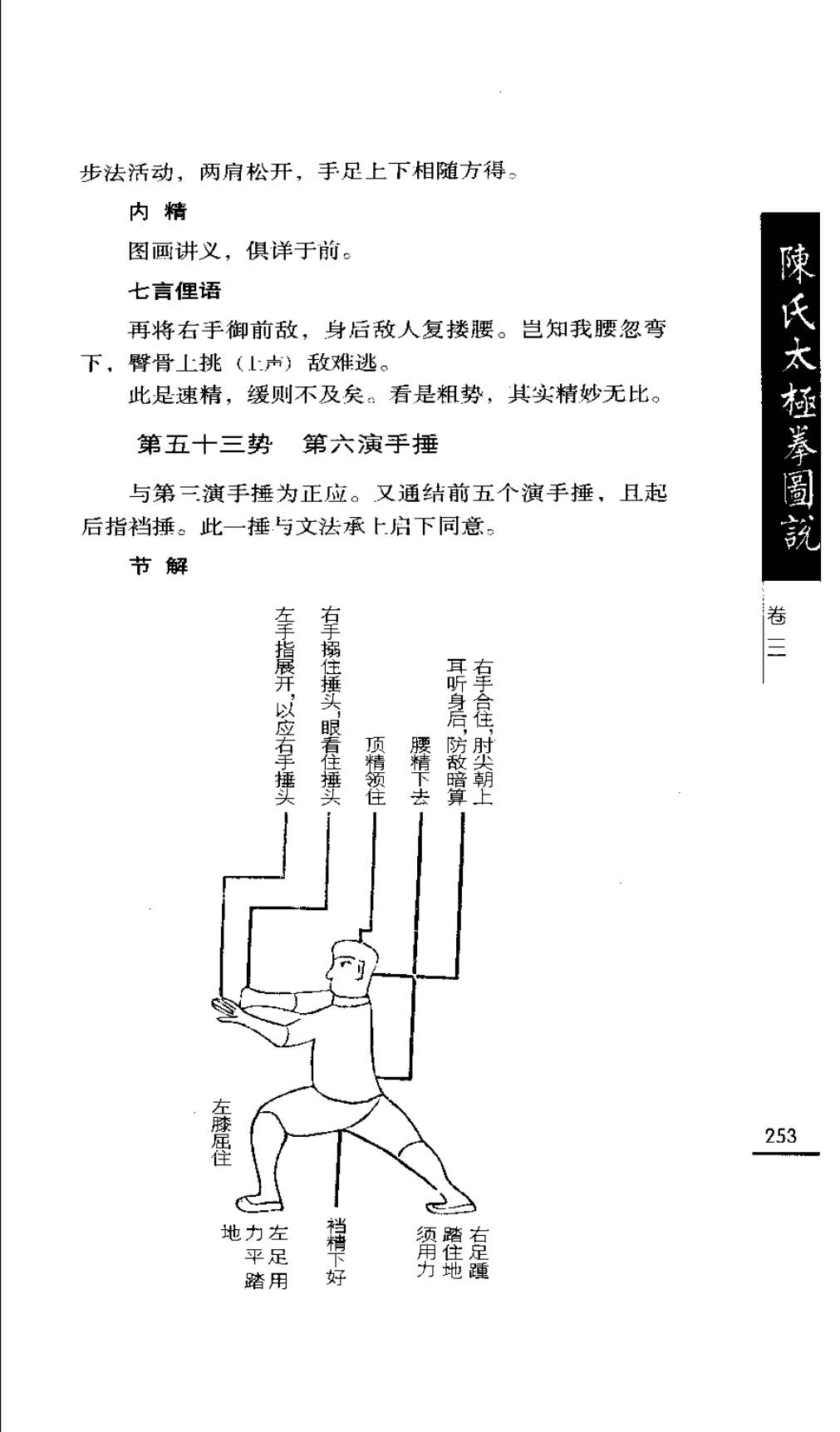
陳氏太極拳圖說 卷三 (Chen Family Taijiquan Illustrated, Volume III)
Guiding the Beginner (Yin Meng 引蒙)
In the Third Performing-Hand Fist, the right hand strikes the enemy in front and the right foot likewise follows, landing in front — hence it forms a back-view diagram. Because the enemy was somewhat far, the right foot was especially advanced to reach the enemy. In this performing-hand fist, however, the right hand strikes forward using the joining fist (he chui 合捶); but the enemy is very close to my body, so the right foot need not advance a step to assist where the right hand falls short. The right foot does not move and remains behind — hence it forms a front-view diagram.
Inner Jing (Nei Jing 內精)
In Shan Tong Bei 閃通背 the body collided and turned back around; the right foot is behind and the right hand also behind. Use coiling-silk jing (chansijin 缠丝精), turning one full circle from behind, then joining forward into the fist — only then does the strike have force. Moreover, the jing of the whole body, above and below, must all join together, with the spirit gathered entirely in the fist — only then can it defeat the enemy. The diagrams of inner jing all appear before.
Taking the Image (Qu Xiang 取象)
Cui 萃 (Gathering), Xiao Guo 小過 (Small Excess), and Da Zhuang 大壯 (Great Strength) were already discussed for the Third Performing-Hand Fist; here Zhen 震 (Thunder) is taken again. For the fist can frighten those near and startle those far — "thunder startles for a hundred li"; the performing-hand fist is like this.
Seven-Character Folk Verses
A clap of thunder bursts from the dust; the myriad creatures are startled together — thunder for a hundred li. The right hand strikes from below toward the front, just like the rolling rumble (hui hui 虺虺) in the sky.
Chen Shi Taijiquan Tushuo (陳氏太極拳圖說), Volume 3
Posture 54: Lan Ca Yi (攬擦衣)
This Lan Ca Yi (攬擦衣) echoes the previous Lan Ca Yi, and brings to a conclusion the first three Lan Ca Yi.
Jie Jie (節解, Section Explanation):
- Waist jing (腰精) sinks down
- Right knee bends and holds
- Right foot treads flat
- If the body is not stable, it must be propped round
- From beginning to end the crotch jing (襠精) sinks down; if the crotch jing does not sink down, it sinks below
- The left foot presses firmly against the ground
Yin Meng (引蒙, Guiding Instructions):
The right hand withdraws to in front of the right ribs; the right foot advances from behind to the right of the left foot, level with it. Then the right hand and right foot move together. The right hand, from in front of the left ribs, first circles a small circle from below upward, then slowly unfolds the arm from left to right; the hand opens, the five fingers bound together, the hand level with the shoulder. The right foot follows the right hand, also first circling a small circle,
Diagram labels:
- From beginning to end the fist must never lose its top jing (頂精); once the top jing is lost, the four limbs have nothing to attach to and lack spirit, therefore it must be led up, to serve as the guiding principle for the whole body.
- The eyes look at the right middle finger; the right hand opens with the fingers bound.
- The chest closes forward holding the jing; the chest slightly bent, naturally holding it.
- The left hand braces at the waist
- The left shoulder relaxed
- Waist jing sinks down
- Right knee bends and holds
- Right foot treads flat
- If the body is not stable, it must be propped round
- From beginning to end the crotch jing sinks down
- The left foot presses firmly against the ground
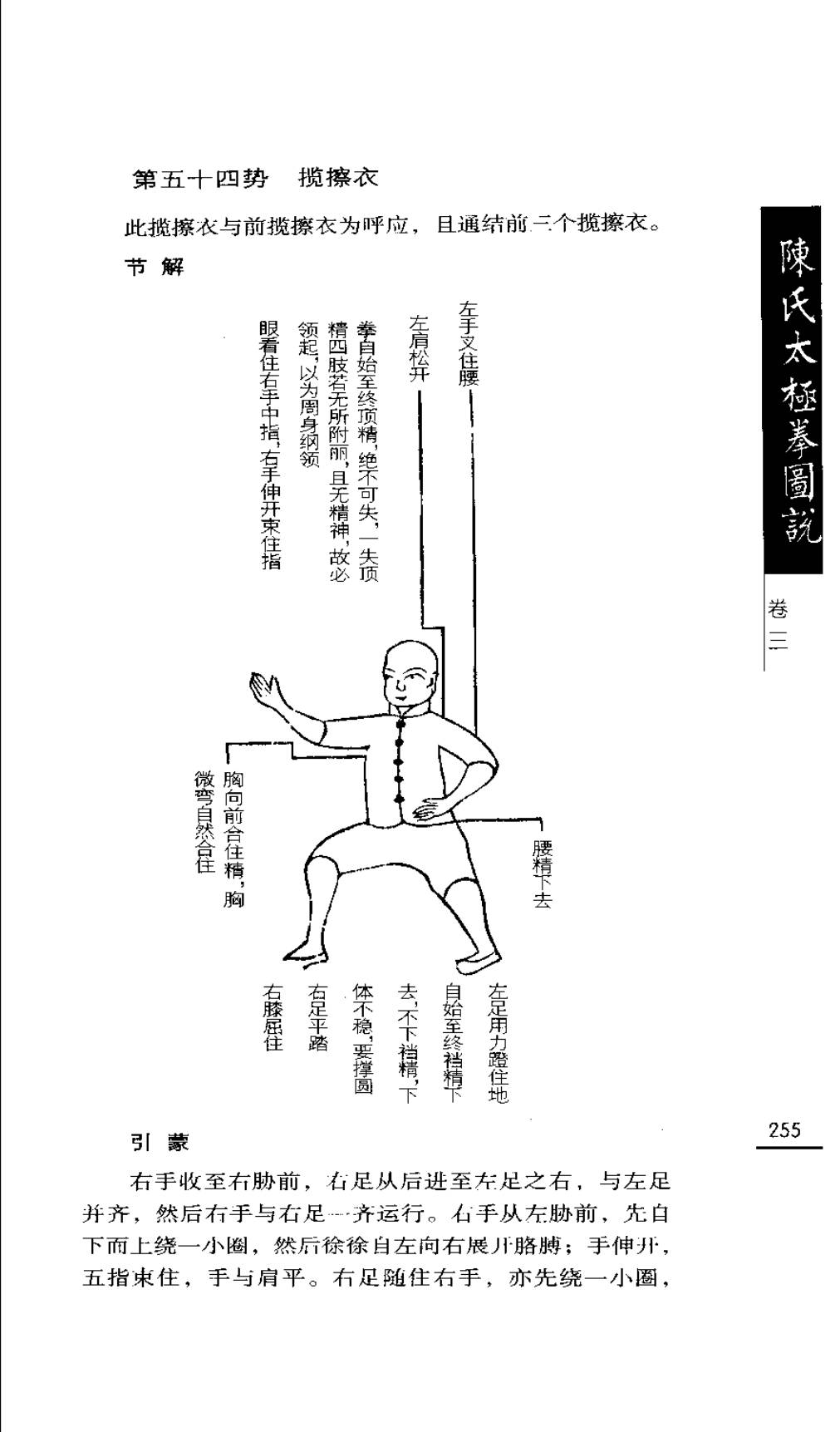
Chen Shi Taijiquan Tushuo (陳氏太極拳圖說)
Then slowly bend from the left, the posture like a new moon, stepping out to the right. The left foot stays in place without moving; the left hand circles a round from inside to outside, then turns back to below the left armpit, bracing the waist.
Nei Jing (內精, Internal Energy):
The moving hand uses forward silk-reeling energy (順纏精, shun chan), reeling out to the fingertips. Reeling from inside to outside is called forward silk-reeling (順纏). The right leg likewise uses forward silk-reeling energy, reeling out to the toes. The left hand uses reverse silk-reeling energy (逆纏精): reeling from outside inward is called reverse silk-reeling (逆纏) or inverted reeling (倒纏). The diagrams are seen earlier, at the first Lan Ca Yi (攬擦衣) and Posture 22.
Qu Xiang (取象, Taking the Image):
Posture 2 took Tai (泰), Posture 21 took Xiao Xu (小畜), Posture 43 took Meng (蒙) — each has its own meaning, already stated before. This posture: the left arm bent is like "the hidden dragon does not act" (潛龍勿用); the right arm extended is like "the dragon appears in the field" (見龍在田); therefore it also takes from Qian (乾). The way of Qian transforms without fixed direction, possessing the virtue of yang firmness (陽剛). The left and right arms likewise transform without fixed direction, hence they are compared to the dragon.
Qi Yan Li Yu (七言俚語, Seven-Character Folk Verse):
Alone the right hand extends like the appearing dragon; the left hand coils back to seal the left side. Of itself the Great Harmony's primal qi (太和元氣) governs; one yin and one yang guard the chest.
Chen Shi Taijiquan Tushuo (陳氏太極拳圖說), Volume 3
Posture 55: The Seventh Single Whip (第七单鞭, Di Qi Dan Bian)
Jie Jie (节解, Section Explanation):
It corresponds from afar with the previous six Single Whips.
Diagram labels:
- The left arm and fingers extended open, the five fingers bound together
- The shoulder relaxed
- The eyes fixed on the left middle finger
- The top jing (頂精) held up
- The ears listening behind
- The right arm must not be raised up like a rack; follow its natural course
- The left arm held with the back; the right five fingers bound together
- The chest must be contained (含蓄); the qi (氣) descends to the dantian (丹田); no horizontal qi left above
- The left knee bends and holds
- The waist jing sinks down
- The crotch jing sinks down and props round
- The left foot treads flat in an eight-character (八字) shape
- The left foot hooks forward
- The heel uses pressing jing (蹬精)
- The right leg must not go soft
Yin Meng (引蒙, Guiding Instructions):
The left hand draws out from the waist and closes with the right hand. The right hand first turns a small circle, using the forward-turning method (順轉法) to slowly extend the arm leftward, five fingers bound, eyes on the middle finger; the right hand turns a small circle from the front and closes with the left hand. The right hand uses inverted-turning jing (倒轉精). The left foot first withdraws beside the right foot, first turning a small circle; then steps out a large step leftward like the character eight (八字), swinging the right foot back to press the ground, treading flatly.
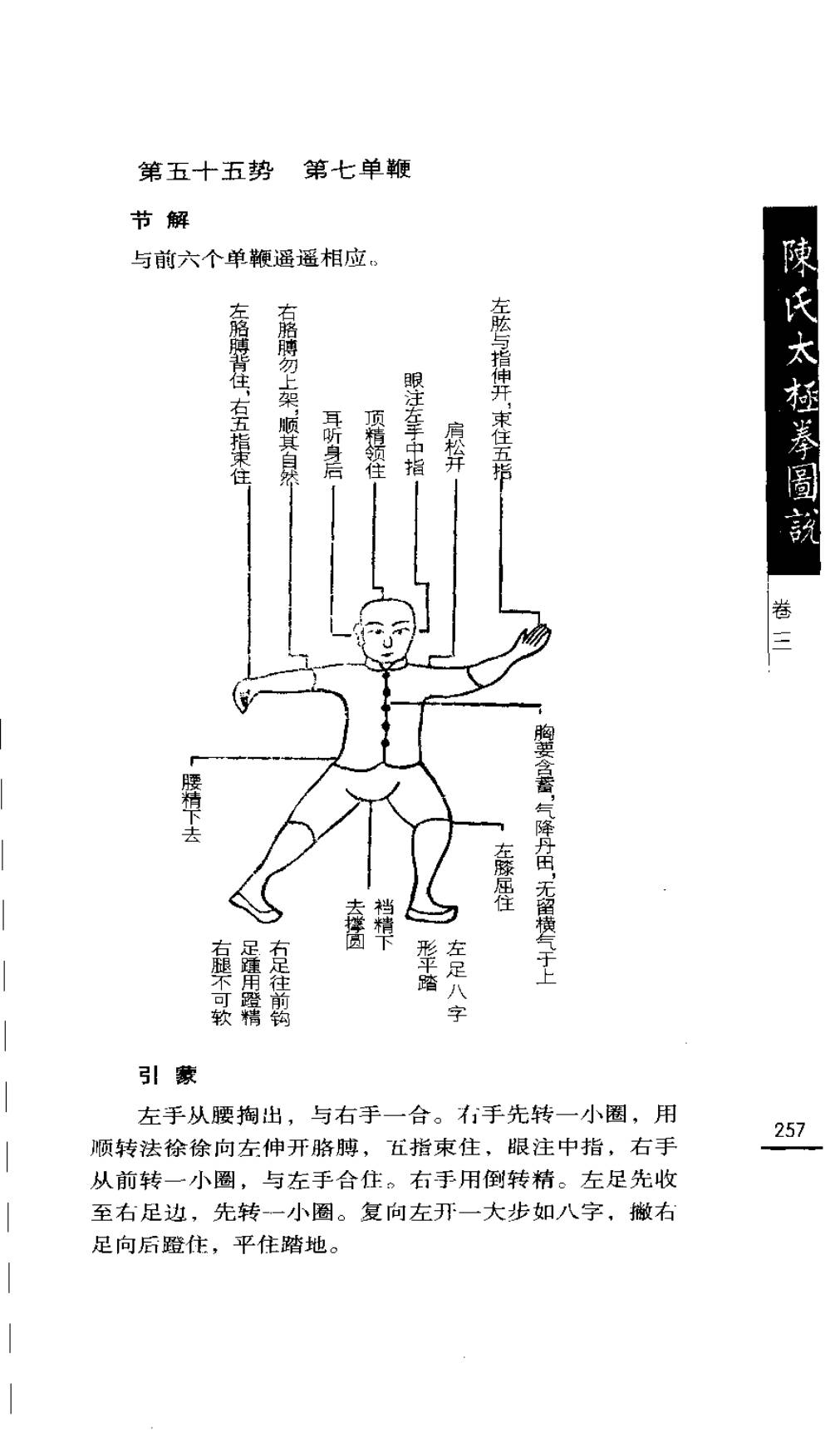
Chen Shi Taijiquan Tushuo (陳氏太極拳圖說)
Nei Jing (內精, Internal Energy):
The left and right hands closing are both closed with inverted silk-reeling jing (倒纏精). The method of moving the left and right hands: the left hand uses forward silk-reeling jing (順纏精); the jing goes up from below the ribs to the armpit, and from the armpit reels from outside inward, stopping at the finger pads. The right hand's jing travels up behind the ribs to the shoulder, and from the shoulder reels diagonally from inside outward, reaching the fingernails — this is inverted silk-reeling jing. Such is the method of moving these two hands. As for the feet, the right foot does not move from its place; only twist the heel so the toes hook leftward; the left foot withdraws and then opens again. When stepping out, this too is forward silk-reeling jing. Starting from the finger pads of the left and right, reel from inside outward up to the hip bone, the intention closing inward. The left hand leads the left foot, the right hand leads the right foot, moving together. In exposition it must be set out point by point distinctly; for the diagrams see in detail Posture 3, Single Whip (單鞭).
Qu Xiang (取象, Taking the Image):
Posture 3 took Kan–Li–Pi–Tai (坎離否泰), Posture 27 took Wu Wang (無妄), Posture 36 combined Kan–Li with Qian–Kun (乾坤), Posture 41 took Zhen (震), Posture 44 took the changed hexagrams of Kan–Li. This posture is soft outside and firm within, so it takes from Qian and Kun. Qian and Kun are the father and mother of the six children (六子, the other trigrams), and therefore encompass them all.
Qi Yan Li Yu (七言俚語, Seven-Character Folk Verse):
On the seventh day comes the return (the seventh Single Whip) — its turning is marvelous; empty above, solid below, the image of Kan and Li. Who would know that hard and soft are both fully present? The six children have ever taken the Two Modes (兩儀) as their ancestor.
Chen Shi Taijiquan Tushuo (陳氏太極拳圖說), Volume 3
Posture 56: Left-Right Cloud Hands (左右雲手)①
It corresponds with the two previous Cloud Hands (雲手). This one occupies the lower position, hence it is called the Lower Cloud Hands. The one in front is the Front Cloud Hands; the one behind, the Rear Cloud Hands. "Cloud Hands" means the hands revolving back and forth, like clouds spiraling and gushing — an image-form (象形). It is also said: "moving the hands with the hands revolving" — the phrase also works as "moving hands."
Diagram: Yunshou Qi Shi Tu (雲手起勢圖, Starting Posture of Cloud Hands)
Diagram labels:
- Shoulder relaxes down (肩松下)
- Elbow relaxes down (肘松下)
- Chest closed and held (胸合住)
- Elbow slightly bent (肘微彎)
- Five fingers bound, hand goes backward (五指束住,手向後去)
- Crotch open and round (襠開圓)
- Lifting intention (提意)
- Rear waist sinks down, right knee slightly bent (後腰向下,右膝微屈)
- Right foot turns directly in toward the left foot without touching the ground, following the right hand back a step, about one chi (右足直向左足收轉,不落地,隨住右手回步,大約一尺)
- Waist jing sinks down (腰精下去)
- Hand falls, with an intention to draw inward and a tendency to rise (手落下,有欲往裏收兼有上泛之勢)
- Left foot treads solid; the rear heel and toes follow the left hand as if exerting force (左足踏實,後踵足趾隨左手似有用力)
Boxing depends entirely on the opening posture (起勢); once the opening gains the moment (得勢), everything below gains the moment. This posture succeeds Single Whip (單鞭): if an enemy comes from the right, one must first lead him with the right hand. To lead with the right hand, one must first drop the right shoulder; to drop the right shoulder, one must first lead upward with the left hand. When the left hand leads up, the left shoulder relaxes down, the chest closes forward, and the crotch jing (襠精) sinks down. The left foot is solid, the right foot empty. Body method and hand method move all together. After this, moving the right hand first, one naturally gains the opportunity and the moment, because the incoming channel is genuine. Even without an enemy, practicing the movement empty-handed, one still feels the sequence gaining the moment, the mechanisms lively. Therefore I say each posture depends entirely on its opening — at the joint where the bones connect (接骨頭筍處), how the previous posture comes down and how this posture rises up must be studied with care. And it all lies in the closing-down: one must consider how to move to complete satisfaction, without the least deficiency. When spirit and qi (神氣) are full,
① The original edition reads "Lower Cloud Hands" (下雲手); according to the table of contents it is here changed to "Left-Right Cloud Hands" (左右雲手).
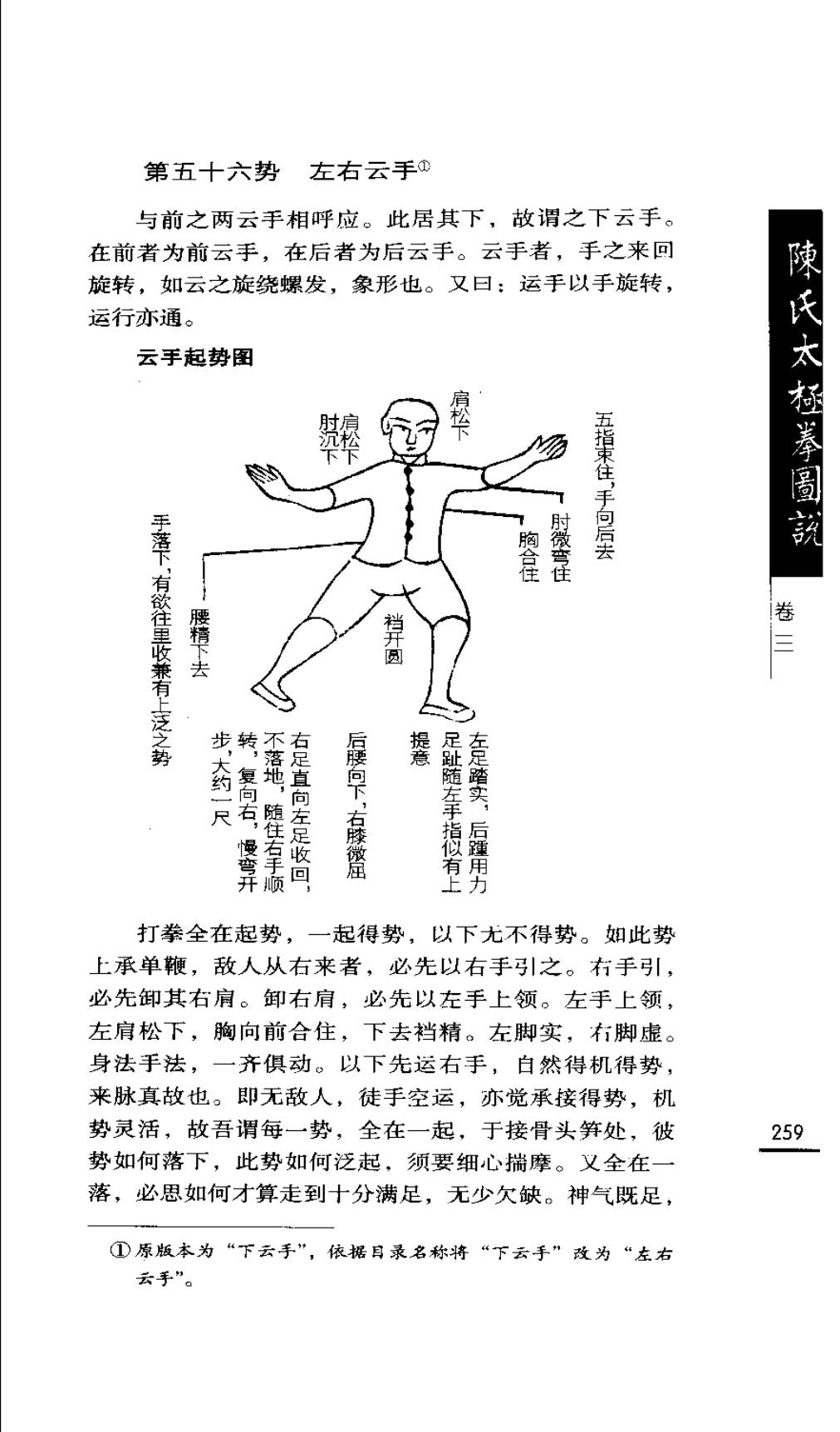
Main text
This posture seems as if it could stop, yet the mechanism of the next movement has already stirred: one wishes to stop but cannot stop. For the very mechanism of "wishing to stop, about to stop" has already summoned up the next posture. Therefore I say: at this moment the state is "seemingly stopped yet not stopped" (not stopped, because the spirit is still not full), "not stopped yet stopped" (what stops is only a single line — the next posture rises immediately). At this juncture one must examine it in fine detail. Moreover, the right arm has already extended itself; without bending it certainly cannot extend again. So the left hand leads upward, the right shoulder naturally releases downward, and the right hand naturally uses the jin of drawing-in to retract the arm. Thus what does not bend cannot extend; what does not extend cannot bend — this is natural principle, known to all. What is difficult lies wholly in using the silk-reeling jin (chan si jin, 缠丝劲) to draw it in and make it advance. Although the left hand leads upward and the right hand draws back in, everything must unite at the chest: the waist jin sinks down, the crotch jin (dang jin, 裆劲) rounds and props up, the left foot plants solidly, the right foot lifts empty — then the upper body feels ever more lively. Of the sixty-four postures, every single one is like this. I raise one corner only as an example for the rest; the student should reflect on it himself.
Diagram notes (Yun Shou, Cloud Hands — right hand moving)
The right hand turns one circle, clouding upward, then leads upward; the left hand follows the right hand moving rightward, also arriving at the chest. Yet the left hand, having gathered down from above, has already turned half a circle by here; the right hand likewise does not pause, moving at once upward and forward.
Here the right hand has withdrawn to the front of the body at the chest; from above downward and then rising, it uses silk-reeling jin to turn one large circle, arriving here without stopping.
The eyes follow the right hand's movement: wherever the right hand goes, the eyes go too. The same on the left side, using the middle fingertip as the target, the finger-pad exerting force.
The ears listen to the left; the crown jin (ding jin, 顶劲) holds well.
The right foot follows along; the right hand, gathered to the left, does not slowly bend at the foot's side, stops, then slowly bends outward as the posture opens the step; though the foot touches the ground it does not rest.
Diagram
Yun Shou you shou yun xing tu (云手右手运行图), "Diagram of the right hand's movement in Cloud Hands": the figure stands in a left bow stance (left leg bent forward and planted, right leg empty behind), the right arm circling along a dotted arc, the left hand gathered at the chest, the eyes on the right hand.
(Printed page number: 260)
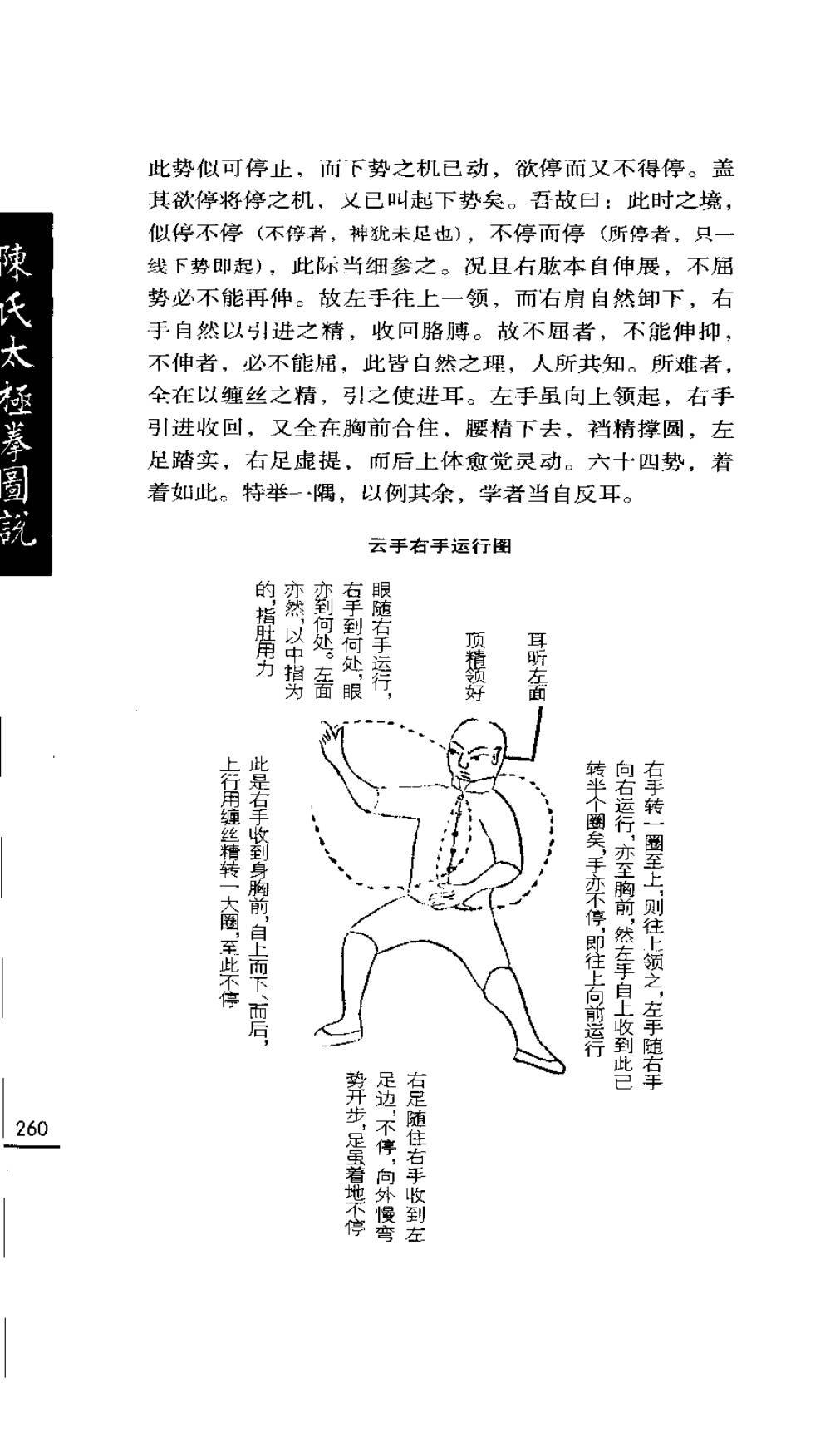
Main text (internal jin, nei jin 内劲)
The dantian qi (dan tian qi, 丹田气) divides into five parts. In truth it is one qi threading through above and below, and cannot collapse — this is one and the same. The heart-qi leads; the dantian rises: six parts reach the heart, then divide again into two streams — three parts rise to the left shoulder, three parts to the right shoulder, all threading through the shoulder bone out to the fingers of both hands. What is within the bone is called central qi (zhong qi, 中气); what manifests in flesh and skin is called silk-reeling jin (chan si jin, 缠丝劲). The remaining four parts divide into two streams: two parts course down the left thigh, two parts the right thigh, all threading through the bone out to the toes of both feet. The heel lands first. The forefoot must be lively; the toes point when they should point and must use force; they move when they should move — toes and calf must both use force. Left and right Cloud Hands are both moved by the method of forward turning. First lead the left hand upward, then lower the right hand; next the right hand descends on the right, gathered back to the chest. The left hand turns half a circle from above to behind; when the right hand rises from the chest and moves rightward, the left hand descends and gathers back to the chest; when the left hand rises from the chest and moves leftward, the right hand descends from the right and gathers back to the chest. Neither hand ever pauses. This one goes, that one comes; that...
Diagram notes (Yun Shou, Cloud Hands — left hand moving)
The left hand, from the chest, uses silk-reeling jin to move upward and leftward, arriving here without stopping; the right wrist faces forward.
As the left hand moves, both eyes watch the left hand; the hand must be lively.
The shoulders relax down; the left hand turns its circle, and the shoulders follow the turning circle.
The crown jin (ding jin, 顶劲) holds well.
The eyes should stay fixed on the left hand.
The ears should listen behind.
When the left hand reaches the top, the right hand from below gradually gathers to the chest, the five fingers bundled; without pausing it moves at once rightward, rising from the chest to move leftward — the two alternately revolving without cease.
The left foot steps out leftward, very large, about a chi and a half; the left foot follows the left hand's movement, as the right hand's footwork was.
The right foot steps out rightward, small, about one chi. This step gradually moves leftward, the right foot naturally yielding.
Diagram
Yun Shou zuo shou yun xing tu (云手左手运行图), "Diagram of the left hand's movement in Cloud Hands": the figure in a left bow stance, the left hand raised to shoulder height in motion, the right hand gathered at the waist, dotted lines marking the circular paths of both hands, with labels for crown jin, eyes, ears and shoulders.
(Printed page number: 261)
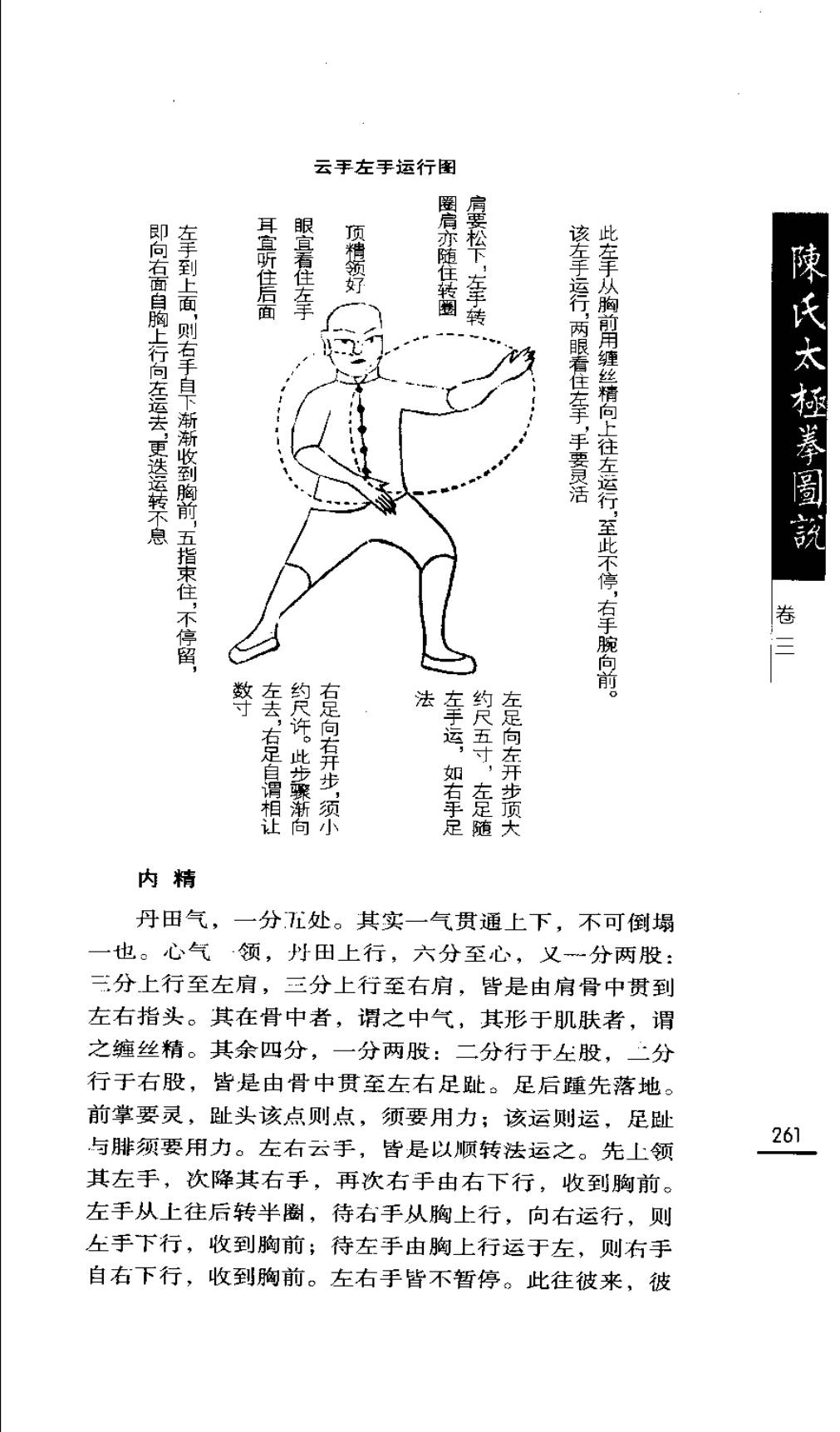
Main text
...goes, this one comes; left and right revolve in linked succession, like the courses of sun and moon: when the sun goes the moon comes, when the moon goes the sun comes. Hence one hand governs only half the body. The left hand moves leftward, and the left foot follows the left hand, stepping leftward. The left foot's step is rather large — it purely uses the method of advancing sideways — therefore it cannot be too large. As for the right hand's movement, its turning circle is of the same size; only the footwork differs slightly. When the right hand moves rightward, the right foot also steps from left to right, but the step it opens is slightly smaller. The body moves sideways toward the left while the right foot advances; if the step were not small it could not go left, advancing gradually — so the right step must yield to the left step, yet it cannot be too small. Cloud Hands has no fixed number of repetitions; one stops according to the ground at hand. Generally it goes no more than three or four steps to the left. As to when it is about to stop: at the start the left hand leads upward on the left, the left arm half-extended, half-bent; at the very end of Cloud Hands the left hand still comes down on the left side, half-extended, half-bent, while the right hand comes to rest before the chest. Such are the specifications of left and right hands. As for footwork: when the left foot has stepped out leftward, the right foot should be drawn back inward; yet when "drawing back" it does not actually draw back — it plants right where it stepped, the left and right feet about no more than two chi apart.
Method of movement (yun xing fa, 运行法)
Left and right movement is all "one smooth advance" (yi shun qian qu, 一顺前去). For instance with the left hand and left foot: they rise from the chest, from within. The hand extends leftward, the left foot steps out rising from within; then the right hand descends and gathers to the chest. The right foot follows the right hand in gathering to the left foot's side, no more than four or five cun apart. When the right hand rises from the chest, extends rightward and moves, the left hand at once descends from the left and gathers to the chest. Both hands are always going toward the right side. The right foot, from within, slowly bends and steps out rightward; then the left foot draws from the left toward the right foot, drawing in only an inch or two — indeed it need not reach the right foot's side. This is the method of gradually stealing leftward; otherwise, if the left foot always drew fully to the right foot's side, it would remain in its original place and could not open leftward. Thus the moment one foot lifts, it is storing momentum for the next step and leaving room for it — the method of mutual yielding. Every posture is like this; remember: whether left or right, the hand and foot on that side move in one smooth line, differing only in the visible traces of rising, descending, and gathering from outside to within.
Diagram (zuo you yun xing shou tu, 左右运行手图)
Two intersecting circles, their intersection marked "chest" (xiong jian, 胸间). The left circle is the right hand's path: up, right, outside, down, run inward; the right circle is the left hand's path: up, left, outside, down, descending. Text above the diagram: the hand rises level with the upward movement; the right hand runs one down-stroke; the movement goes up from the right, by the right hand; together with the left hand descending inward; moving together as one smooth turn. Caption below: left and right revolve in linked succession without cease.
(Printed page number: 262)
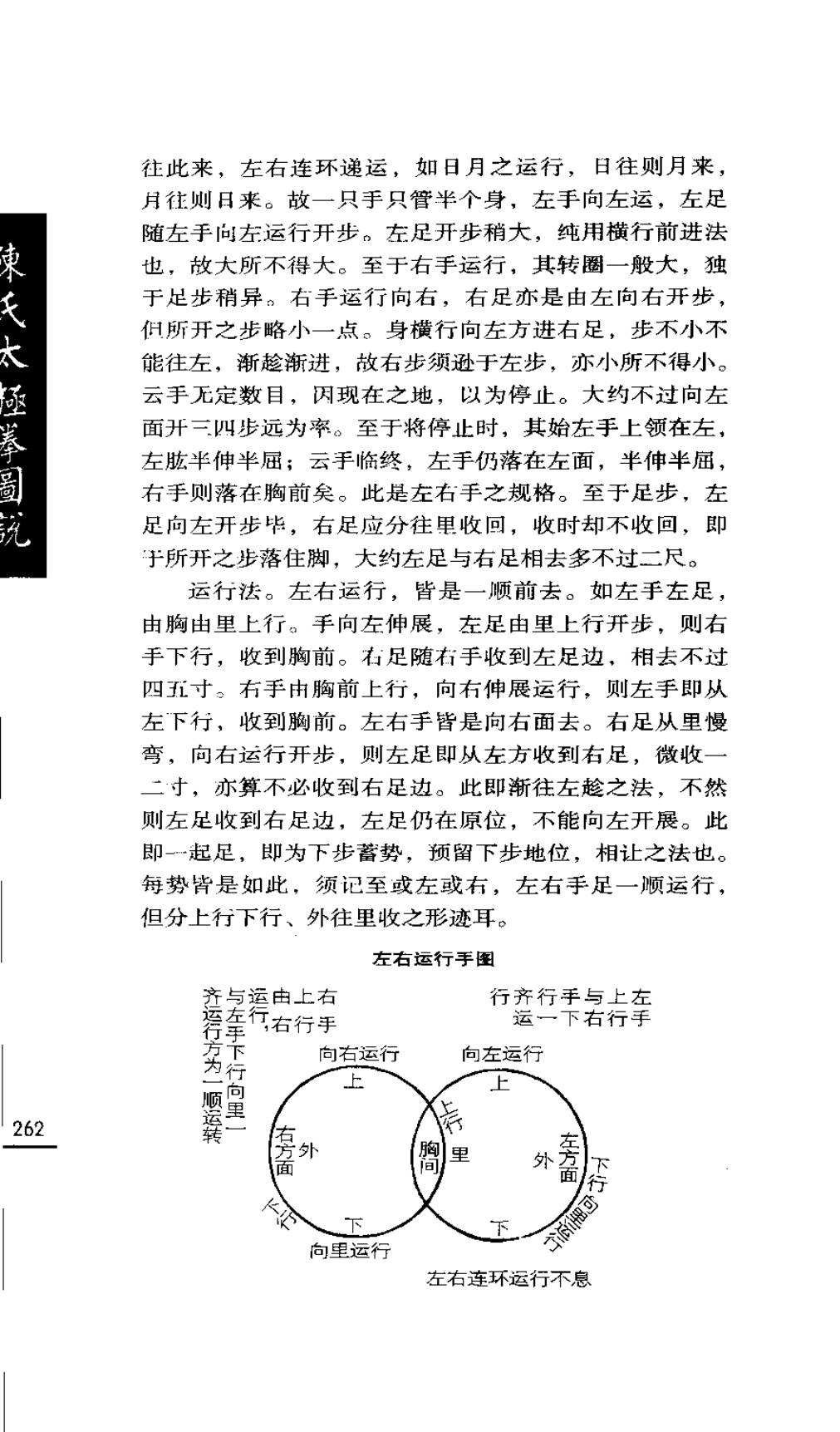
Diagram: Movement of Left and Right Hands and Footwork (左右手运行足步图)
(The figure shows two arcs tracing the paths of the left and right hands, marked 起 qi "begin" and 落 luo "finish"; below are drawn the footwork and notes on step size and circling direction.)
Figure notes (right to left):
- 落处 luo chu — the finishing place
- The left foot steps large, gradually moving left — this is "seizing the moment" (趁 chen)
- As the right foot lifts it first traces a small circle
- As the right foot lifts it likewise first traces a small circle
- The right foot steps small, also gradually edging leftward
- 起 qi (begin) / 落 luo (finish) / 起 qi
Taking the Image (取象)
Left and right Cloud Hands (云手 yun shou): the heart is utterly empty and bright, and the two hands wheel and dance like sun and moon, so the image is taken from Li (离, the trigram Fire). The Image says: "Li means clinging. The sun and moon cling to heaven; doubled brightness clings to what is right; the second and fifth lines both attain correctness." The form runs on central qi (中气 zhong qi), and people are thereby won over in their hearts. This is the transforming of all under heaven. Li receives the central qi of Qian, so the central qi of the form is all the central qi of Qian. The Image says: "Brightness doubled — thus Li." The left hand is like the sun, the right hand like the moon; one extends and one bends, like sun and moon alternating in shining. The great man is Heaven's lord. With inherited brightness (that is, the rotation of the two hands) he illuminates the four quarters (guarding against the enemy above, below, and on all four sides). Because he holds the center, he goes out and gains.
When the middle lines first change we get Gen (艮, Mountain): Gen is a mountain; the central qi pours through and one stands firm as a mountain peak. Gen is the hand, and means stopping — with the hand one stops the opponent, and strikes. Its reverse is Dui (兑, Joy): in meeting the enemy I rejoice, purely drawing him in to advance with harmonious, rounded qi. Its inverse is Zhen (震, Arousing) — rousing, the idea of the spirits being stirred; Zhen is the foot, meaning movement left and right without a gap. On the second change we get Qian (乾), whose reverse is Kun (坤): one gains the upright qi of Qian and Kun. On the third change we get Zhen, the trigram of the east: all things issue from Zhen, one gains the qi of life and movement. Its reverse is Xun (巽): all things are ordered by Xun — the sense organs and limbs all move together, all obeying in their movement. Its inverse is Gen: Gen is the gate-tower, the gatekeeper, the hand — my guarding is so strict there is no opening to enter; even at dusk the gatekeeper bars passage, and with the hand the enemy is stopped from advancing and attacking. Li's reverse is Kan (坎, Water): a man can meet things with an empty heart, careful and prudent, not daring to rely on himself. Though enemies come from right, left, above and below, he views them as "no level ground without a slope." With this "yellow center piercing principle," suppleness aided by uprightness, he treads danger as if level ground, and no slope is not leveled. Li is fire; when locking and transforming move freely, nothing undertaken is inauspicious.
(Further on the image) — Same body. Dun (遁) means hiding: the spirit should be stored within, its edges never shown abroad. On the upper part of the ding tripod the two ears stand at the sides, with rings in them that, once set moving, revolve without end — like the movement of the two hands. Below, the three legs stand together, immovable: like the two feet in the form — one foot planted and unmoving is the tripod leg standing firm; the other foot moves like a tripod leg that seems to bend yet does not bend, utterly stable. For one foot steadies the other — how could there be a mishap? Though it seems unsteady, in truth nothing unexpected occurs. One takes the sure footing beneath; there is no need to insist that the tripod's three legs and a man's two legs share one body.
(printed page 263)
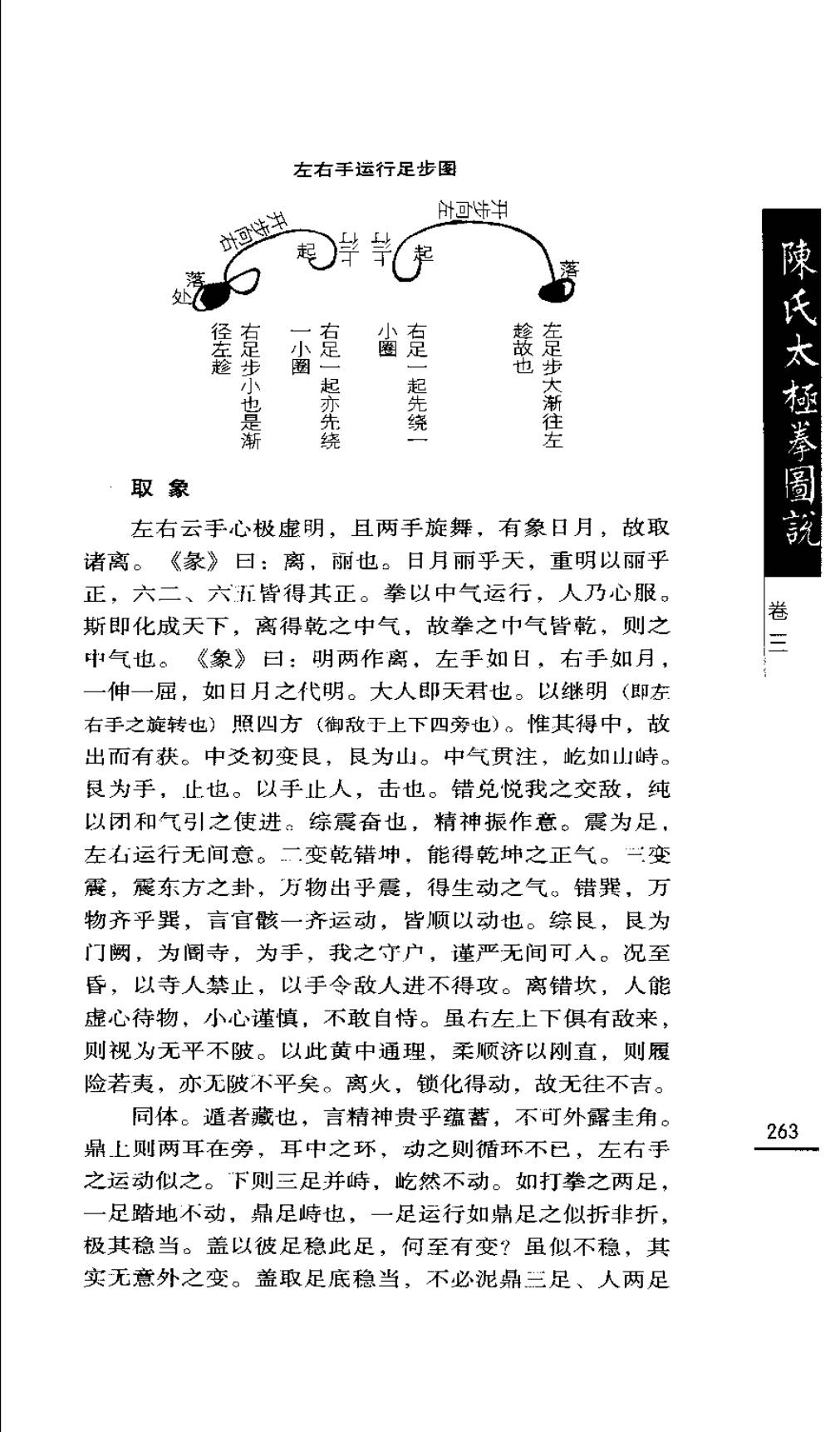
(Continuing from the previous page) ... the form of it.
Song (讼, Contention): two men contest a case — one says a word, the other a phrase, each claiming he is right. The alternating movement of the left and right hands simply means each acts according to its own part. Jia Ren (家人, The Family): the five sense organs and the hundred bones take turns moving, like one household, old and young, men and women, each fulfilling its proper duty. Wu Wang (无妄, No Error): the heart in the form is nothing but sincerity — with a true heart one does true deeds, never deceiving oneself; true principle runs all through it. Ge (革, Change): when the left hand should take command, change to the left hand; when the right should, change to the right — no error, no delay. Da Xu (大畜, Great Accumulation): to hold and nourish — taiji's yin and yang embrace a vast range. Kui (暌, Opposition): separation; in the movement of the two feet, though the spirit has no gap, there is inevitably some separateness in the visible traces.
Zhong Fu (中孚, Inner Truth) speaks of the disposition of the form — everything is sincere. Da Zhuang (大壮, Great Power): four yang lines advancing together, irresistible. When the form's central qi (zhong qi) goes somewhere, who can stop it? Xu (需, Waiting): from waiting in the mud to waiting with wine and food — it means going from danger to safety, sorrow first and joy after. The hexagram: "Xu has truth; brilliance, success; perseverance brings good fortune; it furthers to cross the great water." The Image says: "Xu means waiting: danger lies ahead. The strong and vigorous do not sink — their principle cannot come to impasse." It means gaining the central qi of Qian: nothing undertaken is unfitting. First line: waiting at the outskirts — favorable to persevere. Second line: waiting on the sand, with breadth at the center (衍 yan means breadth; dwelling at the center with breadth) — hence good fortune in the end. Third line: waiting in the mud, drawing in the enemy — careful respect and one is not defeated. Fourth line: waiting in blood, getting out of the pit. Fifth line: waiting with wine and food (an image of pleasant circumstances) — perseverance brings good fortune, through centrality and correctness. Top six: entering the pit; three uninvited guests arrive — respect them, and in the end good fortune. Moving the hands leftward is advance without retreat; with central qi moving through it, entering danger and emerging from it both end well.
Seven-Character Vernacular Verses (七言俚语)
First
Sun and moon shine bright, dawn upon dawn; left and right hands wheel, their forms entwined. Moving left, left and right (hands and feet all move left); left hand rising (from inside outward), right hand sinking (from outside inward and back) — do not disorder the sequence. Moving right, the right foot points squarely right; the left foot (the foot is named, but the hand is included in it) stands left while its intent joins rightward (though the left foot is on the left, its intent also faces right). Left and right each take command as they please; when the moment of command comes, they hand over in turn (whatever should go left all goes left, whatever should go right all goes right). Taiji's yin and yang — true creation's craft: embroidered mandarin ducks I embroider for you to see.
Second
One return, one advance, the hands move again; the rotation differs not a hair from before. Only look carefully from below at the peng (棚/掤) — the left foot differs slightly (edging north-west five or six cun), which opens what follows.
(printed page 264)
Posture 57: Gao Tan Ma (高探马, "Rising and Patting the Horse")
The upper figure is a front view, the new style; the lower figure is a back view, the old style.
Sectional Notes (节解)
Front-figure labels:
- Crown lifted by jing (顶精 ting jing) — hold it up
- Eyes fixed on the right hand
- Right arm as if bent yet not bent, as if extended yet not extended, palm facing up
- Elbow tip pointing down
- Left arm bent, wrist turned down
- Right knee bent and held
- Right foot planted flat
- Left foot touching with the toes
Back-figure labels:
- Crown lifted by jing — hold it up
- Facing the back of the hand (small note at the right humerus)
- Right humerus in front
- Left knee bent and held
- Crotch jing (裆精 dang jing) sinking down
- Right foot empty, lightly touching
- Left foot solidly planted
(printed page 265)
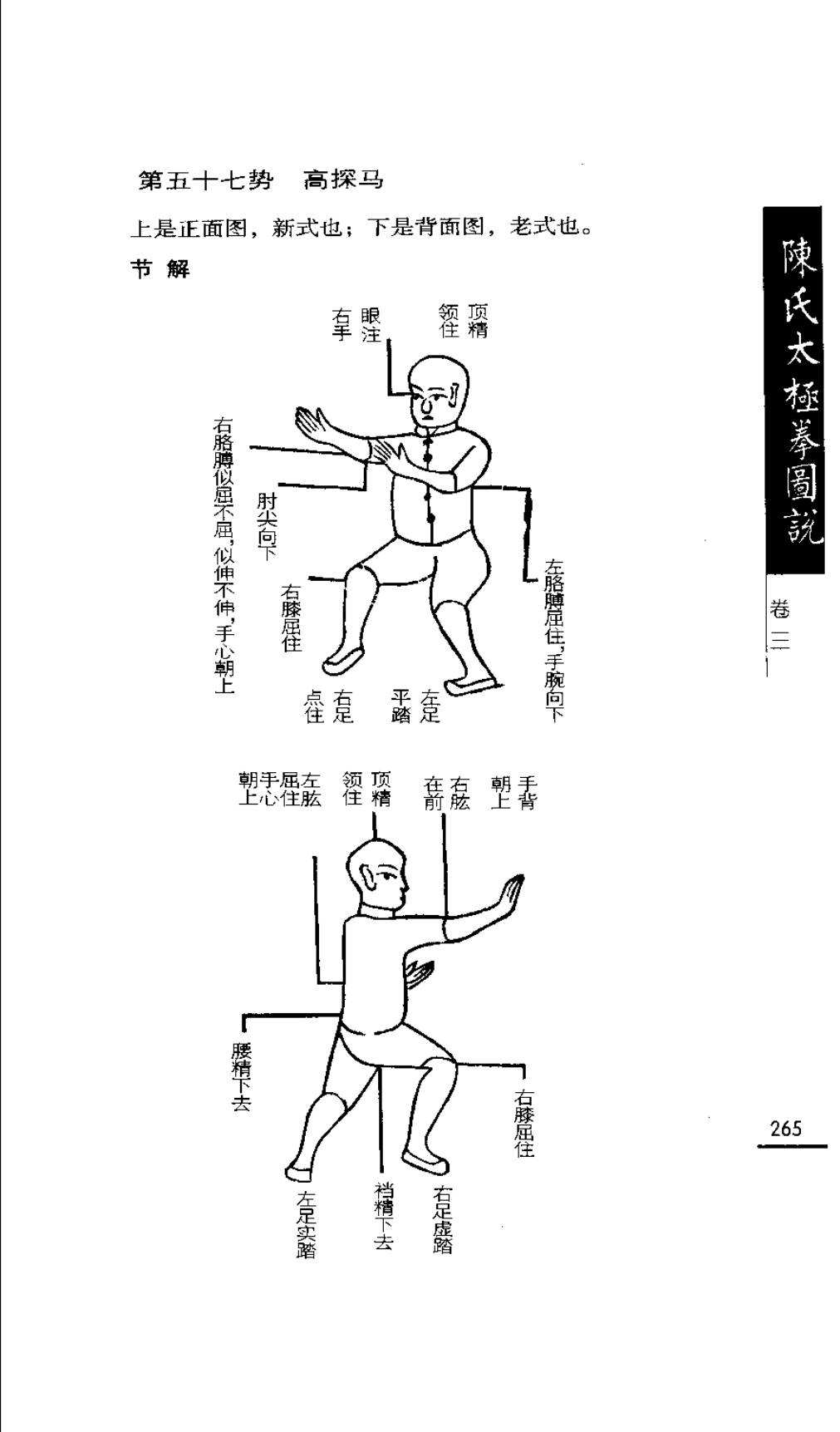
*Chen Shi Taiji Quan Tu Shuo* (陳氏太極拳圖說, Chen Family Taijiquan Illustrated Explanation)
Yin Meng (引蒙, Leading the Beginner)
New Style (新式 xīn shì): The right foot steps forward to beside the left foot, without touching the ground, and is immediately drawn back and placed on the ground. The left foot is also drawn back and placed beside the right foot, its toes touching the ground. As the right foot is drawn back, the left and right hands also follow it, circling from above downward in a large arc toward the rear, then turning forward, the two palms closing together, about a chi (尺, ~33 cm) apart.
Old Style (老式 lǎo shì): The left and right hands likewise circle round from behind in a large arc. The body turns smoothly around, the right foot unmoving; the left foot is drawn back and placed behind, the right arm (肱 gōng) extends, the left arm bends. Although the two hands are about a chi and a half apart, the palms nevertheless face the face and are closed with jing (精, essence/internal energy).
Nei Jing (内精, Internal Energy)
In the Gao Tan Ma (高探马, High Patting Horse), both new and old styles, the right hand is reverse-winding jing (倒转精, dào zhuǎn jīng). It rises from below the back up to the back, from the back inward, then from below obliquely to the outside, coiling to the fingernail — this is yang jing (阳精). The left hand is forward-winding jing (顺转精, shùn zhuǎn jīng): it rises from below the armpit up to the armpit, then rises from the armpit, from inside to outside, coiling obliquely to the finger pad — this is yin jing (阴精). One yin, one yang, and the jing can be closed and held. In the new style the body posture does not turn, so the left foot is in front; yet the jing in the chest also turns smoothly following the hands and feet — this is called the internal and external as one qi (气) circulating. In the old style the body turns smoothly through half a circle, so the left foot is behind, and the body's turning arc is larger than in the new style; but it lacks the harmony of the chest jing of the new style. The new style is the back-bent elbow jing (背折肘精), its path short; the old method is the turning-silk-reeling method (转身缕法, the 缕法 being the method of leading in, 引进), its path longer. For the diagram, see the twenty-fourth posture (图见二十四势).
Qu Xiang (取象, Symbolic Imagery)
The former Gao Tan Ma took the hexagrams Shi He (噬嗑, Biting Through) and Bi (贲, Grace); this posture takes the hexagram Sui (随, Following). This means that internal and external, upper and lower must all follow the jing, and must not go against it.
Seven-Character Folk Verse (七言俚语)
Upper and lower, hands and feet each follow each other;
From rear to front, turning — do not linger.
It only depends on whether the body posture turns or not;
In striking and grappling, each has its own novelty.
(Printed page number: 266)
*Chen Shi Taiji Quan Tu Shuo* (陳氏太極拳圖說), Volume 3 (卷三)
Posture 58: Shi Zi Jiao (十字脚, Crossed Feet)
Jie Jie (节解, Section Explanation)
This posture corresponds to the earlier Left and Right Ca Jiao (擦脚, Rubbing Feet). It is called Crossed Feet because the hands strike to form a cross (十字) while striking with the foot.
Yin Meng (引蒙, Leading the Beginner)
When Gao Tan Ma (高探马, High Patting Horse) is finished, first step the left foot forward, slanting left, opening one diagonal step; the left hand blocks across the abdomen and is placed at the right ribs, the right hand bends, its arm laid across the top of the left arm. Then the right foot swings horizontally from left to right. The left hand moves from right to left, like a balance-beam, striking horizontally at the toes of the right foot.
Nei Jing (内精, Internal Energy)
The right hand first uses forward-winding silk-reeling jing (顺转缠丝精, shùn zhuǎn chán sī jīng), coiling from the armpit to the finger pad, settling at the left ribs with the back of the hand facing up. The left hand uses reverse-winding silk-reeling jing (倒转缠丝精), coiling to the finger pad, from below going left, rising and going right, pressing on top of the right arm. The left foot swings horizontally from left toward the right, while the left hand moves horizontally from right to left, striking the toes of the right foot. The left hand goes from right to left, striking the enemy on his left side; the right foot goes from left to right, swinging the foot horizontally to strike the enemy on his right side. If the left hand and right foot cannot strike in a favorable position, then lean in — either inward (里靠) or outward (外靠) — with the right foot first landing on the ground. The shoulder (right shoulder or left shoulder, used according to which gives you the favorable position, 得势) closes forward once (the faster, the better), striking the enemy's chest with the shoulder — this is the marvelous use of Crossed Feet. When another controls my two hands, I strike him with the lean; when I control another's two hands, leaning in from inside or outside to strike him feels even more effective and satisfying.
Diagram Labels (图注)
- 左肱屈住在上 — the left arm bends, positioned on top
- 右足面平,膝微屈 — the right sole is level; the knee slightly bent
- 眼神注于左手 — the gaze focuses on the left hand
- 身往前合,顶精领住 — the body closes forward; the crown jing (顶精) leads and holds up
- 右肱在左肱下 — the right arm is beneath the left arm
- 腰精下去,右足抬起,与大腿根平 — the waist jing sinks down; the right foot lifts level with the thigh root
- 左足平实踏地 — the left foot presses flat and solid on the ground
Diagram: a figure performing the Crossed Feet posture, arms crossed before the chest, left arm above, right arm below, right foot raised, left foot flat on the ground. (Printed page number: 267)
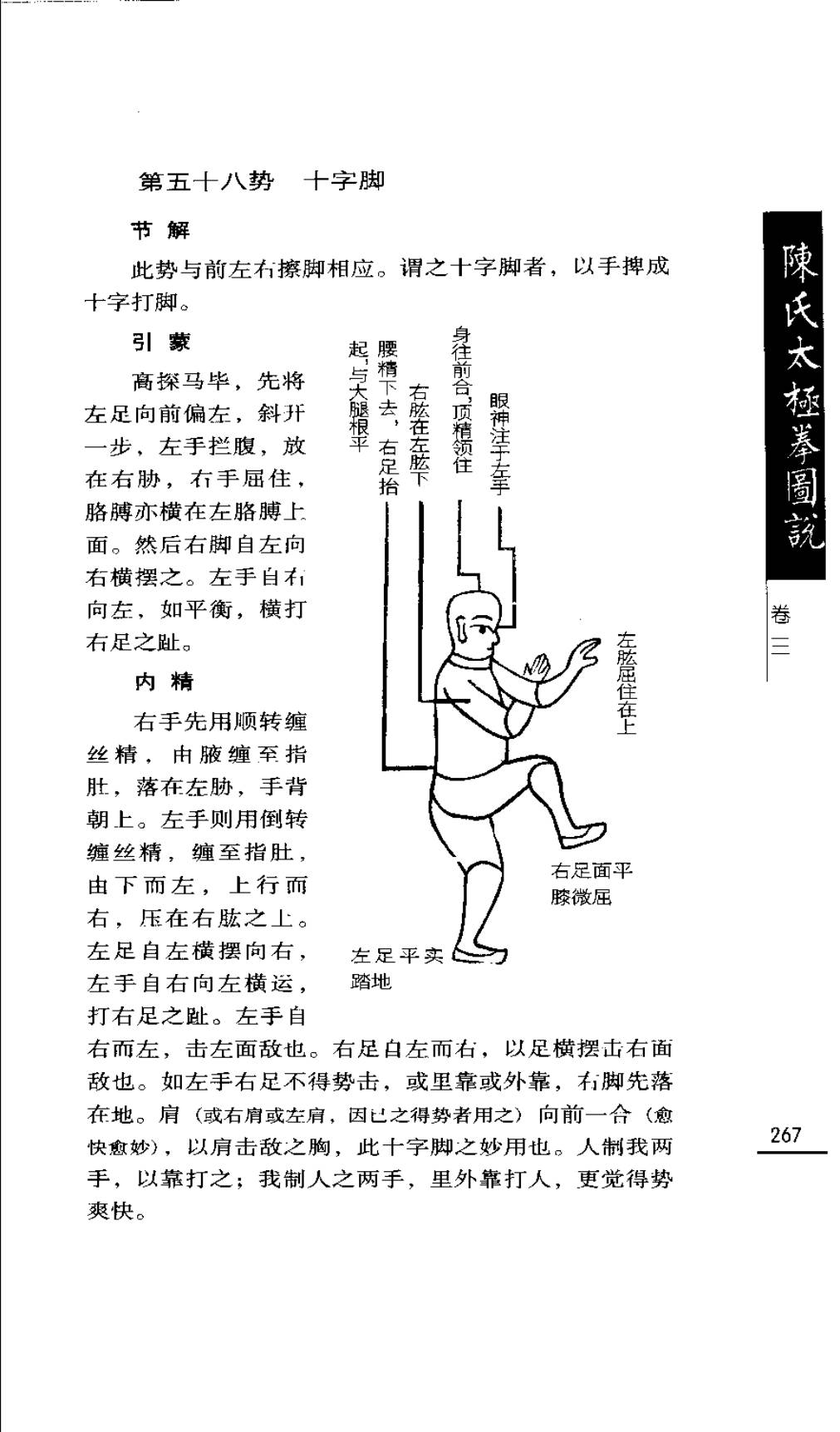
Diagram of the Internal Circulation of the Meridians in the Left and Right Hands (左右手内经运行图)
Whenever the coiling essence (chansijing 缠丝精) of left and right extends the arm outward, it coils from the shoulder and armpit all the way to the fingertips. When drawing inward and gathering, bringing the essence in, it coils from the fingernails and finger pads back to the shoulder and to the armpit.
Labels in the diagram:
- Left hand follows the coil (shunchan 顺缠) and rises — one circle
- Right hand reverses the coil (nichan 逆缠) from the chest forward — one circle
- Right hand reverses the coil and descends — one circle
- Left hand reverses the coil and comes out — one circle
- Right hand follows the coil and comes in — one circle
- Left hand follows the coil from the chest forward — one circle
The essence of the whole body, when sent outward, is all issued from the dantian (丹田); when gathered inward, it is all gathered into the dantian. Yet all of it is governed by the mind (xin 心), and everywhere one sees the bearing of the great harmonious primal energy (taihe yuanqi 太和元气).
Taking the Image (取象)
I first strike the opponent with my right hand; he seizes my right hand and presses it against my body — this right hand has already lost its position: one difficulty. I then strike with my left hand, but he also seizes my left hand and presses it on top of my arm. The left hand has also lost its position: a second difficulty. It is not that I deliberately arrange my two hands into a cross; rather, I strike with my two hands one after another, and as the opponent controls me and puts me in straits, they form a cross shape — difficulty upon difficulty. Hence the image is taken from the hexagram Jian 蹇 (Difficulty/Obstruction). Jian means difficulty. The Yijing says: "Jian. Favorable in the southwest." Therefore the left foot steps out toward the southwest (because the southwest land is level and easy). First line: "Going meets obstruction; coming brings praise." Third line: "Going meets obstruction; coming turns back." In both, one waits for rescue with a sincere heart and guards oneself with a calm mind. At the fifth line (Nine in the fifth): "Great obstruction; friends come." Some use the foot to swing, some lean with the left, some lean with the right — countless methods; if one fails here, one succeeds there. Hence the Image says: "Great obstruction; friends come." Left and right shoulders, left and right hands and feet are all parts of the same body. Having this shared body, what is there to fear in obstruction? Top line: "Going meets obstruction; coming brings great abundance." What fortune could be greater!
Seven-Character Folk Verse (七言俚语)
Two sides cross hands to test who is stronger; above, below and all four sides can be defended. Only the "tie-across" (shuan heng 拴横 — when the opponent seizes my hand and holds it across against his chest, and I cannot move) traps my hand: like an army besieged at Gaixin, the momentum is hard to expand. Who knows that Taiji moves without fixed direction — countless methods are stored within the chest. "Mountains end, waters vanish, I doubt there is a road" — one sinking shoulder lean shatters a bronze wall. Until body meets body in the lean,
(final line continues on the next page)
[Transcription note: the original writes 脂肚, likely intended as 指肚 (finger pad); the 行 in 压在行胳膊之上 is suspected to be a scribal error. Both transcribed as printed.]
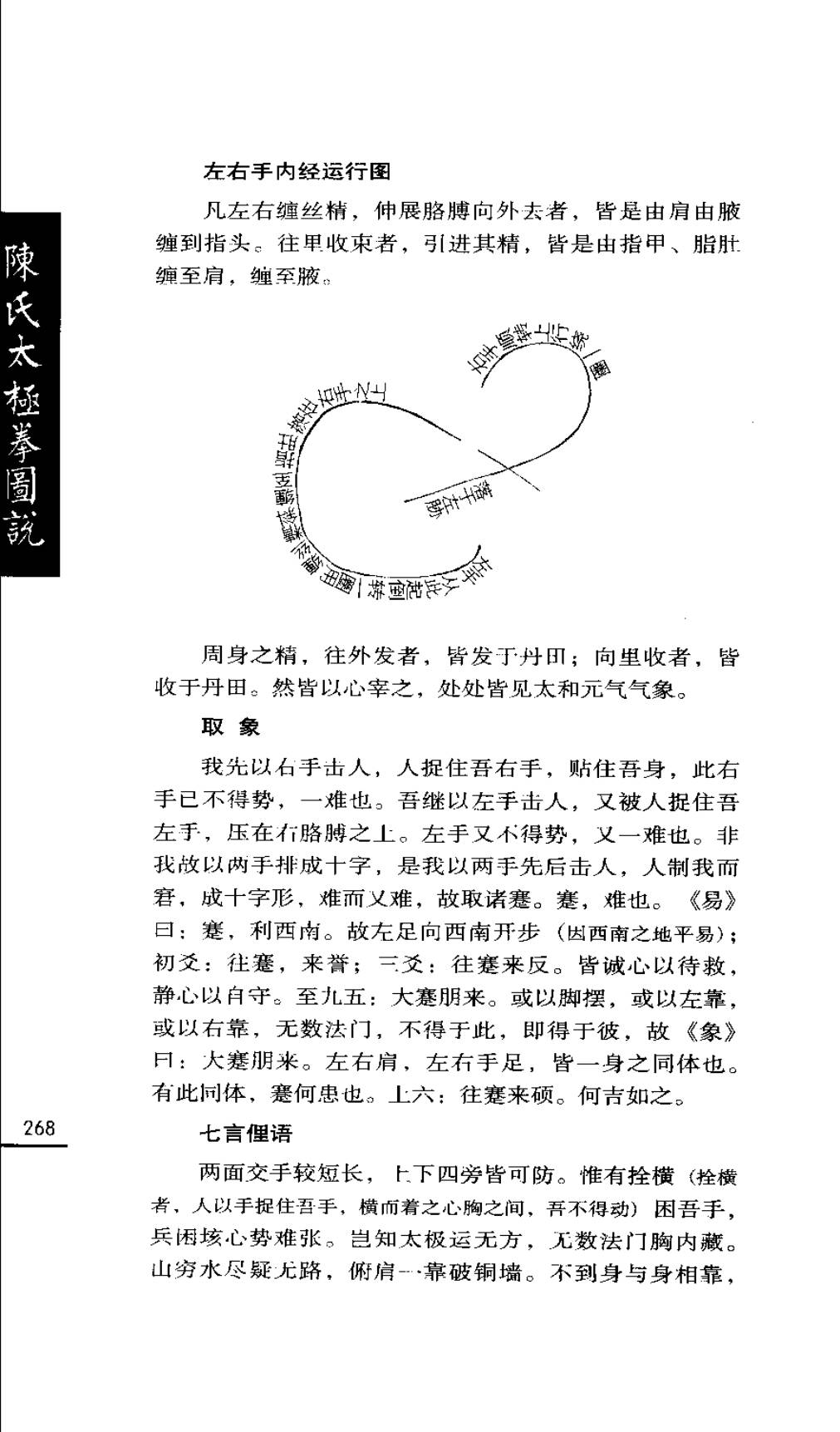
Five-Character Verse
Even a precious pearl can hardly give off light. The primal energy (yuanqi 元气) naturally stores the subtle secret; at the hungriest moment the hawk strikes the rabbit — watch it soar. The hawk chases, wheeling six times with the momentum; from where could the rabbit not flee in panic? Cao Cao burned his ships at Red Cliffs, Han Gaozu escaped Xingyang; extraordinary plans and extraordinary stratagems have no fixed form — all wisdom lies in using it on the spot. On the spot, one moment, victory by intelligence; preparedness averts peril — this lies in everyday practice. Everyday gongfu truly without lapse — a single point of numinous mind smells the wondrous fragrance.
(note: the verse opens mid-poem on this page; transcribed as printed)
Posture 59: Zhidang Chui 指裆捶 (Punch to the Crotch)
Sectional Explanation (节解)
Labels in the figures:
- The eyes fix on the enemy's crotch
- Top essence (dingjing 顶精) holds firm
- The chest closes forward, essence held
- Right hand grasps (□ unclear)
- Left foot in front, stamped down flat with force
- Right foot behind, also pressing down with force
- Crotch essence round and alive
This posture corresponds with Erqi (二起, Double Kick), Golden Rooster Standing on One Leg (金鸡独立) and Chaotian Deng (朝天蹬, Heel Kick to the Sky): the Double Kick strikes below the jaw, this one points to below the crotch — correspondence of above and below. The two Golden Rooster postures use the knee against the crotch, this uses the fist to point at the crotch — correspondence of difference and similarity. The closing is tight and rigorous, forming an elegant composition.
Introduction (引蒙)
Cross Feet (十字脚): the left foot steps forward, opening to the left. After the right foot finishes its swing, the right heel turns smoothly through more than half a circle. The face turns from the previous posture's rear; the right foot lands on the ground, the left foot takes a large step forward to the left. The left hand sweeps past the left knee and comes down behind the body, fingers pinched together, wrist facing up. Earlier, just as the left foot lands, the left hand goes from in front of the face top to bottom, sweeps behind the left ribs and rises again, turns over, comes forward top to bottom, and strikes the enemy's crotch with the fist. The crotch is a vital spot; striking it can secure victory.
[Transcription note: between the figure labels and the prose some short lines of the 节解 could not be fully captured; one character after 右手搦 in the labels is unclear, marked □.]
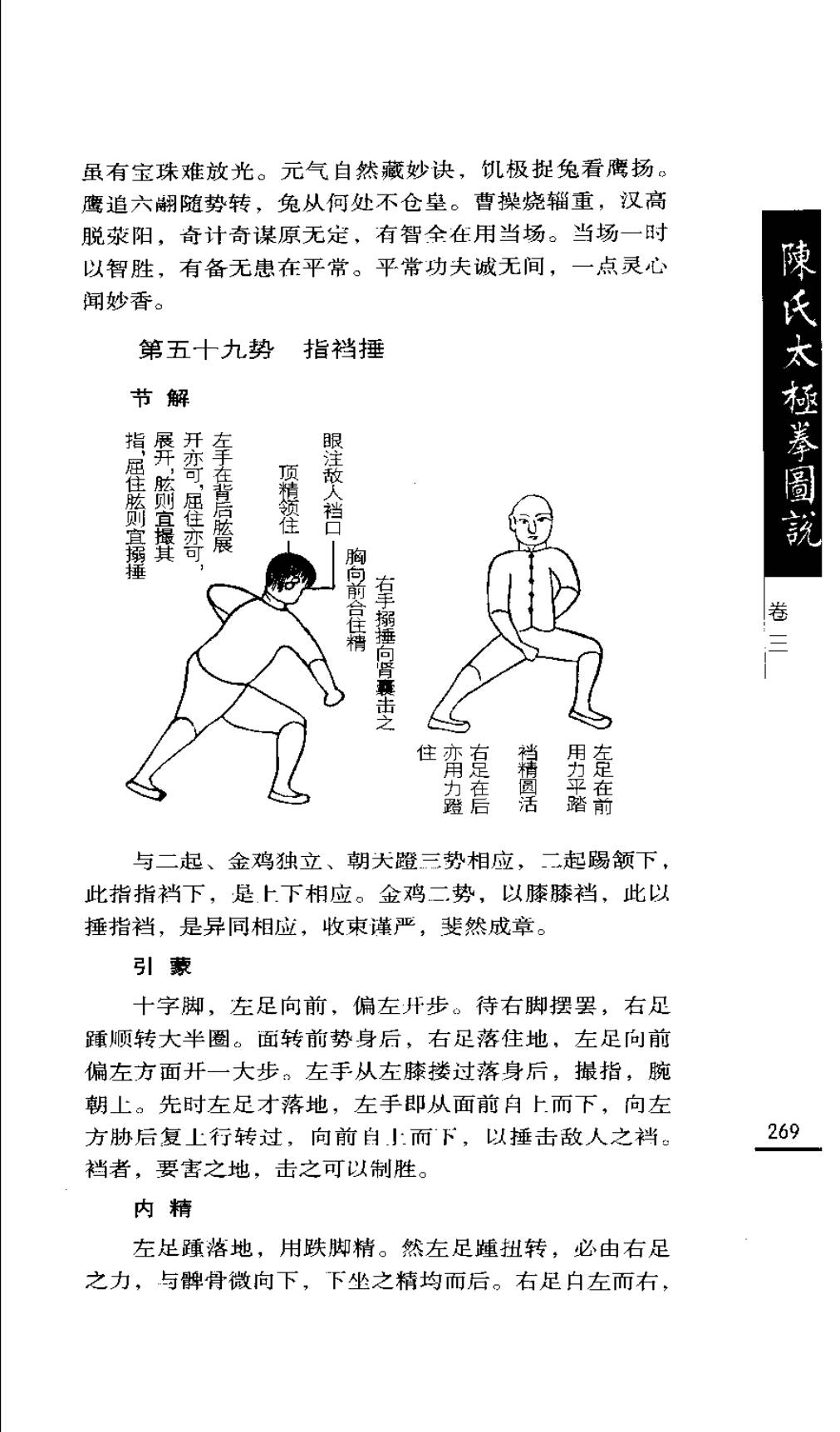
*Printed page number: 270 — Chen Shi Taijiquan Tushuo (陳氏太極拳圖說)*
Main text
The body is like a balanced scale; once it turns with a single deflection, the heel of the left foot acts like the hub of a millstone, and turning comes easily. The left foot's rotation is "smooth-turning" force (順轉勁, shunzhuan jin); however, the left knee must be bent slightly — two or three parts — otherwise, when the right foot applies its sweeping force (擺勁, bai jin), the left foot cannot hold the stance, and the body above would twist and topple. The left foot steps forward; the left hand sweeps across past the left knee and, going backward, uses reverse coiling silk-reeling force (倒轉纏絲勁, daozhuan chansijin), coiling all the way to the fingers.
When the right foot lands, the right hand immediately uses reverse-turning force (倒轉勁, daozhuan jin) to coil diagonally to the armpit. When the right hand turns from behind and comes forward, the force beneath the armpit coils diagonally from behind the armpit to the fist head (捶頭, chuitou); the spirit of the whole body gathers in the fist. Use combining force (合勁, he jin), back of the hand facing upward, holding the force together, striking the opponent's groin. This is used when the opponent is close to one's body; at a distance it will not reach. The spirit of the whole body is all combining force.
The right hand uses the reverse-coiling method, the same as in "Brush Knee and Twist Step" (摟膝拗步, louxi aobu). But in Brush Knee Twist Step the right hand folds over from behind, arrives in front of the face, and the hand lands in front of the chest; here the right hand folds from behind to the front, diagonally toward the opponent's groin, with the combining fist striking the opponent. Though the force used is the same, the final destination is slightly different. In Brush Knee Twist Step the hand lands above, the five fingers stretched and gathered; here the hand holds a fist that lands below, hence the difference. As for the left hand, its movement uses reverse coiling, no different from Brush Knee Twist Step, so no drawing is needed.
This is a diagram facing west; west is the front. It is still within the bounds of the "sweeping foot" (擺腳, bai jiao) section.
Taking the Image (取象)
In this posture the right hand grips the fist, like "a great fruit not eaten" — hence it takes the image of Bo (剥, Splitting Apart). The previous posture was amid danger.
This posture emerges from beyond the danger; the difficulty is already resolved — hence it further takes the image of Xie (解, Deliverance). The Image says: "Deliverance — the danger stirs; by moving one escapes the danger." Deliverance is a matter of hard and soft finding the mean, whereby the difficulty resolves itself. Meeting danger in times of ease, and now returning again to ease — hence it further takes the image of Fu (復, Return). Walking the middle path, nothing fails to return. The Yi says: "On the seventh day comes return." Is this not the meaning of "when Pi (否, Standstill) reaches its extreme, Tai (泰, Peace) arrives"?
Seven-Character Folk Verses (七言俚語)
The First
Surrounded by foes, it is hard to break from the crowd;
Left arm and right foot sweep away the three armies.
Turning around, strike straight for the vital ground,
Subduing the demons, scattering them in confusion.
The Second
The body has many places of pain,
But the most painful dwells always in the groin.
To enter the tiger's den and seize the tiger's cub… *(sentence continues on the next page)*
Diagrams
- Circular diagram (center): illustrates the continuous flow of movement and energy (silk-reeling force, chansijin). Annotations around the rim:
- (upper arc): 右足踏地右手即从后转过来面向东右手即从下搂膝 — "Right foot steps down, right hand comes from behind, turn to face East, right hand brushes below past the knee"
- (inside circle): 缠丝精捶头合住精 — "Silk-reeling force, the fist head holds the force together"
- (lower arc): 左足向前开步 — "Left foot steps forward"
- (lower left): 左手从左膝搂过 — "Left hand sweeps across past the left knee"
- (lower left, lower): 倒转缠丝精缠到指 — "Reverse coiling silk-reeling force coils to the fingers"
- Stick figure (right of the circle): a figure leaning forward, right hand extended downward/forward in a striking or pressing technique.
- (vertical, above figure): 此处是身已倒转 — "Here the body has already turned"
- (vertical, right of figure): 過來面向東右手即從下摟膝
- (diagonal, near hand): 纏絲勁捶頭合住勁
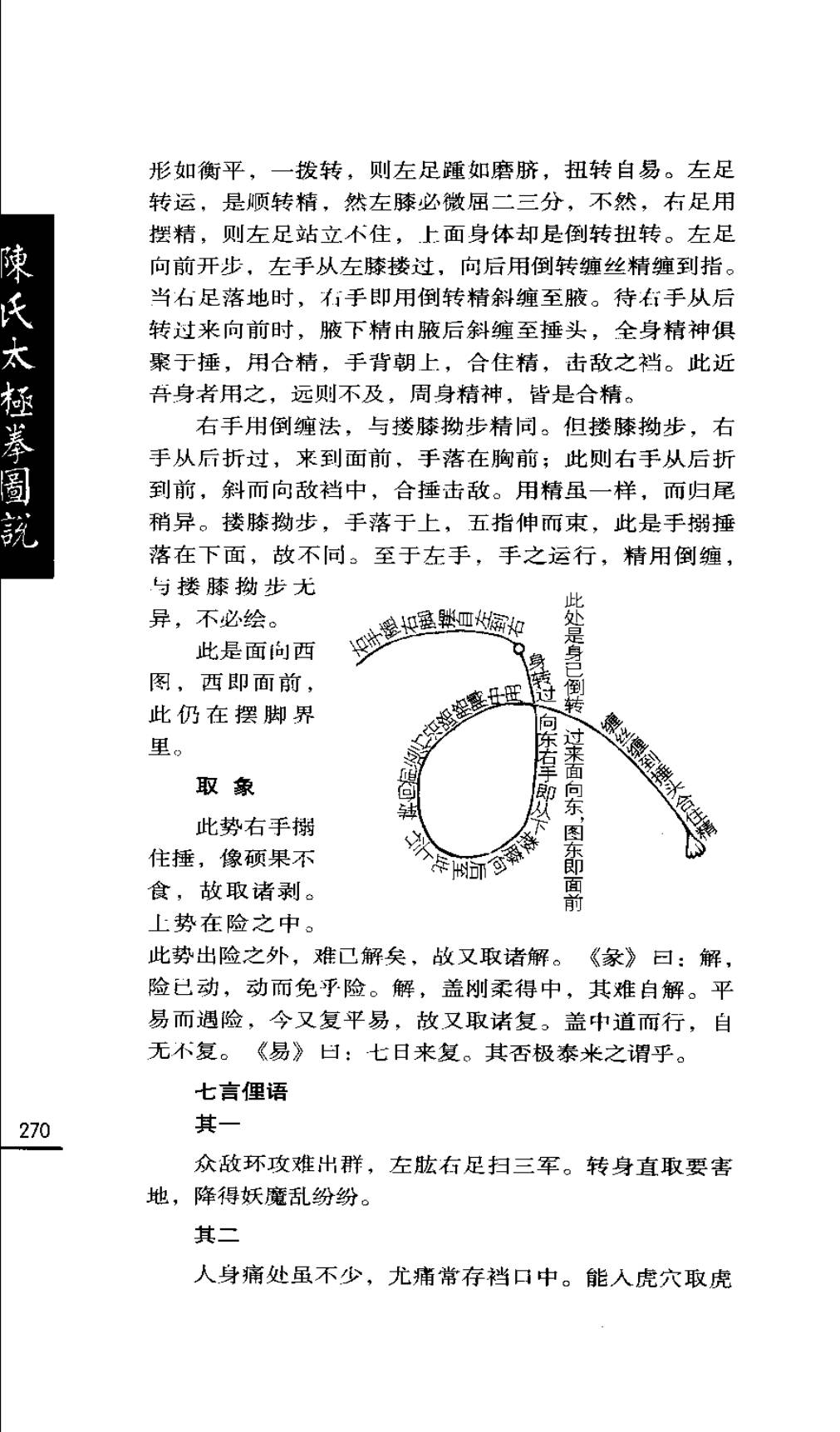
*Printed page number: 271 — Chen Shi Taijiquan Tushuo, Volume 3 (陳氏太極拳圖說 卷三)*
Main text
……a master can teach even the unteachable into heroes.
Explanation of the Boundaries Between the Two Postures (两势各界解)
Although below "Fist to the Groin" (指裆捶, zhidang chui) the name is "Green Dragon Emerges from the Water" (青龍出水, qinglong chushui), in truth this is a movement running through the seam between "Fist to the Groin" and the next posture, "Single Whip" (單鞭, danbian); it must not be taken as only one posture. "Fist to the Groin" is the first half of "Green Dragon Emerges from the Water," and "Green Dragon Emerges from the Water" is the second half of "Fist to the Groin" — together they form one posture. The reason "Green Dragon Emerges from the Water" is drawn separately is that its internal force arises from the farthest source: from the Pucan point (僕參, on the heel) it travels against the current upward, over the back to the Fufen point (附分), and on to the right fingers — hence it is drawn separately.
The Fifty-Ninth Posture: Green Dragon Emerges from the Water ① (the road after Fist to the Groin)
It closely corresponds with "Fair Lady Works the Shuttles" (玉女穿梭, yunü chuansuo). Its right hand's smooth turning (順轉, shunzhuan) matches the left hand's reverse turning; its level leaping method is likewise the same. But "Fair Lady Works the Shuttles" makes a great turn of the body, while this one does not turn; it corresponds at a distance with the two gatherings of the seventh and ninth postures.
The force of the left and right hands is entirely the same. But there, the hands gather from afar to the front of the chest; here, one leaps from near to far — one gathering, one releasing, responding across the distance.
Explanation by Sections (节解)
The left arm is bent and held; the left hand falls to the right ribs; crown force (頂勁, ding jin) leads the foot; the chest closes forward; the right shoulder sinks down.
Guidance for Beginners (引蒙)
Below "Fist to the Groin," "Green Dragon Emerges from the Water" follows immediately. In the seam between the two postures, first sink the right shoulder; the right half of the body sinks with it; once the foot has gone down, rise again and leap forward. Before the leap, the right fist is like the tassel of a rope whip: to strike forward, first gather backward. Then……
……the right hand goes forward. It lands, therefore the knee bends; the spirit of the whole body……
Diagram Labels
Left of the figure:
- 左胳膊屈住,左手落右(脅) — "Left arm bent; left hand falls to the right ribs"
- 右肩松下 — "Right shoulder sinks down"
- 頂勁領足,胸向前合 — "Crown force leads the foot; the chest closes forward"
Right of the figure:
- 眼神注于右手 — "The gaze fixes on the right hand"
- 右胳膊微屈一二分,不可太直,亦不可太彎 — "The right arm bends slightly, one or two parts; not too straight, nor too bent"
- 右手將所攛之捶展開,手束住指 — "The right hand opens out the fist it flung; the hand gathers the fingers in"
Below the figure:
- 左足隨右足向前飛縱 — "The left foot flies forward following the right foot"
- 裆中會陰、長強,勁隨頂勁上提 — "The Huiyin and Changqiang points in the groin: force rises with the crown force"
- 縱如靈貓撲鼠,純是精神,又虛又靈 — "Leap like a clever cat pouncing on a mouse: pure spirit, both empty and nimble"
- 此膝是右足足心向前縱,足始落地,故屈膝,全身精神皆右手前去 — "This knee: the right foot leaps forward with the sole, the foot just landing, hence the bent knee; the whole body's spirit goes forward with the right hand"
Footnote
① The original edition numbered this as the sixtieth posture; based on the preceding "Explanation of the Boundaries Between the Two Postures" — "Fist to the Groin is the first half of Green Dragon Emerges from the Water; Green Dragon Emerges from the Water is the second half of Fist to the Groin; together they form one posture" — the original "sixtieth posture" has been corrected to the fifty-ninth.
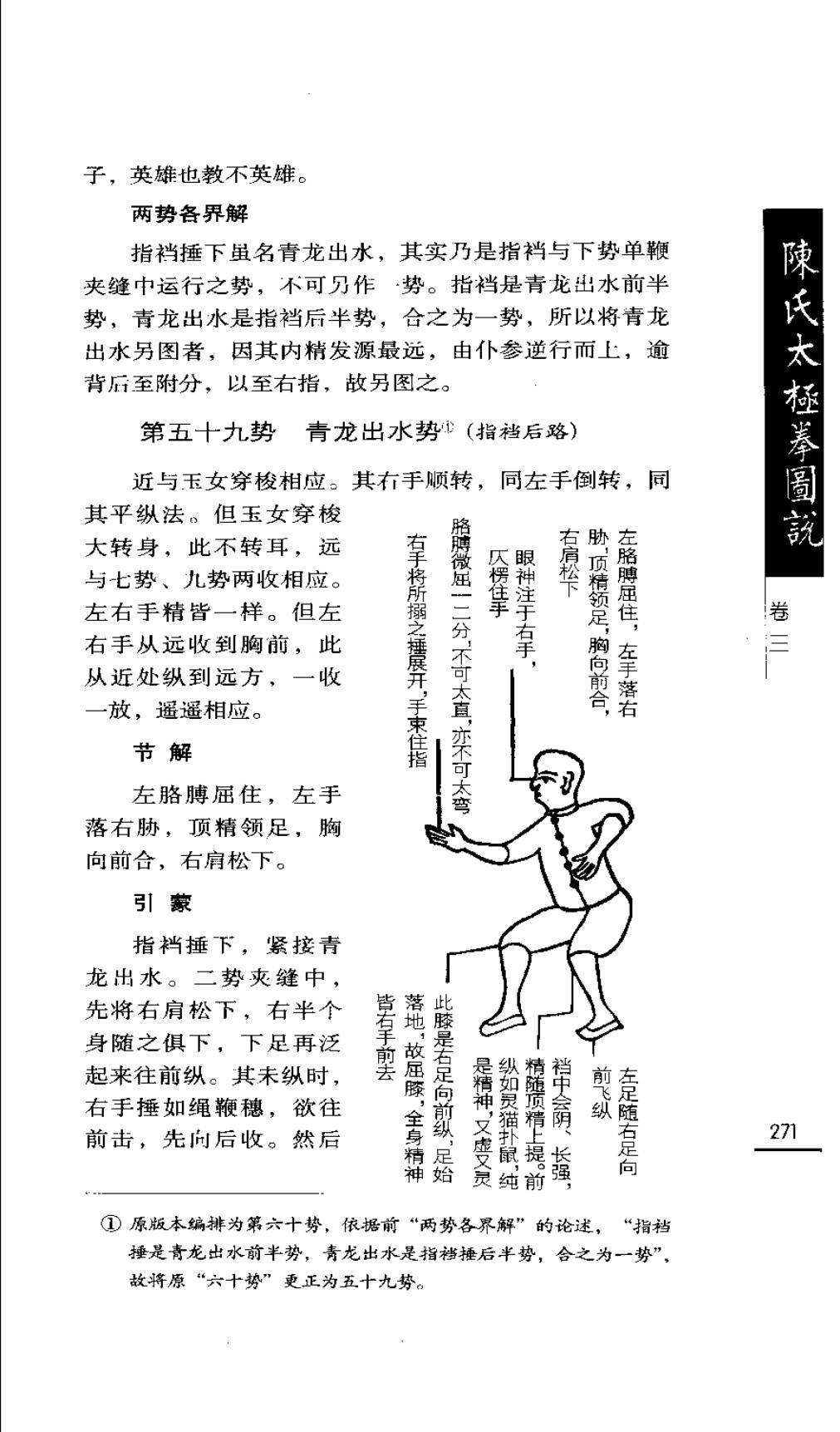
(The leap-forward / strike instruction)
Rising from behind, it circles forward in one great arc and strikes out; the body likewise follows with a forward leap (纵 zòng). The secret of the leap: the hand in front leads forward, while at the rear the Yinbai, Dadun, Lidui, Qiaoyin and Xiaxi points of the right foot all use jing (精 refined force). The jing travels from the sole through the Yongquan point, up over the heel, ascending against the usual course past Weizhong, Yinmen, Chengfu and Huantiao, slanting in along the side of the body (扶边), rising past Hunmen and Pohu to Fufen, then slanting upward again, by Quyuan past Xiaohai, slanting into Zhigou and Yangchi, twisting along the way; the hand opens out, the five fingers gathered, and the right hand leads the body leaping forward, the left foot pushing hard down against the ground. All follows the right hand forward; the left hand, following the body, lands in front of the right breast when the front foot touches down, and stops.
Nei jing (internal essence)
The whole right half of the body uses right-turning jing (right turn is the compliant/顺 turn, turning from inside outward). The right hand uses coiling essence (缠丝精 chansijing), rising from the armpit, from inside to outside, coiling aslant to the finger pads. The right foot likewise uses coiling essence, coiling compliantly to the thigh root, rising to meet the side of the body and ascending together, reaching Fufen and branching to the armpit, coiling aslant to the finger pads. The left hand and left foot must use reverse-turning essence before they can follow the right hand and right foot in their circle. The root of the forward leap lies wholly in the heart (心 xin). When the heart's essence is raised, the essence at the crown (顶) holds up top, the dantian essence in the middle is sent upward, inclining to the right half of the body. Below, of the two feet the right uses the springing method, its sole pressing hard backward. Before the leap all is storing essence — gathering essence and concentrating spirit, binding the qi (气 qi) together. At the moment of leaping it is purely a forward pounce, essence going straight ahead. The right hand turns and advances together, like a sparrowhawk pouncing on a quail, an eagle seizing a cunning [hare]... [end of page partially illegible]
Diagram
One figure: the forward-leap posture — right foot pushing off behind, body pouncing forward, right hand reaching out, left hand gathered before the right breast.
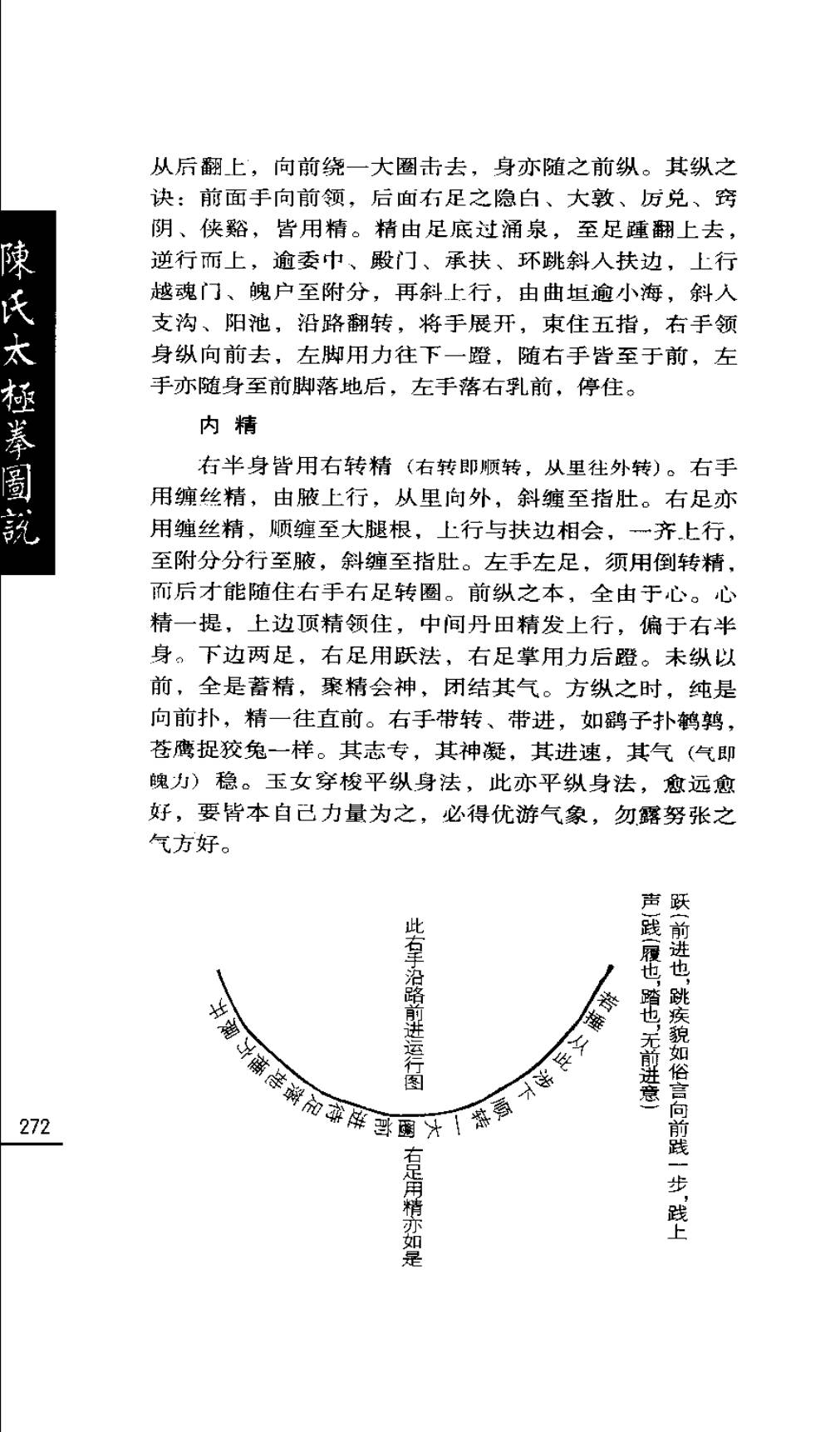
Posture 60: Dan Bian (单鞭, Single Whip)
This is the seventh Single Whip; it ties together the preceding six Single Whips, like "return comes after seven days" (七日来复, Hexagram Fu) — the composition is rigorous.
Seven-character folk verses (七言俚语)
First:
The dragon in the water nourishes its true self; like an inchworm it first bends in order to stretch. A sudden clap of thunder in the sky — the leaping in the pool is doubly spirited.
Second:
Turning the fist, hanging and advancing, enter without delay; like a dragon leaving the water, parting from the spring pool. Leaping through the air it flies up to heaven, with five-colored auspicious clouds following behind (the five-colored clouds are a metaphor for the whole body).
Section explanation (节解) — diagram labels
Upper row (right to left):
- Left five fingers bound together (左五指束住)
- Left elbow sinks down
- Left shoulder relaxed down; the eyes
- fix on the tip of the left middle finger
- Essence at the crown holds up (顶精领住)
- Right shoulder relaxed down; the ear
- listens behind
- Right elbow sinks down
- Right hand's five fingers pinched together
Lower row (right to left):
- Chest closes forward
- Knees bent
- Left foot, like the character "eight," angled out and flat on the ground
- Crotch open and rounded
- Right leg open in a circle
- Right foot slightly bent, two or three [tenths]
- pushing backward
- The essence of both sides of the waist sinks down
Diagram
Single Whip final posture: facing forward, left hand extended with fingers bound together, right hand pinched and extended to the right rear; left foot angled out flat, right foot slightly bent pushing back; knees bent, crotch rounded, chest closing forward, crown essence held up, waist essence sinking.
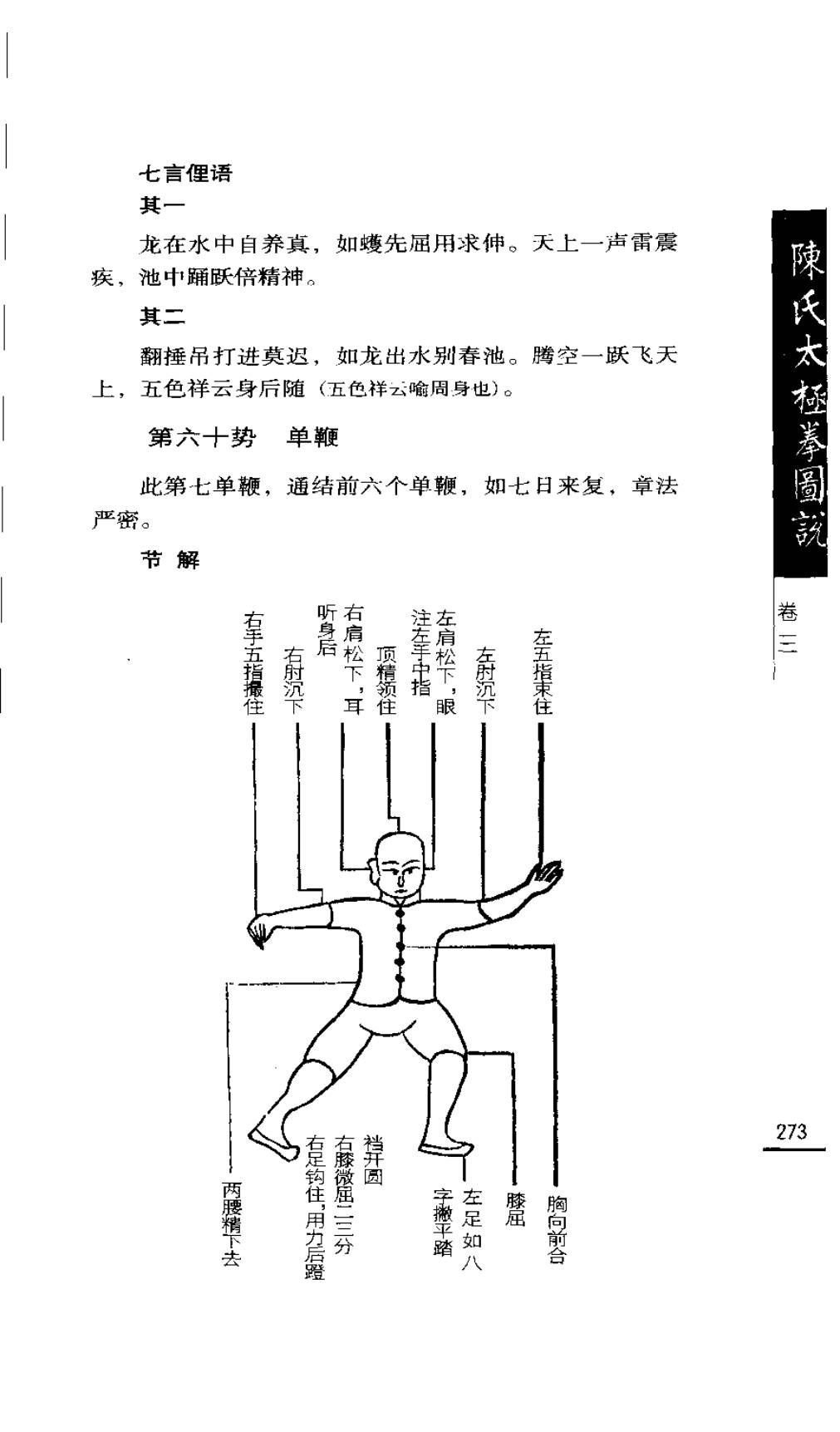
Yin meng (引蒙, Guiding the Beginners)
The two forearms with the left and right hands, and the two thighs with the left and right feet, first close from the outside inward. Then the left hand extends from beside the right ribs toward the left, the fingers bound together. The left foot likewise steps out from right to left, moving along its path — this is the "slow curve" posture (慢弯势). The right hand turns from behind through a small circle forward, the fingers pinched together, and joins with the left hand. When the two hands join, the whole upper body joins; the right foot hooks toward the left, and the two feet close with the two knees. Then the essence of the crotch (裆) naturally opens round. The remaining methods are as before.
Nei jing (internal essence)
The left and right hands first join; their essence is all coiling essence (缠丝精 chansijing), coiling aslant from the shoulders inward to the fingernails. Then the left hand first circles a small circle from below upward, then slowly, in a slow curve, moves left. Extend the forearm, open the fingers, bind the fingers — do not let them scatter. Using coiling essence from inside outward, coiling aslant to the finger pads — this is the compliant (顺) turning circle. The right hand turns from behind to the front, also through a small circle, using coiling essence in reverse, coiling aslant from the shoulder inward to the fingernails. When the two feet join, all is reverse coiling: from the toes, from outside inward, ascending against the course, coiling aslant to the thigh root. After joining, the left foot follows the left hand, turns a small compliant circle, then steps out left in a slow curve. Its essence goes from the thigh root, inside to outside, descending and coiling aslant to the toes, placed in the shape of the character "eight"; Dadun and Pucan must press firmly on the ground. The right foot hooks in front; upper and lower body alike gather the essence from outside inward, and only then does it not scatter.
Qu xiang (取象, Taking the Image)
Above is empty, like Li (离, Fire); therefore take Li. Below is full, like Kan (坎, Water); therefore take Kan. Kan and Li are the middle son and middle daughter of Qian and Kun (乾坤); water and fire intersect, and return still to Qian and Kun. Qian and Kun are of the ten thousand things... [continues on next page]
(No diagram on this page.)
(Conclusion of Qu xiang from previous page) ... The surfaces of the thighs and forearms seem wound with silk. Slanting coiling, compliant and reverse, each has its fixed rule — it well repays close, deep study. When genuine practice has accumulated long, one day it all opens suddenly into taiji quan. Every part of the human body is taiji; in every movement and every stillness there is wholeness. If you wish to fathom the source images of that wholeness — the bright moon of the third and fifth [days] just full, shining over the ten thousand things of the world; nothing escapes before the eyes and ears. To seize or release is all up to me; every turn is the Way — awaken at the fountainhead.
Posture 61: Pu Di Jin (铺地锦, Brocade Spreading over the Ground), also called Pu Di Ji (铺地鸡)
Section explanation of Pu Di Ji, first half of Shang Bu Qi Xing (七星捶, Seven-Star Fist)
Diagram labels
- Right elbow bent like the Dipper (右肘屈住如斗)
- The ear listens behind
- Crown essence holds up; the right hand grips the fist (搦捶)
- The eyes fix on the left hand and left foot
- The calf rests on the ground
- Right leg bent, knee facing up
- Lifting upward, waist bent forward; when the body rises the knee goes up, heel exerting force
- Right foot flat on the ground, awaiting the body
- The hip bone (髀骨) sits down; the Huiyin point below, lifted upward
- Left foot's Pucan rests on the ground; as the body is about to rise the toes close forward and Pucan exerts force — only then can one rise
Diagram
Pu Di Ji (low posture): one leg crouched bent, one leg straight along the ground; right hand gripping fist, elbow bent like the Dipper above, left hand below; waist bent forward, in a low crouch about to rise.
Explanation
The first half of Shang Bu Qi Xing (Stepping Up to the Seven Stars) is called Pu Di Ji; the second half is called Qi Xing Chui (Seven-Star Fist), the completed posture being like Jin Gang Dao Dui (金刚捣碓, Buddha's Warrior Attendant Pounding the Mortar). Why "Seven-Star Fist"? Because the left and right hands and feet form the shape of the Big Dipper, it is named Seven-Star Fist. It is not named Jin Gang Dao Dui because there the left hand moves from below upward, whereas here the left hand is bent and on top, shaped like the Northern Dipper. Hence it is not Jin Gang Dao Dui but Shang Bu Qi Xing Chui.
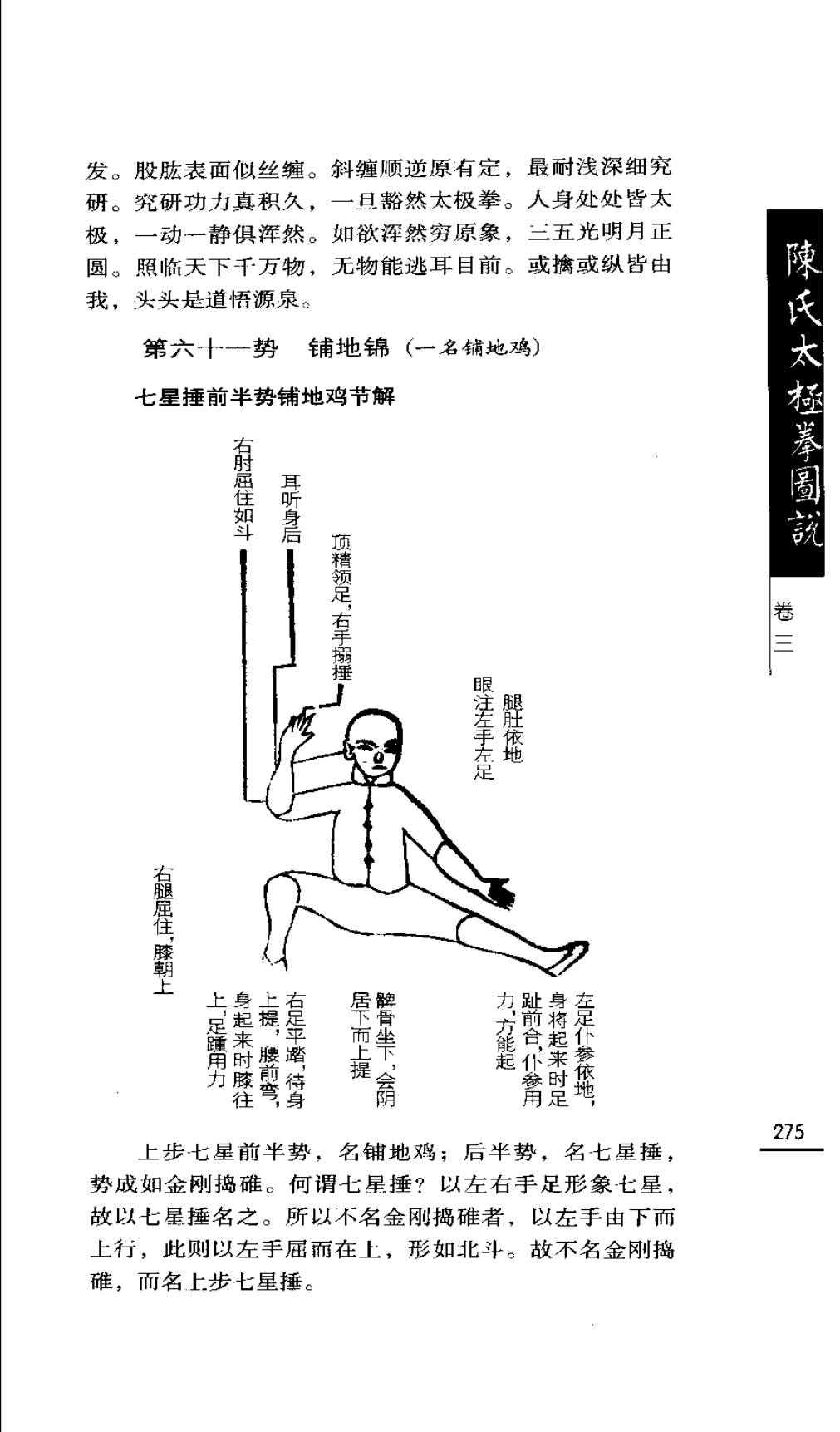
Yin meng (Guiding the Beginners)
The right fist and forearm are bent and held; the body sits down to the ground; the left hand and left arm open out. The left leg extends, calf resting on the ground, heel resting on the ground. The right knee is bent, held at the right of the body. The five toes grip the ground; the big toe and rear heel both exert force.
Nei jing (internal essence)
When the body is about to rise, the right hand uses compliant-turning essence (顺转精), coiling aslant from the hand to the armpit, from the armpit up to the shoulder, down the back to the right waist, from the waist to the left thigh, using reverse-coiling essence to the toes of the left foot — the reverse of Qing Long Chu Shui (青龙出水, Azure Dragon Leaves the Water), where essence runs from foot to hand; here it runs from the right hand to the left foot. The left hand uses forward-charging essence.
Diagram labels
Left diagram (top to bottom):
- Sitting down from here, the left leg cannot extend and the right knee cannot bend
- A straight line above and below — the body must not sit down to the ground from here
- At such a time the thigh sits back to the ground
- Only then can the left thigh extend and the right knee bend
- Body down
Right diagram (top to bottom):
- Right knee leads upward, heel exerting force
- Diagram of the legs, lower left and right
- Left knee faces up
- For the stepping-up foot, the right foot draws level
- Left foot
- with the heel exerting force together — only then can the body rise
- Lift the right knee; heel and toes of the left foot
- right foot closes inward
- calf rests on the ground
- initial sitting
Caption: The left diagram is of rising after sitting; its use of essence is as described. The right diagram is of the thigh first landing, before the body rises; the right one comes first, the left one after.
Echoes with other postures
This posture echoes Die Cha (跌岔, Falling and Splitting). In Die Cha one drops straight through the air, the right foot stamping the ground with a sound like metal or stone, to stamp the enemy's foot; the left foot kicks the enemy's shin bone (臁骨) and can break his daring; the right hand opens the arm, grips the ground and rises, the left hand charges forward to push the enemy's chest. Here instead the thigh sits back, sitting on the enemy's knee; the right fist is bent with the intent of striking forward. The left leg extends; if victory fails, both hands press to the ground to the right and use the sweeping whip (扫堂鞭) to sweep the shins of the crowd of enemies, and the difficulty dissolves of itself. So it echoes its kin. It also echoes Jin Ji Du Li (金鸡独立, Golden Rooster Stands on One Leg): there the left leg stands vertical, here it lies horizontal; there the right knee knees the enemy, here likewise the right knee bends and holds; there the left hand hangs down and the right forearm rises, here the right hand is bent and the left hand charges upward. Hence they echo above and below. It also echoes Er Qi (二起, Double Kick): there the body flies into mid-air, here the body drops to the ground — so again they echo above and below.
Pu Di Ji: the chicken is hot-tempered, its skin burning; it wants to lie on damp earth to cool its skin.
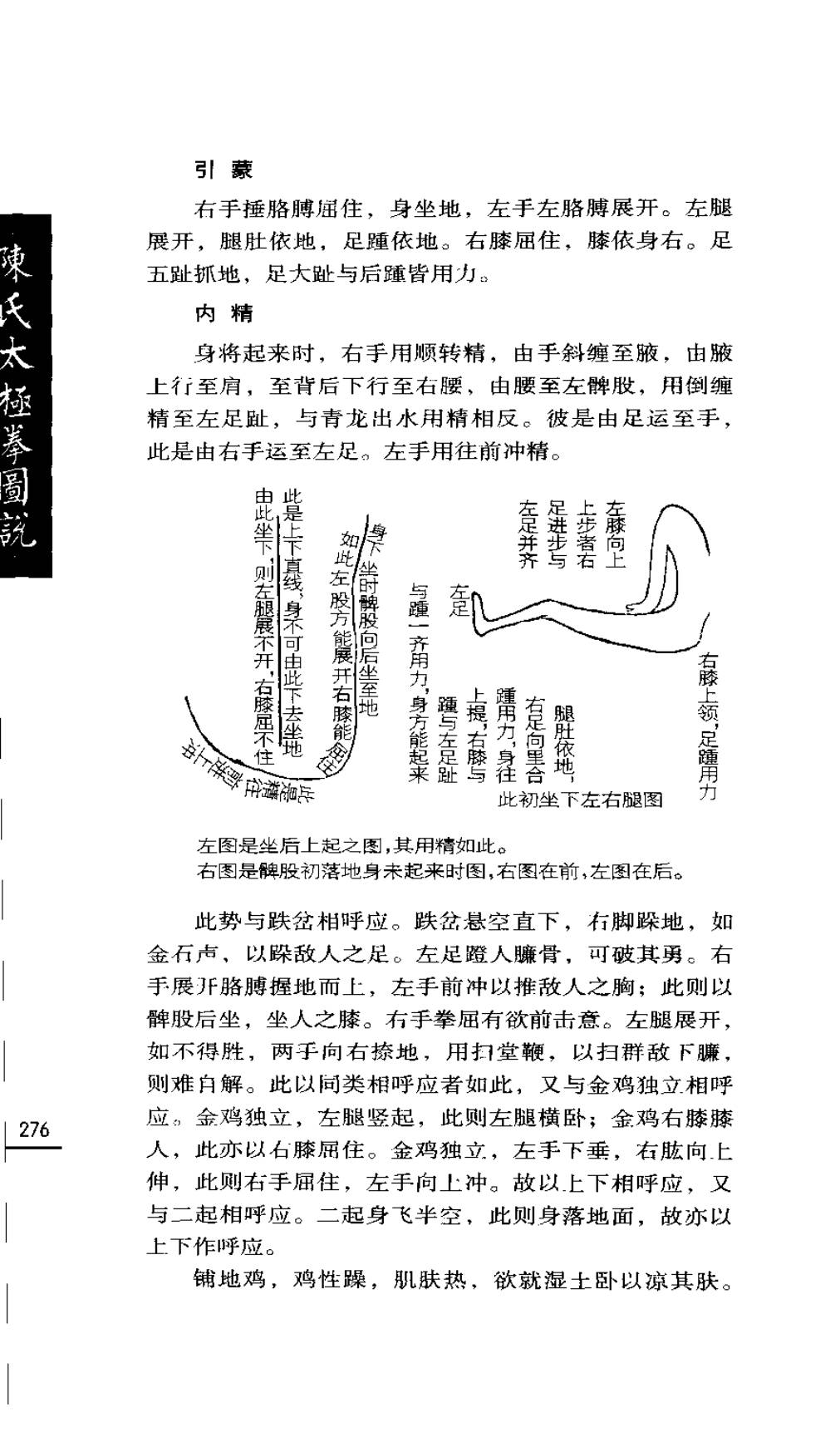
Chen Shi Taiji Quan Tushuo, Volume 3 (陳氏太極拳圖說 卷三)
Text
[It crouches] on the ground, one wing spread out, one leg stretched open. In the human body the left hand and right arm extend in the same way — hence the name [of this posture, "Chicken Paving the Ground" 铺地鸡/铺地锦, pùdì jī].
Correspondence with the trigram (取象 qǔxiàng)
Xun 巽 corresponds to the chicken. The chicken is naturally combative; when it fights it spreads its wings — the left and right hands resemble this. A hen brooding eggs loves to settle its body sitting on the ground; the form is similar, hence the image is taken from Xun. In the human body Xun corresponds to the thigh (股 gǔ). Xun means "entering" (入 rù). The hips and thighs sit on the ground, the left thigh spread open on the ground, the whole body sunk down upon the earth, like falling into a pit. "In the bed beneath" of the Kan–Xun lines refers to the ground. The chicken paves the ground, the body lying on the earth — just as Xun lies beneath the wood/forest. Of the first line (初爻 chūyáo): "It furthers one to see the great man" — here, "useful to the armed man" (利用武人). The left hand extends, the right hand bends — the image of the warrior. Hence this image is taken.
Seven-character folk verses (七言俚语 qīyán líyǔ)
First
未被人推身落地,如何下体坐尘埃,
下惊上取君须记,颔下得珠逞奇才。(此说到七星捶)
Not yet pushed by another, the body falls to the ground —
how can the lower body sit in the dust?
"Startled below, take from above" — you must remember this;
seizing the pearl beneath the chin displays extraordinary skill. (This speaks of the Seven-Star Punch, 七星捶 qīxīng chuí.)
Second
曩时跌岔甚无情(以足蹬臁),此又落尘令人惊。
人知扫腿防不住,岂料七星耀玉衡。
In former times the Falling Split (跌岔 diēchà) was ruthless (the foot kicks the shin),
and now this falling into the dust startles people again.
Others know to guard against the sweeping leg, yet cannot,
Who would expect the Seven Stars to shine upon the Jade Balance (玉衡 Yùhéng)?
Chen Shi Taiji Quan Tushuo, Volume 3
Posture 61: Shang Bu Qi Xing Chui 上步七星捶 ("Step Forward, Seven Stars"), ending with Jingang Dao Dui 金刚捣碓 ("Buddha's Warrior Attendant Pounds the Pestle")
Yinmeng 引蒙 (elementary instruction)
The left hand thrusts forward, circles upward one full turn, and settles in front of the chest. The fingers bend slightly, the wrist faces upward. The right hand travels from the rear forward and upward as well, also turning one large circle in the normal direction, clenching the fist and settling into the middle of the left wrist. The left foot closes slightly inward; the jing 精 at the crown of the head lifts once. In the lower body, the right knee and the right heel area (仆参 púcān region of the ankle) press together with the left heel with unified force; lifting upward, the body rises and the right foot steps — advancing from rear to front, also turning one circle upward and settling down, level with the left foot.
Neijing 内精 (internal essence)
When the body rises, use the jing inside the body, the same as in the previous three Jingang Dao Dui: in every case the qi 气 must return to the dantian 丹田, the heart calm and the qi harmonious, attaining the original image of Taiji 太极.
Quxiang 取象 (correspondence)
The Seven-Star Fist (七星捶 qīxīng chuí) takes the same image as the previous three Jingang Dao Dui. But the former took "the One trunk scattering into the ten thousand branches," while this one takes "the ten thousand branches returning to the One trunk." As the Zhongyong 中庸 says at its beginning: Heaven's decree (天命) scatters through the middle and ends in the ten thousand affairs. It says Heaven on high has no sound and no smell — the meaning is the same; only thus can the whole pattern be gathered to a close.
Diagram labels
- Thigh seemingly straight yet not straight; chest closes forward; right knee bends one or two [inches]
- Right shoulder releases down
- Right elbow sinks down
- Waist jing sinks down
- Left thigh seemingly straight yet not straight
- Left and right feet tread flat and even
- Crotch jing separates — otherwise it is not [correct]
- Crown jing holds up, level
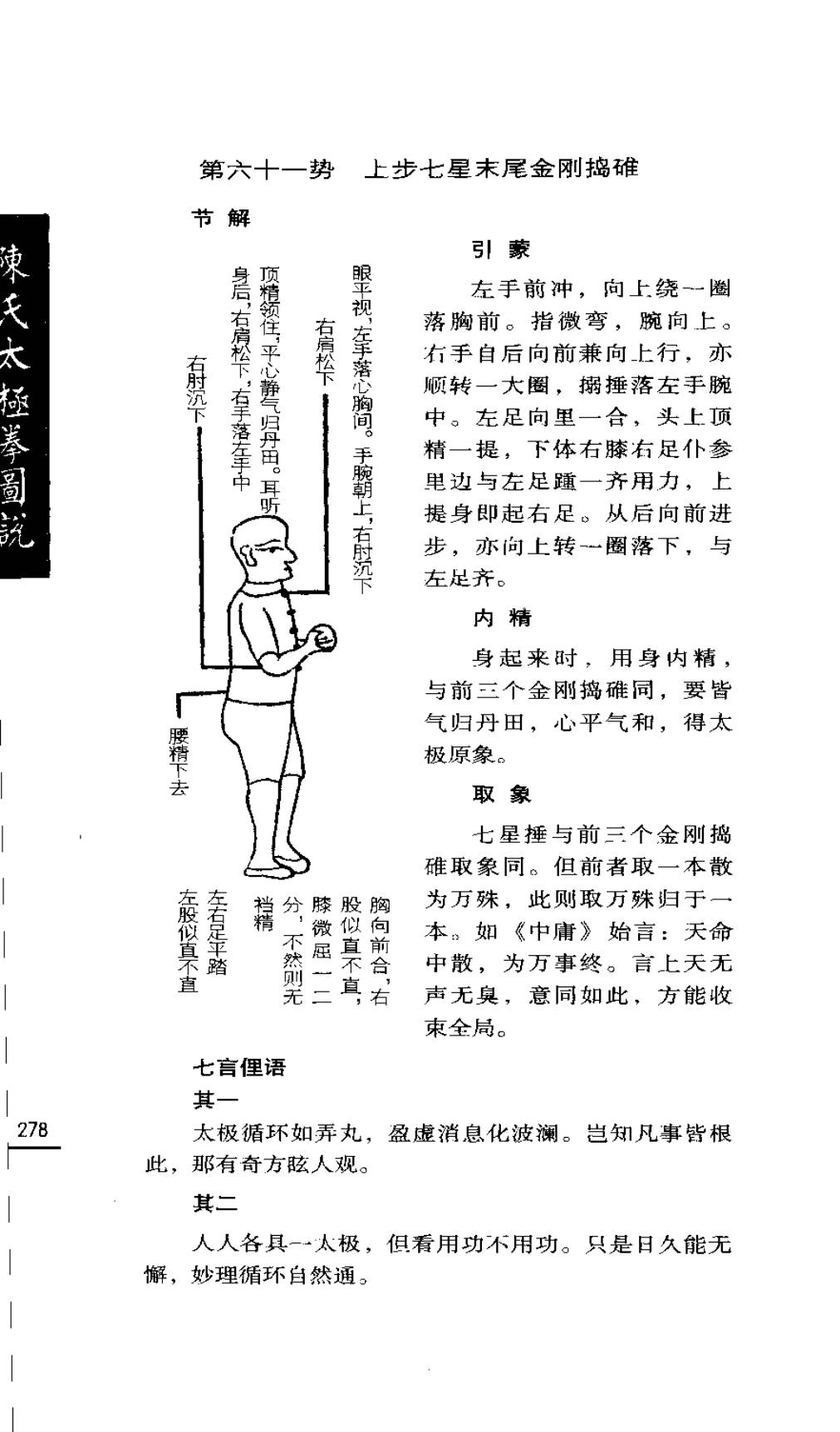
Chen Shi Taiji Quan Tushuo, Volume 3
Seven-character folk verse, third
脚踢拳打下乘拳,妙手无处不浑然。
任他四围皆是敌,此身一动悉颠连。
我身无处非太极,无心成化如珠圆。
遭着何处何处击,我亦不知玄又玄。
总是此心归无极,炼到佛家一朵莲。
功夫到此仍不息,从心所欲莫非天。
Foot kicks, fist strike — that is the lower-grade boxing;
the wondrous hand is nowhere but in seamless wholeness.
Let enemies surround me on all four sides —
one movement of this body topples them all in a chain.
No place in my body is not Taiji 太极;
without deliberate mind it transforms like a round pearl.
Wherever I am met, there I strike,
and I myself know not how deep the mystery runs.
All comes of this heart returning to Wuji 无极,
refined until it is a single lotus of the Buddha.
When gongfu 功夫 reaches this point yet does not cease,
following the heart's desire, nothing is not of Heaven.
Posture 62: Xia Bu Kua Hu 下步跨虎 ("Step Back, Riding the Tiger")
It corresponds to Lou Xi Ao Bu 搂膝拗步 ("Brush Knee, Twisting Step"). In Brush Knee Twisting Step the right hand is in front and the left hand behind; here the right hand is above and the left below. There the stance is wide and crossed (拗); here the stance is withdrawn and bound (束) — the two answer each other by opposition.
Jiejie 节解 (section analysis) — Yinmeng 引蒙
The right hand and left hand divide horizontally from in front of the chest and descend. The right hand turns one circle backward from front to rear; turning forward, the arm lies across and settles above the fontanel (囟门 xìnmén). The left hand divides downward, also turning one circle backward, the elbow rounding and rolling behind the body. The right foot retreats one large step, the knee bends, the foot treads flat on the ground. The left foot also retreats one step, set crosswise a foot (尺 chǐ) apart. When the foot lands, the toes press the ground, the knee bends; the crown jing 精 lifts upward, the crotch jing sinks downward — above and below contend for the jing in mutual tension. In between, the chest closes forward, the hips and thighs kick up toward the rear. The waist jing sinks down, the lower abdomen closes forward, and the face lifts to look at the middle finger of the right hand.
Diagram labels
- Right elbow bends and suspends above the head
- Right hand fingers gathered; the eyes' spirit fixed on the right hand
- Crown jing lifts up, fully raised
- Left hand behind, gathered (撮); fingers and wrist face upward, elbow bent rounding, like mounting the tiger
- Toes press the ground, hips and thighs kick up
- Waist jing sinks, knee bends, toes
- Crotch rounds open
- Crotch sinks, foot down
- Chest closes forward, right knee bent, right foot treads flat
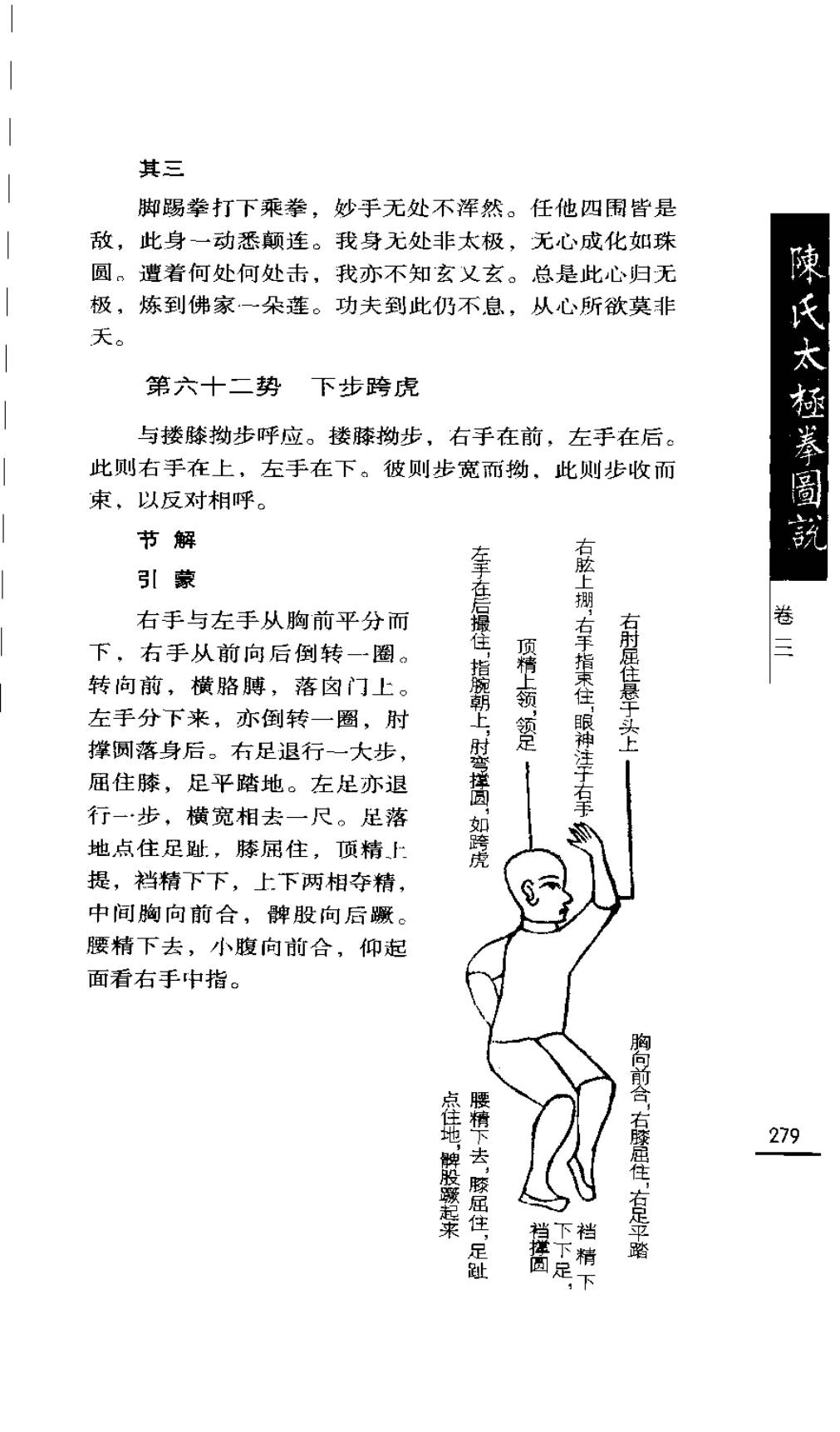
Nei Jing Left-and-Right Hand-and-Foot Diagram (內經左右手足圖, Nèijīng zuǒyòu shǒuzú tú)
Paragraph 1:
In this posture, the method of lowering the body: the smaller the better. Yet if the crotch (dang, 裆) does not open wide, the body will not sink. On the right arm it is as if a thousand-jin heavy weight presses on the crown; the left and right arms are square outside and round within; upper and lower, the spirit gathers together, all using embracing-closing jin (baohe jing). Above is empty, below is substantial; yet the substantial part must be worked with emptiness — only emptiness is agile; being agile, when things come one accords with them smoothly, and there is naturally no obstruction.
Paragraph 2:
In this posture there are ten faults easily seen:
1. The left arm must not be straight; if straight it cannot protect the head and jaw.
2. The left hand is behind; if it cannot close and hold the jin, the echo-response cannot watch over one another.
3. If the left and right feet are too close, the crotch does not open.
4. If the feet are known to be spread wide, yet the figure-eight (ren-character) crotch does not change, the body is made unable to sink.
5. If one forcibly stamps the foot downward without the crown jin leading, forcing the crotch open — forcing makes stiff, stiff makes dead-fixed; dead-fixed means no liveliness; no liveliness means no agility; no agility makes turning dull.
6. The crown jin may be known to lead upward, but if the left and right thighs have not used coiling silk jin (chansi jin, 纏絲精) to prop open and close, close and prop open, then although it is called "open," the crotch has opened only a crack of a seam — it cannot make the crotch like the mouth of a dipper, stable as Mount Tai.
7. The whole body's spirit lies entirely in the eyes; where the gaze fixes is where the spirit gathers. The right hand rises in peng (shang peng), the left hand closes behind; the two arms propped round — only then does it count as one posture. If one moves the hands muddleheadedly without using the mind, once the mind is unused, the spirit has nowhere to tend and cannot consolidate, lost in scattering.
8. (continuing) If the waist jin cannot sink down, the qi cannot return to the dantian (qì guī dāntián). If the qi does not return to the dantian, then zhongji and huiyin become frivolous. Because there is no horizontal qi filling the chest to repletion, then behind the back...
*(Text continues on the next page.)*
Diagram 1 — Nei Jing left-right hand-foot diagram:
Labels within the figure: 胸 (chest), 背 (back); 左手胸平分 (left hand level with chest), 右手胸平分 (right hand level with chest).
Caption between diagrams: 背在後書法不得不如此 — the back is behind; the writing method cannot but be like this.
Diagram 2 — Henggu (橫骨, pubic/horizontal bone): a structural diagram of pelvis and legs, labeled: left foot, toes touching the ground (趾點住地); right/left knees bent holding the foot (膝屈住足); crotch jin must close forward (裆精又要向前合住); open-hold jin (開住精) at left, close-hold jin (合住精) at right; left/right thighs coil chanshi down to the feet (大腿到纏絲纏倒用足).
*(Printed page number: 280)*
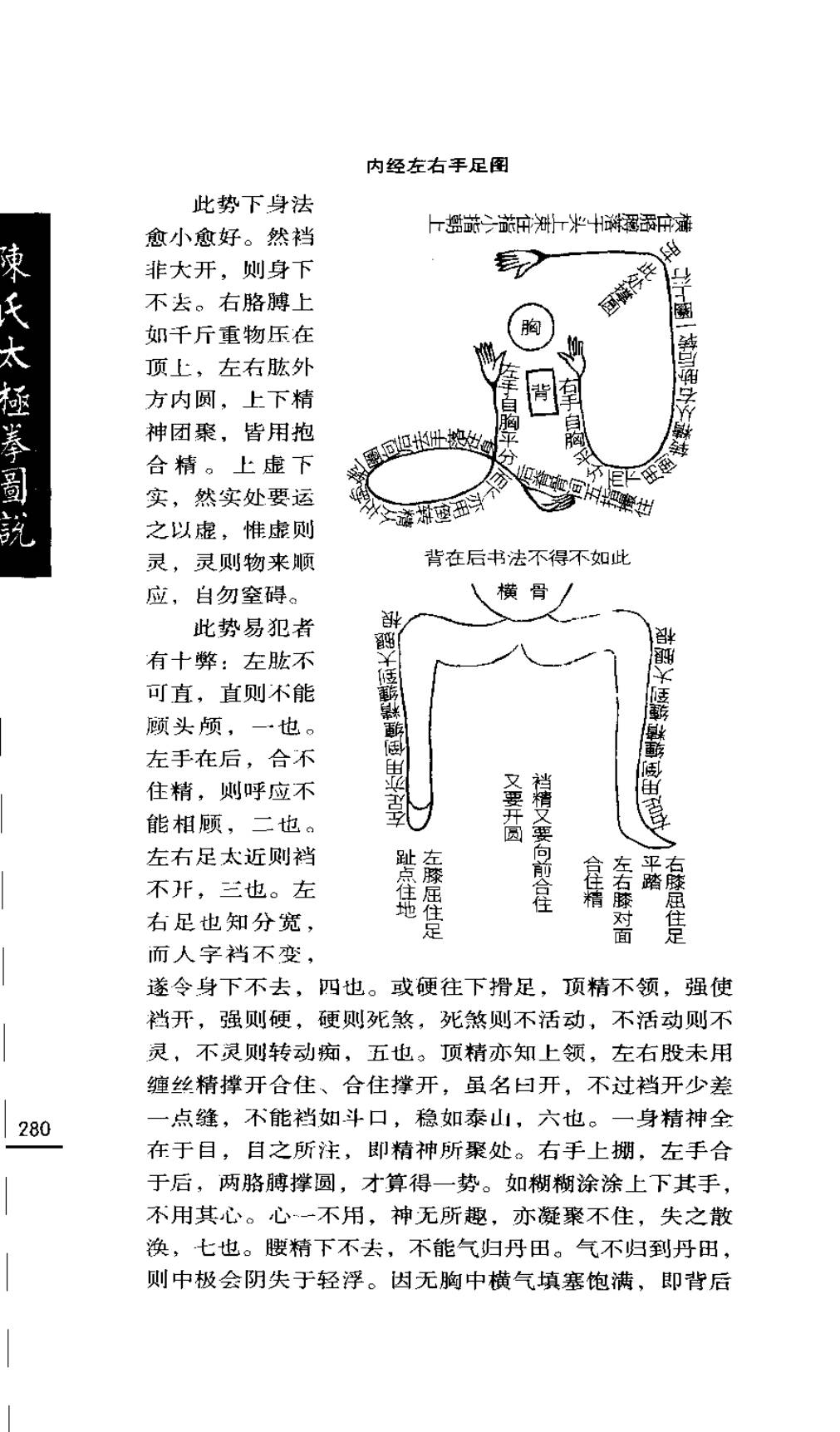
*Chen Shi Taijiquan Tu Shuo* (陳氏太極拳圖說, Illustrated Explanation of Chen-Style Taijiquan), Volume 3 — page 281.
Daodao (陶道), Shenzhu (身柱) and Lingtai (靈台) [points on the back]; the transverse qi on left and right is likewise all filled and sufficient, yet front and back are both sluggish and obstructed. For if one does not close forward, the fault is leaning back; if one closes forward, then the crotch essence (dang jing, 襠精) becomes light and floating, the soles of the feet unsteady, and the upper body is no longer lively and responsive — this is the eighth fault. If the crown essence (ding jing, 頂精) is led too far, the head is suspended too high; if it cannot be raised, the body collapses — this comes from not settling the waist essence (yao jing, 腰精) and crotch essence, so the body is not under its own control — the ninth fault. Once crotch and waist essence are both well settled below, if the thighs and hips still cannot rise, not only can the front crotch not close, but even the upper body cannot be locked together. If upper and lower cannot lock the essence together, the soles have no strength, and anything outside can topple me — such is the tenth fault. With these ten faults, how could the whole body, above and below and on every side, be correctly formed everywhere, and lively everywhere? Not only can it not be correct and lively; moreover all sorts of strange ailments arise in profusion. At that point, even a good physician cannot remedy it — through the depth of accumulated faults one enters a wrong path. How lamentable!
Question: in performing this posture (shi, 勢), what constitutes a correct form? The two hands in front part evenly from the chest, one going right and one going left. For the right hand going right: use the essence of parting (pi jing, 披精) from above downward to separate. The right hand uses the reverse coiling method (dao chan fa, 倒纏法) to coil to the Jianyu point (肩髃). This is the hand going from above downward behind the right ribs — this is the first half-circle. Then from below and behind, move upward, bend the arm (gu, 肱), and let the hand fall level with the head five or six inches from the fontanelle (xin men, 囟門). Spread the hand and bind the fingers; when bound, the heart-mind gathers in. The little finger's outer side faces up, the wrist faces outward, the back of the hand faces inward; using the reverse-coiling essence coil back again from the Jianyu, coiling obliquely to the side of the five fingers — this is the second half-circle of the right hand; combining them makes one great circle. The arm on top, its shape like a moth's eyebrow (emei, 蛾眉) — this is the form of the right hand.
The left hand parts down from the chest, using coiling-silk essence (chansi jing, 纏絲精) in reverse coiling to the shoulder. Then the left hand turns from behind outside the left ribs, forward and again backward, falling behind the left ribs; its essence again coils from the shoulder in reverse to the fingers. The five fingers are held together in a cluster, the arm bent and propped round; the left hand and right hand close together, their essences echoing each other — this is the form of the left hand.
The two eyes fix their spirit on the fingernails of the right hand; where the eyes fix, there too is the heart-mind, giving the spirit a place to return — this is the form of the gaze (yan shi shi, 眼視式).
Raise the crown essence. Leading the crown essence does not mean stiffly tensing the two great tendons behind the head at the nape; it means lifting the central qi (zhong qi, 中氣) upward. As if intending, as if not intending, neither light nor heavy, seemingly present seemingly absent; one point of sudden alertness in the heart, the essence flowing to the back of the crown. One must not lift too far, nor fall short. Too far and the body hangs suspended above; too little and the qi stays in the chest, hard to send down — this is the form of the crown essence (ding jing shi, 頂精式). The crown must be lively; when lively, turning left and right becomes easy — this is the crown form.
The ears listen left and right and behind, fearing unexpected assault. If someone comes from behind, there must first be a sound; one can hear the sound — a sound is naturally different from silence. Therefore with the heart calm and the qi still, the ears are naturally sharp — this is the form of the two ears (er shi, 耳式).
The two shoulders must constantly relax and sink; on seeing them rise, immediately relax them down. Yet when they must unavoidably rise, let them rise; once the rising is finished, relax at once. If not relaxed, the whole arm cannot change nimbly; therefore rise when rising is fitting, relax when relaxing is fitting. When each posture finishes, the chest closes forward and the two shoulders echo each other — this is the form of the two shoulders (jian shi, 肩式).
The two elbows should sink down; if not sunk, the shoulders rise, and they are unfit for use. This posture alone is otherwise: here the right elbow is bent on top, propping the forearm upward, horizontally pushing up. If elbow and arm do not push up, they cannot hold up what is above. The left elbow, with the back bent, props against the right… (text continues on the next page)
*Chen Shi Taijiquan Tu Shuo* (陳氏太極拳圖說) — page 282.
…[elbows] echoing each other — this is the form of the left and right elbows (zhou shi, 肘式). The strength of the right hand's five fingers all pours into the little finger's side (xiao zhi jia, 小指胛), holding up and propping upward. When strength is led from this place, then the elbow and the upper and lower arm both exert strength. The left hand is behind, fingers clustered, wrist turned upward, so that one's finger cannot be seized by another and bent backward. And when the fingers are clustered, it also shows the heart-mind gathering in. The two hands, one up one down, one front one back, echoing as one breath — this is the form of the two hands (shou shi, 手式).
From the waist up: behind, the Pohu (魄戶) and Gaohuang (膏肓) points close toward the front of the ribs. On the chest and flanks: the first row — Yuanye (淵腋) and Dabao (大包) belong to the Triple Burner (san jiao, 三焦). The second row — Zhejin (輒筋) and Riyue (日月) also belong to Lesser Yang Triple Burner. The third row — Yunmen (雲門), Zhongfu (中府), Shidou (食竇), Xiongxiang (胸鄉) belong to lung and spleen. The fourth row — Jianyin/Houyin row (頷陰), Qimen (期門), Tianchi (天池) belong to liver and gallbladder. The fifth row — Yangming large intestine's Quepen (缺盆), Qihu (氣戶), Liangmen (梁門), Guanmen (關門) belong to intestine and stomach. The sixth row — Lesser Yin's Shufu (腧府), Shencang (神藏), Youmen (幽門), Tonggu (通谷/通骨) belong to heart and kidney. The middle row — Huagai (華蓋), Zigong (紫宮), Yutang (玉堂), Danzhong (膻中), Zhongting (中庭), Jiuwei (鳩尾). The flanks on both sides from Yuanye and Dabao down to Youmen and Tonggu all close toward Yutang and Danzhong; the flanks left and right all echo each other — this is the form of the two flanks above the waist.
From the waist down: left and right Qichong (氣衝) and Weidao (維道) all close toward Qihai (氣海), Guanyuan (關元), Zhongji (中極) — this is the form of the two soft flanks below (ruan xie xia shi, 軟脅下式). The flesh of the two thighs and buttocks rises upward; if it does not rise, the front crotch cannot close. Below the soft ribs is the waist; if the waist essence (yao jing, 腰精) does not sink down, knees and feet have no strength. Inside the thigh at Huantiao (環跳), the bone closes inward; if it does not close, the two thighs lose themselves in scattering — these are the forms of three places: the waist, the buttocks, and the bone inside Huantiao.
The transverse qi (heng qi, 橫氣) in the chest descends and returns to the dantian (丹田, that is, Qihai 氣海); the qi of the dantian gathers at the perineum (yin, 陰); the transverse qi accumulates there and the hard qi transforms into soft qi. When the heart-mind does not move, this qi is always still; when the heart's qi issues forth, this qi rises to assist the heart's qi. If this qi is well used, it becomes the central qi (zhong qi, 中氣); if ill used, it becomes transverse qi. There are not two kinds of qi: the soft yet powerful is the central qi; what is merely hard is transverse qi. As for its function: impartial, not leaning, without excess or deficiency — that is the *function* of the central qi, not its *substance*. The substance of the central qi is the correct qi of yin and yang within my heart — what Mencius called the qi matched with the Way and righteousness, the flood-like qi (haoran zhi qi, 浩然之氣).
Here, the qi of the dantian below the chest: thus with not a single thing in the heart, utterly empty and responsive (xu ling, 虛靈); the moment anything is grasped at, it is neither empty nor responsive. Only with stillness sustain it, nourish its sincerity, until in motion and stillness all is fitting and transformation is unfathomable — this is the form of the heart-mind (xin zhi shi, 心之式).
As for the crotch: the qi of the upper body gathered above the testicles (luan, 卵) sinks straight down — this is what the vulgar call the "thousand-jin drop" (qian jin zhui, 千斤墜), utterly substantial! When not used, the substantial transforms back into empty — this is called "moving the substantial into the empty"; if not empty, above and below are both unresponsive. At both sides of the perineum the roots of the two great thighs prop apart; if they prop apart one inch here, the two knees open a foot by themselves. This posture should open two inches, yet what opens must be empty, must not trespass into the substantial: once it touches the substantial, turning becomes unresponsive. Yet where they open, the roots of the two legs are all closing essence (he jing, 合精); the thighs rise far, the lower abdomen closes forward, and the crotch opens of itself. One who is good at opening the crotch: even a single thread's width of opening may be called open, because it is empty and round, both sides closing together while the middle opens wide. One who is bad at opening the crotch: the crotch like the character 人, narrow above and wide below, neither empty nor round — though it looks open, it cannot be called open! This is the form of the crotch's middle (dang zhong shi, 襠中式). The two thighs close in front and open behind, close outside and open inside, paired against each other, echoing… (continues on next page)
*Chen Shi Taijiquan Tu Shuo* (陳氏太極拳圖說), Volume 3 — page 283.
…[the two thighs] responding to each other — this is the form of the thighs (da tui shi, 大腿式). Both kneecaps close inward; both knees are bent, with a space of a bit over a foot held open between them — this is the form of the knees (xi zhi shi, 膝之式). The outer shins (wai lian, 外臁) of both lower legs close their essence toward the inner shins, paired facing each other — this is the form of the two lower legs (liang xiao tui shi, 兩小腿式).
As for the two feet: the right foot treads flat, like earth settled on the ground; the left foot is planted on its point, like an awl driven into the earth. The right foot is flat and substantial; the left foot is firm yet empty. What is empty conceals the momentum of the lowered posture; the toes and the outer edge of the foot both exert strength closing inward, and the heels both press heavily on the ground — this is the form of the two feet (liang zu zhi shi, 兩足之式).
As for the lower body: both feet use coiling-silk essence (chansi jing, 纏絲精) in reverse coiling, moving against the flow upward, from the toes past the Yongquan point (湧泉) to the outer edge of the foot, coiling from outside inward; the coil reaches the roots of the two thighs and enters the dantian (丹田) — this is the use-of-essence form of the lower body (xia ti yong jing shi, 下體用精式).
So minute a posture: its arising is compared to that [hexagram], and its established rules are these. From head to foot each part has its fixed form. If one can truly strive to remove the faults, transform oneself into the midst of the compass and square, then go beyond the compass and square — following the compass and square yet not confined by them — then one has attained it.
Taking the Image (Qu Xiang, 取象)
The right arm dwells above, like the top line of Li (離, Fire ☲). Within, the emptiness and brightness of the heart is like the empty middle of Li. Below, the essence of the dantian is full and the soles of the feet exert strength, like the bottom line of Li; therefore the image is taken from Li.
Seven-Character Vernacular Verses (Qi Yan Li Yu, 七言俚語)
*The First*
Two hands part evenly, hips and tailbone floating; the small body crouches, curled like a gibbon (yuan nao, 猿猱). The right hand holds up the mountain's ridge pressing down; the left arm strides below, the tiger's body firm. The crotch root opens wide, the posture of jade tablets (gui bi, 圭璧); the eyes gaze up at the high fingernails. One foot substantial, one empty, the feet differ; with one turn of the body, all the youngsters submit.
*The Second*
Mount Tai (比喻 a strong enemy) presses on the eggs (比喻 the hand), holding the upper stream (meaning: above the head). Qian (乾) miscast becomes Kun (坤), bearing the globe of the earth (Li is the middle line of Qian; changed from Qian, which is the father of Li — hence speaking of Li must go back to Qian). Another change of the middle line of the Qian hexagram: the doubled Li's fire blazes on the emerald peak.
*Chen Shi Taijiquan Tu Shuo* (陳氏太極拳圖說) — page 284.
Posture 63: Front Half-Turn of the Body, Sweeping the Foot (前半勢轉身擺腳)
This posture echoes the previous Sweeping the Foot, but its transition between what precedes and what follows differs in momentum; the middle is the same.
Diagram labels
Right palm faces back, arm in a slow-bending posture (右掌朝後,胳膊慢彎勢)
Right elbow props outward (右肘向外撐住)
Ears listen behind the body (耳聽身後)
Crown essence held in lead (頂精領住)
Eyes look toward the chest (眼視胸前)
Left hand falls in front of the right breast (左手落右乳前)
Left knee slightly bent (左膝微屈)
Foot treads flat on the ground (足平踏地)
Right leg raised on the body's left, foot level with the thigh root (右腿抬起在身左,足與腿根平)
Guiding the Uninitiated (Yin Meng, 引蒙)
The previous posture's step is Straddling the Tiger (kua hu, 跨虎): the right hand is held up over the head, back of the hand facing up. The right arm seems motionless yet moves — moving without moving — turning backward with the body. The left hand is behind, also gradually rising, also turning with the body. The left foot steps out toward the northwest; the right foot turns back with the body, opening one large backward step, landing to the northwest of the left foot. The left and right arms also spread out toward the northwest; the hand spreads open and binds the five fingers together; the two hands are level with the breasts, and the right leg lifts toward the southeast, foot level with the thigh root. Then the right foot moves horizontally through the air from south to north, while the left and right hands sweep horizontally from north to south. When the sweeping of the right foot is finished, the right foot lands in its original place; the left and right hands pour down from the south, not stopping until the northwest; from behind to the front they turn one great circle, falling in front of the chest.
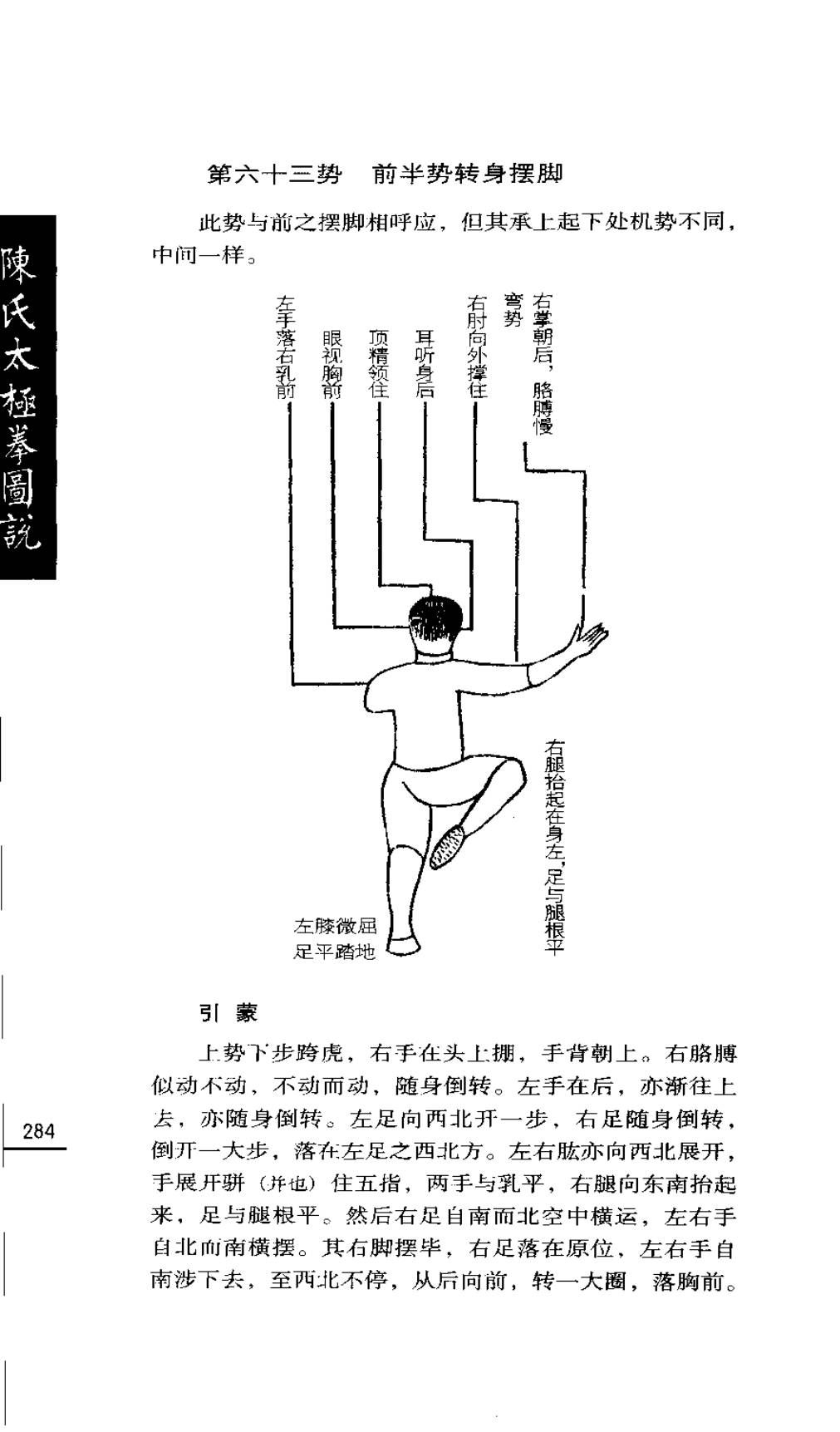
*Chen Shi Taijiquan Tu Shuo* (陳氏太極拳圖說) — page 285.
The left hand is in front, the right hand behind, both fists grasped together (nuo, 搦); close the chest, close the crotch; the feet left and right do not move, the knees are bent.
Internal Essence (Nei Jing, 內精)
The left hand turns around from behind; its essence rises from the Riyue point (日月) up to the shoulder, using the forward coiling method (shun chan fa, 順纏法) in front, coiling obliquely to the hand. The right hand uses reverse-turning coiling-silk essence (dao zhuan chanshi jing, 倒轉纏絲精), coiling from the shoulder and back, outside to inside, until it reaches the fist (chuitou, 捶頭). The left leg uses forward-coiling essence, coiling from the toes up to the leg root, returning to the dantian (丹田) and descending into the crotch. The right leg uses reverse-coiling essence, rising from the toes, coiling to the leg root, returning to the crotch.
Seven-Character Vernacular Verse (七言俚語)
The right hand props upward, the body turns back; first release the right arm and yield to the hero. Then strike both hands to the left; the left foot sweeps across and seizes the very work of creation (duo hua gong, 奪化工).
Posture 64: Cannon Overhead (Dang Tou Pao, 當頭炮)
This completed posture takes this [movement] as its head, joined with the Sweeping Foot (bai jiao, 擺腳) as one posture. It is called Cannon Overhead because first one strikes at the opponent before the face with the fist.
Analysis of the Sections (Jie Jie, 節解) — diagram labels
Waist essence sinks down; without the waist essence sinking, the soles have no strength, and the crotch cannot close (腰精下去……)
The two elbows face outward; the two fists face each other, one front one behind, essence closed together (兩肘向外……)
The two shoulders relax down; do not raise them like a shelf (兩肩鬆下,勿上架)
The crown essence is well led; the crown essence connects below to Changqiang (長強) — the key to the body (頂精領好……)
The eye's spirit fixes on the left hand and left fist (眼神注於左手左拳)
The chest must close forward, empty and hollow, containing the ten thousand images, utterly empty (胸要向前合住……)
The whole body, joint by joint, all closes essence facing one another; above and below close essence as one breath (全體節節……)
The right foot hooks inward, the inner heel pushes back, the toes close inward (右足鉤住……)
The right knee is slightly bent; bent, the crotch opens (右膝微屈……)
The crotch must open wide, must be empty, must be round, must be closed together (襠要開大……)
The big toe closes inward, exerting strength gripping the ground (足大拇向裏合……)
Bent and held, the left knee passes beyond the toes (屈住,左膝皆過足趾)
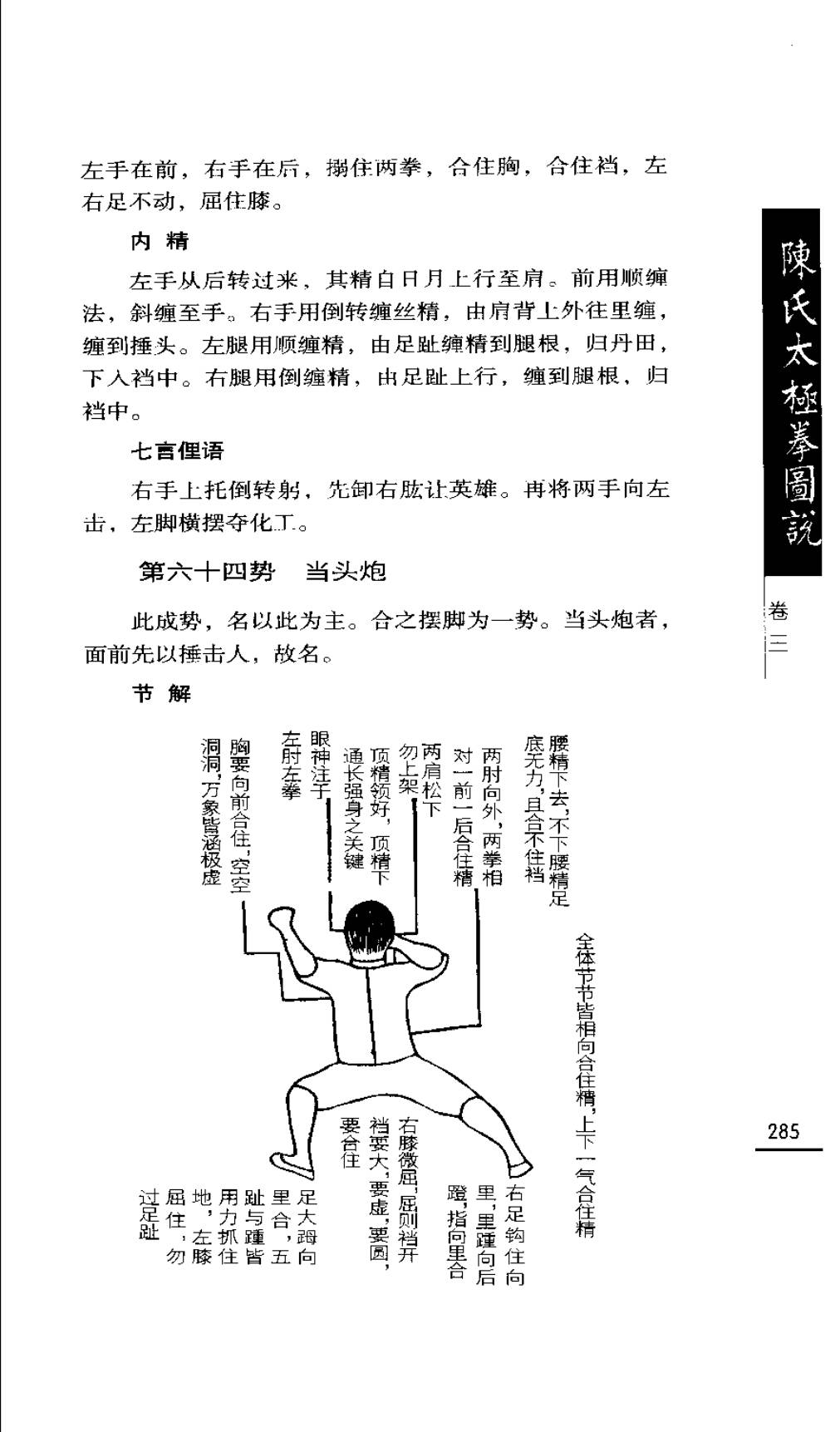
(Printed page: 286)
Yin Meng (Guiding the Novice)
The left and right hands go from above downward, from the front to the right and then behind; then from behind the right, turning forward again, they sweep one large circle, and the stroking fist (掳捶 lu chui) comes to rest before the chest. The left hand (when the hand is named, the forearm is included) uses coiling energy in the forward direction (顺转精 shun zhuan jin); the right hand uses reverse coiling energy (倒转精 dao zhuan jin); the left leg uses forward-coiling energy, the right leg reverse-coiling energy — this was already explained under Shuai Jiao (摆脚). The left and right elbows face outward; the left and right fists point upward along the arm. The whole upper body applies embracing-closing energy (抱合精 bao he jin) — it is the energy within the chest. The movement runs from the left, from above downward, then from below upward, turning one circle from the right around to the left, the chest closing forward. The crotch energy opens round and closes firmly (裆精 dang jin); the toes of both feet grip, holding the energy; the energy at the crown is held up (顶精 ding jin); the shoulders, knees, and ankles all turn outward-to-inward, and the combined force gathers in the fist. The eyes look at the space between the left and right hands. This posture is also called Hu Xin Quan, "Protect the Heart Fist" (护心捶), closely echoing the first posture Jin Gang Dao Dui (金刚捣碓, "Buddha's Warrior Attendant Pounding the Mortar"): both take protection of the heart as their chief aim. If the heart-mind does not waver, then above, below and on all four sides one is attentive without omission.
Nei Jin (Internal Energy)
After turning the body, the left and right hands circle from behind forward. The left fist uses back-folding energy (背折精 bei zhe jin) — the fist strikes upward; using the back-folded elbow, the right fist holds its energy closed and comes forward to support the left hand. In this posture the left hand reverses its rotation from above downward, and the whole body turns following the turning of the left hand. For when the body secretly steps out one pace with the left foot and turns around, the right arm naturally gains momentum downward, unloading the heavy pressure from above. Once that pressure is eight or nine tenths unloaded, the left hand immediately uses forward-coiling back-folding energy to strike the opponent's left ribs, and the attack can hardly be resolved. Now the left hand, in usefulness, never matches the right hand in strength; but here the left hand is near the opponent and gains the position to strike first, so the spirit of the whole body must follow the momentum to aid the left hand. Outwardly the two hands face each other and join, yet in truth they both join from right to left; the unloading downward from the left is opening; the turning of the energy, joining from left to right, is closing. One rise and one join — and the art of the fist is complete. For the opening and closing of my body are the closing and opening of heaven and earth, and the closing and opening of heaven and earth are the opening and closing of my body. The human body is a small heaven-and-earth: one and two, two and one — uniting them is Taiji. Taiji is that in which yin and yang are already present but not yet formed; yin and yang are the names given once Taiji has divided. Movement engenders yang — this is opening; stillness engenders yin — this is closing. Therefore I say that one opening and one closing exhaust the art of the fist. When the left foot is in front and the right foot behind, the right foot advances level with the left, and the hands circle from below upward and settle before the chest — that is Jin Gang Dao Dui. Ending yet beginning again, beginning yet ending again, ending and beginning cycle without end. Hence in practice, perform each circle according to your own strength: one repetition will do, ten will do — the number does not matter. If you have strength, keep moving; when strength is spent, stop; do not force movement beyond the rules. Simply follow what is natural, and you will attain it.
(Printed page: 287; Volume 3)
Right-margin vertical title: 陳氏太極拳圖說 卷三 (Chen Shi Taijiquan Tu Shuo, Volume 3)
Zuo You Yun Xing Tu (Diagram of Movement Left and Right)
Left diagram (a curved line showing circular movement, five labels arranged counter-clockwise around it):
- 从北转东 cong bei zhuan dong — from the north turn to the east
- 往南去 wang nan qu — go toward the south
- 往北去 wang bei qu — go toward the north
- 往西去 wang xi qu — go toward the west
- 合左手 he zuo shou — joins with the left hand
Right diagram (a curved line showing hand movement, three labels):
- 左手自此卸下 zuo shou zi ci xie xia — the left hand lets the load down from here
- 左肘向左 zuo zhou xiang zuo — the left elbow toward the left
- 右手由右肋前推 you shou you you lei qian tui — the right hand pushes forward from before the right ribs
Main Text
This is the place of turning in the movement (转关 zhuan guan): once the bend is turned, the hand goes forward — that is the place of striking the opponent. If one does not turn a full circle, the strike has no power.
This is the method of moving along the path; the coiling silk energy (缠丝精 chansijin) belongs precisely within the movement of the two forearms.
Qu Xiang (Taking the Image)
The two hands part — this resembles the top line of the hexagram Kan (坎, Water); the body lying level in the middle resembles the middle line of Kan; the two feet apart resemble the bottom line of Kan — hence the image of Kan is taken. "Kan is full in the middle" means the solidity of yang resides within. Soft outside, firm within — that is the image of Kan. Kun, with the yielding of its middle line, exchanges with the middle line of Qian; the yielding changes into the firm — this is the proof that Kun crosses by its central qi, the image of the middle son. Joined with the previous posture: Li below, Kan above, forms Ji Ji (既济, After Completion); reversed, it forms Wei Ji (未济, Before Completion). The first posture, Jin Gang Dao Dui (金刚捣碓), is Taiji generating the two forms. Confucius said: "After heaven and earth exist, the myriad things arise; after the myriad things, there are male and female; after male and female, husband and wife; after husband and wife, father and sons — and from father and sons onward, generation is endless." The last two postures are middle son and middle daughter, blood and qi at their prime, principle full and qi abundant, with the promise of endless generation — hence Li and Kan are taken. Li below and Kan above is called Ji Ji: things are not exhausted; therefore it ends receiving Wei Ji.
Qi Yan Li Yu (Seven-Character Folk Verse)
阖辟刚柔顺自然,一扬一抑理循环。当头一炮人难御,动静形消太极拳(言皆归于太极,合太极)。
Closing and opening, firm and yielding, follow what is natural; one raising, one lowering, principle cycles round. A cannon straight at the head is hard to withstand; movement and stillness, form dissolved — all is Taijiquan (meaning: all returns to Taiji, merging into Taiji).
Wu Yan Li Yu (Five-Character Folk Verse)
太极理循环,相传不计年。此中有精义,动静皆无愆。收来名为引,放出箭离弦(此二句,上句言引进落空,下句言乘机击打)。虎豹深山踞,蛟龙飞潭渊(上句言静,下句言动)。开合原无定(活泼泼地),屈伸势相连(却有一定)。太极分阴阳,神龙变无方。天地为父母,摩荡柔与
Taiji's principle cycles; handed down without counting years. Within this there is refined meaning: in movement and stillness, no fault. Drawing in is called "leading" (引 yin); releasing is an arrow leaving the string (these two lines: the first speaks of leading in to emptiness — 引进落空; the second of striking by seizing the moment). Tiger and leopard crouch in deep mountains; flood-dragon flies in pool and abyss (first line speaks of stillness, second of movement). Opening and closing are by nature unfixed (lively and alive); bending and extending, the postures connect (yet there is a constancy). Taiji divides into yin and yang; the spirit-dragon changes without fixed method. Heaven and earth are father and mother; the grinding, tossing of the soft and the…
(The final line 摩荡柔与 breaks off at the foot of this page and continues on the next.)
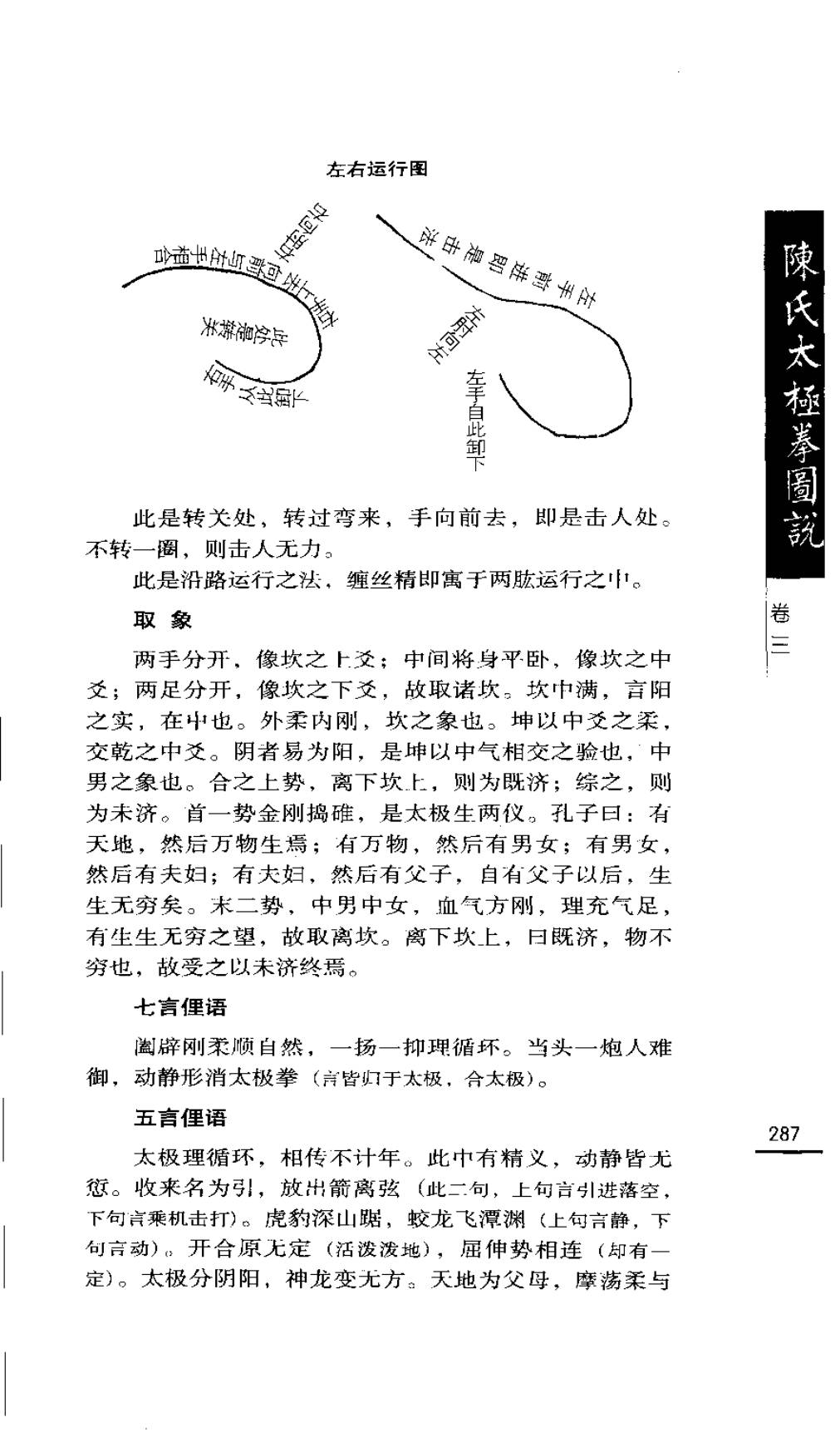
(Printed page: 288)
Left-margin vertical title: 陳氏太極拳圖說 (Chen Shi Taijiquan Tu Shuo)
(Note: the opening character 剛 gang — "firm" — completes the last line of the Five-Character Folk Verse carried over from page 320, 摩荡柔与…刚.)
Wu Yan Li Yu (Five-Character Folk Verse, continued)
剛。生生原不已,奇正不尋常,乾坤如囊籥,太極一大囊。盈虛消息故,皆在此中藏。至終復自始,一氣運弛張。有形歸无迹,物我兩相忘(與道為一)。太極拳中路,功夫最為先。循序無躐等,人盡自合天。空談皆漲墨,實運是真詮。鸢飛上戾天,魚躍下入淵。上下皆真趣,主宰貴精研。若問其中意,道理妙而玄。往來如晝夜,日月耀光圓。會得真妙訣,此即太極拳。凡事都如此,不但在肘間。返真歸璞后,就是活神仙。隨在皆得我,太璞自神全(仍歸太極)。
English rendering:
…firm. Generation upon generation never ceases; the direct and the unexpected are nothing ordinary. Heaven and earth are like a bellows (囊籥 nang yue); Taiji is one great sac. The workings of fullness and emptiness, increase and decline, are all hidden herein. Reaching the end, it begins again — one qi drives the slackening and the drawing taut. What has form returns to the traceless; self and things are both forgotten (one with the Dao). Of the paths in Taijiquan, gongfu comes first of all. Proceed in order, skipping no steps, and every person accords with heaven. Empty talk is but ink run wide; actual practice is the true interpretation. The kite flies up and strikes the sky; the fish leaps down and enters the deep. Above and below hold true delight; the master of it all prizes careful study. If you ask the meaning within it: the principle is subtle and mysterious. Going and coming are like day and night; sun and moon shine with rounded light. Once you grasp the truly marvelous secret — this very thing is Taijiquan. All affairs are so — not only at the elbow. After returning to truth and the uncarved block, one is a living immortal. Wherever one is, one finds one's self; the great uncarved block is whole in spirit (returning again to Taiji).
Appendix
Chen Shi Jia Cheng 陳氏家乘 (Chen Family Genealogy)
Chen Zouting 陳奏庭, given name Wangting 王廷. In the Ming he was a government-school student (xiangsheng 庠生); under the Qing he entered the military school, and was expert in Taijiquan 太極拳. He once traveled to Shanxi to visit friends and saw two boys wrestling; two old men stood by watching, and he watched too. One old man said: "Would you like to wrestle, sir?" He said: "Yes." The old man had one of the boys grapple with him. The boy wrapped his arms around his waist, lifted him, and struck his qihai 氣海 point with the knee three times, then set him down. Suddenly both old and young vanished; it was growing dark, and he returned home melancholy.
He was close friends with Li Jiyu 李際遇, a military graduate of Dengfeng County. When Dengfeng rose in disorder because officials drove the people to it, with Jiyu at its head, he tried to stop him. As they went up the mountain, arrows rained down like rain, yet could not wound him. He met one adversary and chased him, circling the imperial fort three times without catching him. After Li Jiyu's cause failed, a servant surnamed Jiang 蔣 served him — the very man he had once chased. This man could outrun a rabbit over a hundred paces, and was also skilled in boxing. Living in turbulent times, his exploits in sweeping away the disorderly hordes were beyond counting, but all records have been lost, leaving only one song of long and short lines (changduanju 長短句), which reads:
"Alas for those years, wearing armor and grasping sharp weapons, sweeping away the disorderly hordes, several times amid peril. Receiving imperial grace bestowed — all in vain. Now, old and gasping what breath remains, I have only the scroll of the Huangting 黃庭 to keep me company. When bored I create quan 拳 (boxing); when busy I till the fields. In spare moments I teach some disciples and sons and grandsons — to become dragons or tigers, as it may. Pay the official grain early, repay private debts at once. Pride and flattery: never use them; patience and yielding come first. Everyone says I am a fool; everyone says I am mad. I keep my ears washed and never dust my cap (seek no office), laughing to scorn the ten-thousand-household nobles whose anxious toil cannot compare with mine. My heart is ever at ease. Fame and profit I never covet; I have penetrated the mechanism and recognized that Handan 邯鄲 (dream of glory). Delighting myself among fish and water, lingering amid mountains and rivers — thriving means nothing to me, perishing means nothing. If only the world were at peace and I could live serene and tranquil, neither scheming nor craving, why should I care how the world fawns or freezes? Success is no concern, failure is no concern. If I am not an immortal, then who is?"
Chen Jingbai 陳敬柏, courtesy name Changqing 長青, a man of the early Qianlong era, loved Taijiquan. A Shandong thief of eighteen, coveting a pane of glass from the governor's window, flew over roofs and walls and escaped beyond the city; the constables dared not arrest him. Then he, with the camp, was ordered to make the arrest. The thief stabbed a knife toward Jingbai; he gripped the blade with his teeth, threw the thief out the door, and the thief submitted. After the case was solved, the thief also joined the camp
Chen Shi Taiji Quan Tu Shuo 陳氏太極拳圖說 · Appendix · Chen Family Genealogy (continued)
[He proved] effective. At that time the famous masters of Shandong were no match for him in art, so he was nicknamed "Gai Shandong 蓋山東" (Cover of Shandong), a testimony to the height of his skill.
Chen Yuhui 陳毓蕙, courtesy name Chuting 楚汀. A juren 舉人 (provincial graduate) of the renzi 壬子 year of Qianlong; magistrate of Huating 華亭, Fengxian 奉賢, Jinkui 金匱 and other counties in Jiangsu; Grain-Intendant Assistant Judge (tongpan 通判) of Changzhou Prefecture; Sub-prefect of Chuansha 廳; assistant examiner of the jiamao 丁卯 provincial examination.
Chen Bulai 陳步萊, courtesy name Pongsan 蓬三. A juren of the guiyou 癸酉 year; magistrate of Nanpi 南皮, Qinghe 清河, Julu 鉅鹿 and other counties in Zhili. Transferred as acting magistrate of Qiubei 丘北 County, Yunnan, later specially appointed magistrate of Mile 彌勒 County.
Chen Bushan 陳步蟾, courtesy name Lüqing 履青. A juren of the jiawu 甲午 year of Qianlong; magistrate of Mayang 麻陽 County, Hunan; assistant examiner of the wushen 戊申 provincial examination.
Chen Shan 陳善, courtesy name Jiamo 嘉謨. A government student; in the sixtieth year of Qianlong attended the Feast of a Thousand Elders (qiansouyan 千叟宴).
Chen Yuying 陳毓英, courtesy name Guanqian 冠千. A county-school student; in the sixtieth year of Qianlong, aged eighty-eight, attended the Feast of a Thousand Elders.
Chen Jixia 陳繼夏, courtesy name Bingnan 炳南, a man of the end of the Qianlong era, expert in Taijiquan 太極拳. Whenever he milled flour he began by pushing with both hands, then reduced by stages; when reduced to one finger he would still press with it, and even a single turn of the mill was never idle work; later his art surpassed his teacher's. He excelled at painting; the murals of the Guandi Temple in Zhaobao 趙堡鎮 were all his, lifelike and masterly. One day, while painting a Buddha image at Gusheng Temple 古聖寺 (west of Chengou 陳溝 village), someone snatched at him from behind; he threw the man down before him. Asked his name, it proved to be Rensan 荏三 of Henan, a famous figure in the art. He was filial to his mother, supporting her with simple fare (shushui chenghuan 菽水承歡), and the whole village was transformed by his example.
Chen Bingwang 陳秉旺, Bingren 秉壬, and Bingqi 秉奇 — all three were adept at Taijiquan; honing one another's skills, their art became refined to the point of spirit; people called them the "Three Heroes" (sanjie 三傑). Bingren was also expert in medicine. Bingwang's son Changxing 長興 fully inherited his father's learning, upright and dignified in bearing, nicknamed "Tablet Chen" (paiwei chen 牌位陳); his following of disciples was especially great — Yang Fukui 楊福魁 (Yang Luchan) being the most famous. Changxing's son Gengyun 耕耘, courtesy name Xiacun 霞村; Gengyun's sons Yannian 延年 and Yanxi 延禧 carried on the art. Gengyun once fought the Yue bandits (Cantonese Taiping rebels) under Zhongsheng 仲牲 and won military merit.
Chen Peng 陳鵬, courtesy name Wanli 萬里, a famous physician of the early Jiaqing era. He practiced Taijiquan to perfection; none could fathom its depths. Though poor, he kept himself upright; his qi 氣 was relaxed and free; his nature was tranquil, free of vulgar cares.
Chen Yaozhao 陳耀兆, courtesy name Youguang 有光, born in the Qianlong era, died in the Daoguang era at eighty. Charitable and generous, strict in household discipline, orderliness within and without; he taught his sons by righteous methods, and sons and grandsons all entered the government school. He was devoted to Taijiquan; the warriors of the day all received his teaching, yet in subtlety none surpassed him.
Chen Gongzhao 陳公兆, courtesy name Deji 德基. His learning was pure and correct; many famous scholars came from his school. Upright and square in his own conduct, in affairs he did not bend for private ends; charitable and generous. In the seventeenth year of Daoguang, a year of famine, he set up porridge kitchens and gave out food, saving countless lives. Every severe winter he bought clothing for the poor. For villagers hard-pressed at weddings and funerals he gave open-handedly without any air of benefaction. "Sowing grain and bequeathing good counsel" — his teaching was righteous. His sons Youheng 有恆,
Chen Shi Taiji Quan Tu Shuo 陳氏太極拳圖說 · Appendix · Chen Family Genealogy (continued)
...Youben 有本 also entered the government school; of upright conduct, he was expert in Taijiquan 太極拳. His grandson Zhongsheng 仲牲 mastered its details and later repeatedly won merits in battle (he has a separate biography). He lived to eighty, and his neighbors, honoring his age and virtue alike, inscribed a tablet over his gate.
Chen Youheng 陳有恒, courtesy name Shaoji 紹基, and his younger brother Youben 有本, courtesy name Daosheng 道生, were both government students who practiced Taijiquan; Youben especially obtained the pearl of the art, and the skills of sons and nephews were all shaped by him. His bearing was modest and yielding, as if he were always falling short. The Taijiquan experts of the day nearly all came from his school. Elder and younger brother were friendly and respectful, constant from first to last, in perfect harmony. Youben's disciples Chen Qingping 陳清平, Chen Youlun 陳有綸, Chen Fengzhang 陳奉章, Chen Sande 陳三德 and Chen Tingdong 陳廷棟 all gained from him, and Chen Gengyun 陳耕耘 also studied under him. Qingping transmitted to He Zhaoyuan 和兆元, Zhang Kai 張開 and Zhang Gaoshan 張皋山 of Zhaobao 趙堡鎮; Youlun transmitted to Li Jingyan 李景延 and Zhang Dahong 張大洪. Jingyan also took Zhongsheng as master and once fought the Yue bandits (Taiping rebels). Tingdong was also skilled in saber technique.
Chen Zhongsheng 陳仲牲, courtesy name Yichi 宜箎, sobriquet Shichang 石厂. Clever from childhood, he ranged over the classics and histories; then, taking up the family Taijiquan, he abandoned letters for the martial and, obtaining its secrets, his art rose above others, with marvelous martial strength. In the third year of Xianfeng 咸豐 (1853), the Yue-Nian (Taiping) chieftains Lin Fengxiang 林鳳祥 and Li Kaifang 李開方 led several hundred thousand men into northern Henan, crossing the river by boat from Gong 鞏 on the eighteenth of the fifth month. He called for resistance, mustering his full brother, the military student Jisheng 季牲, clan brothers Hengshan 衡山 and Gengyun, eldest son Yao 堯, nephew Sen 森 and others, together with several hundred clan followers and over ten thousand village militia. On the twenty-first he met them in battle, leading his men into the enemy formation and killing several of the rebel "commanders." The bandits were defeated; pursuing, he slew several hundred more, enraging them, and on the twenty-second they plundered, burned and massacred, leaving every household on their path empty. Angered further, he resolved to fight on, repeatedly tearing down banners and slaying commanders. In melee of more than eighty exchanges he suddenly saw among the rebels men in yellow kerchiefs and yellow armor, beating drums, with the banner of Sima 司馬 raised beside them. Knowing this must be the chief, he flew forward and cut down the rebel leader as easily as taking something from a bag; the rest broke in terror. Yet foreseeing their vengeance, he first planned an ambush. On the twenty-third Jisheng lay in ambush north of the Hu 滹 River, Yao and Sen in the temple, Hengshan and Gengyun as reserves; he led his men luring the enemy across the Hu, when the ambushers burst out and attacked from three sides. The rebels could not hold, cast off armor, dragged weapons, trampled each other, and corpses lay over the fields — yet the enemy's main camp was still untouched. Another ambush was prepared: on the twenty-fourth Hengshan lay at Wujun village 伍郡村, Jisheng on the left of the ditch and Gengyun on the right, clan nephews Jingben 敬本 and others as wings, and the clan elder Junde 俊德 with Li Nanfang 李南方 and others as reinforcements. The rebels indeed marched out in force from Liulin 柳林. He met them first, his men vying not to fall behind; when blades met they mowed the enemy down like weeds. Suddenly he met a fierce foe — the rebel champion "Big-Head King" (Datou Wang 大頭王) Yang Fuqing 楊輔清, six chi tall, several spans around the waist, who once carried a bronze cannon under his arm and leapt over the parapet of the Wuchang walls, which thereupon collapsed — undefeated ever since. Seeing his earlier followers defeated, he came forward to fight. Seeing him imposing and huge, our hero would not underestimate him, but lured him into the ditch and wore him down with flanking ambushers. When the rebel's strength failed and he fled, he pursued, hooking his lance about his neck. The rebel was still crafty, hiding under the saddle; as he moved to strike at the horse's belly the rebel flew back onto the saddle; swiftly with one hand he thrust the lance and struck him squarely in the throat. The rebel toppled from his horse; he took his head; the rebel host fled in horror with scarce any hope of escape. Suddenly dust darkened the sky to the west and cannon shook the earth to the east; he swiftly ordered his forces split to meet them, and just as
*Chen Shi Taijiquan Tu Shuo* (陈氏太极拳图说) — book page 292
Biographical continuation (no posture diagram on this page). ...Upon the relief arriving, Lord Li Wenqing led troops to assist; the bandits had already fled back into the willow groves. Being like a bird startled by the bow, they could not rest in their nest: they moved their rabble and besieged Qinhuai, but after fifty days it did not fall. Hearing that our lord was ordered to the rescue, they slipped away behind the Taihang Mountains. The commanders, hearing his name, vied to invite him with courtesy, but because his mother was old he could not bear to leave. Later when his mother fell ill he personally attended her with medicine, not undressing for months. When she died he mourned deeply, and the funeral followed the ancient rites exactly. From then he devoted himself to teaching students, and his pupils grew ever more numerous, his door always full of visitors.
In the sixth year of Xianfeng (1856), bandits harassed Bozhou. The imperially appointed militia commissioner ordered matters of bandit suppression; Grand Marshal Yuan of the Court of the Imperial Stud directed him to administer Henan's general military-supply bureau, and provincial officials Mo and Yu sent letters to former Wen county magistrate Zhang Li to accompany the camp. Our lord led village militia at double pace to Bo, and with his younger brother Jisheng won five victories in succession: first destroying the reinforcements of the Bailongwang temple, then striking the lair at Zhiheji, recovering Bozhou within days. The remnant fled to Chenzhou; pursuing them there, he won three battles in three engagements, beheading over a thousand and capturing carts of weaponry. In the seventh year bandits occupied Lu'an; in the sixth month, by letter from Grand Marshal Yuan and Governor Ying, he hastened to relieve Lu'an, besieging day and night and recovering the city in three days. For this great merit the Board of War, by imperial decree, granted him the sixth-rank cap and plume, to await appointment under the Hebei garrison. In the eleventh month bandits from Kaizhou and Qingfeng raided Anyang, Hua, Xun and other counties; Prefect Luo of Zhangde requested he relieve Zhangde — before he arrived the bandits fled east at the news: his repute preceded him. In the eighth year bandits rose on all sides; Zhang Lexing attacked Sishui. Our lord, on county orders, recruited militia and defended the river banks strictly; the bandits scouted for days but found no way to cross north, and Wen's territory remained safe.
In the ninth year Mengcheng and Fuyang fell; the imperially appointed commissioner's secretary, Lord Mao of the Shuntian prefecture, directed our lord to act with the grand wing-commanders Jia, Yi, Qiu and Luo, attacking the bandits from flank positions; they broke several stockades and recovered two cities. He was rewarded with fifth rank and the peacock plume, attached to the Hebei garrison as standby captain. In the eleventh year, the Long Spear Society bandit Li Zhanbiao led over a hundred thousand from Shandong raiding the three prefectures of Zhang, Wei and Huai; the commissioner Lord Lian ordered him to recruit militia for defense. He met the enemy at Muluan store in Wuzhi; the bandits reversed their banners and dared not move west.
In the sixth year of Tongzhi (1867), the bandit Zhang Zongyu led several hundred thousand from Jiang into Huai. Our lord, with his son Xin, nephew Sen, clansmen, disciples and several thousand militia, fought from morning until noon on the fourteenth day of the twelfth month. Sen killed several bandits one after another; grievously wounded, he still fought bravely to the death, but his horse stumbled and he fell to cannon fire. Our lord, grief-stricken and furious, urged the multitude to a furious battle: they killed two fierce generals, two banner commanders, and over two hundred crack soldiers. Fighting on till evening and rallying the remaining courage, they killed several hundred more. The bandits were finally routed and fled out of Huai territory. His lifetime's堆积 battle merits, on every tongue, were all rooted in his mastery of Taijiquan (太极拳). When he died, mourners came from many commanderies; all proposed renaming him "Yingyi" (英义, Heroic-Righteous), and I followed the multitude, saying: agreed. (Liu Yunan 刘毓楠)
*Chen Shi Taijiquan Tu Shuo* (陳氏太極拳圖說) — book page 293
Appendix (附錄) — biographical sketches from the *Chen Family Genealogy* (《陳氏家乘》):
Chen Jisheng (陳季牲)①, courtesy name Jisui (伋隨), a military school graduate (武庠生), twin milk-brother of Zhongsheng (仲牲). He repeatedly won battle merits alongside his elder brother.
Chen Huamei (陳花梅), courtesy name Hezhai (鶴齋), studied under Changxing (長興) with very pure gongfu. His sons Wuchang (五常) and Wudian (五典) carried on his art; disciple Chen Xi (陳玺) fought the Yue bandits (粵匪) together with Zhongsheng.
Chen Hengshan (陳衡山), courtesy name Zhennan (鎮南), was expert in Taijiquan (太極拳). In the battle of Liulin (柳林), Hengshan was in the very front rank — a true warrior. Later he taught students.
Chen Zhongli (陳仲立), grand-nephew of Sande (三德), a military graduate. Highly practiced with bow and arrow; learned the quan (拳) from Sande, and was skilled with spear, saber, and eyebrow-level staff (齊眉棍).
Chen Tong (陳同), Chen Fuyuan (陳復元), Chen Fengju (陳丰聚), Ren Changchun (任長春)② — all disciples of Zhongsheng. In the third year of Xianfeng (咸豐, 1853) they fought with merit.
Chen Miao (陳淼), son of Zhongsheng's elder brother, courtesy name Huaisan (淮三), of righteous conduct. In the sixth year of Tongzhi (同治, 1867) when Zhang Zongyu (張總愚) invaded Qinhuai (覃怀) and raided Wen county, Miao led brave men against the bandits, shot several dead, was severely wounded, and though wounded still shouted in command of the multitude; his horse stumbled and he fell to cannon. His wife née Ran (冉氏) was honored for chastity and filiality (節孝).
Chen Yao (陳垚), courtesy name Kunsan (坤三), son of Zhongsheng, entered the military school at nineteen. Every year he practiced the quan (拳) ten thousand times, unremitting for twenty years. He fought bandits alongside his father and was never once defeated.
The above is excerpted from the *Chen Family Genealogy* (《陳氏家乘》).
Footnote ①: Based on extant historical materials, Chen Jisheng served before the 23rd year of Daoguang (道光) as magistrate of Julu county (鉅鹿縣知縣), later accumulating merits alongside his brother: promoted to sixth rank in the 7th year of Xianfeng (1857), granted fifth rank in the 8th year, and in the 9th year imperially titled Wu Jie Jiangjun (武節將軍, Martial General of Military Integrity).
Footnote ②: The original edition misprinted "Ren Changchun" as "Liu Changchun" (劉長春). Based on the 1915 *Zhongzhou Wenxian Jizhi* (《中州文獻輯志》) and the *Zhongzhou Xianzhe Zhuan: Biography of Chen Zhongsheng* (《中州先哲傳·陳仲牲傳》) and other sources: in his youth Ren Changchun worked as a hired laborer in the household of Chen Zhongsheng, the Qing "Wu Jie Jiangjun", while also learning Taijiquan, until Zhongsheng's death. Hence "Liu Changchun" has been corrected to Ren Changchun.
No posture diagrams on this page — appendix biographies only.
*Chen Shi Taijiquan Tu Shuo* (陳氏太極拳圖說) — book page 294
Blank page. Only the spine title *陳氏太極拳圖說* runs vertically along the left edge, with the printed page number 294 at bottom left. No body text, no diagrams.
*Chen Shi Taijiquan Tu Shuo* (陳氏太極拳圖說), Appendix (附錄) — book page 295
Biography of Lord Chen Yingyi (陈英义公传)
The master Chen of Yingyi (英义, "Heroic-Righteous" — his posthumous name) was named Zhongshen (仲甡), courtesy name Zhixun (志壎), also Yichi (宜篪), sobriquet Shichang (石厂). His ancestors lived in Hongdong (洪洞), Shanxi, and migrated to Wen (温) in the Hongwu era of the Ming (明洪武); for generations the family held hidden virtue, passing down farming and study. The master had three brothers; he and his younger brother Jishen (季甡) were born of the same milk, so alike in face that neighbors could not tell them apart. As a child he was remarkably intelligent; at three he accidentally fell into a well, and a white tiger carried him out — the water was over a zhang deep, yet his clothes were not wet. When somewhat older he grew weary of the study of exegesis (章句), abandoned letters for the martial arts, learning to be "a match for ten thousand men"; stratagems and skills, none did he not master. Yet he was always scholarly and courteous, never once fighting with anyone, settling disputes for his community — his reputation for righteousness was known to all. By nature hospitable, he admired the manner of Beihai (北海, Kong Rong); with friends he made no distinction between "you and me". He entered the military school together with Jishen, both hoping to advance, to glorify the family gate and serve the state. But fate was perverse (数奇), and he failed the examinations. So he withdrew to the woods, taught students, farmed with his own hands and cared for his parents, with no further thought of office.
In the fifth month of the third year of Xianfeng (咸丰, 1853), the Yue bandits (粤匪, Taiping) crossed the river, several hundred thousand strong, intending to flatten Heshuo (河朔). The whole prefecture trembled, none sure of life; Wen, right on the river, feared most. County magistrate Zhang personally visited his home and earnestly begged him to resist the enemy. Thinking of his native place (桑梓), righteousness would not permit refusal: he donned armor, grasped weapons, championed loyalty (勤王), led several hundred students straight into the enemy camp, charging left and right as through empty ground. He killed their fierce general nicknamed "Big Head King" (大头王), and dozens of their pseudo-sima and pseudo-commanders. The bandits fell back greatly, then secretly moved to besiege Huaicheng (怀城) — but their keen edge was blunted, and when the great commanders' troops arrived they fled at mere rumor. The commanders, hearing the master's name, all revered him, sending envoys daily, many calling in person. Mindful of his aged mother he firmly declined. Later, having no choice, he went to see the commanders, among them Li, governor of Henan (河南省巡抚), his examiner-patron (座师), who at their meeting said he regretted not having recognized the hero earlier, and pressed him to stay and break the enemy; only after repeated courteous refusals did he let him go home to care for his mother. When the affair was settled, memorial was made and he was granted the fifth rank with peacock plume (五品花翎). His heart at rest serving his mother, he was never moved by rank or fame — such was his detachment. Later his mother fell ill; he personally attended her with medicine, not undressing for over a year. At her death he mourned until flesh clung to bone; the funeral followed the ancient rites, and mourners came from several commanderies. From then he devoted himself to teaching; his pupils grew ever more numerous, outside the door—
(Continued on the next page. No diagrams on this page.)
*Chen Shi Taijiquan Tu Shuo* (陳氏太極拳圖說) — book page 296
(Continued from previous page) ...were often full (of footwear). He had three sons: Yao (垚) entered the military school (武庠); Yan (焱) and Xin (鑫) became annual tribute students (岁贡); all were brilliant and spirited with their father's manner, and people said the lord had worthy sons. The lord was born in the 14th year of Jiaqing (嘉庆, 1809), 27th day of the first month, at the yin hour (寅时, 3–5 a.m.), and died in the 10th year of Tongzhi (同治, 1871), 14th day of the tenth month, at the xu hour (戌时, 7–9 p.m.), aged sixty-three. On the day of his death the neighbors grieved; mourners filled the gate, and all proposed renaming him "Yingyi" (英义). I, unworthy, enjoyed twenty years of friendship with the master, and I too followed the multitude, saying: agreed.
No diagrams on this page.
*Chen Shi Taijiquan Tu Shuo* (陳氏太極拳圖說), Appendix (附錄) — book page 297
Biography of Chen Zhongshen (陳仲甡傳), from the Zhongzhou Xianzhe Zhuan (《中州先哲傳》)
Chen Zhongshen (陳仲甡), courtesy name Yichi (宜篪), was a native of Wen county (溫縣). In the early Qing there was one Chen Wangting (陳王廷), expert in the quan method (拳法), on good terms with Li Jiyu (李際遇) of Dengfeng. When Jiyu raised troops, Wangting went to stop him; arrows fell like rain yet could not wound him. For this reason many in the Chen clan through the generations studied his art, and Zhongshen's skill was counted the finest.
In the fifth month of the third year of Xianfeng (咸豐, 1853), the Yue bandits (粵寇) Lin Fengxiang (林鳳翔) and Li Kaifang (李開方) led several hundred thousand across the river at Gong (巩) and occupied the willow groves on the east bank at Wen, their power swelling greatly. Zhongshen called on the villagers to drive out the bandits: with his younger brother Jishen (季甡), Gengyun (耕耘), nephew Sen (森), eldest son Kun (壵), and several hundred of their students, over ten thousand village militia (鄉勇) assisted. On the twenty-first he met them in battle, plunging into their ranks and killing several enemy commanders; the bandits broke, and he pursued and cut down several hundred more. Next day the bandits burned and slaughtered wildly — everything they passed became wasteland — and sent fierce cavalry to press in. Zhongshen led his men hand-to-hand, each one matching a hundred; the bandits were swept away, the dead lying one upon another; he beheaded one chieftain, and the bandits again fled. Frustrated in successive battles, the bandits poured out of the willow groves in full force, about a hundred thousand.
Zhongshen ordered Jishen to ambush with his men on the left of the gully, Gengyun on the right, and himself faced the enemy. One fierce bandit, six chi tall, his waist several arm-spans around, fought to the death. Zhongshen marveled at his appearance and lured him into the gully; the ambush sprang, and Zhongshen struck at his neck with a spear. The bandit hid under his horse's belly, grappled Zhongshen down, then leapt back into the saddle; Zhongshen's spear pierced his throat and took his head. This was the bandits' fierce general Yang Fuqing (楊輔清), the "Big Head King" (大頭王) who, when Wuchang fell, had leapt onto the walls carrying a bronze cannon. The bandits scattered in four directions; by the time Li Tangjie (李堂阶) arrived with village troops, the bandits had fled back into the willow groves. Since the bandits had risen in western Yue (粵西) and swept through several provinces unopposed, resisting them with village militia began with Zhongshen; his name spread among the commanders.
In the sixth year, militia commissioner Yuan Jiasan (袁甲三) ordered him to attack Bozhou (亳州): five battles, five victories. Pursuing the bandits to Chenzhou (陳州): three battles, three wins, over a thousand slain or captured. Seventh year: took Lu'an (六安州) with others. Eighth year: Zhang Lexing (張樂行) attacked Sishui (汜水); Zhongshen defended the river. Ninth year: commissioner Mao Changxi (毛昶熙) ordered him to attack Mengcheng (蒙城) and Fuyang (阜陽). In the twelfth month of the sixth year of Tongzhi (同治, 1867), the Nian bandit Zhang Zongyu (張總愚) led several hundred thousand from Shanxi against Huaiqing (怀庆). With his son Xin (鑫), nephew Sen and several thousand students Zhongshen resisted, from dawn to mid-afternoon beheading two enemy generals, two banner-holding commanders, and several hundred bandits before the enemy was finally routed. Sen shot dead several—
(Continued on the next page. No diagrams on this page.)
Chen Shi Taijiquan Tu Shuo (陈氏太极拳图说, Chen Family Taijiquan Illustrated Explanation) — book page 298
English translation
...the bandits: although struck by a spear he fought to the death; his horse suddenly stumbled, and he fell to cannon fire in the line of battle. Zhongsheng (仲牲) was then over sixty years old; he died not long after, and people near and far mourned him, posthumously styling him "Yingyi" — "Heroic and Resolute" (英毅). Zhongsheng served his parents with filial piety, taught his sons strictly, and kept faith with his friends; yet he was always gentle and scholarly in manner, and never quarrelled with anyone. Jisheng (季牲), courtesy name Fangsui (仿随), was a military licentiate of a county school (wu xiangsheng, 武庠生). Those who transmitted his teaching were Chen Tong (陈同), Chen Fuyuan (陈复元), Chen Fengju (陈丰聚), Li Jingyan (李景延), and Ren Changchun (任长春); yet none of them equalled Zhongsheng.
(In the fourth year of the Republic, yimao year of the sexagenary cycle [1915], Mr. Minxiu, collecting documents of Zhongzhou [Henan], obtained the Chen Family Genealogy (陈氏家乘) of Wen county, took the deeds of our late forebears, and placed them in the "Biographies of Men of Righteous Conduct" (义行传) of the Zhongzhou documents collection. Because I wrote a preface for Mr. Minxiu and there discussed the deeds of our late forebears, I have carried this account forward and set it before it here, so that readers may know that Taijiquan has rendered service to the world. Recorded respectfully by your son, Xin [Chen Xin]).
[Margin, book title] Chen Shi Taijiquan Tu Shuo (陳氏太極拳圖說)
[Printed page number] 298
Chen Shi Taijiquan Tu Shuo (陈氏太极拳图说) — book page 299 (Appendix, 附錄)
English translation
[Margin] Chen Shi Taijiquan Tu Shuo — Appendix (fulu, 附錄)
[Title] Epitaph of Mr. Chen of Wen County (Wenxian Chen Jun Mu Ming, 溫縣陳君墓銘) — by Zhang Jiamou (張嘉謀) of Nanyang
The Chen clan of Chenjiagou in Wen County has transmitted Taijiquan (太极拳) through the generations. During the Xianfeng reign, Lord Yingyi (英義公), Zhongsheng (仲牲), practised it with exceptional refinement and rendered service to his home region. Mr. Chen was Yingyi's youngest son; his taboo name was Xin (鑫), his courtesy name Pinsan (品三), and he was a stipend tributary student (lin gongsheng, 廩貢生). Carrying on his forebears' aspiration, he took the boxing classics (quan jing, 拳經) to heart, synthesized the many manuals, and rooted everything in the Yijing (易). Of the River Chart and Luo Writing (河圖洛書), the Former Heaven and Later Heaven arrangements, the hexagram images and line images — whatever he saw was nothing other than Taiji (太極); he reduced it all to the method of silk-reeling essence (chansi jing fa, 纏絲精法) and completed the Taijiquan Tu Shuo (太極拳圖說) in four juan. He also compiled the Chen Family Genealogy (陳氏家乘) in five juan. He may truly be called one who continued and transmitted well, bringing honour to the martyrs who went before him.
As Taijiquan spread over time, although all schools trace their ancestry to the Chen family, each took what it had gained and taught it on in turn. Some taught orally with no books; booksellers sought profit, plagiarizing and abridging, pandering to the mentality of those who fear difficulty, want quick results, and do not seek thorough understanding. Students suffered from having no way to see the whole. Mr. Chen was deeply troubled by this. In old age, without a son of his own, poor and ailing, he summoned his elder brother's son Chunyuan (椿元)① from Xiangnan and, on his return, entrusted the book to him, with the words: "If you can transmit it, transmit it; otherwise burn it — do not give it to reckless men!" It happened that Henan was compiling its provincial gazetteer; Director Han ordered Jiamou, together with Wang Ziyuan-bai (王子圜白) and the Reader-in-ordinary Du Youmei (杜編修友梅), to visit and see Mr. Chen's book. By then several years had passed since Mr. Chen's death and he was about to be buried. Through the mediation of Liu Yingxian (刘瀛仙) of Gong county, Chunyuan sent the book with a request for an epitaph. Jiamou admired that Chunyuan could read a chest of books and had inherited the family learning; he also grieved that our country, long accumulated in weakness, was gradually falling ill, and that readers of the essential Way of the ancient sages readily lose its truth. So he entrusted it to Wang Ziyuan-bai, and appended these words:
The Taiji circle (太極圈) embraces heaven and earth. Who has laboured to break it open? The Chen family's hereditary fist. Its source is probed in the Yijing, its subtleties studied and deep mysteries hooked out: the River Chart and the dragon-horse, wood and fire rising in the dark; the Luo Writing and the tortoise-and-serpent, metal and water hidden and firm; thunder, wind, mountain and lake, Kan, Li, Kun and Qian. At fifty Confucius studied the Changes — the mind-transmission of Mount Ni...
[Footnote ①] Chen Chunyuan (陈椿元) was the third son of Chen Xin's elder cousin Chen Sen (陈森). Chen Sen had three sons: eldest Meiyuan (梅元), second Huaiyuan (槐元), third Chunyuan (椿元); the Chen family genealogy and stele inscriptions record Chunyuan. Zhang Jiamou of Nanyang, in the "Epitaph of Mr. Chen," and Liu Huandong of Gong county, in the "Postface to the Wenxian Chen Pinsan Taijiquan Manual," mistakenly wrote "Chunyuan" (椿元) as "Chunyuan" (春元). Zhang Jiamou and Liu Huandong were the proofreaders of this book, and while proofreading they further misaltered the editor "Chunyuan" (椿元) to "Chunyuan" (春元). This edition uniformly corrects "春元" back to "椿元"; this explanation is hereby given.
[Printed page number] 299
Chen Shi Taijiquan Tu Shuo (陈氏太极拳图说) — book page 300
English translation
[Margin, book title] Chen Shi Taijiquan Tu Shuo (陳氏太極拳圖說)
Issuing from Zhen, completing at Gen — thus the four seasons move (出震成艮,四时行焉). A summary of the essentials: the subtle words on silk-reeling (chansi, 缠丝), rooted between waist and spine (腰吕 — the printed character reads lü 吕, probably for lü 膂, the spine). Up and down, left and right; forward, reverse, inverted, overturned; great circles and small circles — the square of the carpenter's square, the circle of the compass (矩方规圆). Waning and waxing, emptying and filling (消息盈虚); coming and going like thunder and whip; twisting and coiling, folding and unrolling; the sail turned with the wind or against it. Riding the whirlwind on ram's-horn gusts, roaming free and unfettered (逍遥 — after Zhuangzi's Peng bird); above ninety thousand li, in the sixth month planning the southward flight. The bones and joints sound in unison, harmonious as the cries of phoenix and luan; light as a drifting swan's feather, heavy as a settling Mount Ao. Water flows and flowers open; the gorge is cut but clouds join across it; with mind and without mind (有心无心) — all of itself so, naturally (自然而然). When dragon and tiger finish their battle, the True Man lies hidden in the deep (真人潜渊); floating and roaming within the compass-circle (规中), subtly attaining the ring/hinge (妙得其环). Therein both martial and civil (乃武乃文), therein the sage aspires to Heaven (乃圣希天); boxing — or immortality? The Way comes before the art (道在艺先).
[Printed page number] 300
*This scan page is not a form-posture page: it is the opening page of prose from the appendix — a postscript (跋 ba). No diagrams, no labels.*
Center title (horizontal):
跋 (Ba — Postscript)
Right margin (vertical):
陳氏太極拳圖說 附錄 (Chen Shi Taiji Quan Tu Shuo — Appendix)
Main text:
The four fascicles of the Taiji Quan Illustrated Manual (太極拳圖譜) reproduced here were transmitted by Mr. Chen Shichang (陳石廠) of our Wen county; his worthy son, the xiucai Chen Pinsan (陳品三), following the postures, elaborated them fully with illustrations and explanations, intending to hand them down to later generations far and wide.
I observe that people in the world who possess boxing skill often indulge in the courage of animal vigor and do not keep to what is right; some, deeming themselves bold knights-errant, run rampant and bully their home villages — these are what the Grand Historian (Sima Qian) called the "Zhi the Robber living among the people." As for those who throw away their bodies to repay favors through vengeance, like the class of Zhuan Zhu and Nie Zheng, they are called men of lofty righteousness, yet in truth they are moved only by private obligation. Those who possess refined boxing skill and direct it toward loyalty and righteousness are few indeed; and those who root it in principle and the Way (li, dao) are fewer still. Now, in observing this Taiji quan fa (太極拳法, the method of Taiji boxing): it traces its source to the He River and Luo River charts (Hetu–Luoshu), draws upon the Neijing (內經, the Inner Classic of medicine), and mostly rests on the established sayings of the former Confucians; and where it presses most urgently on a man, it is again in governing oneself with reverence (jing 敬) and receiving things with humility (qian 謙). Is this not precisely what it is to root oneself in principle? As for its issuing forth in loyalty and righteousness, this shines all the more plainly before the eyes and ears of all. Yet I hold that the master's loyalty and righteousness were not merely the brief glow of "one hand and one foot" (a single act of personal prowess); their bearing on the larger course of events was truly not slight.
In the third year of Xianfeng (1853), the bandits of the south, followers of Hong [Xiuquan] and Yang [Xiuqing], having already taken Jiangning (Nanjing), dispatched their partisans Lin Fengxiang, Li Kaifang and others to invade the north. In the fifth month of that year, from Gongxian on the Luo River they seized civilian boats, crossed the Yellow River, and attacked Wen county, encamping among the willow groves of the river flats. One Yang Fengqing (楊奉清), known among the rebels as "Big-Head King" (大頭王), was the fiercest and most daring, able to scale a city wall carrying two bronze cannon. The rebels relied on his valor: wherever he went nothing solid withstood him, no assault failed. But when he reached Wen, Master Shichang destroyed him with the method of Taiji boxing in a ditch. At that time the fame of Chenjiagou's boxing valor was known throughout the realm, and the rebels, their spirit broken, left Wen and laid siege to Huaiqing. Yet having lost the man they relied upon, they besieged it for more than forty days and could not take it.
When the rebels crossed the river, their intent was to drive straight north and fall directly upon the capital. But barely had they reached Wen when the savage chieftain was destroyed, so that they were pinned beneath strong walls, the days dragging on; the capital made its preparations, relief armies gathered on all sides, and the rebels' original plan came to nothing. Therefore I say the master's loyalty and righteousness bore on the whole enterprise, and were no small matter. Had Yang not been destroyed, Huaiqing might not have held; and had Huaiqing not held, the rebels, bearing the unchecked momentum with which nothing solid withstood them, would have reached the capital itself — the whole situation would have been beyond imagining. Of old, when the two lords Zhang [Xun] and Xu [Yuan] died defending Suiyang, commentators said that with one corner [of the empire] they screened the Jiang–Huai region, so that the rebels could not drive the whole of their force straight at Chang'an. By extension...
*(continues on the next page)*
Printed page number: 301
*Continuation of the appendix postscript (跋 ba) — prose page, not a form-posture page. No diagrams, no labels.*
Margin (vertical):
陳氏太極拳圖說 (Chen Shi Taiji Quan Tu Shuo)
Main text (continuing from the previous page):
...it amounted to a great merit of the restoration of the Tang. If, then, the master destroyed Yang so as to protect Huaiqing and thereby preserve the capital, how could his merit be allowed to pass unrecorded? From this I came to understand the method of Taiji boxing (太極拳法): that it issues forth in loyalty and righteousness because it is rooted [in the Way] and comes to fulfillment in principle (li 理). Compared by this standard, those in the world who merely carry boxing skill on their backs — how could they be spoken of in the same breath!
Mr. Pinsan (陳品三, Chen Xin) and I were once fellow zhusheng (諸生, government students) together, and we were friends through letters; that is why, on the basis of this Taiji manual (太極拳譜), I have reasoned things out at such length. As for the master's other military merits, since they bore no relation to the larger course of events, I do not record them here.
Colophon (end of page):
大中華民國十一年壬戌孟冬 晚生李春熙敬跋
(First winter month of the renxu year, eleventh year of the Republic of China [1922]; respectfully postscribed by your junior, Li Chunxi 李春熙)
Printed page number: 302
Lời Tựa & Phụ Lục / Preface & Appendix
*A second postscript (跋 ba) in the appendix — prose page, not a form-posture page. No diagrams, no labels.*
Right margin (vertical):
陳氏太極拳圖說 附錄 (Chen Shi Taiji Quan Tu Shuo — Appendix)
Center title:
跋 (Ba — Postscript)
Main text:
My friend Sun Zhonghe (孫仲和) related to me the story of how Mr. Chen Zhongsheng (陳仲牲) seized the "Big-Head King" (大頭王) with his bare hands — a display of heroic spirit and righteous bearing that left one awestruck. He also told how at the house of a certain elderly gentleman, several dozen big bandits arrived suddenly; the gentleman entertained them with fair words and urgently summoned Zhongsheng. By then the red candles were burning high and the banquet was arrayed in splendor. Zhongsheng entered and at once extinguished the candles; the bandits raised a great clamor and drew their blades, striking at one another in the dark. In moments all was silent — the bandits had all killed one another, while Zhongsheng remained entirely unharmed. For when the bandits were striking each other down, he kept himself at their hand's side the whole time, using the bandits to die in his place, while he himself stood in the middle of the banquet with a bowl held in his hand and one foot planted — one may call it utterly marvelous, and it made one's awe boundless.
Now I have seen this Taiji quan manual (太極拳譜): it is what Mr. Chen won through a lifetime's application of effort, and the art was used to be transmitted to his family. That is why, down to today, the Chen clan of Chenjiagou in Wen county — men and women alike — all practice this art and are known for divine valor. Because of the fear that it be kept secret and shown to no one, [Chen Xin] has now expounded it in full detail and had it printed to hand down to the world — this is truly "the great Way held in common" (大道為公). Readers of this book, if they can ponder it deeply and study it with diligence, will gain great benefit for their health and strength; from this comes self-strengthening, and with it a strong nation will not be hard to reach. As for the principle of taiji (太極之理), the author's own preface and the various prefaces by the worthies have discussed it in detail, so I do not repeat it here; I have recorded his lesser-known deeds so that later generations may have something to examine.
Colophon:
後學荊文甫謹跋 (Respectfully postscribed by your later student, Jing Wenfu 荊文甫)
Printed page number: 303
*The actual page is almost entirely blank: only the vertical running-title banner and the page number. No body text, no form postures, no diagrams.*
Margin (vertical):
陳氏太極拳圖說 (Chen Shi Taiji Quan Tu Shuo)
Printed page number: 304
*This page is the postface (後敘 hou xu) of the appendix — prose, not a form-posture page. No diagrams, no labels.*
Right margin (vertical):
陳氏太極拳圖說 附錄 (Chen Shi Taiji Quan Tu Shuo — Appendix)
Title (centered):
溫縣陳品三《太極拳譜》後敘 (Postface to the Taiji Quan Pu of Chen Pinsan of Wenxian)
Main text (paragraph 1):
In my youth I was friends with Master Guan of Wen county, Shaozhou (關紹周), and from him heard of the great deeds of the taiji grandmasters of Chenjiagou, Chen Zhongsheng (陳仲牲) and his brothers, in killing enemies and defending their homeland, and I secretly admired them. When I grew up, I traveled north and south for more than twenty years and saw a good many taiji boxing books, yet of Chenjiagou alone nothing was heard; I privately wondered whether their learning had perhaps been lost. This spring I met Chen Chunyuan (陳椿元) at Jiaozuo, and he showed me the Taiji Quan Pu (太極拳譜) written by his uncle, Mr. Pinsan (品三). Grounded in the profound purport of the Yi of Fuxi (羲易), following the acu-points and channels of physiology, it explains the marvelous function of every posture and points out the knack of entering the gate; it sets out the results of six hundred years of painstaking research by the famous philosophers of the Chen lineage generation after generation, and sets them down freely in writing concealing nothing — washing away once and for all the old habit of boxing masters who guard secrets and pass on nothing. I received it and read it with joy and astonishment: the learning of Chen-style taiji had indeed not died out, and moreover had achieved great new insights. Truly he is the Mencius or Xunzi of the Confucian school, the Ashvaghosha or Nagarjuna of the Buddhists!
Mr. Pinsan's name was Xin (鑫). He was the second son of Lord Zhongsheng and a suigongsheng (歲貢生, annual tribute student) of the Qing. Beyond his teaching duties he studied the boxing arts intensively and transmitted his father's learning in full. In his later years he exerted himself for more than ten years to complete this book. He wished to print and publish it in his lifetime, but his wish was not fulfilled. He had no son; on his deathbed he handed the complete manuscript to his nephew Chunyuan, saying: "This is my life's heart's blood. If you can print and circulate it, very good; otherwise, burn it." When I heard Chunyuan's words I was grieved, and reflecting that in this day of powerful invaders pressing upon us, this manual urgently ought to be printed, so as to train the physiques of the nation's people. In the seventh month, on business I traveled to Xu–Hai, Ping–Tian [Beiping–Tianjin] and Datong, and everywhere sought out able-minded fellow enthusiasts. The Henan guoshu masters Chen Junfeng (陳峻峰), Zhang Jiruo (張霽若) and Bai Yusheng (白雨生) all contributed generously. Returning to Kaifeng (Bian 汴) in the eighth month, the gentlemen Zhang Zhongfu (張中孚), Guan Baiyi (關百益), Wang Keting (王可亭) and Han Zibu (韓自步) likewise thirsted for the cause, zealously pooled funds, and after two meetings the book was given to the engravers (剞劂). Mr. Pinsan may now close his eyes beneath the ground: from today the world of national arts has opened another fascinating great way!
Main text (paragraph 2):
Yet I still harbor a quiet, secret worry: it is human nature that for a rare book kept in secret, one longs for it day and night, braving mountains and rivers, traveling tens and hundreds of li to seek it, copying and reading it morning and evening till the tongue wears out and the hands callus, and still not content. But once it circulates openly and can be had anywhere, one often cannot finish reading even one fascicle — why? Because familiarity breeds carelessness! My hope is that the people of this nation who read this manual will, just as...
*(continues on the next page)*
Printed page number: 305
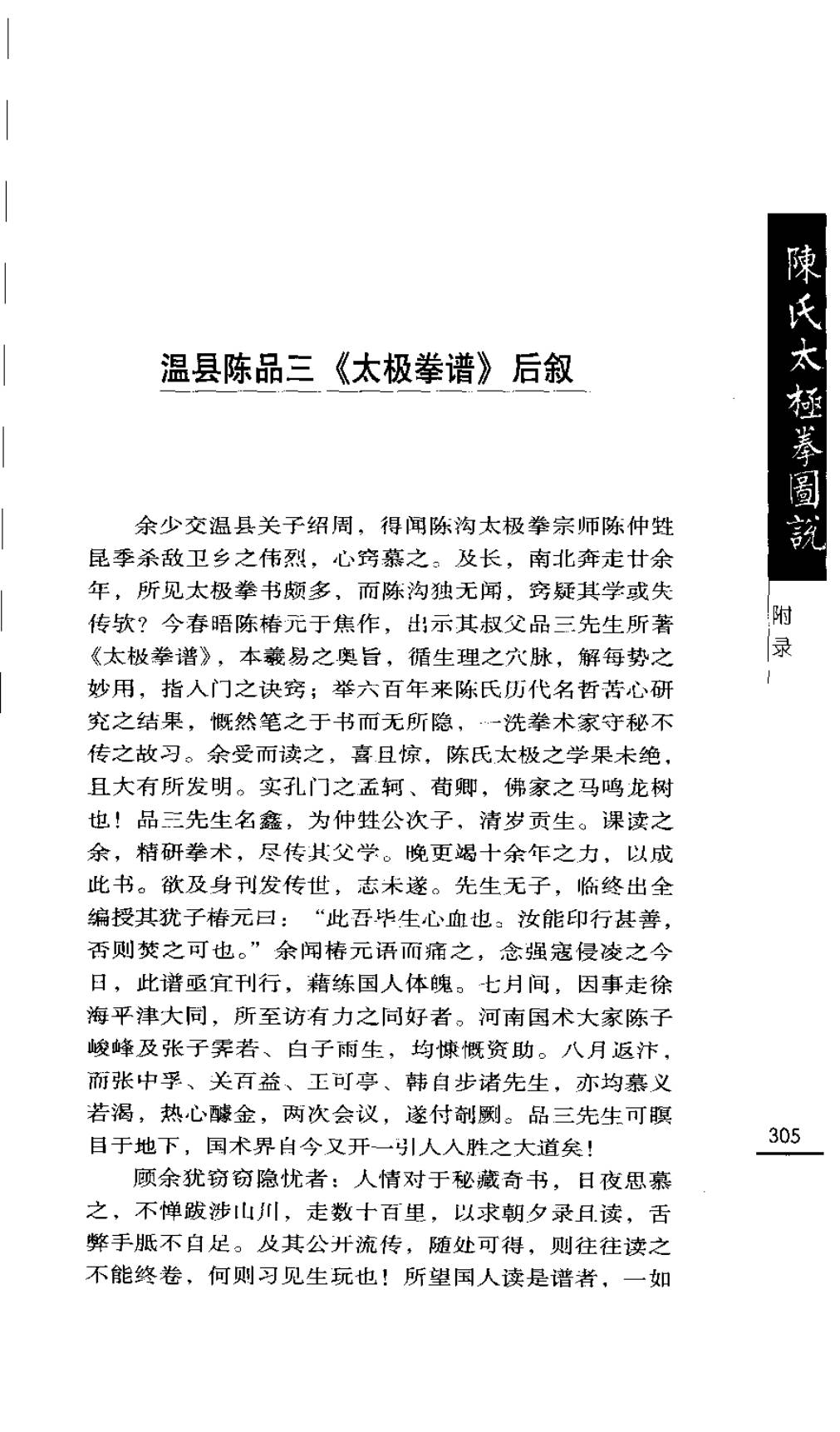
(Spine title: 陳氏太極拳圖說 — Chen Shi Taijiquan Tushuo, "Illustrated Explanation of Chen-Style Taijiquan")
Preface (conclusion), by Liu Huandong (劉煥東):
异僧传道,黄石授书,特别宝重而熟玩之,不仅得之于心,更进而实有诸身。十年锻炼,一可挡千,孟贲遍地,四夷敛迹,恢复失土,发扬国权,则同人等努力刊行此书之微愿也。
Translation: "When an extraordinary monk transmitted the Way, and Huang Shi (the Old Man of the Yellow Stone) presented the book [of strategy], they were treasured and studied with special care — not only grasped in the mind, but further made real in the body. After ten years of training, one man could withstand a thousand. If men of Meng Ben's strength were everywhere, the surrounding peoples would withdraw and hide; lost territories would be recovered and national sovereignty exalted. This is the modest wish of us colleagues who have striven to publish this book."
中华民国二十一年双十节 — "Double Tenth Day (October 10), the twenty-first year of the Republic of China (1932)."
刘焕东谨叙 — "Respectfully prefaced by Liu Huandong."
(Printed page number: 306)
*Note: This is the final page of the preface (colophon-type page); the form-instruction diagrams end on the preceding pages.*
陳氏太極拳圖說 (Chen Shi Taijiquan Tushuo)
Appendix (附錄 / fulu):
Names (姓氏) connected with the newly published, revised and supplemented edition of the "Illustrated Explanation of Chen-Style Taijiquan" (新刊订补《陈氏太极拳图说》姓氏):
- Original author (原著者 yuanzhuzhe): Chen Xin, courtesy name Pinshan (陈鑫品三), of Wen County (温县).
- Editors (编辑者 bianjizhe): his nephews Chen Xueyuan (雪元) and Chen Chunyuan (椿元).
- Collaborating redactors (参订者 candingzhe): granddaughter Shuzhen (淑贞); grandsons Jin'ao (金鳌) and Shaodong (绍栋).
- Collators/reviewers (校阅者 jiaoyuezhe): Chen Panling, courtesy name Junfeng (陈泮岭峻峰), of Xihua; Liu Huandong, courtesy name Yingxian (刘焕东瀛仙), of Gong County; Guan Baiyi (关百益, known by his courtesy name), of Kaifeng; Zhang Jiamou, courtesy name Zhongfu (张嘉谋中孚), of Nanyang.
- Publication supporters (助刊者 zhukanzhe): Chen Panling of Xiping; Han Yunzhang, courtesy name Zibu (韩运章自步), of Biyang; Zhang Jingming, courtesy name Jiruo (张镜铭霁若), of Gong County; Bai Yusheng (白雨生) of Gong County; Guan Baiyi of Kaifeng; Zhang Jiamou of Nanyang; Wang Dishu (王帝枢) of Nanyang.
Editorial notes (注):
"Xinkan dingbu" (新刊订补): "xinkan" means first publication, "dingbu" means revision and supplementation of the original work — hence the title "newly published, revised and supplemented" (per the 1992 explanation of the National Copyright Administration regarding this book's title).
"Original author: Chen Xin Pinshan of Wen County" designates the author of the original work.
"Editors: nephews Xueyuan and Chunyuan" carries two meanings: the editors organized, revised and supplemented the incomplete manuscript into a complete work that could be published; "bosheng" (胞侄, nephews) indicates the kinship between the editors and the original author.
(Printed page number: 307)
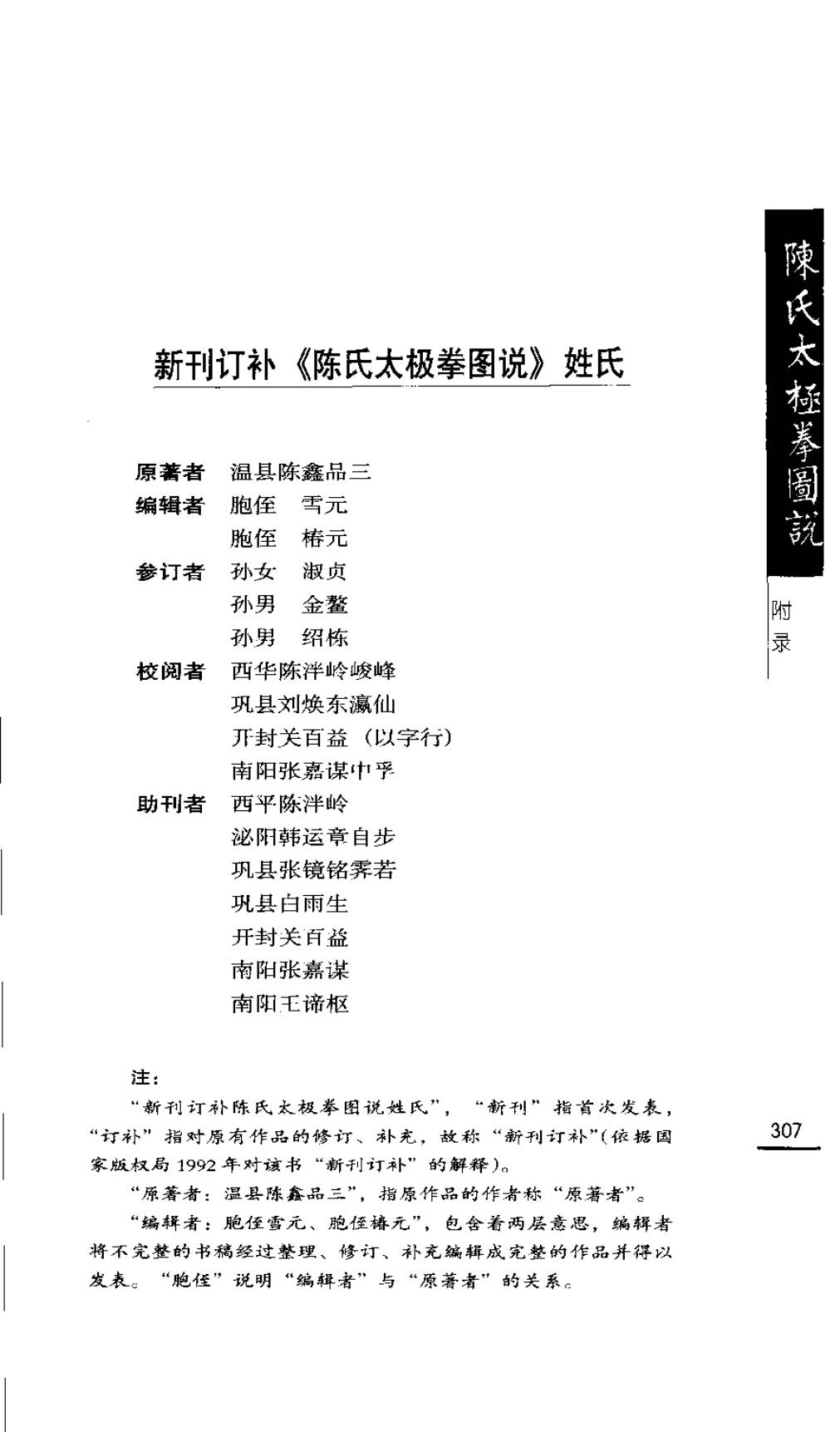
陳氏太極拳圖說 (Chen Shi Taijiquan Tushuo)
Continuation of the editorial notes (注) on the appendix of names:
"Collaborating redactors (参订者 candingzhe): granddaughter Shuzhen, grandsons Jin'ao and Shaodong" — these are the workers who took part in organizing, revising and supplementing the book. The granddaughter Shuzhen was a granddaughter of Chen Sen (陈森); the grandson Jin'ao was the eldest grandson of Chen Yao (陈垚); the grandson Shaodong was the eldest grandson of Chen Sen. In this book, the "original author," "editors," and "collaborating redactors" are all listed in order of generational seniority and age.
"Collators/reviewers (校阅者 jiaoyuezhe)": among them, Chen Panling of Xihua was the director of the former Henan Provincial Guoshu (National Arts) Academy (河南省国术馆); Guan Baiyi of Kaifeng was the director of the former Henan Provincial Museum (河南省博物馆); Zhang Jiamou of Nanyang and Liu Huandong of Gong County were both highly respected public figures of the time.
"Publication supporters (助刊者 zhukanzhe)": Chen Panling, Han Zibu, Zhang Jiamou, Zhang Jingming, Guan Baiyi, Bai Yusheng, and Wang Bangshu were all well-known figures of the day, deeply concerned with the publication and distribution of the "Illustrated Explanation of Chen-Style Taijiquan" (《陈氏太极拳图说》); for this they donated seven hundred silver dollars (大洋 dayang), without which the book could not have been published and distributed.
(Printed page number: 308)
*Note: No diagrams, figures, or verse text (歌诀) appear on this page. This concludes the back matter of the book.*