Nội Cảnh Đồ — The Chart of the Inner Landscape
Nội Cảnh Đồ — bức họa cơ thể người như một ngọn núi linh thiêng
The most famous Daoist picture of the human body: a mountain that is also a spine, a river that is also the flow of essence, and a loop of light that joins the two great vessels. Engraved in 1886 at the Abbey of the White Clouds, it is at once a map of internal alchemy and the best-loved image of the meridian system in the Chinese world.
1. What the chart is Bức đồ này là gì?
The Nội Cảnh Đồ (Chinese 內景圖, also written 內經圖; English “Chart of the Inner Landscape” or “Chart of the Inner Warp”) is a single sheet on which the whole human figure is hidden inside a landscape. The head is a mountain peak, the spine is a winding watercourse, the heart is a spinning star, and the viscera are palaces, fields and furnaces. Its roots reach back to the 黄庭經 Huangting jing (Scripture of the Yellow Court, 4th century), a meditation manual that first described the body as an inner world of gods and palaces, and to the tenth-century body diagrams of Yanluo zi 煙蘑子.
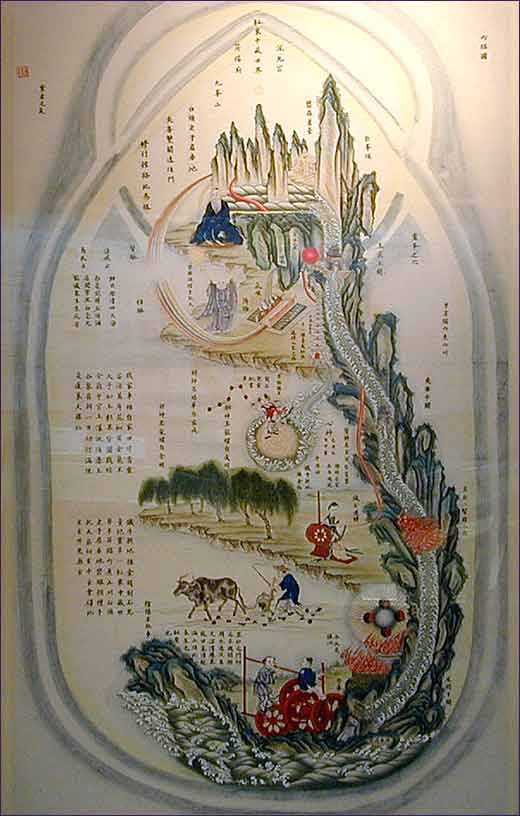
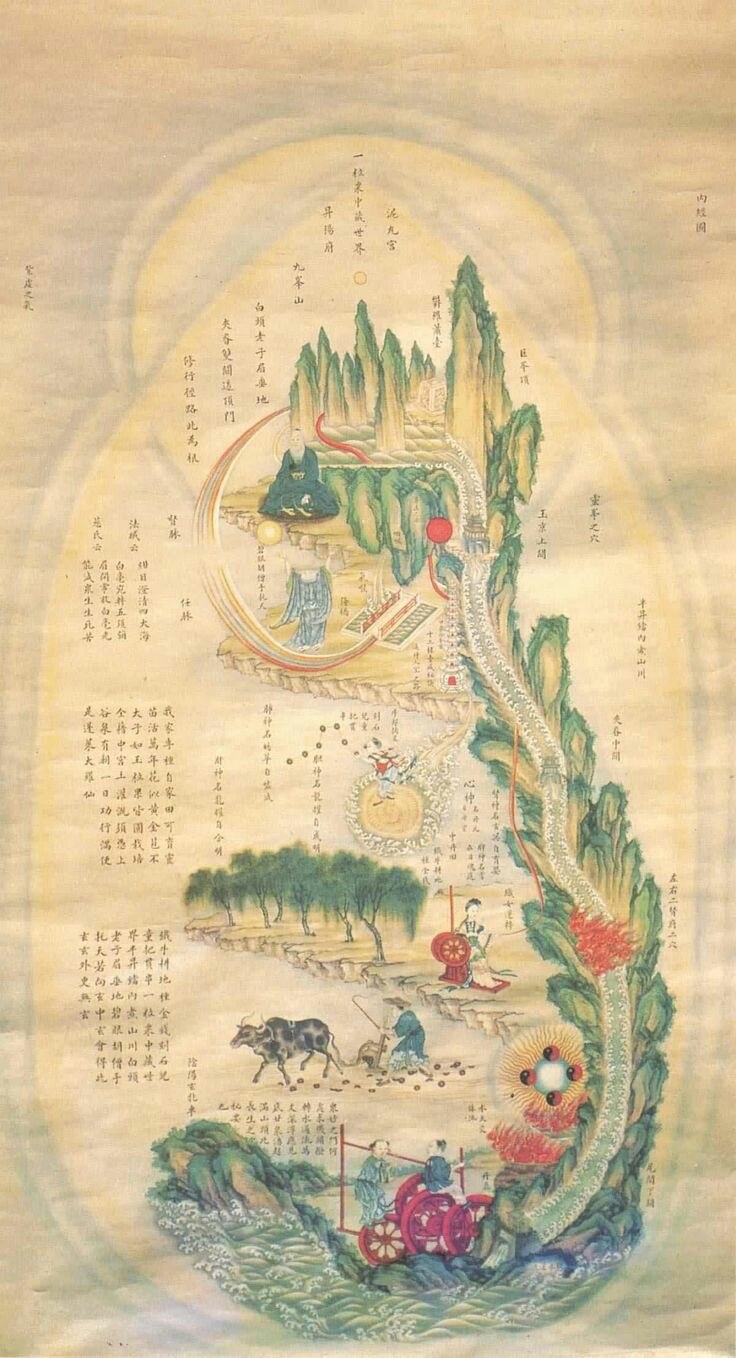
The present design is late. The oldest surviving monumental version is the stone stele cut in 1886 in the courtyard of the Baiyun Guan (Abbey of the White Clouds) in Beijing, beside the better-known Xiuzhen tu. The colophon says that the Taoist Liu Chengyin found the picture on an old silk scroll in the library of a temple on Mount Song (Songshan, Henan), saw that “the joints and articulations, the meridians and vessels are clearly distinguished, and each one contains its cavities,” and had it carved so that it might be widely circulated. A coloured scroll painted at the Qing imperial Ruyi guan 如意館 is now kept in the Museum of the History of Chinese Traditional Medicine in Beijing.
Anatomy or alchemy? The picture is sometimes called the “Inner Scene Diagram” and read as a map of the organs — but that is only half its purpose. As a medical illustration it shows visceral relationships; as a neidan chart it shows a method. The same image, two readings: the physician looks at organs and vessels, the adept looks at the journey of the Elixir.
2. How to read it — from the feet up Đọc từ dưới lên
Like almost all neidan body-pictures, it is read from the bottom upwards, following the three stages of practice. Its three main parts are the lower, middle and upper Cinnabar Fields (三丹田, tam đan điền).
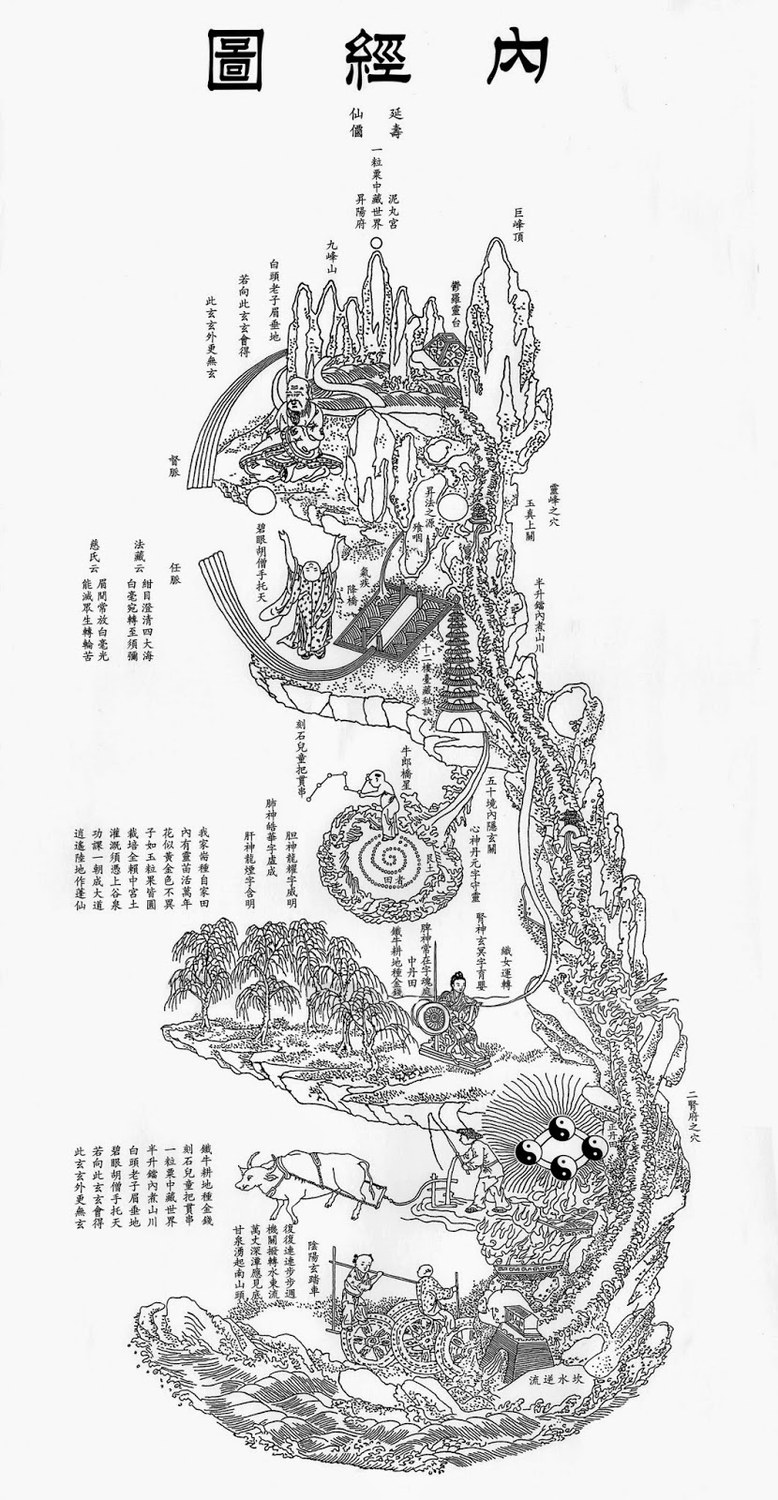
The lower field — reversing the water
At the bottom, a boy and a girl — Yang and Yin — tread a water-wheel at the base of the spine (尾長, the Caudal Funnel, weilü). Instead of letting the essence (精, jing) drain downwards, they invert its flow: the watercourse that climbs the spine is the 河車 River Chariot (heche), and the water is turned into a fiery furnace that heats the lower Cinnabar Field — the four yin-yang symbols beside it stand for the four external agents (Wood, Fire, Metal, Water), the fifth (Earth) being their conjunction. To the left the iron ox ploughs the field and plants the golden coin: the first seed of the Golden Elixir.
The middle field — the Herd Boy and the Weaving Girl
At the centre, in the region of the heart, the middle Cinnabar Field is drawn as a spiral. Above it sits the Herd Boy holding the Northern Dipper; below him works the Weaving Girl at her loom. In the old story the two can meet only once a year, across a bridge of magpies. In alchemical language they are not lovers but heart and kidney — Fire and Water, Li and Kan — and their union (心腺交會, “the meeting of heart and kidney”) is the moment the Elixir is born.
The upper field — the Mud Pill and the two vessels
The upper part is the upper Cinnabar Field, the 泥丸宮 Mud Pill Palace (niwan) in the head. The twelve-storied tower is the throat and trachea; behind it lies the Jade Pillow at the base of the skull. Here the two great vessels finally appear: the Control vessel (督脈 Du Mai) rises at the back, and the Function vessel (任脈 Ren Mai) begins at the front. Beside the Du Mai sits Laozi, his long white eyebrows hanging to the ground; beside the Ren Mai stands the monk Bodhidharma, arms raised to hold up the heavens. The two dots are the eyes — Sun and Moon, Yin and Yang.
The poem hidden in the picture
The chart carries verses that double as instructions. Two of the best known, in Louis Komjathy's translation:
The names of the visceral spirits written around the middle field come from chapter eight of the Huangting jing: the heart is Danyuan “Elixir Origin”, the kidneys Xuanming “Mysterious Obscurity”, the liver Longyan “Dragon Mist”, the lungs Haohua “Brilliant Splendour”, the spleen Changzai “Continuously Existing”, and the gallbladder Longyao “Dragon Glory”. These are not organs but personified functions — the mind-body of the tradition drawn as a celestial bureaucracy.
3. The meridian map inside the picture Hệ kinh mạch trong tranh
Although the chart is not a textbook of acupuncture, it is built on the meridian system (經統 jing-luo) — and specifically on the two “extraordinary vessels” that alchemists used above all others:
- Du Mai 督脈 — the Governing (or Control) Vessel, rising along the back and spine. In the picture it is the river that climbs the mountain, and the route of the River Chariot.
- Ren Mai 任脈 — the Conception (or Function) Vessel, running up the front midline. It meets the Du Mai at the tongue and upper palate — the Magpie Bridge (鶗橋), the one place the loop can close.
- The Microcosmic Orbit 小周天 (Tiểu Chu Thiên) — the closed circuit formed when breath and attention carry the essence up the Du Mai and back down the Ren Mai. The whole picture is that circuit.
- The Three Gates 三關 (sanguan) — the narrow passes on the way up: Weilü 尾長 at the coccyx, Jiaji 夹脊 between the kidneys, and Yuzhen 玉枕 at the base of the skull.
- The Three Dantian 三丹田 — the lower field in the belly (Sea of Qi), the middle field at the heart, and the upper field in the head.
Everything else in the picture — the ox, the loom, the tower, the immortals — is a symbol for a stage of the same journey. Read the spine as the road, the three gates as its toll-houses, and the orbit as the round trip.
4. Nội Cảnh Đồ and the modern theory of the meridian system Đối chiếu với lý thuyết kinh lạc hiện đại
Classical Chinese medicine describes twelve primary meridians and eight extraordinary vessels, through which qi and blood circulate and on which some 361 acupoints sit. The Nội Cảnh Đồ shows mainly the two extraordinary vessels — Ren and Du — and the loop between them. The obvious modern question is: is there a physical structure that answers to this? After more than fifty years of research the honest answer is: no single, unique meridian organ has ever been found — but several real anatomical systems map onto it surprisingly well. Four of them matter most.
| In the chart | Classical meridian / TCM | Modern correlate proposed today | Status |
|---|---|---|---|
| River climbing the spine (River Chariot) | Du Mai 督脈 (Governing Vessel) | Spinal autonomic axis (sympathetic chain); the “Superficial Back Line” of the myofascial meridians | Partial overlap |
| Stream down the front midline | Ren Mai 任脈 (Conception Vessel) | Ventral midline fascia; parasympathetic (vagal & sacral) territory | Hypothesis |
| The closed loop (joined at the tongue) | Microcosmic Orbit 小周天 | A closed-loop regulation model: fascia + autonomic feedback | Interpretive |
| Three Gates 三關 | Gate points along the Du Mai | Anatomical choke-points: sacrococcyx, thoracolumbar fascia, suboccipital region | Descriptive |
| Furnace / lower Dantian | Sea of Qi 氣海 (Qihai, Ren-6) | Lower-abdominal fascial & interstitial space; enteric and pelvic autonomic plexuses | Metaphor |
| Viscera with named spirits | Zang-fu 脏腑 and their functions | Organs plus their psychosomatic / autonomic regulation | Symbolic |
| Cavities (qiao 笃) noted on the chart | Acupoints (361 classical) | Fascial-plane intersections with distinctive electrical & mechanical properties | Evidence (fascia) |
Lens 1 — Fascia: the leading candidate
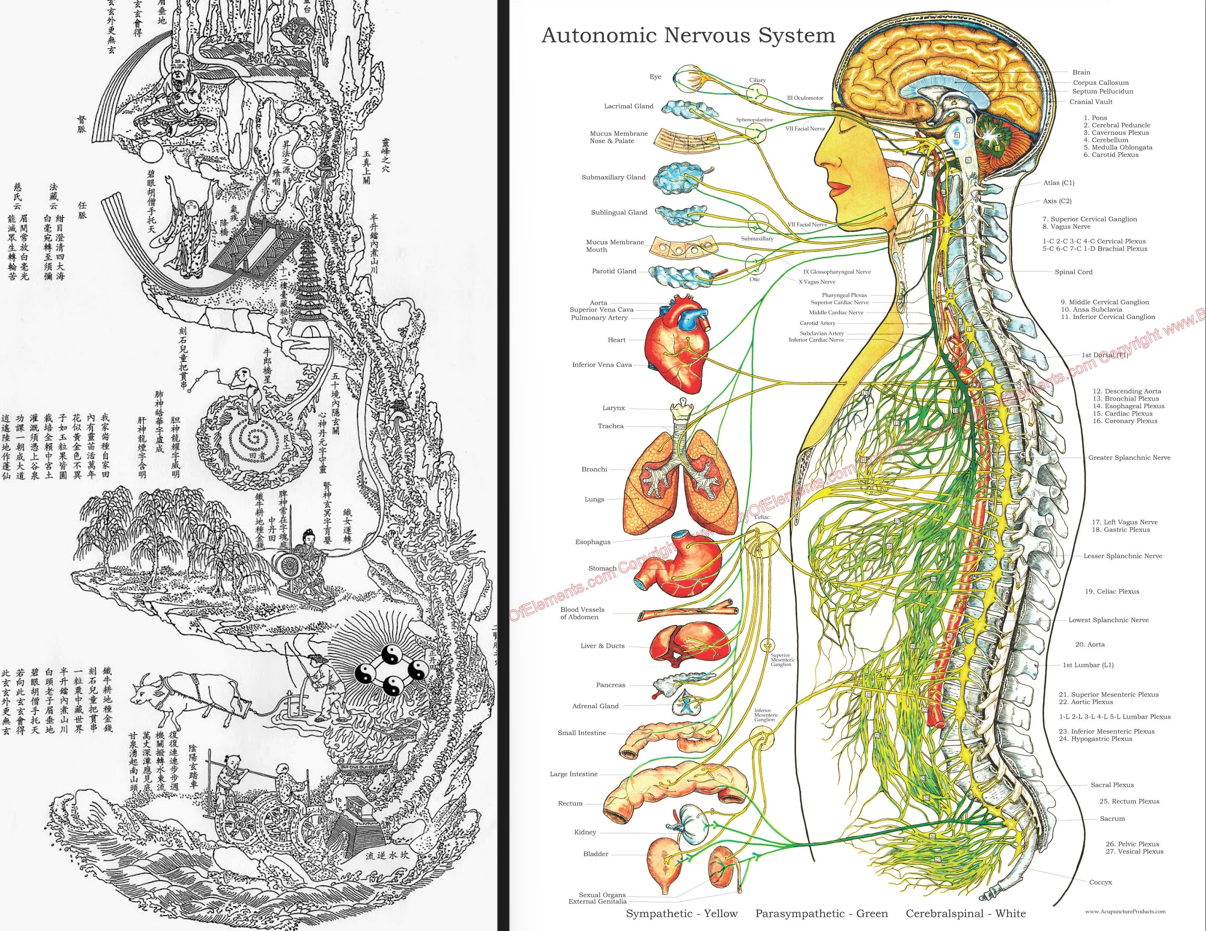
The strongest modern hypothesis is that the meridian network corresponds to the body's connective tissue. Whole-body reconstructions of the fascia show line-like structures whose form and location resemble the classical meridians; CT and MRI studies in living bodies found the same pattern. The “needle grasp” and the deqi sensation depend on the needle physically engaging fascial tissue, and intermuscular connective tissue carries roughly 90% of the force transferred between muscles. On this view the meridians are not a separate organ but the continuum of fascia and interstitium — a plausible physical home for what the tradition called the jing-luo.
Lens 2 — The autonomic nervous system
The comparison plate above is the clearest one: the chart's tall vertical axis occupies the same territory as the sympathetic trunk and the parasympathetic outflow. Practitioners describe the Microcosmic Orbit as a change in tone — warmth, calm, a sense of downward settling — and the vagus nerve is exactly the channel through which such shifts run. The chart's “ascent” is best read as autonomic regulation imagined as a river, not as fluid travelling in a tube.
Lens 3 — Myofascial meridians
In Anatomy Trains Thomas Myers describes continuous myofascial chains that run the length of the body. Two of them line up neatly with the chart: the Superficial Back Line (sole → calf → hamstring → spine → skull → brow) tracks the Du Mai, and the Front Line tracks the Ren Mai. This gives the orbit a biomechanical reading — the “road” is a chain of linked tissue, and the “gates” are its stiff junctions.
Lens 4 — Interstitial channels and the neurophysiology of needling
Two further ideas sit further out on the evidence scale. The primo-vascular system — fluid-filled “Bonghan ducts” reported along the vessels and organs — would be an elegant answer to the question, but it remains controversial and largely unreplicated. Meanwhile the neurophysiology of acupuncture is well established: needling excites fine A-delta and C fibres, which act through segmental gate control (Melzack & Wall) and descending inhibition, releasing endogenous opioids — the basis of Han Jisheng's work on acupuncture analgesia — and locally raising adenosine. Here the “meridian” is a signalling network, not a conduit.
What the chart got right — and where it diverges.
Right: that the body is one connected, self-regulating network; that the spine is a central channel of that network; that mind and body are a single loop; and that prevention and daily cultivation matter more than repair. Diverges: there is no unique anatomical “meridian” tube; the ox, the loom and the immortals are alchemical poetry, not anatomy; and the meridians of TCM are best understood as a functional map rather than a single physical structure. The Nội Cảnh Đồ is therefore not a wrong anatomy drawing — it is a different kind of map, and a remarkably durable one.
The bottom line. Read as science, the chart is anatomically loose but physiologically suggestive. Read as a teaching image, it is still unmatched: no modern diagram has ever shown the Microcosmic Orbit — Ren Mai, Du Mai, the Three Gates and the three Dantian — with such economy and beauty. Modern research does not so much refute the picture as re-translate it, into the language of fascia, the autonomic nervous system and the neurophysiology of needling.
5. Where to go deeper Tư liệu trong thư viện
.mkv masters are kept in the offline archive.
Sources for this study. Chart provenance and reading: Fabrizio Pregadio, The Taoist Tradition (Golden Elixir Press) and “Neijing tu (Chart of the Inner Warp)”; Livia Kohn, Taoist Views of the Body; Catherine Despeux, “Nei-ching T'u and Hsiu-chen T'u”; Louis Komjathy, translation of the inscriptions of the Diagram of the Inner Channels; Joseph Needham, Science and Civilisation in China, vol. V; Kristofer Schipper, The Taoist Body. Modern meridian theory: Helene Langevin and colleagues on acupuncture and the connective-tissue / fascia network; Thomas Myers, Anatomy Trains; Melzack & Wall on gate control; Han Jisheng on acupuncture analgesia; Kim Bong-han on the (contested) primo-vascular system. Images: public-domain reproductions of the Baiyun Guan stele and the Qing coloured scroll.